Flow Characteristics of Elastin-Like Polypeptide(ELP) Coated Packed Bed
Duckjong Kim, Jonghwan Lee, Sang-Jin Park and Jinho Hyun
온도 감응성 폴리펩티드로 표면 처리된 충전층의 유동 특성
김덕종
†
· 이종환**
· 박상진*
· 현진호**
Key Words :
Flow characteristic(유동 특성), Elastin-Like Polypeptide(온도 감응성 폴리펩티드), Packed bed(충전층)Abstract
Elastin-Like polypeptide (ELP) composed of elastin -based repeating units is an artificial biomaterial which is biocompatible and non-immunogenic. ELP shows a characteristic inverse phase transition between hydrophobic and hydrophilic phase by external stimuli such as salt, pH and temperature. In this study, ELP coated PS (polystyrene) beads are packed in tubing and the thermo -responsive flow characteristics of the packed bed are investigated. Preliminary test results show that the control of the fluid flow can be achieved by using the temperature driven phase transition effect of the ELP coated beads in a microchannel.
1. Introduction
Elastin-Like polypeptide (ELP) composed of elastin - based repeating units is an artificial biomaterial which is biocompatible and non-immunogenic. ELP shows a characteristic inverse phase transition between hydrophobic and hydrophilic phase by external stimuli such as salt, pH and temperature. Due to the interesting property, many researches have been conducted to apply ELPs to highly sensitive purification of proteins, drug delivery and tissue engineering
(1). However, to the authors ’ knowledge, there is little effort to clarify the effect of an ELP coated surface on the fluid flow around the surface in spite of its importance. Hence, in the present work, ELP coated PS (polystyrene) beads are packed in a tube whose inside diameter is 1 ㎜ and the
thermo -responsive flow characteristics of the packed bed are investigated.
2. Materials and Methods
ELPs are synthesized by genetic expression of recombinant E.coli and purified by cyclic inverse transition
(2). The inverse phase transition temperature can be controlled in the range of 25~48
oC by adjusting the length of ELP molecules or a specific amino acid of repeating units. In this study, ELPs whose inverse phase transition temperature is 37
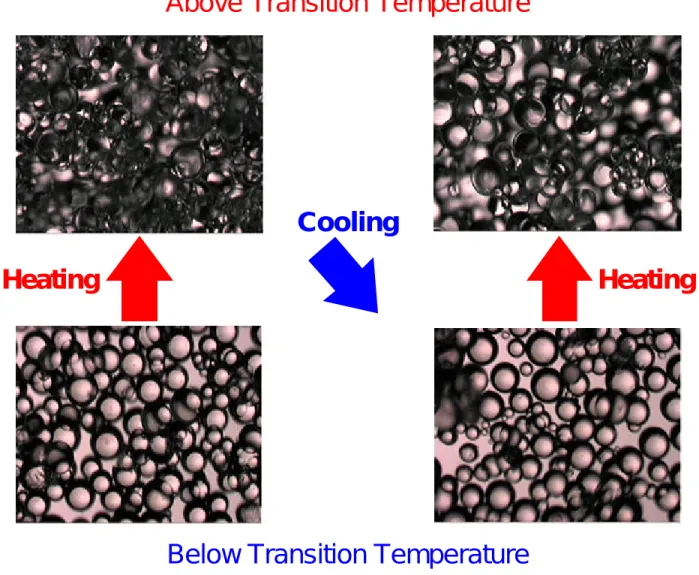
oC are tested. Fig. 1 shows the reversible phase transition of the ELP coated PS beads immersed in DI water. When the temperature is above the transition temperature, ELPs become hydrophobic and this leads to an aggregation of the ELP coated PS beads. On the other hand, when the temperature is below the transition temperature, ELPs are hydrophilic and soluble in aqueous solution. This clearly shows the possibility of the thermo -reponsive microvalve using the ELP coated PS (polystyrene) bead as an actuating material.
†
Corresponding Author, Member
Korea Institute of Machinery and Materials E-mail : [email protected]
TEL : (042)868-7121 FAX : (042)868-7335
*Korea Institute of Machinery and Materials
**
Seoul National University
3187
For a preliminary test, the ELP beads are packed in a tube whose inside diameter is 1㎜ as shown in Fig. 2.
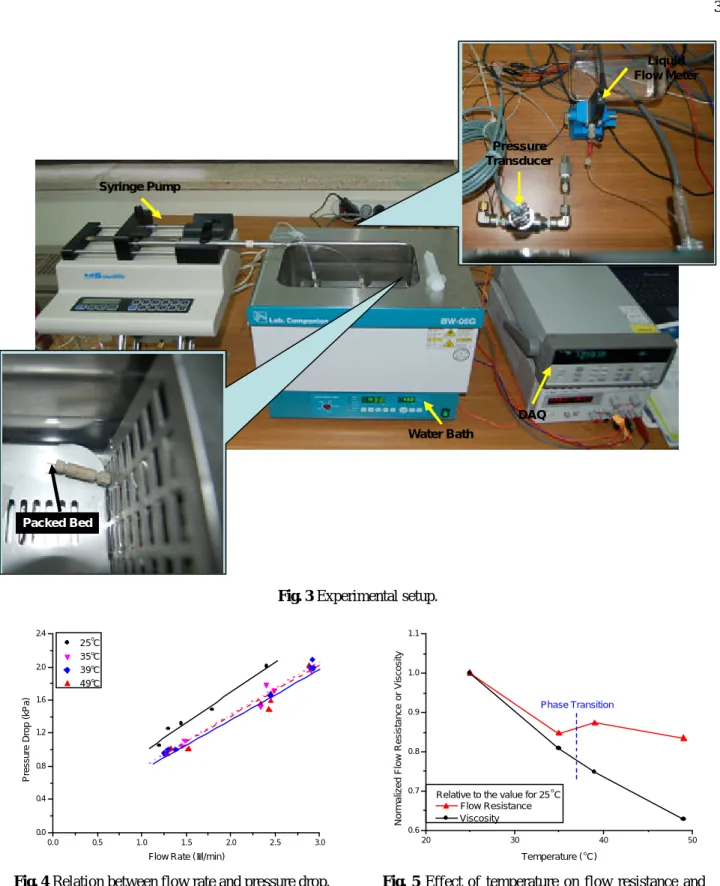
This packed bed is tested using the experimental setup shown in Fig. 3. DI water is infused into the packed bed using a syringe pump. The pressure difference across and the flow rate through the packed bed of the ELP beads
are measured by a differential pressure transducer and a liquid micro mass flow meter, respectively. To control the temperature of ELPs, the tube packed with the ELP coated beads is immersed in a water bath as shown in Fig.
3 and the water temperature is adjusted.
3. Experimental Results
Fig. 4 shows the relation between the flow rate through and the pressure drop across the packed bed of the ELP coated beads. The pressure drop for the same flow rate apparently decreases as the temperature increases from 25 °C to 35°C. However, the pressure drop decrease due to the additional temperature increase is negligible until 49 °C. As the temperature increases, the viscosity of DI water passing through the packed bed decreases as shown in Fig. 5. Since the viscosity is proportional to the flow resistance in the laminar flow Fig. 1 Reversible phase transition of ELP coated PS beads.
Below Transition Temperature Above Transition Temperature
Cooling
Heating Heating
Packed Bed of ELP Coated Beads Tubing
Fig. 2 Tested packed bed.
3188
3
3 regime, the flow resistance should decrease with the temperature increase. However, Fig. 5 clearly shows that the flow resistance does not decrease with the temperature increase above the transition temperature, 37°C. This can be ascribed to the pore size decrease due to the aggregation of the ELP beads shown in Fig. 1. Fig.
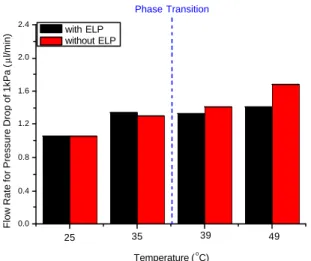
6 shows the effect of the temperature on the flow rate for the pressure drop of 1 ㎪. It is found that the flow rate can be maintained regardless of the temperature change due to the phase transition property of ELPs. From the test results, it can be inferred that the control of the fluid flow can be achieved by using the temperature driven Syringe Pump
Pressure Transducer
Liquid Flow Meter
Water Bath
DAQ
Packed Bed
Fig. 3 Experimental setup.
Fig. 5 Effect of temperature on flow resistance and fluid viscosity.
20 30 40 50
0.6 0.7 0.8 0.9 1.0 1.1
Normalized Flow Resistance or Viscosity
Temperature (oC) Relative to the value for 25oC
Flow Resistance Viscosity
Phase Transition
Fig. 4 Relation between flow rate and pressure drop.
0.0 0.5 1.0 1.5 2.0 2.5 3.0
0.0 0.4 0.8 1.2 1.6 2.0 2.4
Pressure Drop (kPa)
Flow Rate (µl/min) 25oC
35oC 39oC 49oC
3189
phase transition effect of the ELP coated beads in a microchannel.
4. Conclusions
In this work, flow characteristics of the ELP coated packed bed is investigated. Test results show that the flow resistance does not decrease with the temperature increase above the transition temperature in spite of the viscosity decrease. This is thought to be related to the inverse phase transition between hydrophobic and hydrophilic phase of ELPs covering the beads. It is expected that a reliable and precisely controllable microvalve using ELPs tested in this study will be developed in the near future.
References
(1) F. J. Arias, V. Reboto, S. Martin, I. Lopez, and J. C.
Rodriguez-Cebello, 2006, "Tailored Recombinant Elastin-Like Polymers for Advanced Biomedical and Nano(bio)technological applications," Biotechnology Letter, Vol. 28, pp. 687~695.
(2) K. Na, O. Kim, J. Jung, J. Lee, D. Kim, S.-J. Park, and J. Hyun, 2006, “Elastin-Like Polypeptide:
Genetic Synthesis, Characterization and Applications,” Proc. of 10
thKorean Peptide Symposium, Seoul.
Fig. 6 Effect of temperature on flow rate for pressure drop of 1kPa.
0.0 0.4 0.8 1.2 1.6 2.0 2.4
Flow Rate for Pressure Drop of 1kPa (µl/min)
Temperature (oC) with ELP
without ELP
35 39 49
Phase Transition
25
3190