<학술논문> DOI https://doi.org/10.3795/KSME-A.2017.41.3.193 ISSN 1226-4873(P rint) 2288-5226(Online)
850℃에서의 Alloy 617 용접재의 저사이클 피로 특성 §
황정준
*· 김선진
*· 김우곤
**· 김응선
*** 부경대학교 기계설계공학과, **한국원자력연구원
Low Cycle Fatigue Behavior of Alloy617 Weldment at 850 Jeong Jun Hwang
*, Seon Jin Kim
*, Woo Gon Kim
**and Eung-Seon Kim
*** Dept. of Mechanical Design Engineering, Pukyong Nat’l Univ.,
** Korea Atomic Energy Research Institute
(Received August 20, 2016 ; Revised November 4, 2016 ; Accepted December 17, 2016)
Key Words: Low Cycle Fatugue(LCF, 저사이클 피로), Gas Tungsten Arc Welding(GTAW, 가스텅그스텐아
크 용접), Weldment(용접재), Fatigue Life(피로수명), Transgranular(입내파괴)
초록
: Alloy 617은 초고온가스로(VHTR)의 중간열교환기(IHX)의 유력한 후보 재료 중의 하나이다. 850의 고온에서 Alloy 617 용접재의 저사이클 피로 거동을 고찰하기 위하여, 완전 양진 변형률제어 피로 시험이 0.6에서 1.5%의 전변형률범위에서 수행되었다. 용접재 시험편은 V-그루브 형상의 가스텅그스텐 아크 용접한 용접 패드로부터 가공되었다. 피로수명은 전변형률범위가 증가할수록 감소하였다. 모든 실 험조건에서 Alloy 617 용접재 시험편의 반복 응력 반응 거동은 초기 수 사이클에서 반복 변형률 경화 현상을 나타내었다. 또한 모든 피로 균열의 발생과 전파는 입내파괴의 파손 모드를 보였다.
Abstract: Alloy 617 is one of the primary candidate materials to be used in a very high temperature reactor
(VHTR) system as an intermediate heat exchanger (IHX). To investigate the low cycle fatigue behavior of Alloy 617 weldments at a high temperature of 850℃, fully reversed strain-controlled fatigue tests were conducted with the total strain values ranging from 0.6~1.5%. The weldment specimens were machined using the weld pads fabricated with a single V-grove configuration by gas tungsten arc welding (GTAW) process.
The fatigue life is reduced as the total strain range increases. For all testing conditions, the cyclic stress response behavior of the Alloy 617 weldments exhibited the initial cyclic strain hardening phenomenon during the initial small number of cycles. Furthermore, the overall fatigue cracking and the propagation or cracks showed a transgranular failure mode.
§ 이 논문은 대한기계학회 신뢰성부문 2016년도 춘계
학술대회(2016. 4. 28. - 29., 부경대학교) 발표논문임.
Corresponding Author, [email protected],
Ⓒ 2017 The Korean Society of Mechanical Engineers
1. 서 론
초고온가스로(VHTR)는 수소와 전기를 경제적 으로 생산하기 위한 제4세대(Gen-IV) 원자로 중 의 하나로 가장 유망 받는 노형 중의 하나이
다.
(1,2)원자력용 니켈기 초합금인 Alloy 617은 초
고온가스로의 중간열교환기의 유력한 후보재료 중의 하나이다.
(2~4)원자로의 기동 및 중지 뿐만
아니라 동력전달은 부재의 저사이클 피로 및 크 리프-피로 하중을 유발한다.
(2~4)따라서 Alloy 617 의 신뢰성 있는 설계를 수행하기 위해서는 고온 에서의 저사이클 피로 및 크리프-피로 수명에 대 한 물성 자료가 필요하다 .
이러한 관점에서 국제적으로 많은 연구자들이
Alloy 617에 대한 저사이클 피로 및 크리프-피로
거동에 대한 많은 연구를 수행하여 왔다.
(2~8)하지
만 이들의 연구는 대부분은 Alloy 617 모재에 대
한 연구 결과이다. 국내의 경우는 Alloy 617에 대
한 저사이클 피로에 관한 연구는 아주 미약한 실
Element ASTM B168-08 This study
C 0.05-0.15 0.08
Ni 44.5 min 53.11
Fe 3.0 max 0.949
Si 1.0 max 0.084
Mn 1.0 max 0.029
Co 10.0-15.0 12.3
Cr 20.0-24.0 22.2
Ti 0.6 max 0.41
P 0.015 max 0.003
S 0.015 max <0.002
Mo 8.0-10.0 9.5
Al 0.8-1.5 1.06
B 0.006 max <0.002
Cu 0.5 max 0.0268
Table 1 Chemical composition in wt.% of the Alloy
617 plate used in this study
Fig. 1 Illustration of specimen cutting from the
GTAWed pad
Fig. 2 Shape and dimensions of cylindrical low
cycle fatigue testing specimen
0 2 4 6 8 10 12 14 16 18 20 22 24 26 28 30
-1.0 -0.8 -0.6 -0.4 -0.2 0.0 0.2 0.4 0.6 0.8 1.0
Strain rate 10-3/sec T = 850oC
0.6%
0.9%
1.2%
1.5%
St rai n Amp , %
Time (Sec)
Fig. 3 Schematic diagram of strain history for
continuous low cycle fatigue
정이다 .
(9,10)또한 실용적 관점에서 구조부재는 필
연적으로 용접에 의하여 접합되므로 용접재에 대 한 저사이클 피로 특성의 파악과 신뢰성 있는 데 이터의 확보가 필수적이다. 이러한 관점에서 저 자 등은 한국원자력연구원과 더불어 Alloy 617에 대한 상온 및 고온에서의 저사이클 피로 특성 평 가에 대한 일련의 연구를 수행하였다 .
(2,9~11)본 연구에서는 Alloy 617/Alloy 617 가스텅그스 텐아크 용접한 용접재 시험편에 대하여 850℃에 서의 완전 양진 변형률제어 저사이클 피로 실험 을 수행하고 고찰한 결과를 보고하고자 한다 .
2. 실험방법 및 절차
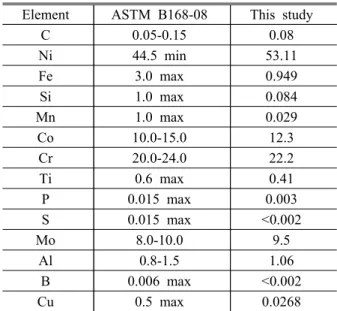
본 연구에 사용된 재료는 Alloy 617의 상용 열 간 압연 판재로서 제조사에서 생산된 Heat Number는 Haynes 617, R617 6 8837이며, 원 판재 의 크기는 25mm(T) × 1200mm(W) × 3600mm(L)이 다. 본 재료의 화학적 성분은 Table 1에서 볼 수 있는 것처럼 ASTM 규격
(12)을 잘 따르고 있음을 알 수 있다. 그리고 니켈과 코발트, 크롬, 몰리브 덴의 성분비가 높아 내열성 뿐만 아니라 내식성 또한 매우 뛰어난 재료이다.
본 연구에 사용된 용접은 가스텅그스텐아크 용 접(GTAW)이 사용되었다. 본 용접에 사용된 용가 재는 KISWEL사에서 제조한 KW-T617를 사용하 였다. 용접시편은 14층 41패스로 용접되었으며, 용접형상은 V-groove, 각도 80도, 10mm root gap
을 갖도록 하였다 . 본 용접 방법과 조건에 대한
상세한 내용은 참고문헌
(1)를 참조 바란다. Alloy
617 용접재의 시험편 채취 모식도를 Fig. 1에 나
타낸다. 용접재 시험편의 채취방향은 압연방향과
일치하고 용접방향과 수직이 되도록 하였다 . 본
실험에 사용된 실험 장비는 인스트론사의 100
kN의 만능유압 피로 시험기를 사용하였으며, 온
도를 제어하기 위한 고온로는 MTS 653 튜브형
로를 사용하였다 . 850℃에서 완전 양진 변형률제
어 피로 시험을 ASTM 규격
(13)에 따라 수행하였
다. 변형률속도는 모든 조건에서 ×
로 일
정하게 제어하였다. 본 실험에서 제어한 전변형
률범위는 0.6, 0.9, 1.2 및 1.5%의 네 가지 조건에
Fig. 4 Specimen configuration and position of the
12.5mm extensometer
0 10 20 30 40 50
0.4 0.6 0.8 1.0 1.2
LCF Alloy 617 WJ at 850oC, Total Strain range, ΔεΤ(%) =1.5%
20% Drop Off
Ratio of Peak Stress
Number of Cycles
Failure, N
f(32)
Fig. 5 Illustration of LCF failure criterion
0 1000 2000 3000 4000
0.0 0.5 1.0 1.5 2.0 2.5
LCF testing at 850oC Strain rate : 1.0E-03/s
This Experiment
Alloy 617 GTAW Weldment Total strain range, Δεt(%)
Number of cycles to failure, Nf(cycles) J. K. Wright et al. Data(2013) Alloy 617 Base Metal
Fig. 6 Comparison of fatigue life for Alloy 617
weldments and the base metal
100 101 102 103 104
-1000 -800 -600 -400 -200 0 200 400 600 800 1000
Alloy 617-Weldment (WJ) Temp. = 850oC Strain rate 10-3/s
Peak (Max./Min.) stress, (MPa)
Number of cycles, N (Cycles)
Total Strain 0.6%
Total Strain 0.9%
Total Strain 1.2%
Total Strain 1.5%
Fig. 7 Peak tensile and compressive stresses plotted
as a function of number of cycles
서 수행되었다. 그리고 Fig. 3에 네 가지 조건의 전변형률범위에 대한 변형률 이력을 나타낸다 .
Fig. 4는 본 실험에 사용된 시험편에 부착한 신 장계의 모식도를 나타낸 것으로 신장계의 게이지 길이는 12.5mm의 것을 사용하였다. 실제 본 연구 의 피로 실험은 응력의 80% drop off에서 종료하 였다. 한편, 본 실험에서의 피로수명의 정의는 Wright 등
(8)과 같이 Fig. 5와 같이 Peak Stress Ratio가 20% 감소하는 지점, 즉 다시 말해 0.8%
의 Peak Stress Ratio의 점과 일치하는 지점의 사 이클을 피로수명으로 정의하였다.
3. 실험 결과 및 고찰
3.1 저사이클 피로수명 거동
Fig. 6에 본 연구의 저사이클 피로 실험으로 얻 어진 Alloy 617 용접재에 대한 피로수명과 Wright 등의 Alloy 617 모재에 대한 피로수명 데이터를 포함하여 함께 정규좌표로 나타내었다 . 그림에서 알 수 있듯이 용접재 및 모재 모두 전변형률범위
가 증가할수록 피로수명은 비교적 지수 함수적으 로 감소하는 경향을 보이고 있음을 알 수 있다.
이는 또한 Totemier
(4)의 800에서의 Alloy 617 용 접재의 결과와도 유사한 경향을 보이고 있음을 알았다 . Alloy 617 용접재의 피로수명은 동일 전 변형률범위에서 모재보다도 그 피로수명이 짧다 는 것을 알 수 있었다 . 이는 용접에 의한 미세조 직의 변화와 함께 용접으로 인한 용접 결함, 그 리고 재료의 연성에 기인하는 것으로 사료된다 .
3.2 반복 응력 반응 거동
반복 응력 반응 거동은 저사이클 피로 시험중 재료의 응력 반응 변동을 나타내는 것으로, 일반 적으로 반복 응력 반응 거동은 경화 , 연화 그리 고 유지의 영역을 포함하고 있다. 이들 영역의 상대적인 비율은 재료에 의존한다 .
(9)Fig. 7은 본 연구에서 수행한 850℃에서의
Alloy 617 용접재의 반복 응력 반응 거동을 고찰
하기 위해 피크 인장 응력과 압축 응력의 관계를
나타낸 것이다 . 즉, 사이클 수에 따른 인장응력과
-0.8 -0.6 -0.4 -0.2 0.0 0.2 0.4 0.6 0.8
-600 -400 -200 0 200 400 600
0.6%
0.9%
1.2%
1.5%
Strain, ε (%)
Stress, σ (MPa)
Fig. 8 Stress-strain hysteresis loops of Alloy 617
weldment for the half-life cycle at each total strain range
Trace of extensometer
Secondary crack Main crack
Fig. 9 Photograph of failed specimen for 0.6% of
total strain range at 850℃
(a)
(b)
Fig. 10 Transgranular fracture path shown in specimen
tested at total strain range (a) 0.6% and (b) 1.5%
압축응력의 함수로 나타내었다. Peak Stress는 전 변형률범위가 증가할수록 증가하는 경향을 보이 고 있다. Wright 등
(8)의 850℃에서의 Alloy 617 모 재의 저사이클 피로에 관한 결과와 유사한 경향 을 보이고 있으며, 균열이 발생하기 전까지 경화 후 연화하는 거동을 보이고 있고 , 전변형률범위 0.9%의 경우를 제외하면 전변형률범위가 증가하 면 전응력진폭은 증가하는 것으로 나타났다 . 이 는 전변형률범위가 증가할수록 피로수명이 감소 하는 것과 비교적 잘 일치하고 있다 . 결과적으로 Alloy 617 용접재의 850℃에서의 반복 응력 거동 은 모든 전변형률범위에서 비교적 초기 수십 사 이클 동안에 반복 변형률 경화 거동을 나타내고 있음을 알았다 .
3.3 히스테리시스루프 거동
Fig. 8은 각각의 전변형률범위에 대한 반수명에 서의 히스테리시스루프 곡선을 나타낸다. 전변형 률범위 0.9%의 경우를 제외하고 최대 인장/압축 응력은 전변형률범위가 증가할수록 증가하였다.
그리고 전변형률범위가 낮은 0.6%와 0.9%에서는
위쪽과 아래쪽이 가파른 형상을 나타내었다. 이 는 Wright 등
(8)의 950℃에서의 Alloy 617 모재에 대한 히스테리시스루프 곡선과 아주 유사한 경향 을 보였다.
3.4 파손 해석
Fig. 9는 전변형률범위 0.6% 시험편의 거시적 파괴 양상을 나타낸 것이다. 균열은 시험편 표면 에서 용접금속 영역에서 주균열과 2차 균열 등이 발생함을 보여주고 있다. 파괴된 시험편은 거시 적으로 웨지 (wedge) 타입의 파단 양상으로 나타 났다. 본 연구의 모든 실험 조건에서 동일한 양 상의 파괴 거동을 보였다 .
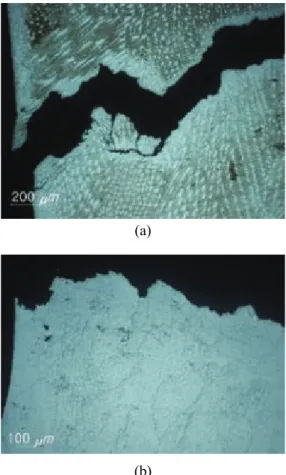
Fig. 10은 전변형률범위 0.6%와 1.5%에서 파손 된 시험편의 파단면을 광학현미경으로 관찰한 사 진이다. 본 실험에 사용된 Alloy 617 용접재 시험 편은 입내파괴 (transgranular)의 형태로 균열이 발 생, 전파함을 알 수 있다. 이는 Carroll 등
(3)의 950
℃에서의 Alloy 617 모재 시험편에 대한 저사이
클 피로의 파손 모드와도 매우 유사한 결과를 얻
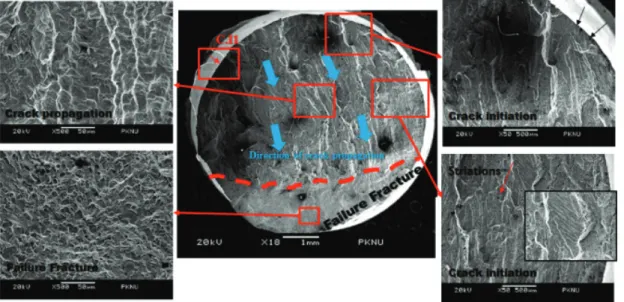
Fig. 11 Fractured surface observation of Alloy 617 weldment tested at 1.5% of total strain range