222 Vol. 19, No. 3, pp. 222~227, June 2007
Nonlinear Focusing Wave Group on Current 흐름의 영향을 받는 파랑 그룹의 비선형 집중 Julien Touboul * , Efim Pelinovsky ** and Christian Kharif *
쥬리언 투보울*·에핌 페리높스키**·크리스티안 카리프*
Abstract : Formation of freak waves is studied in deep water from transient wave packets propagating on current. Those waves are obtained by means of dispersive focusing. This process is investigated by solving both linear and nonlinear equations. The role of nonlinearity is emphasized in this interaction.
Keywords : dispersive focusing, wave-current interaction, kinematic model, nonlinear equations.
요 지 :심해에서생성된최극해파가파랑과상호작용하는현상에대한연구를수행하였다
.
이러한파랑은분 산집중을이용하여산정하였다.
이러한과정은선형및비선형방정식의해를구하여얻을수있다.
상호작용에서 비선형성의역할을 강조하였다
.
핵심용어 :분산집중
,
파랑-
흐름상호작용,
운동학적모형,
비선형방정식1. Introduction
Freak, rogue or giant waves are extreme events. They are characterized by their unpredictability, which explains that they are known as ”waves from nowhere”. As a matter of fact, they are responsible for an important number of large damages, caused to ships or offshore rigs. Over the last twenty years, a large number of events has been reported, and a lot of ship disappearances have been correlated to rogue waves events. Up to now there is no definite consen- sus about a unique definition of freak wave. The most pop- ular definition is the amplitude criterion: the height of a freak wave should exceed twice the significant height of the background wave field. Several mechanisms have been suggested to explain the formation of freak waves, such as spatio-temporal focusing (Kharif et al., 2001; Johannessen and Swan, 2003; Gibson and Swan), nonlinear or modula- tional instability (Benjamin-Feir instability) (Benjamin and Feir, 1967; Dyachenko and Zakharov, 2005), envelope soli- ton and breather interactions (Clamond and Grue, 2002).
Those mechanisms have been reviewed by Kharif and Peli- novsky in (2003) and by Dysthe in (2001).
Wave-current interaction contributes also in the freak wave formation and historically, this mechanism was the rst to explain the origin of freak waves (Peregrine, 1976; Smith, 1976). In fact, the vertical shear of the oceanic current is important for short wind waves with length shorter than a few meters (Craik, 1985; Thomas, 1981; Thomas, 1990;
Silva and Peregrine, 1988; Shrira and Sazonov, 2001), but can be ignored for typical gravity waves. The horizontal variability of the oceanic current is relatively high (for instance in the vicinity of the Agulhas current off South Africa) and leads to the strong spatial (geometrical) focusing of the swell (Lavrenov, 1998; White and Fornberg, 1998). Mean- while the current (even uniform) can influence the temporal focusing of wind waves. Recently Wu and Yao (2004) stud- ied the last problem experimentally. They observed a shift of the focusing point, and by analyzing the shape of limit- ing freak waves, and their spectral evolution, they con- cluded that the nonlinearity of freak waves is affected by
*Institut de Recherche sur les Phénoménes Hors Equilibre (IRPHE), Technopole de Chateau-Gombert, 49 rue Joliot Curie, BP146, 13384 Marseille cedex 13, France
**Department of Nonlinear Geophysical Processes, Institute of Applied Physics, 46 Uljanov Street, Nizhny Novgorod, 603950 Russia
the presence of current. Indeed, the role of nonlinearity on uniform wave trains propagating on currents has been investigated numerically in by Ryu et al. (2003).
This work presents a series of numerical simulations of a focusing wave train propagated with and without current in infinite depth. The current is assumed to be constant in space. The wave packet with linear frequency modulation is generated at a fixed point. Herein we emphasize the problem we are dealing with is a boundary value problem (BVP) and not an initial value problem (IVP). In this partic- ular case, the Galileo transformation is not used directly.
Firstly (section 2), we demonstrate the shifting of focal points in the framework of kinematic approach. Then, the fully nonlinear numerical method is briey introduced (sec- tion 3). Numerical results of freak wave formation on the current obtained in the framework of the fully nonlinear model are presented and compared to results given by lin- ear theory, including the kinematic model. A special interest is taken to analyze the evolution of the spectral components present in the focusing wave group.
2. The Kinematic Model
Due to the dispersive behaviour of water waves, when short waves propagate in front of longer waves, they will be overtaken, and large amplitude wave can occur at a fixed point. A linear approach of the problem would lead to con- sider sea surface as a superposition of linear waves of fre- quencies ω ( x , t ). Following Whitham (1974) and Brown (2001), the spatio-temporal evolution of these components is governed by the following hyperbolic equation
(1) where c g is the group velocity. The boundary value prob- lem for this equation can be solved by using the method of characteristics. Its solution is
(2) where ω 0 corresponds to the temporal frequency distribu- tion of the wave train at x = 0. By differentiating the fre- quency, it comes
(3)
and one can notice that the case dω 0 / dτ < 0, which corre- sponds to the case of short waves emitted before longer waves, leads to a singularity. This singularity corresponds to the focusing of several waves at t = T
fand x = X
f. For infinite depth, the group velocity of each components is given by
c
g( ω ) = g /2 ω . As a matter of fact, the frequency to impose to a wave maker located at x = 0, and for 0 < t <
T is given by
(4) where g is the acceleration due to gravity. This frequency modulation, varying linearly from ω
minto ω
max, provides the optimal focusing of the linear wave packets in still water and is very often applied in the laboratory condi- tions. Components following this law will all merge at the same place X
f, and the same time T
f, coordinates of the focusing point in the ( x - t ) plane, given by
(5) In presence of current, equation (1) should be modified, to take care of the Doppler effect. It rewrites
(6) where U is the current velocity. The solution, previously given by (2), becomes
(7) By differentiating the frequency, it comes
(8)
One can notice that the dynamics of the wave group is more complicated. The denominator is now a function of time, and is equal to zero for several values of space and time. The waves do not merge at the same place, at the same time. The focusing point is theoretically spread to a focusing area, extending from L
minto L
max, where
(9)
∂ω --- ∂t c
g( )∂ω ω
∂ x ---
+ = 0
ω x t ( ) ω , =
0( ) τ , τ t x c
g( ) ω
--- –
=
∂ω --- ∂t = 1 2 --- + ( dω x g ⁄
0)dω ⁄ dτ
0⁄ dτ
ω ( ) g 0 , t 2--- T
f– t
X
f---
=
X
fgT
2--- 1
ω
max– ω
min---
= , T
f2 ω
max--- g X
f=
∂ω ∂t
--- [ c
g( ) U ω + ]∂ω
∂ x ---
+ = 0
ω x t ( ) ω , =
0( ) τ , τ t x c
g( ) U ω + --- –
=
∂ω ∂ t
--- dω
0⁄ dτ
1 2 xg
g + 2 ωU
( )
2--- dω --- dτ
0--- +
=
L
max= X
f⎝ ⎛ 1 2 + --- Uω g
max⎠ ⎞
2, L
inx= X
f⎝ ⎛ 1 2 + --- Uω g
min⎠ ⎞
2The kinematic model presented above has some limita- tions. It demonstrates the shifting of the focusing point, but cannot predict wave amplitudes which are formally infinite at this point. To avoid this problem, a fully linear approach is used based on the Fourier integral. It is based on the linear dispersion relation in infinite depth, in pres- ence of current, that reads
(10) where k ( ω ) is the wave number. This equation is solved iteratively, by means of Newton’s method. Solutions preserving the sign of ( kx – ωt ) are considered. By introducing this dispersion relation into linear equa- tions, it comes
(11) that can be solved at any place and any time by knowing
η (0, t ).
3. Mathematical Formulation of the Fully Nonlinear Problem
The problem is solved numerically by assuming valid the potential theory. Hence, φ , the velocity potential, satises the Laplace’s equation ∆φ = 0. By introducing the decomposi- tion
(12) where Ux is the potential due to the presence of current, and ϕ can be understood as a perturbed potential, one can notice that ϕ is also solution of the Laplace’s equa- tion ∆ϕ = 0. Classical free surface conditions, respec- tively kinematic and dynamic, reads
(13) The solution of the Laplace’s equation for j, with the above boundary conditions can be obtained by using Green’s second identity. A mixed Euler-Lagrange description of the problem is adopted, meaning that a particular description
of the surface is used. More details can be found in Brown (2006). This method has been checked by compari- son with numerical simulations by Zhu and Zhang (1997), and a good agreement has been found.
4. Results and Discussion
Numerical simulations presented here show the interac- tion of the focusing wave packet and current. The focusing wave group has a frequency varying from 1 . 3 to 0 . 7 Hz. It is propagated numerically with, and without a current vary- ing from U/c g = -0.25 to U/c
g= + 0.25. If the mean steepness, during simulations, is of order ε ~ 0 . 1, it can locally reach 0 . 35 for large wave events corresponding to an important nonlinearity.
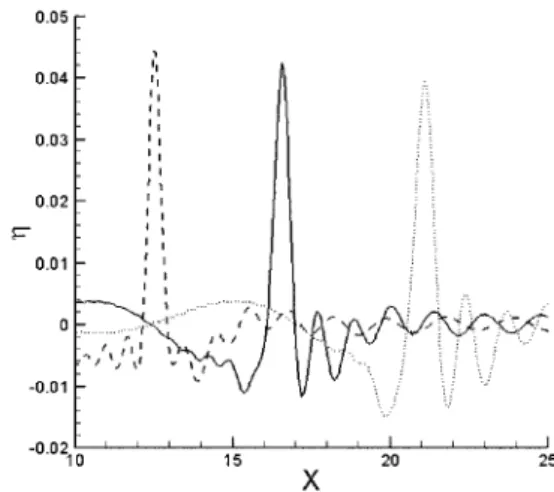
Figure 1 presents the free surface obtained at each focus- ing point by solving the nonlinear equations, without cur- rent, and with current velocities of U/c
g= - 0 . 125 and U/c
g= + 0 . 125. Here c g is the mean group velocity of the frequency modulated wave group. The focusing point is defined as the location where maximum elevation is reached. Differences appear between those profiles. The group propagated with a co-current focuses further (and later) than the one propa- gated freely, while its elevation is lower. On the other hand, the group propagated in a counter-current focuses closer (and faster), and its amplitude is larger than the amplitude of the group propagated freely. Variation of freak wave amplitude is of order 10%. The evolution of the focusing
ω kU –
( )
2= gk
η x t ( ) , 1 2 π
--- η ( 0 , τ ) exp ( iωτ ) τ d
–∞+∞
∫ exp [ i kx ωt ( – ) ]dω
=
φ x z t ( , , ) Ux φ x z t = + ( , , )
∂η --- ∂t ∂ϕ --- ∂z ∂ϕ --- ∂x ∂η --- ∂x
– U∂η
∂x --- –
=
∂ϕ ∂x --- = ( --- ∇ϕ 2 )
2– U∂ϕ ∂x --- – gη
Fig. 1.
Free surface elevation at each focusing time for a group
propagated freely (solid line) with counter-current of
velocity U / cg= -0 . 125 (dashed line), and with co-cur-
rent of velocity U / cg= +0 . 125 (dotted line).
= +0 . 125 (dotted line).
point corresponds to linear prediction. Indeed, one can notice from equation (9) that linear theory predicts an area spread- ing closer than X
ffor counter-stream, and further for co- stream. On the other hand, results concerning wave ampli- tudes are surprising. Actually, linear theory predicts a spread- ing of the focusing area in both counter and co-stream, which should result in a decay of the wave amplitude in both cases. Quantitative comparisons can be obtained with linear approach presented above.
Figure 2 presents the location of the focusing point obtained from both linear and nonlinear methods, plotted as a function of current velocity. Theoretical values obtained from the kinematic model also appear. One can notice a very good agreement between linear and nonlinear meth- ods. Focusing appears in an area spreading from L max to
L min , as predicted by the kinematic model. Very weak dif- ferences can be observed between linear and nonlinear methods, especially in strong countercurrents, where the waves become steeper. This shows that from a kinematic point of view, the linear representation of the problem is a relevant approach.
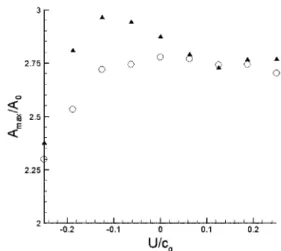
Figure 3 shows the maximum elevation reached at the focusing point as a function of the current velocity, for both linear and nonlinear models. Differences are more impor- tant here. For the linear model, the maximum is reached without any current. This can be understood by considering
that the focal point turns into a focusing area in both cases of counter and co-current. The energy is spread, and the resulting wave is lower. The influence of current, through Doppler effect, leads to non-optimal focusing, as it was shown in the framework of the kinematic model. Disper- sion parameter, d 2 k/dω 2 increases for counter-current more than for co-current, which results in a decay of the focal amplitude for counter-current. For the nonlinear case, the observation is different. If the behavior in co-currents is very similar to the behavior presented by the kinematic model, the evolution in counter-currents is different. These differences have a pronounced maximum in a counter-cur- rent of U/c
g= - 0 . 125. The amplification of the wave ampli- tude on counter-current is due to two effects. Firstly, wave dispersion (deviation from optimal focusing) is decreased in counter-currents when nonlinearity is taken into account, as it is emphasized later. This mechanism tends to keep coherence of components, and maintain focusing on counter- currents. Secondly, the role of the modulational (Benjamin- Feir) instability increases while the wave steepness is enlarged in counter-currents. Thus, the nonlinear parameter
ak is increased, and the growth rate of modulational insta- bility is also increased. This mechanism also tends to increase wave amplitude on focusing point. Development of this mdoulational instability in frequency modulated wave groups propagated has been observed in by Brown and Jensen (2001). One can notice that this phenomenon should disap- pear for two dimensional waves propagating in finite depth,
Fig. 2.
Numerical focusing point as a function of the current velocity, for both linear (circles) and nonlinear models (triangles), plotted together with the theoretical extreme values of the focusing area Lmin and Lmax from the kine- matic model.
from the kine- matic model.
Fig. 3.
Amplitude at the focal point as a function of the current
velocity, for both linear (circles) and nonlinear models
(triangles).
since modulational instability is not relevant in this case.
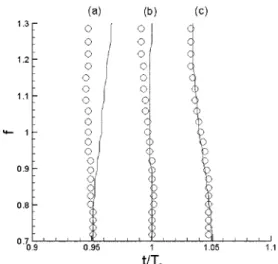
The time frequency representation of the focused wave group, obtained by means of wavelet analysis, is presented on Figure 4 for freak waves obtained on several current velocities U/c
g. A perfect focusing should be represented as a vertical straight line. Results obtained with the linear model are plotted together with results of the fully nonlin- ear simulations. As expected, the agreement is excellent for a freak wave obtained on a co-stream (c). It emphasizes the linear behavior of the waves during the focusing process in a co-stream. It can be understood by the low steepness of waves involved in the process. In both linear and nonlinear simulations, the focusing obtained is not perfect, illustrat- ing the spread area of focusing. Weak differences appear for the case without current. Those differences concern high frequencies, corresponding to the most nonlinear waves.
Components are almost perfectly focused in the ( t - f ) plane, explaining the high amplitude reached for that cur- rent velocity. As mentioned earlier, the differences between nonlinear and linear simulations are larger in the case of
U/c
g= -0 . 125. Figure 4 confirms that high frequencies propa- gate faster in the nonlinear simulation, as predicted by first- order correction of the linear dispersion relation (see Whitham (1974)). Therefore, high frequencies components focus on longer distances in this case, than in the linear one.
Nonlinearity seems to balance the linear effect, by acceler- ating slowest components of the group, and maintaining focusing on larger locations. This explains partially the dif- ferences observed in amplitudes between kinematic model and nonlinear one.
5. Conclusion
The interaction between a focusing wave group and cur- rent is studied numerically. Two methods are used. In linear theory we use an approximated kinematic approach as well as full linear solution based on the Fourier integral. Another approach is to solve numerically the nonlinear equations.
The results obtained for both models are compared. The global kinematic behavior (locations of the focal points) is found to be similar. In terms of maximum amplitude, some differences are obtained. In the linear description, maximal amplitudes of freak waves are obtained without current, while in the nonlinear case, maximal amplitude of freak waves occurs in a weak opposing current. The presence of a maximum of the amplitude curve in linear theory is related with the shift from optimal conditions of linear focusing. In nonlinear theory, waves propagated on counter-current suf- fer a decay of wavelength resulting in an increase of their steepness. Increasing nonlinearity results in two phenom- ena. First, the dispersion relation is changed, leading non- linear waves to propagate faster than the group velocity predicted by the linear dispersion relation. Secondly, the modulational instability can develop. These phenomena result in larger values of the wave amplitude at the focal point.
Acknowledgement
Particularly, this study is supported by INTAS grant (06- 1000013-9236), and also for EP - by grants from INTAS (03- 51-4286) and RFBR (05-05-64265).
References
Kharif, C., Pelinovsky, E., Talipova, T. and Slunyaev, A. (2001).
Focusing of nonlinear wave groups in deep water, JETP Letters, vol. 73, No. 4, 170-175.
Johannessen, T.B. and Swan, C. (2003). On the nonlinear dynam- ics of wave groups produced by the focusing of surface water waves, Proc. R. Soc. London, vol. A459, 1021-1052.
Gibson, R.S. and Swan, C. The evolution of large ocean
Fig. 4.