침전법을 이용한 이산화티탄 입자 제조에 알콜과 온도가 미치는 영향에 관한 연구
김덕술 ✝
✝
동명대학교 의용공학과(2012년 9월 4일 접수 ; 2012년 9월 18일 수정 ; 2012년 9월 21일 채택)
Study about The Effect Alcohol and The Temperature Exert on TiO 2 Particle Production by Sedimentation Method
Duck-Sool Kim
✝
✝ Dept. of Biomedical Engineering, Tongmyong University, 179 Sinseseono, Nom-gu, Busan, 608-711, Korea
(Received September 4, 2012 ; Revised September 18, 2012 ; Accepted September 21, 2012)
요약 : 본 연구에서는 TiO
2
입자를 얻을 수 있는 침전법을 이용하여 TiO2
입자를 제조하였다.TiO
2
입자 제조시 사용되는 알콜 용매의 종류와 온도 변화 등의 매개변수가 TiO2
입자의 결정 구 조, 입자의 크기 및 형태에 미치는 영향을 조사하였다. TiO2
입자제조시 용매로 사용한 알콜 종류 인 methyl alcohol, iso–propylalcohol, 그리고 tert–butylalcohol를 scanning electron microscope(SEM) 분석한 결과 iso–propylalcohol이 가장 좋은 결과를 가져왔다. 그리고 온도 변화 를 열분석법을 사용한 결과 200 ℃에서 500 ℃까지는 아나타제 구조를 유지하였으나, 800 ℃에서는 루틸 구조로 전환되었다.주제어 : 침전법. 이산화티탄, SEM, 열분석, 아나타제 구조, 루틸 구조.
Abstract : Using the Sedimentation method it's possible to get TiO
2
particle from which by this research, TiO2
particle was produced. The parameter in the kind of the temperature and the alcohol solvent used TiO2
particle production investigated crystal structure of TiO2
particle and the influence exerted on the size of the particle and the form. After scanning electron microscope (SEM) analyzed methyl alcohol, iso-propylalcohol and tert-butylalcohol used by a solvent at the TiO2
particle production, iso-propylalcohol was most effective. And after an thermogravimetric analyzer method was used, the anatase structure was maintained 500 ℃ by 200 ℃, but it was converted by the rutile structure by 800℃.
Keywords : Sedimentation method, TiO 2, thermogravimetric analyzer, scanning electron microscope(SEM), anatase structure, rutile structure.
✝
주저자 (E-mail : [email protected])
1. 서 론
이산화티탄(이하 TiO
2
)은 대표적인 백색안료 로서 도료, 제지, 플라스틱, 고무 등에 사용되면 서 실생활에 널리 적용되는 아주 중요한 무기 화합물로써, 한 국가의 경제발전도를 1인당 TiO2
사용량으로 비교하기도 한다. TiO2
는 백 색안료중 가장 높은 굴절률을 가지고 있으므로 은폐력, 착색력이 아주 우수하고 물리적으로 아 주 안정하며 또 화학적으로 무독성이기 때문에 화장품, 의약품 등에 널리 사용되고 있다[1-3].그리고 전자적 특성을 이용하여 전자재료, 용접 봉 피복재 등 그 쓰임새가 광범위하여 실생활 중에서 항상 접할 수 있는 제품이다.
최근에는 TiO
2
의 특성을 이용한 새로운 제품 들이 개발되어 적용되는 추세가 급속도로 진행 되며, 국가간의 경쟁이 치열하다. 이러한 TiO2
는 결정구조에 따라 루틸형(Rutile), 아나타제형 (Anatase) 및 브루카이드형(Brookite)으로 구분 되는데 저온상인 아나타제형과 고온상인 루틸 형이 보편적으로 관찰된다. 보통 루틸형은 빛의 산란효과가 우수하여 백색안료, 전자장치등의 유전체 재료로 사용되며, 또 화학적 안정성의 이점으로 광학렌즈의 코팅재료로의 응용연구 [4-5]가 활발하게 이루어지고 있으며, 아나타제 형은 광촉매반응과 광전기 화학적 적용을 위해 많은 연구가 이루어지고 있다[6-7]. 그러나 브 루카이트형은 아나타제상이나 루틸상의 혼합없 이 순수한 브루카이트형의 제조는 매우 어려운 것으로 알려져 있으며[8], 이와 같은 제조상의 어려움이 광촉매와 촉매지지체로의 응용이 제 한되는 원인중의 하나가 되고 있다.
그리고 TiO
2
는 입자크기, 형태 및 결정구조 에 따라 그 응용분야가 달라지기 때문에 다양 한 제조방법에 관하여 많은 연구가 이루어지고 있다. 현재까지 알려진 TiO2
제조방법은 수열합 성법[9], CVD법[10], 침전법[11-12], 졸겔법[13], 황산법과 염산법등이 있다. 주로 분체 원료를 얻을 수 있는 수열합성법은 장치가 복잡하고 연속적인 작업이 어려우며, 그리고 출발물질을 기상으로 공급하여 화학반응에 의해 박막을 증 착시키는 화학증착법(Chemical Vapor Thposition, CVD)이 있다. 졸겔법은 현재 TiO2
를 얻는 방법으로 많이 이용되고 있지만, 불순 물의 잔존에 의해 순순한 TiO
2
를 얻기 힘들고생성된 TiO
2
는 결정결함이 많아 촉매활성을 저 하시키는 문제점을 가지고 있다. 그리고 황산 법과 염산법은 입자크기가 100-200nm로 조밀 하고 공정 중 유기가스가 발생하는 단점을 가 지고 있다.본 연구에서는 사용되는 용매의 종류에 따라 다양한 결정 형태의 TiO
2
입자를 얻을 수 있는 침전법을 이용하여 TiO2
입자를 제조하였다.TiO
2
입자 제조시 사용되는 알콜 용매의 종류 와 소성온도 변화 등의 매개변수가 TiO2
입자 의 결정 구조, 입자의 크기 및 형태에 미치는 영향을 조사하였다.2. 실 험
2.1. 시약TiO
2
입자 제조에 사용된 원료로는 먼저 Titanium isopropoxide(이하 TTIP : Ti(OC3
H7
)4
, 97%)는 Aldrich사의 제품을 정제 하지 않고 사용하였다. 그리고 용매로 사용한 알콜 종류인 methyl alcohol (MeOH), iso-propylalcohol(i-PrOH), 그리고 tert- butylalcohol(t-BuOH)는 모두 Aldrich사 특급시 약을, 증류수는 Water Deionizer (DF-500, Crystalab. Inc., U.S.A)를 이용하여 만든 3차 증류수를 사용하였다. 상업용 TiO2
는(Anatase 형, Rutile형) 대정화금(주)에서 판매하는 것을 이용하였다.2.2. 실험방법
일정량의 용매[14]가 들어있는 250mL, three-neck flask에 TTIP를 첨가한 후 교반기 로 충분히 교반을 시킨 후에 상온건조를 시킨 다음 소성온도를 각각 200℃, 500℃, 그리고 800℃에서 3시간동안 시켜 TiO
2
입자를 얻을 수 있었다. 자세한 합성방법은 Fig.1에 나타내 었다.2.3. 분석
상업용인 TiO
2
입자와 합성된 TiO2
입자의 열 적 안정성을 확인하기 위해 열분석 시스템 (Thermal Analysis System; TAS, SSC5200, Seiko, Japan)을 사용하였다. TiO2
의 결정성은 X선 회절장치(X-ray Diffractometer; XRD,Model X PERT, Philips, Netherland)로 측정하 였으며 그 측정 조건은 scan mode : Continuous Scan, scan range : 10-70, scan speed : 2.0 (deg/min), sampling pitch : 0.05(deg), preset time : 1.50(sec), X-ray tube target Cu, voltage : 30.0 (kV), current:30.0(mA) 이다. 또한 TiO
2
의 입자 크기 및 균일성은 주사전자현미경(Scanning Electron Microscope; SEM, Model S-4200, Hitachi, Japan)으로 확인하였다. TiO2
를 소성하기 위하 여 관형 전기로(Tube furnace, 고려전기로, Korea)를 사용하였다.Titanium tetraisopropoxide(TTIP)
↓
Alcoholic Solvents (MeOH, i-PrOH, t-BuOH)
↓
Distilled water(pH=2) 8 hours ↓ Heating(80℃)
Collidal suspension Evaporating solvent
↓
Calcination(200℃~800℃) Crytalline TiO
2
Fig. 1. Preparation scheme for TiO
2
particles by Ti(OC
3
H7
)4.
3. 결과 및 고찰
3.1. TiO2
입자의 열적 안정성사용되는 알콜 용매 종류와 소성온도 변화에 따라 제조된 TiO
2
입자내의 유기물의 함량과 열적 안정성을 알아보기 위해 열분석법을 사용하였다. 시판되고 있는 TiO
2
(아나타제형과 루틸 형)입자의 열분석 결과는 Fig. 2에 나타내었다.아래와 같이 상온에서 약 500°C 까지의 온도변 화부분에서 무게의 감소는 거의 보이지 않음을 알 수 있었다. 이는 시판용 TiO
2
입자내 에는 유기물등의 불순물이 거의 없음으로 열적인 안 정성을 보이는 것으로 보여진다.Temperature (
oC)
0 100 200 300 400 500
Weight (mg)
11.0 11.1 11.2 11.3 11.4 11.5
anantase
rutile
Fig. 2. TGA curves of commercial TiO
2
particle
2q (degree)
0 10 20 30 40 50 60 70 80
Intensity (a.u.)
Anatase Rutile
A R
Fig. 3. The XRD patterns of commercial TiO
2
particles.Fig. 3. 에서는 일반적으로 나타나는 TiO
2
의XRD 패튼이다. 대부분의 화학적인 방법으로 제조된 이산화티탄은 준 안정한 아나타제의 결 정구조를 가지며 열처리를 하면 루틸 상으로 변한다[15].
3.2. TiO
2
입자의 결정구조TiO
2
의 결정구조 및 미세 결정크기를 알아보기 위해 X-선 회절분석기(X-ray
Diffractometer; XRD, Model X PERT, Philips, Netherland)를 사용하였다.
이산화티탄 입자의 아나타제에서 루틸로의 전환 온도는 450 ℃에서 1200 ℃까지인데, 전구 체의 성질과 구조 및 입자제조조건에 의존하는 것으로 알려져 있다[16].
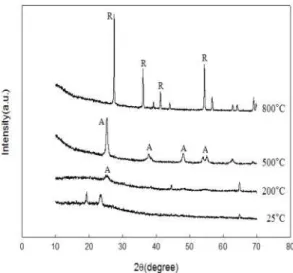
Fig 4. (TTIP/MeOH), Fig. 5. (TTIP/BuOH) 와 Fig. 6. (TTIP/Propyl) 까지 보는 바와 같 이 소성온도(200 – 800℃)에 따른 이산화티탄 입자의 X-선 회절분석 결과를 나타내었다.
일반적으로 소성은 TiO2 입자의 결정성을 개 선하는데 사용되고, 소성온도가 증가하면서 TiO
2
입자는 비결정성 구조에서 아나타제 구조 로, 아나타제 구조에서 루틸 구조로 점차 변환 된다. 위에 보인Fig 4. - Fig. 6. 나타난 것처 럼 아나타제의 결정구조는 200 ℃에서 500 ℃ 까지 유지 하였으나, 800 ℃에서는 완전한 루 틸 구조로 전환되었다.Fig. 4. The XRD patterns of TiO
2
particles (TTIP/MeOH), calcined at various temperatures.Fig. 5. The XRD patterns of TiO
2
particles (TTIP/BuOH), calcined at various temperatures.Fig. 6. The XRD patterns of TiO
2
particles (TTIP/Propyl), calcined at various temperatures.3.3. TiO
2
입자 형태와 크기Fig. 7.에서 나타나는 것같이 (a)에서는 200
℃에서 소성된 이산화티탄 입자는 크고 각이진 형태를 보여주었으나 (b)의 800 ℃에서 소성시 킨 경우에는 완전한 구형에 가까운 것을 관찰 할 수 있었다. 또한, 소성온도가 증가할수록 입 자의 크기가 커지는 것을 볼 수 있었다.
(a) Anatase type TiO
2
(b) Rutile type TiO
2
Fig. 7. SEM images of commercial TiO
2
particles.
3개의 알콜을 첨가하여 실험한 결과 그림을 Fig 8. (TTIP/MeOH), Fig. 9. (TTIP/BuOH)와 Fig. 10. (TTIP/Propyl) 에서 보는 바와 같이 소성온도 (200℃, 500℃와 800℃)에 따른 이산 화티탄 입자의 SEM의 결과를 나타내었다.
TTIP/MeOH, (a) 200℃
TTIP/MeOH, (b) 500℃
TTIP/MeOH, (c) 800℃
Fig. 8. SEM images of TiO
2
particles prepared by TTIP/MeOH (25℃), calcined at (a) 200℃, (b) 500℃ and (c) 800℃.그림을 확대(약 600 nm)하여 본 결과 Fig. 9.
(TTIP/BuOH)이 가장 일정한 크기의 구형을 나타내었다. 이것은 (a)의 200 ℃에서 소성된 이산화티탄 입자는 크고 각이진 형태를 보여주 었으나 (b)의 500 ℃에서 소성시킨 경우에는 각 이 많이 진 불균일한 표면을 가진 구형을 나타 내었다.
TTIP/i-PrOH, (a) 200℃
TTIP/i-PrOH, (b) 500℃
TTIP/i-PrOH, (c) 800℃
Fig. 9. SEM images of TiO
2
particles prepared by TTIP/i-PrOH (25℃), calcined at (a) 200℃, (b) 500℃ and (c) 800℃.TTIP/t-BuOH, (a) 200℃
TTIP/t-BuOH, (b) 500℃
TTIP/t-BuOH, (c) 800℃
Fig. 10. SEM images of TiO
2
particles prepared by TTIP/t-BuOH (25℃), calcined at (a) 200℃, (b) 500℃ and (c) 800℃.또한 (c)의 200 ℃에서 소성시킨경우에는 완 만한 형태의 구형과 한쪽 지름이 긴 타원형을 두 가지 형태를 동시에 가지며, 결과적으로 (a) 의 200 ℃입자그림은 소성온도가 높아질수록 (c)의 800 ℃입자그림의 구형에 가까워지는 것 을 관찰할 수 있었다.
4. 결 론
침전법을 이용하여 TiO
2
입자 제조시 사용되 는 알콜 용매의 종류와 소성온도 변화 등의 매 개변수가 TiO2
입자의 결정 구조, 입자의 크기 및 형태에 미치는 영향을 조사한 결과 다음과 같은 결론을 얻었다.1. TiO
2
입자제조시 용매로 사용한 알콜 종류인 methyl alcohol (MeOH), iso – propylalcohol (i-PrOH), 그리고 tert – butylalcohol (t-BuOH)를 사용한 결과 iso – propylalcohol (i-PrOH)이 가장 좋은 결 과를 가져왔다.2. TiO
2
입자제조시 소성온도를 변화시킨 경우 200 ℃에서 500 ℃까지는 아나타제의 결정 구조를 유지하였으나, 800 ℃에서는 완전한 루틸 구조로 전환되었다.3. TiO
2
입자제조과정에서 알콜을 첨가하고 소 성온도가 증가해도 TiO2
입자는 아나타제 구조에서 루틸 구조로 점차 변환되었다.참고문헌
1. B. M. Lee, D. Y. Shin, and S. M. Han, Synthesis of Hydrous TiO
2
Powder by Droppimg Precipitant Method and Photocatalytic Properties,J. of the Kor.
Cer. Soc
. 37(4), 308 (2000).2. T. Fuyuki and H. Matsunarni, E1ectronic Properties of the Interface between Si and TiO
2
Deposited at very Low Temperatures,Jpn. J. App. Phys.,
25(9), 1288 (1986).3. K. Prasad, A. R. Bal1y, P. E. Schrnid, F.
Levy, J. Benoit, C. Barthou and P.
Benal1ou1, Ce-doped TiO
2
Insu1ators in Thin Fi1m E1ectro1urninescent Devices,J. App. Phys.,
36, 5696 (1997).4. Y. Zheng, E. Shi, Z. Chen, W. Li, and X.
Hu, lnf1uence of Solution Concentrati-on on the Hydrothermal Preparation of Titania Crystallites,
J. Mater. Chemi.,
11, 1547 (2001).5. A Pottier, C. Chaneac, E. Tronc, L.
Mazerolles, and J. P. Jolivet, Synthesis of Brookite TiO
2
Nanoparticles by Thermolysis of TiCl4
in Strongly Acidic Aqueous Media,J. Mater. Chem.
, 11, 1116 (2001).6. S.J. Kim, S.D. Park, C.J. Jeon, K.H. Kim, H.G. Lee, Preparation of Mono-dispersed Ultrafine TiO2 Crystalline Powders by Homogeneous Spontaneous Precipitation From Aqueous TiOCl
2
Solution,Journal of the Korean Ceramic Socity,
35(10) 1212 (1998).7. S.J. Kim, S.D. Park, and Y.H Jeong, Homogeneous Precipitation of TiO
2
Ultrafine Powders from Aqueous TiOCl
2
Solution.
J. Am. Ceramic Soc.,
82(4), 927 (1999).8. H. Kominami, M.Kohno, and Y. Kera, Synthesis of Brookite-type Titanium Oxide Nano-crystals in Organic media,
Journal of Materals chemistry,
10, 1151 (2000).9. Q. Chen, Y Qian, Z. Chen, G. Zhou and Y Zhang, Preparation of TiO
2
Powder with Different Morphologies by An Oxidation-hydrothennal Combination Method, Mat. Lett.,
22, 77 (1995).10. H. Y. Lee, Y. H. Park and K. H. Ko, Photocatalytic Characteristics of TiO
2
Films by LPMOCVD,
J. Kor. Ceram, Soc.,
36, 1303 (1999).11. B. M. Lee, D. Y Shin and S. M. Han, Synthesis of Hydrous TiO
2
Powder by Dropping Precipitant Method and Photocatalytic Properties,J. Kor. Ceram., Soc.,
37, 308 (2000).12. B. M. Lee, D. Y Shin and S. M. Han, Synthesis of Hydrous TiO
2
Powder by Dropping Precipitant Method and Photocatalytic Properties,J. Kor. Ceram., Soc.,
37, 308 (2000).13. Grtzel, M., Sol-gel Processed TiO
2
Films for Photovoltaic Applications,J. Sol-Gel Sci. Technol.,
22(1-2), 7 (2001).14. C. S. Ki and P. Sotris E, The Effect of Alcohol Solvents on the Porosity and Phase Composition of Titania,
J. of Colloid and Interface Sci.,
231, 289 (2000).15. P. N. K. Kumar, XRD Patterns of Nanosized TiO 2 Powders Prepared by PFPE-NH 4 Surfactant at Various Preparation Conditions, Ph. D. Thesis, University of Twente,
7500 AE Enschede
, The Netherlands (1993).16. V. Chhabra, V. Pillai, B. K. Mishra, A.
Morrone, and D. O. Shah, Synthesis, Characterization, and Properties of Microemulsion - Mediated Nanophase TiO2 Particles,