−
159
−아르곤 분위기의 NaCl 수용액에서 구리의 산화 용해반응에 미치는 염화이온의 영향
천정균·김연규*
한국외국어대학교 자연과학대학 화학과 (2008년 7월 10일 접수 : 2008년 8월 5일 채택)
Chloride Ion Effects on Anodic Dissolution of Copper in Aqueous NaCl Solutions under Argon Atmosphere
Jung-Kyoon Chon and Younkyoo Kim*
Department of Chemistry, College of Natural Science, Hankuk University of Foreign Studies, Yongin, Kyunggi-Do, 449-791, Korea
(Received July 10, 2008 : Accepted August 5, 2008)
초 록
변전위법
,
순환전압전류법,
대시간전류법및대시간전기량법을이용하여구리의산화용해반응에 미치는Cl
−의영향을조사하였다.
아르곤분위기의NaCl
수용액에서Cu
의산화용해반응은전반응식
Cu + 2Cl
−CuCl
2−+ e
−에따라일어나며, Cu
표면에Cl
-가흡착하는 과정에잘맞는등온식은
Temkin
흡착등온식 임을 알 수 있었다.
Abstract :
We investigated chloride ion effects on anodic dissolution of copper using potentiodynamic method, cyclic voltammtery, chronoamperometry and chronocoulometry. The anodic dissolution reaction of copper in NaCl solution under argon atmosphere is Cu
+2Cl
−CuCl
2−+ e
−and chloride ion adsorption process in copper surface can be explained by Temkin isotherm.
Keywords :
Copper, Anodic dissolution, Chloride ion.
1. 서 론
구리
(Cu)
는 열전도도와전기전도도가 좋을뿐만 아 니라가공이편리하여 전력,
통신,
전자,
해양등의산업현장에서많이사용되는금속재료이다
.
구리는Cu/
Cu(I)
의표준전위(E
0= 0.520 V)
가수소발생의표준전위(E
0= 0.000 V)
보다 높아Pourbaix
도표의 부식면역 영역(immunity region)
에있으며중성용액에서부착력(adhesive force)
이 좋은 산화피막이 생성되기 때문에 다른금속보다부식이 느린것으로 알려져왔으며1-3) 바닷물과 같이 산소가용해되어 있는 염화 이온(Cl
−)
매질
(chloride media)
에서는구리의부식속도가증가하 는것으로보고된바있다.
4-7)Cl
−매질에서구리표면 에는일차적으로CuCl
피막이생성된다.
그러나CuCl
피막은 구리 표면의 부식을충분히 막아주지 못하며
Cl
−의 농도에 따라CuCl
2−, CuCl
32−, CuCl
43− 등의 착이온으로구리가녹아나오는 것으로알려져있다
.
4-13)본 연구에서는아르곤 분위기의
0.1 M~0.5 M
중성NaCl
수용액에서일어나는구리의 부식속도를변전위법
(potentiodynamic method, PD)
으로 측정하여 비 교하였으며,
순환전압전류법(cyclic voltammetry, CV),
대시간전류법
(chronoamperometry, CA)
및대시간전기 량법(chronocoulometry, CC)
을이용하여구리 부식의반응메커니즘에 미치는
Cl
−의영향을조사하였다. 2
2
*E-mail: [email protected]
된 용액
(deaerated solution)
에서의 측정은10
분 동안아르곤을 흘려준 후 아르곤 분위기에서 수행하였으며 산소가 포화된용액은산소를
10
분간흘려준 후산소 분위기에서수행하였다.
시중에서구입한분석 급(AR
grade)
시약을실험에사용하였으며원판형구리전극은측정전에
No. 1200
의연마지(emery paper)
에이어서0.1
μm
알루미나곤죽으로덮인연마지포(emery cloth)
로 연마한후증류수로씻은다음에 −0.6 V
에서60
초동안 사전환원(prereduction)
시키고10
초 동안 평형시간을유지한후측정에사용하였다
.
3. 결과 및 고찰
3.1 Potentiodynamic Polarization (PD) Measurements
Fig. 1
은아르곤,
공기,
산소분위기의0.5 M NaCl
수 용액에서측정한구리전극의PD
곡선들이다. Fig. 1
에서보는바와같이산소의농도가증가할수록부식전위
(E
corr)
해수와마찬가지로
NaCl
수용액에서일어나는산화환원 반응은이미 보고된바와 같이 다음과같은 반응 일것이다
.
3-12)산화반응
(1) (2)
환원반응
(3) (4)
반응식
(1)
과(2)
에 대한 메커니즘은transient
및steady-state Tafel
기울기와EIS
자료로부터 각각 식(5)
와(6), (7)
과(8)
처럼제안된 바있다.
12)(fast) (5) (diss. rds) (6) Cu + 2 Cl
–CuCl
2–+ e
–2 Cu + 2 OH
– →Cu
2O H +
2O + 2 e
–2 H
2O + 2 e
–H
2+ 2 OH
–O
2+ 2 H
2O + 4 e
–4 OH
–Cu Cl +
–CuCl
ads+ e
–CuCl
ads+ Cl
– →CuCl
2–Fig. 1. Potentiodynamic polarization curves of copper electrode measured in 0.5 M NaCl solution under argon, air and oxygen atmosphere.
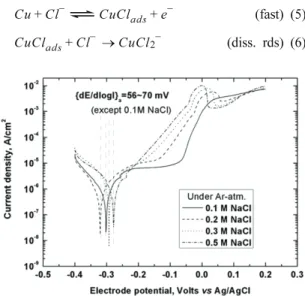
Fig. 2. Potentiodynamic polarization curves of copper
electrode measured in the different concentration of
NaCl solution under argon atmosphere.( dE/dt = 1 mV/sec)
(fast) (7) (pass. rds) (8) 3.2 Cyclic Voltammetry(CV)
Fig. 3
은아르곤분위기에서NaCl
용액의 농도변화에 따라 측정한
CV
를 나타낸 것이다. Fig. 3
에서나타나는
0.095 V
산화봉우리(E
pa1)
와 −0.278 V
부근의 환원봉우리(E
pc)
는이미보고한바있는반응(1)
에의한 준가역적(quasi reversible)
산화환원반응이다.
12)Fig. 3
의첫번째산화반응이일어나는
Tafel
영역(
−0.3 V~0.1 V)
에서
E
에대한logI
를Fig. 3
의inset
에나타내었다. Fig. 3
의inset
에나타난Tafel-type plots
으로부터얻은 일정전류에서전극전위의NaCl
농도의존성과,
일정전위에서전류의
NaCl
농도의존성을각각Fig, 4
와Fig. 5
에 나타내었다. Fig. 4
와5
에서 얻은{dE/dlog[NaCl]}
I=
−
95 mV
와{dlogI/dlog[NaCl]}
E= 1.40
은Tafel
기울기,
반응차수그리고흡착등온식
(isotherm)
과밀접한관계 를가지고있다.
반응 메커니즘에서다시 논의하겠지 만 구리 전극에서 일어나는 염화이온의 흡착은 일반 적인Langmuir
흡착 등온식 보다는Temkin
흡착등온식에더잘따르는것으로보인다
.
3.3 Chronoamperometry and Chronocoulometry
아르곤 분위기의
0.5 M NaCl
용액에서 측정한PD
곡선
(Fig. 1
참조)
의구리산화Tafel
영역의 전극전위 에서(
−0.2 V
에서0.0 V
사이)
대시간전류곡선을 얻어Fig. 6
에나타내었다. Fig. 6
의전류-
시간곡선을적분하여시간의제곱근에대한전기량을
Fig. 7
에나타내었Cu OH +
–CuOH
ads+ e
–2 CuOH
ads→Cu
2O H +
2O
Fig. 3. Cyclic voltammograms of copper electrode measured in the different concentration of NaCl solution under argon atmosphere. (dE/dt = 20 mV/sec) Inset shows the Tafel-type plots in the first anodic dissolution region (
−0.3 V~ 0.1 V) of CVs.
Fig. 4. The electrode potential measured in the different concentration of NaCl solution at constant current density.
Fig. 5. The current density measured in the different concentration of NaCl solution at constant potential.
Fig. 6. Chronoamperometric curves of copper electrode
measured in the different potential step in 0.5 M NaCl
solutions under argon atmosphere.
의 그림이
Q
축의 음의 절편, t
1/2축의 양의 절편을보일때
,
관계식은Q = (4nFk
f/
π)C
M(t
L1/2t
1/2−t
L)
로주어진다
.
14,15)여기서C
M은구리 전극의활동도에해당하으로보아
,
구리의산화용해에대하여 반응(1)
로표현한 전반응은
Cl
−의 흡착과동시에1
−전자가 이동하는반응
(5)
와이어서일어나는속도결정단계인반응(6)
으로이루어진것으로보인다
.
(fast) (5) (diss. rds) (6)
염화이온의흡착을
Langmuir adsorption
으로가정하면 반응(5)
에 대한 속도 식으로부터{
θ/(1
−θ)} =
K5[
Cl−] exp{
FE/
RT}
가 얻어지며여기에서 θ는coverage, K
5는 반응(5)
에대한평형상수, F
는Fadaday
상수, R
은기체상수
, T
는절대온도를나타낸다.
속도결정단계인반 응(6)
로부터 부식전류 Idiss=
Fk6θ[
Cl−]
를얻을수있으 며 낮은coverage
즉 θ가zero
에 접근할경우I
diss는 식(9)
가된다.
(9)
식
(9)
에log
를취해 정리하면식(10)
이된다. (10) Cu Cl +
–CuCl
ads+ e
–CuCl
ads+ Cl
– →CuCl
2–I
diss= Fk
6K
5[Cl
–]2exp
{FE/RT
}I
disslog = const. + 2 log
[Cl
–]+ E/ 0.0592 Fig. 7. Charge density for t
1/2obtained from the
integration of current graphs for time in Fig. 6.
Fig. 8. Tafel plots obtained from the transient or the steady state currents for the different potential step in
Fig. 6. Fig. 9. The heterogeneous corrosion rate constant for
copper electrode potential in 0.5 M NaCl solution.
식
(10)
으로부터 구한 산화반응의Tafel
기울기(
βa=
dE/
dlogIdiss)
는~60 mV
로이는Fig. 8
의실험결과와잘일치한다
.
또한Fig. 8
와9
의transient Tafel
기울 기(125~132 mV)
는반응(5)
을초기단계에서비가역반응 으로 간주하면 부식전류 Idiss=
Fk5[
Cl−]exp{
FE/2
RT}
가 되며여기에서얻어지는Tafel
기울기(
βa)
는120 mV
이므로 이 역시 실험결과와 잘 일치하고 있다
.
그러나Cl
−의농도의영향은(9)
식으로부터{
dE/
dlog[
NaCl]}
I=
−
120 mV, {
dlogI/
dlog[
NaCl]}
E= 2.0
이 되어야 하나, Fig. 4
와5
에서각각 −95 mV
와1.40
으로 측정되었다.
이는
Langmuir
흡착등온식을적용하는데무리가있어보인다
. Cl
−는금속표면에흡착이 잘되는이온이므로 θ →0
인경우가아니면흡착된Cl
−는서로상호작용이있을것이다
.
일정농도이상의Cl
−용액에서Cl
−는흡착평형
(5)
에이어반응(6)
이일어날뿐아니라, (11)
과같 은연속적인1
−전자전이의산화를거쳐전극표면에서 생성된CuCl
2가Cu
2+ 와2Cl
−로 용해되면서 부식이진행된다고 보고된바있다
.
4, 8, 17, 18(rad) (11)
이 경우 표준흡착자유에너지는 Δ
G
oθ=
ΔG
o+ r
θ(
여기에서
r
은 흡착분자들 사이의상호작용을 나타낸다)
일 것이므로
Frumkin
등온식을 도입하면,
반응(5)
의 속도식에 의한 흡착등온식은
{
θ/(1
−θ)}exp{r
θ/RT}
= K
5[Cl
−]exp{FE/RT}
가되며Temkin
의중간흡착조건({
θ/(1
−θ)} =·· 1)
을적용하면(12)
식이얻어진다. (12)
속도결정단계인 반응
(11)
에 의한 부식전류 Idiss11= 2
Fk11[
Cl−]
θexp{
αr
θ/
RT}exp{
αFE/
RT}
이 므로,
이식에(12)
식을대입하고Temkin
조건으로 θ를상수
c
로간주하면(13)
식이 얻어진다.
(13)
식
(13)
에log
를취해 정리하면식(14)
가된다.
(14)
α를
0.5
로간주하면Tafel slope (dE/dlogI)
a= ~60 mV,
반응차수
{dlogI/dlog[NaCl]}
E= 1.5,
전극전위의NaCl
농도 의존도
{dE/dlog[NaCl]}
I= ~
−90 mV
가되어 측 정값에많이 근접함을알수있다.
퍼텐셜에너지그림의 대칭성을약간수정하여 α를
0.45
로보면Tafel slope
은~66 mV,
반응차수는1.45,
전위의농도 의존 도는~
−95 mV
을얻을수있으며이는각각의측정값 과거의 일치하고있다.
4. 결 론
중성
Cl
−수용액에서Cu
의산화용해반응은전반응 식[Cu + 2Cl
−CuCl
2−+ e
−]
에 따라 일어나며,
Cu
표면에Cl
-가 흡착하는 과정에 잘 맞는 등온식은Temkin
흡착등온식이다. Cu
가산화되는 영역의 단계전위에서
10
초정도의전류-
시간 그림을측정하여순 간및정류상태의Tafel plot
으로부터신뢰성있는자 료를얻었으며동시에불균일속도상수(9.3×10
−6cm/s)
도구할수있었다
.
감사의 글
이 연구는
2008
년도 한국외국어대학교 학술조성연구비로이루어졌습니다
.
참고문헌
1. M. Pourbaix, “Atlas of Electrochemical Equilibria (English Ed. By J.A. Franklin),” NACE, Houston, pp384- 398 (1974).
2. U. Bertocci, “An EQMB examination of Cu surface oxides in borate buffer”, Electrochim. Acta ,
49, 1831 (2004).
3. J-K. Chon and Y. Kim, “Hydrodynamic effects on corrosion and passivation of copper in borate buffer solution”, J. Kor. Electrochem. Soc. ,
10(1), 14 (2007).
4. H. Otmacic, J. Telegdi, K. Papp, and E. Stupnis-Lisac,
“Protective properties of an inhibitor layer formed on copper in neutral chloride solution”, J. Appl. Electrochem. ,
34,