1. INTRODUCTION
With many industries are conforming to the use of blockchain, a lot of new implementation methods have been developed to extend its original func- tionality. One of them is a smart contract where users can implement the traditional contract with- out having intermediaries to authenticate the con- tract, thus making it more secure. Blockchain also
has been adopted by IBM with Hyperledger [1], which started as intermediaries for international businesses contracts between different business especially with a lot of layer of communication and then have been extended to other types of data ex- change and even more complicated operations.
Wearable devices or henceforward we general- ize as IoT devices have started to be significantly important in our daily life since it started to in-
Healthcare System using Pegged Blockchain considering Scalability and Data Privacy
Akmal Azizan
†, Quoc-Viet Pham
††, Han Suk Young
†††, Kim Jung Eon
††††, Kim Hoon
†††††, Park Junseok
††††††, Hwang Won-Joo
†††††††ABSTRACT
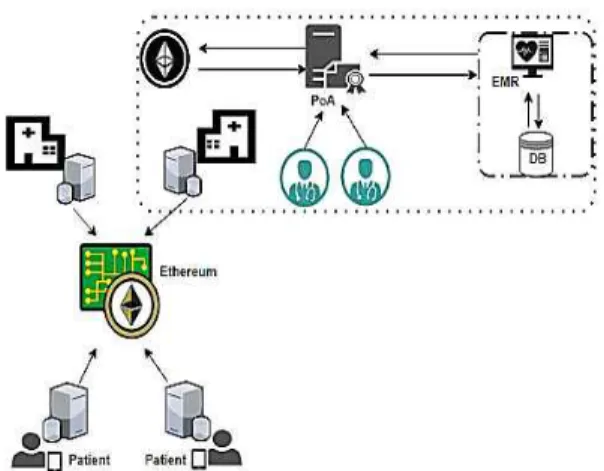
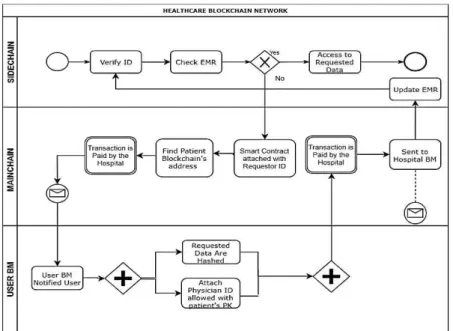
The rise of the Internet of Things (IoT) devices have greatly influenced many industries and one of them is healthcare where wearable devices started to track all your daily activities for better health monitoring accuracy and even down to tracking daily food intake in some cases. With the amounts of data that are being tracked and shared between from these devices, questions were raised on how to uphold user’s data privacy when data is shared between these IoT devices and third party. With the blockchain platforms started to mature since its inception, the technology can be implemented according to a variety of use case scenarios. In this paper, we present a system architecture based on the healthcare system and IoT network by leveraging on multiple blockchain networks as the medium in between that should enable users to have direct authority on data accessibility of their shared data. We provide proof of concept implementation and highlight the results from our testing to show how the efficiency and scalability of the healthcare system improved without having a significant impact on the performance of the Electronic Medical Record (EMR) that mostly affected by the previous solution since these solutions directly connected to a public blockchain network and which resulted in significant delays and high cost of operation when a large amount of data or complicated functions are involved.
Key words: Healthcare, Privacy, Blockchain, Scalability, Wearable Devices, Smart Contract, Pegged Blockchain, Sidechain, IoT, Electronic Medical Record
※ Corresponding Author : Won-Joo Hwang, Address:
197 Injero, Gimhae, Gyeongnam 50834, South Korea,, TEL : +82-55-320-3847, FAX : +82-55-322-6275, E-mail
: [email protected]
Receipt date : Jan. 10, 2019, Revision date : Apr. 2, 2019 Approval date : May 8, 2019
†††
Dept. of Information and Communication Systems, Inje University (E-mail: [email protected])
†††
ICT Convergence Center, Changwon National
†††
Institute of Digital Anti-Aging Healthcare (IDA), Inje University (E-mail: [email protected])
†††††††
Dept. of Emergency Medicine, Inje University, Ilsan Paik Hospital
(E-mail: [email protected])
†††††††
Dept. of Emergency Medicine, Inje University, Ilsan Paik Hospital (E-mail: [email protected])
†††††††
Dept. of Emergency Medecine, Inje University, Ilsan Paik Hospital (E-mail : [email protected])
†††††††