• 검색 결과가 없습니다.

A Study about Development of Hydrogen Peroxide Stabilizer in Modified Fenton Reaction Using Anion Surfactant

N/A
N/A
Protected

Academic year: 2021

Share "A Study about Development of Hydrogen Peroxide Stabilizer in Modified Fenton Reaction Using Anion Surfactant"

Copied!
6
0
0

로드 중.... (전체 텍스트 보기)

전체 글

(1)

環境 및 生態工學

大 韓 土 木 學 會 論 文 集

第31卷 第4B 號·2011年 7月 pp. 377 ~ 382

음이온 계면활성제를 사용한 modified Fenton 반응의

과수안정제 개발에 관한 연구

A Study about Development of Hydrogen Peroxide Stabilizer in Modified Fenton Reaction Using Anion Surfactant

김한기*·박강수**·김정환***·박주양****

Kim, Han Ki · Park Kang Su · Kim, Jeong Hwan · Park, Joo Yang

···

Abstract

In this study, hydrogen peroxide is stabilized in modified Fenton reaction to improve the soil remediation. Phenanthrene, which is the typical compound in PAHs, was spiked into soil samples to copy the original contaminated site. Anionic sur- factant, SDS (Sodium dodecyl sulfate) was used for hydrogen peroxide stabilizer. 4 mM of Fe(II), 5~50 mM of SDS and 102.897 mM of H 2 O 2 was injected into soil samples which is contaminated by 125 mg/kg of phenanthrene to analyze decom- position rate of phenanthrene in modified Fenton reaction. In condition which SDS was injected 30 mM, decomposition rate of phenanthrene has best efficiency as 95% and in condition which SDS was injected over 30 mM, decomposition rate is lower than SDS 30 mM because SDS enacted as scavenger in the system. Results which assess the change of hydrogen peroxide con- centration after injecting hydrogen peroxide stabilizer showed that hydrogen peroxide concentration was 14.6995 mM so that is stabilized at Fe(II) 2 mM condition in 48 hours. On the other hand, hydrogen peroxide is not stable in Fe(III) condition. SDS concentration was fixed and iron concentration was changed 2~8 mM to find out optimize proportion between iron concen- tration and SDS concentration in modified Fenton reaction. Consequentially, in condition of which Fe(II) 4 mM and SDS 30 mM, reaction has the highest removal rate as 95%.

Keywords : hydrogen peroxide stabilizer, modified fenton reaction, surfactant, SDS, phenanthrene

···

요 지

본 연구에서는 modified fenton 반응에서 과산화수소를 안정화하여 오염토양 정화의 효과를 증대시키고자 하였다 . 오염토

양을 모사하기 위하여 PAHs 계열의 대표적인 오염물질인 phenanthrene 을 사용하였다 . 과수안정제로는 음이온 계면활성제인

SDS(Sodium dodecyl Sulfate) 를 사용하였다 . Modified Fenton 반응에서 phenanthrene 의 제거율을 확인하기 위하여 Fe(II) 4 mM, SDS 5~50 mM H 2 O 2 102.897 mM phenanthrene 125 mg/kg 으로 오염된 토양에 주입하였다 . 과수안정제인 SDS 가 30 mM 이 사용된 경우 phenanthrene 의 제거 효율이 95% 로 가장 높게 나타났으며 30 mM 이상에서는 시스템에서

SDS 가 scavenger 로 작용하여 오염물질의 제거효율이 SDS 30 mM 일 때 보다 낮게 나타났다 . 과수안정제를 사용한 뒤 과

산화수소의 농도변화를 분석한 결과 Fe(II) 2 mM 에서 48 시간 이후 14.6995 mM 이상 남아있어서 가장 안정적이었지만 ,

Fe(III) 주입한 경우에는 과산화수소가 안정화되지 않았다 . Modified Fenton 반응에서 철과 SDS 농도 사이의 최적의

율을 찾기 위하여 SDS 의 농도는 30 mM 로 고정하고 철의 농도를 2~8 mM 로 변화시켜 실험한 결과 Fe(II) 4 mM 및

SDS 30 mM 에서 약 95% 의 가장 높은 제거율을 보였다 .

핵심용어 : 과수안정제 , 수정펜톤반응 , 계면활성제 , SDS, 페난트린

···

1. 서 론

대표적인 유류 토양오염물질인 polycyclic aromatic hydro-

carbons(PAHs) 는 토양 내 미생물의 활동을 저해하고 먹이

사슬 내에서도 높은 체내 축적률을 보일 뿐 아니라 체내 축

적 시 높은 암 발생률 및 돌연변이 발생률을 보이므로 관심 이 집중되고 있다 (Laflamme 등 , 1978; Morillo 등 , 2007).

산불 , 난방 및 차량에서 배출되는 매연이나 폐기물 소각 등 다양한 발생원에서 화석 연료의 불완전한 연소에 의해 대기

중으로 방출된 PAHs 는 기상 및 입자상의 중간 형태로 대기

*정회원·한양대학교대학원건설환경공학과석사과정

(E-mail : [email protected])

**한양대학교대학원토목공학과석사

(E-mail : [email protected])

***한양대학교대학원박사후과정

(E-mail : [email protected])

****정회원·교신저자·한양대학교건설환경공학과교수
(E-mail : [email protected])

(2)

중으로 확산되어 토양에 퇴적되며 (Johnsen 등 , 2004; Morillo, 2007) 정유 및 정제 , 목재의 방부처리 등의 공정 중 발생하 는 폐기물 및 폐수를 통해서도 토양 및 지하수 오염을 유발 한다 (Wilcke, 2000).

일반적으로 PAHs 는 토양 내에서 물에 대한 용해도 및 물 질전달율 (mass transfer rates) 이 낮아 (Yeom 등 , 1996) 효과 적으로 분리해 내기가 매우 어렵기 때문에 토양증기추출 (Soil Vapor Extraction, SVE) 등의 원위치 (in-situ) 처리 공법 적 용 시 특별한 효과를 보지는 못하였다 ( 박준석 , 2006). 일반

적으로 PAHs 는 큰 분자 구조를 갖고 있기 때문에 바이오벤

팅 (bioventing) 등과 같은 미생물의 대사 활동을 통한 생물 학적 처리에는 한계가 있는 것으로 알려져 있다 (Martens 등 ,

1995). 반면에 오염토양의 물리화학적 처리는 처리방법이 쉽

고 , 오염물질을 빠르게 분해할 수 있다는 점에서 장점을 갖 고 있으며 유류오염토양의 원위치 토양세척 (in-situ soil-

washing) 등의 물리화학적 처리공정에 대한 연구가 지속적으

로 진행되어 왔다 . 특히 오존과 과산화수소를 이용한 화학적 산화처리는 고도산화처리 (Advanced Oxidation Process,

AOP) 방법의 하나로서 본래 폐수처리 등에 적용되어

다 . AOP 조건하에서 강력한 산화력을 가진 hydroxyl

radical(OH

) 은 비 선택적으로 유기오염물을 분해시키는 능력 을 가지고 있다 . 과산화수소와 철 이온의 반응으로 hydroxyl radical 을 생성하는 Fenton 반응은 액상에서 chlorophenols (Barbeni 등 , 1987), PCBs, chlorobenzene(Sedlack 등 , 1991), Chlorophenoxy herbicides(Pignatello, 1992) 및 formaldehyde (Murphy 등 , 1989) 등과 soil slurry reactor 에서 pentachlo- rophenol(watts , 1990), trifluralin(Tyre , 1991) 같은

유해한 환경오염물질을 효과적으로 분해시킬 수 있다고 보 고되었다 .

대부분의 In-situ Fenton 정화기술은 토양 내에서 과산화 수소의 분해속도가 빨라 넓고 깊은 지역까지 산화력이 미치 지 못하기 때문에 목표 제거효율을 달성하기 위해서는 과량 의 과산화수소를 주입해야 하는 문제점을 갖고 있다 . 이와

같은 문제점을 극복하고 효율적인 Fenton 정화공정을 실시

하기 위하여 토양 내에서 과산화수소의 안정성을 향상시키 고 토양 내 유기오염물질의 분해효율을 높이는 물질을 과수 안정제 (hydrogen peroxide stabilizer) 라고 한다 . 최근 들어 과수안정제를 첨가한 Modified Fenton 반응에서 과산화수소 의 안정성에 관한 연구가 계속해서 이루어지고 있으며 중성

pH 영역에서 토양 내 유기물의 양이 많을수록 과산화수소의 분해가 안정적이며 (Smith 등 , 2006), 과수안정제로 다양한 유기계 리간드의 효용성을 평가한 연구 결과에 따르면

Phytate 가 가장 효율적이라는 (Watts 등 , 2007) 결과도 보고 되었다 .

본 연구에서는 음이온 계면활성제인 sodium dodecyl sulfate(SDS, C

12

H

25

SO

4

Na) 를 사용하여 과산화수소의 안정 성 향상 및 토양 내 유기오염물질의 이동성 향상을 도모하 고자 하였다 . Fe(II), Fe(III) 의 주입 농도 및 계면활성제의 주입 농도를 다양하게 하여 과산화수소의 안정성 및 오염물 질의 제거율을 비교 및 분석하였으며 , 이를 바탕으로

Fenton 공정을 유기오염물질로 오염된 토양에 적용 시 가장

효율적인 약품 주입 비율을 제시하고자하였다 . 유기오염물질

로 오염된 토양을 모사하기 위해 대표적 PAHs 물질인

phenanthrene(C

14

H

10

) 을 사용하였으며 Fenton 반응과 유사

Fenton 반응 시 phenantheren 및 과산화수소의 농도를 비교 하였고 , 최종적으로 phenanthrene 분해효율을 최대화 하는

Fe(II), Fe(III) 및 SDS 의 주입비를 산정하였다 . 2. 실험 재료 및 방법

2.1 실험 재료

인공오염토양을 모사하기 위하여 silica sand(Sigma- Aldrich, white, -50+70 mesh) 와 phenanthrene(Aldrich, 98%)

을 사용하였다 . Fenton 반응에 필요한 과산화수소 (showa, 35%) 는 10 배 희석하여 사용하였으며 철은 FeCl

2

및 FeCl

3

(Sigma-Aldrich, 99%) 를 수용액 상태로 만들어 사용하였다 .

과산화수소의 소모를 지연시키고 오염물의 탈착반응을 기대 하기 위하여 음이온 계면활성제인 SDS(Sigma-Aldrich, 99%) 를 사용하였다 .

2.2 실험 방법

인공오염 토양을 모사하기 위하여 phenanthrene 0.05 g 을

hexane 100 mL 에 용해시킨 500 ppm phenanthrene stock 을 제조하고 이를 silica sand 2 g 이 담긴 40 mL scintillation borosilicate vial 에 각각 0.5 mL 를 주입한 후 후드에서 24

시간동안 hexane 을 휘발시켜 phenanthrene 이 silica sand 에 충분히 흡착될 수 있도록 하였다 .

Fenton 반응 및 유사 Fenton 반응에 의한 phenanthrene 의 분해를 확인하기 위하여 다음과 같은 순서로 오염토양에 시 약을 주입하였다 . 미리 준비된 오염토양에 Fe(II) 와 Fe(III)

의 농도를 각각 2, 4, 6, 8 mM 로 주입한 후 과수안정제로 사용된 음이온 계면활성제인 SDS 를 실험 조건에 따라 각각

5, 10, 20, 30, 40, 50 mM 주입하였다 . 이후 과산화수소

를 각 102.897 mM 로 균등하게 주입하였으며 모든 실험에

서 주입된 총 용액의 부피는 균일하게 1 mL 가 되도록 하

여 햇빛이 들지 않는 곳에서 보관하였다 . 2.3 분석 방법

2.3.1 총 phenanthrene 농도

Silica sand 에 흡착된 phenanthrene 의 농도를 측정하기 위 하여 준비되어 있는 40 mL vials 에 acetone 19 mL 를 주 입하여 vial 내에 총 액상의 부피가 20 mL 가 되게 하였다 .

그 후 silica sand 에 흡착되어 있는 phenanthrene 을 모두

aceton 으로 추출시키기 위하여 U.S.EPA 에서 제시한 방법을 참고하였다 . U.S.EPA method 3550C(U.S.EPA, 2007)

실험의 목적에 맞게 적용하였으며 , 이에 따라 초음파세척기

(Branson 5510) 를 이용하여 2 시간 동안 추출한 후 적당량의 무수황산나트륨 (Na

2

SO

4

anhydrous, Duksan, 99%) 을 첨가하

여 시료 내에 존재하는 수분을 제거하고 1 mL 를 분취하였다 .

PAHs 에 대한 분석방법은 U.S.EPA method 8310(U.S.EPA,

1986) 에 따라 HPLC(High Performance Liquid Chromato-

graphy, Younglin Korea) 를 사용하여 농도를 측정하였다 . 이

때 HPLC 의 유동상으로는 물과 acetonitrile(Fisher, HPLC

grade) 을 15:85 의 비율로 섞어 사용하였으며 진공펌프와 초

(3)

음파 세척기를 사용하여 공기를 제거시켜주고 분당 1 mL 로 흘려주며 5 분간 측정하였다 .

2.3.2 과산화수소 농도

이론적인 과산화수소 초기농도는 102.897 mM 이며 , UV- TiSO

4

method(Eisenberg, 1943) 를 사용하여 노란색으로 발 색된 시료를 UV-VIS spectrophotometer(UV mini 1240, shimadzu) 를 사용하여 405 nm 파장에서 측정하였다 . 3. 결 과

3.1 Fe(II) Fe(III) 사용한 Fenton 반응

3.1.1 Fenton 반응에서 철의 농도 변화에 따른 H

2

O

2

분해 Fenton 반응에 있어서 중요한 인자인 과산화수소의 농도

변화에 따라 오염물질의 제거율이 변화한다 . 본 실험에서는

72 시간 동안 과산화수소의 농도변화 추이를 관찰하였으며 그 결과를 Fig. 1 에 나타내었다 . Fe(II) 및 Fe(III) 를 사용한 경

우 모두 반응 초기에 과산화수소가 빠르게 분해되기 시작하 였으며 , 12 시간 이내에 전체의 90% 이상이 분해되었다 .

철의 농도 차이에 따른 분해경향의 차이는 뚜렷하게 나타나 지 않았으며 본 실험을 통해 반응 시작 후 12 시간이 지나

면 철의 몰농도에 상관없이 Fenton 반응이 종결되는 것으로

나타났다 .

3.1.2 Fenton 반응에서 철의 농도 변화에 따른 Phenanthrene

의 분해

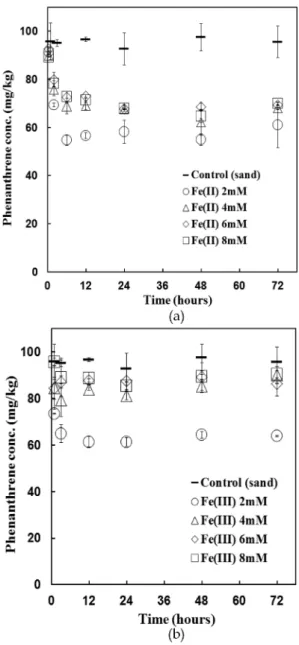
Fenton 반응에서 철의 농도 변화에 따른 phenanthrene 의 분해 경향을 72 시간동안 확인하였으며 이를 Fig. 2 에 나타 내었다 . 과산화수소의 분해경향과 유사하게 반응 시작 후 12

시간까지 phenanthrene 의 제거가 일어났으며 12 시간 이후

phenanthrene 의 제거율은 크게 감소하였다 . 이는 과산화수소 가 분해되어 생성되는 hydroxyl radical 이 phenanthrene 을 산화시킨다는 (Ananthula 등 , 2007) 기존의 연구결과와 일치 한다 . 철의 농도에 따른 phenanthrene 의 분해 효율을 살펴

Fig. 1 Kinetics of H 2 O 2 degradation in various concentrations of (a) Fe(II) and (b) Fe(III). The error bars are ranges of measured hydrogen peroxide concentrations. Some error bars are smaller than the symbols. Initial concentration of H 2 O 2 is 102.897 mM.

Fig. 2 Kinetics of phenanthrene degradation in various

concentration of (a) Fe(II) and (b) Fe(III). Initial

concentration of phenanthrene is 125 mg/kg. Some

error bars are smaller than the symbols. Any reagent

is not added in control test.

(4)

본 결과 Fe(II) Fe(III) 모두 2 mM 에서 가장 높은 분해

효율을 보였으며 , 최종적으로 약 50~60% 가 제거되었다 . 주

입된 철의 농도가 4 mM 이상인 경우 철 주입량이 증가할수

록 phenanthrene 제거율의 변화는 뚜렷이 증가하지 않았다 . 3.2 Modified Fenton 반응에서 SDS 농도 변화에 따른 phenanthrene 분해

SDS 의 농도 변화에 따른 오염물질의 제거효율을 알아보기 위하여 Fe(II) 의 농도를 4 mM 로 고정한 후 SDS 의 농도를 5, 10, 20, 30, 40, 50 mM 로 다양하게 변화하여 실험한 후 그 결과를 Fig. 3 에 나타내었다 . phenanthrene 은 SDS 10 mM 이 하인 경우 40% 의 제거 효율을 가지며 SDS 20 mM 이상 주입하였을 때 80% 이상 제거되는 것으로 나타났다 . SDS 30 mM 인 경우 95% 로 가장 높게 나타났으나 SDS 30 mM

이상인 modified Fenton 반응의 경우 phenanthrene 의 분해 효 율이 SDS 30 mM 에 비하여 감소되는 것으로 나타났다 . 이 는 SDS 30 mM 이상에서 과수안정제인 SDS 가 비선택적인 산화 작용을 하는 hydroxyl radical 의 scavenger 로 작용하여 제거효율을 저해한 것으로 판단된다 .

3.3 Fe(II), Fe(III) SDS 사용한 modified Fenton

반응 3.3.1 Modified Fenton 반응에서 철의 농도변화에 따른

H

2

O

2

의 분해

3.2 의 결과를 통하여 Fe(II) 4 mM 과 SDS 30 mM 이 주 입된 경우 오염물질 분해효율이 최대임을 확인하였다 . 이를

바탕으로 SDS 30 mM 에서 철의 농도변화에 따른 과산화수

소의 분해경향을 분석하였으며 그 결과를 Fig. 4 도시하였

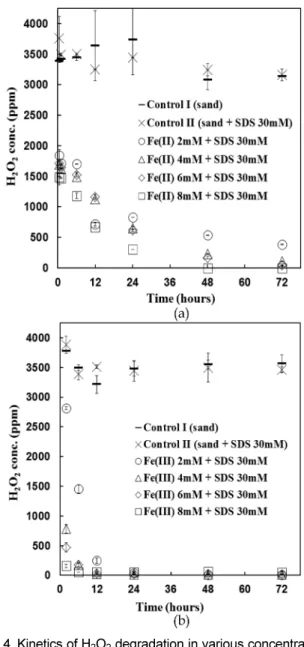
다 . Fe(II) 와 SDS 를 주입한 modified Fenton 반응 시 , 철

의 농도에 따른 정도의 차이는 있지만 , 전체적으로 과산화수 소의 분해가 지연된 것을 확인하였다 . 특히 Fe(II) 2 mM

경우 반응 시작 후 48 시간까지 14.6995 mM 이상의 과산 화수소가 잔류 하는 것을 확인하였으며 이를 통해 SDS 가 과수안정제로서 과산화수소의 안정성을 확보하는데 긍정적인 역할을 하였음을 알 수 있다 . Fe(III) SDS 주입한 modified Fenton 반응의 경우 , SDS 주입에 따른 과산화수 소의 분해 경향에는 큰 차이가 없었으며 모두 반응 시작 후

12 시간 이내에 90% 이상 분해되었다 .

3.3.2 Modified Fenton 반응에서 철의 농도변화에 따른

phenanthrene 의 분해

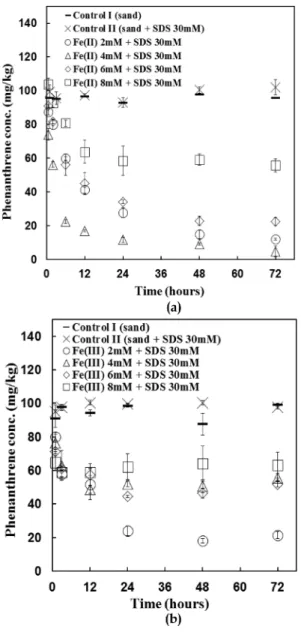
3.3.1 과 실험조건을 동일하게 유지한 뒤 phenanthrene 의 분해를 실험한 후 결과를 Fig. 5 에 나타내었다 . 72 시간동안

phenanthrene 의 분해 경향을 확인한 결과 , Fe(II) 및 Fe(III)

을 사용한 modified Fenton 반응 모두 SDS 를 주입하지 않 은 경우에 비하여 약 30~45% 증가하였다 . Fe(II) 4 mM

및 Fe(III) 2 mM 의 조건에서 각각 약 95%, 80% 의 가장

Fig. 3 Kinetics of phenanthrene degradation in various concentrations of SDS (5~50 mM) and Fe(II) 4 mM.

Initial concentration of phenanthrene is 125 mg/kg.

Some error bars are smaller than the symbols.

Fig. 4 Kinetics of H 2 O 2 degradation in various concentrations

of (a) Fe(II) and (b) Fe(III) and SDS 30 mM. Initial

concentration of H 2 O 2 is 102.897 mM. Some error

bars are smaller than the symbols.

(5)

높은 제거율을 보였으며 전반적으로 Fe(II) 를 사용한 경우가

Fe(III) 를 사용한 경우보다 제거 효율이 높게 나타났다 .

Fe(III) 사용한 Fenton-like 반응 다음 (1)~(3)

응이 지배적으로 일어나며 (Goi 등 , 2008) 일반적인 Fenton

반응에서 생성되는 강력한 산화제인 OH

(oxidation reduction potential, ORP 2.73 eV) 이 생성되기 어렵다 . 반면에 Table 1

에서 보는 바와 같이 산화제인 HO

2

(ORP 0.79 eV) 환원

제인 O

2

(ORP -0.33 eV) 이 주로 발생된다 . 이와 같은 이 유로 Fenton 반응의 산화력이 감소하여 Fe(III) 을 사용한 경

우의 제거 효율이 Fe(II) 를 사용한 경우보다 낮게 나타나게

된다 .

Fe(III) + H

2

O

2

→ Fe(II) + HO

2

+ H

+

(1) HO

2

↔ O

2

+ H

+

(pKa = 4.8) (2) HO

2

+ Fe(III) → Fe(II) + O

2

+ H

+

(3) 4. 결 론

본 연구에서는 철 이온과 음이온 계면활성제인 SDS 를 사

용하여 최적 효율을 갖는 토양 Fenton 정화 공법을 개발하

고자 하였으며 최적의 분해 효율을 찾기 위하여 다양한 조 합을 통한 kinetic test 수행하였다 .

Fe(II) 및 Fe(III) 의 농도를 SDS 의 주입 유무에 따라 각각

2, 4, 6, 8 mM 로 변화시켰다 . SDS 가 첨가되지 않은 Fenton

반응의 경우 Fe(II), Fe(III) 모두 2 mM 에서 가장 높은 분 해 효율을 나타냈으며 SDS 첨가된 경우 Fe(II) 4 mM

서 가장 높은 제거 효율을 보였다 . SDS 농도를 5, 10, 20, 30, 40, 50 mM 로 변화시켜 SDS 의 주입량의 변화에 따른

phenanthrene 분해 효율을 확인한 결과 Fe(II) 4 mM:SDS 30 mM 일 때 95% 의 가장 높은 제거 효율을 보였다 . SDS 30 mM 이상에서는 SDS 가 hydroxyl radical 의 scavenger 로 작용하여 오염물질의 제거 효율을 감소시켰다고 판단하였다 .

본 연구를 통하여 상기 비율의 음이온 계면활성제를 사용 시 과산화수소의 안정제로서 긍정적인 효과를 얻을 수 있음 을 확인하였다 . 이를 바탕으로 SDS 를 과수안정제로 사용 시 저농도의 과산화수소를 사용하여 토양 내 유기오염물질을 효 과적으로 제거할 수 있으며 향후 추가 공정개발을 통하여 실용화에 도움이 될 것으로 기대된다 .

참고문헌

김정환 , 최영무 , 김정환 , 박주양 (2007) Phenanthrene goethite

촉매에 의한 Fenton 산화에 있어서 음이온 / 비이온 및 혼합

계면활성제의 영향 . 대한환경공학회·한국대기환경학회·한국 폐기물학회 공동학술대회 논문집 , 한국폐기물학회 , P025, pp.

2545-2548.

김정환 , 최원호 , 김정환 , 박주양 (2009) Phenanthrene 의 goethite

촉매에 의한 Fenton 산화에 있어서 음이온 / 비이온 계면활성

제의 영향 . 대한토목학회논문집 , 대한토목학회 , 제 29 권 제 2B 호 , pp. 207-212.

박준석 (2006) 펜톤산화 공정을 이용한 난분해성 오염토양의 처리 .

지반환경공학회지 , 한국지반환경공학회 , 제 7 권 제 2 호 , pp. 28- Ananthula, Rajeshwar., Takahiro Yamada, Philip H. Taylor (2007) 33.

Kinetics of oh radical reaction with phenanthrene : New Absoulute Rate Measurements and Comparison with Othe PAHs, Interna- tional Journal of Chemical Kinetics , Vol. 39, pp. 629-637.

Ang, Carolina C. and Abdul S. Abdul (1991) Aqueous Surfactant washing of residual oil contamination from sandy soil. Ground Water Monitoring and Remediation , Vol. 11, Issue 2, pp. 121- 127 .

Bielski, B.H.J. and Allen, A.O. (1977) Mechanism of the dispro- portionation of superoxide radicals. J. Phys. Chem. Vol. 81, Fig. 5 Kinetics of phenantheren degradation in using various

concentrations of (a) Fe(II) and (b) Fe(III) and SDS 30 mM. Initial concentration of phenanthrene is 125 mg/

kg. Some error bars are smaller than the symbols.

Table 1. Comparison of the oxidation-reduction potentials of some inorganic radicals (C. von Sonntag, 2006). HO 2

radical has lower oxidation-reduction potential (+1.48 eV) than OH

(+2.73 eV) and O 2

-(-0.33 eV) has negative oxidation-reduction potential

Couple Oxidation-Reduction Potential, eV

OH

, H + /H 2 O +2.73

OH

, OH +1.90

HO 2

, H + /H 2 O 2 (pH 0) +1.48

HO 2 /HO 2 +0.79

O 2 /O 2 − -0.33

(6)

No. 11, pp. 1048-1050.

Barbeni, M., Minero, C., and Pelizzetti, E. (1987) Chemical degra- dation of chlorophenols with Fenton's reagent (Fe 2+ + H 2 O 2 ).

Chemosphere , Vol. 16, pp. 22-25.

Beak, S.O., Field, R.A., Goldstone, M.E., Kirk, P.W., Lester, J.N., and Perry, R. (1991) A review of atmospheric polycyclic aro- matic hydrocarbons; Source, fate and behavior. Water, Air &

Soil Pollution , Vol. 60, No. 3-4, pp. 279-300.

Berardescok, G., Dyhman, S., Gallagher, E., and Shiaris, M.P.

(1998) Spatial and temporal variation of phenanthrene degrad- ing bacteria in intertidal sediments. Appl. Environ. Microbial , Vol. 64, No. 7, pp. 2560-2565.

Blumer, M., Blumer, W., and Reich, T. (1997) Polycyclic aromatic hydorcarbons in soil of a mountain valley: correlation with highway traffic and cancer incidence. Environ. Sci. Technol. , Vol. 11, No. 12, pp. 1082-1084.

C. von Sonntag (2006) Free-radical-induced DNA damage and its repair: A Chemical Perspective. Springer , Berlin, pp. 357-481.

Goi., A., Veressinina, Y., and Trapido, M. (2008) Degradation of salicylic acid by Fenton and modified Fenton treatment. Chem- ical Engineering Journal , Vol. 143, Issues 1-3, pp. 1-9.

Eisenberg, G.M. (1943) Colorimetric determination of hydrogen peroxide, Industrial and Engineering Chemistry , Vol. 15, No.

5, pp. 327-328.

Johnsen, Anders, R., Lukas, Y. Wick and Hauke Harms (2005) Principles of microbial PAH-degradation in soil. Envrionmen- tal Pollution , Vol. 133, pp. 71-84.

Kiwi, J., Lopez, A., and Nadtochenko, V. (2000) Mechanism and Kinetics of the OH- radical intervention during Fenton Oxida- tionin the Presence of a Significant Amount of Radical Scaven- ger (Cl-). Envrion. Sci. Technol. , Vol. 34, No. 11, pp. 2162- 2168.

Laflamme, R.E. and Hites, R.A. (1978) The global distribution of polycyclic aromatic hydrocarbons in recent sediments, Geochim- ica et Cosmochimica Acta. , Vol. 42, Issue 3, pp. 289-303.

Lauren, L., Bissey, Jeffrey, L., Smith and Richard, J. Watts (2006) Soil organic matter-hydrogen peroxide dynamics in the treat- ment of contraminated soils and groundwater using catalyzed H 2 O 2 propagation (modified Fenton's reagent). Water Research . Vol. 40, Issue 13, pp. 2477-2484.

Lin, Sheng H., Chi, M. Lin, and Horng, G. Leu (1999) Operating characteristics and kinetic studies of surfactant wastewater treatment by Fenton oxidation. Wat. Res. , Vol. 33, No. 7, pp.

1735-1741.

Lin, J.-M., Nakagawa, M., Uchiyama, M., and Hobo, T. (1999) Determination of Critical Micelle Concentration of SDS in For- mamide by Capillary Electrophoresis. Chromatographia , Vol.

50, No. 11/12, pp. 739-744.

Martens, Dean A. and William T. Frankenberger, Jr (1995) Enhanced degradation of polycyclic aromatic hydrocarbons in soil treat- ment with an advanced oxidative process - Fenton's reagent,

Journal of Soil Contamination , Vol. 4, No. 2, pp. 175-190.

Morillo, E., Romero, A.S., Maqueda, C., Madrid, L., Ajmone-Mar- san, F., Grcman, H., Davidson, C.M., Hursthouse, A.S., and Villaverde, J. (2007) Soil Pollution by PAHs in urban soils : a comparison of three European cities. J. Environ. Monit. , Vol. 9, pp. 1001-1008.

Murphy, A.P., Boegli, W.J., Price, M.K., and Moody, C.D. (1989) A Fenton-like reaction to neutralize formaldehyde waste solu- tions. Environ. Sci. Technol. , Vol. 23, No. 2, pp. 166-169.

Rickabaugh, J., Clement, S., Martin, J., Sunderhaus, M., Lewis, R.F. (1986) Chemical and microbial stabilization techniques for remedial action sites. proceedings of the Twelfth annual reaserch symposium, EPA/600/9-85/022, pp. 193.

Sedlack, D.L. and Andren, A.W. (1991) Aqueous-Phase oxidation of polychlorinated biphenyls by hydroxil radicals. Environ. Sci.

Technol. , Vol. 25, pp. 1419-1427.

Stull, Daniel R. (1947) Vapor pressure of pure substnaces organic compounds. Industrial and Engineering chemistry , Vol. 39, No.

4, pp. 517-540.

Tyre, B.W., Watts, R.J., and Miller, G.C., (1991) Treatment of four biorefractory contaminates in soils using catalyzed hydrogen peroxide, J. Environ. Qual. , 20, pp. 832-838.

Watts, R.J., Udell, M.D., Rauch, P.A., and Leung, S.W. (1990) Treatment of pentachlorophenol-contaminated soils using Fen- ton's reagent. Hazardous Waste and Hazardous Materials , Vol.

7, No. 4, pp. 335-345.

Watts, R.J., Dennis, D. Finn, Lynn, M. Cutler, Jeremy, T. Schmidt, and Amy, L. Teel. (2007) Enhanced stability of hydrogen per- oxide in the presence of subsurface solids. Journal of Contam- inant Hydrology , Vol. 91, Issues 3-4, pp. 312-326.

Wilcke, Wolfgang (2000) Polycyclic Aromatic Hydrocarbons (PAHs) in Soils - A Review. J. Plant Nutr. Soil Sci. , Vol. 163, pp. 229- Chu, W. (2003) Remediation of contaminated soils by surfactant- 248.

aided soil washing. Pract. Periodical of Haz., Toxic, and Radio- active Waste Mgmt. , Vol. 7, Issue 1. pp. 19-24.

Yeom, Ick tae, Mriganka M. Ghosh and Chris D. Cox (1996) Kinet- ics Aspects of Surfactant Solubilization of Soil-Bound Polycy- clic Aromatic Hydrocarbons. Environ. Sci. Technol. , Vol. 30, No. 5, pp. 1589-1595.

Yunfu Sun and Joseph J. Pignatello. (1993) Activation of Hydron- gen Peroxide by Iron(III) chelates for Abiotic Degradation of Herbicides and Insecticides in Water. J. Agric. Food Chem. , 41, pp. 308-312.

Zhao, Baowei, Lizhong Zhu, Wei Li and Baoliang Chen (2005) Solubilization and biodegradation of phenanthrene in mixed anionic-nonionic surfactant solution. Chemosphere , Vol. 58, pp.

33-40.

( 접수일 : 2011.1.13/ 심사일 : 2011.3.21/ 심사완료일 : 2011.6.23)

수치

Fig. 1 Kinetics of H 2 O 2  degradation in various concentrations of (a) Fe(II) and (b) Fe(III)
Fig. 3 Kinetics of phenanthrene degradation in various concentrations of SDS (5~50 mM) and Fe(II) 4 mM.
Table 1. Comparison of the oxidation-reduction potentials of some inorganic radicals (C

참조

관련 문서

This study takes about 2-3 days to analyze, which is much shorter than the existing fuming nitric acid method, so it is easy to analyze a large amount of samples and will be

4-8 Evaluation of rail corrugation for artificial specimen A (30 mm wavelength); (a) LVDT signal, (b) FFT analysis, (c) STFT analysis and (d) digitizing result

The purpose of this study is to examine the service quality of a tennis court which is one of public sport facilities and analyze a difference in

The purpose of this study is to analyze the relationship between dance performances, which is a part of social contribution activities of local governments,

In this study, hydrogen peroxide(H 2 O 2 ) was used for producing low molecular weight sodium alginates(LMWSAs) under e-beam irradiation or controlled

After first field tests, we expect electric passenger drones or eVTOL aircraft (short for electric vertical take-off and landing) to start providing commercial mobility

1 John Owen, Justification by Faith Alone, in The Works of John Owen, ed. John Bolt, trans. Scott Clark, "Do This and Live: Christ's Active Obedience as the

The initial rate of the hydrolysis reaction is much larger than the sum of the rates of the condensation reactions so that [SiOH] equals the consumption of H 2 O by hydrolysis.