Kor J Fish Aquat Sci 46(4),359-364,2013 한수지 46(4), 359-364, 2013
Original Article
359 서 론
현대사회의발전은인류에게풍요로움이라는혜택을안겨주 었지만일상생활에서경험하는다양한사건이스트레스요인으 로작용하며, 이러한상황에적응하기위해더많은스트레스를 받게된다. 과도한스트레스는인간에게장∙단기적장애를유발 하며이러한장애중하나가수면장애의형태로나타날수있다. 인간수명에있어서 1/3은수면을취하는시간으로건강유지 및정신적안정에있어수면의중요성은매우높다. 이와더불 어정상적수면자가비정상적수면자에비해사소한생활사건 의빈도가낮고(Weller et al., 1993), 스트레스가적은기간에는 수면량이증가하고스트레스가많은기간에는수면량이감소하 는경향을보인다는연구결과도있다(Hick and Garcia, 1987).
미국의정신질환분류편람인 Diagnostic and Statistical Manual
of Mental Disorders, 4th edition (DSM-IV) 에서는 “대부분의 불면증은심리, 사회및의학적스트레스를받을때급성으로생 긴다”라고설명하고있으며, 실제불면증환자들중 78%가스 트레스가불면증을유발하였다고보고하고있다(Bastien et al.,
2004). 이처럼정상적인수면을유지하는것은인간을포함한
고등동물들에서성장과발달, 정서적인건강, 그리고면연력유 지등의기본적인기능을유지하는데필수적이다.
수면장애, 즉불면증의치료를위해서는의학계에서는단기적 불면증환자의경우벤조디아핀제, 비벤조디아핀제와같은약 물치료를사용하고있다(Szabadi, 2006). 이들약물의약리학적 기능은벤조디아핀제의경우이온채널을통해억제성염소이온 의흐름을증가시키는 gamma-amino butyric acid (GABA)의 기능을증진시킨다(McKernan and Whiting, 1996; Gallopin et
al., 2004). 벤조디이아제핀은총수면시간과수면의연속성을
Article history;
Received 12 June 2013; Revised 19 June 2013; Accepted 27 June 2013
*Corresponding author: Tel: +82. 51. 772. 5453 Fax: +82. 55.772. 0020 E-mail address: [email protected]
Kor J Fish Aquat Sci 46(4) 359-364, August 2013 http://dx.doi.org/10.5657/KFAS.2013.0359 pISSN:0374-8111, eISSN:2287-8815
ⓒ The Korean Society of Fishereis and Aquatic Science. All rights reserved
Lactobacillus brevis BJ20를 이용한 굴(Crassostrea gigas)ㆍ다시마 (Saccharina japonica) 발효 분말의 항산화 및 항염증 활성 효과
Inordinate stress causes disorders of various systems in humans and activates defense mechanisms to maintain ho- meostasis in the body. Sleep is a vital, highly organized process regulated by complex systems of neuronal net- works and neurotransmitters. Sleep is an essential biological process whose underlying regulating involves numerous anatomical structures and biochemical substances that can be compromised by stress and by the immune system.
Gamma-amino butyric acid (GABA) is the main inhibitory neurotransmitter of the central nervous system, and activation of GABAA receptors is known to favor sleep. This study was conducted to evaluate the possible applica- tion of Lactobacillus brevis BJ20 fermentation to improve the functional qualities of sea tangle Saccharina japonica and oyster Crassostrea gigas. Antioxidant activity was determined by assaying levels of radical scavenging activity against 1,1-diphenyl-2-picrylhydrazyl (DPPH) and superoxide. L. brevis BJ20 fermentation of sea tangle and oyster enhanced both antioxidant and antiinflammatory activities. These results suggested that L. brevis BJ20 fermented sea tangle and oyster could be used for alleviation of stress and to promote sleep.
Key words: Fermentation, Sea Tangle, Oyster, Gamma-amino butyric acid (GABA), Antioxidant (주) 마린바이오프로세스
Young Mi Kang, Nam-Sik Woo and Yong Bae Seo*
강영미ㆍ우남식ㆍ서용배*
Effects of Lactobacillus brevis BJ20 Fermentation on the Antioxidant and Antiinflammatory Activities of Sea Tangle Saccharina japonica and
oyster Crassostrea gigas
Marine Bioprocess Co. LTD., Busan 619-912, Korea
강영미ㆍ우남식ㆍ서용배 360
증진시키지만, 낮동안의졸림이나전향적기억상실증을유발 하고심각한신체적의존과남용의가능성이있는것으로보고 되고있다(Bressler and Bahl, 2003; Zhdanova, 2004; Krueger,
1999). 비벤조디아제핀계수면제중가장잘알려져있는졸피
뎀은수면잠복기를줄이며총수면시간을늘려수면중깨는것 을감소시키는것으로알려져있다. 하지만이들을복용한직후 후향적기억상실이관찰되기도하며, 이는 α1 GABAA수용체 에결합하면서생기는약리학적결과로생각된다(Roehrs et al., 1994; Sherin et al., 1998).
이처럼스트레스로인한신체적이상중하나로나타나는수 면장애에대한치료를위한접근으로약물치료를시행하고있 으나, 이는다양한부작용과신체적적응에따른약물오남용 을야기시킬수있다. 이러한이유로미국등의선진국에서는 수면 촉진물질로는 알려져 있는 아데노신(Adenosine), 아세 틸콜린(acetyl choline), 세로토닌(serotonin, 5-hydroxytrypta- mine), 멜라토닌(melatonin, N-acetyl-5-methoxy-tryptamine),
GABA 등을중심으로천연의수면유도보조제를개발하고자
하는연구를꾸준히수행 중이다. 수면유도와관련된호르몬 이며송과선(pineal gland)에서 분비되는 멜라토닌과 세로토 닌은신경전달물질로서작용하는물질이다. 멜라토닌의경우 망막으로부터의전달되는빛에의해멜라토닌합성효소(NAT) 의활성이저해되므로암기에높고명기에낮은변동을보인 다(Lee et al., 2001). 세로토닌또한신경전달물질로서멜라토 닌과같이트립토판을원료의측면에서연구가많이진행되고 있는물질이다(Leventhal et al., 2003; Oh and Oh, 2003; Oh and Oh, 2004). 멜라토닌, 세로토닌과유사한신경전달물질로
서 GABA는발견초기에는식물과미생물대사산물로알려졌
었지만그후, GABA가포유류의중추신경계에필수구성요소
로알려지면서활발한연구가진행되기시작한물질중하나이 다(Kang and Oh, 2007). GABA의기능으로는뇌조직에주로 존재하는 GABA-receptor가리간드로작용하는 GABA와결 합하여억제성신경전달물질로서작용하며, GABA 양이증가 되면정서적안정과항정신불안증, 항경련효과와혈압상승억 제효과가있음이알려져있다 (Mody et al., 1994; Abe et al.,
1995). 반대로부족할경우에는뇌조직의기능적장애로돌발
적인의식상실, 경련등의감각장애를일으키는간질을유발시 킨다고알려져있다(Kang and Oh, 2007).
굴은 GABA의전구물질인글루탐산(glutamic acid)을다량 (4.8%/dry base; w/w)함유하고, 국내외적으로항산화활성, 간 기능개선및심혈관계효능물질로써보고되어온천연아미노 산인타우린(taurine)을다량(4.2% / dry base; w/w 기준) 함유 하고있다. 그리고, 다시마는 GABA의전구물질인글루탐산 (glutamic acid)을고농도(5% / dry base 기준)함유하고, 국내 외적으로심혈관계효능물질로써보고되어온기능성해조다 당류인후코이단(fucoidan, 함황당)을함유한안정성이확보된 원료물질이다.
본연구에서는현대인들의대다수가한번씩경험했을스트레 스로인한수면장애에대한치료보조제적수단으로해양생물
인굴과다시마의발효로통해생산된 GABA가수면유도호르
몬에도영향을줄것이라는것에주목하여스트레스로인한긴 장완화와수면유도증진에대한기능성에대해연구함으로써
굴∙다시마발효추출물에함유된 GABA를스트레스로인한
긴장완화및수면유도기능성식품소재로서활용하기위한탐 색과기초자료를확보하고자한다.
재료 및 방법 재 료
다시마는 2012년 10월에부산광역시소재서진기장영어조합
법인에서구입하여사용하였고, 굴은 2012년 11월에경상남도 통영산굴을구입하여사용하였다. Lactobacillus brevis BJ20 은 Marinebioprocess Co., Ltd (Busan, Korea)에서분리동정 한것을사용하였다.
마우스대식세포(RAW 264.7)는 ATCC (No. TIb-71, USA) 에서분양받았고, Penicilline/Streptomycine, fetal bovine se- rum 및 DMEM은 Invitrogen (GIBCOBRL, USA)에서구입 하였으며 각실험에필요한 3-(4,5-dimethylthiozol-2-ly)-2,5- diphebyltetrazolium bromide, Lipopolysaccharide (LPS), sulfanilamide, N-(1-naphthyl)-ethylene-diamine dihydrochlo- ride, H3PO4는 Sigma-Aldrich Co. (St. Louis, USA)에서구입 하여사용하였다. 기타다른모든시약은 analytical grade를사 용하였다.
굴 및 다시마 추출액의 제조
다시마추출물은수세, 탈염, 분쇄공정을거쳐적당한크기로 분쇄한다음여기에 16배의물(w/v)을첨가하고, 80℃에서 30 분간열수추출한다음 20 mesh 망으로걸러제조하였다.
굴추출물은상업용가수분해효소(Alcalase)로 40ºC, 1시간 동안효소분해한이후 60ºC, 1시간동안효소를실활시킨이후 원심분리하여제조하였다.
굴∙다시마 발효분말 의 제조
굴∙다시마발효분말(fermented sea tangle and oyster pow- der, FSO)은다시마추출액 45% (w/v), 굴추출액 45% (w/v), yeast extracts 4 % (w/v), glucose 4% (w/v)를각각혼합하고, 멸균 (121℃에서 30분) 및균주(2% L. brevis BJ20) 접종을실 시한다음발효 (37℃에서 24시간) 및재멸균(121℃에서 30분) 하고건조하여제조하였다. 제조된발효분말을이용하여항산 화및항염증활성평가용시료로사용하였다.
DPPH 라디칼 소거 활성
FSO의 DPPH (1,1-diphenyl-2-picrylhydrazyl) 라디칼에대
굴 및 다시마 유산균 발효 분말의 항산화 및 항염증 활성 361
한소거활성은 Nanjo et al. (1996)의방법에따라측정하였다. 시료 30 μL에 60 μM DPPH (1,1-diphenyl-2-picrylhydrazyl) 용액 30 μL를혼합후반응액을 100 μL quartz capillary tube 에옮겨 2분후 electron spin resonance (ESR) spectrometer (JES-FA, JEOL Ltd, Tokyo, Japan)로측정하였다. 실험조건 은 magnetic field, 336.5±5 mT; power, 5 mW; modulation frequency, 9.41 GHz; amplitude, 1×1,000; sweep time, 30 s;
temperature, 298 K. 이었다. DPPH radical 소거능은 H와 H0 의상대적인 radical signal peak 높이의차이에의하여계산하 였다.
Radical scavenging activity (%) = (1 - H/H0) × 100 Superoxide dismutase (SOD) activity
FSO의 superoxide radical은 Zhao et al. (2006)에따라시료 10 μL에 0.3 mM riboflavin 10 μL, 1.6 mM EDTA 10 μL, 800 mM DMPO 10 μL를첨가한후 365 nm의 UV lamp에서 1 분동안조사하였다. 반응물을 quartz capillary tube에옮긴후 ESR spectrometer를 이용하여 분석하였으며 실험조건은 다 음과같다. 즉, magnetic field, 336.5±5 mT; power, 10 mW;
modulation frequency, 9.41 GHz; amplitude, 1×1,000; sweep time, 30 s; temperature, 298 K. superoxide radical 소거능은 H 와 H0의상대적인 radical signal peak를이용하는수식에의해 계산하였다.
Radical scavenging activity (%) = (1 - H/H0) × 100 세포배양
마우스대식세포를 pencillin (100 units/mL)/ streptomycin (100 μg/mL) solution과 10% fetal bovine serum이 포함된 DMEM 배지를사용하여 5% CO2, 37℃ incubator (Forma se- ries II, Thermo, USA)에서배양하여사용하였다.
MTT assay
24 well plate에마우스대식세포주 5×10⁵개를분주하고, 4시 간뒤에새로운배지로교체한후일정농도(2.5, 5.0, 10.0, mg/
mL)의시료를 24시간동안처리하였다. 3-(4,5-dimethylthio- zol-2-ly)-2,5-diphebyltetrazolium bromide (0.1 mg/mL)를각 well에처리하여 4시간동안배양한후형성된 insoluble forma- zan을 DMSO에녹이고 ELISA reader (Wallac 1420, BMS, USA)를통해 540 nm에서흡광도를측정하였다
Viability (%) = (반응군의흡광도/대조군의흡광도) × 100 Cell base NO assay
24 well plate에마우스대식세포주 5×10⁵개를분주하고, 4시 간뒤에새로운배지로교체한후일정농도 (2.5, 5.0, 10.0, mg/
mL)의시료를 1시간동안전치리한다음 LPS를 1 μg/mL로 16
시간동안처리하였다. 이어서세포배양상층액 100 μL를 96 well에분취하고, Griess 용액(1% sulfanilamide/0.1% N-(1- naphthyl)-ethylenediamine dihydrochloride/2.5% H3PO4) 100 μL를첨가한다음 5분간반응후 ELISA reader (Wallac 1420, BMS, USA)를통해 540 nm에서흡광도를측정하였다.
Inhibition (%) = 1-[(반응군의흡광도-색보정군의흡광도)/대 조군의흡광도]×100
결과 및 고찰 굴 다시마 발효분말(FSO)의 제조
스트레스에인한긴장완화와수면증진에효과가있는 FSO Table 1. Change in GABA and glutamate concentration in fer- mented sea tangle Saccharina japonica and oyster Crassostrea gi- gas with Lactobacillus brevis BJ20
Oyster:
tangleSea
Before
fermentation After
fermentation After fermentation Glutamate
(g) Glutamate
(%) Glutamate
(g) Glutamate
(%) GABA
(g) GABA (%)
1:9 10.22 9.3 3.88 3.5 3.80 3.4
2:8 10.71 9.1 4.01 3.4 4.02 3.4
3:7 11.66 9.2 4.32 3.4 4.40 3.5
4:6 12.63 9.1 4.27 3.1 5.01 3.6
5:5 13.89 9.0 4.39 2.9 5.70 3.7
6:4 15.91 9.0 6.33 3.6 5.75 3.3
7:3 19.000 9.0 9.64 4.6 5.61 2.7
8:2 24.20 9.0 16.20 6.0 4.80 1.8
9:1 35.74 9.0 27.00 6.9 5.24 1.3
Before fermentation, Glutamate (g) After fermentation, Glutamate (g) After fermentation, GABA (g) Before fermentation, Glutamate (%) After fermentation, Glutamate (%) After fermentation, GABA (%)
GABA content (%)
10 9 8 7 6 5 4 3 2 1 0
Dry weight (g/g)
40 35 30 25 20 15 10 5
0 1:9 2:8 3:7 4:5 5:5 6:4 7:3 8:2 9:1
Content ratio of oysters and sea tangle
100
80
60
40
20
0
50 μg/mL 100 μg/mL
Concentration (μg/mL)
Superoxide scavenging activity (%)
BHAFSO
100
80
60
40
20
0
50 μg/mL 100 μg/mL
Concentration (μg/mL)
Inhibition (%)
BHA FSO 100
80
60
40
20
0
50 μg/mL 100 μg/mL
Concentration (μg/mL)
Scavenging activity (%)
BHAFSO 100
80 60 40 20
0 50 μg/mL 100 μg/mL
Concentration (μg/mL)
Electronic donating activity (%)
BHAFSO
160
120
80
40
0
12.5 μg/mL 25 μg/mL 50 μg/mL 100 μg/mL
Concentration (μg/mL)
Vliability (%)
Kojic acid FSO
100 80 60 40 20
0
50 μg/mL 100 μg/mL
Concentration (μg/mL)
Inhibition (%)
Kojic acid FSO
A
B
Fig. 1. Gamma-amino butyric acid (GABA) content and residual glutamate in accordance with the composition ratio sea tangle Saccharina japonica and oyster Crassostrea gigas.
강영미ㆍ우남식ㆍ서용배 362
의제조를위해서굴과다시마추출물을각각다른농도를넣어 유산균발효시최대 GABA 생산량을비교분석하였고, 그결 과는 Fig. 1과 Table 1에나타내었다. 굴과다시마추출액의농 도는각각 1:9 비율에서 9:1 비율까지배지조성성분에함유시 켰으며그결과굴과다시마의함량이 5:5인비율에서잔존글 루탐산함량 2.9%이며 GABA 생산량은 3.7%로확인되어굴과 다시마추출액의최적함량비는 1:1로판단되었다.
굴∙다시마 발효분말(FSO)의 항산화 활성 분석
상업적으로시판되고있는항산화제인 BHA (butylated hy- droxyanisole)과 FSO을대상으로 ESR spectrometer를이용하 여 DPPH radical scavenging activity를실험한결과는 Fig. 2와 같다. Positive control인 BHA (butylated hydroxyanisole)의경 우 50 μg/mL와 100 μg/mL의농도에서각각 48.7%, 86.5%의 활성을나타내었고, FSO의경우에는각각 89.7%, 91%로확 인되었다. 상용화된항산화제인 BHA와 FSO의 DPPH radical 소거능비교시적은농도에서 FSO의 DPPH radical 소거능이
월등이뛰어난것으로분석되며 FSO만의농도에따른 DPPH
radical 소거능의비교시 50 μg/mL와 100 μg/mL의농도차이 에따른소거능은큰변화가없었다. 따라서, FSO는 50 μg/mL 농도에서 DPPH radical 소거능이가장우수한것으로판단되 며, 상용화된 BHA 보다소거능이아주우수하다고판단된다. 이러한결과는, 미생물에의한발효로항산화활성을가지는것 으로알려진페놀화합물이증가하기때문(Song et al., 2011)인 것으로판단된다. 이는다시마추출액을대상으로한 Eom et al.
(2010)의연구와 Bae and Kim (2010)의연구에서유산균, 곰 팡이, 효모발효에의해 DPPH radical 소거활성이증가한다는 연구결과와도같은경향을나타내고있다.
세포들은대사과정, 외부환경에의한스트레스등에의해세
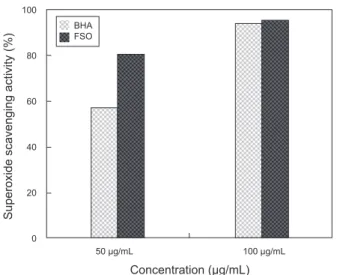
포내에서활성산소는끊임없이생성된다. 이러한활성산소는 핵산과단백질등의생체고분자물질과반응하여세포이상을 유발시키는물질중에하나이다. 또한활성산소와지질이반응 하면과산화지질이생성되어 세포벽이상을야기시키며사 람등의고등동물에게는혈관벽이나세포막의구조가파괴되 어조직이손상된다고알려져있다 (Masaki et al., 1995). 이러 한활성산소에대한보호효과를측정하기위해서 FSO의활성 산소제거능을측정하였고, 그결과는 Fig. 3에나타내었다. 활 성산소제거능은 positive control인 BHA의경우 50 μg/mL와 100 μg/mL의농도에서각각 56.4%, 83.5%이었고, FSO의경 우각각 80.2%, 93.4%로확인되었다. BHA와 FSO의활성산소 제거능의비교시 FSO가 superoxide radical 소거능이뛰어난 것으로분석되며 FSO만의농도에따른 SDO 활성은농도차이 에따른변화가없었다. 따라서 SOD radical scavenging 효과 는 DPPH radical 소거능과같이 FSO 50 μg/mL에서가장높은 활성을가지는것으로판단된다.
Xanthine oxidase는퓨린염기의대사과정에있어서매우중 요한효소로서 hypoxanthine을 xanthine으로산화시키고나아 가 xanthine을 uric acid로최종산화시킨다. 이러한일련의반 응과정중에인체에유해한과산화수소를생성하며과산화수 소는또다시 superoxide radical과같은활성산소종으로변화 하기때문에 xanthine oxidase의저해활성은항산화활성을측 정하는또다른지표이기도하다. GABA 생성 FSO의항산화능 을 xanthine oxidase inhibitory assay로검토한결과는 Fig. 4와 같다. Xanthine oxidase inhibitory assay로살펴본결과항산화 능은 GABA 생성 FSO가 88.1%, 다시마추출액은 89% (Lee et al., 2010)이며, 상업적항산화제로많이이용되고있는대조군 Fig. 2. Effect of Lactobacillus brevis BJ20 fermentation on DPPH
radical scavenging activity of fermented sea tangle Saccharina japonica and oyster Crassostrea gigas (FSO). ▒, BHA (butylated hydroxyanisole); ▩, FSO.
Before fermentation, Glutamate (g) After fermentation, Glutamate (g) After fermentation, GABA (g) Before fermentation, Glutamate (%) After fermentation, Glutamate (%) After fermentation, GABA (%)
GABA content (%)
10 9 8 7 6 5 4 3 2 1 0
Dry weight (g/g)
40 35 30 25 20 15 10 5
0 1:9 2:8 3:7 4:5 5:5 6:4 7:3 8:2 9:1
Content ratio of oysters and sea tangle
100
80
60
40
20
0
50 μg/mL 100 μg/mL
Concentration (μg/mL)
Superoxide scavenging activity (%)
BHAFSO
100
80
60
40
20
0
50 μg/mL 100 μg/mL
Concentration (μg/mL)
Inhibition (%)
BHA FSO 100
80
60
40
20
0
50 μg/mL 100 μg/mL
Concentration (μg/mL)
Scavenging activity (%)
BHAFSO 100
80 60 40 20
0 50 μg/mL 100 μg/mL
Concentration (μg/mL)
Electronic donating activity (%)
BHAFSO
160
120
80
40
0
12.5 μg/mL 25 μg/mL 50 μg/mL 100 μg/mL
Concentration (μg/mL)
Vliability (%)
Kojic acid FSO
100 80 60 40 20
0
50 μg/mL 100 μg/mL
Concentration (μg/mL)
Inhibition (%)
Kojic acid FSO
A
B
Before fermentation, Glutamate (g) After fermentation, Glutamate (g) After fermentation, GABA (g) Before fermentation, Glutamate (%) After fermentation, Glutamate (%) After fermentation, GABA (%)
GABA content (%)
10 9 8 7 6 5 4 3 2 1 0
Dry weight (g/g)
40 35 30 25 20 15 10 5
0 1:9 2:8 3:7 4:5 5:5 6:4 7:3 8:2 9:1
Content ratio of oysters and sea tangle
100
80
60
40
20
0
50 μg/mL 100 μg/mL
Concentration (μg/mL)
Superoxide scavenging activity (%)
BHAFSO
100
80
60
40
20
0
50 μg/mL 100 μg/mL
Concentration (μg/mL)
Inhibition (%)
BHA FSO 100
80
60
40
20
0
50 μg/mL 100 μg/mL
Concentration (μg/mL)
Scavenging activity (%)
BHAFSO 100
80 60 40 20
0 50 μg/mL 100 μg/mL
Concentration (μg/mL)
Electronic donating activity (%)
BHAFSO
160
120
80
40
0
12.5 μg/mL 25 μg/mL 50 μg/mL 100 μg/mL
Concentration (μg/mL)
Vliability (%)
Kojic acid FSO
100 80 60 40 20
0
50 μg/mL 100 μg/mL
Concentration (μg/mL)
Inhibition (%)
Kojic acid FSO
A
B
Fig. 3. Effect of Lactobacillus brevis BJ20 fermentation on super- oxide radical scavenging activity of fermented sea tangle Saccha- rina japonica and oyster Crassostrea gigas (FSO). ▒, BHA (butyl- ated hydroxyanisole); ▩, FSO.
굴 및 다시마 유산균 발효 분말의 항산화 및 항염증 활성 363
인 BHA의 71.3%에비하여약 17%가높아, xanthine oxidase inhibitory가아주우수하다고판단된다.
Nitric oxide는체내에서중요한 signal molecules로알려져 있으며일반적으로외부의염증반응에의한면역반응중에 in- ducible nitric oxide synthase (iNOS)의발현에의하여생성된 다. 또한과량의 nitric oxide가발생할시혈관을손상시키는것 으로알려져있으며 superoxide radical과반응하여더욱독성 이강한 peroxynitrite로생성되어체내조직을손상시키는것 으로알려져있다. FSO의항산화능을 nitric oxide scavenging assay로검토한결과는 Fig. 5와같다. GABA 생성 FSO의항
산화능을 nitric oxide scavenging assay로살펴본결과항산화 능은 GABA 생성유산균첨가다시마∙굴발효물이 36.1%로상 업적항산화제로많이이용되고있는대조군인 BHA의 63.9%
에비하여낮아, nitric oxide 소거능은기존항산화제에비하여 낮다고판단된다.
세포독성 및 항염증 활성
FSO의세포독성에대해조사하기위하여 MTT assay 시행하 였고, 이에대한결과는 Fig. 6A에나타내었다. Positive control 인 kojic acid의경우 12.5 μg/mL, 25 μg/mL, 50 μg/mL과 100 μg/mL에서세포생존률은각농도에따른약 102.3%로나타 났으며, FSO의경우도세포생존율에서있어 kojic acid와큰 차이점을보이지않았다. FSO 농도에따른세포생존율은 12.5 μg/mL일때 115.4%, 25 μg/mL의경우 105.1%, 50 μg/mL의 경우 105% 및 100 μg/mL의경우 104.2%로농도에관계없이
거의일정한세포생존율을보였다. FSO의마우스대식세포에
대하여세포독성이없는것으로나타났으며오히려세포의증 식을촉진하였다.
Before fermentation, Glutamate (g) After fermentation, Glutamate (g) After fermentation, GABA (g) Before fermentation, Glutamate (%) After fermentation, Glutamate (%) After fermentation, GABA (%)
GABA content (%)
10 9 8 7 6 5 4 3 2 1 0
Dry weight (g/g)
40 35 30 25 20 15 10 5
0 1:9 2:8 3:7 4:5 5:5 6:4 7:3 8:2 9:1
Content ratio of oysters and sea tangle
100
80
60
40
20
0
50 μg/mL 100 μg/mL
Concentration (μg/mL)
Superoxide scavenging activity (%)
BHAFSO
100
80
60
40
20
0
50 μg/mL 100 μg/mL
Concentration (μg/mL)
Inhibition (%)
BHA FSO 100
80
60
40
20
0
50 μg/mL 100 μg/mL
Concentration (μg/mL)
Scavenging activity (%)
BHAFSO 100
80 60 40 20
0 50 μg/mL 100 μg/mL
Concentration (μg/mL)
Electronic donating activity (%)
BHAFSO
160
120
80
40
0
12.5 μg/mL 25 μg/mL 50 μg/mL 100 μg/mL
Concentration (μg/mL)
Vliability (%)
Kojic acid FSO
100 80 60 40 20
0
50 μg/mL 100 μg/mL
Concentration (μg/mL)
Inhibition (%)
Kojic acid FSO
A
B
Fig. 4. Effect of Lactobacillus brevis BJ20 fermentation on xan- thine oxidase inhibitory assay of fermented sea tangle Saccharina japonica and oyster Crassostrea gigas (FSO). ▒, BHA (butylated hydroxyanisole); ▩, FSO.
Before fermentation, Glutamate (g) After fermentation, Glutamate (g) After fermentation, GABA (g) Before fermentation, Glutamate (%) After fermentation, Glutamate (%) After fermentation, GABA (%)
GABA content (%)
10 9 8 7 6 5 4 3 2 1 0
Dry weight (g/g)
40 35 30 25 20 15 10 5
0 1:9 2:8 3:7 4:5 5:5 6:4 7:3 8:2 9:1
Content ratio of oysters and sea tangle
100
80
60
40
20
0
50 μg/mL 100 μg/mL
Concentration (μg/mL)
Superoxide scavenging activity (%)
BHAFSO
100
80
60
40
20
0
50 μg/mL 100 μg/mL
Concentration (μg/mL)
Inhibition (%)
BHA FSO 100
80
60
40
20
0
50 μg/mL 100 μg/mL
Concentration (μg/mL)
Scavenging activity (%)
BHAFSO 100
80 60 40 20
0 50 μg/mL 100 μg/mL
Concentration (μg/mL)
Electronic donating activity (%)
BHAFSO
160
120
80
40
0
12.5 μg/mL 25 μg/mL 50 μg/mL 100 μg/mL
Concentration (μg/mL)
Vliability (%)
Kojic acid FSO
100 80 60 40 20
0
50 μg/mL 100 μg/mL
Concentration (μg/mL)
Inhibition (%)
Kojic acid FSO
A
B
Fig. 5. Effect of Lactobacillus brevis BJ20 fermentation on ni- tric oxide scavenging assay of fermented sea tangle Saccharina japonica and oyster Crassostrea gigas (FSO). ▒, BHA (butylated hydroxyanisole); ▩, FSO.
Before fermentation, Glutamate (g) After fermentation, Glutamate (g) After fermentation, GABA (g) Before fermentation, Glutamate (%) After fermentation, Glutamate (%) After fermentation, GABA (%)
GABA content (%)
10 9 8 7 6 5 4 3 2 1 0
Dry weight (g/g)
40 35 30 25 20 15 10 5
0 1:9 2:8 3:7 4:5 5:5 6:4 7:3 8:2 9:1
Content ratio of oysters and sea tangle
100
80
60
40
20
0
50 μg/mL 100 μg/mL
Concentration (μg/mL)
Superoxide scavenging activity (%)
BHAFSO
100
80
60
40
20
0
50 μg/mL 100 μg/mL
Concentration (μg/mL)
Inhibition (%)
BHA FSO 100
80
60
40
20
0
50 μg/mL 100 μg/mL
Concentration (μg/mL)
Scavenging activity (%)
BHAFSO 100
80 60 40 20
0 50 μg/mL 100 μg/mL
Concentration (μg/mL)
Electronic donating activity (%)
BHAFSO
160
120
80
40
0
12.5 μg/mL 25 μg/mL 50 μg/mL 100 μg/mL
Concentration (μg/mL)
Vliability (%)
Kojic acid FSO
100 80 60 40 20
0
50 μg/mL 100 μg/mL
Concentration (μg/mL)
Inhibition (%)
Kojic acid FSO
A
B
Fig. 6. Cell cytotoxity and inhibition of cell base NO level by fer- mented sea tangle Saccharina japonica and oyster Crassostrea gi- gas (FSO). A, cell cytotoxity; B, inhibition of cell base NO level.