*Corresponding author: Jong-Su Seo
Phone: +82-55-750-3750; Fax: +82-55-750-3768;
E-mail: [email protected]
Korean J Environ Agric. 2016;35(3):223-233. Korean Online ISSN: 2233-4173
Published online 2016 September 26. http://dx.doi.org/10.5338/KJEA.2016.35.3.24 Print ISSN: 1225-3537
토마토 농약다성분분석 정도관리용 분석표준물질 개발
김종환1, 오영곤1, 최성길1, 홍수명2, 김선배3, 우인덕4, 김준영4, 서종수1*
1안전성평가연구소 환경독성연구센터, 2국립농업과학원 농산물안전성부 화학물질안전과, 3담양군농업기술센터 미래농업연구과,
4봉화군농업기술센터 농산물안전성분석센터
Development of Analytical Reference Material for Proficiency Test of Pesticide Multi-residue Analysis in Tomato
Jong-Hwan Kim
1, Sung-Gil Choi
1, Young-Gon Oh
1, Su-Myeong Hong
2, Sun-bae Kim
3, In-Duk Woo
4, Jun-Young Kim
4and Jong-Su Seo
1*(
1Environmental Toxicology Research Center, Korea Institute of Toxicology, Jinju 52834, Korea,
2Department of Agro-food Safety, National Academy of Agriculture Science, Rural Development Administration, Wanju 55365, Korea,
3Damyang-gun Agricultural Technology Center, Future Agricultural Center, Damyang 57365, korea,
4Bonghwa Agricultural Technology & Extension Center, Bonghwa 36225, Korea)
Received: 22 August 2016 / Revised: 13 September 2016 / Accepted: 19 September 2016 Copyright ⓒ 2016 The Korean Society of Environmental Agriculture
This is an Open-Access article distributed under the terms of the Creative Commons Attribution Non-Commercial License (http://creativecommons.org/licenses/by-nc/3.0) which permits unrestricted non-commercial use, distribution, and reproduction in any medium, provided the original work is properly cited.
ORCID Jong-Hwan Kim
http://orcid.org/0000-0003-4966-154X Jong-Su Seo
http://orcid.org/0000-0003-1595-1338
223
Abstract
BACKGROUND: This study was to develop a analytical reference material including twenty pesticides in tomato.
To use it for proficiency test, the suitability of homogeneity, storage stability, assigned values and uncertainty for analytical reference material were important.
METHODS AND RESULTS: In order to develop a analytical reference material of tomato for multi-residue analysis of pesticides, twenty-pesticides were treated in tomato and the samples were frozen and homogenized. The homogeneity, stability, assigned value and uncertainty were calculated according to the requirements of the KS A ISO Guide 35, KS Q ISO 13528 and EURL-PT protocol.
The values of the within-bottle standard variation(s
wb) and the between-bottle standard variation(s
bb) were 0.9~6.5%
of assigned value and the uncertainty(u*
bb) due to inhomogeneity was also calculated as 0.6~1.9% for all pesticides. This indicated that it was satisfactory to be used
as a analytical reference material. The storage stabilities of twenty-pesticides at room temperature and freezing conditions were assessed according to the requirement of the KS Q ISO Guide 35. All pesticides were stable at room temperature (20~30℃) for 8 days and freezing (-20℃) for 23 days.
CONCLUSION: The feasibility of analytical reference material for pesticide multi-residue analysis in a tomato matrix was investigated. Homogeneity of within/between- bottle, uncertainty and stabilities at room temperature and freezing condition were satisfactory for a use of proficiency test and quality control. From these results, a analytical reference material would be applicable to monitor the proficiency test of pesticide analysis organizations to improve the reliability and consistency.
Key words: Analytical reference material, Homogeneity, Multi-residue analysis, Pesticide, Stability, Uncertainty
서 론
WTO/TBT 발효로 세계 각국은 측정된 데이터의 비교가 능성(Comparability)과 소급성(Traceability)을 객관적으로
Research Article Open Access
Table 1. Pesticides categorized with instrumental detectors for multi-residue analysis
Analytical instrument Analyzed pesticides
• Liquid Chromatography
-Tandem Mass Spectrometry (LC-MS/MS,17 pesticides)
Acetamiprid, Buprofezin, Clothianidin, Diethofencarb, Ethofenprox, Fenamidone, Novaluron, Pyraclostrobin, Pyridaben, Pyrimethanil, Pyriproxyfen, Spiromesifen, Tebuconazole, Tebufenozide, Tetraconazole, Thiamethoxam, Triflumizole
• Gas Chromatography
-Electron Capture Detector (GC-ECD, 3 pesticides)
Chlorfenapyr, Iprodione, Procymidone
입증하도록 요구하고 있다. 특히, 식품, 의약품 및 의료, 환경
분야에서 인증표준물질에 의한 평가의 중요성은 점차 증가되 거나 필수사항으로 요구하고 있다. 신뢰할 수 없는 분석결과 는 국제적인 신뢰도의 저하를 유발하고 무역에 있어 기술장 벽으로 작용하고 있기 때문에 측정결과의 신뢰성은 매우 중 요한 요소이다(Chang, 2007). 그 중, 농산물에 잔류하는 농 약의 농도는 매우 미미한 수준이기 때문에, 이를 분석하는 장 비의 적합성 또는 분석자의 숙련도 차이는 잔류분석의 결과 에 매우 많은 영향을 미친다. 농산물 내 잔류농약분석 결과의 신뢰성과 일관성을 확립하기 위해 국제적으로 다양한 매트릭 스를 사용한 농약다성분 인증표준물질이 개발되고 있다 (Otake et al ., 2009; Sin et al ., 2012; Otake et al ., 2013;
Yarita et al ., 2014; Grimalt et al ., 2015). KS A ISO Guide 35(2005)에 따르면, 이런 표준물질들은 기기의 교정, 측정방법 또는 물질의 값을 결정하는데 사용되며 재료 및 시 료를 다루는 분야에서 측정결과의 소급성 및 장비의 교정, 측 정결과 및 방법의 유효성 검토를 위해 사용하고 있다. 국내에 서는 이를 보완하기 위해 농약성분이 포함된 표준물질을 개 발하고 있지만, 단일성분으로 구성되어 있어 농약다성분분석 을 요구하는 현재의 시스템에는 맞지 않으며 또한, 농산물 내 의 검출빈도가 낮은 성분으로 구성되어 있어서 정도관리 및 숙련도평가로 사용하기에 적합하지 않다. 따라서, 이를 활용 한 농약잔류분석의 신뢰성 및 일관성을 확보하기가 어려운 실정이다.
본 연구에서는 농약다성분으로 구성되어 있고, 실제 농산 물 내에 검출빈도가 높은 농약성분으로 구성된 표준물질의 개발이 필요하여 토마토시료 내에 20종의 농약이 포함된 분 석표준물질을 개발하였다. 개발된 토마토 농약다성분 분석표 준물질을 활용하여 숙련도평가 및 정도관리평가에 활용하기 위해 KS A ISO Guide 35(2005), KS Q ISO 13528(2009) 및 IUPAC, AOAC International Harmonized Protocol (Thompson et al ., 2006)에서 제시하는 균질성, 안정성 및 표준불확도의 적합성을 확인하였다.
재료 및 방법
농산물 시료의 선정, 농약다성분의 선정 및 시약 농약잔류분석기관의 정도관리 및 숙련도 평가에 활용될 수 있는 농약다성분 분석표준물질을 개발하기 위해 유해물질 잔 류실태조사(국립농산물품질관리원, Korea, 2014)에 적용된 농
산물 중 생산량이 상위 10개 품목에 속하고 농약의 조사건수 가 상대적으로 높은 품목에 속하는 토마토시료를 적용하여 분 석표준물질의 활용 적합성 여부를 평가하였다. 본 시험에 적 용되는 토마토시료는 분석표준물질에 포함되는 20성분의 농 약성분이 없는 것을 확인 한 후, 농약다성분 분석표준물질의 개발에 사용하였다. 분석표준물질에 적용된 20성분의 농약성 분(Acetamiprid, Buprofezin, Chlorfenapyr, Clothianidin, Diethofencarb, Ethofenprox, Fenamidone, Iprodione, Novaluron, Procymidone, Pyraclostrobin, Pyridaben, Pyrimethanil, Pyriproxyfen, Spiromesifen, Tebuconazole, Tebufenozide, Tetraconazole, Thiamethoxam, Triflumizole) 은 ‘2014년 농산물의 국가잔류 조사결과(국립농산물품질관리 원, Korea, 2015)’중 토마토 내에 검출된 농약성분으로 선정 하였으며, 각각의 농약 표준품은 sigma-Aldrich (Steinheim, Germany)에서 구입하여 사용하였다. 저장표준용액(stock solution)의 조제와 분석시료의 전처리에 사용한 유기용매 acetonitrile은 HPLC 등급으로 Burdick&Jackson (Muskegon, MI, USA)로부터 구입하여 사용하였고, QuEChERS법 추출 을 위해 QuEChERS Extraction Kit(roQ
TM)와 정제를 위해 사용된 QuEChERS dispersive dSPE 2 mL(roQ
TM)은 phenomenex(USA)로부터 구입하여 사용하였다. 분석장비 는 Liquid Chromatography-Tandem Mass Spectrometry (LC-MS/MS, Agilent Technology 6420 Triple Quad LC/MS, Singapore)와 Gas Chromatography -Electron Capture Detector(GC-ECD, Agilent Technology 7890A, USA)을 사용하였다.
농약다성분의 동시분석법 확립
20종의 농약 표준품을 acetonitrile로 용해하여 1,000 ug/mL의 stock solution을 만든 후, acetonitrile을 사용하 여 각 농약성분이 0.005, 0.01, 0.02, 0.05, 0.1, 0.2, 0.5 ug/mL이 되도록 혼합용액(mixture solution)을 조제하였 다. 조제된 혼합용액으로부터 일정량을 취하여 LC-MS/MS 와 GC-ECD에 주입하여 각 농약성분에 대한 검량선을 작성 하였다. 분석한 농약의 검출기명 분류는 Table 1과 같다.
회수율시험은 토마토 분말가루 5 g에 각 농약성분이 8.0
μg/g이 되도록 처리한 후, 10 mL의 물을 넣어 1시간 방치
하고 10 mL의 acetonitrile을 넣어 약 1분간 진탕하였다. 진
탕한 시료에 QuERChERS extraction kit(4 g MgSO
4, 1 g
NaCl, 1 g sodium citrate tribasic dihydrate, 0.5 g
Table 2. Liquid Chromatography-Tandem Mass Spectrometry and Gas Chromatography-Electron Capture Detector (LC-MS/MS & GC-ECD) conditions for 20 pesticides
• LC-MS/MS Condition
• Instrument Agilent Technology 6420 Triple Quad LC/MS
• Column Agilent Eclipse Plus C18 1.8 μm, 2.1 mm×100 mm
• Injector Injection volume : 2 μL
• Mobile Phase
A : 5 mM ammonium formate, 0.1% formic acid in Water B : 5 mM ammonium formate, 0.1% formic acid in Methanol
Time(min) Flow rate(mL/min) A(%) B(%)
Intial 0.2 85 15
1.0 0.2 85 15
1.5 0.2 40 60
10 0.2 10 90
15 0.2 10 90
20.0 0.2 2 98
20.1 0.2 85 15
25 0.2 85 15
• MS/MS
No. Pesticides Q1 Mass (m/z) Q3 Mass (m/z) Collision Energy(v)
1 Acetamiprid 223.1 126.1 11
223.1 56.1 11
2 Buprofezin 306.2 201.2 8
306.2 57.2 8
3 Clothianidin 250.1 169.1 7
250.1 132 7
4 Diethofencarb 268.2 226.1 4
268.2 180.1 4
5 Ethofenprox 394.3 359.3 5
394.3 177.2 5
6 Fenamidone 312.1 236.2 8
312.1 92.1 8
7 Novaluron 493.1 158 12
493.1 141.1 12
8 Pyraclostrobin 388.2 194.1 6
388.2 164.1 6
9 Pyridaben 365.2 309.2 7
365.2 147.1 7
10 Pyrimethanil 200.1 107.1 27
200.1 82.1 27
11 Pyriproxyfen 322.2 227.2 9
322.2 96.1 9
12 Spiromesifen 273.2 255.2 12
273.2 187.1 12
13 Tebuconazole 308.2 125.1 15
308.2 70.1 15
14 Tebufenozide 353.3 133.1 3
353.3 105 3
15 Tetraconazole 372.1 159 18
372.1 70.1 18
16 Thiamethoxam 292.0 211.1 5
292.0 181.1 5
17 Triflumizole 346.2 278.1 5
346.2 73.0 5
• Ionization Electrospray Ionization(ESI, Positive)
• GC-ECD Condition
• Instrument Agilent Technology 7890A
• Column HP-5, 30 m×0.320 mm, 0.25 μm
• Injector Temperature: 250℃
Injection vol.: 1 μL, split ratio 50:1
• Oven Initial temperature: 80℃ (2.0 min)
Rate & temperature: 10℃/min⇢200℃⇢2℃/min⇢220℃(4.0 min)⇢10℃/min ⇢300℃(4.0 min)
• Carrier gas Flow rate: 1.0 mL/min (N2 gas)
• Detector ECD-Temperature: 320℃
Make up gas: 60 mL/min
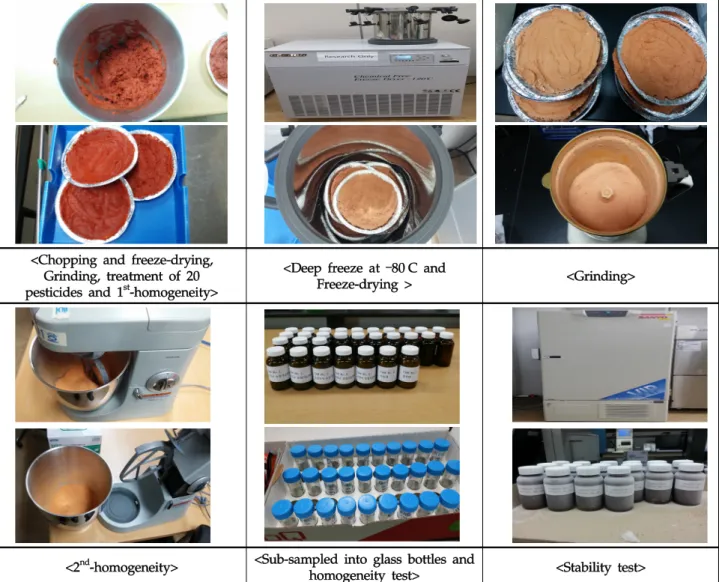
<Chopping and freeze-drying, Grinding, treatment of 20 pesticides and 1st-homogeneity>
<Deep freeze at –80°C and
Freeze-drying > <Grinding>
<2nd-homogeneity> <Sub-sampled into glass bottles and
homogeneity test> <Stability test>
Fig. 1. Procedure for development of analytical reference material of tomato.
sodium citrate dibasic sesquihydrate)을 넣은 후 1분간 진탕한 다음, 3,000 rpm(4℃)에서 5분 동안 원심분리하여 추 출액과 시료층이 분리되도록 하였다. 상등액 7 mL을 취하여 QuERChERS d-SPE-15 mL kit(900 mg MgSO
4, 150 mg PSA, 150 mg C18E)에 넣고 1분간 진탕한 뒤, 3,000 rpm (4℃)에서 5분 동안 원심분리 하였다. 상등액 1 mL을 취하 여 QuERChERS d-SPE-2 mL kit(150 mg MgSO
4, 25 mg PSA, 25 mg C18E)에 넣어 1분간 vortex mixer로 혼합하 였다. 원심분리기로 12,000 rpm(4℃)에서 5분간 원심분리 한 후, 상등액을 PTFE 0.2 um syringe filter로 여과한 다음 상등액 0.5 mL을 acetonitrile 0.5 mL과 혼합하여 Table 2의 분석에 따라 분석하였다. 본 시험은 3반복으로 수행한 후, 결 과를 산출하였다. 직선성(Linearity)는 국립농산물품질관리원 (NAQS, Korea) 시험연구소의 농산물의 잔류농약 분석법 (2014)에서 제시하는 matrix matched calibration method를 적용하였다. 즉, 공시료를 이용하여 표준용액을 농도별로 조 제 한 후, LC-MS/MS와 GC-ECD에 각각 주입하여 농약성 분들의 농도를 정량하였다.
분석표준물질의 조제
토마토 시료를 일정한 크기로 세절한 후, 동결건조 및 분 쇄하여 미세한 분말가루 형태로 만들었다. 토마토 분말가루 400 g에 각 농약성분이 0.1 μg/g (Acetamiprid, Buprofezin, Clothianidin, Diethofencarb, Ethofenprox, Fenamidone, Novaluron, Pyraclostrobin, Pyridaben, Pyrimethanil, Pyriproxyfen, Spiromesifen, Tebuconazole, Tebufenozide, Tetraconazole, Thiamethoxam, Triflumizole) 또는 0.5 μg/g(Chlorfenapyr, Iprodione, Procymidone)이 되도록 처리한 후, 토마토 분말시료 내에 20종의 농약성분이 균질하 게 분포되도록 분석표준물질을 조제하였다(Fig. 1).
균질성 및 인증값(설정값)
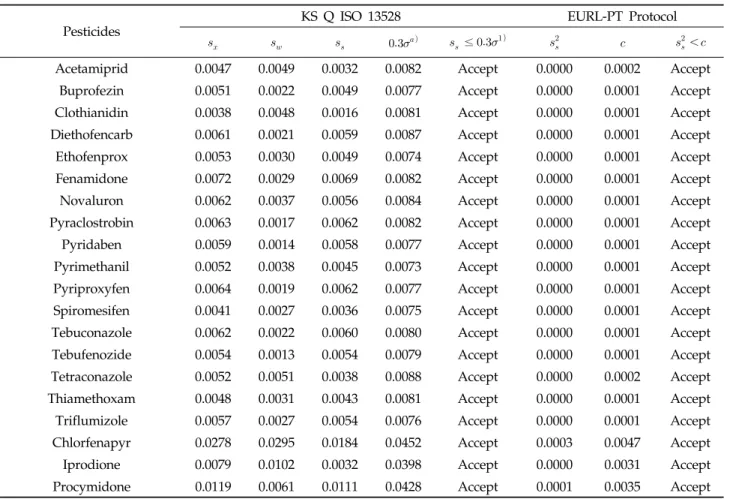
본 연구에서의 균질성의 적합성은 KS Q ISO 13528의 균
질도 평가와 KS A ISO Guide 35에서 제시하는 일원분산분
석법(ANOVA test) 그리고 유럽에서 수행하는 EURL-PT
protocol(Senyuva and Gilber, 2014)의 병간과 병내의
variance 차이에 따른 균질성 평가방법을 적용하여 농약다성
분 토마토 분석표준물질의 균질성 적합성을 판단하였다.
균질성 시험은 조제된 토마토 분석표준물질을 20 g씩 취 하여 100 mL 갈색 bottle에 옮겨 담은 후, 무작위로 10 bottles을 선정하고 각 bottle 내의 상-중-하 위치에서 각각 5 g씩 채취하였다. 채취된 시료는 상기의 회수율 시험과 동일하 게 전처리 및 분석 하였으며, 모든 시료는 3반복 수행하였다.
KS Q ISO Guide 13528에서 제시하는 균질도 평가는 아 래의 공식 (1), (2), (3)에 따라 시료 내( s
w)와 시료 간의 표준 편차( s
s)를 구하였으며, 본 시험의 허용표준편차(
)는 인증값 (설정값)의 25%를 설정하여 계산하였다.
•
(Eq. 1)
•
(Eq. 2)
•
(Eq. 3)
: 균질도 평가를 위해 측정된 데이터
: 전체평균
: 병간시료 (t=1, 2..., g)
: 시험용 시료간의 범위
: 시료평균의 표준편차
: 시료 내 표준편차
: 시료 간의 표준편차
KS A ISO Guide 35에 제시하는 방법에 따라 병간 표준 편차(between-bottle variance, s
bb)와 병내 표준편차(within- bottle variation, s
wb)를 5% 유의수준에서 아래의 공식 (4), (5)에 따라 산출하였다. 본시험의 n0은 누락된 데이터가 없기 때문에, 분석결과의 수 n과 같았다.
•
(Eq. 4)
•
(Eq. 5)
: 병간의 분산
: 병간의 평균제곱
: 병내의 평균제곱
: 각 bottle의 분석결과 수 (=n)
또한, 유럽에서 제시하는 EURL-PT의 공식 (6), (7)에 따 라 Cochran’s test를 수행하여 이상치(outlier)를 확인한 후 F-검정에 의한 분석시료들의 허용편차 기준값을 산출하고 시 료들의 분석결과 편차가 기준값 이내 인 것을 확인하였다 (Kim et. al., 2010, Thompson et al ., 2006). 본 시험의 허 용표준편차는 인증값(설정값)의 25%를 설정하여 계산하였다.
•
(Eq. 6)
•
(Eq. 7)
: 시료 간의 표준편차
: 시료평균의 표준편차
: 시료 내 표준편차
: 인증값의 허용표준편차
: 1.88, 1.01
인증값(설정값)은 숙련도시험에 참가한 기관들의 로버스 트 평균값으로 설정하거나, 인증표준물질(CRM)의 인증 기준 값에 대한 교정으로부터 구한 값을 적용할 수 있지만(Kim et al ., 2010), 본 시험에서는 균질성이 확인된 분석표준물질을 30 반복 추출 및 분석하고 산출된 평균값을 적용하였다.
표준불확도 및 안정성
표준불확도는 병간의 불균질성으로 인해 발생하는 값으로 아래의 공식 (8)에 따라 산출하였다.
•
(Eq. 8)
: 병간의 평균제곱
: 병내의 평균제곱
:
의 자유도 수
: 시료의 갯수
안정성시험은 균질성이 확인 된 분석표준물질이 각 분석 기관에 송부되는 조건과 분석하기 전에 다양한 조건에서 보 관하는 상황을 고려하여, 실온 (20~30℃)에서 8일, 냉동(-2 0℃)에서 23일 동안 보관하면서 토마토 분석표준물질 내 각 농약성분의 안정성을 확인하였다.
안정성의 적합성 여부는 KS A ISO Guide 35(2005)에서 제시하는 아래의 공식 (9)~(12)을 적용하여 확인하였다.
•
(Eq. 9)
•
(Eq. 10)
•
(Eq. 11)
•
(Eq. 12)
: 기울기
: 회귀선의 절편
와
: 시간 경과와 시간경과에 따른 상대적인 농도
: Xi , Yi 의 평균값
Table 3. Results of method validation for 20 pesticides
Pesticides Applied conc. (μg/g) LOD (μg/mL)a) (MDLb)) Linearity(r2)c) Recovery (%) Acetamiprid
8.0
1.0 (10.0) >0.9997 116.3±4.0d)
Buprofezin 0.1 (1.0) >0.9998 102.5±2.8
Clothianidin 0.5 (5.0) >0.9999 115.7±3.1
Diethofencarb 0.1 (10.0) >0.9999 111.7±3.1
Ethofenprox 0.5 (5.0) >0.9998 100.7±2.1
Fenamidone 2.0 (20.0) >1.0000 102.2±3.2
Novaluron 5.0 (50.0) >0.9999 107.7±3.1
Pyraclostrobin 0.1 (1.0) >0.9999 106.8±2.9
Pyridaben 0.5 (5.0) >0.9997 107.0±2.5
Pyrimethanil 0.5 (5.0) >0.9999 104.9±3.8
Pyriproxyfen 0.2 (2.0) >0.9998 105.2±2.8
Spiromesifen 2.0 (20.0) >0.9996 98.3±2.9
Tebuconazole 1.0 (10.0) >1.0000 104.7±3.4
Tebufenozide 0.2 (2.0) >0.9996 109.1±2.6
Tetraconazole 2.0 (20.0) >1.0000 110.0±3.3
Thiamethoxam 2.0 (20.0) >0.9998 117.0±2.7
Triflumizole 2.0 (20.0) >0.9999 101.1±2.5
Chlorfenapyr 5.0 (50.0) >0.9968 104.9±3.3
Iprodione 10 (100) >0.9961 91.1±5.3
Procymidone 5.0 (50.0) >0.9992 107.1±2.6
a) Limit of detection; 3>signal to noise ratio; was determined by a standard solution, b) Method detection limit , c) At least 5 concentrations were used to analyze the samples, d) Average and standard deviation.
Table 4. Results of homogeneity test for 20 pesticides in analytical reference material of tomato
Pesticides
KS Q ISO 13528 EURL-PT Protocol
≤
Acetamiprid 0.0047 0.0049 0.0032 0.0082 Accept 0.0000 0.0002 Accept
Buprofezin 0.0051 0.0022 0.0049 0.0077 Accept 0.0000 0.0001 Accept
Clothianidin 0.0038 0.0048 0.0016 0.0081 Accept 0.0000 0.0001 Accept
Diethofencarb 0.0061 0.0021 0.0059 0.0087 Accept 0.0000 0.0001 Accept
Ethofenprox 0.0053 0.0030 0.0049 0.0074 Accept 0.0000 0.0001 Accept
Fenamidone 0.0072 0.0029 0.0069 0.0082 Accept 0.0000 0.0001 Accept
Novaluron 0.0062 0.0037 0.0056 0.0084 Accept 0.0000 0.0001 Accept
Pyraclostrobin 0.0063 0.0017 0.0062 0.0082 Accept 0.0000 0.0001 Accept
Pyridaben 0.0059 0.0014 0.0058 0.0077 Accept 0.0000 0.0001 Accept
Pyrimethanil 0.0052 0.0038 0.0045 0.0073 Accept 0.0000 0.0001 Accept
Pyriproxyfen 0.0064 0.0019 0.0062 0.0077 Accept 0.0000 0.0001 Accept
Spiromesifen 0.0041 0.0027 0.0036 0.0075 Accept 0.0000 0.0001 Accept
Tebuconazole 0.0062 0.0022 0.0060 0.0080 Accept 0.0000 0.0001 Accept
Tebufenozide 0.0054 0.0013 0.0054 0.0079 Accept 0.0000 0.0001 Accept
Tetraconazole 0.0052 0.0051 0.0038 0.0088 Accept 0.0000 0.0002 Accept
Thiamethoxam 0.0048 0.0031 0.0043 0.0081 Accept 0.0000 0.0001 Accept
Triflumizole 0.0057 0.0027 0.0054 0.0076 Accept 0.0000 0.0001 Accept
Chlorfenapyr 0.0278 0.0295 0.0184 0.0452 Accept 0.0003 0.0047 Accept
Iprodione 0.0079 0.0102 0.0032 0.0398 Accept 0.0000 0.0031 Accept
Procymidone 0.0119 0.0061 0.0111 0.0428 Accept 0.0001 0.0035 Accept
a) The value of 0.3σ was calculated as follows; 0.3×(assigned values×RSD 25%).
Table 5. Assigned value, within-bottle variation(
s
wb) and between-bottle variation(s
bb) for 20 pesticides Pesticides Assigned valuea)(μg/g)
swb sbb
μg/g % μg/g %
Acetamiprid 0.117 0.0061 5.2 0.0019 1.7
Buprofezin 0.108 0.0045 4.2 0.0032 2.9
Clothianidin 0.105 0.0062 5.9 0.0017 1.6
Diethofencarb 0.120 0.0049 4.1 0.0045 3.8
Ethofenprox 0.104 0.0056 5.3 0.0037 3.5
Fenamidone 0.116 0.0046 3.9 0.0057 4.9
Novaluron 0.112 0.0073 6.5 0.0021 1.9
Pyraclostrobin 0.115 0.0047 4.0 0.0048 4.2
Pyridaben 0.109 0.0046 4.2 0.0044 4.0
Pyrimethanil 0.097 0.0052 5.3 0.0050 5.1
Pyriproxyfen 0.110 0.0049 4.5 0.0044 4.0
Spiromesifen 0.104 0.0045 4.3 0.0028 2.7
Tebuconazole 0.109 0.0045 4.1 0.0049 4.4
Tebufenozide 0.113 0.0052 4.6 0.0046 4.1
Tetraconazole 0.121 0.0063 5.2 0.0034 2.8
Thiamethoxam 0.108 0.0052 4.8 0.0041 3.8
Triflumizole 0.102 0.0049 4.9 0.0047 4.6
Chlorfenapyr 0.610 0.0278 4.6 0.0293 4.8
Iprodione 0.535 0.0164 3.1 0.0048 0.9
Procymidone 0.571 0.0108 1.9 0.0068 1.2
a) Analyzed by 30 replication.
Table 6. Uncertainty estimation for 20 pesticides
Pesticides ubb
μg/g %
Acetamiprid 0.0018 1.6
Buprofezin 0.0013 1.2
Clothianidin 0.0018 1.7
Diethofencarb 0.0015 1.2
Ethofenprox 0.0017 1.6
Fenamidone 0.0014 1.2
Novaluron 0.0022 1.9
Pyraclostrobin 0.0014 1.2
Pyridaben 0.0014 1.3
Pyrimethanil 0.0016 1.6
Pyriproxyfen 0.0015 1.3
Spiromesifen 0.0013 1.3
Tebuconazole 0.0014 1.2
Tebufenozide 0.0015 1.4
Tetraconazole 0.0019 1.6
Thiamethoxam 0.0016 1.4
Triflumizole 0.0015 1.4
Chlorfenapyr 0.0083 1.4
Iprodione 0.0049 0.9
Procymidone 0.0032 0.6
결 과
동시다성분 분석법의 확립
20종의 농약성분에 대한 검출한계, 직선성 그리고 회수율 의 결과는 Table 3과 같다. 회수율은 91.1~116.3%의 범위를 나타냈으며, 직선성은 모든 농약성분이 0.99 이상으로 우수하 여 분석표준물질의 인증값(설정값) 산출 및 균질성 확인에 적 합하였다.
균질성 및 인증값(설정값)
무작위로 선별된 10 bottles의 상-중-하 위치에서 분석하
여 균질성을 확인결과는 Table 4와 Table 5와 같았다. KS Q
ISO 13528(2009)에서 제시하는 측정기준으로 확인하였을
때, 농약성분들의 시료 간의 표준편차( s
s) 값이 0.3σ 값보다
작아서 통계학적으로 균질성이 매우 우수하였다. 또한,
Cochran’s test에서 제시하는 기준인 s
s2값이 c 값 보다 작
아 각 농약성분이 매우 균질하게 분포되어 있었다. 일원분산
Table 7. Stability assessment at the different storage conditions for 20 pesticides
Pesticides Storage conditions b1 b0 s(b1) t0.95,n-2×s(b1) b1<t0.95,n-2×s(b1)a)
Acetamiprid Room temperatureb) 0.0012 0.0985 0.0010 0.0132 Accept
Freezingc) 0.0005 0.0978 0.0003 0.0034 Accept
Buprofezin Room temperature -0.0002 0.1004 0.0008 0.0104 Accept
Freezing -0.0001 0.1006 0.0002 0.0031 Accept
Clothianidin Room temperature -0.0013 0.1140 0.0014 0.0182 Accept
Freezing 0.0004 0.1042 0.0007 0.0084 Accept
Diethofencarb Room temperature 0.0006 0.1086 0.0014 0.0179 Accept
Freezing -0.0003 0.1151 0.0003 0.0035 Accept
Ethofenprox Room temperature 0.0016 0.1014 0.0016 0.0207 Accept
Freezing 0.0007 0.1072 0.0001 0.0016 Accept
Fenamidone Room temperature 0.0006 0.1070 0.0002 0.0024 Accept
Freezing 0.0003 0.1059 0.0002 0.0023 Accept
Novaluron Room temperature -0.0003 0.1129 0.0020 0.0248 Accept
Freezing 0.0004 0.1053 0.0002 0.0029 Accept
Pyraclostrobin Room temperature 0.0000 0.1137 0.0015 0.0195 Accept
Freezing -0.0002 0.1159 0.0003 0.0032 Accept
Pyridaben Room temperature -0.0001 0.1046 0.0017 0.0217 Accept
Freezing -0.0001 0.1079 0.0002 0.0024 Accept
Pyrimethanil Room temperature -0.0015 0.1024 0.0005 0.0061 Accept
Freezing -0.0004 0.0971 0.0004 0.0057 Accept
Pyriproxyfen Room temperature -0.0016 0.1109 0.0003 0.0042 Accept
Freezing -0.0001 0.1058 0.0007 0.0088 Accept
Spiromesifen Room temperature -0.0006 0.0994 0.0007 0.0085 Accept
Freezing -0.0001 0.1011 0.0000 0.0004 Accept
Tebuconazole Room temperature 0.0018 0.0988 0.0010 0.0131 Accept
Freezing 0.0003 0.1023 0.0001 0.0008 Accept
Tebufenozide Room temperature -0.0008 0.1177 0.0016 0.0201 Accept
Freezing -0.0006 0.1190 0.0004 0.0049 Accept
Tetraconazole Room temperature -0.0003 0.1106 0.0009 0.0117 Accept
Freezing 0.0002 0.1080 0.0006 0.0078 Accept
Thiamethoxam Room temperature 0.0002 0.0974 0.0010 0.0128 Accept
Freezing 0.0003 0.1031 0.0003 0.0041 Accept
Triflumizole Room temperature -0.0029 0.1000 0.0005 0.0062 Accept
Freezing -0.0002 0.0997 0.0002 0.0025 Accept
Chlorfenapyr Room temperature 0.0067 0.4169 0.0083 0.1057 Accept
Freezing 0.0040 0.4222 0.0034 0.0430 Accept
Iprodione Room temperature -0.0037 0.4330 0.0053 0.0668 Accept
Freezing -0.0015 0.4443 0.0005 0.0057 Accept
Procymidone Room temperature 0.0026 0.4347 0.0050 0.0642 Accept
Freezing -0.0020 0.4422 0.0008 0.0104 Accept
a) t0.95,n-2=12.7 for room temperature, freezing condition, b) Measurement for 8 days, c) Measurement for 23 days.
분석법(ANOVA test)에 의해 산출된 병내 표준편차(within- bottle variation, s
wb)와 병간 표준편차(between-bottle variance, s
bb)는 인증값(설정값)의 0.9~6.5%의 범위였으며, 이 값은 정도관리 및 숙련도 시험의 결과에 미치는 영향이 미 미하여 분석표준물질로 사용할 수 있을 것으로 보인다.
표준불확도 및 안정성
KS A ISO Guide 35에서 제시하는 통계적인 방법으로 산출된 각 농약성분들의 표준불확도는 인증값(설정값)의 0.6~1.9%로 매우 미미한 수준이었다. 이 값은 분석표준물질 의 인증값 확인과 숙련도 및 정도관리 평가에 미치는 영향이 매우 낮아 농약다성분 표준분석물질로 사용하기에 적합한 것 으로 보인다(Table 6).
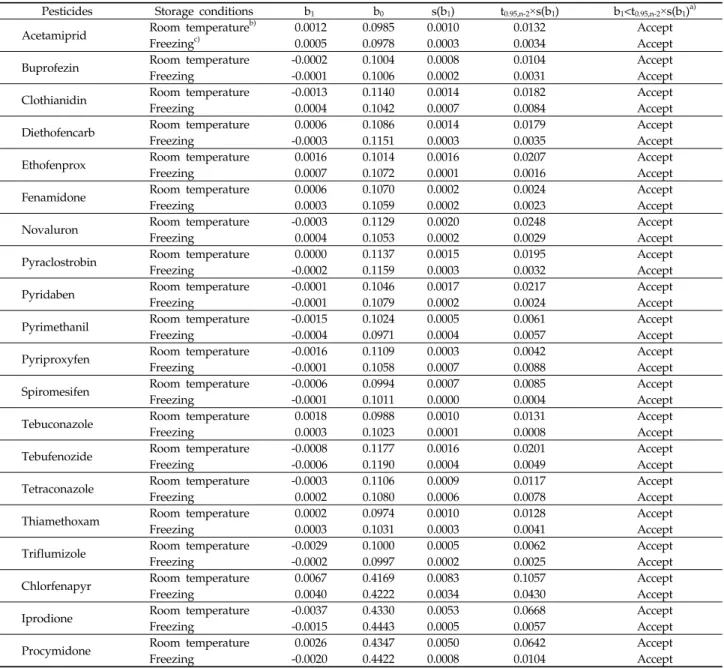
실온(20~30℃), 냉동(-20℃)에서의 토마토 농약다성분 분 석표준물질의 안정성 결과는 Table 7과 같았다. 보관조건에 따른 안정성의 적합성은 아래의 공식 (14)에 따라, 각 농약성 분의 시간과 농도에 따른 추세선의 기울기 절대값(
)이
에
자유도(degree of freedom)와 p =0.95일 때(95%
신뢰수준) Student’s t -factor의 값을 곱한 값보다 작을 경 우에 불안정성이 관찰되지 않은 것으로 판단하였다(Otake et al ., 2013, Yarita et al ., 2014).
•
∙(Eq. 14)
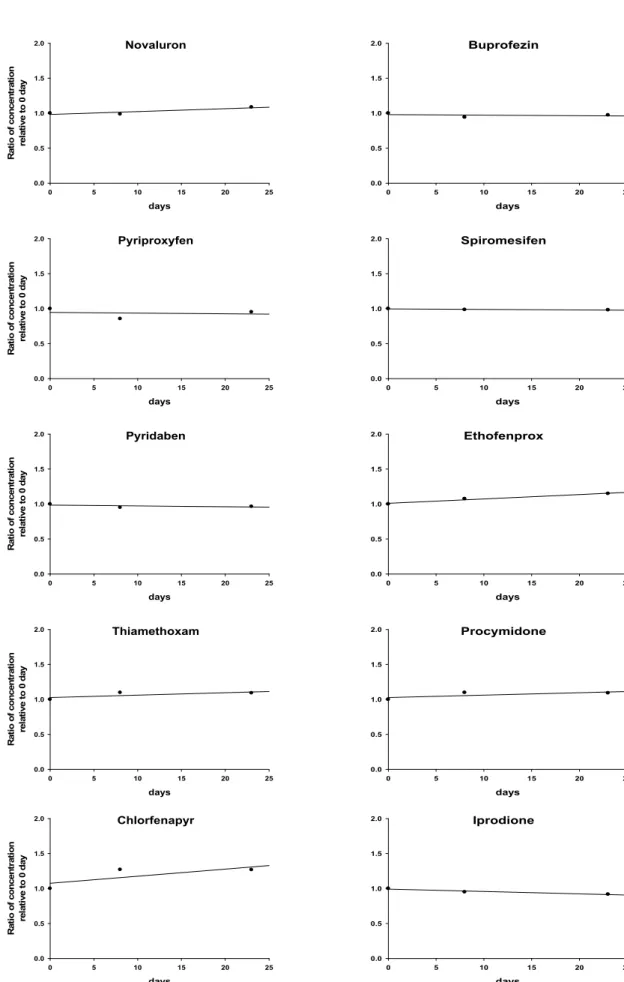
균질성이 확보된 토마토 분석표준물질은 실온에서 8일,
냉동에서 23일 동안 매우 안정한 것으로 확인하였다(Table 7,
Fig. 2).
Clothianidin
days
0 5 10 15 20 25
Ratio of concentration relative to 0 day 0.0 0.5 1.0 1.5
2.0 Acetamiprid
days
0 5 10 15 20 25
0.0 0.5 1.0 1.5 2.0
Pyrimethanil
days
0 5 10 15 20 25
Ratio of concentration relative to 0 day 0.0 0.5 1.0 1.5
2.0 Diethofencarb
days
0 5 10 15 20 25
0.0 0.5 1.0 1.5 2.0
Fenamidone
days
0 5 10 15 20 25
Ratio of concentration relative to 0 day 0.0 0.5 1.0 1.5
2.0 Tetraconazole
days
0 5 10 15 20 25
0.0 0.5 1.0 1.5 2.0
Tebufenozide
days
0 5 10 15 20 25
Ratio of concentration relative to 0 day 0.0 0.5 1.0 1.5
2.0 Tebuconazole
days
0 5 10 15 20 25
0.0 0.5 1.0 1.5 2.0
Pyraclostrobin
days
0 5 10 15 20 25
Ratio of concentration relative to 0 day 0.0 0.5 1.0 1.5
2.0 Triflumizole
days
0 5 10 15 20 25
0.0 0.5 1.0 1.5 2.0
Novaluron
days
0 5 10 15 20 25
Ratio of concentration relative to 0 day 0.0 0.5 1.0 1.5
2.0 Buprofezin
days
0 5 10 15 20 25
0.0 0.5 1.0 1.5 2.0
Pyriproxyfen
days
0 5 10 15 20 25
Ratio of concentration relative to 0 day 0.0 0.5 1.0 1.5
2.0 Spiromesifen
days
0 5 10 15 20 25
0.0 0.5 1.0 1.5 2.0
Pyridaben
days
0 5 10 15 20 25
Ratio of concentration relative to 0 day 0.0 0.5 1.0 1.5
2.0 Ethofenprox
days
0 5 10 15 20 25
0.0 0.5 1.0 1.5 2.0
Thiamethoxam
days
0 5 10 15 20 25
Ratio of concentration relative to 0 day 0.0 0.5 1.0 1.5
2.0 Procymidone
days
0 5 10 15 20 25
0.0 0.5 1.0 1.5 2.0
Chlorfenapyr
days
0 5 10 15 20 25
Ratio of concentration relative to 0 day 0.0 0.5 1.0 1.5
2.0 Iprodione
days
0 5 10 15 20 25
0.0 0.5 1.0 1.5 2.0
Fig. 2. Representative storage stability of freezing condition for 23 days.
결 론
본 연구에서는 농약잔류분석기관의 정도관리 및 숙련도평 가에 사용하기 위해 20종의 농약성분이 포함된 토마토 농약 다성분 분석표준물질을 개발하였다. 분석표준물질의 적합성 을 판단하기위해 병내/병간의 균질성, 실온/냉장의 보관조건 에 따른 안정성, 20종 농약성분의 인증값 그리고 표준불확도 를 확인한 결과, ISO Guides에서 요구하는 기준에 모두 적 합하였다. 토마토 분석표준물질의 안정성(stability)가 실온 8 일 그리고 냉동 23일 동안 안정하여 각 기관에 송부될 때의 조건과 각 기관이 분석 전까지 보관하는 조건이 모두 만족하 여 각 기관의 숙련도평가에 충분히 활용될 수 있을 것으로 보 인다. 하지만, 단기 저장성 외에 장기 저장성을 확인하여 지 속적인 보관가능성에 대한 추가 실험이 필요할 것으로 판단 된다.
따라서, 본 연구를 통해서 개발된 토마토 농약다성분 분석 표준물질은 각 기관의 농약잔류 분석결과에 대한 신뢰성 향 상 및 일관성 유지를 위해서 사용 가능할 것으로 보이며 또 한, 농약잔류 분석결과의 지속적인 모니터링으로 활용 할 수 있을 것으로 사료된다.
Acknowledgment
This study was carried out with the support of Rural Development Administration (Project No.
PJ010857022016), Republic of Korea.
References