Print ISSN: 2288-4637 / Online ISSN 2288-4645 doi:10.13106/jafeb.2021.vol8.no9.0121
Revisiting Customer Complaint Intention: A Case Study of Mobile Service Users in Vietnam*
Liem Thanh NGUYEN
1, Minh Hoang DANG
2, Thu Duyen TAT
3, Dinh Gia Trung TRAN
4Received: May 15, 2021 Revised: July 24, 2021 Accepted: August 02, 2021
Abstract
In the mobile industry, customer complaints play a significant role in retaining customer loyalty to the services provided. Thanks to user complaints, mobile service providers can effectively identify problems and then propose solutions to adapt or improve their services. Hence, it’s critical to understand the relationship between consumer complaints and satisfaction with mobile services.
While several studies have shown that customer satisfaction is an intermediary variable that explains customer complaint intention, there have been few studies on the relationship between pre-determinants of their satisfaction, leaving a gap in our understanding of customer complaint intention. To demonstrate an in-depth approach to this matter, authors revisit justice theory and suggest trust and perceived responsibility variables be combined into a research model. A cross-section survey was conducted to collect data from 265 mobile services users of the three biggest mobile service providers in Kien Giang Province, Vietnam. This study employed Structural Equation Modeling (SEM) method to analyze the samples collected. The result showed that customer complaint intention is affected by distributive justice, interactional justice, trust but not procedural justice. Additionally, the moderating role of the perceived responsibility variable to the relationship between customer satisfaction and complaint intention is also proved.
Keywords: Complaint Intention, Customer Satisfaction, Justice Theory, Trust, Mobile Services JEL Classification Code: L96, M10, M31, O14
to Breazeale (2009), the cost of convincing a new consumer to try a service is five times more than the cost of retaining a current customer. The vital function of resolving customer complaints has increased in the context of increasing competition in the mobile services business, as we have witnessed today (Cho, 2018).
Hart et al. (1990) stated that there is a distinct difference between companies whose customer complaints are well managed and others. Halim and Christian (2013) suggested that the managers should support consumers to raise their complaints directly to the company. Accordingly, successful companies often welcome their customers’ complaints and responsive actions from their staff to resolve these complaints, since they believe these activities illustrate positive cooperation. Companies who inadequately manage customer complaints, on the other hand, fail to recognize the value of customers’ voices (Firnstahl, 1989), and hence their brand or services will not improve.
Today, businesses are gradually realizing the value of customers’ complaints about any issues that cause them to be dissatisfied. However, few studies have been undertaken to emphasize the importance of this tendency to business (Voorhees & Brady, 2005), and in a broader
*Acknowledgments:
This research was conducted with the help of respondents who are mobile users of Mobifone, Vinaphone, and Viettel in Kien Giang Province, Vietnam. Thanks to their feedback, we can complete this project with valuable insights. We also thank our colleagues and friends, who provided great opinions to inspire us to move forward with this research.
1
First Author. Lecturer, Faculty of Accounting - Finance – Banking, Tay Do University, Vietnam. Email: [email protected]
2
Corresponding Author. Lecturer, Faculty of Business Administration, FPT University, Vietnam [Postal Address: FPT University – Can Tho Campus, 600 Nguyen Van Cu Street, An Binh Ward, Ninh Kieu District, Can Tho City, 94100, Vietnam] Email: [email protected]
3
Lecturer, Banking Department, Faculty of Accounting - Finance - Banking, Tay Do University, Vietnam. Email: [email protected]
4
Lecturer, Business Administration Department, International University of Ho Chi Minh City, Vietnam.
Email: [email protected]
© Copyright: The Author(s)
This is an Open Access article distributed under the terms of the Creative Commons Attribution Non-Commercial License (https://creativecommons.org/licenses/by-nc/4.0/) which permits unrestricted non-commercial use, distribution, and reproduction in any medium, provided the original work is properly cited.
1. Introduction
Complaining is important to retain customers and
business profits (Holloway et al., 2005). According
sense, managers in all service industries should investigate consumer intention in the complaint-making process.
This reflects the situation in Vietnam, where studies on the subject are scarce and opinions on the negative side of customer complaint-making continue to feature prominently. Previously conducted studies tended to focus on the prediction of purchasing intent rather than complaint intention. (Cronin et al., 2000). In this context, understanding of how customers intend to make a complaint about a bad experience with services used, as well as what management may do to encourage customers to voice their discontent, is limited. As a result, this paper can be considered one of the first steps in determining the nature of a customer’s complaint. The findings of this study, by providing concrete evidence, can help telecommunication service providers in Kien Giang enhance their current services.
2. Literature Review
Mobile service is unique in that it is delivered over a telecommunications network with no physical or human connection between users and service providers. Hence, customers of mobile services experience higher levels of service uncertainty than users of traditional goods or services. This is the major difference between the mobile service business and other industries in terms of recognizing consumer complaint intent.
On a worldwide scale, earlier customer complaint research focused on justice theory and traditional market products/services to better understand the nature of consumer complaints. The authors will use justice theory and extend the research model with the trust variable in this study.
This is to make the model’s justification for complaint intention clear.
2.1. Justice Theory
The definitions of justice are often regarded in research about exchanges/transactions in society, with or without commercial purpose (Wu, 2013). Accordingly, social exchanges/transactions are often viewed by scholars as a framework to evaluate justice as well as emphasize the role of justice in forming successor transactions (Smith et al., 1999). In this essence, Colquitt et al. (2001) classified justice into 3 main categories after observing 183 relating projects, namely distributive justice, procedural justice, and interactional justice.
Firstly. distributive justice is defined as personal feeling.
This type of justice is produced by a person’s personal assessment of a transaction’s fairness based on a comparison of the price paid and the advantages gained from that transaction (Martinez-Tur et al., 2006). According to Smith et al. (1999), distributive justice affects customer satisfaction
and impacts their complaint intention. Badawi et al. (2021) also confirmed the positive correlation between distributive justice and customer satisfaction. From these point of view, a hypothesis can be extracted that:
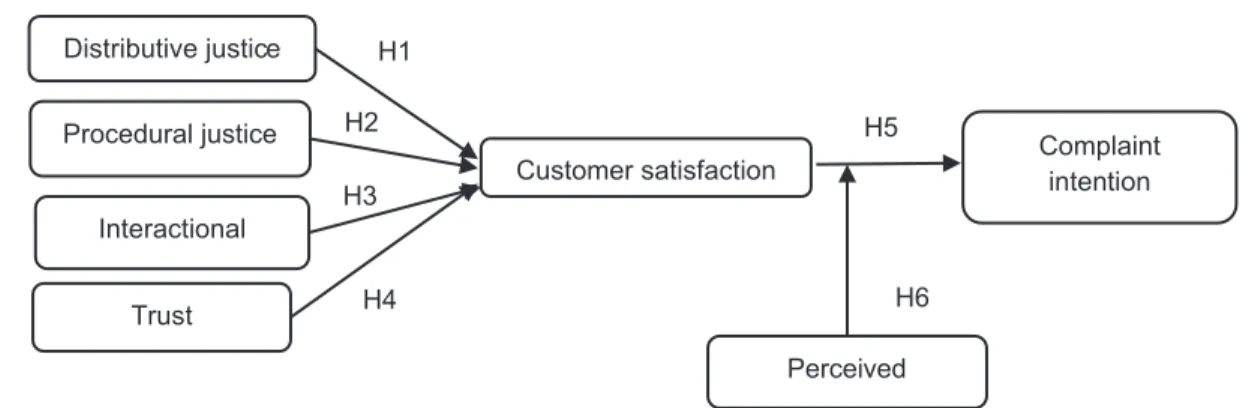
H1: There is a positive relationship between distributive justice and the satisfaction of mobile service users.
Second, procedural justice refers to the principle of fairness in the development of standards and policies (Voorhees & Brady, 2005). As Leventhal (1980) points out, the definition of procedural fairness is based on a set of six criteria: (1) appropriate: the same procedure shall be applied to all; (2) fairness: one who has power in making decisions will not be impacted by any individual benefits while making decisions; (3) correctness: the information collected serving for decision making must be correct; (4) amendment: refer to the availability of mechanisms aiming to correct wrongful decisions; (5) representativeness: all opinions of related parties, who are impacted by the decision, should be recorded and considered; (6) ethics: respecting all ethical standards of society. Research also showed that individuals who believe in procedural justice are also more satisfied with the outcome, even if it is not in their favor (Lind & Tyler, 1988). (Lind &
Tyler, 1988). From this light, a hypothesis can be formed to describe the relationship between procedural justice and customer satisfaction.
H2: There is a positive relationship between procedural justice and the satisfaction of mobile service users.
Third, individual-related viewpoints should be separated in procedural justice to develop the idea of interactional justice, as described by Bies and Moag (1986). Customers will perceive justice through staff behaviors when making decisions (Martinez-Tur et al., 2006; Son & Kim, 2008), and there are four elements to determine interactive justice:
(1) justification for the action; (2) faithfulness; (3) respect and (4) level of privilege. Research in the field of the Internet identified interactional justice as an extent to which online customers can perceive the faithfulness and reliability of companies in respecting their commitments toward protecting personal privacy (Son & Kim, 2008).
Many studies in services stated the relationship between
perceived justice and customer satisfaction (Holloway et al.,
2005). In the hospitality sector, Martinez-Tur et al. (2006)
showed that distributive justice has the most significant
impact comparing to the others. Maxham and Netemeyer
(2002) admitted that 3 categories of justice have a certain
impact on customer satisfaction while conducting their
research in constrution activities. However, the result of
analyzing data illustrated that procedural and interactional
justice dominated distributive justice in predicting customer
satisfaction. This relationship is also confirmed by other
scholars (Voorhees & Brady, 2005), but its impact is different depending on industries as well as geographic regions.
Hence, the authors suggested that the relationship between interactional justice and customer satisfaction should be re-examined.
H3: Interactional justice has a positive effect on customer satisfaction.
2.2. Trust
The role and function of trust have been shown in many social exchange studies (Kelley, 1979). Trust is recognized as a common mechanism to reduce risk in transactions by increasing the participants’ expectation of a positive outcome while making social exchange (Grabner-Kraeuter, 2002).
In TRA theory (Ajzen & Fishbein, 1980), trust is defined as the buyer’s belief that the seller would conduct transactions properly and ethically, whereas Pavlou and Fygenson (2006) defined trust as the buyer’s conviction that the seller will conduct transactions properly and ethically.
In an e-commerce study, Morgan and Hunt (1994) found that trust is one of the most important factors in predicting customer satisfaction, while Lin and Wang (2006) found that trust has a positive association with customer satisfaction.
Customers rarely communicate directly with mobile service providers, although many complaints may arise, such as a miscalculation in the fare of offered services or a failure to meet service quality commitments. When these scenarios arise, customers’ faith in service providers may be undermined. As a result, this study proposes that to improve the research model’s explainability, the trust variable should be examined along with the three types of justice. Accordingly, the proposed hypothesis will be:
H4: Trust has a positive relationship with customer satisfaction in using mobile services.
2.3. The Relationship of Customer Satisfaction and Complaint Intention
Research in service sectors provided that there has been a link between customer dissatisfaction and complaint intention (Zeelenberg & Pieters, 2004). Particularly, Thogersen and Juhl (2009) argued that one of the factors influencing directly customer’s complaint was their dissatisfaction with the malfunctions or shortcomings of products or services. According to Voorhees and Brady (2005), the satisfaction of service has a reciprocal impact on the complaint intention in the future. This means that if customer satisfaction increases, he or she has less intention to make a complaint in the future.
After studying health care, fast food, and entertainment
services, Cronin et al. (2000) concluded that the influence of services on behavioral intent can be impacted by an intermediary variable, which is customer satisfaction.
In this line, the results of the studies provided show that the more customers are unsatisfied with mobile services, the more their intention to make complaints. The suggested hypothesis is thus:
H5: Customer dissatisfaction has a negative relationship with the customer’s complaint intention in using mobile services.
2.4. Moderating Variable
Apart from the variables above, the findings of theoretical research revealed that other moderating variables may underpin the reciprocal relationship between satisfaction and complaint intention. Customers’ complaint intention is facilitated by perceived responsibility, according to the authors, as a moderating variable if they are unsatisfied with the services (Tax et al., 1998). Perceived responsibility is the customer’s perception of the readiness of services providers in resolving problems (Richins, 1987). In addition to this, the research of Voorhees and Brady (2005) and Wu (2016) also indicated the moderating role of perceived responsibility in the relationship between customer satisfaction and complaint intention. From this point of view, this research propose:
H6: The higher the perceived responsiveness is, the stronger the relationship between customer satisfaction and complaint intention.
2.5. Research Model
In line with the proposed hypothesis and the basis of justice theory, this research suggests a research model, which integrates some additional variables (Figure 1).
3. Research Methodology 3.1. Sample Selection
To acquire primary data, the authors used quantitative
methodologies and a field survey. To overcome the
disadvantage of resource scarcity, observed samples were
chosen using a purposeful sampling strategy. Accordingly,
samples were collected from users of all mobile tele-
communication service providers in Kien Giang province,
Vietnam, which are Mobifone, Viettel, and Vinaphone. In
265 observed samples collected, 142 are males (53,6%) and
the remaining 123 are females with 46,4%. The respondents
with the age from 31–40 took the largest percentage in the
survey with 43%, while the second group was 21–30 with 27.9%. Ones with the age of 41–50 was17% and people under 20 were 9.1%, while only 8 people who are over 50 joined the survey (3%). In terms of time using mobile services, only 7 people responded that they are new users with the time of use is under 1 year, while the other groups have been experienced mobile services for 1–3 years (32,1%), 4–6years (30,9%) and over 6 years with 34,3%.
Before answering the main questions, respondents were required to describe in general their personal experiences about problems that they had recently encountered within 6 months. Throughout the survey, the authors were ready to explain and answer any related questions to avoid misunderstandings and maintain the respondents’ focus.
The input data, which is the outcome of 265 final samples, is analyzed using SPSS 20 and AMOS 7.0 software.
3.2. Measurement
The questionnaire was designed in line with Likert’s scale from ‘1-strongly disagree’ to ‘5-strongly agree’.
Additionally, measurement scales for distributive justice, procedural justice, and integrative justice were adapted from Martinez-Tur et al. (2006), Turel et al. (2008), Chiu et al. (2009), and Wu (2013). Trust’s measurement scales were adapted from Wu (2013) and Turel et al.
(2008). The measurement scales applied to measure customer satisfaction, complaint intention, and perceived responsibility were adapted from Wu (2013) and Voorhee and Brady (2005).
The survey was conducted in Kien Giang, a big pro- vince in the south of Vietnam. The authors employed an expert interview method to minimize all discrepancies in terms of languages, cultural and personal opinions while translating the measurement scales from English to Vietnamese. Prior to the main survey, a preliminary study with 50 samples was undertaken to ensure that the questionnaire was appropriate and to assess any potential difficulties.
4. Results
4.1. Testing the Reliability and Analysis of EFA’s Factor
Cronbach’s alpha is considered to test the consistency and reliability of suggested measurement scales and Cronbach’s alpha with a value over 0.6 is good for successor tests. After analyzing, Cronbach values of the measurement scales were: complaint intention (0.949);
customer’s satisfaction (0.878); distributive justice (0.905); procedural justice (0.865); interactional justice (0.904) and trust (0.910).
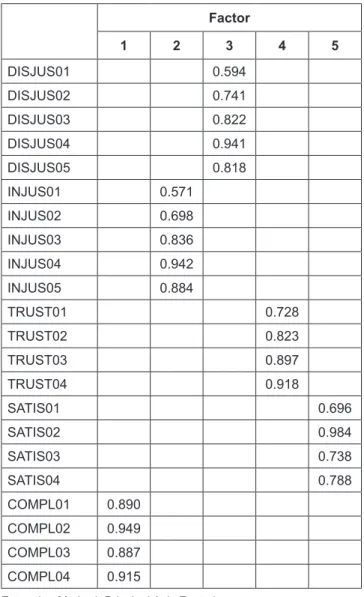
Then, EFA factor analysis was conducted based on exploiting method with principal Axis Factoring and Promax rotation. The result showed that KMO is 0.927, and observed variables in measurement scales of independent variables, which are procedural and interactional justice, could be grouped together into one group. This result may surprise some, however, it can be explained by a study released by Bies and Moag (1986), wherein interactional justice and procedural justice were originally separated.
Based on the result of data analysis, this research proposes that observed variables of procedural justice and interactional justice measurable scales should be grouped and thus form a new independent variable with the name that remains procedural justice and denoted as PROIN. After grouping and simultaneously eliminating Items Projus01, Projus03, and Projus04, the coefficient of KMO is 0.924 and higher than the minimum of 0.7. Moving forward with removing Items Projus02 and Sastic05, the results of EFA analysis of all the variables in the proposed research model showed that the KMO coefficient is 0.911, sig = 0 and other values meet the statistical requirements. Therefore, the variable Projus was completely eliminated in this case of study.
In the end, the authors conducted an EFA analysis after removing Items Projus02 and Sastic05, and the results Distributive justice
Procedural justice Interactional
Trust
Customer satisfaction Complaint
intention
Perceived H1
H3 H2
H4
H5
H6
Figure 1: Proposed Research Model
showed that KMO is 0.9 and 5 factors were totally extracted.
The indicators were thus satisfactory to continue the next steps of analysis (Table 1).
4.2. Confirmatory Factor Analysis CFA
Confirmatory Factor Analysis (CFA) was conducted to confirm the suitability of the measurement scales (Figure 2).
In this study, CFA checked the model fit of the model with AMOS software.
Figure 2 shows the results of CFA with model fit indicators shown on the top right of the figure. This confirmed that the fit indicators of the model are all good enough and these can be used for further analysis.
4.3. Structural Equations Model (SEM)
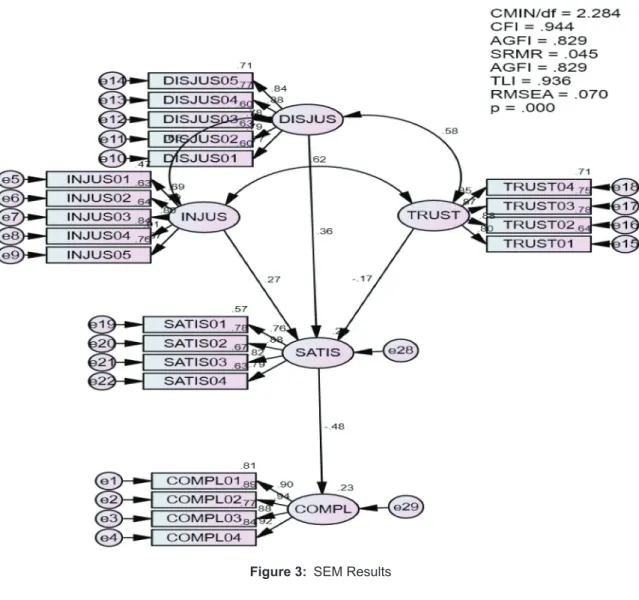
To test the hypotheses about relationships between variables in this research, the authors used a modeling technique of structural equations. The analytical results showed that the model provided a good fit index, matching the criteria of statistical regulations (Figure 3).
Table 2 shows that distributional justice and interactional justice have positive effects on satisfaction, the β indexes are 0.345, 0.287, and all are good P-values. This means that the hypothesis H1 and H3 are accepted. Trust serves explanatory meaning for customer satisfaction with β = 0.204, thus hypothesis H4 is accepted. The analytical results also show that satisfaction is an important intermediate variable to shape the complaint intention (β = -0.632; P-value = 0.025). Through these intermediate variables of satisfaction, the prefixes of distributional justice, interactional justice, and trust affected complaint intention. Therefore, hypothesis H5 is also accepted.
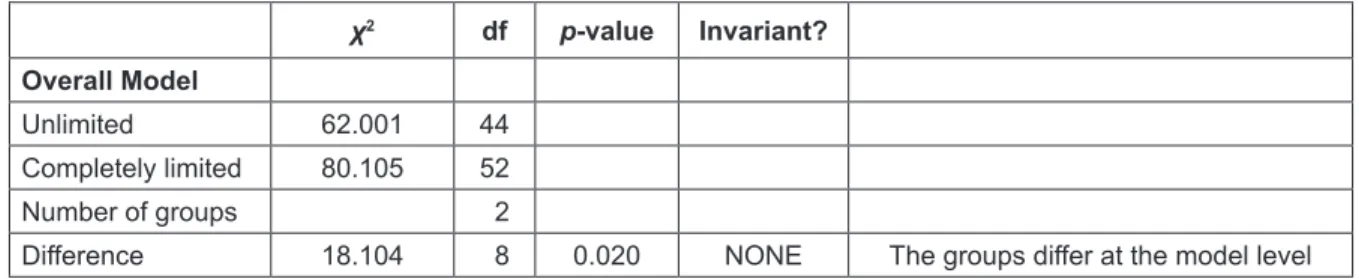
Regarding the moderator role of perceived responsi- bility mentioned in H6, the authors used the multigroup structural equation modeling technique. The observed samples were divided into two groups by the median-split method, namely the group with a high sense of responsibility and the group with a low sense of responsibility. Next, the χ
2difference test was conducted to evaluate the difference between the two sample groups as mentioned. The results showed that the moderator role of the perceived responsibility variable in the relationship between satisfaction and complaint intention is also appropriate (Table 3).
5. Discussion
Many studies have been undertaken on customer behavior intention, and many deliverables have been created, but complaint intention has just lately been discussed and examined (Voorhees & Brady, 2005;
Wu, 2013), and so remains an issue that needs to be resolved. More essentially, there have been few studies focusing on this topic in the telecommunication service industry. As a result, this study may be considered one of the first attempts to investigate the knowledge of consumer complaint intention based on some empirical evidence. Although some perspectives were limited when constructing the survey template, the research’s contribution is to extend the paradigm of justice theory and apply it to explain the issue. The results indi cated that distributive justice, interactional justice, and trust have certain roles in impacting positively customer satisfaction.
Because of this impact, their complaint intention toward the services they receive is contributively formed. In general, the conclusions of this study are consistent with those of Smith et al. (1999) and Martinez-Tur et al. (1999) on the production of goods (2006).
Table 1: Analysis Pattern Matrix
aFactor
1 2 3 4 5
DISJUS01 0.594
DISJUS02 0.741
DISJUS03 0.822
DISJUS04 0.941
DISJUS05 0.818
INJUS01 0.571
INJUS02 0.698
INJUS03 0.836
INJUS04 0.942
INJUS05 0.884
TRUST01 0.728
TRUST02 0.823
TRUST03 0.897
TRUST04 0.918
SATIS01 0.696
SATIS02 0.984
SATIS03 0.738
SATIS04 0.788
COMPL01 0.890
COMPL02 0.949
COMPL03 0.887
COMPL04 0.915
Extraction Method: Principal Axis Factoring.
Rotation Method: Promax with Kaiser Normalization.
a