Print ISSN: 2288-4637 / Online ISSN 2288-4645 doi:10.13106/jafeb.2021.vol8.no3.1073
Environmental Performance and Earnings Persistence:
Empirical Evidence from Indonesia
Ferdy PUTRA
1Received: November 30, 2020 Revised: February 01, 2021 Accepted: February 16, 2021
Abstract
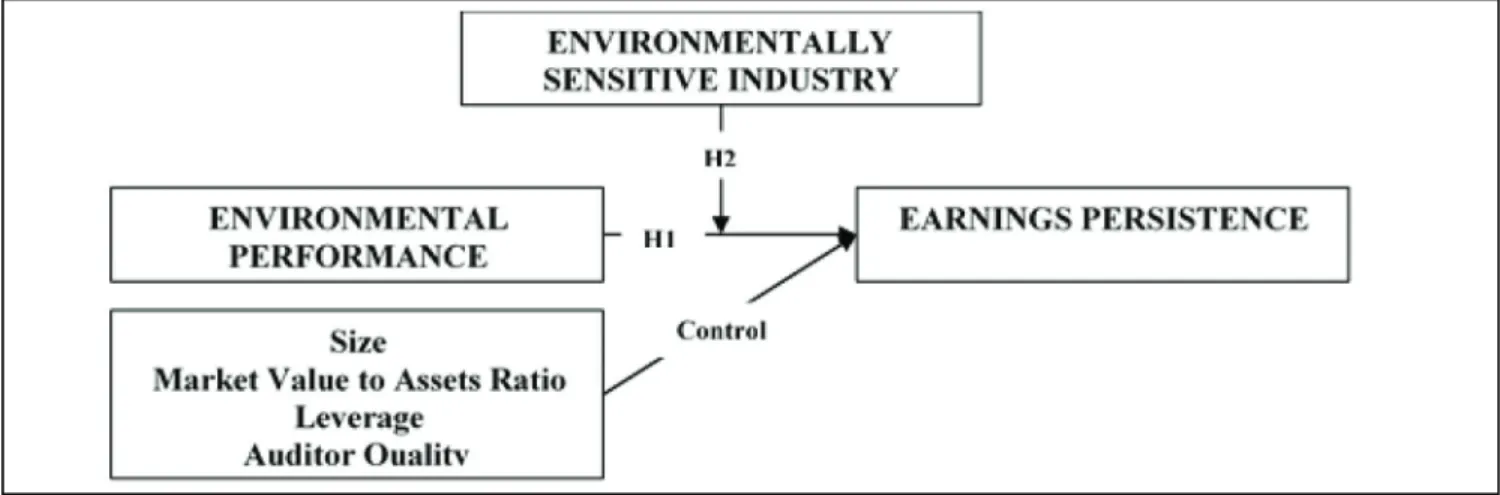
When firms have higher environmental performance, they can provide sustainable business that allows firms to build the value of credibility and ethics, higher reputation, higher productivity, and lower costs. The advantages of environmental responsibilities help firms to maintain their earnings level over a long-term period. This research aims to examine the effect of environmental performance on earnings persistence.
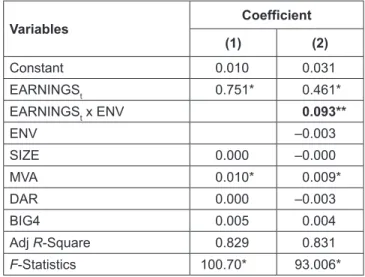
Research samples include 413 manufacturing firms-years listed in the Indonesian Stock Exchange and the PROPER evaluation in 2013–2019. Environmental performance is measured by PROPER evaluation rating. The result shows that environmental performance has a positive effect on earnings persistence. The advantage of environmental responsibilities allows firms to enjoy performance sustainability and persistence in a long-term period, not only periodically. Also, the positive effect of environmental performance on earnings persistence occurs more in the environmentally sensitive industry than non-sensitive ones. Since an environmentally-sensitive industry brings more environmental damage, higher environmental performance is more valuable to provide sustainability. This research has limitations to use all the Indonesian Stock Exchange-listed firms since not all firms participate in the PROPER evaluation. This research implies firms’
management should maintain earnings persistence and sustainability by implementing higher-quality environmental responsibility, especially for firms in an environmentally-sensitive industry.
Keywords: Environmental Performance, Earnings Persistence, Sustainability, Indonesia JEL Classification Code: L25, Q51, Q56
Earnings persistence is one indicator of earnings quality where it is important to help stakeholders to make an economic decision. Persistent earnings help stakeholders to evaluate firms’ business sustainability and predict future performance. For example, stock market participants use earnings persistence to make equity valuation (Penman &
Zhang, 2002; Richardson et al., 2005). Previous studies (Easton & Zmijewski, 1989; Kormendi & Lipe, 1987;
Widiatmoko & Indarti, 2018) find that market responses on earnings information also relate to earnings persistence.
Since it helps stock market participants, such as an investor, higher earnings persistence can lead a firm to generate a lower cost of equity (Francis et al., 2004).
Only sustainable firms’ can provide sustainable earnings.
Sustainable business can be achieved by providing the triple bottom line of business which are profit, people, and planet (Elkington, 1997). Environmental responsibilities are includes in the concept of the triple bottom line. When firms have higher environmental performance, they can provide sustainable business. Environmental performance allows firms to build the value of credibility and ethics (Lys et al., 2015).
1
First Author and Corresponding Author. Lecturer, Department of Accounting, Faculty of Business and Economics, University of Riau, Indonesia [Postal Address: Kampus Bina Widya Km. 12.5, Simpang Baru, Kec. Tampan, Kota Pekanbaru, Riau, 28292, Indonesia]
Email: [email protected]
© Copyright: The Author(s)
This is an Open Access article distributed under the terms of the Creative Commons Attribution Non-Commercial License (https://creativecommons.org/licenses/by-nc/4.0/) which permits unrestricted non-commercial use, distribution, and reproduction in any medium, provided the original work is properly cited.