88
Morphological Characteristics of Medium-Leaf Type
Zoysiagrasses (Zoysia spp.) and Their Classification Using RAPDs
Joon Soo Choi*
Department of Green landscape Science, Dankook University, Cheonan 330-714, Korea
ABSTRACT. Zoysiagrass, especially Jungji implicating medium-leaf type zoysiagrass has been widely used in South Korea recently. This study was carried out to classify 36 selected medium-leaf type zoysiagrass accessions compared to 5 basic zoysiagrass species using RAPDs. Morphological characteristics such as leaf width, leaf angle, leaf sheath length, existance of trichomes and stolon color were measured as useful characteristics for identification of species in Zoysia genus. Nineteen RAPD markers were identified using 8 selected random primers. The dissimilarity coefficient of variants ranged from 0 to 0.736. Three zoysiagrass groups were clustered by dissimilarity coefficient analysis. Group 1 consisted of Z. japonica and some US varieties including ‘Zenith’ and ‘Meyer’. Group 2 consisted of Z. sinica, Z. macrostachya and Korean commercial varieties such as ‘Anyang’, ‘Samdeock’, and ‘Pyeongdong’
medium-leaf type grasses. Group 3 was genetically distinct from Group 1 and Group 2, and included Z. matrella and Z.
tenuifolia. ‘Anyang’, ‘Samdeock’, and ‘Pyeongdong’ medium-leaf type zoysiagrasses showed very close genetic relationship with Z. sinica and Z. macrostachya.
Key words: Identification, Meyer, Zenith, Zoysiagrass, Z. macrostachya, Z. sinica
Introduction
The Zoysia species are native to the Far East and South East Asia, such countries as Korea, Japan, China, Philippines, and Taiwan (Engelke et al., 1983; Fukuoka, 1997). They are distributed widely from tropical to temperate climates. There are five to six species of zoysiagrass reported (Christians &
Engelke, 1994; Yeam et al., 1987a, 1987b). These species have stolons and rhizomes, and show dwarf growing characteristics. Interspecific hybridization is found frequently at the native habitat because of sexual compatibility among all species. However, study of genetic relation among the natural interspecific hybrid has been limited.
As useful methods for identification and classification of plant variety, isozyme patterns (Wilkinson & Beard, 1972), RFLP (Yaneshita et al., 1993), and RAPD had been used lately for the classification of turfgrass species and cultivar.
Zoysiagrasses were classified into five species by using RAPD methods (Choi et al., 1997; Mo, 1997; Yoo, 1997).
Among the zoysiagrasses, Zoysia japonica Steud, Z.
matrella [L] Merr., and Z. tenuifolia (it has recently been renamed as Zoysia pacifica [Goudswaard] Hotta & Kuroki) are used as useful turfgrass (Emmons, 1995; Christians, 2007). Z. japonica (Korean lawn grass) is vigorously growing species with high tolerance to freezing temperature, wear, and shade among the warm and cool season grasses
(Turgeon, 1991). Z. sinica and Z. macrostachya appear to have excellent salinity tolerance, however these two species were not used as turfgrass (Ronghui, 1993).
Recently, there has been increased use of zoysiagrass for garden, park and sports ground in transition zones including South Korea. New varieties with vigorous horizontal growth, short dormancy periods and seed propagation are needed. Seeded varieties ‘Zenith’, ‘J37’, and ‘J36’ were released in USA (Ruemmele & Engelke, 1990). The usage of coarse type Z. japonica has been decreased, however there has been an increased demand of medium-leaf type zoysiagrass (Jungji) which has vigorously spreading characteristics with significantly higher visual quality than Z. japonica. Medium-leaf type zoysiagrass is currently cultivated at about 2,947 ha in South Korea (Choi & Yang, 2006). However, there were limited informations on genetic relationships among variants that make it difficult to produce uniform quality sod.
The purpose of this study was to examine morphological characteristics and genetic relationship among commercially used medium-leaf type zoysiagrasses (Jungji) and some breeding lines to be utilized as basic information for efficient production, management and breeding.
Materials and Methods
Morphological evaluation
Five zoysiagrass species (Z. japonica, Z. sinica, Z.
macrostachya, Z. matrella, and Z. tenuifolia) identified in S.
Korea and 36 selected medium-leaf type accessions consisting of 30 lines which were used as breeding lines at
*Corresponding author; Tel: +82-41-550-3631 E-mail : [email protected]
Received : Nov. 15, 2010, Revised : Nov. 29, 2010, Accepted : Dec. 10, 2010
the Dankook University, and 6 lines used commercially in South Korea for sod production were used in this experiment (Table 1). These zoysiagrasses were characterized in field condition at Cheonan, Korea.
Leaf width, which was quantitative but still effective morphological marker for the identification of zoysiagrass, was measured on the third fully expanded leaf from randomly selected 10 plants. Leaf angle was measured using a graduator between the vertical axis and fully expanded the third leaf. Lowest leaf height was measured from the ground to the top of the lowest leaf sheath. Visual color of stolons was scored on a scale of 0, 1, and 2, (0 = yellowish green, 1
= light purple, and 2 = dark purple). Trichome also was scored on a scale of 0, 1, and 2 (0 = none, 1 = little or only on upper side of leaf blade, and 2 = many on both sides of leaf blade).
DNA extraction
DNA was isolated from fresh leaf tissues using the method described by Rogers and Bendich (1988). Leaf tissue of 0.3 g was ground in a mortar with pestle after small volume of liquid nitrogen was added and then transferred to a microcentrifuge tube followed by addition of 1 mL extraction buffer (2×CTAB buffer). Samples were incubated at 65oC for 30 minutes. The mixture was centrifuged at 11,000×g for 10 minutes and recovered supernatant was mixed with the same volume of chloroform/isoamyalcohol (24:1). After centrifugation at 11,000 ×g for 10 minutes, the supernatant was recovered and mixed with 1/4 volume of 5 M potassium acetate and the same volume of isopropanol or 95% ethanol, and stored at -20oC for over 10 minutes. DNA was precipitated by centrifugation at 4,000×g for 10 minutes, and dissolved in Hi-salt TE buffer. Supernatant was recovered after centrifugation at 11,000×g for 5 minutes, and mixed with 2 volumes of 95% ethanol. The mixture was stored at -20oC refrigerator over an hour. The DNA was precipitated by centrifugation at 4,000×g for 10 minutes and dried overnight at room temperature. Extracted DNA was resuspended in 500µL of 0.1% TE buffer (pH 8.0) and diluted to 50 ng/µL for PCR amplification.
RAPD analysis
The Minicycler (MJ Research, Inc. Watertown, Massachusetts) was used for DNA amplification. Eight arbitrary decamer oligonucleotides (Operon Technologies, California, USA) identified as a useful primer for zoysiagrass classification were used for PCR amplification following the procedure of Choi & Yang (1996) with some modifications. Amplification reaction was performed in 25µL volume containing 50 ng of genomic DNA, 200 µM each of dATP, dCTP, dGTP, dTTP, 0.2µM primer, 10 × reaction buffer, and 1 unit of Taq DNA polymerase (Promega, USA). The reaction mixture was overlaid with
one drop of mineral oil. For amplification process, thermal cycler was programmed for 1 cycle of 93oC for 3 minutes, followed by 44 cycles of 1 minute at 94oC, 1 minute at 38oC, and 2 minutes at 72oC for denaturing, annealing and primer extension, respectively. The last cycle was followed by incubation at 72oC for 3 minutes. Amplification products were analyzed by gel electrophoresis in 1.2% agarose containing 1× TBE buffer (pH 8.0) at 80 V for three hours and thirty minutes. Agarose gel was stained with ethidium bromide, and photographed under ultraviolet light using 667 Polaroid film.
Statistical analysis
The polymorphic DNAs were encoded as 1 and 0 for presence and absence of each band, respectively, in all accessions studied. Data generated from RAPD analyses were analyzed using SPSSWIN (ver. 6.0) statistical program by complete linkage methods. Base on the genetic distances, a dendrogram was constructed.
Results and Discussion
Morphological characteristics
Leaf blade width of 5 zoysiagrass species and 36 selected medium-leaf type lines showed ranges from 0.9 to 4.5 mm (Table 1). The leaf blade width of coarser textured lines
‘SJ2-24’ and ‘ASc’ was 4.5 mm, and Z. tenuifolia showed the narrowest leaf width of 0.9 mm. Leaf blade widths of commercially available ‘Anyang1’ and ‘Anyang2’ were 3.5 mm and 3.6 mm, similar to the other commercial varieties of ‘Samdeock1’ and ‘Samdeock2’.
Leaf angle of Z. sinica was as narrow as 32 degree, while
‘CSM-1’ and ‘CSM-8’ which were progenies between Z.
sinica and Z. matrella showed leaf angle as wide as 83 degree. Lowest leaf height ranged from 1 to 6.46 cm.
Lowest leaf height can be used to decide the proper mowing height. Z. japonica can be distinguished by the existence of trichomes on leaf blade. There are many trichome on both sides of Z. japonica leaf blade. But the other 4 species do not have any trichome on leaf surface. Medium-leaf type zoysiagrass including ‘Jungji’ have trichomes only on the upper side of leaf blade.
Color of zoysiagrass stolon is usually dark purple or light purple. However, artificially selfed progenies of ‘MJ8’ and open pollinated progenies of ‘Zenith’ showed yellowish green. Medium-leaf type zoysiagrasses showed relatively high variations in leaf angle, height of the lowest leaf, existence of trichomes, and stolons color. Any zoysiagrass varieties or breeding lines with the leaf blade width between 4.1 mm (Z. japonica) and 2.0 mm (Z. matrella) or the existence of trichomes on the upper side of leaf blade might be regarded as possible interspecific hybrid type of
Table 1. Morphological characteristics of 5 zoysiagrass species and 36 selected medium-leaf type zoysiagrasses used in the experiment.
No. Species and lines Leaf blade width Leaf angle Lowest leaf heightz Trichomey Stolon colorx
- mm - - °- - cm -
1 Z. japonica 4.1±0.1 62±11 2.34±0.44w 2 2
2 Z. sinica 2.9±0.3 32±4.5 4.20±1.15 0 1
3 Z. macrostachya 3.4±0.3 51±2.2 6.46±2.81 0 2
4 Z. matrella 2.0±0.0 59±11 1.88±0.92 0 2
5 Z. tenuifolia 0.9±0.1 75±5.0 1.12±0.23 0 1
6 SJ2-19 3.2±0.3 52±4.5 2.92±0.64 1 1
7 SJ2-24 4.5±0.6 46±8.2 2.80±0.69 1 2
8 SJ2-25 3.5±0.4 56±5.5 2.70±0.72 1 2
9 NSm 2.9±0.1 53±4.5 1.96±0.65 1 1
10 NSm-2 3.8±0.5 50±8.9 1.92±0.53 1 2
11 NSm-4 3.6±0.2 53±4.5 1.58±0.42 2 1
12 NSm-10 3.7±0.3 50±0.0 2.54±0.47 1 2
13 MJ8 3.0±0.1 58±4.5 1.44±0.11 1 1
14 MJ8-7S 3.0±0.1 57±14 2.16±0.34 1 0
15 MJ8-9S 2.9±0.4 53±4.5 1.66±0.40 1 0
16 MJ8-16S 3.4±0.3 74±8.9 1.38±0.40 1 2
17 CSM-5 3.0±0.1 64±5.5 2.24±0.51 0 2
18 CSM-8 3.0±0.1 83±2.7 1.60±0.53 0 2
19 AJ9-17 4.3±0.2 56±5.5 1.96±0.46 2 2
20 SJ21 3.2±0.2 42±5.7 2.90±0.42 1 2
21 SJ21-1 3.0±0.0 55±5.0 2.24±0.18 1 2
22 SJ21-10 3.4±0.2 50±7.1 3.60±0.42 1 2
23 CSM-1 2.2±0.2 83±8.4 1.42±0.26 0 2
24 Zenith-F 2.4±0.4 54±4.2 1.68±0.24 1 0
25 Zenith-M 3.4±0.2 59±2.2 1.60±0.42 1 0
26 Zenith-C 4.3±0.6 48±7.6 2.14±0.92 1 0
27 S4M2 2.2±0.1 47±19 2.30±0.41 1 2
28 YSm 3.0±0.2 51±7.4 2.42±0.82 2 2
29 Samdeock3v 3.8±0.5 48±11 3.74±1.69 1 2
30 USm 2.3±0.3 56±8.9 1.00±0.12 1 2
31 SJ20 3.1±0.2 49±7.4 1.82±0.28 1 1
32 ASc 4.5±0.4 48±5.7 2.34±0.98 2 1
33 ASm 2.9±0.5 48±5.7 1.78±0.48 1 2
34 Anyang1v 3.5±0.4 49±7.4 2.60±0.42 1 2
35 Anyang2v 3.6±0.3 58±8.4 2.78±0.83 2 2
36 Samdeock1v 3.6±0.3 55±6.1 3.60±0.89 1 2
37 Samdeock2v 3.5±0.3 46±4.2 3.36±0.50 1 2
38 Pyeongdongv 3.3±0.4 46±5.5 3.82±0.75 1 2
39 Z. koreana 3.3±0.2 48±8.4 3.54±0.46 1 2
40 I.Mey 2.9±0.4 57±6.7 1.40±0.46 2 2
41 DBm 2.8±0.4 54±5.5 1.72±0.21 1 1
zLowest leaf height: measured from the base of the ground to the top of the lowest leaf sheath.
yTrichome: 0=none, 1=only on upper side of leaf blade, 2=many on both sides of leaf blade..
xStolon color: 0=yellowish green, 1=light purple, 2=dark purple.
wMean±SE
v Commercial varieties used in South Korea
zoysiagrasses.
Genetic distance of zoysiagrass
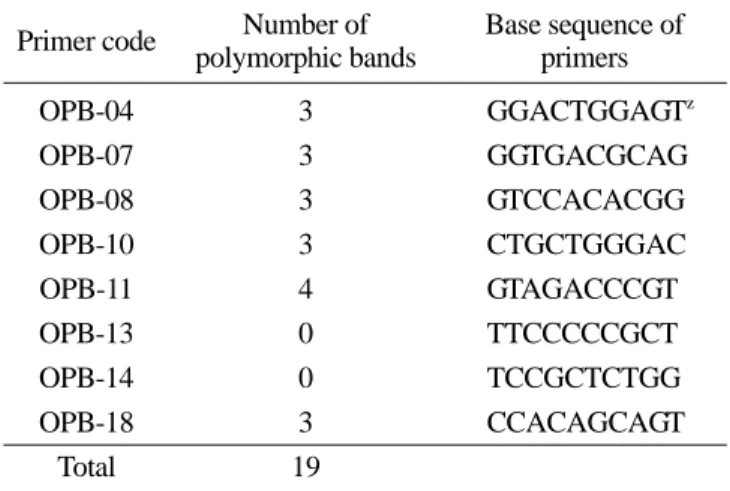
Nineteen polymorphic bands found from 8 random primers used for RAPD were analyzed with zoysiagrass species and 36 selected medium-leaf type zoysiagrasses (Fig. 1, Table 2). Genetic distances between all pairs of 41
zoysiagrass species and accessions were calculated from hybridization patterns obtained by 19 RAPD markers.
Dissimilarity coefficient (DC) 0 means the 19 RAPD markers have the very same patterns, and 1 means the 19 RAPD markers have completely different patterns (Fukuoka et al., 1992).
Dissimilarity coefficient of 41 zoysiagrass species and accession showed ranges from 0.00 to 0.736. The dissimilarity coefficient between ‘Zenith-M’ and ‘Zenith-C’
was 0.00, which means that they are very similar genetically.
Z. sinica and ‘CSM-8’ are relatively far apart among tested accessions and DC of them was 0.736 (Table 4). Accession
‘MJ8’ is the Z. japonica cv. Meyer introduced from US.
‘MJ8-7S’, ‘MJ8-9S’, and ‘MJ8-16S’ were progenies of artificially selfed ‘MJ8’. DC of these lines showed ranges from 0.157 to 0.421. But the open pollinated progenies of Z.
japonica cv. Zenith showed relatively narrower ranges from 0.00 to 0.105. It means ‘Meyer’ (MJ8) has wider genetic variation compared to ‘Zenith’ zoysiagrass.
Dissimilarity coefficient of 5 basic species and 7 medium- leaf type zoysiagrasses also were compared (Table 5). The DC between Z. tenuifolia and Z. matrella was 0.105, meaning very similar genetically compared to the other basic species (Z. japonica, Z. macrostachya, and Z. sinica).
DC of 0.210 between Z. macrostachya and Z. sinica also means genetic similarity of these two species. ‘Anyang1’,
‘Anyang2’, ‘Samdeock1’, ‘Samdeock2’, ‘Samdeock3’, and Table 2. Number of polymorphic bands of 8 random primers
used for RAPD analysis of 5 zoysiagrass species and 36 selected medium-leaf type zoysiagrasses.
Primer code Number of polymorphic bands
Base sequence of primers
OPB-04 3 GGACTGGAGTz
OPB-07 3 GGTGACGCAG
OPB-08 3 GTCCACACGG
OPB-10 3 CTGCTGGGAC
OPB-11 4 GTAGACCCGT
OPB-13 0 TTCCCCCGCT
OPB-14 0 TCCGCTCTGG
OPB-18 3 CCACAGCAGT
Total 19
zBase sequence from 5' to 3'.
Fig. 1. RAPD patterns of medium leaf types zoysiagrasses. Six primers, A through F, were Operon 10 mer kit B04, B07, B08, B10, B11, and B18, respectively. Line 1 to 16 is the same numbers of zoysiagrasses in table 1. Line M is the marker from a mixture of pBR322 digested with AvaII and PBR322 digested with both EcoRI, and AvaII.
Table 3. Binominal matrix from RAPD analysis of 5 zoysiagrass species and 36 selected medium-leaf type zoysiagrasses.
No. OPB-04 OPB-07 OPB-08 OPB-10 OPB-11 OPB-18
A B C A B C A B C A B C A B C D A B C
1 1 1z 0z 1 1 0 0 0 0 1 0 0 1 0 1 1 0 1 1
2 1 1 0 0 1 0 0 0 0 0 0 1 0 1 1 0 1 0 0
3 1 1 0 0 1 0 1 0 0 0 0 1 1 0 1 0 1 0 1
4 1 1 1 0 1 0 1 1 0 0 1 1 0 0 1 0 0 1 1
5 1 1 1 0 1 0 1 0 0 0 1 1 0 0 1 0 0 0 1
6 1 1 0 0 0 0 0 1 1 1 0 1 1 1 1 0 1 0 1
7 1 0 0 0 0 1 0 0 1 0 0 1 1 0 1 1 0 1 1
8 1 1 0 0 0 1 0 1 0 0 1 0 1 1 1 0 0 1 1
9 0 1 0 1 1 0 1 1 0 1 1 1 1 0 1 0 0 1 1
10 1 1 0 0 1 1 0 1 0 0 0 1 1 0 1 1 1 0 0
11 1 1 0 1 1 1 0 1 0 1 0 1 1 0 0 1 0 1 1
12 1 1 0 1 1 1 0 1 0 1 1 1 1 1 1 1 0 1 1
13 1 1 0 0 1 1 1 1 0 1 0 1 1 0 1 0 0 1 1
14 1 1 0 0 0 1 0 1 1 1 0 1 0 0 1 0 0 1 1
15 1 1 0 0 0 0 0 1 1 1 0 1 0 1 0 1 0 1 1
16 1 1 0 0 0 1 1 1 1 1 0 1 1 1 0 1 0 1 1
17 0 1 0 0 1 0 1 0 0 0 0 1 1 1 1 1 1 0 0
18 0 1 0 1 0 1 0 0 0 1 1 0 1 0 0 1 0 1 1
19 0 1 0 1 0 1 0 0 0 1 1 0 1 1 1 1 0 1 1
20 1 1 0 0 0 1 1 0 0 1 0 1 1 0 1 1 0 1 1
21 1 1 0 0 1 1 0 1 0 1 0 1 1 0 1 0 1 0 1
22 1 1 0 0 1 1 0 0 0 1 0 0 0 1 1 0 0 1 1
23 0 0 1 0 1 1 0 0 0 0 0 1 1 0 1 0 1 0 1
24 1 1 0 0 0 1 1 1 0 1 1 1 1 0 1 1 0 1 1
25 1 1 0 1 0 1 1 1 0 1 1 1 1 0 1 0 0 1 1
26 1 1 0 1 0 1 1 1 0 1 1 1 1 0 1 0 0 1 1
27 1 1 1 0 1 1 1 0 0 1 1 1 0 0 1 1 0 1 1
28 1 1 0 1 1 1 0 1 0 1 0 1 1 1 1 1 1 1 1
29 1 1 0 0 1 1 1 0 0 1 0 1 1 1 1 1 1 1 1
30 0 1 0 0 0 0 1 1 1 1 0 1 1 1 1 0 0 1 1
31 1 1 0 0 1 1 0 0 0 0 0 1 1 0 1 0 1 1 1
32 0 1 0 0 1 1 0 1 1 1 0 0 1 0 1 0 0 1 1
33 1 1 0 0 0 0 0 1 1 1 0 1 1 1 1 0 0 0 1
34 1 1 0 0 1 1 0 0 0 0 0 1 1 1 1 0 1 1 1
35 1 1 0 0 1 0 0 0 1 1 0 1 1 1 1 0 1 1 1
36 1 1 0 0 1 1 0 0 0 1 0 1 1 0 1 0 1 1 1
37 1 1 0 0 1 0 0 0 0 1 0 1 1 0 1 0 1 1 1
38 0 1 0 1 1 0 0 0 0 1 0 1 1 0 1 0 1 1 1
39 1 1 0 1 1 1 0 0 0 1 0 1 1 1 1 0 1 1 1
40 1 1 0 0 0 1 1 1 1 1 0 1 1 0 1 1 0 1 1
41 0 1 0 1 1 0 1 1 0 0 1 1 1 0 1 0 0 1 1
z1=band presence, 0=band absence.
‘Pyeongdong’ were commercially available medium-leaf type zoysiagrasses in South Korea. Their DC showed ranges from 0.105 to 0.315, meaning relatively similar genetics.
The DC between ‘Anyang1’ and ‘Anyang2’, which were collected from sod farms of different area, showed 0.157. Z.
koreana, ‘Samdeock1’, ‘Samdeock2’, and ‘Pyeongdong’
also showed similar genetic distances with ‘Anyang1’ and
‘Anyang2’. This may indicate that medium-leaf type zoysiagrasses used commercially in S. korea are not very different genetically.
Classification of medium-leaf type zoysiagrasses Based on the genetic distances, a dendrogram showing genetic relationships among 41 zoysiagrass species and accessions was constructed by SPSSWIN method (Table 3, Fig. 2). The 36 medium-leaf type varieties and accessions were divided into three major groups; Z. japonica based group (I), Z. sinica and Z. macrostachya based group (II), and Z. matrella and Z. tenuifolia based group (III).
‘Zenith’, ‘Meyer’ (MJ8 and I.Mey), which were developed in USA, and some breeding lines in Korea were Table 4. Squared Euclidean dissimilarity coefficient matrix of 5 zoysiagrass species and 8 artificially selfed and open-polli- nated progenies belonging to group I.
1 2 3 4 5 13 14 15 16 18 24 25 26
1. Z. japonica 0.000 2. Z. sinica 0.473 0.000 3. Z. macroz 0.368 0.210 0.000 4. Z. matrella 0.478 0.421 0.315 0.000 5. Z. tenuifolia 0.478 0.315 0.210 0.105 0.000 13. MJ8y 0.315 0.473 0.263 0.263 0.263 0.000 14. MJ8-7S 0.421 0.473 0.473 0.368 0.473 0.210 0.000 15. MJ8-9S 0.421 0.473 0.578 0.473 0.578 0.421 0.210 0.000 16. MJ8-16S 0.473 0.631 0.526 0.526 0.631 0.263 0.263 0.157 0.000 18. CSM-8 0.263 0.736 0.631 0.631 0.631 0.473 0.473 0.473 0.421 0.000 24. Zenith-F 0.368 0.631 0.421 0.315 0.421 0.157 0.263 0.368 0.210 0.315 0.000 25. Zenith-M 0.368 0.631 0.421 0.315 0.421 0.157 0.263 0.473 0.315 0.315 0.105 0.000 26. Zenith-C 0.368 0.631 0.421 0.315 0.421 0.157 0.263 0.473 0.315 0.315 0.105 0.00 0.000
zZ. macrostachya.
yZ. japoncia cv. Meyer introduced from USA.
Table 5. Squared Euclidean dissimilarity coefficient matrix of 5 zoysiagrass species and 7 medium-leaf type (Jungji) zoysiagrasses commercially used in South Korea belonging to group II.
1 2 3 4 5 29 34 35 36 37 38 39
1. Z. japonica 0.000
2. Z. sinica 0.473 0.000
3. Z. macrostachya 0.368 0.210 0.000
4. Z. matrella 0.478 0.421 0.315 0.000
5. Z. tenuifolia 0.478 0.315 0.210 0.105 0.000
29. Samdeock3z 0.315 0.368 0.263 0.473 0.473 0.000
34. Anyang1z 0.368 0.210 0.210 0.421 0.421 0.157 0.000
35. Anyang2z 0.315 0.263 0.263 0.473 0.473 0.210 0.157 0.000
36. Samdeock1z 0.263 0.315 0.210 0.421 0.421 0.157 0.105 0.157 0.000
37. Samdeock2z 0.210 0.263 0.157 0.368 0.368 0.210 0.157 0.105 0.052 0.000
38. Pyeongdongz 0.210 0.368 0.263 0.473 0.473 0.315 0.263 0.210 0.157 0.105 0.000 39. Z. koreana 0.263 0.315 0.315 0.526 0.526 0.157 0.105 0.157 0.105 0.157 0.157 0.000
zCommercial varieties (medium-leaf type) used in South Korea.
included in group I. Zoysiagrass was brought to the United States immediately prior to 1895 and Z. japonica, Z. matrella, and Z. tenuifolia were believed to be used as main materials for breeding (Diesburg, 1997). However, ‘Anyang’, ‘Samdeock’, and ‘Pyeongdong’ medium-leaf type zoysiagrasses which have
been used commercially in South Korea, were included in group II. It might be concluded that these commercial varieties are more similar to Z. sinica and Z. macrostachya than Z.
japonica. Z. sinica and Z. macrostachya and showed medium leaf widths of 2.9 mm and 3.4 mm, narrow leaf Fig. 2. Dendrogram of 5 zoysiagrass species and 36 selected medium-leaf type lines based on squared Euclidean dissimilarity distance from 19 RAPD markers. I : Z. japonica based group, II: Z. sinica and Z. macrostachya based group, III: Z. matrella and Z. tenuifolia based group.
angle, and long lowest leaf height. This means that the medium-leaf type zoysiagrasses (Jungji) may have limited adaptation to low mowing height. S4M2 was included in group III. This inbred line showed narrower leaf width resulting in higher visual quality but maybe with lower cold hardiness.
Average morphological characteristics of 3 groups were summarized in Table 6. Group I and group II showed similar leaf width from 3.27 mm to 3.36 mm. However, group I showed wider leaf angle than group II, which indicates horizontal leaf orientation of group I. Lowest leaf height that is the length of vertical stem plus lowest leaf sheath was significantly different between group I and group II. This difference may influence the practical mowing height.
Medium-leaf type zoysiagrasses belonging to group I may be mowed lower than the zoysiagrasses in group II. Group I zoysiagrasses are believed to have more trichomes while group II zoysiagrasses show more reddish color. Group III zoysiagrasses are finer in texture resembling Zoysia matrella. This group of zoysiagrasses can be bred into higher quality zoysiagrasses with further breeding efforts.
Acknowledgment
This study was supported by a grant from Korea Forest Services.
References
1. Choi, J.S. and G.M. Yang. 1996. PCR conditions for effective identification of Korean native zoysiagrass (Zoysia spp.) spe- cies by DNA polymorphism. J. Kor. Soc. Hort. Sci. 37(1):166- 170.
2. Choi, J.S., B.J. Ahn, and G.M. Yang. 1997. Classification of zoysiagrass (Zoysia spp.) native to the southwest coastal regions of Korea using RAPDs. J. Kor. Soc. Hort. Sci.
38(6):789-795.
3. Choi, J.S. and G.M. Yang. 2006. Sod production in South
Korea. Kor. J. Turf. Sci. 20(2):237-251.
4. Christians, N.E. 2007. Fundamentals of turfgrass management.
John Wiley & Sons, Inc. Hoboken, NJ, pp.63-65.
5. Christians, N.E. and M.C. Engelke. 1994. Choosing the right grass to fit the environment. pp.99-113. In: A.R. Leslie (ed.).
Integrated pest management for turf and ornamentals. CRC Press, Levis Publishers.
6. Diesburg, K.L. 1997. Zoysiagrass breeding in the United States.
International symposium of zoysiagrass breeding. Dankook Uni- versity, Korea. pp.9-14.
7. Emmons, R.D. 1995. Turfgrass science and management. Del- mar Publishers. pp.50-52.
8. Engelke, M.C., J.J. Murray, and D.Y. Yeam. 1983. Distribution, collection and use of zoysiagrass in the far east, part II. Agron- omy abstract p.125.
9. Fukuoka, H. 1997. Breeding of Zoysia in Japan. International symposium of zoysiagrass breeding. Dankook University, Korea. pp.1-8.
10. Fukuoka, S., K. Hosaka, and O. Kamijima. 1992. Use of ran- dom amplified polymorphic DNAs (RAPDs) for identification of rice accession. Jpn. J. Genet. 67:243-252.
11. Mo, S.Y. 1997. Analysis of genetic diversity for the accessions of zoysiagrass and their hybrid lines with morphological char- acteristics and RAPD markers. MS Thesis, Konkuk University, Korea.
12. Rogers, S.O. and A.J. Bendich. 1988. Extraction of DNA from plant tissue. Plant molecular biology manual A 6:1-10.
13. Ronghui, Li. 1993. Lawngrass of China. pp.896-897. In: R.N.
Carrow, N.E. Christians, and R.C. Shearman (eds.). 7th Inter- national Turfgrass Society Research Journal.
14. Ruemmele, B.A. and M.C. Engelke. 1990. Zoysiagrass culti- vars. Grounds Maintenance. April. pp.92-126.
15. Turgeon, A.J. 1991. Turfgrass management (3th ed.). Prentice Hall, Upper Saddle River, NJ. pp.77-104.
16. Wilkinson, J.F. and J.B. Beard. 1972. Electrophoretic identifi- cation of Agrostis palustris and Poa pratensis cultivars. Crop Sci. 12:383-384.
17. Yeam, D.H, J.J. Murray, and G.R. Bauchan. 1987a. Classifica- tion of zoysiagrass using morphological traits. J. Kor. Soc.
Table 6. Morphological characteristics of 3 groups of zoysiagrass classified using 19 RAPD markers.
Groupz Numbers of accession within group
Width of leaf blade (mm)
Leaf angle (o)
Lowest leaf heighty
(cm) Trichomex Stolon
colorw I 23 3.36±0.13 55±1.83 2.05±0.13 1.17±0.10 1.3±0.2v II 15 3.27±0.10 52±2.83 3.08±0.32 0.86±0.16 1.8±0.1 III 3 1.70±0.40 60±8.11 1.76±0.34 0.33±0.33 1.7±0.3
zGroup I : Z. japonica based group, II : Z. sinica and Z. macrostachya based group, III : Z. matrella and Z. tenuifolia based group.
yLowest leaf height : measured from the base of the ground to the top of the lowest leaf sheath.
xTrichome : 0=none, 1=only on upper side of leaf blade, 2=many on both sides of leaf blade.
wStolon color : 0=yellowish green, 1=light purple, 2=dark purple.
vMean±SE.
Hort. Sci. Abstract 5(1):128-129.
18. Yeam, D.H, J.J. Murray, and G.R. Bauchan. 1987b. Classifica- tion of zoysiagrass using isozyme traits. J. Kor. Soc. Hort. Sci.
Abstract 5(1):130-131.
19. Yoo, H.K. 1997. Comparison of genetic similarity among spe- cies and ecotypes of zoysiagrasses with that among species and cultivars of cool-season turfgrass using RAPD. MS Thesis,
Dankook University, Korea.
20. Yaneshita, M., R. Nagasawa, S. Kaneko, Y. Ogihara, and T.
Sasakuma. 1993. Genetic characterization of zoysiagrasses by RFLP analysis of nuclear DNA. pp.786-792. In: R.N. Carrow, N.E. Christians, and R.C. Shearman (eds.). 7th International Turfgrass Society Research
중엽형 한국잔디 (Zoysia spp.) 류의 형태적 특성과
RAPDs를 이용한 분류
최준수*
단국대학교 생명자원과학대학 녹지조경학과
요 약: 한국잔디류중 엽폭이 3~4 mm 정도를 보이는 중지류는 최근에 국내에서 가장 널리 이용되고 있는 잔디 이다. 본 연구에서는 한국잔디류 중 중엽형 36 계통과 기본 5종의 근연관계를 확인해 보고자 RAPD 방법을 사용 하였다. 형태적 특성조사는 엽폭, 잎각도, 최하위 잎의 잎집 길이, 엽모, 지상포복경의 색 등을 조사하였다. 여덟 개의 프라이머를 이용하여 19개의 RAPD 마커를 확인하였다. 마커를 이용하여 유전적 유사도를 조사한 결과
0~0.736의 유전적 변이정도가 확인되었다. RAPD 마커를 이용하여 분류한 결과 3개 군으로 나뉘어 졌다. 제1군에
는 들잔디와 함께 미국에서 육성된 ‘Zenith’, ‘Meyer’등이 포함되었다. 제2군에는 갯잔디, 왕잔디와 함께 ‘안양중 지’, ‘삼덕중지’, ‘평동중지’ 등이 포함되었다. 그리고 제3군은 제1군, 제2군과 비교해 유전적으로 거리가 멀게 나 타났으며, 금잔디와 비단잔디가 포함되었다. 한국에서 주로 이용되고 있는 ‘안양중지’, ‘삼덕중지’, 그리고 ‘평동중 지’ 류는 갯잔디 및 왕잔디와 유전적 유사도가 높은 것으로 나타났다.
주요어: 한국잔디, 잔디식별, 마이어, 제니스, 왕잔디, 갯잔디