Corresponding author:Hong, Jung-Kee, Policy Coordination Division, Ministry of Environment, Tel:+82-2-2110-6670, E-mail:[email protected]
Received:24 May, 2010. Accepted:14 June, 2010.
- 103 -
Expectation-performance Analysis
on Natural Landscape Review Program in Korea
Lee, Gwan-Gyu
1)and Hong, Jeong-Kee
2)1)
College of Forest Environment & Science, Kangwon National University,
2)
Policy Coordination Division, Ministry of Environment.
자연경관심의제 도입의 기대-성과 분석
이관규
1)․홍정기
2)1)
강원대학교 산림환경과학대학․
2)환경부 정책총괄과
국문요약
본 연구는 환경부 주관으로 2006년부터 시행되어 온 자연경관심의제도의 제도 도입 당시의 기대수 준과 현재의 성과수준을 분석함으로써 발전방향을 모색하고자 진행되었다. 동 제도를 도입함으로써 얻고자 하였던 목표와 효과를 분석변수로 설정하고 당시의 기대수준과 제도도입 약 4년이 지난 2010 년도 시점의 기대치 달성 성과수준을 비교하였다. 자연경관심의위원 전원을 대상으로 설문조사를 시 행하여 분석하였으며, 비교결과 도출된 기대와 성과의 불일치 수준을 분석하고 그 원인을 고찰하였다.
그 결과, 제도 도입시 기대수준은 3.79, 성과수준은 3.09으로 나타나 당초 기대에 비해 그 성과가 다소 낮은 것으로 평가되었다. 성과가 기대에 미치지 못한 주요 항목은 자연경관을 고려한 개발사업계획 수준 제고(-2.91), 경관개선 실천성 제고(-2.97), 자연경관자원 주변경관의 개선(-3.00)으로 나타났다.
이와 같은 결과를 고찰하여 동 제도의 발전방향으로 심의절차개선과 홍보강화, 자연경관심의위원 전 문성 확보, 심의내용과 범위 개선, 심의기준 객관화, 전문가 참여 의무화를 단기적 발전과제로 도출하 였다. 중장기적으로는 계획적 접근에 의한 경관관리 및 심의와 자연경관보전자원의 대상과 개념을 시각적 자원 뿐만 아니라 생태적 자원으로도 확장시켜야 함을 제안하였다.
Key Words:
경관, 환경계획, 경관관리, 경관평가, 경관영향I. Introduction
As natural landscapes have multi-functions and multi-effects including economic and eco-environmental values as well as psychological and physiological treatment (Parsons, 1991), a need to conserve, restore and manage natural landscape resources have emerged (Dearden, 1985; Japanese Natural Environment Research Center, 1995; Byeon et al., 2000; Yoo et al., 2002). Since it requires a lot of time and money to restore, if at all possible, once the natural landscape is destroyed, it is important to minimize the destruction and maximize conservation and preservation by assessing and analysing beforehand rather than end-of-pipe measures (Choi et al., 2004; Song et al., 2007).
Therefore, Ministry of Environment has introduced the Natural Landscape Review Program in order to analyse and predict in advance, and to reduce impact from all kinds of development plans and projects on landscapes.
The Natural Landscape Review Program (NLRP) is enforced by Ministry of Environment in accor- dance with Natural Environment Conservation Act. After the revision of the Act in 2004, the program has been in operation since January 1, 2006. The Program reviews the development projects within a certain distance from protected areas, e.g. natural parks, ecology and landscape conservation areas, and protected swamp areas, which are subject to Prior Environmental Review System (PERS) and Environmental Impact Assess- ment (EIA). 1) NLRP also controls the develop- ment projects in the areas other than the protected areas which are designated by a Presidential Decree out of those which are subject to the 1) Article 28, Natural Environment Conservation Act.
review of PERS and EIA. It is stipulated that the Program should review mainly on whether the natural landscapes are destroyed, whether the sites, types, colors, heights and scales are harmo- nious, and the possibility of whether a landscape might change from the project when seen from major observatories.
According to the statistics since its launch in 2006 to May 2007, among a total of 6,290 environmental review cases, 414 have undergone NLRP (Ministry of Environment, 2007c), which implies that the number of NLRP cases increases in proportion to the number of PERS and EIA cases. Currently, duplication with existing PERS, professional capacity of the landscape review com- mittee, relations with similar systems conducted by other departments, and the scope of projects subject to NLRP are under debate.
At this point of the first half of 2010, where three years have passed since its outset, this study aims to provide directions for improvement by examining problems of NLRP and quantitatively analyzing the initial expectations and performances of the system.
II. Methods and materials
In order to analyze the initial expectation level
and the current performance level, variables were
set for this purpose and a survey was conducted
to NLRP commissioners. Then, expectation and
performance values by each variable were quanti-
tatively analyzed, and the interpretation was made
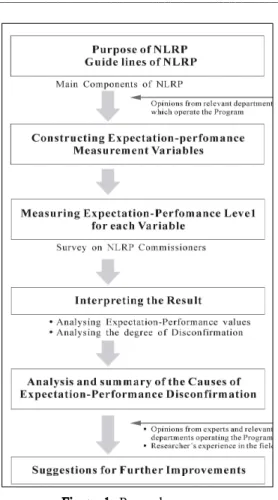
on the cause of disconfirmation (Figure 1). The spe-
cific methodology for the research is as follows:
Figure 1. Research process.
1. Expectation and performance variable
In order to set the variables to measure initial expectations of the NLRP, main components of NLRP guidelines of both past and present were examined (Ministry of Environment, 2005; 2007a;
2007b). This is because the main components of NLRP presented in the guidelines are deemed to be expectations of NLRP, hence they can used as variables for assessing expectation-performance assessment. Main components of NLRP guidelines and the purposes of introducing the Program lie in conserving natural landscapes effectively, reduc- ing the impact of development projects which affect the surrounding landscapes that require conservation, and improving professional capacity of landscape plans. There was improving objec-
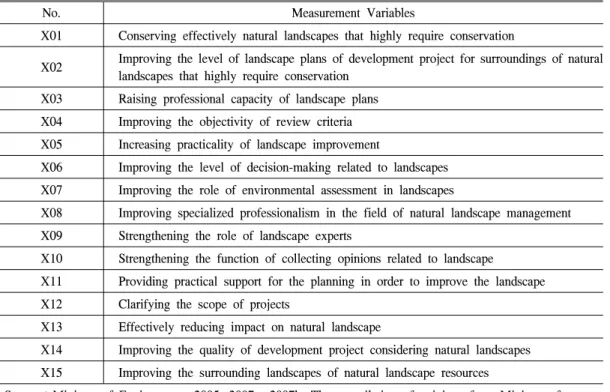
tivity of landscape plans. This was summarized as raising the objectivity of NLRP, increasing practicality of landscape improvement, strength- ening the function of collecting opinions and the role of landscape experts (Ministry of Environment, 2005; 2007a; 2007b). By compiling opinions of relevant departments of Ministry of Environment, initial expectations on the Program-clarifying the scope, reducing practical impact on natural land- scape, taking natural landscape into consideration when planning a development project, and practi- cally improving the surroundings of landscapes that require conservation-are organized as 15 expectation- performance level measurement variables, which are laid out in Table 1:
2. Expert suvery
A survey was conducted to experts who take an active part as NLRP commissioners, to public servants in Ministry of Environment and its regional environmental offices, and to EIA agencies. Ques- tionnaires were distributed in May 2008 and May 2009, and 32 responses from NLR commissioners, 18 from Ministry of Environment and its regional offices, 17 from EIA agencies were collected, and three responses could not be analyzed, hence a total of 66 were used for analysis. The rationale for the selection was for their nation-wide location and their long experience with various types of projects, and thus they were considered as experts who can present practical and valuable opinions on the expectations and performances of the Program.
3. Methods of Measurement and Survey
Five-step Likert scale for expectation and per- formance of NLRP constructed for each variable so as to compare expectations and performances.
In addition, the causes of disconfirmation between
No. Measurement Variables
X01 Conserving effectively natural landscapes that highly require conservation
X02 Improving the level of landscape plans of development project for surroundings of natural landscapes that highly require conservation
X03 Raising professional capacity of landscape plans X04 Improving the objectivity of review criteria X05 Increasing practicality of landscape improvement
X06 Improving the level of decision-making related to landscapes X07 Improving the role of environmental assessment in landscapes
X08 Improving specialized professionalism in the field of natural landscape management X09 Strengthening the role of landscape experts
X10 Strengthening the function of collecting opinions related to landscape
X11 Providing practical support for the planning in order to improve the landscape X12 Clarifying the scope of projects
X13 Effectively reducing impact on natural landscape
X14 Improving the quality of development project considering natural landscapes X15 Improving the surrounding landscapes of natural landscape resources
sSource:Ministry of Environment, 2005; 2007a; 2007b; The compilation of opinions from Ministry of Environment and regional offices were organized according to the purpose of this study.
Table 1. The outcome of setting variables for expectation-performance measurement.
Please assess the initial expectations and the present performances with regard to Natural Landscape Committee Program
Initial Expectation Current Performances If the performance fail to meet the expectation, please briefly describe the causes
The effects of the Program
will be: The effects of the Program
are:
very high high average low none very
high high average low none 1. Conserving effectively natural
landscapes that highly require conservation
2. Improving the level of landscape plans of development project for surroundings of natural landscapes that highly require conservation
… 16. others
Table 2. Standards and the main method of the survey.
initial expectations and performances for each variable, if found, were to be explained in qual- itative manner by the experts (Table 2). Moreover,
the field “others” was included in order to accom-
modate their own assessments other than the ones
suggested by the questionnaire.
4. Interpertation of the result
After comparing average values between expec- tations and performances for each variable, the differences between them were interpreted as expectation-performance disconfirmation. By order- ing the scale of differences, the ranks of expec- tation-performance disconfirmation for each variable was evaluated and the causes of disconfirmation were interpreted. The causes of disconfirmation were compiled and analyzed from qualitative responses. The test for significance regarding the differences of the values between expectations and performances was made with t-test of significance level 0.05. To analyze and verify whether there are differences depending on different group of respon- dents, ANOVA of significance level 0.05 was conducted. Microsoft Excel 2003 was used for the compilation and analysis of the data, and SPSS ver.11 was used for statistical analysis.
5. Expectation-performance disconfirma- tion analysis and suggestions for future improvements
For each variable which had higher expectation- performance disconfirmation, all the explanations were taken into account, and common factors were induced so as to analyze the causes of expectation- performance disconfirmation. Measures to solve the common issues were sorted by causes, and they were divided into short- and mid/long-term objectives as suggestions for future improvements.
III. Result and discussion
1. Expectation level
The expectation level of the total variables recorded mean 3.79 within a range of the highest value 5 to the lowest 1. This implies that in terms
of expectation level at its outset, experts mostly perceived that the effects of NLRP would gen- erally be “high”. In particular, they expected:
natural landscapes which highly require conservat- ion can be effectively conserved (X01, 4.22), the role of environmental assessment in landscapes can be increased (X07, 4.09), role of landscape experts would be strengthened (X09, 4.00), and level of landscape plans of development projects for surroundings of natural landscapes that highly require conservation would be raised (X03, 3.91).
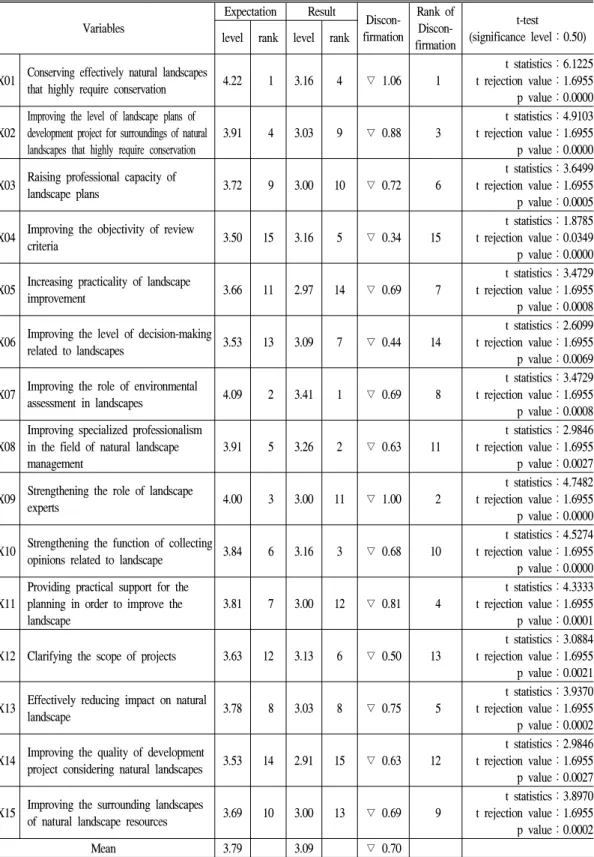
All the variables were distributed among “very high (5)”, “high (4)”, “average (3)”, with the lowest being 3.50 and the highest 4.22, which can be inferred that all the respondents judged that the expected effects of introducing NLRP was positive (Table 3).
2. Performance level
The performance level of all the variables recorded an average of 3.09. This implies that the performance of NLRP about two and a half years after its launch was assessed at average. In par- ticular, increasing the role of environmental assess- ment in landscapes (X07, 3.41), increasing special- ized professionalism in the field of natural landscape management (X08, 3.26), and collecting opinions related to landscape (X10, 3) are the performance level in descending order. No perfor- mance level was higher than that of the expectation.
The lowest was improving the quality of develop-
ment project considering natural landscapes (X14)
which recorded 2.91, and increasing practicality
of landscape improvement (X05, 2.97). These
recorded below average. Majority of experts did
not consider that the level of development project
plans did not improve even though NLRP was
implemented, and further, they believe the Program
Variables Expectation Result Discon- firmation
Rank of Discon- firmation
t-test (significance level:0.50) level rank level rank
X01 Conserving effectively natural landscapes that highly require conservation 4.22 1 3.16 4 ▽ 1.06 1 t statistics:6.1225 t rejection value:1.6955 p value:0.0000 X02 Improving the level of landscape plans of
development project for surroundings of natural
landscapes that highly require conservation 3.91 4 3.03 9 ▽ 0.88 3 t statistics:4.9103 t rejection value:1.6955 p value:0.0000 X03 Raising professional capacity of landscape plans 3.72 9 3.00 10 ▽ 0.72 6 t statistics:3.6499 t rejection value:1.6955 p value:0.0005 X04 Improving the objectivity of review criteria 3.50 15 3.16 5 ▽ 0.34 15 t statistics:1.8785 t rejection value:0.0349 p value:0.0000 X05 Increasing practicality of landscape improvement 3.66 11 2.97 14 ▽ 0.69 7 t statistics:3.4729 t rejection value:1.6955 p value:0.0008 X06 Improving the level of decision-making related to landscapes 3.53 13 3.09 7 ▽ 0.44 14 t statistics:2.6099 t rejection value:1.6955 p value:0.0069 X07 Improving the role of environmental assessment in landscapes 4.09 2 3.41 1 ▽ 0.69 8 t statistics:3.4729 t rejection value:1.6955 p value:0.0008 X08 Improving specialized professionalism
in the field of natural landscape
management 3.91 5 3.26 2 ▽ 0.63 11 t statistics:2.9846
t rejection value:1.6955 p value:0.0027 X09 Strengthening the role of landscape experts 4.00 3 3.00 11 ▽ 1.00 2 t statistics:4.7482 t rejection value:1.6955 p value:0.0000 X10 Strengthening the function of collecting opinions related to landscape 3.84 6 3.16 3 ▽ 0.68 10 t statistics:4.5274 t rejection value:1.6955 p value:0.0000 X11 Providing practical support for the
planning in order to improve the
landscape 3.81 7 3.00 12 ▽ 0.81 4 t statistics:4.3333
t rejection value:1.6955 p value:0.0001 X12 Clarifying the scope of projects 3.63 12 3.13 6 ▽ 0.50 13 t statistics:3.0884 t rejection value:1.6955 p value:0.0021 X13 Effectively reducing impact on natural landscape 3.78 8 3.03 8 ▽ 0.75 5 t statistics:3.9370 t rejection value:1.6955 p value:0.0002 X14 Improving the quality of development project considering natural landscapes 3.53 14 2.91 15 ▽ 0.63 12 t statistics:2.9846 t rejection value:1.6955 p value:0.0027 X15 Improving the surrounding landscapes of natural landscape resources 3.69 10 3.00 13 ▽ 0.69 9 t statistics:3.8970 t rejection value:1.6955 p value:0.0002
Mean 3.79 3.09 ▽ 0.70
Table 3. Result of analysis on responses from the survey.
was not linked to actions for landscape improve- ment (Table 3).
3. Degree of Expection-Performance Dis- confirmation
Analyzing the degree of expectation-performance disconfirmation in all the variables, there was not a single variable that recorded higher performance than what was expected, and the mean value was recorded at 0.70, meaning that they are under- evaluated as less than the expectation level. In particular, conserving effectively natural landscapes that highly require conservation (X01), strength- ening the role of landscape experts (X09), improv- ing the level of landscape plans of development project for surroundings of natural landscapes that highly require conservation (X02), providing practical support for the planning in order to improve the landscape (X11) recorded -1.06, -1.00, -0.88, -0.81 of the highest disconfirmation level, respectively.
It was highly expected that the Program would be able to conserve the natural landscape resources that highly require conservation, but the actual performance of NLRP at an early stage was under-evaluated at an average. The surrounding landscapes of development project which have high value of conservation were expected to be controlled very effectively, but the performance was also under-evaluated at an average. It was expected that establishment of plans for improve- ment of the level of landscapes would improve in qualitative terms, but the performance was eval- uated at an average (Table 3).
4. Causes of Disconfirmation
The expert opinions on the causes of discon- firmation with regard to main variables were
analyzed and common issues were induced from the process. Despite operation of NLRP, the main causes of not having the performance than expected in effectively conserving landscapes that highly require conservation are:first, perfunctory assess- ment reports; second, the limited scope covering only the area within the project and the lack of ability to control the surroundings; third, difficulty in judging the conservation effects only with a report; and fourth, difficulty in planning a practical alternative.
The roles of actual landscape experts were not strengthened and the level of their participation was low, because:first, lack of experts; second, lack of public relations of NLRP. In particular, it was frequently criticized the incapacity or inap- propriateness of the experts who nevertheless participated in drafting landscape review report.
The causes of the performance lower than the
expectation level with regard to improving the
level of landscape plans of development project
for surroundings of natural landscapes that highly
require conservation were:first, the limited scope
covering only the area within the project; second,
difficulty in judging the local landscape deterio-
ration only with a report; third, lack of practical
measures to improve landscapes; and fourth,
insufficient understanding at the early stage of
landscape plan on ways to reflect landscape
resources which require conservation. The causes
of not meeting the expectation that practical
support for the planning in order to improve the
landscape would be provided were:first, lack of
understanding of reviewers on guidelines and
passive reviews; second, lack of public relations
and lack of connection with land use and landscape
plan.
5. Suggestions for Further Improvements
By analyzing experts' qualitative responses as to the causes of expectation-performance discon- firmation, common causes were induced, and then short- and mid/long-term measures were sorted out and organized as follows:
1) Short-term measures
In short term, it is assumed that practical improvements can be achieved through amending the current system.
Firstly, the process of reviews should be im- proved and public relations should be strengthened.
When it is assumed that the impact on landscape is insignificant, the process of natural landscape review should be simplified. In this case, a method to judge the significance of the impact on landscape is required, and alternatives are the scoping method and positive-list screening method.
In the case of scoping, whether or not the review should be applied can be decided by hearing the opinions of the Environmental Review Council (when a project is subject to prior environmental review) or the those of the Scoping Committee (when subject to EIA), which will be made oblig- atory. In this case, cooperation and inter-linked operation would be necessary due to the difference between the related law and the department who management the system. In the case of positive- list screening, since currently the scope for the review is fairly extensive, it is a procedural method to, on the one hand, strengthen the review for the projects subject to NLRP, and on the other hand, simplify or omit the process for those that are not or those that are listed. The period of review is also important for the improvement of the process.
The procedure and institutional tools should be improved so that NLRP would be made at the
stage of location and land use planning, and suggestions for landscape impact reduction should also be reflected in real terms. The current proce- dure already provides for such measures, but it is hardly conducted at the appropriate time, and many are deemed perfunctory. Therefore, it is necessary to introduce the public relations method as an alternative.
Secondly, professionalism of NLRP Committee needs to be secured. By amending the requisites for the committee could help secure professionalism as a preliminary measure. In particular, we need an institutional mechanism that would take into account the experiences, knowledge and researches with respect to landscape review for the committee composition.
Thirdly, the components and the scope of review should be improved. Currently, the main contents of review are landscape axis, whether landscapes are destroyed, harmony with the sur- roundings, impact reduction measures, change prediction and assessment, whereas the results of review that are to be reflected into the project are usually “location adjustment”, “density adjustment”,
“color adjustment”, “utilization of plant materials”,
“afforestation of surroundings”, “afforestation of
buildings”, etc. “within the site”, which seem rather
limited and passive. It is worth considering the
introduction of measures such as landscape agree-
ment, landscape restoration system, to reduce the
landscape impact to areas other than the project
side. Unnecessary reviews and procedures can be
reduced by distributing impact reduction manuals
for linear and area projects and by providing
measures for consideration in advance to reflect
the usual comments. The effect of impact reduction
measures for each cases is expected to be
doubled when it is analyzed in conjunction with
PERS by comparing at the review stage the opinions for landscape impact reduction with landscape impact and impact reduction measures and their expected results for each case.
Fourthly, the criteria should be more scientific and it needs to be improved. The key criteria for the landscape impact assessment, alternatives comparison, impact reduction effect analysis, etc.
is the “viewpoint”, and hence it is imperative to provide for more objective viewpoint selection criteria and procedure. The standard and method- ologies for selecting viewpoint, view lines, and view areas, and the distinction between linear and area projects needs to be made. In addition, objective methodologies are required for view landscape simulation from viewpoint. A subtle change in angle, camera height, balanced, etc. can result in huge differences in the landscape simu- lation, consequently there is a need to establish a standardized methodologies. With current guide- lines, the objectiveness is yet to be attained.
Fifthly, landscape simulation and its analysis and interpretation should be conducted by experts or competent institutions. As alternatives, require- ments for natural landscape impact assessment review drafting agencies under the Natural Environ- ment Conservation Act can be established, or requirements for natural landscape impact assess- ment review or landscape review drafting can be established among EIA report drafting agencies.
2) Mid-and long-term measures
Firstly, the extent of resources that are subject to natural landscape conservation should be enlarged. For this, we need to update the definition of natural landscape, which in the past the review was focused on the visual side of landscape. Now the ecological resources inherent in natural land-
scape should also be the subject of conservation.
Re-establishing the date for landscape conservation and restoration should also be improved. It is more than necessary to strengthen the past view- point decision-making process of view point within the site or in the order of viewpoint, project site, and natural landscape and its analysis and interpretation. It is also necessary to broaden the landscapes subject to landscape management, from the site that needs landscape conservation over to landscape-viewing areas.
Secondly, the conversion to pre-planning land- scape management system is required. It is neces- sary to establish measures to include landscape planning and management or to prepare a separate plan for natural parks, swamp conservation areas, ecological landscape conservation areas. Within the protected areas and within certain distance from the boundary, it is necessary to adopt measures to establish landscape management plans.
Regarding the contents of landscape plan, internal and external viewpoints, view lines, view areas, open space for viewing, guidelines for building landscape design, guidelines for road-side landscape need to be taken into account. A separate plan needs to be established for each locality, measures should be provided to allow for the plan needs to be periodically reviewed for amendments, and measures to secure local participation at the plan- ning stage should be adopted.
Thirdly, systematic approach needs to be
adopted. When development projects are under
way near the conservation areas, establishment of
landscape plans should be mandatory. The land-
scape plan should include the following:review
of landscape management plan for conservation
areas and its incorporations; establishment of view-
points, view lines, view areas; open space for
viewing; plan to secure skyline, building landscape plan (color, structure, density, land use and location relations), landscape agreement, local participation, etc.
IV. Conclusion
In order to provide directions for further im- provements of NLRP, this study conducted mea- surement and comparative analyses of the level of initial expectations and performances through experts survey, and reached the following conclusions:
1. The expectation level for the development on the field of natural landscape through NLRP was high with 3.79 on average. In particular, it was expected that natural landscapes that highly require conservation could be effectively conserved, the role of environmental assessment in the field of landscape would be improved, the role of landscape experts would be strengthened, and the level of landscape plans of development project for surroundings of natural landscapes that highly require conservation would also be improved.
2. The performances level of the Program, however, was recorded at an average level of mean 3.09, which failed to meet the expectations.
The performances did not live up to the expec- tations for all the variables. The lowest perfor- mance level was 2.91 for “Improving the quality of development project considering natural land- scapes” and “Increasing practicality of landscape improvement”. Most experts did not consider the level of development project plan to be raised through the introduction of NLRP.
3. Expectation-performance disconfirmation was recorded at more than 0.70 on average, which implies that it was valued below expectation level.
Although natural landscape resources that highly
require conservation were expected to be effec- tively conserved, the performance of actual early operation of the system was valued lower at an average level. In addition, the role of landscape experts was expected to be strengthened, but the performance was at an average level. It was expected that the level of landscape plans of development project for surroundings of natural landscapes that highly require conservation would be controlled very effectively, but the performance was valued lower at an average level. It was also expected that plan to improve the landscape would be improved in qualitative terms, but the perfor- mance of the Program was valued at an average level.
4. The causes for expectation-performance dis- confirmation for key variables include:perfunctory assessment report; limitation of scope within the project site and the actual lack of capacity to control the surroundings; difficulty in judging only with the report on whether the resources have high conservation effects; difficulty in providing practical alternatives; lack of experts; lack of public relations of the Program; unqualified experts or non-experts in the field of landscape; lack of actual landscape improvement measures; reviewers' low understanding on guidelines and their passive reviews; lack of connection between the land use and the landscape plan.
5. For future improvements of the Program, the
following were suggested:in short term, improv-
ing review procedures and strengthening public
relations, securing professionalism of NLRP com-
mittee, improving the contents and scope of the
review, more scientific review criteria, mandatory
participation of competent institutions and experts
in the field of landscape; and in mid- and long-
term, re-establishing subject-matter and concept
of natural landscape conservation resources; tran- sition to pre-planning landscape management sys- tem; measures to improve NLRP through system- atic approach. Landscape experts need to understand the unique nature of the complex and multilateral field of landscape, and have a keen insight to view development projects in an integrated and holistic manner. This study requires further research in order to complement the limitations of not including the opinions of those that are subject of the natural landscape review.
Acknowlegement
I would like to convey my deepest appreciation to NLRP commissioners who, despite their tight schedule, have actively and voluntarily responded to the survey. This study was fulfiled by the support of the Institute of Forest Science, Kangwon Nation- al University.
Reference