음성인식에서 주 성분 분석에 의한 차원 저감
이창영*
Dimensionality Reduction in Speech Recognition by Principal Component Analysis
Chang-Young Lee
*요 약
이 논문에서 우리는 MFCC 특징벡터의 차원 저감을 통해 음성 인식에서의 계산량을 줄이는 방법을 조사한 다. 특징벡터의 특성분해는 벡터의 성분을 분산의 크기에 따라 배치되도록 선형 변환 시켜준다. 첫 번째 성분 은 가장 큰 분산을 가져서 패턴 분류에서 가장 중요한 역할을 한다. 따라서, 분산이 작은 성분들을 제외시키 는 차원 저감을 통하여, 계산량을 줄이면서 동시에 음성 인식 성능을 저하시키지 않는 방법을 생각할 수 있 다. 실험 결과, MFCC 특징벡터의 성분을 절반 정도로 줄여도 음성인식 오류율에 큰 악영향이 없음이 확인되 었다.
ABSTRACT
In this paper, we investigate a method of reducing the computational cost in speech recognition by dimensionality reduction of MFCC feature vectors. Eigendecomposition of the feature vectors renders linear transformation of the vectors in such a way that puts the vector components in order of variances. The first component has the largest variance and hence serves as the most important one in relevant pattern classification. Therefore, we might consider a method of reducing the computational cost and achieving no degradation of the recognition performance at the same time by dimensionality reduction through exclusion of the least-variance components. Experimental results show that the MFCC components might be reduced by about half without significant adverse effect on the recognition error rate.
키워드
Dimensionality Reduction, Speech Recognition, Computational Cost Reduction, Principal Component Analysis 차원 저감, 음성 인식, 계산 비용 저감, 주 성분 분석
* 교신저자(corresponding author) : 동서대학교 산업경영공학과([email protected])
접수일자 : 2013. 07. 03 심사(수정)일자 : 2013. 08. 23 게재확정일자 : 2013. 09. 23
I. Introduction
The state-of-the-art technology in the field of speech recognition has now reached such a level of performance and robustness that permits lots of daily applications. As a result, we are now living in a world of various appliances which deploy the
relevant technologies [1-7].
Redundancy is unavoidably inherent in any kind of information. There are four major causes for it:
hardware, information, time, and software. In some
applications, redundancy is utilized to improve the
system performance [8-11]. For example, difference
in perception between natural speech and
high-quality synthetic speech is inferred to be due to the redundancy of the acoustic-phonetic information encoded in the speech signal. Therefore, in this case, it is better not to remove redundancy for natural speech [12]. There are many other instances, on the other hand, that redundancy reduction enhances the relevant performance [13].
The ultimate goal in regards to the redundancy is to pursue both maximum relevance and minimum redundancy (MRMR) at the same time [14].
The speech signal is in itself somewhat redundant and it is usual to extract feature vectors that contain useful information in a reduced size.
One of the popular feature vectors is mel-frequency cepstral coefficients (MFCC), which is commonly adopted in speech recognition.
The number of components in MFCC is usually taken to be 13 on empirical grounds [15]. In this paper, as a means for decreasing the calculational cost without deteriorating the recognition performance, we investigate a method of reducing the MFCC components by principal component analysis (PCA) [16].
The organization of this paper is as follows.
Section II provides a brief description on PCA.
Section III describes details of the experiments performed in our study. In section IV, experimental results are presented to demonstrate the efficacy of the method. Concluding remarks are given in section V finally.
II. Principal Component Analysis
Given a set of vectors
x
∈
∼ (1)
the mean vector ∈
is first estimated:
x
(2)
The new vectors with zero mean are obtained by
y
x
∼ (3)
Correlation matrix for new vectors are then estimated to be
∼ ∼ (4)
The eigenvalue equation is given by
R q
q
∼ (5)
the eigenvalues of which,
, are assumed to be arranged in descending order as follows:
≥
≥ ⋯ ≥
(6)
The normalized eigenvectors
∼
form a set of basis vectors in the transformed vector space. The vectors transformed by
∼ ∼ (7)
are said to have "the principal components".
This transformation is defined in such a way that the first principal component has the largest possible variance (that is, accounts for as much of the variability in the data as possible), and each succeeding component in turn has the highest variance possible under the constraint that it be orthogonal to (i.e., uncorrelated with) the preceding components.
PCA is the simplest of the true eigenvector-
based multivariate analyses. Often, its operation can
be thought of as revealing the internal structure of
the data in a way that best explains the variance
in the data. If a multivariate data set is visualized as a set of coordinates in a high-dimensional data space (1 axis per variable), PCA can supply the lower-dimensional picture, a "shadow" of this object when viewed from its most informative viewpoint.
This is done by using only the first few principal components so that the dimensionality of the transformed data is reduced.
III. Reducing MFCC Orders with PCA
By applying PCA on MFCC and adopting the components of large variances, we reduced the calculational cost. For evaluation of the proposed methods, we consider two independent approaches.
The first one is the speech recognition performance.
The second approach, a supplement to the first one, is concerned with the separability of MFCC feature vectors. For this purpose, we employ the Fisher discriminant objective function.
Pattern classification is a very important task in many fields such as data mining, image and speech coding, pattern recognition, and other statistical analyses. An efficient procedure for this job should have the objective of separating the classes in multi-dimensional data space as discriminatively as possible. In pattern classification, separability of patterns is usually estimated by the Fisher discriminant objective function given by
.
and
represent the between-class and within-class scatters respectively, which are expressed by
∈
's are feature vectors and
denotes the -th class.
and represent mean values for the
class
and for the whole feature vectors respectively. Given a set of feature vectors, principal component analysis and/or discriminant analysis might be utilized to find transformations of the extracted MFCC vectors aiming at efficient separability [19-20].
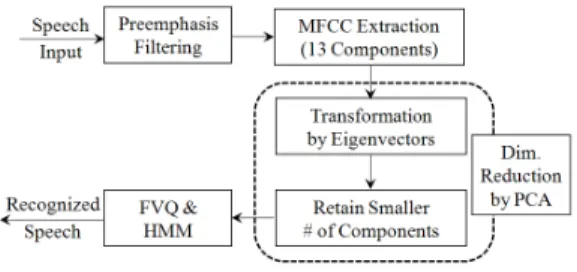
Figure 1 shows block diagram of the speech recognition with dimensionality reduction by PCA.
The procedure without the broken box corresponds to the conventional method.
Fig. 1 Block diagram of the speech recognition with dimensionality reduction by PCA
IV. Experimental Results and Discussion
Our experiments were performed on a set of phone-balanced 300 Korean words. To see the effect of vocabulary size also, we divided the words into three sets as in Table 1. The sets A and B are disjoint each other and C is the union of them.
Table 1. Three sets of speech data divided for studying the effect of the vocabulary size
Word Set Number of Words
A 100
B 200
C 300
Forty people including 20 males and 20 females
produced the speech and the utterance tokens were
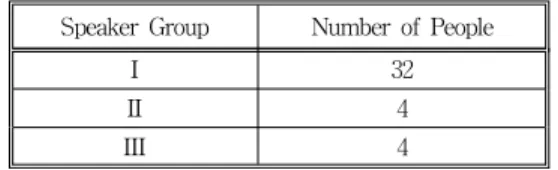
divided into three disjoint groups as in Table 2.
Table 2. Division of the 40 people's speech production into three groups
Speaker Group Number of People
I 32
II 4
III 4
Thirty-two people's speech tokens of the group I were used in generating codebooks of size 512, whose centroids serve for fuzzy vector quantization (FVQ) of all the speeches of 40 people. HMM parameters were updated on each iteration of training epoch. In order to choose which values of parameters to use in the final test of speech recognition, some test speeches are necessary. The parameters that yield the best performance on the group II were stored and used for the test on the group III to obtain the final performance of the speaker-independent speech recognition system.
This prescription prevents the system from falling (overfitting) too deep into the local minimum driven by the training samples of the group I and hence becoming less robust against the speaker- independence when applied to the group III. It is a good strategy for balance between memorization and generalization [17].
The speech utterances were sampled at 16 kHz and quantized by 16 bits. 512 data points corresponding to 32 ms of time duration were taken to be a speech frame for short-term analysis.
To each frame, Hanning window was applied after pre-emphasis for spectral flattening. MFCC feature vectors of order 13 were obtained and then cepstral mean subtraction (CMS) were applied on utterance basis to endow robustness against various adverse effects such as system dependence and noisy environment.
Codebooks of 512 clusters were generated by the K-means clustering algorithm on the MFCC feature vectors obtained from the speeches of the group I
the codebook centroids were calculated and sorted.
Appropriately normalized fuzzy membership values were assigned to the nearest two clusters and a train of two doublets (cluster index / fuzzy membership) were fed into HMM for speech recognition processing.
For the HMM, a non-ergodic left-right (or Bakis) model was adopted. The number of states that is set separately for each class (word) was made proportional to the average number of frames of the training samples in that class [18]. Initial estimation of HMM parameters was obtained by K-means segmental clustering after the first training. This procedure facilitates the convergence of the parameters so fast.
Backward state transitions were prohibited by suppressing the state transition probabilities
with to a very small value but skipping of states was allowed. The last frame was restricted to end up with the final state associated with the word being scored within a tolerance of 3.
Parameter reestimation was performed by Baum-Welch reestimation formula with scaled multiple observation sequences to avoid machine errors that might be caused by repetitive multiplication of small numbers. After each iteration, the event observation probabilities
were boosted above a small value.
Three features were monitored while training the HMM parameters: (1) the recognition error rate for the group II of Table 2, (2) the total probability likelihood of events summed over all the words of the training set according to the trained model, and (3) the event observation probabilities for the first state of the first word in the vocabulary list.
Training was terminated when the convergences for these three features were thought to be enough.
The parameter values of that give the best result for the group II were stored and used in speech recognition test on the group III.
Figure 2 shows the variances for MFCC feature
vector components with and without application of PCA.
Fig. 2 The variances for MFCC feature vector components with and without application of PCA
We see that the first few components have relatively large variances. Another feature is that the effect of PCA is slightly meaningful only for the first two components. This means that the feature vectors are already distributed almost along the principal axes.
As for the computational cost, it is roughly proportional to the number of feature vector components. Since the eigenvectors
are already determined in the training phase, the additional cost accompanying PCA in the recognition phase comes from the vector transformation of Eq. (7), which is practically insignificant. Therefore, if we retain six MFCC components, for example, then the computational cost might be reduced by half or so.
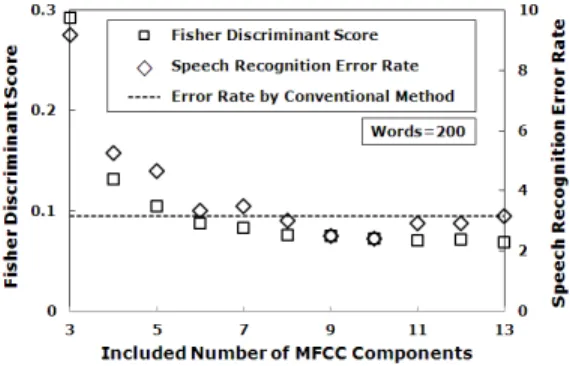
Figure 3 shows Fisher discriminant score (squares) and recognition error rate (diamonds) for vocabulary size of . The abscissa is the included number of MFCC components of large variances. The horizontal dotted line denotes the recognition accuracy for conventional method where 13 components with no PCA are all used.
We see that no significant degradation of recognition performance and Fisher discriminability occur if we include six or more MFCC components.
Fig. 3 Fisher discriminant score (squares) and recognition error rate (diamonds) for vocabulary size
of
In other words, we might lessen the computational cost for speech recognition by including only six components of feature vectors. In short, the dimensionality reduction by PCA eigendecomposition is expected to be effective in decreasing the computational cost of speech recognition. Similar results were reported by Hu et al. for phoneme recognition [21].
IV. Conclusion
In this paper, we studied the method of reducing the computational cost in speech recognition by dimensionality reduction through principal com- ponent analysis. PCA was found to be of a little help in enhancing the variances of the vector components.
The test of the proposed method was performed
in two ways: speech recognition with FVQ/HMM
and Fisher discriminant analysis. Experimental
results have shown that about half of the MFCC
components might be discarded without significant
adverse effects on the speech recognition per-
formance and the Fisher discriminant score.
References
[1] M. Pleva, "Speech and Mobile Technologies for Cognitive Communication and Information Systems", 2011 2nd International Conference on Cognitive Infocommunications, pp. 1-5, 2011.
[2] S. Primorac & M. Russo, "Android Appli- cation for Sending SMS Messages With Speech Recognition Interface", 2012 Proceedings of the 35th International Convention, pp. 1763-1767, 2012.
[3] G. Nemeth, "Speech-Enhanced Interaction with TV", 2011 2nd International Conference on Cognitive Infocommunications, pp. 1-5, 2011.
[4] O. Viikki, I. Kiss, & J. Tian, "Speaker- and Language-Independent Speech Recognition in Mobile Communication Systems", ICASSP '01, Vol. 1, pp. 5-8, 2001.
[5] M. Kang, "A Study on the Design of Multimedia Service Platform on Wireless Intelligent Technology", The Journal of the Korea Institute of Electronic Communication Sciences, Vol. 4, No. 1, pp. 24-30, 2009.
[6] J. Yoo, H. Park, H. Shin, & Y. Shin, “A Study of the Communication Infrastructure Constr- uction for u-City in Korea”, The Journal of the Korea Institute of Electronic Commu- nication Sciences, Vol. 1, No. 2, pp. 127-135, 2006.
[7] Y. Kim & H. Lee, "A Study on Improved Method of Voice Recognition Rate", The Journal of the Korea Institute of Electronic Communication Sciences, Vol. 8, No. 1, pp. 77-83, 2013.
[8] I. Spiro, G. Taylor, G. Williams, & C. Bregler,
“Hands by Hand: Crowd-Sourced Motion Tracking for Gesture Annotation”, IEEE Computer Society Conference on Computer Vision and Pattern Recognition, pp. 17-24, 2010.
[9] W. Sun, Z. Wu, H. Hu, & Y. Zeng,
"Multi-Band Maximum a Posteriori Multi- Transformation Algorithm Based on the Discriminative Combination", International Co- nference on Machine Learning and Cybe- rnetics, Vol. 8, pp. 4876-4880, 2005.
[10] H. Tohidypour, S. Seyyedsalehi, H. Roshandel,
& H. Behbood, "Speech Recognition Using Three Channel Redundant Wavelet Filterbank", 2nd International Conference on Industrial Mechatronics and Automation (ICIMA), Vol. 2, pp. 325-328, 2010.
[11] M. Paulik & A. Waibel, "Spoken Language Translation from Parallel Speech Audio:
Simultaneous Interpretation as SLT Training Data", ICASSP, pp. 5210-5213, 2010.
[12] D. Pisoni, H. Nusbaum, & B. Greene,
"Perception of Synthetic Speech Generated by Rule", Proceedings of the IEEE, Vol. 73, No. 11, pp. 1665-1676, 1985.
[13] S. Alizadeh, R. Boostani, & V. Asadpour, "Lip Feature Extraction and Reduction for HMM-Based Visual Speech Recognition Sys- tems", 9th International Conference on Signal Processing (ICSP), pp. 561-564, 2008.
[14] V. Estellers, M. Gurban, & J. Thiran,
"Selecting Relevant Visual Features for Speech Reading", IEEE International Conference on Image Processing (ICIP), pp. 1433-1436, 2009.
[15] J. Deller, J. Proakis, & J. Hansen,
"Discrete-Time Processing of Speech Signals", Macmillan, New York, pp. 246-251, 1994.
[16] S. Haykin, "Neural Networks", Prentice Hall, New Jersey, pp. 392-440, 1999.
[17] L. Fausett, "Fundamentals of Neural Net- works", Prentice Hall, New Jersey, p. 298, 1994.
[18] M. Dehghan, K. Faez, M. Ahmadi, & M.
Shridhar, "Unconstrained Farsi Handwritten Word Recognition Using Fuzzy Vector Quantization and Hidden Markov Models", Pattern Recognition Letters, Vol. 22, pp. 209- 214, 2001.
[19] J. Hung, "Optimization of Filter-Bank to Improve the Extraction of MFCC Features in Speech Recognition", Proceedings of 2004 International Symposium on Intelligent Mul- timedia, Video and Speech Processing, pp. 675-678, 2004.
[20] A. Martin, D. Charlet, & A. Mauuary, "Robust Speech/Non-Speech Detection Using LDA Applied to MFCC", 2001 IEEE International Conference on Acoustics, Speech, and Signal Processing," Vol. 1, pp. 237-240, 2001.
[21] H. Hu & S. Zahorian, "Dimensionality Redu-
ction Methods for HMM Phonetic Reco- gnition", 2010 ICASSP, pp. 4854-4857, 2010.
저자 소개
이창영(Chang-Young Lee)