http://dx.doi.org/10.12750/JET.2016.31.3.249
Reproductive performance comparison between local and crossbred sows reared under backyard and farming condition in Rangamati district of Bangladesh
1,†M.I. Hossain, 2M.M. Momin, 3K.M. Fakhrul Islam, 4M.N. Quader, 5G. Miah
1Post graduate student, Department of Genetics and Animal Breeding, Chittagong veterinary and animal sciences university khulshi, chittagong-4225
2Lecturer, Department of Genetics and Animal Breeding, Chittagong veterinary and animal sciences university khulshi, chittagong-4225
3,4Post graduate student, Faculty of veterinary medicine, Chittagong veterinary and animal sciences university khulshi, chittagong-4225
5Professor, Department of Genetics and Animal Breeding, Chittagong veterinary and animal sciences university khulshi, chittagong-4225
ABSTRACT
It is imperious to know the reproductive parameters of the subsisting swine breed for profitable farming in Bangladesh. This study was designed to compare the reproductive parameters of sows at hilly areas between the local and crossbred at farm and backyard level. A total of 116 breedable sows were included. The data on age at puberty, litter size, birth weight, weaning weight, gestation length, interval between farrowing and number of piglets born per sow in local and crossbred sows were determined and direct questionnaire method was used for data collection. The present study revealed that age at puberty between farm and backyard system of crossbred sows was 8.88±0.153 and 9.85±0.221 months, respectively. The farrowing interval was shorter in crossbred sows which were kept in farming system rather than backyard system. The interval between farrowing and onset of estrus was shorter in crossbred sows.
The gestation length was almost similar between backyard and farm condition. The number of litter size per sow per farrowing was 8.45±0.41 in crossbred and 7.17±0.250 in local pigs at backyard system. The birth weight and weaning weight were more in farm conditions than backyard system. The age at puberty in local breed was lower than the crossbred and litter size was 8.45±0.407 in crossbred which was higher than local breed 7.17±0.250 in backyard system. These results suggest that reproductive parameters of local sow need to be improved for better production and crossbred sows should be reared for obtaining desired productivity.
(Key word: Reproductive parameter, farm, backyard, local, crossbred)
†Corresponding author: Md. Iqbal Hossain Tel: +8801521224080
E-mail: [email protected]
INTRODUCTION
Bangladesh is an agricultural country, where livestock is the main fuel for the driving of economy of Bangladesh.
Livestock is one of its important components, which provide protein, solve unemployment and earn foreign exchange (Taylor and Roese, 2006; Cole, 1996). Bangladesh is one of the densely populated places in this world. Almost all of the outlying men and women in the land are generally landless and they are also living below poverty line.
The pigs are reared by poor people who neither have means nor know how to improve production. A lot of individuals
tend to be out of work as well as regarding 50% from the individuals are afflicted by malnutrition. Pigs tend to be quick developing as well as probably the most productive animal’s breeds (Durranc, 2008; Phookan et al., 2006; Prakash et al., 2009; Taylor and Roese, 2006). Pig is considered as the richest source of animal protein at a lower cost for the peoples who consume pork. In Bangladesh, domestic breeds of pig are reared on garbage, kitchen waste and human excreta.
Productivity of domestic breeds is low.
Large pigs generally noticed in Chittagong hill Tracts. In fact, it is really hard task to find out the specific variety of pigs in Bangladesh due to most of them are indigenous breed. The
tribe people in the mountain area rear most of the pigs. Due to the high number of litter size, easy rearing with available natural resources, high disease resistance and low production cost, pig rearing is getting importance in the tribal regions to extrude poverty. The pig rearing continues to be primitive scavenging in nature because the farmers remain backward in education, economy and social activities. However, it is imperative to know the reproductive parameters of the existing swine breed in Bangladesh.
Therefore, government has an initiative to improve the native pigs by
crossbreeding them with superior exotic genes. For that reason exotic breeds specially Yorkshire, Landrace, Hampshire and Poland China are gaining popularity due to high growth potential (Johnson et al., 2001). For this vision it is imperative that indigenous pig resources might be up-graded to meet the requirement of animal protein (Taneja et al., 1978). More than 1 billion pigs in the world, about 65% are raised in Asiatic countries (FAO, 2011).
Improvement of reproductive traits will improve efficiency of swine growth for the reproductive system behavior could make improvements to efficacy for swine production. However exotic germ plasm, when introduced into hot and humid climate like as Bangladesh, India etc, suffers higher embryonic death losses resulting decreasing the number of litter size. Estimated genetic correlations among productive and reproductive traits are low and sometimes positive or negative (Rydhmer et al., 1995;
Adamec and Johnson, 1997).
Pig has high reproductive performance with excellent prolific nature and fertilization capacity (Peltoniemi et al., 2007). A recent report on production system of swine in the rural area of Rangamati and Khagrachari districts of Bangladesh demonstrated that the average litter size, birth weight, post-weaning weight and weaning period were 9.3, 1.72 kg, 9.0 kg and 40.8 days, respectively (Hossain et al., 2011). This low reproductive performance of sow in Bangladesh is due to inefficient management of rearing system. A number of studies have documented that litter size (number born) in primiparous sows is larger than that in gilts and that litter size increases through the fourth or fifth pregnancy (Carmichael and Rice, 1920; Lynch, 1965). For this reason, it is indispensable to know the reproductive parameters of the existing swine breed in Bangladesh.
The objectives of this study were: 1) to estimate reproductive performance of crossbred sows under backyard and farming system; 2) to know the reproductive performance of local and crossbred sows under backyard system; and 3) to know the effect of parity on reproductive performance of sows under farming condition.
MATERIALS AND METHOD
The study was conducted at Sadar upazilla of Rangamati district in Bnagladesh. The reproductive traits of 116 sows were recorded from the district pig farm, Manikchari, Rangamati sadar (n=66) and from 11 backyard pig farm of Rangamati sadar upazila (n=50).
1. Methods of data collection
In order to make the data collection successful, the investigator personally visited door to door to the selected upazila of the study area and from the authorized person of the district pig farm. Direct interview method was used for collection of information. Information given by owners of sows were recorded on questionnaire for analysis.
2. Preparation of the questionnaire
The questionnaire was prepared according to the objectives of the investigation and was designed in a simple way so that the farmers could understand easily. The questionnaire included questions to collect information on age at puberty, gestation period, number of piglets born per sow, parity of sows, and interval between farrowing, litter size, birth weight and weaning weight.
3. Determination of reproductive parameters of sows I) Age at puberty
It was determined by calculating intervals from birth to first detected estrus of individual gilt and was expressed in month.
II) Type of breed
It was determined by breed history and its cross from the owner of pig
III) Weaning weight
It was determined by calculating body weight after weaning by weighing balance and according to owner observation.
IV) Birth weight
Table 1. Reproductive performance of crossbred sows under backyard and farming system
Reproductive traits Farming Backyard
F -value Significance value
Mean± SE Mean± SE
Age at puberty 8.88±0.15 9.85±0.22 10.40 **
Litter size 8.48±0.25 8.45±0.41 0.00 NS
Birth weight 0.74±0.02 0.65±0.02 8.12 **
Weaning weight 4.83±0.05 4.79±0.09 0.15 NS
Gestation period 116.83±0.37 115.45±0.56 1.61 NS
Farrowing interval 7.19±0.09 7.60±0.10 4.21 *
*Mean significance at 5% level (P<0.05) ** Mean significance at 1% level (P<0.01)
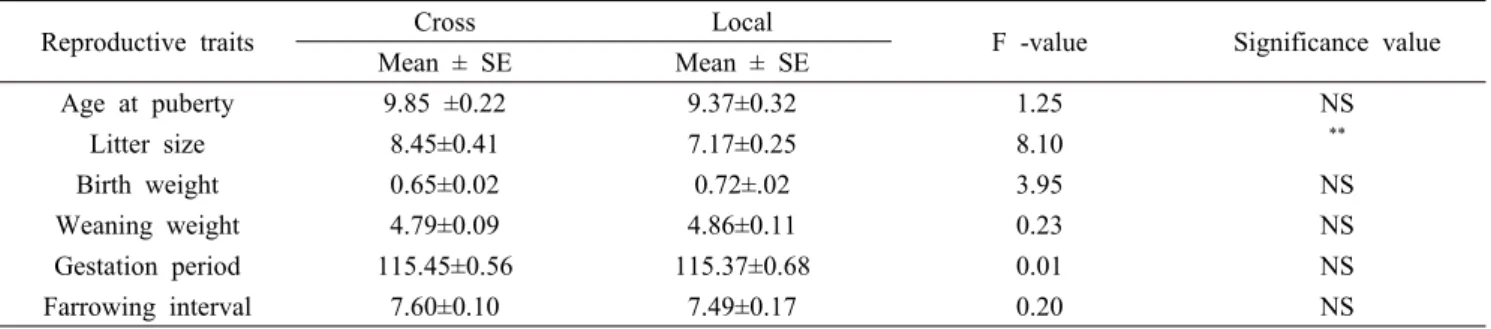
Table 2. Comparison of reproductive performances between crossbred and local sows under backyard system
Reproductive traits Cross Local
F -value Significance value
Mean ± SE Mean ± SE
Age at puberty 9.85 ±0.22 9.37±0.32 1.25 NS
Litter size 8.45±0.41 7.17±0.25 8.10 **
Birth weight 0.65±0.02 0.72±.02 3.95 NS
Weaning weight 4.79±0.09 4.86±0.11 0.23 NS
Gestation period 115.45±0.56 115.37±0.68 0.01 NS
Farrowing interval 7.60±0.10 7.49±0.17 0.20 NS
*Mean significance at 5% level (P<0.05) ** Mean significance at 1% level (P<0.01) It was determined by calculating body weight after born by
weighing balance in farm and according to owner opinion at rural level.
V) Gestation length of sows
It was determined by calculating the interval between the date of natural service and the date of parturition. The gestation period was expressed in days.
VI) Number of piglets born per sow
It was determined by counting the numbers of live and dead fetuses delivered by individual sows.
VII) Parity of sows
It was determined by recording the number of parturition occurred by individual sows. Farmers were interviewed to know this.
VIII) Interval between farrowing
It was determined by calculating by the interval between date of parturition and date of onset of estrus and was expressed in days.
4. Statistical analysis
The collected data (age at puberty, farrowing interval, gestation period etc) were entered to MS excel (Microsoft office 2007, USA) and analyzed by one-way ANOVA of
compare means procedure using SPSS software version 16.
Descriptive statistics were used to determine the mean and standard error of mean.
RESULT
The study was conducted to observe reproductive performances of both local and crossbred sows of rural areas in Rangamati hill district.
The present study determined the reproductive parameters namely age at puberty, interval between farrowing, gestation length, and number of parity, litter size, birth weight and weaning weight, which are presented in Table 1. The outcome of table between farming and backyard system indicate that the age at puberty and birth weight is highly significant (P<0.05) and farrowing interval is also significant (P<0.05). In this calculation the mean and standard errors of age at puberty, birth weight and farrowing interval are (8.88±0.15 month, 0.74±0.02 kg and 7.19±0.09 month in farming system respectively and 9.85±0.221 month, 0.65±0.02 kg and 7.60±0.10 month in backyard system respectively. The litter size, weaning weight, gestation period are not significant (P>0.05).
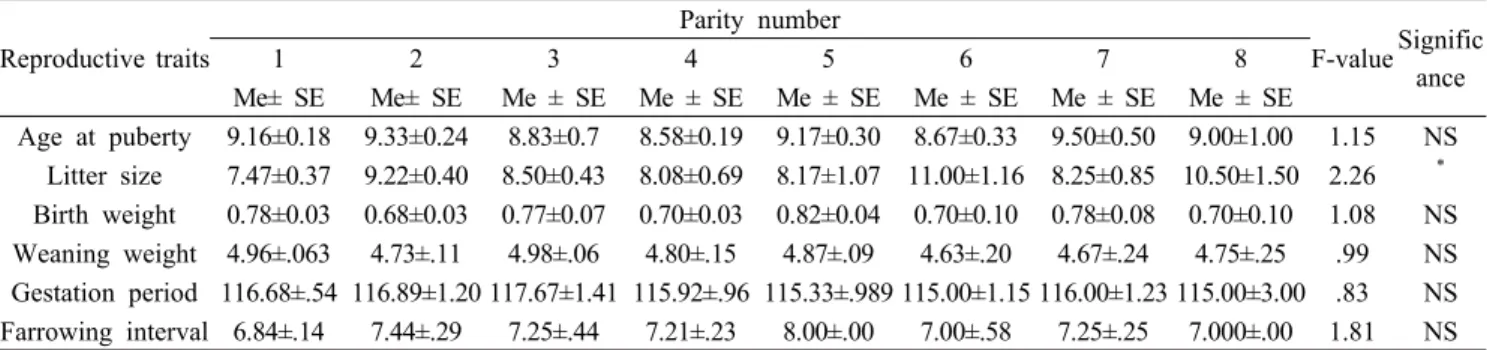
Table 3: Effect of parity on reproductive performance of sows under farming condition
Reproductive traits
Parity number
F-valueSignific
1 2 3 4 5 6 7 8 ance
Me± SE Me± SE Me ± SE Me ± SE Me ± SE Me ± SE Me ± SE Me ± SE
Age at puberty 9.16±0.18 9.33±0.24 8.83±0.7 8.58±0.19 9.17±0.30 8.67±0.33 9.50±0.50 9.00±1.00 1.15 NS Litter size 7.47±0.37 9.22±0.40 8.50±0.43 8.08±0.69 8.17±1.07 11.00±1.16 8.25±0.85 10.50±1.50 2.26 * Birth weight 0.78±0.03 0.68±0.03 0.77±0.07 0.70±0.03 0.82±0.04 0.70±0.10 0.78±0.08 0.70±0.10 1.08 NS Weaning weight 4.96±.063 4.73±.11 4.98±.06 4.80±.15 4.87±.09 4.63±.20 4.67±.24 4.75±.25 .99 NS Gestation period 116.68±.54 116.89±1.20 117.67±1.41 115.92±.96 115.33±.989 115.00±1.15 116.00±1.23 115.00±3.00 .83 NS Farrowing interval 6.84±.14 7.44±.29 7.25±.44 7.21±.23 8.00±.00 7.00±.58 7.25±.25 7.000±.00 1.81 NS
* Mean significance at 5% level (P<0.05)
In the table 2 we find that the litter size is highly significant (P<0.05) between cross and local breed within backyard system and mean and standard error between cross and local breed are 8.45±0.41, 7.17±0.25 comparatively. On the other hand age at puberty, birth weight, weaning weight, gestation period, farrowing interval are significant.
Table 3 notifies that the comparison of reproductive traits among the parity number in farming conditions where litter size is highly significant (P<0.05). The age at puberty, birth weight, weaning weight, gestation period and farrowing interval are not significant with the parity number.
DISCUSSION
Age at puberty is one of the most important reproductive parameter for any profitable farm animal. In my study the average age at puberty is 8.88±0.153 month in farming system and 9.85±0.221 month in backyard system respectively. The age at puberty in European Large White gilts was 8 months (Bon et al., 1979) and occurrence of puberty between 5 and 8 months in European breeds had been reported by (Christenson and Ford, 1979; Hughes, 1982) respectively which is strongly coincide with this study due to may be environmental and management conditions.
In contrast of this study (Sinha, 2012; Tummaruk et al., 2003) stated a lower puberty age than my observation. It might be due to breed difference, environmental conditions, management systems and after all genetic dissimilarities among the breeds are mentionable.
The average birth weight of pig is 1.72 kg in rural areas (Hossain et al., 2012) which is higher than my observation that is 0.74±0.016 kg birth weight in farming condition and
0.65±0.02 kg in backyard system respectively. The reasons for higher body weight in previous study is for may be difference in management and dietary supplements during pregnancy period as we studied in a remote farm in Chittagong hill tracts Bangladesh.
It is observed that the mean interval of farrowing between farm and backyard crossbred sows are 7.19±0.09 month and 7.60±0.10 month in my study. This result is highly consistent with the finding of Sinha (2012). The reported mean of farrowing interval in cross breed shows is higher than that of a previous study (Knox and Zas, 2001) where the mean of farrowing interval is 86.2 days. The variations of farrowing interval of different studies might be due to variations in breeds of pigs and their crossing, agro-climatic conditions, feeding and management practices.
The mean number of litter size in this study was 8.45 which is higher than the previous study (Motaleb et al., 2014) where 5.3 piglets is born per litter and lower than the previous finding (Halina et al., 1993) obtained 12.2 piglets per litter after evaluating 98 farrowings. (Cole and Foxcroft 1982) also reported to have 12 piglets per litter in domestic sows which also higher than my study. The variation among studies may be due to lower body weight, smaller size of the sows and management practices including dietary supplement.
A relationship between litter size and parity in which litter size continued to increase through the fifth parity or approximately 3 years of age (Carmichael and Rice, 1920;
Lynch, 1965) which not coincide with my study whereas the fluctuations are found in the production of piglets. The parity have no effects on the weaning weight, birth weight, age at puberty, gestation period (Akdag et al., 2009) which is coincide with my observations. There was no significant effect of parity on those traits.
CONCLUSION
It might be concluded that the age at puberty of crossbred sows between farming and backyard system were 8.88±0.15 month and 9.85±0.22 month, respectively. The litter size was 8.48±0.25 which was longer in farming sows within the crossbred than backyard system. The interval between farrowing was shorter in crossbred sows which were kept in farming system than backyard system. The values of gestation length were almost similar. The birth weight and weaning weight were more in farm conditions than backyard system.
The age at puberty in local was lower than the crossbred and litter size was 8.45±0.41 in crossbred which was higher than local breed 7.17±0.25 in backyard system. Litter size was increased with the parity number and it was fluctuated due to the parity number. The production system of pig farm and its reproductive performance was not so satisfactory in our country. The crossbred sows should be reared for obtaining desired productivity.
REFERENCES
Adamec, V., and Johnson, R. K. (1997). Genetic analysis of rebreeding intervals, litter traits, and production traits in sows of the National Czech nucleus. Livestock Production Science 48:13-22
Akdag, F., Arslan, S., and Demir, H. (2009). The effect of parity and litter size on birth weight and the effect of birth weight variations on weaning weight and pre-weaning survival in piglet. Journal of Animal and Veterinary Advances 8:2133-2138.
Bhat, P. N., Taneja, V. K., and Garg, R. C. (1978). Effects of crossbreeding on reproduction and productive traits. Indian J. Anim. Sci. 48:7-78.
Bon, S., Vigny, M., and Massoulié, J. E. A. N. (1979).
Asymmetric and globular forms of acetylcholinesterase in mammals and birds. Proceedings of the National Academy of Sciences 76:2546-2550.
Carmichael, W. J., and Rice, J. B. (1920). Variations in farrow:
with special reference to the birth weight of pigs. Bulletin
(University of Illinois (Urbana-Champaign campus).
Agricultural Experiment Station; no. 226.
Christenson, R. K., and Ford, J. J. (1979). Puberty and estrus in confinement-reared gilts. Journal of animal science 49:743-751.
Cole, H., H. (1996), Introduction to livestock production, Edn, Freeman and co. San Framciscoand London. Journal animal science 60:1372-1374.
Durranc, L., and Maxson, C. A. (2008).Swine production on a small scale, Jr.Animal science 23:523-557.
Hossain, M. E., Chakma, S., Khatun, M. M., Hasanuzzaman, M., Miah, M. Y., & Biswas, M. A. A. (2012). Production systems of swine in the rural areas of Rangamati and Khagrachari districts of Bangladesh. Bangladesh Journal of Animal Science 40:28-33.
Johnson, A. K., Morrow-Tesch, J. L., and McGlone, J. J. (2001).
Behavior and performance of lactating sows and piglets reared indoors or outdoors. Journal of animal science 79:2571-2579.
Knox, R. V., and Zas, S. R. (2001). Factors influencing estrus and ovulation in weaned sows as determined by transrectal ultrasound. Journal of animal science 79:2957.
Mazdiyasni, K. S., Lynch, C. T., and Smith, J. S. (1965).
Preparation of Ultra‐High‐Purity Submicron Refractory Oxides. Journal of the American Ceramic Society 48:372-375.
Motalab, M. A. (2013) Reproductive parameters of native sows in selected area of Bangladesh. MS Thesis, Department of surgery and obstetrics, Faculty of Veterinary Science, BAU pp.1-27.
Peltoniemi, M., Thurig, E., Ogle, S., Palosuo, T., Schrump, M., Wutzler, T., and Mikhailov, A. (2007). Models in country scale carbon accounting of forest soils. Silva Fennica 41:575.
Phookan, A., Laskar, S., Aziz, A., and Goswami, R. N. (2006).
Reproductive performance of indigenous pigs of the Brahmaputra valley of Assam.Tamilnadu J. Vet. Anim. Sci.
2:121-125.
Prasanna, J. S., Prakash, M. G., Gupta, B. R., and Mahender, M. (2009). Genetic study on reproductive traits in crossbred pigs. Livestock Research for Rural Development 21(9).
Rydhmer, L., Lundeheim, N., and Johansson, K. (1995).
Genetic parameters for reproduction traits in sows and relations to performance test measurements. Journal of animal breeding and genetics 112:33-42.
Sharon, N., and Lis, H. (1993). Carbohydrates in cell recognition.
Scientific American 268:82-89.
Sinha, R. C., Rahman, M. A., Islam, M. T., and Abdullah-Al Mamun, M. (2014). Determination of reproductive parameters of sows at rural areas of Bangladesh. Journal of Advanced Veterinary and Animal Research 2:74-79.
Taylor G, and Roese, G. (2006). Basic pig husbandary. NSW, New South Wales, pp.89-98.
Tilton, J. E., Foxcroft, G. R., Ziecik, A. J., Coombs, S. L., and Williams, G. L. (1982). Time of the preovulatory LH surge in the gilt and sow relative to the onset of behavioral estrus. Theriogenology 18:227-236.
Tummaruk, P., Suwimonteerbutr, J., and Laotanakit, A. (2003).
The impact of indoor temperature and humidity on puberty attainment in gilts. In The 11th symposium of the world association of veterinary laboratory diagnosticians \ and OIE seminar on biotechnology, department of Obstetrics, Gynaecology and Reproduction, Faculty of Veterinary Science Chulalongkorn University, Bangkok, Thailand (p.153).
Received July 27, 2016, Revised August 22, 2016, Accepted September 30, 2016