Received Jun 10, 2009; Revised Jul 10, 2009; Accepted Aug 02, 2009
Corresponding author: Sung Hwoan Cho
Tel: +82 (51) 410-4755 e-mail: [email protected] 1225-3480/25206
사료 종류별 사육수온이 전복 치패의 성장에 미치는 영향
조성환, 조영진
한국해양대학교 해양과학기술대학 해양환경생명과학부
Effect of Temperature Condition on Growth of Juvenile Abalone, Haliotis discus hannai with the Different Feeds
Sung Hwoan Cho and Young Jin Cho
Division of Marine Environment & BioScience, College of Ocean Science & Technology, Korea Maritime University, Busan 606-791, Korea
ABSTRACT
This study was performed to determine the effect of temperature condition on growth of juvenile abalone Haliotis discus hannai with the different feeds. Two types of feed (dry sea tangle and experimental diet) at water temperatures of 20 and 23℃, and 23 and 26℃ were applied to experimental abalone twice. Forty-five juvenile abalone averaging 10.1 g in the first feeding trial and 11.5 g in the second feeding trial were randomly stocked into 6 of 50 L plastic rectangular containers each. Fishmeal, soybean meal and shrimp head meal was used as the primary protein source in the experimental diet. And dextrin and wheat flour, and soybean oil were used as the primary carbohydrate and lipid sources in the experimental diet, respectively. The dry sea tangle and experimental diet were fed to abalone once a day at the ratio of 1.5-2.0% total biomass of abalone with a little leftover in each experimental condition. Weight gain of abalone was significantly affected by feed type, but not by water temperature in the first feeding trial. Regardless of water temperature, weight gain of abalone fed the experimental diet was significantly higher than that of abalone fed the dry sea tangle. However, weight gain of abalone was significantly affected by water temperature, but not by feed type in the second feeding trial. Weight gain was highest in abalone fed the experimental diet at 23℃, followed by abalone fed the dry sea tangle at 23℃, abalone fed the experimental diet and dry sea tangle at 26℃, which was lowest. Moisture and crude protein content of the edible portion of abalone was significantly affected by feed type, but not by water temperature in the second feeding trial. However, ash content of the edible portion of abalone was significantly affected by water temperature, but not by feed type. In considering these results, it can be concluded that the well formulated feed was superior to the dry sea tangle for growth of juvenile abalone, and water temperature conditions of 20 and 23℃ seemed to be better than 26℃ to improve weight gain of abalone.
Key words: abalone, haliotis discus hannai, temperature condition, dry sea tangle, experimental diet.
서 론
2008년 우리나라 전복류 양식 총생산량은 총 5,145 톤으로 2008년 패류양식 총생산량인 약 34만 톤의 2%에도 미치지 못하지만, 가치의 면에서는 전복양식 총생산금액이 약 1,700 억원으로 패류양식 총생산금액인 약 3,707 억원의 46% 이상
을 차지하는 것으로 나타나서, 우리나라 패류 양식업에 있어서 전복이 얼마나 중요한 위치를 차지하고 있는 가를 잘 보여주고 있다 (KNSO, 2009). 우리나라 전복양식의 경우 겨울철에는 전복의 사육 및 수질 관리가 용이하기 때문에 자연산 해조류 (미역, 다시마 등) 를 주된 먹이로 공급하고 있지만 해조류내 의 주요 영양소 함량이 전복의 정상적인 성장에 필요로 하는 요구량에 비하여 낮기 때문에 효율적인 전복생산이 이루어지 지 못하고 있는 실정이다. 또한 겨울철을 제외한 시기에는 자 연산 해조류를 구하기가 어렵기 때문에 겨울철에 많이 생산되 는 해조류를 미리 준비하여 건조시킨 건미역이나 건다시마를 주로 공급하고 있으나 이들 해조류의 건조나 보관 과정에서 야
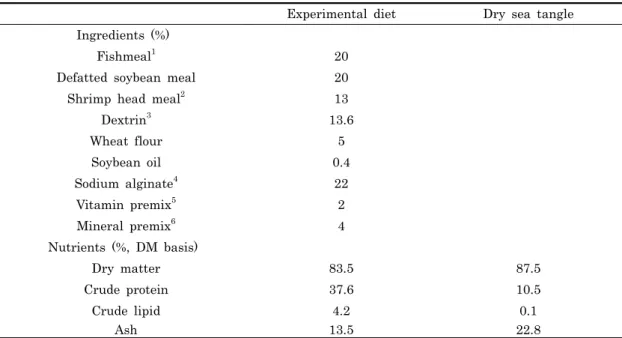
Experimental diet Dry sea tangle Ingredients (%)
Fishmeal1 20
Defatted soybean meal 20
Shrimp head meal2 13
Dextrin3 13.6
Wheat flour 5
Soybean oil 0.4
Sodium alginate4 22
Vitamin premix5 2
Mineral premix6 4
Nutrients (%, DM basis)
Dry matter 83.5 87.5
Crude protein 37.6 10.5
Crude lipid 4.2 0.1
Ash 13.5 22.8
1Fishmeal imported from Chile.
2Shrimp head meals were supplied by Jeilfeed Co. Ltd. (Haman, Gyeongsangnam-do, Korea).
3Dextrin was purchased from Sigma Chemical, St. Louis, MO, USA.
4Sodium alginate was purchased from Sigma Chemical, USA.
5Vitamin premix contained the following amount which were diluted in cellulose (g kg-1 mix): L-ascorbic acid, 200; α-tocopheryl acetate, 20; thiamin hydrochloride, 5; riboflavin, 8; pyridoxine, 2; niacin, 40;
Ca-D-pantothenate, 12; myo-inositol, 200; D-biotin, 0.4; folic acid, 1.5; p-amino benzoic acid, 20; K3, 4;
A, 1.5; D3, 0.003; choline chloride, 200; cyanocobalamin, 0.003.
6Mineral premix contained the following ingredients (g kg-1 mix): NaCl, 10, MgSO4․7H2O, 150; NaH2PO4․ 2H2O, 250; KH2PO4, 320; CaH4(PO4)2․H20, 200; Ferric citrate, 25; ZnSO4․7H2O, 4; Ca-lactate, 38.5;
CuCl, 0.3; AlCl3․6H2O, 0.15; KIO3, 0.03; Na2Se2O3, 0.01; MnSO4․H2O, 2; CoCl2․6H2O, 0.1.
Table 1. Ingredients and composition of the diets used in the study 기되는 영양소 파괴나 불균형으로 인하여 전복의 성장 및 생산
성을 저하시키는 요인이 되고 있다.
따라서 전복의 안정적인 양식생산을 위하여 전복용 배합사료 의 개발은 반드시 이루어져야 하며, 현재까지 전복용 배합사료 개발에 대한 다수의 연구가 수행되어 보고된 바 있으며 (Uki et al., 1986a, b; Mai et al., 1995a, b; Lee and Park, 1998; Lee et al., 1998a, b, c; Lim and Lee, 2003; Cho et al., 2008), 전복 치패의 단백질 및 지질 요구량은 25%-35% 및 3%-7% 내외인 것으로 알려져 있다 (Mai et al., 1995a, b).
참전복 (Haliotis discus hannai)은 야행성으로서 적정사 육수온은 15℃-20℃ 범위로 알려져 있으나 (Yoo, 1998), 전 복양식 어민들은 그 이상의 온도에서 전복의 성장이 빨리 이루 어진다고 주장하고 있다. 전복치패에서부터 상품크기까지 성 장시키는데 3-4년 정도 걸리는 점을 고려할 때 적정사육수온 을 규명하여 사육함으로서 빠른 성장을 이루어 양식기간을 단 축시키는 것은 전복의 효율적이고 안정적인 양식생산을 위해 규명되어야 할 중요한 요소이다. 따라서 본 연구에서는 자연산
먹이인 건조다시마와 전복용 배합사료 공급시 사육수온이 전 복 치패의 성장에 미치는 영향을 비교 분석하였다.
재료 및 방법 1. 전복 및 사육 실험 준비
전복 치패를 개인양식장에서 구입하여 사육실험 현장으로 옮긴 후 1주간 20℃의 사육수온에 적응시켰다. 일부의 전복 치패를 다음 1주 동안에 1일 0.5℃씩 상승시켜서 23℃의 수온 으로 적응시켰으며, 적응기간 동안에는 1일 1회 (17:00) 건조 다시마를 전복 체중의 약 1.5% 공급하여 주었다. 총 12 개의 50 liter 사각형 플라스틱 수용기에 비슷한 크기의 전복 치패 (시작시 무게: 10.1 ± 0.02 g) 45 마리를 임의로 각각 분산 수용한 후, 이들 50 liter 사각형 플라스틱 수용기 6 개씩을 1.3톤 유수식 raceway (수량: 1.0 톤) 에 분산 수용하였다.
각각의 raceway는 20℃와 23℃로 일정하게 온도를 유지하여 주었으며, 8주간의 1차 사육실험을 실시하였다. 각 raceway 별 주수량은 80 L/min이었으며 유수식으로 사육하였다. 광주 기는 자연광주기를 따랐으며, 충분한 양의 산소공급을 위하여
Feed type Temperature (℃) Initial weight (g) Final weight (g) Survival (%) Weight gain (g)
Dry sea tangle 20 10.1 ± 0.03 11.2 ± 0.09 99.3 ± 0.74a 1.1 ± 0.07b
23 10.0 ± 0.01 11.0 ± 0.03 100 ± 0.00a 1.0 ± 0.03b
Experimental diet
20 10.0 ± 0.01 12.2 ± 0.03 100 ± 0.00a 2.2 ± 0.03a
23 10.0 ± 0.03 11.9 ± 0.11 99.2 ± 0.80a 1.9 ± 0.08a Two-way ANOVA
Feed type 0.9 0.0006
Water temperature 0.9 0.3
Interaction 0.1 0.6
Values (mean ± SE) with the different superscript letters within the same column are significantly different (p < 0.05).
Table 2. Survival (%) and weight gain (g/fish) of abalone fed the dry sea tangle and experimental diet at 20 and 23℃
for 8 weeks
각 raceway별로 공기주입을 시켜주었다.
2개월간의 1차 사육실험 종료 이후에 생존한 전복들을 전부 모아서 23℃에서 1주간 수용한 후 일부의 전복 치패를 다음 1 주 동안에 1일 0.5℃씩 상승시켜서 26℃의 수온으로 적응시켜 주었다. 총 12 개의 50 liter 사각형 플라스틱 수용기에 비슷 한 크기의 전복 치패 (시작시 무게: 11.5 ± 0.52 g) 45 마리 를 임의로 각각 분산 수용한 후, 이들 50 liter 사각형 플라스 틱 수용기 6 개씩을 1.3 톤 유수식 raceway에 분산 수용하였 다. 각각의 raceway 23℃와 26℃로 일정하게 온도를 유지시 켜 주었으며, 8주간의 2차 사육실험을 실시하였다. 기타 사육 조건은 1차 사육실험과 동일하였다.
2. 실험 디자인
2 (사료종류) × 2 (사육수온) factorial design으로 1차 및 2차 사육실험을 실시하였다. 1차 사육실험에서의 온도구간은 20℃와 23℃이었으며, 2차 사육실험에서의 온도구간은 23℃
와 26℃로 일정하게 유지시켜 주었다. 사료종류는 제조한 전 복용 배합사료와 건다시마 2 종류를 각각의 사육수온에서 공 급하여주었다.
3. 먹이 준비
본 실험에 사용된 먹이는 2 종류로서 제조한 전복용 배합사 료와 건다시마를 공급하여 주었다. 배합사료의 주요 단백질원 으로 어분 20%, 대두박 20%와 새우머리분 13%를 사용하였 으며, 탄수화물원으로 dextrin 13.6%와 소맥분 5% 및 지질 원으로 대두유 4% 첨가한 사료를 준비하였다 (Table 1). 사 료의 성형은 각 원료를 잘 혼합한 후 혼합물 100 g 당 물 100 g을 가하고 다시 잘 혼합한 후 압착하여 5%의 염화칼슘 수용 액에 40초간 담구어서 알긴산 나트륨을 칼슘염으로 치환시켰 다. 사료는 사각형 (가로 × 세로 = 1 cm × 1 cm) 형태로 두께 0.15 cm가 되도록 절단한 후 응달에서 밤 동안 건조시 킨 이후 냉동고 (- 25℃) 에 보관하면서 필요시마다 소량씩 사
용하였다.
사육실험 기간 동안의 먹이 공급양은 각 수용기별 전복 전 체중의 1.5%-2.0%를 매일 오후 5시에 1 회 공급하여 주어서 전복이 충분히 먹이를 골고루 섭취하도록 하였으며, 남은 먹이 는 격일제로 청소하여 제거하였다. 사육실험기간은 총 16주간 이었다.
4. 일반 성분 분석
실험사료 및 전복 가식부의 일반성분분석은 AOAC (1990) 에 따라 분석하였으며, 조단백질 (N × 6.25) 은 automatic analyzer, 조지방은 ether 추출법, 수분은 105℃의 dry oven 에서 건조하여 측정하였으며, 조섬유는 automatic analyzer (Fibertec, Tecator) 및 조회분은 550℃의 회화로에서 4시간 동안 태운 후 정량하였다.
5. 통계처리
Two-way ANOVA와 Duncan's multiple range test (Duncan, 1955) 로서 실험구간의 유의성을 검정하였으며, 이 때 이용한 통계용 program은 SAS version 9.1 (SAS Institute, Cary, NC, USA) 이었다.
결과 및 고찰
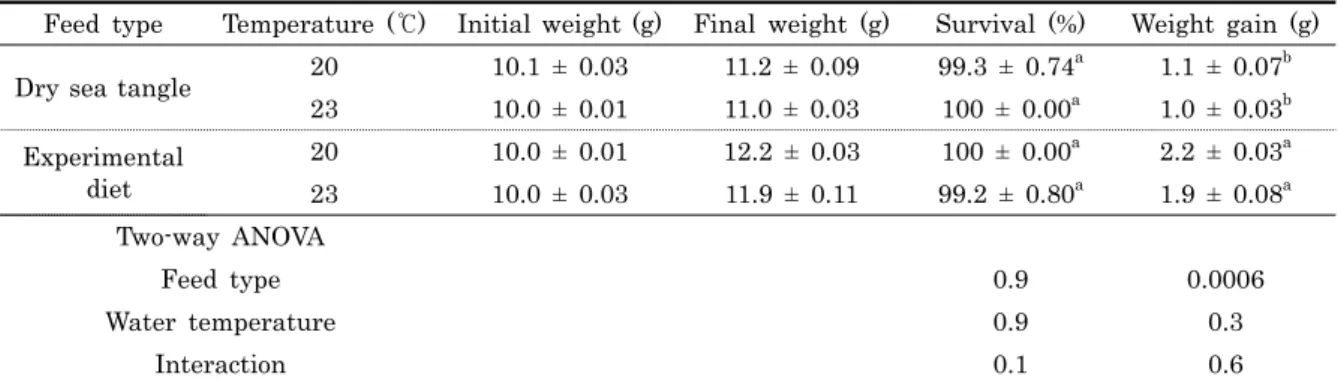
사육수온 20℃와 23℃에서 전복용 배합사료와 건다시마를 8주간 공급한 1차 사육실험에서 전복의 생존율 (%) 및 체중 증가는 Table 2와 같다. 전복의 생존율은 사료종류나 사육수 온에 따른 유의적인 차이를 보이지 않았다 (p > 0.05). 그러 나 전복의 체중증가는 Two-way ANOVA 분석결과, 사료종 류에 따라서 유의적인 차이를 보였으나 (p < 0.0006), 사육수 온에 따른 유의적인 차이는 보이지 않았다. 사육수온에 관계없 이 전복용 배합사료를 공급한 실험구에서 건다시마를 공급한 실험구보다 유의적으로 우수한 성장을 보였다. 지금까지 수행
Feed type Temperature (℃) Moisture (%) Crude protein (%) Crude lipid (%) Ash (%) Dry sea tangle 23 79.6 ± 0.14a 12.4 ± 0.31b 0.93 ± 0.07a 2.35 ± 0.08ab
26 80.2 ± 0.12a 12.6 ± 0.28b 0.54 ± 0.04b 2.42 ± 0.08ab Experimental
diet
23 78.6 ± 0.50a 14.4 ± 0.41a 0.72 ± 0.11ab 2.20 ± 0.04b 26 78.6 ± 0.83a 14.6 ± 0.64a 0.83 ± 0.05a 2.49 ± 0.06a Two-way ANOVA
Feed type 0.02 0.001 0.6 0.5
Water temperature 0.5 0.6 0.1 0.02
Interaction 0.6 0.8 0.02 0.1
Values (mean ± SE) with the different superscript letters within the same column are significantly different (p <
0.05). Moisture, crude protein, crude lipid and ash content of the edible portion of the initial abalone were 80.1, 12.5, 0.66 and 2.82%, respectively.
Table 4. Chemical composition (wet weight basis, %) of the edible portion of abalone fed the dry sea tangle and experimental diet at 23℃ and 26℃ for 8 weeks
Feed type Temperature (℃) Initial weight (g) Final weight (g) Survival (%) Weight gain (g)
Dry sea tangle 23 11.0 ± 0.03 12.8 ± 0.09 100 ± 0.00a 1.8 ± 0.13ab
26 11.1 ± 0.04 12.3 ± 0.12 100 ± 0.00a 1.2 ± 0.09c
Experimental diet
23 11.9 ± 0.11 13.8 ± 0.13 99.2 ± 0.81a 1.9 ± 0.09a 26 12.0 ± 0.08 13.6 ± 0.12 97.7 ± 1.84a 1.5 ± 0.14b Two-way ANOVA
Feed type 0.07 0.06
Water temperature 0.3 0.002
Interaction 0.3 0.2
Values (mean ± SE) with the different superscript letters within the same column are significantly different (p < 0.05).
Table 3. Survival (%) and weight gain (g) of abalone fed the dry sea tangle and experimental diet at 23 and 26℃ for 8 weeks
된 많은 연구에서 영양학적으로 균형이 잘 갖추어진 전복용 배 합사료의 공급은 자연산먹이를 공급한 전복에 비하여 훨씬 우 수한 성장을 보인 연구 결과와 일치하였다 (Uki et al., 1985;
Hahn, 1989; Viana et al., 1993; Britz, 1996; Lee et al., 1998a; Bautista-Teruel et al., 2003; Naidoo et al., 2006; Cho et al., 2008). 전복의 종에 따라서 적정사육수온 은 다소 다르며, red abalone (H. rufescens) 의 적정사육수 온은 18.4℃인 것으로 알려져 있으며 (Diaz et al., 2000), 또 한 green abalone (H. fulgens) 을 20℃와 25℃의 사육수온 에서 광주기를 달리하여 6개월간 사육한 결과 20℃의 사육수 온에서 24시간 암주기 조건하에서 가장 우수한 성장 결과를 보였다 (Garcia-Esquivel et al., 2007).
사육수온 23℃와 26℃에서 전복용 배합사료와 건다시마를 8 주간 공급한 2차 사육실험에서 전복의 생존율 및 체중증가는 Table 3과 같다. 전복의 생존율은 사료종류나 사육수온에 따 른 유의적인 차이를 보이지 않았다 (p > 0.05). 그러나 전복 의 체중증가는 Two-way ANOVA 분석결과, 사료종류에 따 라서 유의적인 차이를 보였으나 (p < 0.002), 사육수온에 따
른 유의적인 차이는 보이지 않았다. 23℃ 사육수온의 전복용 배합사료를 공급한 실험구에서 전복의 체중증가는 26℃ 사육 수온의 전복용 배합사료나 건다시마를 공급한 실험구에 비하 여 유의적으로 우수한 성장을 보였으나 (p < 0.05), 23℃ 사 육수온의 건다시마를 공급한 실험구와 유의적인 차이는 없었 다. 또한 26℃ 사육수온의 전복용 배합사료 공급구에서 전복 의 체중증가는 건다시마 공급구에 비하여 유의적으로 우수하 였다 (p < 0.05). 2차 사육실험에 있어서 비록 비유의적이긴 하지만 23℃의 전복용 배합사료 공급구에서의 체중증가 경향 이나 26℃의 전복용 배합사료 공급구에서의 뚜렷한 전복 체중 증가는 1차 사육실험과 거의 유사하였다.
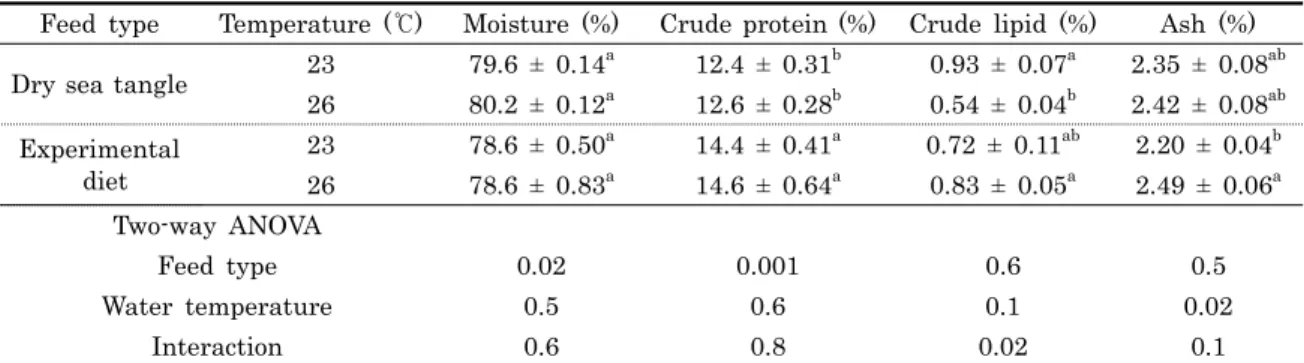
2차 사육실험 종료시 생존한 전복 가식부의 일반성분분석 결과는 Table 4와 같다. Two-way ANOVA 분석결과, 전복 가식부의 수분 함량 (p < 0.02)과 조단백질 함량 (p <
0.001)은 사료종류에 따른 유의적인 차이를 보였으나, 사육수 온에 따른 유의적인 차이는 보이지 않았다. 그러나 One-way ANOVA 분석결과, 전복 가식부의 수분 함량은 실험구간에 유 의적인 차이를 보이지 않았으나, 조단백질 함량은 사육수온에
상관없이 전복용 배합사료를 공급한 실험구에서 건다시마를 공급한 실험구에 비하여 유의적으로 높았다. 조지질 함량은 Two-way ANOVA 분석결과, 사료종류나 사육수온에 따른 유의적인 차이는 없었으나, 사료종류와 사육수온의 유의적인 상호작용이 관찰되었다 (p < 0.02). 23℃의 건다시마와 26℃
의 전복용 배합사료 공급구에서 조지질 함량이 26℃의 건다시 마 공급구에 비하여 유의적으로 높았으나 (p < 0.05), 23℃의 전복용 배합사료 공급구와는 유의적인 차이를 보이지 않았다.
본 연구의 결과와 유사하게 공급된 먹이의 영양소 함량에 따라 서 전복 가식부의 체성분이 크게 영향을 받았다(Mai et al., 1995a, b; Lee and Park, 1998; Lee et al., 1998a, b, c).
전복 가식부의 회분 함량은 Two-way ANOVA 분석결과, 사육수온에 따른 유의적인 차이를 보였으나 (p < 0.02), 사료 종류에 따른 유의적인 차이는 보이지 않았다. 조회분 함량은 전복용 배합사료 공급시 26℃에서 23℃보다 유의적으로 높았 으나 (p < 0.05), 다른 실험구간에 유의적인 차이는 없었다.
그러나 이 결과는 전복 가식부의 함량이 사료내 회분 함량에 직접적인 영향을 받는다는 이전의 연구결과와 상이하였다 (Lee et al., 1998a; Cho et al., 2008).
본 연구에서 사육실험 1과 2에서 모두 사료종류에 따라서 전복의 성장은 유의적인 차이를 보였으며 건다시마를 공급한 실험구보다 전복용 배합사료를 공급한 실험구에서 우수한 성 장을 보였다. 사육실험 1에서는 사육수온에 따른 전복의 성장 은 유의적이 차이를 보이지 않았으나, 사육실험 2에서 사료종 류에 상관없이 23℃에서의 전복 성장이 26℃에서보다 우수하 였으며 26℃에서는 전복용 배합사료를 공급받은 전복의 성장 이 건다시마를 공급받은 전복보다 유의적으로 우수하였다. 전 복의 성장 개선을 위한 적정사육수온 규명을 위하여 20℃-2 3℃사이의 사육수온에 대한 보다 정확한 자료 규명이 필요한 것으로 사료된다. 특히 자연해수부다 5-7℃정도 높은 사육수 온을 연중 유지할 수 있는 원자력발전소 온배수를 활용한 전복 양식장의 경우 전복의 성장개선을 위한 적정사육수온을 항상 유지시켜 줌으로서 상품크기까지 걸리는 시간을 단축시켜 전 복양식생산 단가를 크게 절감시킬 수 있을 것으로 사료된다.
ACKNOWLEDGEMENTS
본 연구는 지식경제부 및 정보통신진흥원의 대학 IT 연구센 터 지원사업 (IITA-2009-C1090-0903-0007) 의 연구결과로 수행되었으며, 이에 감사드립니다.
REFERENCES
AOAC (1990) Official Methods of Analysis, 15th ed.
Association of Official Analytical Chemists, Arlington, Virginia, USA.
Bautista-Teruel, M.N., Fermin, A.C. and Koshio, S.S.
(2003) Diet development and evaluation for juvenile abalone, Haliotis asinina: animal and plant protein sources. Aquaculture, 219: 645-653.
Britz, P.J. (1996) The suitability of selected protein sources for inclusion in formulated diets for the South African abalone Haliotis midae. Aquaculture, 140: 63-73.
Cho, S.H., Park, J., Kim, C. and Yoo, J.H. (2008) Effect of casein substitution with fishmeal, soybean meal and crustacean meal in the diet of the abalone Haliotis discus hannai Ino. Aquaculture Nutrition, 14: 61-66.
Diaz, F., del Rio-Portilla, MA., Sierra, E., Aguilar, M.
and Re-Araujo, A.D. (2000) Preferred temperature and critical thermal maxima of red abalone Haliotis rufescens. Journal of Thermal Biology, 25: 257-261.
Duncan, D.B. (1955) Multiple range and multiple F tests. Biometrics, 11: 1-42.
Garcia-Esquivel, Z., Monetes-Magallon, S. and Gonzalez-Gomez, M.A. (2007) Effect of temperature and photoperiod on the growth, feed consumption, and biochemical content of juvenile green abalone, Haliotis fulgens, fed on a balanced diet.
Aquaculture, 262: 129-141.
Hahn, K.O. (1989) Nutrition and growth of abalone. In:
Handbook of Culture of Abalone and Other Marine Gastropods (Hahn, K. O. ed.), pp. 135-156. CRC Press. Florida, USA.
KNSO (2009) Korea National Statistical Office. KOSIS Statistical DB, Daejeon, Korea.
Lee, S. and Park, H.G. (1998) Evaluation of dietary lipid sources for juvenile abalone (Haliotis discus hannai). Journal of Aquaculture, 11: 381-390. [in Korean]
Lee, S., Yun, S.J. and Hur, S.B. (1998a) Evaluation of dietary protein sources for abalone (Haliotis discus hannai). Journal of Aquaculture, 11: 19-29. [in Korean]
Lee, S., Lim, Y., Moon, Y.B., Yoo, S.K. and Rho, S.
(1998b) Effects of supplemental macroalgae and Spirulina in the diets on growth performance in juvenile abalone (Haliotis discus hannai). Journal of Aquaculture, 11: 31-38. [in Korean]
Lee, S., Yun, S.J., Min, K.S. and Yoo, S.K. (1998c) Evaluation of dietary carbohydrate sources for juvenile abalone (Haliotis discus hannai). Journal of Aquaculture, 11: 133-140. [in Korean]
Lim, T. and Lee, S. (2003) Effect of dietary pigment sources on the growth and shell color of abalone (Haliotis discus hannai). Journal of Aquaculture, 36: 601-605.
Mai, K., Mercer, J.P. and Donlon, J. (1995a) Comparative studies on the nutrition of two species of abalone, Haliotis tuberculata L. and Haliotis discus hannai Ino. III. Responses of abalone to various levels of dietary lipid. Aquaculture, 134:
65-80.
Mai, K., Mercer, J.P. and Donlon, J. (1995b) Comparative studies on the nutrition of two species of abalone, Haliotis tuberculata L. and Haliotis discus hannai Ino. IV. Optimum dietary protein level for growth. Aquaculture, 136: 165-180.
Naidoo, K., Maneveldt, G., Ruck, K. and Bolton, J.J.
(2006) A comparison of various seaweed-based diets and artificial feed on growth rate of abalone in land-based aquaculture systems. Journal of Applied Phycology, 18: 437-443.
Uki, N., Kemuyama, A. and Watanabe, T. (1985) Development of semipurified test diets for abalone.
Bulletin of the Japanese Society of Scientific Fisheries, 51: 1825-1833.
Uki, N., Kemuyama, A. and Watanabe, T. (1986a) Optimum protein level in diets for abalone. Bulletin of the Japanese Society of Scientific Fisheries, 52:
1005-1012.
Uki, N., Sugiura M. and Watanabe, T. (1986b) Requirement of essential fatty acids in the abalone Haliotis discus hannai. Bulletin of the Japanese Society of Scientific Fisheries, 52: 1013-1023.
Viana, M.T., Lopez, L.M. and Salas, A. (1993) Diet development for juvenile abalone Haliotis fulgens evaluation of two artificial diets and macroalgae.
Aquaculture, 117: 149-156.
Yoo, S.K. (1998) Shallow-Sea Culture. 625 pp. Guduk Publishing Co. Busan [in Korean]