• 검색 결과가 없습니다.

Evaluations of the Space Dose and Dose Reductions in Patients and Practitioners by Using the C-arm X-ray Tube Shielding Devices Developed in Our Laboratory

N/A
N/A
Protected

Academic year: 2021

Share "Evaluations of the Space Dose and Dose Reductions in Patients and Practitioners by Using the C-arm X-ray Tube Shielding Devices Developed in Our Laboratory"

Copied!
9
0
0

로드 중.... (전체 텍스트 보기)

전체 글

(1)

https://doi.org/10.14316/pmp.2016.27.4.241 pISSN 2508-4445, eISSN 2508-4453

Received 28 November 2016, Revised 23 December 2016, Accepted 24 December 2016

Correspondence: Haijo Jung ([email protected])

Tel: 82-2-970-1346, Fax: 82-2-970-1963

cc This is an Open-Access article distributed under the terms of the Creative Commons Attribution Non-Commercial License (http://creativecommons.org/licenses/by-nc/4.0) which permits unrestricted non-commercial use, distribution, and reproduction in any medium, provided the original work is properly cited.

Evaluations of the Space Dose and Dose Reductions in Patients and Practitioners by Using the C-arm X-ray

Tube Shielding Devices Developed in Our Laboratory

Jae Seok Kim*, Sung Ho Kim*

, Bu Hyung Lee*

, Soo Il Kwon*, Hai Jo Jung

, Seong Wook Hoe

, Jin Hyun Son

, Byeong Sam Kang

*Department of Medical Physics, Kyonggi University, Suwon,

Korea Institute of Radiological and Medical Sciences, Seoul,

Department of Radiological Science, Sin-Gu University, Seongnam, Korea The present study used a digital angiography x-ray device to measure the space dose and exposure dose of patients and practitioners using x-ray tube shielding devices developed in our laboratory. The intent of the study was to reduce the space dose within the test room, and to reduce the exposure dose of patients and practitioners.

The patient and practitioner exposure doses were measured in five configurations in a human body model. The glass dosimeter was placed on the eye lenses, thyroid glands, left shoulder, right shoulder, and gonads. The beam was collimated at full size and at a 48% reduction for a comparative analysis of the measurements. The space dose was measured with an ion chamber at distances of 50 cm, 100 cm, and 150 cm from the x-ray tube under the following conditions: no shielding device; a shielding device made of 3-mm-thick lead (Pb) [Pb 3 mm shield], and a shielding device made of 3-mm-thick Pb (outside) and 3-mm-thick aluminum (Al) (inside) [Pb 3 mm+Al 3 mm shield]. The absorbed dose was the lowest when the 3-mm-thick Pb+3-mm-thick Al shield was used. For measurements made with collimated beams with a 48% reduction, the dose was the lowest at 154 μGy when the 3-mm-thick Pb+3-mm-thick Al shield was used, and was 9 μGy lower than the measurements made with no shielding device. If the space dose can be reduced by 20% in all situations where the C-arm is employed by using the x-ray tube shielding devices developed in our laboratory, this is expected to play an important role in reducing the annual exposure dose for patients, practitioners, and assistants.

󰠏󰠏󰠏󰠏󰠏󰠏󰠏󰠏󰠏󰠏󰠏󰠏󰠏󰠏󰠏󰠏󰠏󰠏󰠏󰠏

Key Words: Space scattered dose, C-arm, Exposure dose, Radiation workers

Introduction

Recently, the use of fluoroscopic examinations and fluoro- scopy-guided interventional radiological procedures has increased.

1)

Since long-lasting radiation exposure on the same body parts can lead to excessive exposure, particularly to the skin, the measurement and reduction of the exposure dose for patients are more crucial in fluoroscopic examinations and in- terventional radiological procedures than in computed tomog-

raphy (CT).

2)

The International Commission on Radiological Protection (ICRP) Report 85 addresses both patient and practi- tioner exposure to radiation that can occur during interven- tional radiological procedures. In the report, exposure to radia- tion includes the direct exposure of the hands to radiation fields, exposure due to x-rays scattered from the patient or ta- ble, and minute quantities of x-ray leakage from x-ray tubes.

3)

Since such exposure for practitioners is smaller in dose than the direct exposure experienced by patients, skin damage and other symptoms rarely occur. Nonetheless, damage to the eye lenses, including cataracts, and damage to the hands of practi- tioners exposed to the radiation field have been reported.

According to the ICRP report, when the eyes of interventional

radiological practitioners are exposed to a total of 4,000 mGy

of radiation for three months (5,500 mGy if more than three

months), it can cause cataracts to develop. Furthermore, a re-

(2)

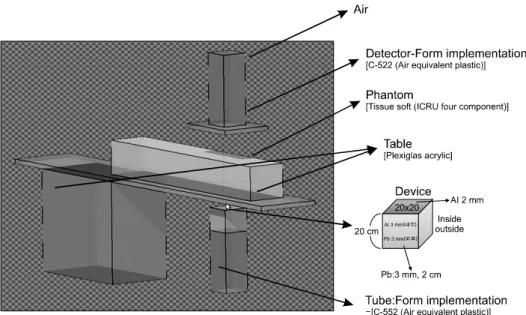
Fig. 1. Geometry design for Monte Carlo simulation.

port by the National Council on Radiation Protection and Measurements (NCRP) suggests that 150 mSv is the threshold dose for cataracts.

4)

In addition, considering the stochastic ef- fect of radiation, radiation workers are always exposed to dis- eases, such as cataracts and leukemia, based on the linear non-threshold (LNT) model, which does not specify the thresh- old dose for exposure. Therefore, the present study intends to reduce the exposure of practitioners, patients, and assistants to radiation during fluoroscopic examinations and interventional radiological procedures. In order to reduce the exposure dose, the radiation field size can be reduced in general radiographic procedures. However, since the tests employed during interven- tional radiological procedures must account for the overall shape of the blood vessels, it is often difficult to conduct the tests with fixed radiation field sizes. Although compression paddles can be used to regulate the thickness of the subject, the use of such compression paddles is inappropriate in angio- graphic examinations because the quality of the images is in- fluenced by the breathing of the subject. Moreover, as the tube voltage is automatically regulated by the x-ray device depend- ing on the thickness of the subject, it is difficult to regulate the tube voltage to reduce the scattered rays. Regarding the distance, the scattered rays decrease as the distance increases in accordance with the inverse square law of distance.

However, since the distance between the patient and x-ray tube is dependent on the procedure being conducted, the distance

cannot be used to reduce number of scattered rays. Thus, the present study measured the absorbed dose for patients and practitioners with and without shielding devices installed around an x-ray tube. The measurements were comparatively analyzed in order to evaluate the effectiveness of the x-ray tube shielding devices as a way to minimize the exposure dose for patients and practitioners during fluoroscopic examinations and interventional radiological procedures.

Materials and Methods

1. Monte Carlo simulation for space dose rate measure- ments (Fluke 2011.2c.5)

1) Geometry design: All space within the test room for the interventional radiological procedure was filled with air, and the detector was fabricated using C-552 (air-equivalent plastic). The phantom was constructed from tissue-soft (ICRU four component) materials, the patient table was made from Plexiglas acrylic, and the x-ray tube used C-552 (air-equivalent plastic). The shielding devices were cubes made with 3-mm-thick lead (Pb) and 2-cm-thick Pb, which was the thick- est of all the simulations, and the devices were designed to shield four sides of the cubes, excluding the top and bottom.

The designs with and without shielding devices were simu-

lated, as shown in Fig. 1.

(3)

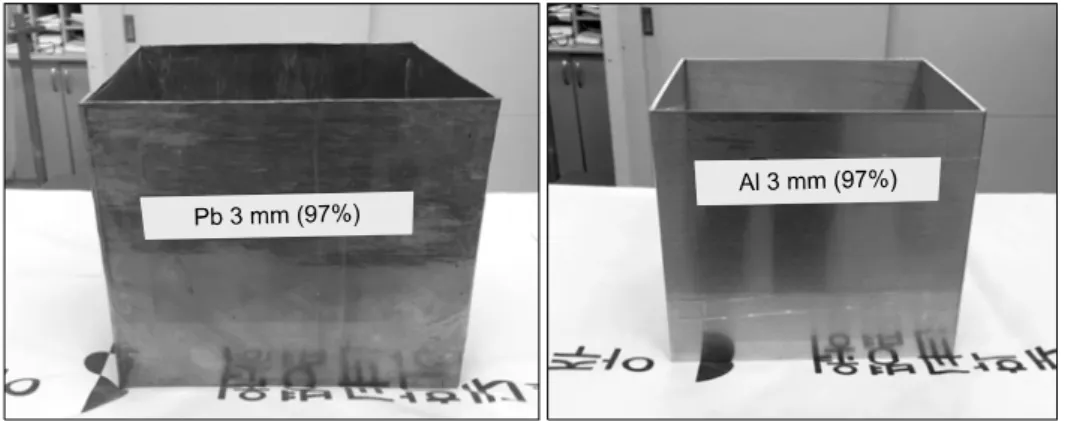
Fig. 2. 3-mm-thick Pb (x-ray tube shield) and 3-mm-thick Al (x-ray tube double shield).

2) Source term

(1) radiography spectrum generated photon (80 kVp with 2.1 mm Al, 3.4% ripple)

(2) collimation size 14 cm×14 cm

(3) photon flux implemented through user routine (http://www.

edonnelly.com/genspectrum.php-radiorgaphy spectrum generator.

Usr-1D x-ray 80 kVp 23).

3) Physics models and cross-section data libraries (1) default physics option: PRECISIO

(2) nucleus-nucleus interactions: Boltzmann master equation (3) cross-section data libraries (260 multi group cross sec- tion, PEANUT package)

4) Scoring

(1) ambient dose equivalent (ICRP 74)

(2) voxel size (x, y, z): 1.95 cm×2.38 cm×0.99 cm 2. C-arm, exposure conditions, shielding materials A Philips Allura Xper FD20 (Eindhoven, Netherlands) was used as the x-ray C-arm device for the experiments. For the measurements, an ion chamber (model 9015RM Radiation Monitor Controller 426 West Duarte Road Monrovia, California 91016, USA) and a glass dosimeter (PRL-glass dosimetry ven- dor Asahi Glass Co., FDG-202SE. Japan) were used. As the abdominal tissue-equivalent phantom, a human body phantom (pelvis 76-642-300) was used. The shielding devices were made with 3-mm-thick Pb and 3-mm-thick aluminum (Al). For the shielding devices, the 1-mm- and 2-mm-thick Al filters were attached to the front of the shielding devices made in our laboratory. The Pb and Al satisfied the Korean Standards Association (KSA)'s KSD6701 regulation. For the experiments conducted with the human phantom, the conditions were iden-

tical to those used for transarterial chemoembolization (TACE).

The imaging condition was 80 kV, and within the range of 23 mA-1,000 mA, the mA/s was adjusted depending on the thick- ness of the patient (automatic exposure control (AEC)). The size of the detector was 48.26 cm×43.18 cm, and the height of the device was 85 cm. The source to image receptor distance (SID) was 110 cm, and the fluoroscopic radiation field was not enlarged. No additional filter, other than that required for the experiments, was used inside or outside of the device. As shown in Fig. 2, the x-ray tube shielding devices were designed in the form of a 20.5 cm×20.5 cm×20.5 cm cube made of 3-mm- thick Pb. In order to absorb the low-energy side-scattered rays, another shield that was a 20 cm×20 cm×20 cm cube made of Al 3 mm was added within the Pb shielding device.

3. Measurement of doses

The space dose rate was measured with an ion chamber un- der the following conditions: no shielding device, a 3-mm- thick Pb shield, and a 3-mm-thick Pb+3-mm-thick Al shield.

Excluding the directions of the tube support and patient table, the space dose rate was measured in six out of eight directions separated by 45

o

at the center of the x-ray tube at distances of 50 cm, 100 cm, and 150 cm. As shown in Fig. 3, the direc- tions were set by assuming the patient was in the supine posi- tion: above the head (overhead; A), 45

o

to the right of the head (right head 45

o

; B), to the right of the hip (right side; C), 45

o

to the right of the right leg (right leg 45

o

; D), 45

o

to the left of the leg (left leg 45

o

; E), and 45

o

to the left of the head (left head 45

o

; F). From these six directions, measurements were made three times, and the mean values were calculated.

The patient exposure dose was measured at a fixed point in

(4)

Fig. 3. Schematic diagram of the measurement of six directions

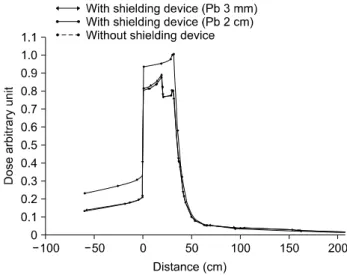
(A-F). Fig. 4. Arbitrary dose unit based on the distance in the Z axis.

the abdominal tissue-equivalent phantom (fourth lumbar verte- bra). The measurements were made without any shielding de- vice to remove low-energy scattered rays entering the phan- tom, with a 3-mm-thick Pb shield, with a 3-mm-thick Pb+

3-mm-thick Al shield, and 3-mm-Pb+3-mm-thick Al shields with 1-mm- and 2-mm-thick Al filters attached to the top.

For the measurements of the practitioner exposure dose, a human body model was placed 15 cm away from an imagi- nary right femoral artery puncture site in the phantom in a di- rection of 45

o

to the right (D). The glass dosimeter was placed on the eye lenses of the model, thyroid, right and left should- ers, and gonads. The measurements were made under the fol- lowing conditions: no shielding device, 3-mm-thick Pb shield, 3-mm-thick Pb+3-mm-thick Al shield, Pb shield+3-mm-thick Al shield+1-mm-thick Al filter, and Pb shield+3-mm-thick Al shield+2-mm-thick Al filter. The average body measure- ments of Korean adult males aged 20∼60 are as follows:

height 168 cm, height of the eyes 157 cm, neck height 144 cm, shoulder height 135 cm, and the height of the gonads 82 cm.

5)

The measurements were made in μGy for 60 s under fluoroscopy 80 kVp and 12 mAs (AEC).

Results

1. Monte Carlo simulation results for the space dose rate

The space dose varied around the x-ray tube depending on

the presence or absence of the x-ray tube shielding devices.

The space dose around the x-ray tube was less when the shielding devices were present. The distribution of the space dose in the other remaining spaces, except for the x-ray tube, did not show notable differences when the shielding devices were added or removed. As shown in Fig. 4, it was estimated that the dose differed within the distance of 50 cm. Further, the changes in the distribution of the space dose when the thickness of the Pb shielding device was changed from 3 mm to 2 cm were found to be insignificant.

2. Measurements of the space dose distribution con- ducted with the ion chamber placed 50 cm, 100 cm, and 150 cm away from the x-ray tube.

When no shielding device was used, the space dose meas- ured at 50 cm was 7.54 mR/min for the lenses, 13.03 mR/min for the thyroid, and 27.33 mR/min for the gonads. At 100 cm, the dose was 5.57 mR/min for the lenses, 6.35 mR/min for the thyroid, and 6.74 mR/min for gonads. At 150 cm, the dose was 3.05 mR/min, 5.16 mR/min, and 2.96 mR/min for lenses, thyroid, and gonads, respectively.

When the 3-mm-thick Pb shield was used, the space dose

measured at 50 cm was 6.69 mR/min for lenses, 11.74

mR/min for the thyroid, and 23.33 mR/min for gonads. At 100

cm, the dose was 4.68 mR/min for lenses, 5.28 mR/min for

the thyroid, and 5.79 mR/min for gonads. When measured at

150 cm, the dose was 2.52 mR/min, 2.61 mR/min, and 2.61

(5)

Table 1. Space dose rate with or without a shielding device measured at 100 cm in an x-ray tube.

Device (Mean) (SD) N F Post hoc test in ANOVA

Not used (a) 1.04 0.15 18 7.464*** a>b*

a>c**

Pb 3 mm (b) 0.88 0.17 18

Pb 3 mm+Al 3 mm (c) 0.84 0.16 18

*p<0.05, **p<0.01, ***p<0.001.

mR/min for lenses, thyroid, and gonads, respectively.

When the 3-mm-thick Pb+3-mm-thick Al shield was used, the space dose measured at 50 cm was 6.12 mR/min for lens- es, 11.46 mR/min for the thyroid, and 23.01 mR/min for gonads. The dose measured at 100 cm was 4.47 mR/min for the lenses, 5.01 mR/min for the thyroid, and 5.66 mR/min for the gonads while that measured at 150 cm was 2.44 mR/min for the lenses, 2.53 mR/min for the thyroid, and 2.14 mR/min for the gonads. When the measurements of the space dose rate at different distances (50 cm, 100 cm, and 150 cm) were ana- lyzed through univariate analysis (SPSS ver 23.0 ANOVA), the differences observed in the presence and absence of shield- ing devices at the distance of 50 cm were not statistically significant.

However, as shown in Table 1, at the distance of 100 cm, the differences observed between the different shielding de- vices were statistically significant. In particular, the differences between the case of no shielding device and the 3-mm-thick Pb shield (p<0.05), and between the no shielding device and the 3-mm-thick Pb+3-mm-thick Al shield (p<0.01) were stat- istically significant. However, the difference between the 3-mm-thick Pb and 3-mm-thick Pb+3-mm-thick Al shields was not significant (p>0.05).

The differences between the various types of shielding de- vices were also statistically significant at the distance of 150 cm (p<0.001). In particular, the differences between when no shielding device and the 3-mm-thick Pb shield, and between no shielding device and the 3-mm-thick Pb+3-mm-thick Al shield were statistically significant (p<0.01) whereas the dif- ference between the 3-mm-thick Pb and the 3-mm-thick Pb+

3-mm-thick Al shields was not (p>0.05).

When the space dose rates measured at distances of 50 cm, 100 cm, and 150 cm from the phantom placed in supine posi- tion to mimic the TACE procedure were summed in each of

the aforementioned six directions, the dose rate was the high- est at 14.16 mR/min in the right-side direction (C) with no shielding device. When the Pb shield was used, the rate was highest at 12.99 mR/min in the left head 45

o

direction (F) whereas it was highest at 12.21 mR/min in the overhead direc- tion (A) when the Pb+Al shield was used. No regular pattern was found in the highest space dose rates observed in the six directions that was dependent on the use of shielding devices.

Moreover, when the measurements made at 50 cm, 100 cm, and 150 cm were summed in the six directions, the space dose rate measured without shielding devices in the direction of the practitioner (right leg 45

o

; D) was 15.2% less on average than the measurements made in the other five directions. When the Pb shield was used, the mean reduction rate was 24.2% while the reduction rate was 23.5% when the Pb+Al shield was used. The exposure dose measured in the direction of the prac- titioner (right leg 45

o

; D) was the lowest among those meas- ured in the six directions.

3. Measurements of the absorbed dose in the abdominal tissue phantom

For the full-size beams (21.5 cm×28 cm), the absorbed dose was 186 μGy when no shielding device was used; 185 μGy when the Pb shield was used; 181 μGy when the Pb+Al shield was used; 186 μGy when the Pb+Al+1-mm-thick Al filter shield was used; and 186 μGy when the Pb+Al+

2-mm-thick Al filter shield was used. When the measurements made with no shielding device were compared to the other four measurements, the dose decreased by 1 μGy with the Pb shield and by 5 μGy with the Pb+Al shield. The measure- ments made with the Pb+Al+1-mm-thick Al filter and Pb+

Al+2-mm-thick Al filter shields were identical at 186 μGy.

In particular, simulating the use of the smart road map func-

tion, which is a major function of the Philips angiography de-

(6)

Table 2. Analysis of absorbed dose difference between beam collimation size.

Size (Mean) (SD) N df t

Full 184.8 2.45 50 81.531 36.350***

Down 160.8 3.97 50

***p<0.001.

Fig. 5. Comparison of the absorbed dose of the full size &

down-sized beam collimations in the phantom.

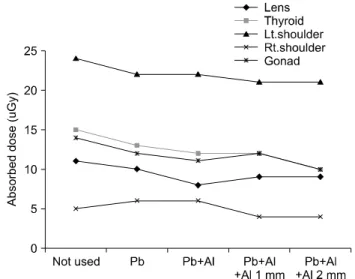
Fig. 6. Comparison of the absorbed doses of the lenses, thyroid, left, right shoulder, and gonads depending on the presence or absence of shielding.

vices, the beams were collimated and down-sized to 14.5 cm×20 cm, and the doses were measured. The doses were 163 μGy, 162 μGy, 154 μGy, 164 μGy, and 160 μGy when no shielding device, Pb shield, Pb+Al shield, Pb+Al+

1-mm-thick Al filter shield and Pb+Al+2-mm-thick Al filter shield were used, respectively. In the comparison of the re- spective full size and down-sized beam measurements shown in Fig. 5, the dose decreased by 23 μGy (reduction rate 12.3%) when no shielding device was used. When the Pb shield was used, the dose decreased by 23 μGy in down- sized beams (reduction rate 12.4%). For the Pb+Al shield, the dose decreased by 27 μGy in down-sized beams (reduction rate 14.9%). When the Pb+Al+1-mm-thick Al filter shield was used, the dose decreased by 20 μGy in down-sized beams (reduction rate 10.75%), and the dose decreased by 26 μGy in down-sized beams when the Pb+Al+2-mm-thick Al filter shield was used (reduction rate 13.97%). The reduction rate between measurements made with full size and down- sized beams was greatest when the Pb+Al shield was used.

To compare the absorbed doses between the full size and down-sized beams, an independent sample t-test was conducted

as shown in Table 2 using SPSS ver. 23.0, and the difference between the full size and down-sized beams was found to be statistically significant (p<0.001).

4. Practitioner exposure dose

When the doses measured at the lenses, thyroid, left should- er, right shoulder, and gonads were summed together, the to- tals were 69 μGy, 63 μGy, 59 μGy, 58 μGy, and 54 μ Gy with no shielding device, Pb shield, Pb+Al shield, Pb+Al

+Al 1 mm filter shield, and Pb+Al+Al 2 mm filter shield, respectively. The absorbed dose of the practitioner decreased by 15 μGy when the Pb+Al+2-mm-thick Al filter shield was used compared to that when no shielding device was used, a reduction rate of 21.7%. When the doses absorbed by the practitioner measured at the different body parts were com- pared, the dose was greatest in left shoulder, followed by the thyroid, gonads, lenses, and right shoulder, as shown in Fig. 6.

When the absorbed dose in the lenses was analyzed, the dose

(7)

Table 3. Difference in absorbed dose depending on the presence or absence of a shield in lens.

Device (Mean) (SD) N F Post hoc test in ANOVA

No used (a) 11.00 .67 10 63.359*** a>b, c, d, e***

d>b, c*

e>b, c*

Pb (b) 7.60 .52 10

Pb+Al (c) 7.60 .52 10

Pb+Al+Al 1 mm (d) 8.50 .53 10

Pb+Al+Al 2 mm (e) 8.50 .53 10

*p<0.05, ***p<0.001.

decreased by 3 μGy when the Pb+Al shield was used com- pared to that when no shielding device was used, a reduction rate of 27.2%.

Post-hoc analyses were conducted using SPSS ver. 23.0 to compare the absorbed doses in the eye lenses, thyroid, left shoulder, right shoulder, and gonads. For the lenses, the differ- ences between the shielding devices were statistically sig- nificant, as shown in Table 3. In particular, the differences be- tween the measurements made when no shielding device was used, Pb shield, Pb+Al shield, Pb+Al+1-mm-thick Al filter shield, and Pb+Al+2-mm-thick Al filter shield were sig- nificant (p<0.001).

For the thyroid, the differences observed in the presence and absence of shielding devices were found to be statistically significant. In particular, the differences between the measure- ments made with no shielding device used, Pb shield, Pb+Al shield, Pb+Al+1-mm-thick Al filter shield, and Pb+Al+

2-mm-thick Al filter shield were significant (p<0.001). In ad- dition, for the left shoulder, the differences between no shield- ing device and with shielding devices were statistically significant. In particular, the differences between the measure- ments made with no shielding device, Pb shield, Pb+Al shield, Pb+Al+1-mm-thick Al filter shield, and Pb+Al+

2-mm-thick Al filter shield were significant (p<0.001).

Similarly, for the right shoulder, the differences observed be- tween the presence and absence of shielding devices were stat- istically significant. In particular, the differences between the measurements made with no shielding device, Pb+Al+

1-mm-thick Al filter shield, and Pb+Al+2-mm-thick Al filter shield were found to be statistically significant (p<0.001). For the gonads, the differences between the measurements made using different types of shielding devices were also significant.

In particular, the differences between the measurements made

with no shielding device, Pb shield, Pb+Al shield, Pb+Al+

1-mm-thick Al filter shield and Pb+Al+2-mm-thick Al filter shield were significant (p<0.001).

Discussion

Since the discovery of radiation, shielding methods have been extensively researched. Vano et al.

6,7)

reported that the exposure dose of practitioners can increase greatly when in- appropriate x-ray devices or inadequate personal protective de- vices are used. Moreover, since other radiation workers can al- so be subjected to exposure doses, the installation of simple cost-effective shielding devices that do not interfere with the purposes of treatment can reportedly decrease the exposure dose for patients, practitioners, and radiation workers.

In the present study, shielding devices were placed around

an x-ray tube in order to reduce the low-energy scattered rays

emitted from the x-ray tube, and the doses were measured be-

fore and after shielding in terms of the space dose, patient ex-

posure dose, and practitioner exposure dose. In particular, the

reduction in the dose was greater when an Al shield was used

inside the lead shield compared to when only the Pb shield

(3-mm-thick Pb) was used to shield the x-ray tube. This is be-

cause the short- and long-wavelength energies with peaks at

the tube voltage are emitted together through Bremsstrahlung

rays with a continuous energy distribution and specific x-rays

with specific energy ranges in x-ray vacuum tubes that use

tungsten (W) as the target material. As a consequence of the

Bremsstrahlung process, the distribution of low-energy rays is

higher than that of high-energy rays in x-rays, and these

low-energy rays cannot easily penetrate the subject and thus

cannot contribute to the formation of the images. Instead, the

rays only increase patient and practitioner exposure doses and

(8)

also increase the number of side-scattered rays. For these rea- sons, 3-mm-thick Al was placed inside the lead shield to ab- sorb the low-energy photons to further shield lead with a high atomic number (Z=82). In terms of the space dose rate, the rate decreased by 2.41 mR/min when Al was used in addition to the Pb compared to when only Pb was used (the reduction rate 3.69%).

In measuring the patient exposure dose with full size and down-sized beams, beam collimation was conducted using the smart road map function in the Philips angiography device, which is intended for use in interventional radiological proce- dures, including TACE. Since full size beams can increase the patient exposure dose, when embolic materials are injected into areas to be embolized after an angiography, the smart road map function only collimates the areas of interest. Considering this, it was confirmed that the doses measured with full size and down-sized beams differed in the presence and absence of shielding devices. With full size beams, the difference between the measurements made without a shielding device and with the Pb+Al shield was the greatest at 5 μGy, with a reduc- tion rate of 2%. With down-sized beams, the difference be- tween the measurements made without a shielding device and with the Pb+Al shield was the greatest at 9 μGy (reduction rate 5%). In general, embolization procedures cannot be com- pleted within a few minutes. In other words, the procedure can last for more than several tens of minutes or even several hours. The measurements made in the present study simulated 1 min of fluoroscopy. If the procedure lasts for several hours, the shielding devices used in the present study can be em- ployed to indirectly decrease the dose for patients and practitioners.

For practitioners in particular, according to the radiation worker exposure dose analysis results reported in 2008 by the Korean Food and Drug Administration, the doses to which ra- diologists, nurses, and radiographers are exposed were 0.42 mSv (±0.13), 0.66 mSv (±0.24), and 1.33 mSv (±0.15), respectively. The doses are much greater than the annual cu- mulative doses of Canadian and Japanese radiation workers of 0.09 mSv and 0.26 mSv, respectively.

8)

In contrast to general x-ray examinations, angiographic examinations are often con- ducted over long periods of time, and patients and practitioners are thus not protected from radiation exposure. In particular,

radiation exposure to the eye lenses of interventional radio- logical practitioners has been previously reported. According to the 2004 report by the Radiological Society of North America (RSNA), Haskal reported that the incidence of radiation-in- duced cataracts has increased by approximately 8%.

9)

Therefore, the risks of doses to the eye lenses and thyroid cannot be ignored. In the present study, the difference between the absorbed doses in lenses measured without a shielding de- vice and with the Pb+Al shield was 3 μGy (reduction rate 27.27%). For the absorbed doses in the thyroid, the difference between measurements made without a shielding device and with the Pb+Al shield was 3 μGy (reduction rate 20%).

A limitation of the present study is that the weights of the Pb and Al shield materials are 7.5 kg and 1.4 kg, respectively, and this could create problems when affixing the shielding devices. Moreover, heavier devices can also limit the angle and rotation of the C-arm, which would limit the use of the C-arm. Therefore, lighter devices should be developed.

Conclusion

Since interventional radiological procedures take a long time to conduct, the use of shielding devices (3-mm-thick Pb+

3-mm-thick Al) is an alternative that can reduce the exposure dose of patients and the exposure of the thyroid and eye lens- es of practitioners to radiation. In addition, practitioners should wear lead goggles or thyroid protectors in order to protect themselves from unnecessary exposure to radiation. In addi- tion, the present study found that x-ray tube shielding devices can reduce the space dose by 20% in all situations where the C-arm is used. Thus, the shielding devices are expected to play an important role in reducing the annual exposure dose of patients and radiation workers, including practitioners and assistants.

References

1. NCRP report 160: Ionizing radiation exposure of the population of the United States, medical exposure: are we doing less with more, and is there a role for health physicists. Health Phys, Schauer DA, Linton OW. (2009)

2. Woo Kyoung Jeong: Radiation exposure and its reduction in

the fluoroscopic examination and fluoroscopy Guided interven-

tional radiology, Korea Medical Association, 54(12):1269-1270

(9)

3. Schueler BA: Operator shielding: how and why. Tech Vasc Interv Radiol 13:167-171 (2010)

4. NCRP report 116: Limitation of exposure to ionizing radiation.

National Council on Radiation Protection and Measurements, Bethesda (1993)

5. Http://sizekorea.kats.go.kr

6. Vano E, Gonzalez L, Beneytez F, et al: Lens injuries in- duced by occupational exposure in non-optimised interventional radiology laboratories. Brit J Radiol Vol 71:728-733 (1998)

7. Vano E, Gonzalez L, Guibelalde E, et al: Radiation ex- posure to medical staff in interventional and cardiac radiology. Brit J Radiol Vol. 71: 954-960 (1998)

8. 2008 Report: Occupational Radiation Exposure in Diagnostic Radiology in Korea. Korea Food & Drug Administration, Medical Institutions, Seung Hee Kim (2008)

9. Brateman L: Radiation safety considerations for diagnostic radi-

ology personnel. Radiographics 19:1037-1055 (1999)

수치

Fig.  1.  Geometry  design  for  Monte  Carlo  simulation.
Fig.  2.  3-mm-thick  Pb  (x-ray  tube  shield)  and  3-mm-thick  Al  (x-ray  tube  double  shield).
Fig.  3.  Schematic  diagram  of  the  measurement  of  six  directions
Table 1. Space dose rate with or without a shielding device measured at 100 cm in an x-ray tube.
+3

참조

관련 문서

In the analysis of the dose constraint of nuclear medical radiation workers using chi-square test statistics, the dose constraint at (the time of) the highest

In this architectural design field, the space with new concept and organic space come into sight, escaping from the space concept in the geometric and

XAFS: X-ray absorption fine structure XES: X-ray emission spectroscopy XRF: X-ray fluorescence.. Use of x-rays; a probe based

A Study on the Evaluation of Space Recognition Space Recognition Space Recognition in the Space Recognition in the in the in the Concourse of Hospital using the

The structure and film optical properties were investigated by X-ray diffraction(XRD), the particle size and thickness were investigated by scanning

Single crystal X-ray structure determination clearly revealed structural authenticity of each compound and alluded electronic alteration via investigation on the

These results indicate that the leching efficiency of Ag could be enhanced using MEK in the nitric acid process for the recover of Ag from the used X-ray film..

the intersection of several such symmetry elements.. International Tables for X-ray Crystallography.. International Tables for X-ray Crystallography.. International Tables