• 검색 결과가 없습니다.

3D Hierarchical Heterostructure of TiO<sub>2</sub> Nanorod/Carbon Layer/NiMn-Layered Double Hydroxide Nanosheet

N/A
N/A
Protected

Academic year: 2021

Share "3D Hierarchical Heterostructure of TiO<sub>2</sub> Nanorod/Carbon Layer/NiMn-Layered Double Hydroxide Nanosheet"

Copied!
7
0
0

로드 중.... (전체 텍스트 보기)

전체 글

(1)

한국표면공학회지 J. Korean Inst. Surf. Eng.

Vol. 51, No. 6, 2018.

https://doi.org/10.5695/JKISE.2018.51.6.365

<연구논문>

ISSN 1225-8024(Print) ISSN 2288-8403(Online)

3D Hierarchical Heterostructure of TiO 2 Nanorod/Carbon Layer/NiMn-Layered Double Hydroxide Nanosheet

Wei Zhao

a

and Hyunsung Jung

a,*

a

Electronic Convergence Materials Division, Nano Convergence Materials Center, Korea Institute of Ceramic Engineering & Technology (KICET), Republic of Korea (Received 2 October, 2018 ; revised 20 November, 2018 ; accepted 10 December, 2018)

Abstract

1D core-shell nanostructures have attracted great attention due to their enhanced physical and chemical properties. Specifically, oriented single-crystalline TiO

2

nanorods or nanowires on a transparent conductive substrate would be more desirable as the building core backbone. However, a facile approach to produce such structure-based hybrids is highly demanded. In this study, a three-step hydrothermal method was developed to grow NiMn-layered double hydroxide-decorated TiO

2

/carbon core-shell nanorod arrays on transparent con- ductive fluorine-doped tin oxide (FTO) substrates. XRD, SEM, TEM, XPS and Raman were used to analyze the obtained samples. The in-situ fabricated hybrid nanostructured materials are expected to be applicable for photoelectrode working in water splitting.

Keywords : TiO

2

, Layered double hydroxide, Core/Shell, Nanowires, Nanosheets

1. Introduction

In recent years, owing to an impending global energy crisis as well as hazardous environmental pollution caused by declined fossil-fuel production and increased fossil-fuel consumption, intensive research has focused on solar energy conversion to provide clean chemical fuels (H

2

, CH

4

, etc.) [1,2]. Generally, solar-to-fuel conversion significantly depends on the semiconductor materials which can harvest photon energy across the wide solar spectrum and generate charge carriers at the suitable energy levels [3,4].

Among various semiconductor materials, titanium dioxide (TiO

2

) has been extensively investigated and considered as one of the most promising

candidates because of its low cost, earth abundance, high chemical stability, and eco- friendliness [5,6]. It is commonly known that TiO

2

can exist in various dimensions and morphologies, namely zero-dimensional (0D) nanoparticles (NPs) [7], one-dimensional (1D) nanofibers [8], nanorods (NRs) [9], nanowires [10], and nanotubes [11], two-dimensional (2D) nanosheets (NSs) [12] and nanoplates [13], and three-dimensional (3D) hierarchical and interconnected architectures [14,15]. In particular, 1D TiO

2

nanostructured materials, especially TiO

2

NRs, have been extensively studied due to their distinctive advantages. They have a high aspect ratio, so that they inherited all the typical features of TiO

2

NPs and displayed a large specific area. In addition, the relative ease of their fabrication adds to their advantages. Meanwhile, the relatively large specific surface area and chemical stability make them ideal building blocks for assembling various surface heterostructures, allowing 1D TiO

2

NRs to be widely used in water splitting [16], solar cells

* Corresponding Author: Hyunsung Jung

Gyungnam Jinju-si Soho-ro 101 Korea Institute of Ceramic

& engineering

Tel: +82-55-792-2711 ; Fax: +82-55-792-2492

E-mail: [email protected]

(2)

[17], and nanodevices [18]. Various synthesis methods, such as electrodepositions, hydrothermal techniques, physical vapor deposition, and chemical vapor deposition, for TiO

2

NR arrays on transparent conductive oxide substrates, along with their characterization, have been reported in abundance [19,20]. Compared with other methods, the hydrothermal method has many advantages, including relatively low reaction temperature, ease of adjusting the reaction conditions (e.g., temperature, pH, concentration, and molar ratio) to modify compositions, structures, and morphologies of products.

Moreover, the 1D core-shell nanostructures have attracted great interest recently due to their enhanced physical and chemical properties as compared to their bulk counterparts [21,22]. The core-shell nanostructures normally possess different properties from either of the constituents which make them eligible for applications in areas of global interest [23]. Therefore, developing controlled protocols for the synthesis of heterostructured core-shell NR arrays is essential for developing new economic materials for potential applications.

In this study, we demonstrate a combined three- step hydrothermal synthesis protocols for the fabrication of self-supported core-double-shell NR arrays. The TiO

2

NR arrays were prepared onto FTO glass substrate as the core backbone, followed by coating with amorphous carbon and then NiMn-layered double hydroxide (LDH) nanosheets conformally on them as the first and second shell materials, respectively.

2.Experimental section

2.1 Materials

Titanium(IV) butoxide (TBO, 98.0%), nickel nitrate hexadrate (Ni(NO

3

)

2

·6H

2

O, 97.0%), and hexamethylenetetramine (HMTA, 99%) were purchased from Sigma Aldrich. Manganese acetate (Mn(CH

3

COO)

2

·4H

2

O), dextrose anhydrous (C

6

H

12

O

6

, 98.0%), and hydrochloric acid (HCl, 35-37 wt%) were purchased from Daejung Chemicals & Metals Co., Ltd. All the reagents were used without further purification.

2.2 Synthesis of TiO

2

nanorod arrays (NRAs) In a typical synthetic process, the fluorine-doped tin oxide (FTO) glass substrates (1.5 × 1.5 cm

2

) were first cleaned by ultrasonication in a mixture of isopropyl alcohol and deionized (DI) water for 2 h. Subsequently, they were they were rinsed with DI water and then dried in an N

2

stream at room temperature. Then the FTO glass substrate was soaked into a thoroughly mixed solution of DI water (30 mL), HCl (30 mL), and TBO (1.0 mL) in a Teflon-lined stainless-steel autoclave with its conductive side facing down. The autoclave was put in an electric oven set at a temperature of 150

o

C for 20 h. After the autoclave was cooled down to room temperature, the FTO glass substrate was taken out and rinsed thoroughly with ethanol and DI water, followed by annealing at 500

o

C in air for 2 h.

2.3 Synthesis of TiO

2

/C core-shell NRAs For the carbon coating, the annealed TiO

2

NRAs underwent another hydrothermal process. Briefly, the FTO glass substrate with TiO

2

NRAs was put into a Teflon-lined stainless-steel autoclave where there was a solution of dextrose (0.03 M). The reaction was allowed to carry out at 180

o

C for 18 h, followed by heat treatment at 500

o

C in N

2

for 3 h.

Thus, the carbon-coated TiO

2

NRAs (TiO

2

/C NRAs) were obtained.

2.4 Synthesis of TiO

2

/C/NiMn-LDH core- double-shell NRAs

The decoration of NiMn-LDH NSs onto TiO

2

/C NRAs was described as follows. Typically, a transparent solution was prepared with Ni(NO

3

)

2

·6H

2

O, Mn(CH

3

COO)

2

·4H

2

O and HMTA dissolved in 60 mL DI water, and transferred into a 100 mL Teflon-lined stainless-steel autoclave. Afterwards, the FTO glass substrate with obtained TiO

2

/C NRAs was immersed into the solution with its facing down. Then the autoclave was sealed, maintained at 80

o

C for 14 h, and naturally cooled down to room temperature. The FTO glass substrate was washed with distilled water for several times and dried at 60

o

C for several hours.

In addition, NiMn-LDH coated TiO

2

NRAs were also

prepared by using the FTO glass substrate with TiO

2

NRAs under the same procedures, as denoted as

(3)

TiO

2

/NiMn-LDH NRAs.

2.5 Characterization

The samples were characterized by different analytical techniques. X-ray diffraction (XRD) data were collected on a PANalytical X-Pert MPD X- ray diffractometer with a Cu-K α radiation ( λ = 1.54178 Å) source with 2θ range from 10

o

to 70

o

. Field-emission scanning electron microscopy (FE-SEM) images were conducted on a Hitachi S- 4800 scanning electron microscope (Japan).

Transmission electron microscopy (TEM) images, high-resolution TEM (HRTEM) images, and energy dispersive X-ray spectroscopy (EDS) were conducted on a FEI Tecnai G2 F20 field-emission transmitting electron microscope at an acceleration voltage of 200 kV. And X-ray photoelectron spectra (XPS) was obtained on a Thermo Scientific K-Alpha spectrometer using a monochromatic Al K

α

radiation source (1486.6 eV). Raman spectra were taken using a Bruker Senterra Raman spectrometer.

3. Results and discussion

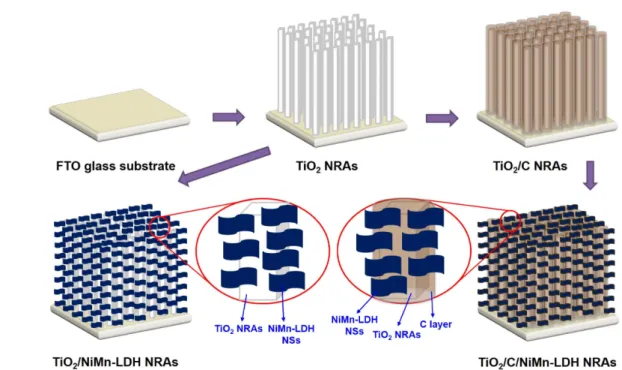
As a typical presentation, TiO

2

nanorod arrays (NRAs) are chosen as a protype for the

investigation of the synergetic effect of amorphous carbobn and NiMn-LDH, and Figure 1 depicts the fabrication process of TiO

2

/NiMn-LDH, and TiO

2

/ C/NiMn-LDH samples.

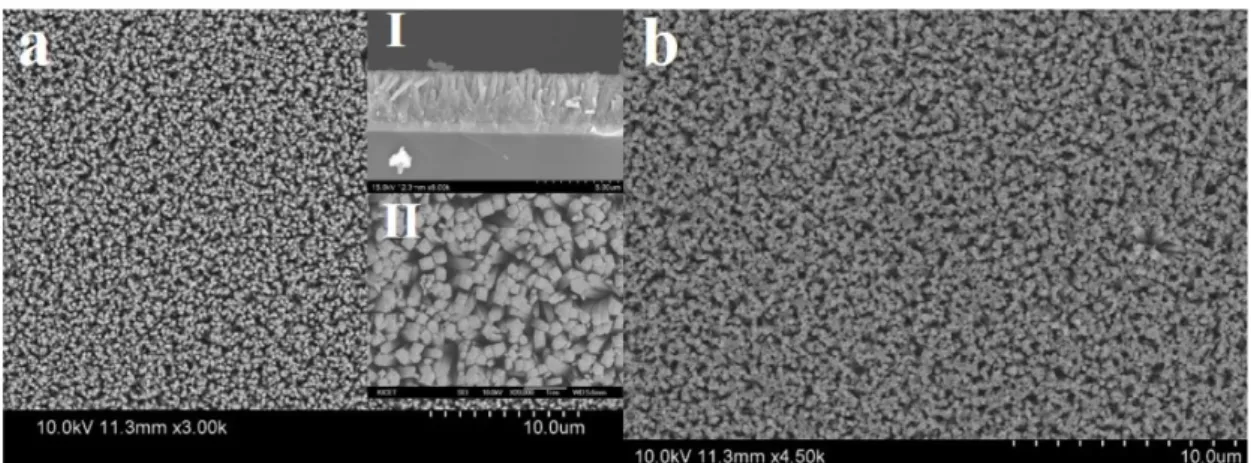
Vertically-aligned TiO

2

NRAs were firstly grown on a FTO glass substrate via a previously reported hydrothermal method [24], with a diameter ranging from 100-200 nm and an average length of ~3.0 μm, as shown in Figure 2(a) and its inset. It is obvious that the entire surface of the FTO substrate is covered uniformly with TiO

2

NRs. Top and side view shown in the inset (I) and (II) of Figure 2(a) show that the top surface of the NRs appears to contain many step edges, while the side surface is smooth. Growth appears to proceed by addition of titanium growth units at the step edges [25]. The NRs are in the tetragonal shape with square top facets, which is just the growth habit for the tetragonal crystal structure. Figure 2(b) shows amorphous carbon- coated TiO

2

NRAs on the FTO substrate. It is clear to see that the surface is smoother than that before carbon coating.

To determine the crystal structure, XRD patterns were collected from the TiO

2

NRAs before and after amorphous carbon coating process (Figure 3).

After subtracting the diffraction peaks from FTO

Fig. 1 Schematic illustration for the fabrication of TiO

2

/C/NiMn-LDH core-double-shell NRAs.

(4)

glass substrate, two peaks at 2 θ angles of 36.5

o

and 63.2

o

were observed in both samples, which are indexed to the characteristic peaks of tetragonal rutile TiO

2

(JCPDS No. 88-1175). They correspond to the (101) and (002) diffraction, respectively.

Moreover, some other diffraction peaks including (110), (111), and (211) were absent, indicating that the TiO

2

NR film is highly oriented with respect to the FTO substrate surface. Commonly the absent diffraction peaks are normally present in polycrystalline or powder samples, indicating that the NRs formed on the substrate are not only aligned, but are single crystalline throughout their length. In addition, a wide peak is shown between 20

o

and 30

o

, demonstrating the existence of amorphous carbon on the surface of TiO

2

NRs after calcination in an inert gas atmosphere (N

2

).

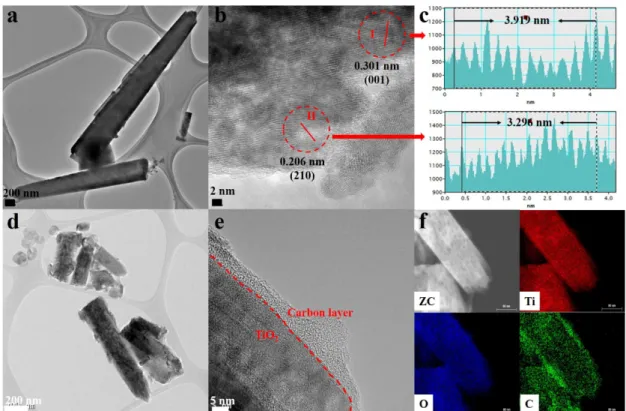
For a better understanding of the microstructure of these structures, TEM has been carried out as shown in Figure 4. The crystallinity of the prepared TiO

2

and TiO

2

/C NRs is also visible from TEM images. Figure 4(a) shows the individual TiO

2

NRs, and high resolution (HR) TEM image shown in Figure 4(b) includes two circled areas (I) and (II). With the estimation of line profiles shown in Figure 4(c), the interplanar fringe spacings are 0.301 nm and 0.206 nm, which match well with the (001) and (210) planes of the rutile phase TiO

2

, respectively. Besides, Figure 4(d) shows the TiO

2

coated with the amorphous carbon, and the HRTEM image (Figure 4(e)) clearly exhibits the existence of crystalized TiO

2

and amorphous carbon layer, with the interface marked using a dashed line, indicating an obvious core-shell structure. The carbon shell thickness is measured to be 5~10 nm. Moreover, to probe the elemental composition of the core-shell, energy dispersive spectroscopy (EDS) mapping under TEM was conducted over a single TiO

2

/C core- shell NR. As shown in Figure 4(f), Ti and O are located in the central part of the core-shell nanostructure, while the elements C is homogeneously distributed across the whole NR, confirming the core-shell nanostructure.

Further structural analysis of the TiO

2

NRAs and TiO

2

/C core-shell NRAs was performed using XPS and Raman scattering. The XPS measurement shown in Figure 5(a) confirms the Fig. 2 SEM images of (a) TiO

2

NRAs, (b) TiO

2

/C core-shell NRAs. (inset: (I) side view, and (II) enlarged top view of TiO

2

NRAs. The scale bars for (a), (b) and the insets are 10 μ m, 10 μ m, 5 μ m, and 1 μ m, respectively).

Fig. 3 XRD patterns of TiO

2

NRAs, and carbon-coated

TiO

2

NRAs.

(5)

presence of carbon together with Ti and O after carbon coating on the TiO

2

NRs. With the increased intensity of carbon, TiO

2

/C core-shell NRAs exhibit lower intensity Ti and O compared to TiO

2

NRAs, indicating that the amorphous carbon layer on the surface of TiO

2

NRs relatively block the signal from elements Ti and O in the center. In addition, three Raman peaks around 248 cm

-1

(weak), 456 cm

-1

(strong), and 618 cm

-1

(strong) in Figure 5(b) from the TiO

2

NRAs represent the O-Ti-O bending and the Ti-O stretching modes and correspond to the TiO

26

. After carbon coating on the surface, two characteristic bands at around 1365 cm

-1

(D band), and 1603 cm

-1

(G band) are observed in TiO

2

/C NRAs, demonstrating the presence of carbon.

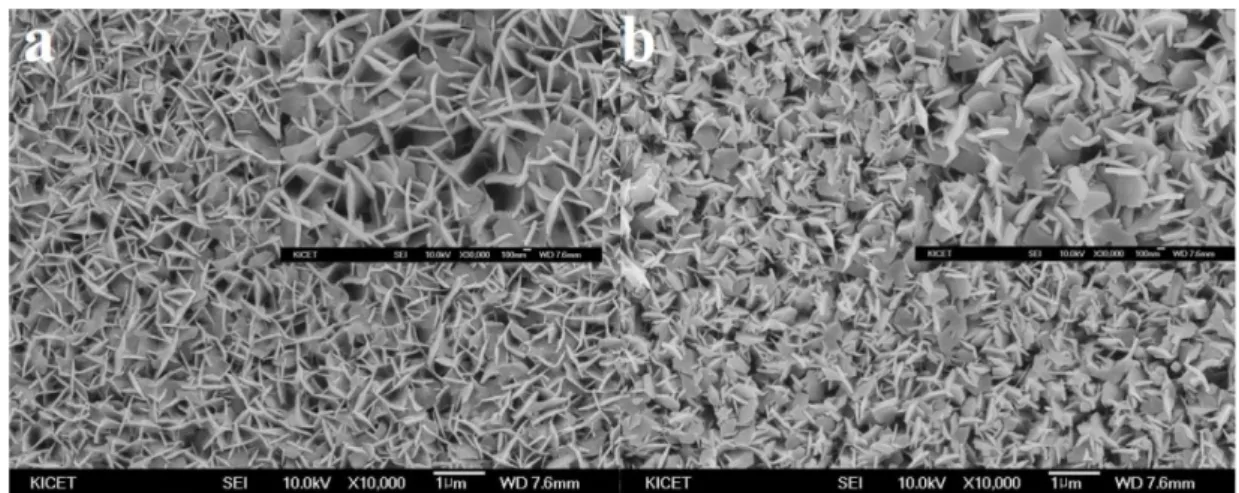
Furthermore, NiMn-LDH nanosheets-decorated TiO

2

NRAs and TiO

2

/C core-shell NRAs were fabricated using the hydrothermal method. Their surface microstructures are analyzed by SEM. As Fig. 4 TEM and HR-TEM images of (a, b) TiO

2

NRs, and (d, e) TiO

2

/C core-shell NRs, (c) line profile plots for circled area (I) and (II) in Fig. 4(b), (f) the HAAD-STEM image and elemental mapping image of an individual NR of a TiO

2

/ C NR.

Fig. 5 (a) XPS spectra and (b) Raman spectra of the obtained TiO

2

NRAs and TiO

2

/C core-shell NRAs.

(6)

shown in Figure 6, it is obvious that NiMn-LDH nanosheets are homogeneously distributed over TiO

2

and TiO

2

/C NRAs shown in Figure 2.

To elucidate the crystal structure of as-prepared hybrids, XRD patterns are also recorded as shown in Figure 7. The diffraction peaks at 2 θ angles of 11.04

o

, 22.44

o

, 34.06

o

, 38.46

o

, 45.4

o

, 59.48

o

, and 60.46

o

are present for NiMn-LDH nanosheets- decorated TiO

2

NRAs and TiO

2

/C core-shell NRAs, which are reasonably assigned to planes (003), (006), (012), (015), (018), (110), and (113), in accordance with NiMn-LDH (JCPDS card No. 38- 0715) [27]. At the same time, several low-intensity peaks for FTO and TiO

2

are also detected, as shown in Figure 7. No other crystalline phase is detected, indicating a high purity of the composites.

4. Conclusions

In this study, NiMn-LDH nanosheets were fabricated on amorphous carbon layer-coated TiO

2

nanorod arrays to form a 3D hierarchical nanostructure on the transparent conductive fluorine-doped tin oxide (FTO) substrates. A three- step hydrothermal approach was used, with the amorphous carbon and NiMn-LDH nanosheets are homogeneously distributed over the surface of rutile TiO

2

nanorods. Furthermore, the fabricated nanostructures will be investigated in the photoelectrochemical water splitting application for the hydrogen generation, because the functional materials including TiO

2

as a photoelectrode for water splitting, LDH as a photocatalyst and carbon layer for the improvement of electrical contacts with the high aspect ratio can be expected to demonstrate high performance.

Acknowledgement

This work was supported by the National Research Foundation of Korea (NRF) grant funded by the Korean government (MSIP) (No.

2017R1D1A1B03030796).

References

[1] X. Long, J. Li, S. Xiao, K. Yan, Z. Wang, H.

Chen, and S. Yang, Angew. Chem. Int. Ed., 2014, Fig. 6 SEM images of (a) NiMn-LDH-decorated TiO

2

NR arrays, and (b) NiMn-LDH-decorated TiO

2

/C core-shell NR arrays on FTO glass. (insets: enlarged view; the scale bars for (a), (b) and their insets are 1 μ m, 1 μ m, 100 nm, and 100 nm, respectively)

Fig. 7 XRD patterns of NiMn-LDH nanosheets-

decorated TiO

2

NRAs and TiO

2

/C core-shell NRAs.

(7)

53, 7584-7588.

[2] J. Zhang, X. Jin, P. I. Morales-Guzman, X. Yu, H. Liu, H. Zhang, L. Razzari, and J. P. Claverie, ACS Nano, 2016, 10, 4496-4503.

[3] P. Zhang, J. J. Zhang, and J. L. Gong, Chem.

Soc. Rev., 2014, 43, 4395-4422.

[4] Y. C. Pu, G. Wang, K. D. Chang, Y. Ling, Y.

Ka. Lin, B. C. Fitzmorris, C. M. Liu, X. Lu, Y.

Tong, J. Z. Zhang, Y. J. Hsu, and Y. Li, Nano Lett., 2013, 13, 3817-3823.

[5] X. Chen, S. Shen, and L. Guo, Chem. Rev. 2010, 110, 6503-6570.

[6] C. T. Dinh, and T. D. Nguyen, and F. Kleitz, ACS Nano 2009, 3, 3737-3743.

[7] Z. Wu, Y. Wang, L. Sun, Y. Mao, M. Wang, and C. Lin, J. Mater. Chem. A, 2014, 2, 8223-8229.

[8] X. Zhang, T. Zhang, J. Ng, and D. D. Sun, Adv.

Funct. Mater. 2009, 19, 3731-3736.

[9] H. J. Yun, H. Lee, J. B. Joo, W. Kim, and J. Yi, J. Phys. Chem. C, 2009, 113, 3050-3055.

[10] J. Su, and L. Guo, RSC Advances, 2015, 5, 53012- 53018.

[11] J. Fan, L. Zhao, J. Yu, and G. Liu, Nanoscale, 2012, 4, 6597-6603.

[12] C. P. Sajan, S. Wageh, A. A. Al-Ghamdi, J. Yu, and S. Cao, Nano Res., 2016, 9, 3-27.

[13] K. Zhao, S. Zhao, J. Qi, H. Yin, C. Gao, A. M.

Khattak, Y. Wu, A. Iqbal, L. Weu, Y. Gao, R.

Yu, and Z. Tang, Inorg. Chem. Front., 2016, 3, 488-493.

[14] T. D. Nguyen-Phan, E. S. Oh, M. Chhowalla, T.

Asefa, and E. W. Shin, J. Mater. Chem. A, 2013, 1, 7690-7701.

[15] W. Dong, Y. Sun, C. W. Lee, W. Hua, X, Lu, Y. Shi, S. Zhang, J. Chen, and D. Zhao, J. Am.

Chem. Soc., 2007, 129, 13894-13904.

[16] M. Altomare, M. Pozzi, M. Allieta, L. G. Bettini, and E. Selli, Appl. Catal. B, 2013, 136, 81-88.

[17] L. Chen, Y. Zhou, H. Dai, Z. D. Li, T. Yu, J.

G. Liu, and Z. G. Zou, J. Mater. Chem. A, 2013, 1, 11790-11794.

[18] J. Y. Huang, Y. K. Lai, F. Pan, L. Yang, H. Wang, K. Q. Zhang, H. Fuchs, and L. F. Chi, Small, 2014, 10, 4865-4875.

[19] A. Dessombz, C. R. Pasquier, P. Davidson, and C. Chaneac, J. Phys. Chem. C, 2010, 114, 19799- 19802.

[20] J. Wang, T. Zhang, D. Wang, R. Pan, Q. Wang, and H. Xia, J. Alloys Compd., 2013, 551, 82-87.

[21] J. Liu, J. Jiang, C. Cheng, H. Li, J Zhang, H.

Gong, and H. J. Fan, Adv. Mater., 2011, 23, 2076- 2081.

[22] X. Xia, Y. Zhang, D. Chao, C. Guan, Y. Zhang, L. Li, X. Ge, I. M. Bacho, J. Tu, and H. J. Fan, Nanoscale, 2014, 6, 5008-5048.

[23] K. Wang, J. Chen, W. Zhou, Y. Zhang, Y. Yan, J. Pern, and A. Mascarenhas, Adv. Mater., 2008, 20, 3248-3253.

[24] F. Ning, M. Shao, S. Xu, Y. Fu, R. Zhang, M.

Wei, D. G. Evans, and X. Duan, Energy & Environ.

Sci., 2016, 9, 2633-2643.

[25] A. Pottier, C. Chaneac, E. Tronc, L. Mazrolles, and J. P. Jolivet, J. Mater. Chem., 2001, 11, 1116- 1121.

[26] Y. Kim, H. M. Hwang, L. Wang, I. Kim, Y. Yoon, and H. Lee, Sci. Rep., 2016, 6, 25212 (1-10).

[27] J. Zhao, J. Chen, S. Xu, M. Shao, Q. Zhang, F.

Wei, J. Ma, M. Wei, D. G. Evans, and X. Duan,

Adv. Funct. Mater., 2014, 24, 2938-2946.

수치

Fig. 1 Schematic illustration for the fabrication of TiO 2 /C/NiMn-LDH core-double-shell NRAs.
Fig. 3 XRD patterns of TiO 2  NRAs, and carbon-coated TiO 2  NRAs.
Fig. 5 (a) XPS spectra and (b) Raman spectra of the obtained TiO 2  NRAs and TiO 2 /C core-shell NRAs.
Fig. 7 XRD patterns of NiMn-LDH nanosheets- nanosheets-decorated TiO 2  NRAs and TiO 2 /C core-shell NRAs.

참조

관련 문서

In this study, 3D PCL scaffolds were fabricated by using notch type nozzle via fused deposition modeling (FDM) to improve the cell adhesion and

In this study, we have deposited poly acrylic acid films on three-dimensional (3D) PCL scaffolds using plasma polymerization and then plasma-polymerized 3D

In an effort to develop a new method to remove nitrogen, this study examined the effects of C/N ratio, carbon source and nitrogen concentration on

⇒ Bromination; test for the double (or triple) bonds because Br 2 in carbon tetra chloride has red brown color after rxn

Yanga, “Mesoporous activated carbon fiber as electrode material for high-performance electrochemical double layer capacitors with ionic liquid electrolyte”, J...

• Inertial sub-layer, viscosity plays a minor role. • Main turbulent

출처 : IAEA 발표 자료(Comprehensive inspection exercise at bulk handling facilities, “U-235 Enrichment measurements by gamma-ray spectroscopy”) 13.  Uranium

In this study, we fabricated electrode tools for electrochemical machining (ECM) using three-dimensional (3D) printing, which outputs free shapes