• 검색 결과가 없습니다.

A SOURCE EXTRACTION METHOD FOR THE AKARI MID-IR FAINT SOURCE CATALOGUE

N/A
N/A
Protected

Academic year: 2021

Share "A SOURCE EXTRACTION METHOD FOR THE AKARI MID-IR FAINT SOURCE CATALOGUE"

Copied!
3
0
0

로드 중.... (전체 텍스트 보기)

전체 글

(1)

Publications of the Korean Astronomical Society pISSN 1225-1534

32: 029 ∼ 031, 2017 March eISSN 2287-6936

⃝2017. The Korean Astronomical Society. All rights reserved. c https://doi.org/10.5303/PKAS.2017.32.1.029

A SOURCE EXTRACTION METHOD FOR THE AKARI MID-IR FAINT SOURCE CATALOGUE Keichiro Nakamichi

1

, Daisuke Ishihara

1

, Hidehiro Kaneda

1

, Shinki Oyabu

1

, Toru Kondo

1

,

Tomoya Amatsutsu

1

, Hidetoshi Sano

1

, and Takashi Onaka

2

1

Graduate School of Science, Nagoya University, Furo-cho, Chikusa-ku, Nagoya, Aichi 464-8602 Japan

2

Graduate School of Science, The University of Tokyo, Hongo, Bunkyo-ku, Tokyo 113-0033 Japan;

E-mail: [email protected]

(Received June 20, 2015; Revised October 27, 2016; Accepted October 27, 2016)

ABSTRACT

We plan to produce a faint source catalogue from the AKARI mid-infrared (IR) all-sky diffuse maps. In the publicly-available AKARI mid-IR point source catalogue (PSC), sources were extracted from single- scan images, and confirmed by using the other scan images. By stacking multiple scan images, we can detect fainter sources which are not listed in the PSC. We optimized the source extraction process using a 6

× 6

area around the star-forming region, Cepheus B. Then, we divided the all-sky data into three seasonal images, and checked the positions and the fluxes of the detected sources on the images. As a result, our new source extraction method works well; 90% of the sources are also identified in the WISE catalogue. In this method, we obtain the detection limit twice deeper than that of the PSC. The number of sources increases by a factor of 2, as compared with the PSC.

Key words: methods:data analysis; technique:photometric; stars:formation

1. INTRODUCTION

We plan to produce a faint source catalogue from the AKARI/IRC 9 and 18 µm mid-infrared all-sky sur- vey data. The publicly-available point source catalogue (PSC; Ishihara et al., 2010) contains reliable but rel- atively bright sources, because point sources were ex- tracted from single scan images. We plan to extract fainter sources by stacking all the scan images. In this case, however, it is difficult to confirm the de- tected sources, because there are no independent mea- surements. In this work, we optimized the parameters in the source extraction process and established a source confirmation method.

2. METHOD

We extracted point sources from the images made by stacking all the scan images. A source is identified, if contiguous pixels with the number of N

pix

have signal values higher than a threshold, by using Source Ex-

http://pkas.kas.org

Table 1

The detection limit and the number of detected sources.

PSC This work 9 µm Detection limit (4σ) (Jy) 0.12 0.06

Number of sources 2439 4106 18 µm Detection limit (4σ) (Jy) 0.22 0.12 Number of sources 704 1190

tractor ver 2.8.6 (Bertin & Arnouts, 1996). In order to confirm the detected sources, we divided the stacked image into the three seasonal images, and checked the positions and the fluxes of the sources on each image. If they are consistent among the seasonal images, we take them as confirmed sources.

We optimized the parameters in the source extrac-

tion process (N

pix

, threshold) using the star-forming re-

gion Cepheus B as a test field. We varied the threshold

from 2σ to 5σ, and N

pix

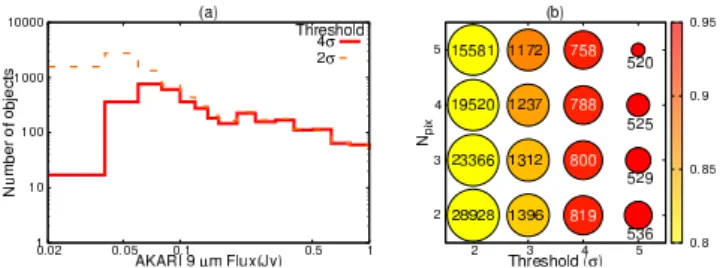
from 2 to 5 pixels. Figure 1a

shows the flux distributions of the detected sources with

(N

pix

, threshold) = (2, 4) and (2, 2). The flux bin which

contains the largest number of sources is regarded as the

29

(2)

30 NAKAMICHI ET AL.

Figure 1. (a) Flux distributions of the detected sources in the 9 µm band with N

pix

= 2. The solid and dashed histograms indicate the sources detected with threshold = 4σ and 2σ, respectively. (b) The fraction of the confirmed sources and the number of detected sources in the 9 µm band. The frac- tion of the confirmed sources is indicated by the color scale, while the number of sources is indicated by the size of the circle with the values.

detection limit. We searched for the parameters which maximize the fraction of the confirmed sources and the number of detected sources.

3. RESULTS

Figure 1b summarizes the fraction of the confirmed sources and the number of the sources extracted for each parameter set. Based on the figure 1b, we adopted threshold = 4σ and N

pix

= 2 as the optimized parame- ter set. The area of N

pix

= 2 is almost equivalent to the PSC sizes in the 9 and 18 µm bands. The detection limit and the number of sources extracted with the optimized parameters are summarized in Table 1. The detection limit is about twice deeper than that of the PSC, which is reasonable considering the number of stacked images.

The number of detected sources is about twice larger than that of the PSC in both 9 and 18 µm bands which is smaller than expected from the 3-dimensional uniform distribution (i.e., 2

1.5

), probably due to the nature of the test field (Cepheus B). Figure 2 shows the distributions of the PSC sources and the newly detected sources for part of the Cepheus B region. Such faint sources not listed in the PSC are detected in this work.

4. DISCUSSION

We evaluated the reliability and the completeness of the detected sources, using the WISE catalogue (Wright et al., 2010). The reliability is defined as the number of the sources identified with WISE to that of the de- tected sources. The completeness is defined as a ratio of the number of the detected sources to that of the sources whose fluxes are higher than the WISE detec- tion limit. We cross-identified the AKARI 9 and 18 µm sources with the WISE 12 and 22 µm sources, respec-

Figure 2. AKARI 9 µm image in the star-forming region, Cepheus B, made by stacking all the scan images. The field size is about 45

×45

, centered at (α, δ) = (347.

3, 61.

3). The squares indicate the PSC sources, while the circles indicate the sources newly detected on this work.

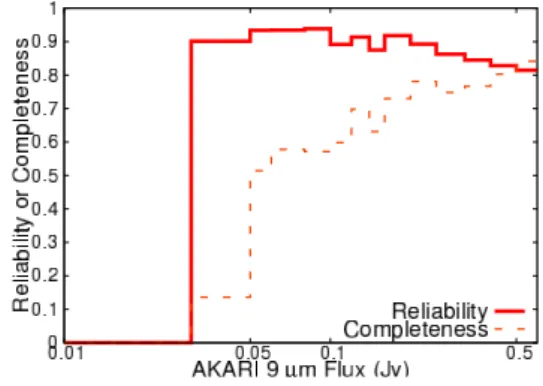
tively. Figure 3 shows a plot between the fluxes in the AKARI 9 µm and the WISE 12 µm bands. Our cross- identifications are reliable because most of the sources show reasonable colors of stars for these bands. The small scatter may indicate objects having red continua or silicate features. Figure 4 shows the reliability and the completeness of the detected sources as a function of the flux. The reliability reaches ∼90% for sources brighter than the detection limit, while the complete- ness is lower than ∼90% at <0.5 Jy. It is because the 12 µm extended sources included in the WISE catalogue tend to be excluded in our list.

5. SUMMARY

We plan to make a faint source catalogue from the AKARI 9 and 18 µm all-sky survey data by stacking all the scan images. We extracted point sources on the stacked images and confirmed them on the three sea- sonal images. The parameters for the source extraction process were optimized to maximize the fraction of the confirmed sources and the number of detected sources.

We carried out this study in the Cepheus B region as a test field. By applying the optimized parameters, we obtain the detection limit and the number of the de- tected sources twice better than those of the PSC. The reliability reaches ∼90% for sources brighter than the detection limit, based on the WISE catalogue.

ACKNOWLEDGMENTS

This research is based on the observations with

AKARI, the JAXA project with the participation of

ESA. This work is supported by JSPS KAKENHI Grant

Numbers Nos. 24740122, 26707008, and 50377925.

(3)

A SOURCE EXTRACTION METHOD FOR THE AKARI MID-IR FSC 31

Figure 3. AKARI 9 µm fluxes versus the WISE 12 µm fluxes for the cross-identified sources. Solid line indicates the locus of stars assuming the Rayleigh-Jeans law.

Figure 4. Reliability (solid line) and completeness (dashed line) in the AKARI 9 µm band as a function of the flux.

The WISE 12 µm sources are used as references.

REFERENCES

Bertin, E. & Arnouts, S., 1996, SExtractor: Software for source extraction., A&A, 117, 393

Ishihara, D. et al., 2010, The AKARI/IRC mid-infrared all- sky survey, A&A, 514, A1

Wright, E. L. et al., 2010, The Wide-field Infrared Survey Ex-

plorer (WISE): Mission Description and Initial On-orbit

Performance, AJ, 140, 1868

수치

Figure 1b summarizes the fraction of the confirmed sources and the number of the sources extracted for each parameter set
Figure 4. Reliability (solid line) and completeness (dashed line) in the AKARI 9 µm band as a function of the flux.

참조

관련 문서

Table 7 compares the accuracy when all the 100 frame images extracted from three pairs of video data were stitched, when the homography matrix was discretely generated for

By the 19th century, organic images were revealed by recreating many natural forms with free curves, while from the late 19th century, organic and

This paper proposes the improved real time object detection and distance measurement system using IR-UWB radar.. Firstly, the IR-UWB signal is applied for

To obtain the local concentration and distribution of soot particles formed within the flame, laser-backlit images produced with a 635 nm light source

Directed Energy Deposition (DED) processes selectively dissolve and solidify the material using a high density energy source to produce a desired product. In

In an effort to develop a new method to remove nitrogen, this study examined the effects of C/N ratio, carbon source and nitrogen concentration on

Digital images were obtained by taking digital impressions with a dental model scanner(S600 ARTI model scanner, Zirkonzhan, South Tyrol, Italy) after connecting the own

The rectifier is a circuit that acts as a dc voltage source by converting the ac voltage from a standard wall outlet to a dc voltage. This voltage is effectively applied