• 검색 결과가 없습니다.

Effects of Proprioceptive Neuromuscular Facilitation Exercises on the Neck Disability Index and Deep Neck Flexor Endurance of Patients with Acute Whiplash Injury

N/A
N/A
Protected

Academic year: 2021

Share "Effects of Proprioceptive Neuromuscular Facilitation Exercises on the Neck Disability Index and Deep Neck Flexor Endurance of Patients with Acute Whiplash Injury"

Copied!
11
0
0

로드 중.... (전체 텍스트 보기)

전체 글

(1)

| Abstract |

Purpose: The purpose of this study is to examine the effects of proprioceptive neuromuscular facilitation (PNF) exercises on the neck disability index and deep neck flexor endurance of acute whiplash injury patients and to provide basic data for PNF exercises for musculoskeletal system disorder patients.

Methods: Twenty acute whiplash injury patients were randomly assigned to an experimental group (n=10) and were treated with PNF exercises whereas a control group (n=10) underwent general exercises. Each session lasted 15 minutes and was performed five times a week for two weeks. The degree of pain was assessed using a visual analogue scale (VAS) and the degree of neck disability was measured by the neck disability index (NDI). Craniocervical flexor endurance (CCFE) tests were conducted to measure deep neck flexor endurance.

Results: In terms of the intragroup changes in VAS, NDI, and CCFE, there were significant decreases in both the experimental and the control groups. After intervention, there were significant differences between the experimental group and the control group in terms of intergroup changes in VAS, NDI and CCFE.

Conclusion: Although the exercises that are generally applied to acute whiplash injury patients are effective on the whole, PNF exercises are considered to be beneficial, given the improvements in the neck disability index and deep neck flexor endurance.

Key Words: Acute Whiplash Injury, Craniocervical flexor endurance (CCFE), Neck disability index (NDI), Proprioceptive neuromuscular facilitation (PNF), Visible analogue scale (VAS)

†Corresponding Author : Beom-Ryong Kim ([email protected])

Original Article Open Access

고유수용성신경근촉진법 운동이 급성 목부염좌 환자의 통증과 목 장애지수 및 심부목굽힘근 지구력에 미치는 영향

강태우⋅정왕모 1 ⋅김범룡 2†

1)

원광대학교병원 물리치료실, 1 정인 운동교육센터, 2 대자인병원 재활센터

Effects of Proprioceptive Neuromuscular Facilitation Exercises on the Neck Disability Index and Deep Neck Flexor Endurance of Patients with Acute Whiplash Injury

Tae-Woo Kang⋅Wang-Mo Jeong 1 ⋅Beom-Ryong Kim 2†

Department of Physical Therapy, Wonkwang University Hospital

1 Department of Physical Therapy, Jeong In Body Exercise Trading Center

2 Department of Physical Therapy, Design Hospital

Received: April 26, 2018 / Revised: May 31, 2018 / Accepted: June 1, 2018

ⓒ 2018 Journal of Korea Proprioceptive Neuromuscular Facilitation Association

This is an Open Access article distributed under the terms of the Creative Commons Attribution Non-Commercial License

(http://creativecommons.org/licenses/by-nc/3.0) which permits unrestricted non-commercial use, distribution, and reproduction

in any medium, provided the original work is properly cited.

(2)

Ⅰ. 서 론

목부염좌(whiplash injury)은 차량운행 중 갑작스러 운 가속과 감속 시 발생한 에너지가 목 부위에 전해져 순간적으로 굽힘과 폄의 동작이 일어나면서 발생한 힘이 목뼈나 목 주변 연부조직의 손상을 말하며, 다양 한 임상증상이 발생되는 편타 관련 장애(whiplash associated disorders)로 이어질 수 있다(Spitzer et al., 1995). 목부염좌은 연부조직 손상의 하나로 초기에 치 료를 받지 않으면 척추의 변형과 더불어 목통증을 동 반하는 2차적인 문제가 발생하게 된다. 증상은 목 뒤가 뻣뻣하고 아프며 목을 잘 돌리지 못하고 , 팔이 쑤시고 아프며, 두통 등을 발생시킨다. 교통사고 발생 이후 일정 시간이 경과하여도 후유증이 지속될 수 있고, 기존의 보존적 치료에 서로 다르게 반응하는 등 예후 를 예측하기 어렵다(Song et al., 2007). 교통사고 이후 통증과 일상생활동작수행의 어려움이 있기 때문에 목 부염좌 환자의 손상 증상에 의한 불편함과 어려움을 개선시킬 수 있는 물리치료 중재 전략이 필요하다.

급성 목부염좌 환자에 대한 다양한 연구를 살펴보 면, 한방에서는 소염약침 복합치료(Im et al., 2011)와 침(sweet bee venom) 시술(Song, 2007)을 통해서 통증 감소와 목 장애지수 및 목의 움직임에 향상을 보였다.

물리치료에서는 Ahn (2012)은 목부염좌 환자에게 물 리치료와 병행하여 테이핑적용과 관절가동기법을 적 용하여 통증과 목 장애지수에 향상된 결과를 보였고, Jung 등(2011)은 멕켄지 운동을 통해 관절가동범위 변 화에는 유의한 차이가 없었지만 통증 감소에 변화를 보였으며 , Jo와 Choi (2015)은 목 관절가동술을 포함은 운동프로그램이 목의 장애지수와 근력 및 지구력에 향상을 보였다. 이와 같이 목부염좌 후 회복과 관련된 중재기법과 방법들이 다양하게 제시되고 있으며, 목 부염좌 후 목 관절가동술 , 일반적인 물리치료, 테이핑 등 적절한 관리와 치료가 조기에 시행되면 목의 통증 감소와 기능적 활동 수행을 위해 도움이 된다고 보고 되고 있다(Sullivan et al., 2009).

물리치료 중재방법 중 관절, 근육, 인대, 건에서 발

생되는 특정 신호를 중추신경계로 전달하는 감각인 고유수용성감각 (Sherrington, 1906)의 저하된 기능을 향 상시킬 수 있는 고유수용성신경근촉진법 (proprioceptive neuromuscular facilitation, PNF)이 있다(Klein et al., 2002). PNF은 고유수용성감각을 자극하여 근육과 신 경을 촉진시켜주어 기능적인 접근을 하는 방법으로 중추신경계 및 근골격계 환자들에게 적용되고 있다 (Jeong et al., 2016; Jeong & Kim, 2017; Kim & Kim, 2017; Kim & Lee, 2017; Song et al., 2017). PNF의 패턴 중 어깨 패턴은 앞쪽올림 , 뒤쪽내림, 뒤쪽올림 및 앞쪽 내림으로 이루어져 있으며 , 이러한 패턴은 PNF 기법 을 적용하여 간접적으로 목으로 가는 근육의 움직임 을 촉진시킬 수 있고 (Adler et al., 2016), PNF을 통해서 목 추간판탈출증 환자의 통증 개선에 효과적인 연구 가 보고되고 있으며 (Kim et al., 2015), 부위는 다르지만 근력 및 통증감소의 향상을 보고하고 있다(Song et al., 2017).

이와 같이 PNF 적용은 통증 감소와 근력의 향상에 긍정적인 방법으로 보고되고 있다 . 그러므로 급성 목 부염좌로 통증의 증가와 목 움직임의 장애로 활동에 어려움을 겪는 환자들을 위하여 PNF을 치료적인 방법 으로 이용될 수 있으며, 지금까지 목부염좌 환자에게 적용한 선행 연구는 미비한 상태이다. 따라서 본 연구 에서는 PNF 운동을 통해서 급성 목부염좌 환자를 위 하여 통증과 목 장애지수 및 심부목굽힘근 지구력에 어떠한 영향을 미치는지 알아보고 , 급성 목부염좌 환자 의 중재를 위한 근거자료로 제시하고자 실시하였다 .

Ⅱ. 연구 방법

1. 연구 대상

본 연구는 2017년 6월부터 7월까지 J시 소재 D병원

에서 교통사고에 의한 목부염좌로 입원치료 중인 환

자 20명을 대상으로 하였다. 본 연구에 대한 충분한

설명을 듣고 적극적으로 참여 하기를 동의한 환자를

(3)

대상으로 하였다 . 이들을 각각 PNF 운동을 적용한 실 험군(n=10)과 일반적 운동을 적용한 대조군(n=10)으 로 무작위 배정하였다.

본 연구의 대상자 선정의 포함 기준은 의사로부터 목부염좌(신경학적 손상이 없는 단순연부조직 손상 환자)을 진단 받은 자, 교통사고 발생으로부터 만 3일 이 지나지 않은 자 , 단순 방사선 검사에서 구조적 문제 가 없는 자로 하였다. 이전 목 수술 또는 시술을 받은 적이 있는 자, 단순 방사선 검사에서 구조적 문제가 있는 자 , 팔로 뻗치는 듯한 통증 등의 증상 및 신경학적 이상증후가 지속적으로 나타나는 자, 선천적으로 척 추질환이 있는 자는 대상자에서 제외하였다 . 연구 대 상자의 일반적 특성은 다음과 같다(Table 1).

2. 실험 방법

1) 운동 프로그램

실험에 참여한 물리치료사는 근골격계 질환의 환 자 치료에 3년 이상의 경력을 가진 물리치료사로 하였 다 . 모든 참가자들은 온찜질 20분, 간섭파 전기 자극치 료 15분, 초음파 치료 5분, 총 40분으로 구성된 일반적 물리치료를 받았다. 실험은 일반적 물리치료 외에 제 공되었다. 참가자들은 무작위 배정된 상태에서 실험 군은 PNF 운동, 대조군은 일반적 운동으로 각각 15분 으로 구성되어, 주 5회 2주간 시행되었다.

PNF 운동은 Yildiz 등(2017)의 연구에서 어깨뼈에 중점을 둔 운동이 목통증과 장애지수에 수준을 감소 시키는데 유의한 차이를 얻은 연구결과를 바탕으로 PNF의 어깨뼈 움직임을 목부염좌 환자 중재를 위하여

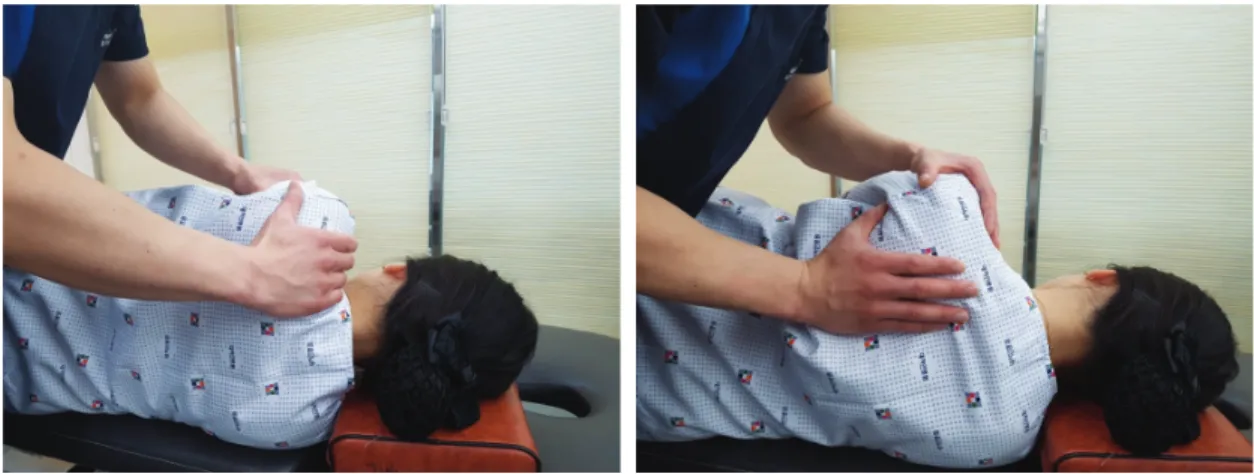
재구성하였다. 어깨뼈의 움직임들 중 앞쪽올림 (anterior elevation)은 올림(elevation)과 내밈(protraction) 및 위쪽돌림(upward rotation)으로 나타나고, 뒤쪽내림 (posterior depression)은 내림(depression)과 뒤당김 (retraction) 및 아래쪽돌림(downward rotation)의 뼈운 동형상학이 나타난다. 뒤쪽올림(posterior elevation)은 올림과 뒤당김 및 위쪽돌림으로 나타나고, 앞쪽내림 (anterior depression)은 내림과 내밈 및 아래쪽돌림의 뼈운동형상학이 나타난다(Neumann, 2010). 어깨뼈 움 직임의 주요근은 앞쪽올림은 어깨올림근, 위등세모 근 , 마름근 및 앞톱니근이 작용하고, 뒤쪽내림은 앞톱 니근(하부), 마름근, 넓은등근 및 아래세모근이 작용 하며, 뒤쪽올림은 위등세모근과 어깨올림근이 작용된 다. 또한 앞쪽내림은 앞톱니근, 마름근, 큰가슴근 및 작은가슴근이 주요근으로 작용한다(Kendall et al., 1993). PNF 운동은 옆으로 누운 자세에서 치료사에 의해 어깨뼈 움직임의 앞쪽올림, 뒤쪽내림, 뒤쪽올림 및 앞쪽내림을 율동적 개시(rhythmic initiation)와 유지 -이완(hold-relax) 및 등장성 혼합(combination of isotonics) 기법을 적용하였다(Table 2)(Fig. 1, 2, 3). 일 반적 운동은 바로 누운 자세에서 반원형 폼 롤러 (core body form roller, COREBODY, Korea)를 뒤통수와 목뼈 에 위치시킨 후 턱을 당긴 상태에서 머리를 좌우로 움직이도록 지시하였다. 폼 롤러 운동 방법은 Shah

& Bhalara(2012)의 피하 및 근섬유 결합 조직에 지속적 으로 부드러운 압력을 가하는 근막이완의 한 방법으 로 대상자에게 적용하였다(Fig. 4). 각각의 운동은 목 주위 근육의 긴장과 통증감소를 목표로 하였다.

Experimental group (n=10) Control group (n=10) p

Sex (male/female) 5/5 5/5 1.00

Age (years) 30.40±5.72 31.40±7.12 0.44

Type of injury

(deceleration/acceleration) 7/3 6/4 1.00

Values are presented as mean±standard deviations.

Table 1. General characteristics of the participants (N=20)

(4)

Type Training

Goals

Position Pattern Technique

PNF exercise

Side lying

Scapular anterior elevation, posterior depression, posterior

elevation, anterior depression

RI Decreased of general tension and pain

Side lying Scapular anterior elevation,

posterior elevation HR Increased of passive range of motion, decreased of pain Side lying Scapular anterior elevation,

posterior elevation CI Increased of active range of motion

Side lying

Scapular anterior elevation, posterior depression, posterior

elevation, anterior depression

RI Decreased of general tension and pain

PNF: proprioceptive neuromuscular facilitation, HR: hold-relax, RI: rhythmic initiation, CI: combination of isotonics.

Table 2. PNF exercise program

Fig. 1. Side lying, scapular pattern, rhythmic initiation. Fig. 2. Side lying, scapular pattern, hold-relax.

Fig. 3. Side lying, scapular pattern, combination of isotonics Fig. 4. Supine, form roller exercise.

(5)

2) 측정항목 및 방법

(1) 통증의 측정

통증의 정도를 측정하기 위해 환자가 느끼는 주관 적인 통증의 객관화를 위해 현재 가장 많이 사용되는 시각적 상사척도(visible analogue scale, VAS)를 이용 하여 대상자가 직접 체크하는 방식을 택하였다 . 통증 이 없는 상태는 0, 통증이 가장 심한 상태는 10으로 하여 10개의 구간이 표시된 종이 위에 직접 체크하도 록 하였다. 검사 재검사 간 신뢰도는 r=0.96이다 (Lingjaerde & Føreland, 1998).

(2) 목 장애지수의 측정

환자의 목 장애정도를 측정하기 위하여 목 장애지 수(neck disability index, NDI))를 사용하였다. 목 장애 지수는 목 부위 이상 측정에 가장 흔히 사용되는 설문 양식으로 처음에는 심한 목통증, 특히 목부염좌 환자 에서 일상생활의 제한 정도를 평가하기 위하여 개발 되었다. 통증강도, 개인적 관리, 들기, 책 읽기, 두통, 집중력, 일하기, 운전, 잠자기 및 여가생활의 10개 항목 에 대하여 각 항목의 점수는 0점에서 5점까지 6개의 등급으로 평가된다. 목 장애지수 점수는 각 항목의 합계로 점수가 높을수록 목 부위 이상과 관련된 기능 장애가 높은 것을 나타낸다. 검사 재검사 간 신뢰도는 r=0.85∼0.95이다(Lee et al., 2007).

(3) 심부목굽힘근 지구력 검사

심부목굽힘근 지구력을 측정하기 위하여 심부목굽 힘근 지구력 검사(craniocervical flexor endurance, CCFE)를 실행하였다(Harris et al., 2005). 검사를 실행 하기 위하여 대상자는 치료용 테이블에 엉덩관절과 무릎관절를 구부리고 하늘을 향하여 머리를 중립 자 세로 누웠다 . 그런 후에 대상자의 위쪽부분 목을 가볍 게 구부리고 바닥에서부터 머리를 2.5cm 들어 올려 위쪽부분 목의 굽힘을 유지하도록 하였다. 측정자는 검지와 중지 손가락을 겹쳐서 침대와 대상자의 머리 사이에 놓고 대상자의 머리가 바닥으로부터 일정한

간격을 유지하도록 되먹임을 제공하였다(Domenech et al., 2011). 대상자의 자세가 유지되지 못하면 한 번의 주의를 주고 , 두 번째 자세를 유지할 수 없으면 측정을 종료하였다. 머리를 들고 유지한 시간을 측정하였으 며 , 5분의 휴식 후에 다시 재검사 하고, 그 평균 시간을 분석을 위하여 기록하였다.

3. 자료 처리

본 연구를 위한 자료처리 방법은 Window용 통계프 로그램 SPSS/PC Statistics 18.0 software (SPSS Inc, Chicago, USA)을 이용하여 통계 처리하였다. 연구 대 상자의 일반적인 특성을 Shapiro-wilk로 정규성 검정 을 하였고 , PNF 운동에 따른 중재 전과 후의 집단 내에 변화를 비교하기 위하여 대응표본 t-검정(paired t-test) 을 실시하였으며, 실험군과 대조군의 집단 간의 차이 를 비교하기 위해 독립표본 t-검정(independent t-test)으 로 검정하였다. 모든 통계학적 유의수준은 α=0.05로 설정하였다.

Ⅲ. 연구 결과

1. 통증 변화 비교

집단 내 통증 (VAS)의 변화는 실험군에서 유의하게 감소하였고(p<0.05), 대조군에서도 유의하게 감소하 였다 (p<0.05). 중재 후 집단 간 통증(VAS)의 변화에서 는 실험군과 대조군 사이에서 유의한 차이가 있었다 (p<0.05)(Table 3).

2. 목 장애지수의 변화 비교

집단 내 목 장애지수 (NDI)의 변화는 실험군에서 유

의하게 감소하였고(p<0.05), 대조군에서도 유의하게

감소하였다(p<0.05). 중재 후 집단 간 목 장애지수

(NDI)의 변화에서는 실험군과 대조군 사이에서 유의

(6)

한 차이가 있었다(p<0.05)(Table 4).

3. 심부목굽힘근 지구력의 변화 비교

집단 내 심부목굽힘근 지구력(CCFE)의 변화는 실 험군에서 유의하게 감소하였고(p<0.05), 대조군에서 도 유의하게 감소하였다(p<0.05). 중재 후 집단 간 심부 목굽힘근 지구력(CCFE)의 변화에서는 실험군과 대조 군 사이에서 유의한 차이가 있었다(p<0.05)(Table 5).

Ⅳ. 고 찰

목부염좌는 차량운행 중 충돌이나 추돌에 의한 갑 작스러운 가속과 감속에 의한 복합손상을 말하며, 이 때 머리와 목은 순간적으로 과다 폄되고 곧이어 굽힘 이 일어나게 되며, 목 주위 근육, 앞세로인대(anterior longitudinal ligament), 섬유고리(fibrous ring) 및 식도 등에 출혈이 생기고 심하면 파열되는 질환이며 (Fishbane, 2002; Perrone, 2003), 목부염좌는 허리통증 보다 발생빈도가 높게 나타난다 (No & Lee, 2006). 따라 Experimental group

(n=10)

Control group

(n=10) t p

Neck disability index (scores)

Pre 30.40±3.10 30.90±3.87 -0.32 0.75

Post 20.80±3.05 24.30±3.89 -2.24 0.04 *

t (p) 11.18(0.00 * ) 4.28(0.00 * )

Difference 9.40±3.06 6.60±4.88 1.54 0.14

Data are mean±standard deviation.

* p<0.05.

Table 4. The comparison of changes in neck disability index within and between group Experimental group

(n=10)

Control group

(n=10) t p

Visual analogue scale (scores)

Pre 7.10±1.20 7.20±1.47 -0.17 0.87

Post 3.20±0.92 4.30±0.82 -2.82 0.01 *

t (p) 12.40(0.00 * ) 7.66(0.00 * )

Difference 3.90±0.99 2.90±1.20 2.03 0.06

Data are mean±standard deviation.

* p<0.05

Table 3. The comparison of changes in visual analogue scale within and between group

Experimental group (n=10)

Control group

(n=10) t p

craniocervical flexor endurance (sec)

Pre 8.15±1.17 7.94±1.03 0.43 0.67

Post 15.05±0.72 13.61±0.81 4.20 0.00 *

t (p) -19.93(0.00 * ) -17.10(0.00 * )

Difference -6.90±1.09 -5.67±1.05 -2.56 0.02 *

Data are mean±standard deviation.

* p<0.05.

Table 5. The comparison of changes in craniocervical flexor endurance within and between group

(7)

서 목부염좌에서 나타나는 여러 가지 문제점들을 해 결해 줄 수 있는 적절한 중재방법이 필요하다 . 하지만 대개의 경우 약물요법 , 침, 일반적 물리치료에만 국한 되는 경향이 있어 반복되는 재발을 막고 치료와 예방 의 측면에서 효율적인 중재의 적용이 필요하다 . 이에 본 연구에서는 목부염좌 환자의 문제점을 효율적으로 해결하기 위해 PNF 운동의 활용이 통증(VAS)과 목 장애지수(NDI) 및 심부목굽힘근 지구력(CCFE)에 미 치는 영향에 대하여 다음과 같이 논의를 하고자 한다.

어깨뼈에서 목 주변으로 연결되는 어깨올림근과 위등세모근 등의 긴장은 목 움직임의 경직, 목 영역의 전단력과 압력을 증가시켜 목의 통증을 유발한다 (Jeong, 2015; Yoo, 2008). PNF 운동에서 준비운동과 정리운동 개념으로 실시한 옆으로 누운 자세에서 어 깨뼈의 앞쪽올림과 뒤쪽내림, 뒤쪽올림과 앞쪽내림을 율동적 개시와 함께 적용하여 긴장으로 장력이 발생 한 어깨올림근과 위등세모근의 이완과 다른 주위근육 과의 움직임을 정상화시키기 위하여 적용하였다. 옆 으로 누운 자세에서 어깨뼈의 앞쪽올림, 뒤쪽올림을 유지 -이완과 함께 적용하여 통증이 있거나 수동적 움 직임이 감소된 목 주위근육의 수동적 움직임을 증가 시켜주고 통증을 감소시키기 위하여 적용하였다. 옆 으로 누운 자세에서 어깨뼈의 앞쪽올림, 뒤쪽올림을 등장성 혼합과 함께 적용하여 목 주위근육의 협응력 과 근력을 강화시키기 위하여 적용하였다. 이와 같은 PNF 운동을 통해서 목 폄과 돌림에 관여하는 등세모 근과 어깨올림근의 긴장과 통증감소 및 움직임이 정 상화되어(Ravichandran & Balamurugan, 2015) 통증과 목 장애지수의 감소 및 심부목굽힘근의 지구력 향상 에 효과를 보인 것으로 사료된다.

치료사가 연부조직의 회복을 돕기 위해 마사지의 다른 형태로 폼 롤러를 적용한다. 대상자는 이완시키 고자하는 신체부위를 폼 롤러 위에 두고 자신의 몸무 게를 이용하여 수행되며 , 폼 롤러에 의해 연부조직에 가하는 압력이 치료사가 마사지를 적용하는 것과 유 사하다. 폼 롤러는 신체활동 후 근육의 불균형, 통증 경감, 관절 스트레스 완화 및 운동범위 개선을 위해

사용되며(MacDonald et al., 2013; MacDonald et al., 2014), 본 연구에서도 어깨올림근과 위등세모근의 이 완과 움직임을 정상화시키기 위하여 폼 롤러를 뒤통 수와 목뼈에 위치시킨 후 턱을 당긴 상태에서 머리를 좌우로 움직이도록 하였다 . 그 결과 통증과 목 장애지 수에 효과를 보였지만, 협응력과 근력 향상을 포함시 킨 PNF 운동 보다는 향상된 결과를 얻지 못하였다.

이와 같은 결과는 목부염좌 환자의 더욱 효과적인 중 재를 위하여 이완과 함께 근력강화 및 협응력을 위한 중재의 필요성을 시사해준다.

Ahn (2012)은 급성 목부염좌 환자 3명을 대상으로 일반적 물리치료만 적용한 대상자 1, 물리치료와 목 부위 테이핑을 적용한 대상자 2, 물리치료와 관절가동 기법을 적용한 대상자 3으로 배정하여 4주간 주 3회 중재한 결과 대상자 2와 대상자 3이 일반적 물리치료 만 적용한 대상자 1보다 통증 감소를 보였고, Im 등 (2011) 급성 목부염좌 환자 20명을 대상으로 일반적 단순 침 치료만 적용한 대조군과 침상안정, 일반적 물리치료, 소염약침 치료를 병행한 실험군으로 무작 위 배정하여 중재한 결과 집단 내⋅간 실험군에서 통 증 감소를 보였다. 이와 같은 선행연구들의 결과는 관절가동기법과 테이핑 및 소염약침 치료가 통증부위 근육과 연부조직의 기계적수용기를 자극하여 근육 경 련이나 인대관련 구조물의 단축을 완화시키는 요소로 작용되어 통증이 감소된 결과이며(Patrick & Ronald, 2002), 본 연구에서도 2주 동안 주 5회 적용한 PNF 운동군과 대조군에서 통증 감소가 중재 전보다 후에 유의한 향상을 보였고, 집단 간 비교에서는 대조군에 비해 PNF 운동군에서 유의한 차이를 보여 선행연구와 같은 결과를 얻었다 . 본 연구의 결과 또한 간접적으로 목 부위 근육과 연부조직에 적용한 PNF의 어깨뼈 움 직임과 함께 적용한 율동적 개시와 유지 -이완 기법이 근육과 연부조직의 긴장을 완화시키고 , 등장성혼합 기법을 통한 목 주위 근육의 근력강화가 목에 가해지 는 스트레스를 감소시켜 통증을 감소시킨 것으로 사 료된다.

목의 장애정도를 평가하기 위해 사용된 목 장애지

(8)

수는 신뢰도가 높은 유용한 도구이며 (Lee et al., 2007), 목부염좌 환자를 대상으로 한 전향적 연구에서 3년 후의 건강상태를 예측할 수 있는 측정방법으로 (Miettinen et al., 2004) 본 연구에서는 2주 동안 주 5회 적용한 PNF 운동군과 대조군에서 목 장애지수가 중재 전보다 후에 유의한 향상을 보였고 , 집단 간 비교에서 는 대조군에 비해 PNF 운동군에서 유의한 차이를 보 였다. Jung 등(2011)은 급성 목통증 환자 14명을 대상 으로 일반적 물리치료를 적용한 대조군과 멕켄지 운 동법을 적용한 실험군으로 무작위 배정하여 3주간 적 용한 결과 중재 전과 후 집단 내 실험군과 대조군 모두 에서 목 장애지수에 향상된 결과를 보였지만, 집단 간 비교에서는 유의한 차이가 없었다 . 급성 목부염좌 를 대상으로 실시한 Im 등(2011)의 연구에서도 동일한 결과를 보였으며, 선행연구들의 결과는 본 연구의 결 과와 다른 결과를 도출 하였다 . 이러한 결과는 본 연구 의 PNF 운동은 어깨뼈 움직임과 함께 등장성혼합 기 법을 통한 목 주위 근육의 근력강화를 포함시켰지만 본 연구의 대조군의 폼롤러 운동과 선행연구의 침이 나 맥켄지 운동법들은 근력강화보다는 목 주위 근육 의 이완의 목적이 강하기 때문에 이러한 결과를 도출 한 것으로 사료되며, Jo와 Choi (2015)의 연구에서 목부 염좌 환자에게 근력운동을 포함하여 중재한 결과 목 장애지수에 향상된 결과를 보여 본 연구의 결과를 지 지한다.

본 연구에서 심부목굽힘근의 지구력은 2주 동안 주 5회 적용한 PNF 운동군과 대조군에서 중재 전보다 후에 유의한 향상을 보였고, 집단 간 비교에서는 대조 군에 비해 PNF 운동군에서 유의한 차이를 보였다. Lee 와 Lee (2010)는 목통증환자들이 목통증을 가지지 않 은 정상인 보다 심부목굽힘근의 지구력이 약하다고 하였으며 , 목통증환자들은 정상인에 비해 근전도에서 심부목굽힘근의 활성화가 감소하고 표면에 위치한 목 굽힘근의 활성화가 증가한다고 하였다(Falla et al., 2004). 본 연구에서도 PNF운동과 대조군에서 통증이 감소됨으로써 심부목굽힘근의 지구력이 증가된 것으 로 사료되며, 통증 감소에 더욱 유의한 차이를 보인

PNF운동군에서 심부목굽힘근의 향상을 보인 것으로 사료된다. Chiu 등(2005)의 연구에서는 목통증 환자와 정상인을 대상으로 심부목굽힘근 지구력 검사를 실시 한 결과 목통증 환자에게서 압력 생체 되먹임장치의 평균 압력이 24mmHg이었고, 정상인은 평균 압력이 28mmHg로 측정되어 목통증이 심부목굽힘근 지구력 검사의 수행능력이 감소한다고 보고하였으며 본 연구 의 결과를 지지해준다.

본 연구의 PNF 운동은 급성 목부염좌 환자의 통증 과 목 장애지수 감소 및 심부목굽힘근의 지구력을 향 상시키는데 효과적이었다 . 일반적으로 PNF 운동은 뇌 졸중과 같은 신경계 환자에게 사용되는 중재방법으로 생각하기 쉽지만 신경계 외의 환자들에게 적용 가능 한 방법으로 본 연구의 급성 목부염좌 환자의 결과를 바탕으로 향후에도 임상에서 PNF 운동을 활용한 다양 한 환자에게 적용된 연구가 필요할 것으로 사료된다 . 본 연구는 차후의 연구에서 개선되어야 할 제한점을 갖는다 . 첫째, 적은 수의 환자를 대상으로 하였기 때문 에 본 연구의 결과를 일반화시키는데 어려움이 있다 . 둘째, 중재기간이 길지 않고 추적조사가 이루어지지 않아 장기간의 중재 효과를 알 수 없었다. 셋째, 목의 관절가동범위 평가가 이루어지 않아 목의 움직임이 얼마나 좋아졌는지 알 수 없었다. 그러므로 향후에는 대상자 수를 늘리고 , 중재기간을 길게 하며, 목 관절가 동범위의 부족한 평가 부분을 추가하여 제한점을 보 완한 PNF 운동의 효과를 명백히 입증할 수 있는 연구 가 진행되어야 할 것이다.

Ⅴ. 결 론

본 연구는 급성 목부염좌 환자를 대상으로 고유수

용성신경근촉진법을 이용한 운동과 일반적인 운동을

적용한 결과 대조군에 비하여 통증과 목 장애지수 감

소 및 심부목굽힘근의 지구력을 향상시키는데 효과가

있었다. 따라서 급성 목부염좌 환자에게 일반적으로

적용되는 운동도 좋지만 더 효과적인 통증과 목 장애

(9)

지수 감소 및 심부목굽힘근의 지구력 향상을 고려한 다면 PNF 운동을 유용하게 적용할 수 있을 것으로 여겨진다.

References

Adler SS, Beckers D, Buck M. PNF in practice: an illustrated guide, 4th ed. Heidelberg. Springer. 2016.

Ahn SW. The effects of modality, taping and joint mobilization for patients with acute whiplash-associated disorder:

case study. The Journal of Korean Academy of Orthopedic Manual Physical Therapy. 2012:18(1);

73-82.

Chiu TT, Law EY, Chiu TH. Performance of the craniocervical flexion test in subjects with and without chronic neck pain. Journal of Orthopaedic and Sports Physical Therapy. 2005;35(9):567-571.

Domenech MA, Sizer PS, Dedrick GS, et al. The deep neck flexor endurance test: Normative data scores in healthy adults. PM&R. 2011;3(2):105-110.

Falla DL, Jull GA, Hodges PW. Patients with neck pain demonstrate reduced electromyographic activity of the deep cervical flexor muscles during performance of the craniocervical flexion test. Spine. 2004;

29(19):2108-2114.

Fishbane DA. A group of cranio-cervical acceleration/

deceleration trauma patients who developed chronic post-traumatic headache. European Spine Journal.

2002;11(6):606.

Harris KD, Heer DM, Roy TC, et al. Reliability of a measurement of neck flexor muscle endurance. Physical therapy.

2005;85(12):1349-1355.

Im JG, Lee JB, Lee HG, et al. Effects of the acupuncture therapy in combination with soyeom pharmacopuncture therapy on acute whiplash injury by traffic accident.

The Journal of Korean Acupuncture and Moxibustion

Society. 2011;28(4):9-18.

Jeong HJ. Effects of different levator scapula stretching positions on scapular kinematics and muscle activities in subjects with short levator scapula. Yonsei University.

Dissertation of Master’s Degree. 2015.

Jeong WM, Kim BR, Kang MG. Effect of treadmill training and proprioceptive neuromuscular facilitation lower leg taping on balance and gait ability in stroke patients.

PNF and Movement. 2016;14(2):83-91.

Jeong WM, Kim BR. The effects of proprioceptive neuromuscular facilitation exercise on the pain and functional disability index of patients with chronic lower back pain. PNF and Movement. 2017;

15(2):195-200.

Jo HY, Choi HS. Effect of combined exercise program applying cervical joint mobilization on functional variables and pain scale of patients with acute neck pain caused by whiplash injury. Korean Society of Sport and Leisure Studies. 2015;59(2):773-784.

Jung SY, Kim SH, Seo YS, et al. The effect comparison of Mckenzie exercise and conservative physical therapy on acute neck pain. Archives of Orthopedic and Sports Physical Therapy. 2011;7(1):9-16.

Kendall FP, McCreary EK, Provance PG. Muscles: testing and function, 4th ed. Baltimore. Williams and Wilkins.

1993.

Kim BR, Lee HJ. Effects of proprioceptive neuromuscular facilitation-based abdominal muscle strengthening training on pulmonary function, pain, and functional disability index in chronic low back pain patients.

Journal of Exercise Rehabilitation. 2017;13(4):

486-490.

Kim CH, Kim BR. The effects of abdominal strength training using proprioceptive neuromuscular facilitation on the balance ability and pain of patients with chronic lower back pain. PNF and Movement. 2017;15(2):

141-148.

(10)

Kim JY, Kim MS, Kim JJ. The effects of proprioceptive neuromuscular facilitation for pain, grip strength on cervical herniated intervertebral disc (HIVD). Journal of Korea Proprioceptive Neuromuscular Facilitation Association. 2015;13(3):145-153.

Klein DA, Stone WJ, Phillips WT, et al. PNF training and physical function in assisted-living older adults.

Journal of aging and physical activity. 2002;

10(4):476-488.

Lee EW, Shin WS, Jung KS, et al. Reliability and validity of the neck disability index in neck pain patients.

Physical Therapy Korea. 2007;14(3):97-103.

Lee GC, Lee DY. The effects of deep neck flexor exercise on pain and neck disability index of the patients with chronic neck pain. Journal of the Korea Academia-Industrial cooperation Society. 2010;

11(11):4331-4337.

Lingjaerde O, Føreland AR. Direct assessment of improvement in winter depression with a visual analogue scale:

high reliability and validity. Psychiatry Research.

1998;81(3):387-392.

MacDonald G, Button DC, Drinkwater E, et al. Foam rolling as a recovery tool after an intense bout of physical activity. Medicine and Science in Sports and Exercise.

2014;46(1):131–142.

MacDonald G, Penney MD, Mullaley ME, et al. An acute bout of self-myofascial release increases range of motion without a subsequent decrease in muscle activation or force. The Journal of Strength and Conditioning Research. 2013;27(3):812–821.

Miettinen T, Leino E, Airaksinen O, et al. The possibility to use simple validated questionnaires to predict long-term health problems after whiplash injury.

Spine. 2004;29(3):47-51.

Neumann DA. Kinesiology of the musculoskeletal system:

foundations for rehabilitation, 2nd ed. St Louis. MO:

Mosby/Elsevier. 2010.

No BR, Lee EY. The clinical study on 34 admission patients due to sequela of traffic accident. Journal of Korean pharmacopuncture institute. 2006;9(2):129-134.

Patrick DW, Ronald M. Text book of pain. Seoul. Jungdam Publishing Co. 2002.

Perrone E. Whiplash injury secondary to a motor vehicle accident. Journal of Pediatric Health Care. 2003;

17(3):148.

Ravichandran H, Balamurugan J. Effect of proprioceptive neuromuscular facilitation stretch and muscle energy technique in the management of adhesive capsulitis of the shoulder. Saudi Journal of Sports Medicine.

2015;15(2):170-175.

Shah S, Bhalara A. Myofascial release. International Journal of Health Sciences and Research. 2012;2(2):69-77.

Sherrington CS. Observations on the scratch-reflex in the spinal dog. The Journal of Physiology. 1906;34(1-2):1-50.

Song BY. A clinical study on the effects of Sweet Bee Venom herbal acupuncture for patients with whiplash injury.

Journal of Korean pharmacopuncture institute.

2007;10(3):77-83.

Song JH, Cho JH, Lee HE, et al. A clinical study on the effect of eo-hyeol bang for patients with whiplash injury caused by a traffic accident. The Journal of Korean Acupuncture and Moxibustion Society.

2007;24(6):97-104.

Song MS, Kim BR, Kim CH, et al. A case report of a proprioceptive neuromuscular facilitation intervention strategy applied with an ICF tool in a patient with anterior cruciate ligament reconstruction. PNF and Movement. 2017;15(1):1-11.

Spitzer WO, Skovron ML, Salmi LR, et al. Scientific monograph of the quebec task force on whiplash-associated disorders: redefining "whiplash" and its management.

Spine. 1995;20(8):1-73.

Sullivan MJ, Thibault P, Simmonds MJ, et al. Pain, perceived

injustice and the persistence of post-traumatic stress

(11)

symptoms during the course of rehabilitation for whiplash injuries. Pain. 2009;145(3):325-331.

Yildiz TI, Turgut E, Duzgun I. Neck and scapula-focused exercise training on patients with non-specific neck pain: a randomized controlled trial. Journal of Sport

Rehabilitation. 2017;0(0):1-21.

Yoo CU. Eletromyographic activity of the neck and shoulder

muscles while watching a DMB phone with the neck

flexed. Yonsei University. Dissertation of Master’s

Degree. 2008.

수치

Table 1. General characteristics of the participants  (N=20)
Fig. 1. Side lying, scapular  pattern, rhythmic initiation. Fig. 2. Side lying, scapular  pattern, hold-relax.
Table 5. The comparison of changes in craniocervical flexor endurance within and between group

참조

관련 문서

The purpose of this study was to investigate the effects of a disability awareness program on improving the attitudes of regular elementary school

The purpose of this study is to analyze the effects of word- recording on learning vocabulary, reading and listening of English. control groups to answer

The purpose of this study is to verify whether The mediating effects of planned happenstance skills on the relationship between perceived social support

The purpose of this study is to analyze the effects of sports marketing strategy fit on organizational attitude and organizational citizenship behavior

The purpose of this study is to examine the effects of flow experience through the dance sports media, a dance sports image, and identification on

The purpose of this study is to analyze the effects of service quality on customer satisfaction and revisit intention perceived by Chinese golf range

The purpose of this study was to examine the effects of 8 weeks of Zumba dance exercise for obese middle-aged women on blood lipid index and vascular aging.. The subjects of

The purpose and necessity of this study was to investigate the effect of the 8-week GX complex exercise program on the stress index, blood lipid and APG