42(7), 1115~1124(2013) http://dx.doi.org/10.3746/jkfn.2013.42.7.1115
한국산 꽃소금과 천일염의 이화학적 특성 및 미생물 분석
이혜미1․이우경2․진중현2․김인철1†
1목포대학교 식품공학과
2대상주식회사 중앙연구소 식품연구실
Physicochemical Properties and Microbial Analysis of Korean Solar Salt and Flower of Salt
Hye Mi Lee1, Woo Kyoung Lee2, Jung Hyun Jin2, and In Cheol Kim1†
1Dept. of Food Engineering, Mokpo National University, Jeonnam 534-729, Korea
2R& D Center Food R& D Lab, Daesang Co., Gyeonggi 467-813, Korea
ABSTRACT The present study was conducted to ensure the diversity of domestic solar salt by analyzing the composi- tion and microbiological characteristics of solar salt (from Docho island: DS) and the flower of salt produced in different Korean salt flats (Sinui island: SF, Bigum island: BF, and Docho island: DF). The analyses showed that the moisture content of the three types of flower of salt and solar salt ranged from 10.54~13.82% and NaCl content ranged from 78.81~84.61%. The mineral content of those salts ranged from 3.57~5.51%. The content of insoluble matter in these salts was 0.01±0.00~0.05±0.00%. The sand content of these salts was 0.01±0.01~0.03±0.01%. By Hunter’s color value analysis, the color of the flower of salt was brighter and whiter than solar salt. The salinity of the flower of salt was a little higher than solar salt as well. The magnesium and potassium ion content of DF was 9,886.72±104.78 mg/kg and 2,975.23±79.73 mg/kg, respectively, which was lower than the content in SF, BF, and DS. The heavy metal content of all salts was acceptable under the Korean Food Sanitation Law. The flower of salt was confirmed to be sweeter and preferable to solar salt. More than 80% of the solar salt crystals were 2~3 mm in size, whereas crystals from the flower of salt were 0.5~2 mm in size. The bacterial diversity of DF and DS were investigated by culture and denaturing gradient gel electrophoresis (DGGE) methods. The number of cultured bacteria in flower of salt was approximately three times more than solar salt. By DGGE analysis, major microbes of DF were Maritimibacter sp., Cupriavidus sp., and unculturable bacteria, and those of DS were Cupriavidus sp., Dunalidella salina and unculturable bacteria. The results of DGGE analysis showed that major microorganisms in solar salts were composed of unidentified and unculturable bacteria and only a few microorganisms were culturable.
Key words: solar salt, flower of salt, DGGE, halophilic bacteria
Received 4 March 2013; Accepted 2 April 2013
†Corresponding author.
E-mail: [email protected], Phone: 82-61-450-2426
서 론
우리나라는 삼면이 바다로 이루어져 있으며, 일부 남해안 을 포함한 서해안의 풍부한 갯벌로 인해 염전이 많아 양질의 값싼 소금을 얻을 수 있다. 소금은 한국의 전통발효식품인 김치, 장류, 젓갈 등에 필수적으로 사용되는 조미료로 제조 방법에 따라 천일염, 암염, 기계염, 재제염 등 크게 4종류가 있으며, 그 소금의 종류에 따라 미네랄 함량에 차이가 있어 건강에 미치는 영향이 다르고 맛과 풍미 및 품질의 차이가 발생하고 있다(1). 또한 사람 혈액의 약 0.9% 정도를 차지하 는 소금은 체내 삼투압 유지, 세포막에서의 물질 운반, 신경 이나 근육의 조절, 체온 조절 등의 역할을 한다(2). 이 중
천일염은 식품공전(3)에 따르면 염전에서 해수를 자연 증발 시켜 얻은 염화나트륨이 주성분인 결정체와 이를 분쇄, 세 척, 탈수 또는 건조한 염을 말하며 Na뿐만 아니라 Mg, Fe, Zn, Cu, Ca, K 등의 미네랄이 3∼4%나 함유되어 건강유지 에 필수적인 조미료로 알려져 있다. 이러한 천일염은 함수를 태양열과 바람으로 자연적으로 증발시켜 결정화 되는데 이 러한 과정 중에 생성되는 초기 결정으로 작고 가벼워 염전의 표면에 얇은 피막으로 떠 있는 소금 결정을 꽃소금(flower of salt)이라 말한다. 대표적 꽃소금으로는 요리에 사용하였 을 때 가장 좋은 맛을 낸다고 알려진 프랑스 게랑드(Gué- rande) 지방의 fleur de sel이 있다. 이 소금은 프랑스 농림 수산성에서 최우수식품에만 부여하는 적색라벨(Label Rouge) 인정을 받았으며, 중금속이나 불용성분, 미생물 등 을 엄격히 관리하고 있다(4). 국내 염전에서도 꽃소금은 천 일염이 결정화되는 초기에 염전의 결정지 표면에 발생하지 만 생산량이 적어 상품화가 이루어지지 않고 있다. 2008년
천일염이 식품으로 전환된 후 소금 관련 연구의 대부분이 천일염의 미네랄 함량에 관한 것으로, 연령에 따른 천일염의 성분함량(5), 습식분해 및 직접용해법에 따른 천일염 중 무 기성분 함량 비교(6), 소금의 종류별 무기질 및 중금속 함량 (7) 등이 보고되었고, 소금을 이용한 발효식품의 특성에 관 한 연구로는 천일염이 김치발효에 미치는 영향(8), 여러 종 류의 소금으로 제조한 새우젓의 이화학적 특성 및 관능적 특성(9), 천일염이 된장의 품질특성에 미치는 영향(10) 등이 보고되었으며 소금의 안전성에 관한 연구(11,12)가 이루어 지는 등 연구들이 진행되었고, 최근에는 외국에서 염전에 생육하는 미생물들에 대한 군집분석, 유전학적 분석 등 염전 이나 소금 유래 호염균들에 관한 연구도 이루어지고 있다 (13-15). 이와 같이 2008년 3월부터 천일염이 광물에서 식 품으로 분류된 이후로 많은 연구들이 이루어지고 있으나, 국내 염전에서 생산되는 꽃소금에 관한 연구는 전무한 실정 이다. 따라서 본 연구는 국내에서 생산되는 꽃소금과 천일염 의 이화학적 분석과 무기물 특성을 비교하였으며, 또한 한국 발효식품에 중요한 역할을 하는 천일염에 함유된 미생물의 분포 및 종류에 대하여 기존의 미생물학적 배양 방법 및 DGGE 분석 기술을 적용하여 꽃소금과 천일염의 미생물 분 포를 확인하고자 하였다.
재료 및 방법
재료
꽃소금 시료는 2012년 전라남도 신안군 신의면, 비금면, 도초면에 소재한 염전에서 채취한 3종을 사용하였으며, 천 일염은 도초면의 꽃소금을 제조한 동일 염전에서 채취하여 사용하였다.
소금의 성분 분석
일반성분 분석은 식품공전(16), AOAC 방법(17)에 따라 행하였다. 수분함량은 시료 약 3 g을 취하여 상압가열건조 법에 따라 측정하였다. 조단백질의 함량은 micro Kjeldahl 법으로 분해 장치(K-435, Büchi Co., Flawil, St. Gallen, Switzerland) 및 증류장치(K-360, Büchi Co.)를 이용하여 측정하였다. 조지방은 조지방분석기(Soxtec 2043, Foss, Copenhagen, Denmark)를 이용하여 ether 추출법으로 시 료를 분석하였다. 조섬유는 fiber analysis system(fiber- cap system, Foss)을 이용하여 측정하였다. 불용분, 사분은 식품공전에 명시된 식염 분석법(3)으로 분석하였다.
소금의 무기성분 분석
소금의 무기질을 분석하기 위하여 소금을 증류수에 0.1%
(w/v)로 녹인 다음 0.25 μm syringe filter(Minisart, Sar- torius Stedim, Heidelberg, BW, Germany)로 여과한 후 사용하였다. 미량 양이온 분석은 시료를 전처리 장치 (MARSXpress, CEM Co., Matthews, NC, USA)로 분해하
여 ICP-MS(inductively coupled plasma mass spec- trometer, Agilent 7500 cx Series, Agilent Technologies, Santa Clara, CA, USA)를 이용하여 분석하였다. 매크로 원 소(Na, Mg, K, Ca)는 원소흡광분석기(AAS, Z-3200, Hitachi, Tokyo, Japan)로 분석하였다. 음이온은 IC(861 Advance Compact IC, Metrohm, Herisau, AR, Switzer- land)를 이용하여 분석하였다. 수은(Hg)은 direct mercury analyzer(DMA-80, Milestone, Bergamo, LO, Italy)로 분 석하였다.
염화나트륨(NaCl) 함량 분석
식품공전(3)에 따라 소금 시료 1 g을 취하여 증류수 500 mL로 용해하고 그중 10 mL를 취하여 크롬산칼륨 시약 (K2CrO4) 2∼3방울을 가하였다. 0.02 N 질산은 AgNO3 용 액으로 적정하여 완전히 적갈색으로 변하는데 소요되는 AgNO3 용액의 적정량으로 식염을 정량하였다.
입도, 구조 및 색도
소금의 입도는 vibratory sieve-shaker(Analysette3, Fitsch, Idar-Oberstein, RP, Germany)를 이용하여 분석 하였고, 주사전자현미경(S-3500N, Hitachi)을 이용하여 결 정 구조 및 크기를 분석하였다. 색도는 색도계(JS-555, Color Techno system Co., Tokyo, Japan)를 이용하여 측 정한 후 Hunter's scale L(lightness), a(redness), b(yel- lowness) 값으로 표시하였다.
관능검사
목포대학교 식품공학과 학생 총 25명의 패널로 관능평가 를 실시하였다. 짠맛, 단맛, 쓴맛, 부드러운 맛 그리고 전체 적인 기호도를 각 시료별로 9점 평점법(매우 나쁘다, 1점;
매우 좋다, 9점)으로 평가하였다.
호염균 동정
2012년산 도초산 꽃소금과 천일염을 3 g씩 멸균수 10 mL에 녹여 포화용액 30%로 제조하였다. 0.20 μm hydro- philic syringe filter(DISMIC-25cs, Advantec, Tokyo, Japan)로 여과 후 액체배지 1 mL로 역필터하여 분리하였 다. Nutrient agar(NA: with NaCl 0%, 2%, 5%)와 Marine agar(MA: with NaCl 0%, 3%, 5%)에 각각 100 μL씩 spreading한 뒤 25°C에서 배양하였다. 각 배지에서 성장한 colony를 3회 이상 순수 분리과정을 거쳐 순수 분리한 다음, 분리된 균을 Solgent사(Daejeon, Korea)에 16s rDNA 염 기서열 결정을 의뢰하였다. 결정된 염기서열은 NCBI(http://
www.ncbi.nlm.nih.gov/)의 Genbank database를 이용하 여 Blast search를 통해 분석하였다.
DNA 추출 및 DGGE 분석
2012년도에 동일 염전에서 생산된 꽃소금과 천일염을
200 mL 멸균수에 40 g씩 녹여 20%(w/v) 용액을 제조한 후 14,000 rpm에서 15분간 원심분리 하여 침전물을 분리한 다음, 멸균수 200 mL로 1회 세척하여 침전물을 회수하였 다. TE buffer 100 μL를 넣고 침전물을 현탁시킨 뒤 끓는 물에 10분 가열한 다음 얼음에 5분간 방치 후, 10,000 rpm 에서 5분간 원심분리 후 상등액을 취하여 PCR DNA tem- plate로 사용하였다. 추출한 DNA를 template로 하고 bac- terial universal primer set인 341f-GC와 907r primer를 이용해 PCR을 수행하였고(MJ mini, Biorad, Hercules, CA, USA) PCR 생성물은 DGGE로 분석하였다. Denatur- ing gradient gel은 7% polyacrylamide(37.5:1=acryl- amide : bisacrylamide)에 7 M urea와 40%(v/v) form- amide를 40∼70% 농도구배로 첨가하여 겔을 제조한 다음, 20 V로 10분, 60 V로 24시간 전기영동(SE 600X Chroma Deluxe Dual Cooled Vertical Unit, Hoefer Inc., New Orleans, LA, USA) 하였다. 전기영동이 끝난 gel은 GelstarTM nucleic acid gel stain(Lonza, Rockland, ME, USA)으로 염색한 후, UVi-tech으로 관찰하여 패턴을 확인하였다.
염기 서열 분석
Denaturing gradient gel 상에서 다른 위치에 존재하는 밴드를 선택하여 잘라내고, 각 밴드에서 회수한 DNA를 주 형으로 GC clamp가 없는 341f와 907r primer를 이용하여 2차 PCR을 실시하였다. Gel extraction kit(Qiagen, Hil- den, NW, Germany)을 이용하여 정제한 PCR 산물은 Solgent사에 DNA 염기서열 결정을 의뢰하였다. 결정된 염 기서열은 NCBI(http://www.ncbi.nlm.nih.gov/)의 Genbank database를 이용하여 Blast search를 통해 Max score 500 이상의 결과 중 일치율이 97% 이상으로 선택하였다.
DNASIS MAX 2.5 software(Hitachi)를 사용하여 align- ment하고 Tree view를 이용하여 neighbor-joining meth- od로 phylogenetic tree를 작성하였다. 또한 Un-Scan-It (Silk Scientific, Inc., Orem, UT, USA)를 이용하여 DGGE band의 intensity를 측정하여 각 동정 균주의 상대적 분포도 를 분석하였다.
통계처리
본 연구에 대한 자료는 통계프로그램인 SPSS 19.0 sta- tistics(SPSS Inc., Chicago, IL, USA)를 이용하여 평균과 표준편차를 산출하였으며 P<0.05 수준에서 Duncan's mul- tiple range test로 유의성을 검정하였다.
결과 및 고찰
소금의 성분 분석
105°C 상압가열건조법으로 실험한 소금의 수분함량을 분석하였다(Table 1). 수분함량은 도초산 꽃소금이 10.54±
0.10%로 가장 낮았고, 신의도산 꽃소금이 13.82±0.12%로
가장 높게 나타났다. 이는 간수의 빠짐 정도에 의한 차이로 숙성 정도에 따라 감소하는 것으로 보고되었다(5). 조단백, 조지방, 조섬유는 거의 존재하지 않는 것으로 나타났다.
소금의 NaCl 함량은 신의도산 꽃소금이 78.81±0.28%, 비금산 꽃소금이 81.67±0.34%, 도초산 꽃소금 84.61±
0.21%, 도초산 천일염이 80.82±0.17%의 함량을 보였다.
이는 대부분의 천일염이 80∼90%의 함량을 지닌다고 보고 된 결과와 유사하였다(18).
불용분, 사분은 각각 신의도산 꽃소금이 0.01±0.00%, 0.01±0.01%로 가장 낮은 값을 보이고, 도초산 천일염이 0.05±0.00%, 0.03±0.01%로 비교적 높은 값을 보였다. 꽃 소금은 함수의 표면에 떠 있는 상태로 채취하기 때문에 바닥 과 직접 닿지 않으며, 국내산 천일염은 결정지 바닥재로 장 판을 사용하여 불용분, 사분 함량이 낮게 나타난 것으로 사 료된다.
매크로 양이온 분석 결과로 Na의 함량이 326,010.00±
558.61∼356,733.83±3,642.15 mg/kg으로 4종의 시료 모두 유사한 값으로 분석되었다. Mg은 도초산 꽃소금에서 9,886.72±104.78 mg/kg으로 비교적 낮은 함량이 검출되 었다. K 역시 도초산 꽃소금에서 2,975.23±79.73 mg/kg으 로 다른 소금들에 비해 낮게 나타났다. 신의도산 꽃소금에서 Ca 함량이 3,447.10 mg/kg으로 가장 높은 값을 나타내고, 2종의 도초산 소금(도초산 꽃소금, 도초산 천일염)이 각각 945.53 mg/kg, 942.43 mg/kg으로 낮은 양상을 보였다.
미량 양이온을 분석한 결과로 신의도산 꽃소금은 Fe, Cu, Zn이 비교적 낮은 함량을 나타내고, 비금산 꽃소금은 Sr이 비교적 높게 검출되었다. 도초산 꽃소금은 Sr이 낮게 검출되 었고, 도초산 천일염의 경우 Fe, Zn이 비교적 높게 확인되었 다.
중금속인 As, Cd, Pb, Hg는 모두 규격 이하(As, Cd, 0.5 mg/kg; Pb, 2.0 mg/kg; Hg, 0.1 mg/kg)로 검출되었다.
소금의 음이온 중 Cl은 신의도산 꽃소금에서 465,447.61
±9,755.39 mg/kg으로 가장 낮게 검출되며, 도초산 꽃소금 이 509,324.20±5,620.37 mg/kg으로 높게 나타났다. SO4 는 도초산 꽃소금에서 21,028.28±973.24 mg/kg으로 낮게 나타나며 비금산 꽃소금이 30,184.94±2,560.14 mg/kg으 로 높게 검출되었다.
구조 및 색도
주사전자현미경으로 소금을 측정하여 결정 구조와 표면 특성, 크기를 확인하였다(Fig. 1). 정제염은 정육각형의 결정 구조를 가지며 천일염은 다른 미네랄이나 이물질에 의해 핵 이 중복되며 겹을 이룬다고 보고되었는데(19), 본 연구에서 사용한 천일염 역시 이와 유사함을 확인하였다. 꽃소금 또한 천일염과 유사한 결정 형태를 보였다. SEM 사진을 이용한 결정의 크기 측정 결과로 신의도산 소금꽃이 0.083×0.083 mm, 비금산 소금꽃이 0.067×0.067 mm, 도초산 소금꽃이 0.081×0.080 mm, 도초산 천일염이 0.112×0.124 mm로
Table 1. Compositional analysis of solar salt and salt of flower (mg/kg) Element Sinuido flower of salt Bigum flower of salt Docho flower of salt Docho solar salt
Cation
Na Mg K Ca Li Al Cr Mn
Fe Co Ni Cu Zn Se Sr Ag U As Cd Pb Hg
334,490.50±3,353.98b1) 13,171.72±236.59b 3,837.07±27.80b 3,447.10±135.41c 0.51±0.14a 6.23±0.99ab 0.25±0.10a 4.93±0.85b - 0.01±0.02a - 1.87±1.55a 1.51±1.37a 0.01±0.01a 77.11±0.36b - 0.02±0.00a 0.03±0.02a 0.01±0.00a 0.23±0.12a 0.03±0.01a
348,197.16±4,305.18c 14,280.38±506.98c 4,776.37±81.39c 1,728.90±16.10b 0.47±0.15a 1.26±1.78a 0.32±0.21a 2.28±0.37a 1.77±0.38b 0.01±0.00a 0.01±0.01a 3.73±0.57a 3.58±2.77a 0.33±0.18b 85.33±9.74b
- 0.03±0.00b 0.03±0.02a 0.01±0.00a 0.20±0.04a 0.06±0.00ab
356,733.83±3642.15d 9,886.72±104.78a 2,975.23±79.73a 945.53±136.40a 0.26±0.21a 7.49±2.18c 0.12±0.18a 5.40±0.22b 3.91±0.93c 0.00±0.00a
- 3.39±0.81a 4.02±0.64a 0.06±0.09ab 39.43±5.13a
- 0.03±0.00b 0.04±0.03a 0.01±0.00a 0.28±0.04a 0.10±0.03c
326,010.00±558.61a 13,788.67±316.10c 3,848.23±115.10b 942.43±40.54a 0.44±0.12a 6.77±3.07b
- 2.05±0.12a 5.09±0.44c 0.01±0.00a 0.59±0.07b 3.50±1.06a 7.80±3.10a 0.27±0.05ab 41.55±0.11a 0.02±0.02a 0.02±0.00a 0.10±0.13a 0.01±0.00a 0.43±0.28a 0.08±0.01ab
Anion
Cl Br NO3
SO4
465,447.61±9,755.39a 814.63±26.25b 93.00±3.13a 27,751.38±341.09b
498,991.94±2,009.53b 802.17±15.85b 116.71±11.79c
30,184.94±2,560.14b
509,324.20±5,620.37b 679.97±38.93a 110.25±1.60a 21,028.28±973.24a
499,429.89±5,423.68b 795.06±53.01b 123.21±23.56a 25,936.30±1,925.47b Total 849,145.76±13,885.18 899,177.99±9,523.18 901,748.38±10,607.69 870,942.52±8,464.65 NaCl (%)
Moisture (%) Crude protein (%) Crude lipid (%) Crude fiber (%) Insoluble matters (%) Sand (%)
78.81±0.28a 13.82±0.12c 0.00±0.00a 0.05±0.01b 0.00±0.00a 0.01±0.00a 0.01±0.01a
81.67±0.34c 10.70±0.40a 0.06±0.02b 0.07±0.00c 0.00±0.00a 0.03±0.00b 0.02±0.01a
84.61±0.21d 10.54±0.10a 0.06±0.01b 0.01±0.00a 0.00±0.00a 0.04±0.00bc 0.03±0.01a
80.82±0.17b 12.61±0.45b 0.00±0.00a 0.02±0.01a 0.00±0.00a 0.05±0.00c 0.03±0.01a
1)All values were expressed as mean±SD. Different letters in a row mean significantly different (P<0.05). -: Not detected.
Fig. 1. The SEM images of salts. (A) Sinuido flower of salt, (B) Bigum flower of salt, (C) Docho flower of salt, (D) Docho solar salt.
7.09 23.04
60.59
0.07 23.32
43.74
16.25
1.89 7.32 1.37 1.98
13.35
0 10 20 30 40 50 60 70
0.5 below 0.5~1.0 1.0~2.0 2.0~2.8 2.8~4.0 above 4.0 Size (mm)
Distribution (%) .
flower of salt solar salt
Fig. 2. Salt crystal size distribution of Docho solar salt and flow- er of salt.
Table 2. Hunter's color values of salts
Sample L a b
Sinuido flower of salt Bigum flower of salt Docho flower of salt Docho solar salt
80.35±0.02c1) 80.00±0.02b 81.48±0.01d 76.06±0.02a
-0.17±0.01c -0.25±0.00b -0.32±0.01a -0.24±0.00b
1.28±0.00b 0.67±0.01a 2.22±0.01d 2.00±0.00c
1)All values were expressed as mean±SD. Different letters in a column mean significantly different (P<0.05).
Table 3. Sensory characteristics of salts
Sample Sensory characteristics
Saltiness Bitterness Sweetness Softness Overall acceptance Sinuido flower of salt
Bigum flower of salt Docho flower of salt Docho solar salt
6.12±1.54ns1) 7.08±1.75 6.60±1.35 6.52±1.83
3.28±1.70ns 3.76±2.35 3.24±1.83 3.32±1.82
3.32±1.82ns 3.68±2.15 3.80±2.00 2.96±1.81
3.00±1.91ns 3.48±1.94 3.48±1.92 3.20±1.66
5.96±1.24ns 5.92±1.68 6.00±1.58 5.76±1.69
1)All values were expressed as mean±SD. ns: Not significant.
측정되었다.
도초산 꽃소금과 도초산 천일염으로 입도를 분석한 결과 천일염은 2.0∼4.0 mm 이상이 전체의 83.30%를 차지하며, 꽃소금은 0.5∼2.0 mm 이상이 83.63%로 대부분을 차지하 였다(Fig. 2). 이는 소금이 생성되는 과정에서 꽃소금은 초 기에 생성된 함수 위에 떠 있는 작은 결정이며, 결정이 커지 며 밑으로 가라앉은 소금을 천일염이라고 정의하는 데 이에 의한 입도 차이로 사료된다.
소금의 색도를 분석한 결과로 천일염에 비해 꽃소금이 밝 은 값을 나타내며, 도초산 천일염이 L값 76.06±0.02로 가 장 낮은 값에 비해 도초산 꽃소금이 81.48±0.01로 가장 밝 은 것으로 나타났다. 적색도는 신의도산 꽃소금이 가장 높으 며, 황색도는 도초산 꽃소금이 가장 높은 값으로 측정되었다 (Table 2). 이는 꽃소금이 바닥에 직접 닿지 않고 함수 표면 에 떠 있는 소금을 채취하기 때문에 불순물이 적어 천일염에 비해 더 밝게 나타나는 것으로 사료된다. 불순물을 제거하여 재결정화한 재제염의 L값이 87.80으로 밝은색을 나타내며, 또한 저장일수에 따라 색도는 변하는 것으로 보고되었다(5).
관능검사
소금 5종에 대해 짠맛, 단맛, 쓴맛, 감칠맛, 전반적인 기호 도 관능적 특성을 조사한 결과로 짠맛은 신의도산 꽃소금이 가장 적고, 쓴맛은 비금산 꽃소금이 가장 높게 평가되었다.
이는 Table 1에 제시된 성분 분석과도 일치하는 결과이다.
쓴맛은 주로 천일염에 함유된 마그네슘염에 인한 것으로 숙 성기간에 따라 감소한다고 보고되었지만(5,19), 본 연구에 서는 천일염전 결정지에서 소금 결정 생성 초기에 해당하는 꽃소금과 결정이 성장하여 침전되어 회수되는 일반적인 천 일염과를 비교한 결과, 제조방법에 따라서도 소금 성분이 달라지고 이로 인한 관능적인 특성도 달라지는 것을 확인할 수 있었다. 본 연구에서 도초산 꽃소금은 천일염에 비해 K와 Mg 함량이 낮으며, 단맛은 높으나 부드러운 맛은 유사한 결과를 보였다. 종합 기호도는 꽃소금이 천일염보다 높았으 며, 꽃소금 중에서는 도초산이 가장 높았다(Table 3).
배양방법을 이용한 미생물 분리 및 동정
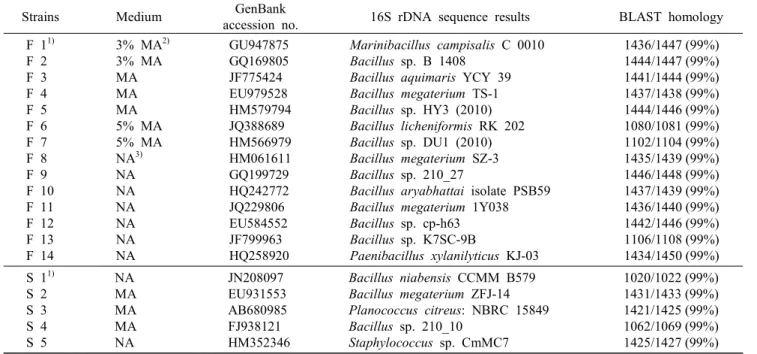
도초에서 생산된 꽃소금과 천일염으로부터 배양이 가능 한 미생물을 분리하여 각 소금에 함유된 미생물의 차이를 분석하였다. NaCl이 첨가된 NA와 MA 배지에 배양된 균주 들을 순수 분리하여 16s rDNA 염기서열 분석을 통해 미생 물 동정을 실시한 결과로 꽃소금에서 14종, 천일염에서 5종 이 확인되었다(Table 4). 꽃소금에서는 Marinibacillus, Paenibacillus를 제외한 12종 모두 Bacillus 속으로 나타나 전체 분리균의 약 86%를 차지하였으며, 천일염에서는 Planococcus, Staphylococcus 각 1종, 그리고 3종의 Bacillus 속이 검출되었다. Na 등(20)은 염전이나 결정지, 소금창고 등 생산단계에서 Halobacillus, Halomonas, Ba- cillus, Idiomarina, Marinobacter, Pseudoalteromonas, Vibrio, Salinivibrio, Virgibacillus, Alteromonas, Staphy- lococcus, unknown sp. 등 12속의 미생물이 검출되었지만, 소금창고에서는 미생물이 분리되지 않은 것으로 보고하여, 생산단계별로 해수에 존재하는 미생물과 천일염 결정 속에 잔존하는 미생물과는 차이가 있음을 보여주고 있다. 본 연구 에서 천일염으로부터 미생물이 분리될 수 있었던 이유는 사 용한 배지 조성 차이와 염전에서 바로 생산된 천일염으로부 터 미생물을 분리하였기 때문에 소금창고에서 저장한 천일 염과 미생물 분포 차이를 보이는 것으로 판단된다. 꽃소금에 서 분리된 Marinibacillus campisalis는 국내 염전에서 분리 되어 보고된 균으로 NaCl 2∼3%에서 성장하는 moderate
Table 4. Identification of culturable microorganisms from solar salt and flower of salt
Strains Medium GenBank
accession no. 16S rDNA sequence results BLAST homology F 11)
F 2 F 3 F 4 F 5 F 6 F 7 F 8 F 9 F 10 F 11 F 12 F 13 F 14
3% MA2) 3% MA MA MA MA 5% MA 5% MA NA3) NA NA NA NA NA NA
GU947875 GQ169805 JF775424 EU979528 HM579794 JQ388689 HM566979 HM061611 GQ199729 HQ242772 JQ229806 EU584552 JF799963 HQ258920
Marinibacillus campisalis C 0010 Bacillus sp. B 1408
Bacillus aquimaris YCY 39 Bacillus megaterium TS-1 Bacillus sp. HY3 (2010) Bacillus licheniformis RK 202 Bacillus sp. DU1 (2010) Bacillus megaterium SZ-3 Bacillus sp. 210_27
Bacillus aryabhattai isolate PSB59 Bacillus megaterium 1Y038 Bacillus sp. cp-h63 Bacillus sp. K7SC-9B
Paenibacillus xylanilyticus KJ-03
1436/1447 (99%) 1444/1447 (99%) 1441/1444 (99%) 1437/1438 (99%) 1444/1446 (99%) 1080/1081 (99%) 1102/1104 (99%) 1435/1439 (99%) 1446/1448 (99%) 1437/1439 (99%) 1436/1440 (99%) 1442/1446 (99%) 1106/1108 (99%) 1434/1450 (99%) S 11)
S 2 S 3 S 4 S 5
NA MA MA MA NA
JN208097 EU931553 AB680985 FJ938121 HM352346
Bacillus niabensis CCMM B579 Bacillus megaterium ZFJ-14 Planococcus citreus: NBRC 15849 Bacillus sp. 210_10
Staphylococcus sp. CmMC7
1020/1022 (99%) 1431/1433 (99%) 1421/1425 (99%) 1062/1069 (99%) 1425/1427 (99%)
1)F: 2012 Docho flower of salt, S: 2012 Docho solar salt. 2)MA: marine agar. 3)NA: nutrient agar.
(A) (B)
Fig. 3. Denaturing gradient gel electrophoresis analysis of PCR- amplified 16S rDNA fragments from Docho solar salt and flow- er of salt. (A) Docho flower of salt, (B) Docho solar salt, PCR amplification was performed with the primers 341f-GC and 907r for 30 cycles. DGGE anlysis was performed between 40%~
70% denaturing gradient.
halophile이라는 기존의 보고(21)와 같이 3% NaCl이 함유 된 MA 배지에서 분리되었다. 염이 없는 NA 배지에서 분리 된 Paenibacillus xylanilyticus는 곤약 재배지역에서 분리 된 내열성 β-mannase 생성균으로 보고(22)되었으며, 꽃소 금에서 분리된 모든 균은 내생포자균으로 확인되었다. 천일 염 역시 Bacillus 속이 주를 이루고 있으며, 천일염에서 분리 된 Planococcus citreus는 Kocur 등(23)이 해수에서 분리 하여 보고한 해양미생물이며, 국내에서는 같은 속인 Plan- ococcus salinarum을 염전에서 분리하여 보고(24)한 바 있 으나, Planococcus citreus는 국내에서 처음으로 동정되었 다. Lee 등(25)은 김치 발효에 있어 유산균을 제외한 김치 우점종으로 Bacillus 속을 보고한 바 있는데, 천일염에 존재
하는 Bacillus 속이 김치와 같은 발효식품에 유용하게 작용
할 수 있을 것으로 사료된다. Marinibacillus campisalis, Bacillus aquimaris, Bacillus aryabhattai 등의 균주는 전 분과 단백질 분해능이 있음이 이미 보고되었으며(21,26, 27), Shon 등(28)과 Hwang 등(29)은 각각 Bacillus mega- terium, Bacillus licheniformis 균주를 검은콩 청국장 발효 에 이용하였을 때 높은 이소플라본의 함량을 지닌 청국장이 제조된다고 보고한 바 있어, 천일염에 존재하는 미생물이 한국의 전통 발효식품에 중요한 발효작용을 할 수 있을 것으 로 사료된다.
DGGE 분석법에 의한 미생물 동정
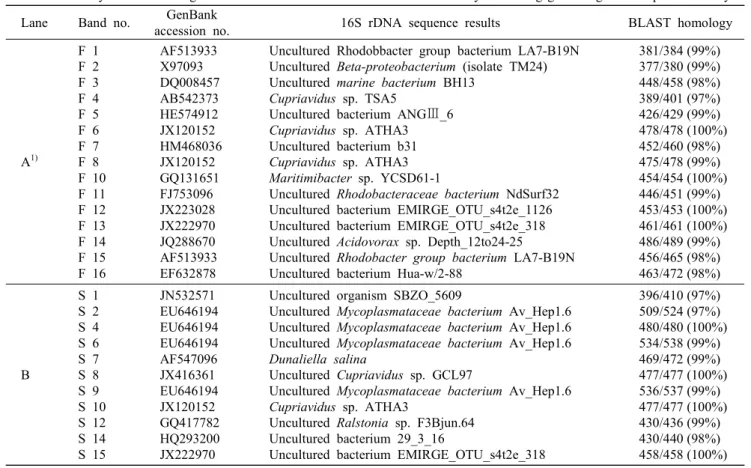
꽃소금과 천일염으로부터 배양과정을 거치지 않고 직접 DNA를 추출하여 PCR을 수행하여 얻은 증폭산물로 DGGE 분석 결과, 꽃소금에서는 16개의 밴드를, 천일염에서는 15 개의 밴드를 분리하였다(Fig. 3). 꽃소금에서는 Cupriavi-
Table 5. Diversity of the microorganisms identified in solar salt and flower of salt by denaturing gradient gel electrophoresis analysis Lane Band no. GenBank
accession no. 16S rDNA sequence results BLAST homology
A1)
F 1 F 2 F 3 F 4 F 5 F 6 F 7 F 8 F 10 F 11 F 12 F 13 F 14 F 15 F 16
AF513933 X97093 DQ008457 AB542373 HE574912 JX120152 HM468036 JX120152 GQ131651 FJ753096 JX223028 JX222970 JQ288670 AF513933 EF632878
Uncultured Rhodobbacter group bacterium LA7-B19N Uncultured Beta-proteobacterium (isolate TM24) Uncultured marine bacterium BH13
Cupriavidus sp. TSA5
Uncultured bacterium ANGⅢ_6 Cupriavidus sp. ATHA3 Uncultured bacterium b31 Cupriavidus sp. ATHA3 Maritimibacter sp. YCSD61-1
Uncultured Rhodobacteraceae bacterium NdSurf32 Uncultured bacterium EMIRGE_OTU_s4t2e_1126 Uncultured bacterium EMIRGE_OTU_s4t2e_318 Uncultured Acidovorax sp. Depth_12to24-25
Uncultured Rhodobacter group bacterium LA7-B19N Uncultured bacterium Hua-w/2-88
381/384 (99%) 377/380 (99%) 448/458 (98%) 389/401 (97%) 426/429 (99%) 478/478 (100%) 452/460 (98%) 475/478 (99%) 454/454 (100%) 446/451 (99%) 453/453 (100%) 461/461 (100%) 486/489 (99%) 456/465 (98%) 463/472 (98%)
B
S 1 S 2 S 4 S 6 S 7 S 8 S 9 S 10 S 12 S 14 S 15
JN532571 EU646194 EU646194 EU646194 AF547096 JX416361 EU646194 JX120152 GQ417782 HQ293200 JX222970
Uncultured organism SBZO_5609
Uncultured Mycoplasmataceae bacterium Av_Hep1.6 Uncultured Mycoplasmataceae bacterium Av_Hep1.6 Uncultured Mycoplasmataceae bacterium Av_Hep1.6 Dunaliella salina
Uncultured Cupriavidus sp. GCL97
Uncultured Mycoplasmataceae bacterium Av_Hep1.6 Cupriavidus sp. ATHA3
Uncultured Ralstonia sp. F3Bjun.64 Uncultured bacterium 29_3_16
Uncultured bacterium EMIRGE_OTU_s4t2e_318
396/410 (97%) 509/524 (97%) 480/480 (100%) 534/538 (99%) 469/472 (99%) 477/477 (100%) 536/537 (99%) 477/477 (100%) 430/436 (99%) 430/440 (98%) 458/458 (100%)
1)A: 2012 Docho salt flower, B: 2012 Docho solar salt.
dus 속 3종, Maritinibacter 속 1종 그리고 uncultured bacteria 11종의 미생물이 동정되었으며, 천일염에서는 Cupriavidus 속과 Dunaliella salina을 제외하고는 9종 모 두 uncultured bacteria로 동정되었다(Table 5). Muyzer 등(30)은 DGGE 분석법이 복잡한 미생물 집단의 유전적 다 양성을 분석하는 분자생물학적 도구라고 보고하였으며, 국 내에서는 발효식품에 DGGE 분석법을 적용하여 김치나 된 장에 우점종으로 존재하는 미생물을 분석하여 보고하고 있 다. Park 등(31)은 김치의 저온발효과정에서 순차적으로 Weissella koreensis, Lactobacillus sakei, 그리고 Leu-
conostoc gelidum이 우점종으로 차지하고 있다고 하였으
며, Lee 등(32)은 김치에 우점종 균은 Weissella confusa, Leuconostoc citreum, Lactobacillus sakei, 그리고 Lac- tobacillus curvatus이라고 보고하였다. 또한 Kim 등(33)은 일본산 된장과 중국산 된장에 존재하는 미생물을 DGGE 방 법으로 분석하여 일본산 된장에는 Tetragenococcus hal- ophilus와 Staphylococcus gallinarum이 우점균이며, 중국 산 된장에서는 Bacillus 속이 우점균이라 보고하였다. 이러 한 결과는 발효식품에 DGGE 분석법을 적용할 경우 우점균 의 종까지 분석이 가능함을 시사해주고 있는 반면, 본 연구 에서 국내산 꽃소금과 천일염에 존재하는 미생물 다양성을 DGGE 방법으로 분석한 결과는 대부분이 uncultured bac- teria나 속까지만 동정이 가능한 결과를 얻을 수 있었다. 이
는 발효식품의 경우 발효과정에서 미생물이 증식하여 발효 에 영향을 줄 수 있는, 알려진 발효 미생물의 상대적 빈도가 높아지지만, 천일염의 경우에는 천일염에 들어있는 미생물 자체만을 분석하기 때문이라 판단된다. 또한 배양방법에 의 한 동정과 DGGE 분석법의 동정 결과가 다른 것으로부터 천일염에 함유된 배양 가능한 미생물의 분포가 상대적으로 매우 낮다는 것을 추측할 수 있다.
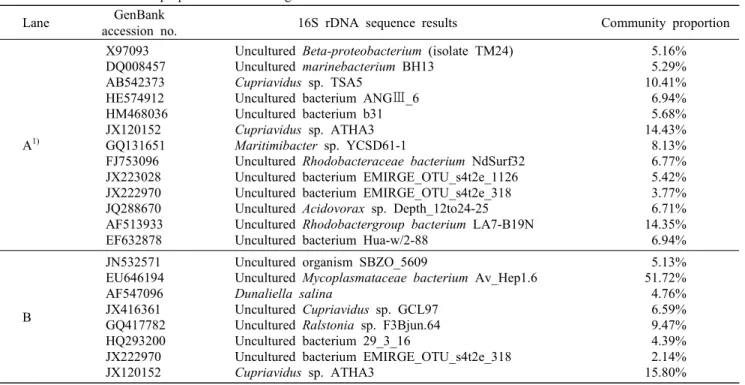
DGGE band의 intensity가 높다는 것은 개체군의 수가 많다는 것을 의미하는데, 도초산 꽃소금에서 Cupriavidus sp. ATHA3(14.43%), Cupriavidus sp. TSA5(10.41%), Maritimibacter sp. YCSD61-2(8.13%), uncultured bac- teria(68%)로 확인되었고 도초산 천일염에서는 Dunaliella salina(4.76%), Cupriavidus sp. ATHA3(15.80%), un- cultured Mycoplasmataceae bacteria(51.72%), un- cultured bacteria(27%)로 분석되었다(Table 6).
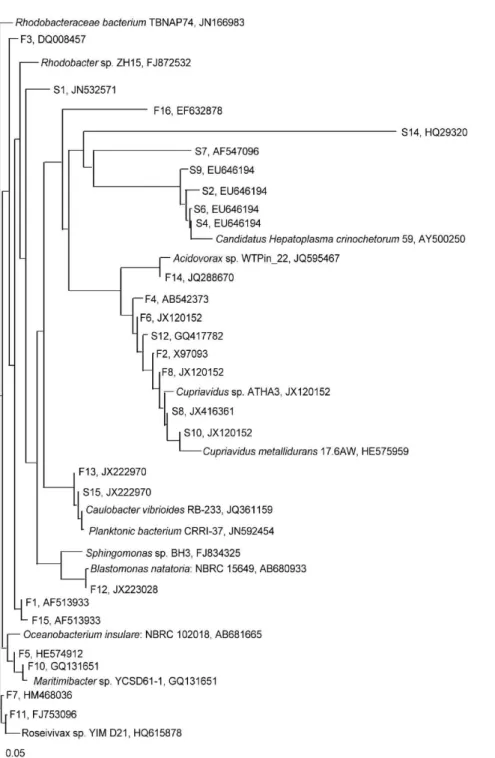
Phylogenetic tree를 그려 계통발생학적 관계를 확인한 결과(Fig. 4), 도초 꽃소금에서는 α-proteobacteria가 9종 (60%)으로 가장 많이 분포하며, β-proteobacteria 5종 (33.3%)과 그 외 1종(6.7%)이 존재하였다. 도초 천일염은 α-proteobacteria가 2종(18.2%), Mollicutes가 4종(36.4
%), β-proteobacteria 3종(27.3%), Chlorophyceae 1종 (9.1%), 그 외 1종(9.1%)이 분포하는 양상을 보였다. Baati 등(13)은 천일염의 미생물 분석 결과로 α-proteobacteria
Table 6. Identification and proportion of microorganisms in flower of salt and solar salt
Lane GenBank
accession no. 16S rDNA sequence results Community proportion
A1)
X97093 DQ008457 AB542373 HE574912 HM468036 JX120152 GQ131651 FJ753096 JX223028 JX222970 JQ288670 AF513933 EF632878
Uncultured Beta-proteobacterium (isolate TM24) Uncultured marinebacterium BH13
Cupriavidus sp. TSA5
Uncultured bacterium ANGⅢ_6 Uncultured bacterium b31 Cupriavidus sp. ATHA3 Maritimibacter sp. YCSD61-1
Uncultured Rhodobacteraceae bacterium NdSurf32 Uncultured bacterium EMIRGE_OTU_s4t2e_1126 Uncultured bacterium EMIRGE_OTU_s4t2e_318 Uncultured Acidovorax sp. Depth_12to24-25 Uncultured Rhodobactergroup bacterium LA7-B19N Uncultured bacterium Hua-w/2-88
5.16%
5.29%
10.41%
6.94%
5.68%
14.43%
8.13%
6.77%
5.42%
3.77%
6.71%
14.35%
6.94%
B
JN532571 EU646194 AF547096 JX416361 GQ417782 HQ293200 JX222970 JX120152
Uncultured organism SBZO_5609
Uncultured Mycoplasmataceae bacterium Av_Hep1.6 Dunaliella salina
Uncultured Cupriavidus sp. GCL97 Uncultured Ralstonia sp. F3Bjun.64 Uncultured bacterium 29_3_16
Uncultured bacterium EMIRGE_OTU_s4t2e_318 Cupriavidus sp. ATHA3
5.13%
51.72%
4.76%
6.59%
9.47%
4.39%
2.14%
15.80%
1)A: 2012 Docho flower of salt, B: 2012 Docho solar salt.
가 14.2%, γ-proteobacteria 14.2%, Bacteroidetes가 71.4
%로 확인되어 본 연구 결과와는 다른 결과를 보여주었다.
요 약
한국산 꽃소금의 특성을 알아보기 위하여 국내에서 생산된 꽃소금 3종과 천일염 1종의 이화학적 및 미생물 분석을 실 시하였다. 수분함량은 10.54±0.10∼13.82±0.12%, 나머 지 조단백, 조지방, 조섬유는 거의 존재하지 않았다. NaCl은 신의도산 꽃소금이 78.81±0.28%, 비금산 꽃소금이 81.67
±0.34%, 도초산 꽃소금 84.61±0.21%, 도초산 천일염이 80.82±0.17%로 나타났다. 불용분, 사분은 각각 0.01∼
0.05%, 0.01∼0.03%로 낮게 검출되었다. 미네랄 분석은 도 초산 꽃소금에서 K과 Mg 함량이 2,975.23 mg/kg, 9,886.72 mg/kg으로 비교적 낮게 나타났다. Ca은 도초산 소금 2종이 945.53 mg/kg, 942.43 mg/kg으로 낮은 함량을 보였다. 중 금속 As, Cd, Pb, Hg은 모두 규격 이하로 검출되었다. 소금 결정을 관찰한 결과로 천일염과 꽃소금 모두 핵이 중복되어 겹으로 적층된 것을 확인하였으며 크기는 비금산 꽃소금이 0.067×0.067 mm로 가장 작고 도초산 천일염이 0.112×
0.124 mm로 꽃소금에 비해 크게 나타났다. 소금의 색도는 꽃소금의 L값이 천일염에 비해 높아 밝게 확인되었다. 관능 검사 결과로 짠맛은 NaCl 함량과 유사하며, 쓴맛은 K과 Mg 함량이 적은 도초산 꽃소금이 낮게 나타났다. 천일염에 비해 꽃소금의 단맛과 기호도가 더 높은 것으로 확인되었다. 호염 균 동정 결과 19종 모두 Firmicutes로 꽃소금에서 Marini- bacillus, Paenibacillus, Bacillus 속이 12종으로 확인되며,
천일염은 Planococcus, Staphylococcus, Bacillus 속 3종 으로 검출되었다. DGGE 실험 결과로 도초산 꽃소금에서 16개의 band와 도초산 천일염에서 15개의 band를 확인하 였다. 동정 결과 도초산 꽃소금에서 Cupriavidus sp. ATHA3 (14.43%), Cupriavidus sp. TSA5(10.41%), Maritimi- bacter sp. YCSD61-2(8.13%), uncultured bacteria(68
%)로 확인되었고, 도초산 천일염에서는 Dunaliella sali- na(4.76%), Cupriavidus sp. ATHA3(15.80%), un- cultured Mycoplasmataceae bacteria(51.72%), un- cultured bacteria(27%)로 확인되었다.
감사의 글
본 연구는 농림수산식품부 연구개발사업 310014-03-1- CG000에 의해 이루어진 것임.
REFERENCES
1. Korea food service news. 2012. The diary of food serv- ice&solar salt in 2012. Seoul, Korea. p 24-31.
2. Kang JH. 2006. Salt and health. Korea Forum 6, Korea Forum Corporation, Seoul, Korea. p 200-203.
3. KFDA. 2011. Korea food and drug administration. Food standards codex Ⅰ. Korean Food Industry Association, Seoul, Korea. p 200-203.
4. Choi JH. 2011. Korean solar salt story for safe luxury salts.
Sigmabooks, Seoul, Korea. p 75-76.
5. Shin TS, Park CK, Lee SH, Han KH. 2005. Effects of age on chemical composition in sun-dried salts. Korean J Food Sci Technol 37: 312-317.
Fig. 4. Phylogenetic tree generated from the neighbor-joining method of 16s rRNA sequence derived by PCR with a primer set (341f and 907r).
6. Jin YX, Je JH, Lee YH, Kim JH, Cho YS, Kim SY. 2011.
Comparison of the mineral contents of sun-dried salt de- pending on wet digestion and dissolution. Korean J Food Preserv 18: 993-997.
7. Park JW, Kim SJ, Kim SH, Kim BH, Kang SG, Nam SH, Jung ST. 2000. Determination of mineral and heavy metal contents of various salts. Korean J Food Sci Technol 32:
1442-1445.
8. Chang JY, Kim IC, Chang HC. 2011. Effect of solar salt on the fermentation characteristics of Kimchi. Korean J Food Preserv 18: 256-265.
9. Lee KD, Choi CR, Cho JY, Kim HL, Ham KS. 2008. Phys-
icochemical and sensory properties of salt-fermented shrimp prepared with various salts. J Korean Soc Food Sci Nutr 37: 53-59.
10. Chang M, Kim IC, Chang HC. 2010. Effect of solar salt on the quality characteristics of Doenjang. J Korean Soc Food Sci Nutr 39: 116-124.
11. Kim HL, Yoo YJ, Lee IS, Ko GH, Kim IC. 2012. Evaluation of heavy metal contents in mudflat solar salt, salt water, and sea water in the nationwide salt pan. J Korean Soc Food Sci Nutr 41: 1014-1019.
12. Na BJ, Ha SD. 2009. Effectiveness and safety of salt. Food Science and Industry 42(2): 60-73.
13. Baati H, Guermazi S, Gharsallah N, Sghir A, Ammar E.
2010. Microbial community of salt crystals processed from Mediterranean seawater based on 16s rRNA analysis. Can J Microbial 56: 44-51.
14. Oren A. 2008. Microbial life at high salt concentrations:
phylogenetic and metabolic diversity. Saline Systems 4: 2.
doi: 10.1186/1746-1448-4-2.
15. Birbir M, Calli B, Mertoglu B, Bardavid RE, Oren A, Ogmen MN, Ogan A. 2007. Extremely halophilic archaea from Tuz Lake, Turkey, and the adjacent Kaldirim and Kayacik salterns. World J Microbiol Biotechnol 23: 309-316.
16. KFDA. 2011. Korea food and drug administration. Food standards codex Ⅱ. Korean Food Industry Association, Seoul, Korea. p 3-33.
17. AOAC. 1980. Official methods of analysis. 17th ed. Associ- ation of Official Analytical Chemists, Washington, DC, USA. Vol 11, p 31.
18. Lee KD, Park JW, Choi CR, Song HW, Yun SK, Yang HC, Ham KS. 2007. Salinity and heavy metal contents of solar salts produced in Jeollanamdo province of Korea. J Korean Soc Food Sci Nutr 36: 753-758.
19. Ha JO, Park KY. 1998. Comparison of mineral contents and external structure of various salts. J Korean Soc Food Sci Nutr 27: 413-418.
20. Na JM, Kang MS, Kim JH, Jin YX, Je JH, Kim JB, Cho YS, Kim JH, Kim SY. 2011. Distribution and identification of halophilic bacteria in solar salts produced during entire manufacturing process. Korean J Microbiol Biotechnol 39:
133-139.
21. Yoon JH, Kim IG, Schumann P, Oh TK, Park YH. 2004.
Marinibacillus campisalis sp. nov., a moderate halophile isolated from a marine solar saltern in Korea, with emended description of the genus Marinibacillus. Int J Syst Evol Microbiol 54: 1317-1321.
22. SubhoshChandra M, Roy N, Lee YS, Park IH, Zhou Y, Kim KK, Choi YL. 2008. Production, purification and character- ization of a thermostable β-mannanase from Paenibacillus xylanilyticus DZ3. 2008 International Symposium and Annual Meeting of the Korean Society for Applied Biologi- cal Chemistry. Busan, Korea. p 208.
23. Kocur M, Zdena P, Hodgkiss W, Martinec T. 1970. The taxonomic status of the genus Planococcus migula 1894.
Int J Syst Evol Microbiol 20: 241-248.
24. Yoon JH, Kang SJ, Lee SY, Oh KH, Oh TK. 2010. Plan- ococcus salinarum sp. nov., isolated from a marine solar saltern, and emended description of the genus Planococcus.
Int J Syst Evol Microbial 60: 754-758.
25. Lee MJ, Cho KH, Han ES, Lee JH. 2010. Bacterial diversity in the initial fermentation stage of Korean and Chinese kimchi. Kor J Microbiol Biotechnol 38: 207-215.
26. Yoon JH, Kim IG, Kang KH, Oh TK, Park YH. 2003.
Bacillus marisflavi sp. nov. and Bacillus aquimaris sp. nov., isolated from sea water of a tidal flat of the Yellow Sea in Korea. Int J Syst Evol Microbial 53: 1297-1303.
27. Shivaji S, Chaturvedi P, Begum Z, Pindi PK, Manorama R, Padmanaban DA, Shouche YS, Pawar S, Vaishampayan P, Dutt CB, Datta GN, Manchanda RK, Rao UR, Bhargava PM, Narlikar JV. 2009. Janibacter hoylei sp. nov., Bacillus isronensis sp. nov. and Bacillus aryabhattai sp. nov., iso- lated from cryotubes used for collecting air from the upper atmosphere. Int J Syst Evol Microbial 59: 2977-2986.
28. Shon MY, Seo KI, Park SK, Cho YS, Sung NJ. 2001. Some biological activities and isoflavone content of Chungkugjang prepared with black beans and Bacillus strains. J Korean Soc Food Sci Nutr 30: 662-667.
29. Hwang JS, Kim JY, Sung DI, Yi YS, Kim HB. 2012. Fer- mentation of black-soybean Chungkookjang using Bacillus licheniformis B1. Korean J Microbiol 48: 216-219.
30. Muyzer G, de Waal EC, Uitterlinden AG. 1993. Profiling of complex microbial populations by denaturing gradient gel electrophoresis analysis of polymerase chain reaction-am- plified genes coding for 16S rRNA. Appl Environ Microbiol 59: 659-700.
31. Park JA, Heo GY, Lee JS, Oh YJ, Kim BY, Min TI, Kim CK, Ahn JS. 2003. Change of microbial communities in Kimchi fermentation at low temperature. Korean J Microbiol 39: 45-50.
32. Lee JS, Heo GY, Lee JW, Oh YJ, Park JA, Park YH, Pyun YR, Ahn JS. 2005. Analysis of kimchi microflora using de- naturing gradient gel electrophoresis. Int J Food Microbiol 102: 143-150.
33. Kim TW, Lee JH, Park MH, Kim HY. 2009. Analysis of bacterial and fungal communities in Japanese- and Chinese- fermented soybean pastes using nested PCR-DGGE. Curr Microbiol 60: 315-320.