• 검색 결과가 없습니다.

대한비과학회

N/A
N/A
Protected

Academic year: 2021

Share "대한비과학회"

Copied!
4
0
0

로드 중.... (전체 텍스트 보기)

전체 글

(1)

J Rhinol 20(1), 2013

- 37 -

A Clinical Analysis of Revision Endoscopic Sinus Surgery:

Single-Center 10-Year Experience

Boo-Young Kim, MD, Min Kim, MD, Jung Mee Park, MD, Hyun Bum Kim, MD, Sung Won Kim, MD, PhD, Byung-Guk Kim, MD, PhD, Jin Hee Cho, MD, PhD,

YongJin Park, MD, PhD and Soo Whan Kim, MD, PhD

Department of Otolaryngology-Head and Neck Surgery, The Catholic University of Korea, College of Medicine, Seoul, Korea

ABSTRACT

Background and Objectives : Endoscopic sinus surgery (ESS) has become a popular procedure for treating chronic sinusitis. Despite recent developments in medical and surgical techniques, primary ESS can still fail. Al- though revision ESS is one solution to the problem of recurrent sinusitis, revision surgery is stressful for patients and otolaryngologists. Therefore, we examined the causes of ESS failure and sought to find ways to prevent the failure of primary ESS. Materials and Methods : All patients who underwent revision ESS in our department between April 2003 and March 2012 were studied retrospectively. Results : During this period, revision ESS was performed 40 times to treat chronic sinusitis. We analyzed the preoperative computed tomographic (CT) findings of primary and revision ESS cases using the Lund-Mackay and Kennedy CT staging scores to compare disease severity. In our cases, the failure of ESS was not affected by the extent of disease, asthma, or allergy. Polyposis was the only useful predictor of revision ESS. Conclusion : Polyposis is an important predictor of revision ESS.

We recommend that patients be followed frequently and carefully, especially those with polyps.

KEY WORDS : Revision Endoscopic S inus Surgery · Nasal Polyps · Asthma.

INTRODUCTION

Recently, endoscopic sinus surgery (ESS) has become a popular procedure for treating chronic sinusitis.

1)

Despite recent developments in medical and surgical techniques, the failure rate of primary ESS is still 2–24%.

2) 3)

In cases of failed ESS, revision ESS is one solution to the problem of recurrent sinusitis. This study reports our experience with the causes and characteristics of revision ESS sta- tistically.

MATERIALS AND METHODS

We retrospectively reviewed 60 primary and 40 revision ESS cases seen in our department between April 2003

and March 2012. During the same period, 690 patients underwent primary ESS for chronic sinusitis in our de- partment. Of these, 60 patients were followed for a mean of 40 months with no recurrent chronic sinusitis. In the revision ESS cases, the mean interval between primary and revision surgery was 15 (range 3–49) years. In the control group, patients who underwent primary ESS had not experienced recurrent chronic sinusitis for a mean of 40 (range 9–105) months.

Exclusion criteria were: benign or malignant tumor; post- operative cheek cysts; sinus surgery for complications of sinusitis; the Caldwell-Luc operation; and immunodefi- ciency or depressed immune status.

Recurrent chronic sinusitis was diagnosed based on an of- fice endoscopic examination and radiologic findings. ESS was indicated for patients in whom optimal medical treat- ment had failed. In our cases, “failure of medical treat- ment” was defined as unsatisfactory results after repeated, appropriate antibiotic therapy with local treatment, such as saline irrigation or nasal spray, for at least 6 months.

We analyzed the preoperative computed tomographic (CT) findings of primary and revision ESS cases using the www.ksrhino.or.kr

Address correspondence and reprint requests to Soo Whan Kim, MD, PhD, Department of Otolaryngology-Head and Neck Surgery, Seoul St.

Mary’s Hospital, College of Medicine, The Catholic University of Korea, 505 Banpo-dong, Seocho-gu, Seoul, 137-701, Korea

Tel: +82-2-2258-6214 , Fax: +82-2 -535-1354 E-mail: [email protected]

Received for publication on February 5, 2013

Accepted for publicatoin on March 31, 2013

(2)

Lund-Mackay

4)

and Kennedy

5)

CT staging scores to com- pare disease severity.

We tested patients for allergies using the multiple aller- gen simultaneous test, eosinophil count, and total im- munoglobulin E concentration. During the operation, we biopsied the polyp and cultured the discharge from the paranasal sinus.

The data collected included demographics, presence of asthma or documented allergy, history of surgery, extent of surgery, pre- and postoperative management, recur- rence of chronic sinusitis, and presence of diabetes mel- litus (DM), high blood pressure (HBP), and/or underlying disease.

All patients with ESSs were treated with saline irriga- tion, inhaled steroids, antibiotics, and antihistamines for 2 weeks postoperatively. Patients with polyps were treated with inhaled steroids for a mean period of 1 month, antibi- otics for 2weeks postoperatively. All patients with asthma were given oral and inhaled steroids for asthma control and followed by a pulmonologist and rhinologist for at least 1 year.

We used Student’s t - test to compare normally distributed variables. Variables that were not distributed normally were analyzed using the Mann–Whitney U - test (PASW Statistics 18; SPSS Inc., Chicago, IL, USA). A p - value <

0.05 was considered to be statistically significant.

RESULTS

We performed revision ESS 40 times to treat chronic si- nusitis; these operations represented 5% of all ESSs we performed. The study sample included 27, 7, 4, and 2 pa- tients who had undergone ESS two to five times, respec- tively. Their mean age at the time of first revision ESS in our department was 52.5 (range 22– 82) years. Thirty patients were male and 10 were female.

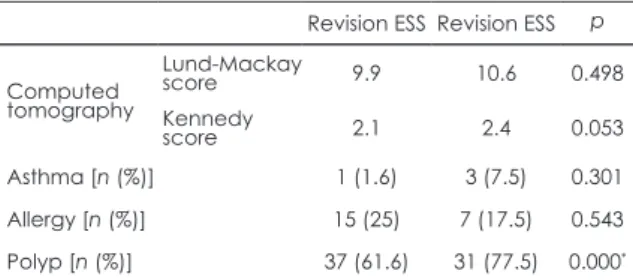
Mean age of primary ESS patients was 40.6 (range 15–85) years (Table 1). Revision ESS was performed for chronic sinusitis without polyps in nine operations and with polyps in 31 (77.5%) operations. Primary ESS was performed for chronic sinusitis without polyps in 23 operations and with polyps in 37 (61.6%) operations. Medication use did not differ between the primary and revision ESS groups. Pa- tients with nasal polyposis had a significantly (p = 0.000) higher propensity for requiring revision ESS (Table 2).

Data from CT scans performed before revision and prima- ry ESS were available for analysis for all 100 operations.

The extents of disease existing before revision and pri- mary ESS were compared. The respective Lund-Mackay and Kennedy CT scores were 9.9 and 2.1 in the primary ESS group and 10.6 and 2.4 in the revision ESS group.

No statistical difference was observed between revision

and primary ESS (Mann–Whitney U - test: Lund-Mackay score, p = 0.498; Kennedy CT score, p = 0.053; Fig. 1).

The primary ESS group contained 15 (25%) patients with allergies and 1 (1.6%) with asthma, versus 7 (17.5%) and 3 (7.5%) patients, respectively, in the revision ESS group.

In the primary ESS group, four patients had renal disease, three patients had thyroid disease, four (6.6%) had DM, and eight (13.3%) had HBP. In the revision ESS group, three (7.5%) patients had DM and 9 (22.5%) had HBP.

Bacterial cultures were positive in one (1.6%) case in the primary ESS group and nine (22.5%) cases in the revi- 38 / J Rhinol 20(1), 2013

Fig. 1. (A) Coronal computed tomographic image showing bi- lateral polyposis in the osteomeatal unit before primary sinus surgery. (B) Before revision sinus surgery, recurrent polyposis was detected bilaterally, especially on the left side, at 3 years after primary sinus surgery.

A B

Primary ESS Revision ESS Total

No. of patients 60 40 100

Male:female 31:29 30:10 61:39

Mean age (years) 40.6 52.5 51.9

Mean follow-up (months) 40 48 43.2

Table 1. Summary of patients in the primary and revision endo- scopic sinus surgery groups.

Table 2. Comparison of primary and revision endoscopic sinus surgery (ESS; Mann–Whitney U - test). The Lund-Mackay and Kennedy computed tomographic scores did not differ be- tween revision and primary ESS (Mann–Whitney U - test: Lund- Mackay score, p = 0.498; Kennedy score, p = 0.053). The revision ESS group contained seven (17.5%) patients with allergy and three (7.5%) with asthma. Patients with nasal polyposis had a high propensity for requiring revision ESS (p = 0.000).

Revision ESS Revision ESS p

Computed tomography

Lund-Mackay

score 9.9 10.6 0.498

Kennedy

score 2.1 2.4 0.053

Asthma [n (%)] 1 (1.6) 3 (7.5) 0.301

Allergy [n (%)] 15 (25) 7 (17.5) 0.543

Polyp [n (%)] 37 (61.6) 31 (77.5) 0.000*

*statistically significantigure.
(3)

sion ESS group. The organisms cultured included methi- cillin-resistant Staphylococcus aureus, penicillin-resistant Streptococcus pneumonia, Serratia sp., and Enterobacter aerogenes. Fungal cultures were positive in eight (13.3%) cases in the primary ESS group and one (2.5%) case in the revision ESS group. The fungus cultured was aspergil- losis in all but one case, in which the pathologist could not identify the type of fungus.

No major complication occurred in either group. The fol- low-up period ranged from 9 to 105 months. In the prima- ry ESS group, polyps recurred, but they did not obstruct the osteomeatal unit or lead to chronic sinusitis.

Five (5%) patients had asthma. Of this subset of patients, all had polyps and three patients underwent revision ESS.

Two patients with asthma who developed polyps required only primary ESS. The presence of asthma was not cor- related with revision surgery (p = 0.301).

Twenty-two (22%) patients had documented allergies;

seven (31%) were advised to undergo revision ESS and 15 (68%) had primary ESS only. Of the seven patients with allergies who had no polyps, one (14%) underwent revision ESS. Of the 15 (68%) patients with polyps and allergy, six (40%) had revision ESS. A history of allergy was not correlated with revision surgery (p = 0.543).

DISCUSSION

Despite developments in ESS techniques, revision ESS remains very stressful for patients and otolaryngologists.

In our series, 40 (5%) cases required revision ESS over 10 years. This rate is lower than those reported in other studies.

2) 3)

For revision ESS, we selected patients who had chronic sinusitis after receiving adequate medication for at least 6 months and those who had an obvious anatomic problem, such as polyps and osteomeatal unit obstruction, that was confirmed endoscopically and by CT.

The extents of disease, asthma, and allergy have been re- ported to predict ESS failure.

6) 7)

In addition, patients with nasal polyposis have a high propensity for recurrence, and nasal polyposis is generally accepted as a major cause of ESS failure.

8) 9) 10) 11)

Senior et al.

12)

concluded that the need for revision surgery was correlated with preoperative CT stage. Holmstrom et al.

13)

reported that the presence of asthma was associated with a higher prevalence of nasal polyposis (13%). Wil- liam

14)

reported the top 10 reasons for maxillary ESS fail- ure, which included an obstructed natural ostium and the presence of sinus disease or resistant organisms.

In contrast, the need for revision ESS was not affected by the extent of disease, sex, age, underlying disease, asthma, or allergy in our series. Asthma or allergy did not significantly predict the failure of primary ESS. Polyposis

was the only significant (p = 0.000) predictor of revision ESS. In our cases, obstruction of the osteomeatal unit by polyposis was the main cause of revision ESS. Revision ESS long after primary ESS was strongly correlated with the presence of polyps without asthma. Such patients were not followed regularly compared with asthmatic patients, which may have enabled undetected nasal polyps to grow until they obstructed the osteomeatal unit. By contrast, pa- tients with asthma or allergies visited the office frequently and took antihistamines, oral steroids, or inhaled steroids intermittently as compared with non-asthmatic or non-al- lergic patients. In our cases, all asthmatic patients visited the hospital or respirology clinic at least once a month.

Consequently, they had better postoperative care and their nasal cavities were checked frequently, which might have caused the lower recurrence rate of chronic sinusitis and the lower likelihood of revision ESS.

The surgical removal of disease is indicated for the treat- ment of chronic sinusitis after the failure of medical treat- ment. However, revision surgery is very stressful for pa- tients and otolaryngologists.

Postoperative care is important for preventing disease recurrence and avoiding revision surgery, especially in patients with polyposis. To prevent the failure of primary ESS, we recommend that patients be followed frequently and carefully, especially those with polyps, regardless of whether they have asthma.

In conclusion, Many factors can affect the outcome of re- vision ESS. In our series, polyposis was the most impor- tant predictor of revision ESS. To reduce the prevalence of revision surgery, regular monitoring for polyposis should be conducted, even after this condition has been treated by ESS.

저자역할(Author Contributions)

김부영, 김민, 박정미, 김현범, 김성원, 김병국, 조진희, 박용진, 김수 환 은 본 연구에서 모든 자료에 접근할 수 있으며, 자료의 완전성과 자 료 분석의 정확성에 책임을 지고 있습니다. 연구 기획 : 김부영, 김민, 박정미, 김현범, 김성원, 김병국, 조진희, 박용진, 김수환. 자료 해석 및 분석 : 김부영, 김민, 박정미, 김현범, 김성원, 김병국, 조진희, 박 용진. 논문 초안 : 김부영. 연구 총괄 : 김수환.

REFERENCES

1) Lazar RH, Younis RT, Long TE, Gross CW. Revision functional endonasal sinus surgery. Ear Nose Throat J 1992;71:131-133.

2) Moses RL, Cornetta A, Atkins JP Jr, Roth M, Rosen MR, Keane WM. Revision endoscopic sinus surgery: the Thomas Jefferson University experience. Ear Nose Throat J 1998;77:190,193-195- ,199-202.

3) Parsons DS, Stivers FE, Talbot AR. The missed ostium sequence and the surgical approach to revision functional endoscopic sinus surgery. Otolaryngol Clin North Am 1996;29:169-183.

Kim et al : Revision Endoscopic Sinus Surgery - Sing-Center Experience / 39

(4)

40 / J Rhinol 20(1), 2013

4) Lund VJ, Kennedy DW. Quantification for staging sinusitis: the staging and therapy group. Ann Otol Rhinol Laryngol Suppl 1995;167:17-21.

5) Kennedy DW. Prognostic factors, outcomes, and staging in eth- moid sinus surgery. Laryngoscope 1992;102:1-18.

6) Kountakis SE, Bradley DT. Effect of asthma on sinus computed tomography grade and symptom scores in patients undergo- ing revision functional endoscopic sinus surgery. Am J Rhinol 2003;17:215-219.

7) Houser SM, Keen KJ. The role of allergy and smoking in chronic rhinosinusitis and polyposis. Laryngoscope 2008;118:1521-7.

8) Lee JY, Lee SW, Lee JD. Comparison of the surgical outcome between primary and revision endoscopic sinus surgery for chronic rhinosinusitis with nasal polyposis. Am J Otolaryngol 2008;29:379-384.

9) Wynn R, Har-EI G. Recurrence rates after endoscopic sinus sur-

gery for massive sinus polyposis. Laryngoscope 2004;114:811- 10) Albu S, Tomescu E, Maxca Z, Nistor S, Necula S, Cozlean A. 813.

Recurrence rate in endonasal surgery for polyposis. Acta Otorhi- nolaryngol Belg 2004;58:79-86.

11) Deal RT, Kountakis SE. Significance of nasal polyps in chronic rhinosinusitis: symptoms and surgical outcomes. Laryngoscope 2004;114:1932-5.

12) Senior BA, Kennedy DW, Tanabodee J, Kroger H, Hassab M, Lanza D. Long-term results of functional endoscopic sinus sur- gery. Laryngoscope 1998;108:151-157.

13) Holmström M, Holmberg K, Lundblad L, Norlander T, Stierna P.

Current perspectives on the treatment of nasal polyposis: a Swed- ish opinion report. Acta Otolaryngol 1992;122:736-744.

14) Richtsmeier WJ. Top 10 reasons for endoscopic maxillary sinus

surgery failure. Laryngoscope 2001;111:1952-1956.

수치

Table 1. Summary of patients in the primary and revision endo- endo-scopic sinus surgery groups.

참조

관련 문서

In particular, the study summarizes the approval process for medical devices in the United States and the European Union. For AI-assisted medical devices

Endoscopic spine surgery has become a practical, minimally invasive technique for decompression in patients with spinal disc herniation or stenosis.. However,

Popular music in the lives of youth and popular music occupies a large portion of the preference for youth is high throughout the survey were more clearly. Survey for

With the increase of the dental implant procedure, there are many cases of Maxillary Sinus Floor Elevation Surgery(MSFES). Additionally, its side effect has

In this study, 1st and 2nd pilot studies was accomplished for revising evaluation standards and as a result, the procedure for implementing mathematics

The political offensive in the Chinese continent is expected to become stronger in the future for the Chinese government, and a sharp confrontation with

In this study, using concept mapping of a variety of learning techniques in the area of science, especially biology, has a positive effect on learning

The OSFE (osteotome sinus floor elevation) technique has been used for maxillary sinus augmentation.. The implants were clinically and radiographically followed