- 15 -
KISEP Original Articles J Rhinol 5((((1)))), 1998
The Effects of Topically Administered Methacholine on the Nasal Patency as Assessed by Acoustic Rhinometry*
Yong Ju Jang, M.D.
ABSTRACT
The aim of this study was to evaluate the effect of topical methacholine on the nasal mucosa in allergic rhinitis and nonallergic control group, particularly in terms of nasal patency. The study population consisted of 32 adults with no nasal disorders and 22 patients with nasal allergy, and their age ranged from 18 to 42. Increasing concentrations of methacholine ranging from 0.125%
to 25% were sprayed on both nasal cavities of the study subjects. The minimal cross sectional area and the nasal cavity volume at each concentration were measured using acoustic rhinometry. The overall incidence of methacholine responsiveness was 56%. The allergic group did not show a significantly higher incidence of methacholine responsiveness compared to the control group. The incidence and the pattern of methacholine responsiveness was not bilaterally symmetric on both sides of the nasal cavities. The results of this study indicate that, both in allergic and control group, topical methacholine stimulation resulted in decreased nasal patency only in a subset of the population.
KEY WORDS:Methacholine·Nasal patency·Acoustic rhinometry.
INTRODUCTION
The parasympathetic nervous system in the nose is distrib- uted to seromucous glands in lamina propria and to the smooth muscle fibers of the arterioles and venous sinusoids.
1)Thus, a cholinergic stimulation by methacholine results in increased rhinorrhea and vasodilation. The effects of topical methacholine stimulation on the secretory activity of nasal cavity have pre- viously been assessed by a symptoms score, the amount of nasal secretion,
2)and a qualitative analysis by lavage.
3)However, the pattern and the amount of the response to the topical cho- linergic stimulation in terms of nasal patency have not been elucidated. Acoustic rhinometry is a new diagnostic tool des- igned to measure the nasal geometry in terms of cross sectional area and volume of the nasal airway.
4)Many studies are being performed using acoustic rhinometry to understand the nasal response to a particular experimental condition. To date, ho- wever, no experimental study has been performed by acoustic rhinometry regarding the nasal responsiveness to topical met-
hacholine. We undertook this study to assess the effect of to- pically administered methacholine on nasal patency, so that we may evaluate the applicability of a methacholine challenge test using acoustic rhinometry in various nasal disorders.
MATERIALS AND METHODS
The study population consisted of 32 voluntary subjects (18 men, 14 women) having no nasal complaints as the control, 22 patients (13 men, 9 women) with allergic rhinitis. The su- bjects’ age ranged from 18 to 42. Allergic rhinitis was diagn- osed by the presence of symptoms such as sneezing, rhinorrhea, and nasal itching, and positive skin test results for multiple specific antigens. In both the allergic and control group, the subjects with septal deformities, turbinate hypertrophy, nasal cavity mass, and purulent nasal secretion were excluded. Serial concentrations of methacholine (Sigma Co, M0) were diluted with phosphate buffered saline (PBS). The graded concentr- ations were 0%, 0.125%, 0.25%, 0.612%, 1.25%, 2.5%, 6.125%, 12.5%, 25%. Shortly before measurement, the temperature of the methacholine solution was controlled at 37℃ using a he- ating chamber. Before spraying the methacholine, two puffs of PBS were applied intranasally as a baseline measurement.
As in the bronchial methacholine challenge test using spiro- metry, the serial concentrations of methacholine, measuring 2 cc, were sprayed thereafter in the both nasal cavities at inter- vals of 5 minutes, and acoustic rhinometric measurements at each concentration were conducted 2 minutes after the meth-
*Supported by research fund from Dankook University Department of Otolaryngology, Dankook University College of Medicine, Cheonan, Korea
Address correspondence and reprint requests to Yong Ju Jang, M.D., Department of Otolaryngology-Head and Neck Surgery, Dankook University College of Medicine 29 Anseo-dong Che- onan Choongnam-Do, Cheonan, 330-714, Korea
Tel:82-417-550-3973, Fax:82-417-556-1090
Accepted for publication on April 14, 1998
16 / J Rhinol 5(1), 1998
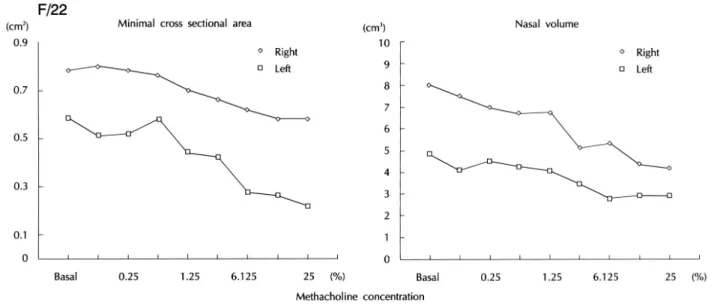
acholine spray. During the measurement, subjects were seated upright and their nasal cavities were gently suctioned before each measurement. To obtain reproducible test results, all the measurements were performed by the same examiner. Serial changes in the minimal cross sectional area (MCA) and nasal volume (NV) with increasing concentrations of methacholine in individual subjects were plotted and analyzed. Positive nasal responsiveness to methacholine was defined as when the MCA and NV of at least one nasal cavity had a gradually decreasing value to the level of less than 80% of baseline measurement at a certain concentration (Fig. 1). Negative responsiveness was defined as when the MCA and NV of both nasal cavities sho-
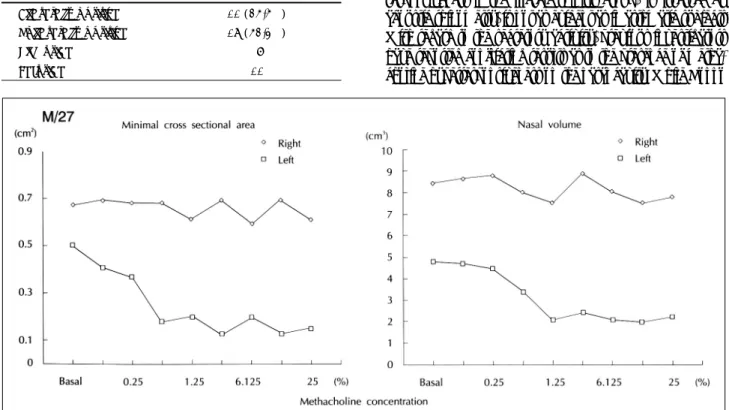
wed no change, irregularity in changes, or an increasing value with the increasing concentrations of methacholine (Fig. 2).
RESULTS
The overall incidence of positive methacholine responsi- veness was 53% in the control group and 59% in the allergic group. The difference between the incidences of the groups did not reach statistical significance (Table 1). The pattern of methacholine responsiveness was not bilaterally symmetric on both sides of the nasal cavities. In the positive responsive population, bilaterally symmetric positive responses (Fig. 1)
Fig. 2. Changes in minimal cross sectional (MCA) area and nasal volume (NV) in subject showing bilaterally negative response. The left nasal cavity showed irregularly changing MCA, whereas the right nasal cavity demonstrated rather increasing pattern in MCA.
Fig. 1. Changes in minimal cross sectional (MCA) area and nasal volume (NV) in subject showing bilaterally positive response. MCA demonstrated gradually decreasing value to the level of less than 80% of the baseline measurement as the increasing concentration of methacholine.
Jang:Effects of Methacholine on Nasal Patency / 17
were seen in 36.6%, whereas 63.4% of the population was unilaterally responsiveness (Fig. 3) (Table 2).
DISCUSSION
Since the asthmatic subjects are hyperresponsive to metha- choline, the methacholine challenge test using spirometry plays an important role for diagnosing and detecting bronchial ast- hma in risk group.
5)While the bronchial airway responds to topical cholinergic stimulation with contractions of its smooth muscle and resultant bronchoconstriction, the nasal airway responds to methacholine primarily in the form of increased secretory activity.
6)In the present study, decreased nasal patency followed an application of topical methacholine stimulation. This change might have resulted from the dilatory effect of the methach-
oline on the capacitance vessels, with resultant thickening of the mucosa in the nose.
7)Traditional methods used for assessing nasal response to methacholine failed to confirm increased nasal reactivity in particular nasal disorders such as allergic rhinitis.
8)In this st- udy, to assess whether acoustic rhinometry can provide diag- nostic significance in methacholine challenge testing for the diagnosis of allergic rhinitis, as spirometry does in diagnosing asthma, the author intended to evaluate the pattern of nasal responses to topical methacholine stimulation in terms of change in the MCA and NV. Since the NV in acoustic rhinometric measurements were expressed as an integration of nasal cross sectional areas to a certain point in the nasal cavity, the NV usually showed a greater percent reduction than the MCA at a particular concentration of methacholine. Thus, in the present study, the author defined positive responsiveness as a percent reduction of nasal cross sectional areas to a level of less than 80% of the baseline measurement. This responsiveness criteria was adopted from the definition of PC 20 in the methacholine challenge test using spirometry for asthmatic subjects. Alt- hough this was an arbitrary criteria, it served in the present study as a fair dividing line between the responsive and unr- esponsive cavities. In this study, at least in terms of nasal patency, the allergic rhinitis group did not show a significantly greater incidence of positive responsiveness than the control group. This result indicates that the significance of methacholine responsiveness in the allergic rhinitis group, as assessed by acoustic rhinometry, is not as evident as in asthmatic subjects.
With regard to the secretory activity, previous investigators have reported conflicting results as to the presence of metha- choline hyperresponsiveness on the nasal cavity. While Konno
Table 1. Comparison of the proportion of positive responsive subjects betweeen control and allergic group
Study group Incidence of positive responsiveness Control 53 % (17/32)
Allergic 59 % (13/22)*
Overall 56 % (30/54)
*not significantly different (p>0.05%)
Table 2. Types of methacholine responsiveness in the responsive subjects
Type of responsiveness Number of subjects (n=30) Bilaterally positive 11 (36.6%) Unilaterally positive 19 (63.4%)
Right side 8
Left side 11
Fig. 3. Changes in minimal cross sectional (MCA) area and nasal volume (NV) in subject showing unilaterally positive response. While the left nasal cavity showed gradual decrement in MCA as the increasing methacholine concentration, the right nasal cavity did not show significant change.
18 / J Rhinol 5(1), 1998
et al.
9)reported that a patient with allergic rhinitis had metha- choline hyperresponsiveness, Mclean,
10)Borum,
11)and Fili- aci,
12)suggested that this kind of methacholine hyperreponsi- veness is not identifiable in subjects with allergic rhinitis.
In the present study, the author could identify the asymmetry of the methacholine responsiveness between the nasal cavities.
This result is in accordance with previous study
13)that reports that a methacholine challenge on the unilateral nasal cavity does not result in significant change in the contralateral cavity.
The author could not demon-strate diagnostic significance of methacholine challenge test using acoustic rhinometry in all- ergic rhinitis. Thus, I would conclude that further studies are required to substantiate the applicability of methacholine ch- allenge testing using acoustic rhinometry.
REFERENCES
1)
Naclerio RM, Baroody FM. In vivo human models for the study of anticholinergic drugs. J Allergy Clin Immunol 1995;95:1069-79.2)
Borum P. Nasal methacholine challenge. J Allergy Clin Immunol 1979;63:253-7.3)
Naclerio RM, Baroody FM, Kagey-Sobotka A, Lichenstein LM.Basophils and eosinophils in allergic rhinits. J Allergy Clin Imm-
unol 1994;94:1303-9.
4)
Hilberg O, Jackson AC, Swift DL, Pedersen OF. Acoustic rhino- metry: evaluation of nasal cavity geometry by acoustic reflexes. J Appl Physiol 1989;66:295-303.5)
Van Wijk RG. Nasal hyperreactivity: its pathogenesis and clinical significance. Clin Experi Allergy 1991;21:661-7.6)
Mygind N, Dahl R. Challenge tests in nose and bronchi: pharmac- ological modulation of rhinitis and asthma. Clin Exp Allergy 1996;26 supple 3:39-43.