Original Article
Received: Oct 21, 2016; Revised: Nov 23, 2016; Accepted: Nov 23, 2016 Correspondence to: Eyob Alemayehu Gebreyohannes
Department of Clinical Pharmacy, University of Gondar-CMHS, Gondar, Amhara, Ethiopia (P.O.Box: 196).
Tel: +251-920255334, E-mail: [email protected]
Recreational Use of Phosphodiesterase 5 Inhibitors and Its Associated Factors among Undergraduate Male Students in an Ethiopian University: A Cross-Sectional Study
Eyob Alemayehu Gebreyohannes1, Akshaya Srikanth Bhagavathula1, Begashaw Melaku Gebresillassie1, Yonas Getaye Tefera1, Sewunet Admasu Belachew1, Daniel Asfaw Erku2
Departments of 1Clinical Pharmacy and 2Pharmaceutical Chemistry, University of Gondar College of Medicine and Health Sciences, School of Pharmacy, Gondar, Ethiopia
Purpose: To assess the prevalence of phosphodiesterase 5 (PDE5) inhibitor use and associated factors among University of Gondar undergraduate students.
Materials and Methods: An institution-based, cross-sectional study, using a survey questionnaire, was conducted from October to December 2015 to assess PDE5 inhibitor use and associated factors among male students at the University of Gondar. A Self-Esteem and Relationship questionnaire (14 items), an International Index of Erectile Function questionnaire (15 items) and a questionnaire on PDE5 inhibitor use (14 items) were included in the survey.
Results: Across all respondents (age, 21.9±1.88 years), more than half (55.7%, n=233) had heard about PDE5 inhibitors, but only 23 men (5.5%) reported trying a PDE5 inhibitor drug at least once. Older students were more likely to use PDE5 inhibitors compared to younger students (adjusted odds ratio [AOR], 1.40; 95% confidence interval [CI], 1.109∼1.768). Those students who were smokers were 5.15 times more likely to use PDE5 inhibitors as compared to their non-smoking counterparts (AOR, 5.15; 95% CI, 2.096∼12.687). In addition, multivariate logistic regression showed that being in a relationship, alcohol use, greater number of cigarettes smoked per day, and more sexual partners were significantly associated with PDE5 inhibitor use.
Conclusions: The prevalence of PDE5 inhibitor use among undergraduate students was 5.5%. Cigarette smoking and other substance use, older age, and greater number of sexual partners were significantly associated factors for PDE5 inhibitor use. These findings suggest that restricting access to PDE5 inhibitor drugs is essential to curtailing misuse among university students.
Key Words: Erectile dysfunction; Ethiopia; Male; Phosphodiesterase 5 inhibitors; Sildnafil citrate
INTRODUCTION
Erectile dysfunction (ED) aka impotence is defined as
the inability to achieve or maintain an erection sufficient for satisfactory sexual performance [1]. It is a relatively common medical problem and is estimated to affect 322
https://doi.org/10.5534/wjmh.2016.34.3.186
www.wjmh.org
million people worldwide, of whom 30 million live in Africa [2].
Phosphodiesterase 5 (PDE5) inhibitors such as sildena- fil (Viagra), tadalafil (Cialis), and vardenafil (Levitra, Vivanza) are drugs approved by the United States Food and Drug Administration for the treatment of ED. Though these drugs are only approved for ED, many young healthy men use PDE5 inhibitors for sexual enhancement. Mounting evidence has identified a trend of recreational use of PDE5 inhibitors in combination with illicit drugs for sexual en- hancement without medical indication [3-5]. Studies have identified several risk factors associated with PDE5 in- hibitors, such as greater number of sexual partners, un- protected sexual relations, and sexually transmitted dis- eases [6,7].
In Ethiopia, alcohol, khat (Catha edulis), and tobacco are the most frequently used recreational substances and the rate of substance use is increasing, particularly in the younger population [8-10]. Due to a lack of strong regu- lations, these PDE5 inhibitors can be easily accessed with- out prescriptions from pharmacies [11]. Although psycho- active substance use has become common practice among university students in Ethiopia, no studies have as- sessed the rate of PDE5 inhibitor use or its associated factors. Thus, we proposed to assess the prevalence of PDE5 inhibitor use and associated factors among University of Gondar (UOG) undergraduate students.
MATERIALS AND METHODS
1. Subject
This institution-based, cross-sectional study was con- ducted from October to December 2015 to assess PDE5 inhibitor use and associated factors among male students at the UOG, Ethiopia. UOG is located in Gondar, in the Amhara region of Northwest Ethiopia. The university has a total of 12,248 male students enrolled at various cam- puses. The study used a quantitative data collection meth- od and included all regular undergraduate students at- tending UOG.
The sample size was calculated using a single pop- ulation proportion formula for a population greater than 10,000 (12,248 regular students). The sample was ob- tained using a proportional stratified random sampling
technique. During the first stage, all 5 campuses were se- lected and the number of students from each campus was determined proportionally based on the number of stu- dents attending each campus. Undergraduate students from each campus were selected using a computer-genera- ted simple random sampling technique. Using a 4% margin of error at 95% confidence level, the sample size was 572 after considering a 10% nonresponse rate.
A brief survey questionnaire containing open-ended and multiple-choice questions was distributed to a cohort of undergraduate students. The anonymous responses were collected by hand from each participant and they were provided with a period of 15 to 20 minutes to finish the questionnaire during their leisure time.
The 52-item survey-questionnaire was divided into 5 domains: (1) an assessment of personal and epidemio- logical data (7 items), (2) an assessment of sexual inter- course experience (2 items), (3) the Self-esteem and Relationship (SEAR) questionnaire (14 items), (4) the International Index of Erectile Function (IIEF) question- naire (15 items), and (5) an assessment of PDE5 inhibitor use (14 items).
The SEAR questionnaire was used to assess sexual rela- tionship scores ranging from 0 to 100 (transformed scores) and to classify them according to a validated tool [12]. The IIEF-15 questionnaire, containing 15 items, was used to as- sess erectile function [13]. A 17-item questionnaire was used to assess PDE5 inhibitor use among undergraduate students.
2. Statistical analysis
All statistical analysis was performed using IBM SPSS ver. 22 (IBM Co., Armonk, NY, USA). Summary statistics of sociodemographic data, sexual intercourse history, and extent of PDE5 inhibitor use were presented using fre- quency and percentages. Mean and standard deviation were used to summarize SEAR and IIEF scores. Binary lo- gistic regression was performed to determine the asso- ciated factors contributing to PDE5 inhibitor use. Signifi- cant risk factors identified by binary logistic regression analysis were included in the multiple logistic regression.
Odds ratios (OR) with 95% confidence intervals (95% CI) were also computed, along with their p-values. A p<0.05 was set as statistically significant.
Table 2. Evaluation of ED according to self-esteem and relationship questionnaire (n=212)
Domain Mean±SD No. of
ED (n) No. of
minimal ED (n) No. of
moderate ED (n) No. of severe ED (n) Sexual relationship (1∼8) 62.4±19.4 >80 (38) 68∼80 (62) 56∼67 (49) <56 (63)
Confidence (9∼14) 68.0±17.8 >87 (31) 79∼87 (41) 60∼78 (78) <60 (62)
Self-esteem (9∼12) 67.6±19.1 >80 (63) 69∼80 (54) 56∼68 (73) <56 (22)
Overall relationship (13∼14) 69.4±25.3 >86 (78) 78∼86 (0) 59∼77 (32) <77 (102)
Overall score 64.8±17.0 >83 (31) 72∼83 (47) 51∼71 (68) <51 (66)
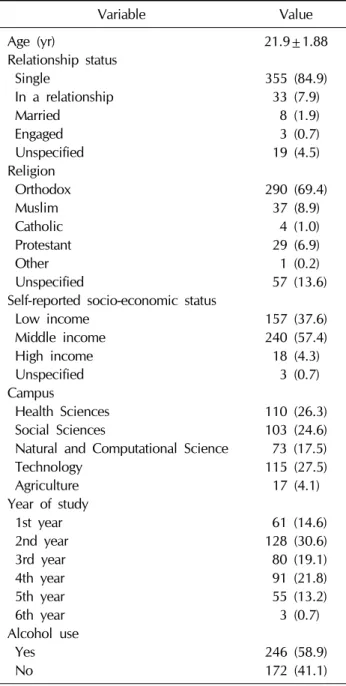
Table 1. Personal and epidemiological characteristics (n=418)
Variable Value
Age (yr) 21.9±1.88
Relationship status
Single 355 (84.9)
In a relationship 33 (7.9)
Married 8 (1.9)
Engaged 3 (0.7)
Unspecified 19 (4.5)
Religion
Orthodox 290 (69.4)
Muslim 37 (8.9)
Catholic 4 (1.0)
Protestant 29 (6.9)
Other 1 (0.2)
Unspecified 57 (13.6)
Self-reported socio-economic status
Low income 157 (37.6)
Middle income 240 (57.4)
High income 18 (4.3)
Unspecified 3 (0.7)
Campus
Health Sciences 110 (26.3)
Social Sciences 103 (24.6)
Natural and Computational Science 73 (17.5)
Technology 115 (27.5)
Agriculture 17 (4.1)
Year of study
1st year 61 (14.6)
2nd year 128 (30.6)
3rd year 80 (19.1)
4th year 91 (21.8)
5th year 55 (13.2)
6th year 3 (0.7)
Alcohol use
Yes 246 (58.9)
No 172 (41.1)
Values are presented as mean±standard deviation or number (%).
3. Ethics approval and consent to participate The study protocol was approved by the institutional Review Board of the School of Pharmacy, University of Gondar, Ethiopia. Prior to survey questionnaire admin- istration, written consent was obtained from each partici- pant. Only those participants who consented to partic- ipate were included in the study. Confidentiality of the in- formation provided by the participants was ensured by not disclosing the information. And consent to publish was obtain from the School of Pharmacy and also obtained from study participants.
RESULTS
The response rate was 73.1% (n=418). Nearly nine- tenths of the respondents were single (89.4%, n=355) with a mean age of 21.9±1.88 years. More than two- thirds (69.4%, n=290) of the respondents were Orthodox Christians and from middle-income families (57.4%, n=
240). One-third (30.6%, n=128) of student participants were in their second year of study and students from the Technology (27.5%, n=115), Health Sciences (26.3%, n=110), and Social Sciences (24.6%, n=103) campuses actively participated in the study. When asked about sub- stance use, nearly six-tenths (58.9%, n=246) reported that they drink alcohol. Half of the respondents reported that they had engaged in sexual activity (50.7%, n=212) in the previous 6 months (Table 1).
1. Self-esteem and relationship questionnaire The overall scores for the study participants from the SEAR questionnaire (1∼14 items) assessing the domains of sexual relationships (1∼8 items) and confidence (9∼
www.wjmh.org Fig. 1. Mean scores±standard deviations of International Index
of Erectile Function (IIEF) questionnaire (n=212).
Table 3. Phosphodiesterase 5 inhibitors (PDE5I) use
Variable Number (%)
When did you first hear about PDE5I? (total=418)
Never heard before 233 (55.7)
Before joining the campus 79 (18.9) After joining the campus 106 (25.4) PDE5I use (total=418)
Yes 23 (5.5)
No 395 (94.5)
Type of PDE5I used (total=23)
I don’t know 7 (30.4)
Sildenafil 10 (43.5)
Not specified 6 (26.1)
Frequency of PDE5I use during intercourse (total=23) Rarely (less than half the time) 14 (60.9)
Sometimes (half the time) 4 (17.4)
Often (more than half the time) 5 (21.7) Knowledge about PDE5I dosage (total=23)
Yes 18 (78.3)
No 5 (21.7)
Motivation for PDE5I use (total=23)
To increase erectile sensation 9 (39.1)
To increase rigidity 8 (34.8)
To enhance self-esteem 7 (30.4)
To impress or satisfy partner 4 (17.4) To decrease refractory phase 2 (8.7)
To decrease libido 2 (8.7)
Curiosity 1 (4.3)
Combining PDE5I with illicit drugs (total=14)
Alcohol 10 (71.4)
Khat 2 (14.3)
Marijuana 1 (7.1)
Khat and cigarette 1 (7.1)
Easy access to PDE5I (total=23)
Yes 15 (65.2)
No 8 (34.8)
Source of PDE5I acquisition (total=23)
A friend 13 (56.5)
Night clubs 1 (4.3)
Pharmacies but no prescription 7 (30.4) Pharmacies with prescription 2 (8.7) Feeling about PDE5I use (total=23)
Useless 1 (4.3)
Not satisfactory 4 (17.4)
Satisfactory 8 (34.8)
Good 7 (30.4)
Excellent 3 (13.0)
Side effects experienced (total=23)
Headache 8 (34.8)
Dizziness 3 (13.0)
Stomach ache 1 (4.3)
Flushing 1 (4.3)
Blurred vision 5 (21.7)
Sensitivity to light 1 (4.3)
Longer erections than wanted 4 (17.4) Wish to use PDE5I again (total=20)
Yes 11 (55.0)
No 9 (45.0)
14 items), including self-esteem (9∼12 items) and overall relationship (13∼14 items) are shown in Table 2. The mean score of the first domain, sexual relationship (1∼8 items), was 62.4±19.4 (range, 25∼100); nearly one-third (29.7%) of participants showed severe ED with poor sex- ual relations according to the SEAR scale. The second do- main, confidence (self-esteem and overall relationship) was 68.0±17.8 (range, 12.5∼100), with a greater num- ber of participants with moderate (32%) to severe ED (31.1%). The self-esteem (9∼12 items) subdomain of the confidence domain mean score was 67.6±19.1 (range, 18.7∼100) and the majority scored more than 80. The overall relationship mean score (13∼14 items) was 69.4±25.3 (range, 37.5∼100) and nearly half of partic- ipants scored less than 77 (48.1%).
2. International index of erectile function questionnaire
The mean IIEF score of men was 21.6±4.52 (range, 6∼
30); the organism function score was 7.3±2.00 (range, 3∼
10); the sexual desire score was 6.8±1.75 (range, 2∼10);
the intercourse satisfaction score was 10.0±2.42 (range, 2∼
15), and overall satisfaction was 7.8±1.88 (range, 2∼10) (Fig. 1). More than six-tenths (62.3%) showed some de- gree of ED according to the IIEF scale.
3. Phosphodiesterase 5 inhibitor use
Across all respondents, more than half (55.7%, n=233)
Table 4. Bivariate and multivariate logistic regression analysis of socio-demographic data and phosphodiesterase 5 inhibitor use
Factors OR (95% CI) AOR (95% CI)
Age 1.397 (1.140∼1.714)** 1.40 (1.109∼1.768)**
Relationship status
Single 1 1
In a relationship 0.165 (0.049∼0.559)** 0.197 (0.053∼0.733)*
Married 0.117 (0.012∼1.141) 0.080 (0.008∼0.823)*
Engaged 1.250 (0.179∼8.729) 1.333 (0.155∼11.498)
Unspecified 1.875 (0.134∼26.320) 2.000 (0.098∼41.003)
Frequency of alcohol use
Never 1 1
Few times 0.024 (0.003∼0.214)** 0.068 (0.007∼0.616)*
Sometimes 0.025 (0.003∼0.242)** 0.049 (0.005∼0.479)*
Most times 0.101 (0.013∼0.807)* 0.173 (0.022∼1.391)
Always 0.312 (0.035∼2.827) 0.333 (0.037∼3.026)
Cigarette smoking 10.555 (4.355∼25.585)*** 5.15 (2.096∼12.687)***
No. of cigarettes per day 1.279 (1.139∼1.433)*** 1.184 (1.062∼1.322)**
No. of life-time sexual partners 1.204 (1.099∼1.320)*** 1.115 (1.010∼1.231)*
Belief about the effect of the use of illicit substances on sex
No effect 1 1
Not much interesting 0.236 (0.054∼1.043) 0.236 (0.054∼1.043)
Somewhat good 0.185 (0.055∼0.626)** 0.185 (0.055∼0.626)**
Very good 0.232 (0.071∼0.755)* 0.232 (0.071∼0.755)*
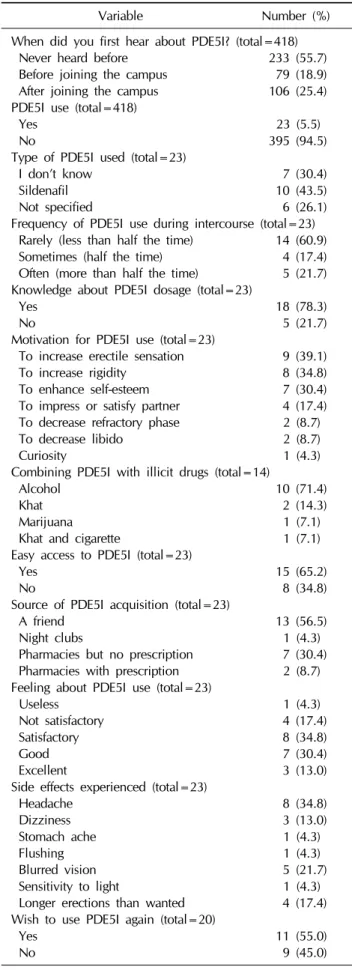
had heard about PDE5 inhibitors, but only 23 (5.5%) men recorded trying a PDE5 inhibitor drug at least once.
Among those men, 10 participants specified sildenafil and the remaining 13 were unable to recall the type of PDE5 inhibitors used. Most of the PDE5 inhibitor users took these drugs rarely (n=14), and 18 specified the exact dos- age of the PDE5 inhibitors used. The motivation behind PDE5 inhibitor use was to increase erectile sensation (n=9), increase rigidity (n=8), enhance self-esteem (n=7) and to impress/satisfy the partner (n=4). However, the majority of the PDE5 inhibitor users reported that they used it along with illicit drugs (marijuana, shisha, and hashish; n=14). Participants also agreed that they could easily access PDE5 inhibitor drugs without a prescription (n=15) and obtain them through friends (n=13). When asked about their experience of PDE5 inhibitor use, 18 men reported a satisfactory to excellent experience, but reported that they experienced headache (n=8), blurred vision (n=5), and longer duration of action (n=4) after us- ing PDE5 inhibitors. Many reported that they would like to use PDE5 inhibitors again (n=11) (Table 3).
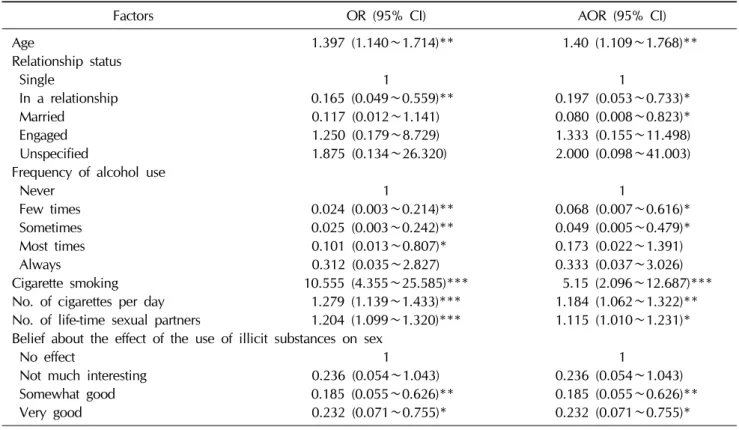
Table 4 indicates sociodemographic and behavioral factors assumed to be associated with PDE5 inhibitor use among the study participants. Age, being in a relationship, alcohol use, cigarette smoking, and beliefs about the effect of illicit substances on sexual relations were found to be significantly associated with PDE5 inhibitor use in multi- variate logistic regression analysis. In particular, older stu- dents were more likely to use PDE5 inhibitors compared to younger students (adjusted OR [AOR], 1.40; 95% CI, 1.109∼1.768). Those students who were smokers were 5.15 times more likely to use PDE5 inhibitors as compared to their counterparts (AOR, 5.15; 95% CI, 2.096∼
12.687). Furthermore, multivariate logistic regression showed that being in a relationship, alcohol use, greater number of cigarettes smoked per day, and more sexual partners were found to be significantly associated with PDE5 inhibitor use (Table 4).
Binary logistic regression data are given in Table 5.
Study campus, SEAR scores, and erectile function were not associated with PDE5 inhibitor use in the binary logis- tic regression analysis (p>0.05). The only significant fac-
www.wjmh.org Table 5. Binary logistic regression between phosphodiesterase 5 inhibitors use among undergraduate students (n=418)
Variable Category OR 95% CI p-value
Campus Non-health science students 1.24 0.496∼3.100 0.645
Health science students Reference - -
SEAR overall score <50 0.494 0.574∼7.128 0.273
≥50 Reference - -
IIEF score <25 0.50 0.812∼4.920 0.132
≥25 Reference - -
Substance use Yes 3.479* 1.162∼10.416 0.026*
No Reference - -
OR: odds ratio, CI: confidence interval, SEAR: Self-esteem and Relationship, IIEF: International Index of Erectile Function.
*p<0.05.
tors were substance use (OR, 3.479; 95% CI, 1.162∼
10.416; p=0.026).
DISCUSSION
Many population-based studies have reported the rec- reational use of PDE5 inhibitors among young men aged 18 to 44 years [4,5,11,14]. Indeed, these drugs are ap- proved for treating ED patients, but young healthy men may wish to use them to enhance their sexual perfor- mance. This use without indication can have an impact on sexual function, relationships with partners, and self- esteem. Moreover, very few studies have addressed the use of PDE5 inhibitors in students [3,15-17]. This is the first study reporting the prevalence of PDE5 inhibitor use among university students in Ethiopia.
Through this investigation, we identified that PDE5 in- hibitors were used as a recreational drug by 5.5% of the participants, which is consistent with the study of Musacchio et al [18] (6%) conducted on college students in the United States. Although the prevalence of PDE5 inhibitor use here is comparably much lower than what was found in a Brazilian study [3], our findings may suggest that PDE5 in- hibitor use by young male students is becoming a problem in Ethiopia. Our population reported that they used PDE5 inhibitors to enhance their sexual performance by improv- ing erectile sensation and increasing penile rigidity.
Similar to other studies, a high percentage (71.5%) of PDE5 inhibitor users liked to use them with alcohol and other illicit drugs [3,18-20]. More than half (56.5%) re- ceived these drugs from a friend, and they also reported
that they can easily access PDE5 inhibitors as non-pre- scribed drugs. This unexpected risky behavior may lead to adverse consequences and such a finding necessitates fur- ther in-depth investigation to better understand these issues.
We used 2 standardized and validated questionnaires to investigate undergraduate students’ sexual relation- ships, using the SEAR questionnaire and IIEF-15 to address their sexual confidence. The scores reflected overall good sexual relationship and confidence levels, with no perva- sive ED. However, 30% of the sample exhibited a ≤50 score for sexual relationship, 20.3% had lower confidence levels, and nearly 45% reported a ≤60 score, indicating ED according to the SEAR. These findings were lower than those of previous studies conducted on medical students and young adult ED patients treating with sildenafil [21,22]. Similarly, only 7.5% had ED according to IIEF-15.
Our findings indicate a relatively high rate of severe ED in university students, which raises concerns. Previous stud- ies indicated that underlying psychological problems were one of the predictive risk factors associated with se- vere ED in young men [21,23]. Psychological issues have a particular impact on the wellbeing of both partners and more emphasis is needed on addressing psychological im- pediments in order to improve all aspects of sexual aspiration. The Global Better Sex Survey reported out of the 48% of young men with a degree of ED, 18% showed a prevalence of severe ED, but very few had taken a medi- cation for ED [24]. This indicates that there is an unmet need to focus on sexual health, particularly in young men.
The transition from high school to college is a critical
developmental period and a time when young men may engage in unprotected sex, especially those with many perceived health risk factors. PDE5 inhibitor drugs should be used only for ED under the direct supervision of health- care providers. Illegal access to these drugs and con- current use with potentially hazardous substances like al- cohol or other illicit drugs might carry additional health risks. In this study, nearly two-thirds of PDE5 inhibitor users reported that they can easily obtain the drugs through a friend, from pharmacies without prescriptions, or from other sources. In addition, more than half of these drug users would like to use them again, which raises con- cerns about risky behavior in young students. With re- gards to substance use, cigarette smoking showed a stat- istically significant association with higher odds of recrea- tional use of PDE5 inhibitors, more so than other sub- stances (AOR, 5.15; 95% CI, 2.096∼12.687). However in the study of Korkes et al [3], nearly three-fourths (71.4%) of young medical students mixed alcohol with PDE5 inhibitors. In binary logistic regression, recreational sub- stance users were 3.4 times more likely to also use PDE5 inhibitors as compared to non-substance users. The rec- reational use of PDE5 inhibitors with other substances can have potentially serious side effects. Moreover, most of the PDE5 inhibitor users frequently reported side effects such as headache, blurred vision, longer duration of ac- tion, and dizziness; these side effects have also been re- ported in previous studies [3,4,25].
We used 2 standardized SEAR and IIEF questionnaires with a cross-sectional study method to assess erectile func- tion, sexual relationships, and confidence. Open-ended questions were limited in the questionnaire and the study was pilot-tested. In addition, PDE5 inhibitor use was test- ed using a different questionnaire to reduce recall bias.
However, the study is not without limitations. First, this study was cross-sectional and conducted at a single in- stitution; therefore, the findings should be interpreted carefully when trying to establish a causal relationship. In addition, it may be difficult to generalize the findings to the whole body of undergraduate students studying at dif- ferent universities in Ethiopia. Finally, data presented here is self-reported, and some of the participants may provide extreme responses as compared to others, according to
might be subject to recall bias.
CONCLUSIONS
The prevalence of PDE5 inhibitor use among under- graduate students was 5.5%. Cigarette smoking and other substance use, older age, and greater number of sexual partners were significantly associated factors for PDE5 in- hibitor use. These findings suggest that restricting access to PDE5 inhibitor drugs is essential for curtailing misuse among university students. Further studies focusing on psychosocial determinants of ED and PDE5 inhibitor use in the younger population are warranted.
ACKNOWLEDGEMENTS
We wish to express our sincere gratitude to the School of Pharmacy at the University of Gondar for the support and guidance they provided during the course of this study. We also would like to acknowledge the study par- ticipants for consenting to participate in the study.
CONFLICT OF INTEREST
No potential conflict of interest relevant to this article was reported.
REFERENCES
1. NIH Consensus Conference. Impotence. NIH consensus de- velopment panel on impotence. JAMA 1993;270:83-90.
2. Ayta IA, McKinlay JB, Krane RJ. The likely worldwide in- crease in erectile dysfunction between 1995 and 2025 and some possible policy consequences. BJU Int 1999;84:50-6.
3. Korkes F, Costa-Matos A, Gasperini R, Reginato PV, Perez MD. Recreational use of PDE5 inhibitors by young healthy men: recognizing this issue among medical students. J Sex Med 2008;5:2414-8.
4. Bechara A, Casabé A, De Bonis W, Helien A, Bertolino MV.
Recreational use of phosphodiesterase type 5 inhibitors by healthy young men. J Sex Med 2010;7:3736-42.
5. Lowe G, Costabile R. Phosphodiesterase type 5 inhibitor abuse: a critical review. Curr Drug Abuse Rev 2011;4:87-94.
6. Mitchell KR, Prah P, Mercer CH, Datta J, Tanton C, Macdowall W, et al. Medicated sex in Britain: evidence from the third National Survey of Sexual Attitudes and Lifestyles. Sex
www.wjmh.org anal intercourse among gay and bisexual men in Scotland:
what are the implications for HIV prevention? Sex Transm Infect 2014;90:125-32.
8. Gebreslassie M, Feleke A, Melese T. Psychoactive sub- stances use and associated factors among Axum University students, Axum Town, North Ethiopia. BMC Public Health 2013;13:693.
9. Mossie TB, GebreMichael GB, Ayele AD. Magnitude of psy- choactive substance abuse among university students, Adigrat, North Ethiopia: cross-sectional study. J Psych 2015;18:281.
10. Dingeta T, Oljira L, Assefa N. Patterns of sexual risk behav- ior among undergraduate university students in Ethiopia: a cross-sectional study. Pan Afr Med J 2012;12:33.
11. Both R. A matter of sexual confidence: young men's non- prescription use of Viagra in Addis Ababa, Ethiopia. Cult Health Sex 2016;18:495-508.
12. Cappelleri JC, Althof SE, Siegel RL, Shpilsky A, Bell SS, Duttagupta S. Development and validation of the Self-Esteem And Relationship (SEAR) questionnaire in erectile dysfunc- tion. Int J Impot Res 2004;16:30-8.
13. Rosen RC, Riley A, Wagner G, Osterloh IH, Kirkpatrick J, Mishra A. The international index of erectile function (IIEF):
a multidimensional scale for assessment of erectile dysfunc- tion. Urology 1997;49:822-30.
14. Kimura M, Shimura S, Kobayashi H, Tai T, Chikano Y, Baba S, et al. Profiling characteristics of men who use phospho- diesterase type 5 inhibitors based on obtaining patterns: da- ta from the nationwide Japanese population. J Sex Med 2012;9:1649-58.
15. Harte CB, Meston CM. Recreational use of erectile dysfunc- tion medications in undergraduate men in the United States:
characteristics and associated risk factors. Arch Sex Behav 2011;40:597-606.
16. Duryea DG, Calleja NG, MacDonald DA. Nonmedical use
of prescription drugs by college students with minority sex- ual orientations. J College Stud Psychother 2015;29:147-59.
17. Freitas VM, Menezes FG, Antonialli MM, Nascimento JW.
Use of phosphodiesterase-5 inhibitors by college students.
Rev Saude Publica 2008;42:965-7.
18. Musacchio NS, Hartrich M, Garofalo R. Erectile dysfunction and viagra use: what's up with college-age males? J Adolesc Health 2006;39:452-4.
19. Campbell N, Clark JP, Stecher VJ, Thomas JW, Callanan AC, Donnelly BF, et al. Adulteration of purported herbal and natural sexual performance enhancement dietary supple- ments with synthetic phosphodiesterase type 5 inhibitors. J Sex Med 2013;10:1842-9.
20. Santtila P, Sandnabba NK, Jern P, Varjonen M, Witting K, von der Pahlen B. Recreational use of erectile dysfunction medication may decrease confidence in ability to gain and hold erections in young males. Int J Impot Res 2007;19:591-6.
21. Shindel AW, Ferguson GG, Nelson CJ, Brandes SB. The sex- ual lives of medical students: a single institution survey. J Sex Med 2008;5:796-803.
22. Yang Y, Liu R, Jiang H, Hong K, Zhao L, Tang W, et al.
Association between dosage frequency and the treatment outcomes of sildenafil in young and middle-aged men with erectile dysfunction: a chinese, multicenter, observational study. Urology 2015;86:62-7.
23. Laumann EO, Paik A, Rosen RC. Sexual dysfunction in the United States: prevalence and predictors. JAMA 1999;281:
537-44.
24. Mulhall J, King R, Glina S, Hvidsten K. Importance of and satisfaction with sex among men and women worldwide: re- sults of the global better sex survey. J Sex Med 2008;5:788-95.
25. Hornung M, Halila GC, Barbosa V. Prevalence of uni- versities that make use of medicines for erectile dysfunction treatment. Visão Acadêmica 2012;13:27-32.