INTRODUCTION
Adolescence is a transitional period from childhood to adulthood.
From the developmental perspective, it is the most crucial period in life, during which both physical and psychological maturations occur. There is international concern about the increasing trend of adolescents’ alco-
hol consumption and smoking behaviors. These events can lead to psy- chological misdeeds and social loss.1) Adolescents’ mental health is closely related to their alcohol consumption and smoking behaviors. Previous studies reported that adolescent tobacco use is a predictable factor for mental health problems such as depression, substance consumption, and personality disorders.2-5) In addition, women are more vulnerable to
Received July 27, 2017 Revised October 2, 2017 Accepted October 8, 2017
Corresponding author Chan-Hee Song Tel: +82-2-3779-1377, Fax: +82-2-780-9114 E-mail: [email protected]
ORCID: http://orcid.org/0000-0002-8929-7730
Copyright © 2018 The Korean Academy of Family Medicine
This is an open-access article distributed under the terms of the Creative Commons At- tribution Non-Commercial License (http://creativecommons.org/licenses/by-nc/4.0) which permits unrestricted noncommercial use, distribution, and reproduction in any medium, provided the original work is properly cited.
Original Article
https://doi.org/10.21215/kjfp.2018.8.6.800 eISSN 2233-9116
Korean J Fam Pract. 2018;8(6):800-807
Korean Journal of Family Practice
KJFP
알코올 섭취 및 흡연과 성별에 따른 한국 청소년의 정신 건강과의 관계: 국민건강영양조사 2010-2012년 자료
김석원1, 송찬희1,*, 정은경1, 정규인2, 옥선명1
가톨릭대학교 의과대학 1가정의학교실, 2정신과학교실
Associations of Alcohol Consumption and Smoking Behaviors with Mental Health According to Gender in Korean Adolescents: Korean National Health and Nutrition Examination Survey, 2010 through 2012
Sukwon Kim1, Chan-Hee Song1,*, Eun-Kyung Jung1, Kuy-In Jung2, Sun-Myeong Ock1
Departments of 1Family Medicine and 2Psychiatry, College of Medicine, The Catholic University of Korea, Seoul, Korea
Background: The study was performed to investigate the associations between behaviors of smoking and alcohol consumption with mental health according to gender in Korean adolescents.
Methods: The data of 1,821 Korean adolescents aging from 13 to 18 years of age who participated in the Korean National Health and Nutrition Examination Survey were used.
Results: Behaviors of both smoking and alcohol consumption were independently associated with perceived stress in males, whereas only smoking behavior was associated with perceived stress in females. In contrast, smoking behavior was a significant factor associated with depressed mood in males, whereas both smoking and alcohol consumption were independently associated with depressed mood in females. According to our results, the number of cigarettes smoked per day in males and having smoked during the prior month in females were the most significant factors related to mental health. In addition, for males, smoking and alcohol consumption were associated more with perceived stress, whereas those activities were associated more with depressed mood in females.
Conclusion: Behaviors of smoking and alcohol consumption have associations with mental health in Korean adolescents, and the associations differ by gender. The influence is more significant and prominent in females.
Keywords: Adolescent; Gender Identity; Smoking; Alcohol Drinking; Mental Health
김석원 외. 알코올 섭취 및 흡연과 성별에 따른 청소년의 정신건강 Korean Journal of Family Practice
KJFP
stress, anxiety, and depression than men, whereas men smoke more and consume more alcohol than women.6-8) An online survey conducted in Korea in 2012 revealed that 20.6% of Korean adolescents in middle/high schools (22.7% of males and 15.8% of females) reported drinking alcohol at least once during the previous 30 days.9) Put another way, one in five Korean adolescents drink alcohol. According to the same survey, the rate of smoking during the prior 30 days was 12.1% (16.3% of males and 5.9%
of females). Considering these results, there are remarkable differences in behaviors of smoking and alcohol consumption between male and fe- male adolescents. However, few studies have focused on gender differ- ences regarding smoking and alcohol consumption associated with men- tal health. Therefore, the present study was performed to elucidate the as- sociations of alcohol consumption and smoking behaviors with mental health in Korean adolescents, and to reveal gender-related differences.
METHODS
1. Subjects
The participants provided their written informed consent before par- ticipating in the Korean National Health and Nutrition Examination Survey (KNHANES). The study design was approved by the Institutional Review Board of the Korea Centers for Disease Control and Prevention (IRB no. 2010-02CON-21-C, 2011-02CON-06-C, 2012-01EXP-01-2C).
For this study, we utilized survey data from KNHANES 2010–2012, which included 1,821 Korean adolescents 13–18 years of age.
2. Smoking and alcohol consumption
Average smoking days for the previous month, average number of cig- arettes smoked per day, whether a respondent had ever smoked during the prior month, life-time smoking experience, and the age of the adoles- cent’s first smoking experience were surveyed. Life-time smoking experi- ence classified respondents as smokers (a person who at the time of the survey smoked any tobacco product daily or occasionally) or non-smok- ers (a lifetime nonsmoker) by referring to World Health Organization 1998 standards. To evaluate alcohol use, the frequency of alcohol con- sumption per month, amount of alcohol consumed in one sitting, whether a respondent had any experience of alcohol consumption, and the age at which alcohol consumption began were surveyed.
3. Socio-demographic and health examination survey Trained interviewers administered questionnaires about the partici- pants’ socio-demographic factors and health. These examiners also con- ducted a physical examination at each participant’s residence or at mobile examination centers. Participants’ socioeconomic statuses was defined based on education and household income. Household income was esti- mated using standardization methods. The estimates were classified by sex and 5-year age groups and compared with the standard income level for South Korea. The adjusted family income was then used to categorize the household income into quartiles. Body mass index (BMI) was calcu- lated by dividing weight by height squared (kg/m2). Regular exercise was defined as high intensity exercise (for at least 20 minutes three times or more weekly), moderate intensity exercise (for at least 30 minutes five times or more weekly), and walking (for at least 30 minutes five times or more weekly).
4. Perceived stress and depression measurements Stress and depressive mood were estimated by trained interviewers.
Stress was measured by the question: “How much do you feel stressed out in your daily life?” The possible responses were “almost never,” “not of- ten,” “often,” or “almost always.” We replaced these responses with a Lik- ert scale of 1 to 4: 1=“almost never”, 2=“not often”, 3=“often,” and 4=“al- most always.” Depression was assessed through responses to the ques- tion, “During the recent 12 months, have you ever felt sad or hopeless al- most every day for 2 weeks in a row, which kept you from doing some usual activities?”
5. Statistical analyses
The data were analyzed through SPSS Statistics version 21.0 (IBM Co., Armonk, NY, USA). Since data were from a nationally representative sur- vey, analysis used a complex sampling design including strata, clusters, and weights. The sample weights from the KNHANES were applied in all analyses. Data from male and female adolescents were examined in separate analyses considering gender differences in behaviors of smoking and alcohol consumption and mental health. Variables of age, BMI, alco- hol consumption and smoking behaviors, exercise, stress perception, de- pression, sleep hours, and monthly household income were compared between male and female adolescents using a general linear model ad- justing for age.
To obtain significant covariates associated with perceived stress and
Original Article
Korean Journal of Family Practice
Sukwon Kim, et al. Alcohol and Smoking Behaviors and Mental Health
Korean Journal of Family Practice
KJFP
depressive mood, ordinal and logistic regression analyses adjusting for age were performed. Average sleep hours per day was the only significant covariate for perceived stress in female adolescents. Associations of alco- hol consumption and smoking behaviors with perceived stress for each male and female adolescent were assessed by ordinal regression analyses adjusting for age and, in females, sleep hours and body images. To deter- mine the associations between behaviors of smoking and alcohol con- sumption and depressed mood, odds ratios (OR) were obtained by logis- tic regression analyses adjusting for age in male and female adolescents.
For females, body images were also calculated.
RESULTS
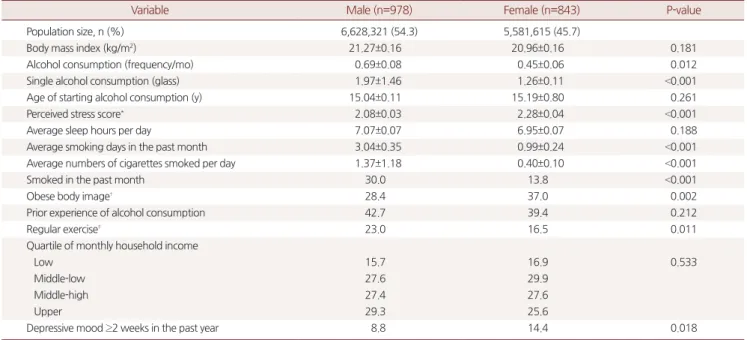
1. General characteristics of study participants by gender (Table 1)
Weighted and age-adjusted general characteristics of male and female adolescents are shown in Table 1. The mean age of male and female ado- lescents was 15.59±0.06 and 15.52±0.07 years, respectively. Male adoles- cents smoked, consumed alcohol, and exercised more than female ado- lescents (all P<0.05). In contrast, female adolescents had higher perceived stress scores (2.28±0.04 vs. 2.08±0.03; P<0.001), higher rates of depressive mood for two or more weeks during the previous year (14.4% vs. 8.8%;
P=0.018), and were more likely to perceive themselves as overweight (“slightly obese” or “very obese”) than male adolescents (37.0% vs. 28.4%;
P=0.002). There were no significant differences in BMI, sleep hours, and monthly household incomes between male and female adolescents (all P>0.1).
2. Associations between covariates and mental health by gender (Table 2)
For male adolescents, no significant factors associated with perceived stress were observed. For female adolescents, longer sleep duration was significantly associated with lower scores of perceived stress (β=-0.063, P=0.006; Table 2) while “slightly obese” and “very obese” body image per- ceptions were significantly associated with higher stress scores (P=0.002, P<0.001, respectively). There were no significant covariates associated with depressed mood in either male or female adolescents.
3. Associations of smoking behavior with mental health by gender (Table 3)
Smoking behaviors associated with perceived stress were revealed in ordinal regression analyses adjusting for age and, in females, sleep hours and body images. Average smoking days for the past month, numbers of cigarettes smoked per day, and having ever smoked during the prior
Table 1. Age and age-adjusted general characteristics of the study participants
Variable Male (n=978) Female (n=843) P-value
Population size, n (%) 6,628,321 (54.3) 5,581,615 (45.7)
Body mass index (kg/m2) 21.27±0.16 20.96±0.16 0.181
Alcohol consumption (frequency/mo) 0.69±0.08 0.45±0.06 0.012
Single alcohol consumption (glass) 1.97±1.46 1.26±0.11 <0.001
Age of starting alcohol consumption (y) 15.04±0.11 15.19±0.80 0.261
Perceived stress score* 2.08±0.03 2.28±0.04 <0.001
Average sleep hours per day 7.07±0.07 6.95±0.07 0.188
Average smoking days in the past month 3.04±0.35 0.99±0.24 <0.001
Average numbers of cigarettes smoked per day 1.37±1.18 0.40±0.10 <0.001
Smoked in the past month 30.0 13.8 <0.001
Obese body image† 28.4 37.0 0.002
Prior experience of alcohol consumption 42.7 39.4 0.212
Regular exercise‡ 23.0 16.5 0.011
Quartile of monthly household income
Low 15.7 16.9 0.533
Middle-low 27.6 29.9
Middle-high 27.4 27.6
Upper 29.3 25.6
Depressive mood ≥2 weeks in the past year 8.8 14.4 0.018
Values are presented as mean±standard error or % by complex samples: general linear model adjusted for age.
*Likert scale from 1 to 4 with 4 being the worst. †Slightly or very obese body images. ‡High-intensity exercise ≥20 minutes and ≥×3/week, moderate-intensity exercise ≥ 30 minutes and ≥×5/week, or walking ≥30 minutes and ≥×5/week.
김석원 외. 알코올 섭취 및 흡연과 성별에 따른 청소년의 정신건강 Korean Journal of Family Practice
KJFP
month were significantly associated with perceived stress in both male and female adolescents (all P<0.05). Any experience of smoking was sig- nificantly associated with increased perceived stress in female adolescents only (P<0.05). When examined at a 95% confidence interval (CI), only the average number of cigarettes smoked per day was found to be signifi- cantly associated with an increasing odds ratio of depressive mood in male adolescents (OR 1.09, 95% CI 1.01–1.18). In contrast, for female ado- lescents, average smoking days per month (OR 1.06, 95% CI 1.02–1.11),
average number of cigarettes per day (OR 1.24, 95% CI 1.04–1.48), having ever smoked during the last month (OR 6.50, 95% CI 2.90–14.52), and any experience of smoking (OR 3.93, 95% CI 2.11–7.33) were associated with higher odds ratios of depressive mood.
4. Associations of alcohol consumption with mental health by gender (Table 4)
Ordinal regression analyses adjusting for age showed that a larger Table 2. Associations between covariates and mental health
Variable Male P-value Female P-value
Perceived stress score*
Body mass index (kg/m2) 0.006 (0.006) 0.313 0.008 (0.011) 0.451
Body image (normal=0)
Very thin 0.301 (0.324) 0.353 0.696 (0.368) 0.059
Slightly thin -0.127 (0.223) 0.570 0.074 (0.250) 0.769
Slightly obese 0.177 (0.232) 0.445 0.631 (0.205) 0.002
Very obese -0.090 (0.320) 0.779 1.095 (0.310) <0.001
Average sleep hours per day -0.018 (0.027) 0.511 -0.063 (0.023) 0.006
Regular exercise† (no=0)‡ -0.018 (0.068) 0.798 0.083 (0.057) 0.147
Monthly household income 0.016 (0.025) 0.534 -0.053 (0.038) 0.165
Depressive mood§
Body mass index (kg/m2) 0.97 (0.69–1.05) 0.473 1.03 (0.95–1.12) 0.427
Body image (normal=0)
Very thin 1.86 (0.74–4.67) 0.187 0.20 (0.06–1.53) 0.120
Slightly thin 0.58 (0.28–1.17) 0.128 1.12 (0.45–2.76) 0.813
Slightly obese 0.69 (0.33–1.48) 0.344 1.79 (0.96–3.33) 0.069
Very obese 1.13 (0.29–4.44) 0.863 1.66 (0.61–4.52) 0.324
Average sleep hours per day 1.17 (0.96–1.42) 0.769 1.11 (0.96–1.29) 0.175
Regular exercise† (no=0)‡ 1.24 (0.66–2.35) 0.500 0.56 (0.28–1.10) 0.093
Monthly household income 0.99 (0.75–1.31) 0.949 0.85 (0.67–1.11) 0.239
Values are presented as β (standard error) or odds ratio (95% confidence interval).
*By complex samples: ordinal regression adjusted for age. †High-intensity exercise ≥20 minutes and ≥×3/week, moderate-intensity exercise ≥30 minutes and ≥×5/week, or walking ≥30 minutes and ≥×5/week. ‡Dummy variable (reference group=0). §By complex samples: logistic regression analysis adjusted for age.
Table 3. Associations of smoking behaviors with mental health
Variable Male P-value Female P-value
Perceived stress score*
Average smoking days in the past month 1.447 (0.509) 0.005 0.059 (0.023) 0.011
Average numbers of cigarettes smoked per day 0.725 (0.254) 0.005 0.207 (0.100) 0.040
Smoked in the past month (no=0)† 0.051 (0.024) 0.034 1.763 (0.565) 0.002
Prior experience of smoking (no=0)† 0.029 (0.026) 0.269 0.966 (0.341) 0.005
Age at the first experience of smoking -0.040 (0.191) 0.833 -0.104 (0.271) 0.704
Depressive mood‡
Average smoking days per month 1.02 (0.99–1.05) 0.248 1.06 (1.02–1.11) 0.011
Average numbers of cigarettes smoked per day 1.09 (1.01–1.18) 0.028 1.24 (1.04–1.48) 0.015
Smoked in the past month 1.70 (0.82–3.60) 0.166 6.50 (2.90–14.52) <0.001
Prior experience of smoking 1.34 (0.70–2.57) 0.376 3.93 (2.11–7.33) <0.001
Age at the first experience of smoking 1.00 (0.68–1.46) 0.979 1.31 (0.84–2.03) 0.227
Values are presented as β (standard error) or odds ratio (95% confidence interval).
*By complex samples: ordinal regression adjusted for age and, in female participants, body image and sleep hours. †Dummy variable (reference group=0). ‡By complex samples: logistic regression analysis adjusted for age, and in female participants, body image.
Sukwon Kim, et al. Alcohol and Smoking Behaviors and Mental Health
Korean Journal of Family Practice
KJFP
amount of alcohol consumption in one sitting and any experience of al- cohol consumption were significantly associated with higher scores of perceived stress in male adolescents (P<0.05). For female adolescents, with additional adjustments for sleep hours and body images, frequency, amount per sitting, and any experience of alcohol consumption were sig- nificantly and positively associated with perceived stress scores (all
P<0.05). No significant factors associated with depressed mood were ob- served in male adolescents, whereas frequency, amount per sitting, any experience of alcohol consumption, and age of first alcohol consumption were all significantly associated with depressive mood in female adoles- cents (P<0.05).
Table 4. Associations of alcohol consumption with mental health
Variable Male P-value Female P-value
Perceived stress score*
Alcohol consumption (frequency/mo) 0.133 (0.092) 0.148 0.153 (0.052) 0.004
Amount of alcohol consumed at once 0.362 (0.180) 0.045 0.099 (0.044) 0.025
Prior experience of alcohol consumption (no=0)† 0.063 (0.025) 0.013 0.543 (0.214) 0.012
Age of starting alcohol consumption 0.033 (0.124) 0.790 -0.069 (0.129) 0.596
Depressive mood‡
Alcohol consumption (frequency/mo) 0.99 (0.88–1.12) 0.925 1.20 (1.04–1.39) 0.014
Amount of alcohol consumed at once 1.04 (0.95–1.14) 0.396 1.17 (1.04–1.30) 0.007
Prior experience of alcohol consumption (no=0)† 0.95 (0.51–1.76) 0.856 3.55 (1.82–6.90) <0.001
Age of starting alcohol consumption 0.98 (0.76–1.25) 0.849 0.80 (0.66–0.98) 0.028
Values are presented as β (standard error) or odds ratio (95% confidence interval).
*By complex samples: ordinal regression adjusted for age and, in female participants, body image and sleep hours. †Dummy variable (reference group=0). ‡By complex samples: logistic regression analysis adjusted for age, and in female participants, body image.
Table 5. Associations of smoking behaviors and alcohol consumption with perceived stress
Variable Male P-value Female P-value
Average numbers of cigarettes smoked per day 0.067 (0.029) 0.020
Prior experience of alcohol consumption (no=0)* 0.498 (0.213) 0.021
Smoked in the past month (no=0)* 1.683 (0.634) 0.008
Alcohol consumption (frequency/mo) 0.054 (0.082) 0.509
Average sleep hours per day -0.202 (0.073) 0.006
Body image (normal=0)
Very thin 0.840 (0.590) 0.155
Slightly thin 0.078 (0.230) 0.735
Slightly obese 0.610 (0.215) 0.005
Very obese 0.892 (0.316) 0.005
Values are presented as β (standard error) by complex samples: ordinal regression adjusted for age and, in female participants, body image and sleep hours.
*Dummy variable (reference group=0).
Table 6. Associations of smoking behaviors and alcohol consumption with depressive mood
Variable Male P-value Female P-value
Average numbers of cigarettes smoked per day 0.10 (1.01–1.20) 0.029 Prior experience of alcohol consumption (no=0) 0.97 (0.86–1.10) 0.610
Smoked in the past month (no=0) 2.59 (1.29–5.19) 0.007
Prior experience of alcohol consumption (no=0)* 2.56 (1.22–5.37) 0.013
Body image (normal=0)*
Very thin 0.14 (0.02–1.32) 0.214
Slightly thin 1.14 (0.46–2.82) 0.289
Slightly obese 1.60 (0.88–2.93) 0.201
Very obese 1.56 (0.19–4.95) 0.229
Values are presented as odds ratio (95% confidence interval) by complex samples: logistic regression analyses adjusted for age and, in female participants, body image.
*Dummy variable (reference group=0).
김석원 외. 알코올 섭취 및 흡연과 성별에 따른 청소년의 정신건강 Korean Journal of Family Practice
KJFP
5. Associations of smoking and alcohol consumption with mental health by gender (Tables 5, 6)
To obtain independent associations between behaviors of smoking and alcohol consumption and mental health, ordinal and logistic regres- sion analyses were performed including the most significant behavioral factors associated with mental health in each male and female adolescent simultaneously.
Average number of cigarettes smoked per day and any experience of alcohol consumption were all significantly associated with perceived stress in males (β=0.067, P=0.020 and β=0.498, P=0.021, respectively), whereas only smoking during the prior month was a significant factor for perceived stress in females with no significance related to the frequency of alcohol consumption (β=1.683, P=0.008 and β=0.054, P=0.509, re- spectively). Daily sleep hours and the perception of being overweight were also significantly associated with perceived stress in females (all P<0.01) (Table 5).
In contrast, only the average number of cigarettes smoked per day was significantly associated with depressed mood in males (OR 0.10, 95% CI 1.01–1.20), whereas smoking during the prior month and frequency of al- cohol consumption were both associated with depressed mood in fe- males (OR 2.59, 95% CI 1.29–5.19 and OR 2.56, 95% CI 1.22–5.37, respec- tively). Body image perception was not associated with depressed mood (Table 6).
DISCUSSION
Our cross-sectional study from a national representative survey was meaningful in that, unlike previous studies, it not only showed that be- haviors of smoking and alcohol consumption have associations with mental health in Korean adolescents but also showed that gender differ- ences exist among those results. According to our study, behaviors of both smoking and alcohol consumption were independently associated with perceived stress in males, whereas only smoking behavior was asso- ciated with perceived stress in females. In contrast, smoking behavior was the significant factor associated with depressed mood in males, whereas both smoking and alcohol consumption were independently as- sociated with depressed mood in females. From our results, the number of cigarettes smoked per day among males and having ever smoked dur- ing the prior month among females were the most significant factors as- sociated with mental health. In addition, for males, smoking and alcohol
consumption were more frequently associated with perceived stress, whereas those were more frequently associated with depressed mood in females.
There are a few things to note from the general characteristics of the participants. Male adolescents smoked and drank significantly more than female adolescents, which is consistent with the results reported by the Korea Centers for Disease Control and Prevention in 2012. A previ- ous study showed that males tend to smoke and drink more frequently than females in response to negative emotions.10) Overall, 12.1% and 20.6% of Korean adolescents engaged in smoking and drinking behav- iors, respectively. Regardless of gender differences, these high rates signify social problems that need to be addressed. A study highlighted the dan- ger of a recent increase in smoking rates in female adolescents.11) Female adolescents may become pregnant in the future, so any kind of deleteri- ous health behavior is a concern. Another study emphasized the hazards related to adolescent smoking; the relative risk of lung cancer for those who start smoking under the ages of 20 and 15 is 2.0 and 3.5 times as high, respectively, compared with those who start smoking as adults.12) The situation is dire if smoking and drinking alcohol influence each oth- er. Smoking is a symptom of habitual drinking in adolescents.13) Drink- ing can spur smoking in adolescents and undermines the resolve to quit smoking.14)
In our study, female adolescents showed higher perceived stress scores and higher rates of depressive mood than male adolescents. The result is consistent with previous studies.15,16) In addition, female adolescents who slept for longer durations reported lower perceived stress scores, which echoes previous research.17) Good sleep is proposed to be a mechanism to lessen depression in adolescents.18,19) On the other hand, regular exercise was not significantly associated with mental health in either male or fe- male adolescents. In contrast, exercise improved adolescents’ mental health in a prior study.20) Another study reported that depressive adoles- cents who exercised regularly as part of a professional intervention showed decreased frequency of depressive moods.21) Physical activity has been hypothesized to increase available cerebral neurotransmitters in- cluding serotonin, dopamine, and norepinephrine, which diminish with a depressive mood. There is an increased amount of these neurotrans- mitters in blood and urine following physical activity. However, whether physical activity leads to an increase in cerebral neurotransmitters re- mains unknown.22) The discrepancy between the present and previous studies may reflect the lifestyles of many Korean adolescents, who are
Sukwon Kim, et al. Alcohol and Smoking Behaviors and Mental Health
Korean Journal of Family Practice
KJFP
notorious for being overwhelmingly busy with studies and having little time to exercise compared with students from other Organization for Economic Cooperation and Development nations.
The present study showed that drinking indices of male adolescents were significantly associated with perceived stress but not with depressive mood, whereas those of female adolescents were more significantly asso- ciated with perceived stress and depressive mood. Similarly, for both male and female adolescents, there were significant associations between smoking indices and perceived stress. An increase in the presence of re- cent smoking experience, number of smoking days per month, and daily cigarette consumption were significantly associated with perceived stress in male and female adolescents. In female adolescents, any experience of smoking was also significantly associated with perceived stress score.
Any past smoking experiences and recent instances of smoking were the most significant factors associated with perceived stress in female adoles- cents, whereas average smoking days during the last month and average numbers of cigarettes smoked per day were most significantly associated with perceived stress in male adolescents. For male adolescents, aside from the average number of cigarettes smoked per day, no smoking be- haviors were associated with depressive mood, whereas average smoking days per month, average number of cigarettes smoked per day, having ever smoked during the last month, and any prior experiences of smok- ing were significantly associated with depressive mood in female adoles- cents.
Taken together, the indices of alcohol consumption and smoking were more significant factors for mental health in female adolescents than in male adolescents. For male adolescents, alcohol consumption and smok- ing behaviors were mainly associated with perceived stress and not with depressive mood, aside from the number of cigarettes smoked per day.
However, these differences should be interpreted carefully considering the cultural background. In general, emotional expressions are more sup- pressed in males than females, which may not be just owing to the sexual variance. Men are more likely to be reluctant to express or admit to their depressed mood in Korean society.
Adolescents habitually smoke and drink in order to temporarily re- lieve themselves from stress.23) Smoking over the age of 25 poses a death hazard ratio of 5.2 compared with non-smokers, whereas smoking prior to 15 years of age poses a death hazard ratio of 18.7 compared with non- smokers.24) In our study, however, the age when alcohol consumption and smoking began was not significantly related to adolescents’ mental
health.
People with higher perceived stress scores smoke more frequently.25-28) A study highlighted that drinking alcohol and smoking are related to psychological stress, depression, and suicide among adolescents.14) From our findings, we can infer that adolescents choose to smoke and drink to avoid psychological conflicts, leading to depressive effects. Therefore, it seems necessary to pay more attention to the mental health, rather than the behavior, of adolescents who smoke or drink alcohol. In addition, the present findings suggest that past and recent experiences of alcohol con- sumption and smoking are also likely to be associated with adolescents’
mental health, especially in females.
The present study has several limitations. First, it was a cross-sectional design, so a causal relationship could not be established. Second, per- ceived stress and depressive mood were each assessed by one question.
However, our study also has strengths, which include nationally repre- sentative survey data and the use of trained and government-verified in- terviewers. Questions about mental health and socio-demographic fac- tors were asked by interviewers who have completed official training programs for this survey and were verified by the Korean government.
The results of the present study suggested that behaviors of smoking and alcohol consumption have somewhat different associations with mental health in male and female Korean adolescents. Therefore, ap- proaches to handling smoking and alcohol issues among adolescents may need to consider gender differences. Prospective studies to elucidate causal relationships and to explore whether ethnic characteristics are as- sociated with smoking or alcohol consumption related to mental health are needed.
REFERENCES
1. Schmitz N, Kruse J, Kugler J. Disabilities, quality of life, and mental disorders associated with smoking and nicotine dependence. Am J Psychiatry 2003;
160: 1670-6.
2. Grant BF. Age at smoking onset and its association with alcohol consump- tion and DSM-IV alcohol abuse and dependence: results from the National Longitudinal Alcohol Epidemiologic Survey. J Subst Abuse 1998; 10: 59-73.
3. Hanna EZ, Yi HY, Dufour MC, Whitmore CC. The relationship of early-on- set regular smoking to alcohol use, depression, illicit drug use, and other risky behaviors during early adolescence: results from the youth supplement to the third national health and nutrition examination survey. J Subst Abuse 2001; 13: 265-82.
4. McGue M, Iacono WG. The association of early adolescent problem behav- ior with adult psychopathology. Am J Psychiatry 2005; 162: 1118-24.
김석원 외. 알코올 섭취 및 흡연과 성별에 따른 청소년의 정신건강 Korean Journal of Family Practice
KJFP
5. Kendler KS, Myers J, Damaj MI, Chen X. Early smoking onset and risk for subsequent nicotine dependence: a monozygotic co-twin control study. Am J Psychiatry 2013; 170: 408-13.
6. Moum T, Falkum E, Tambs K. Sosiale bakgrunnsfaktorer og psykisk helse (social demographic factors and mental health). In: Moum T, editor. Helse i Norge : sykdom, iivsstil og bruk av helsetjenester (Health in Norway. Illness, lifestyle and use of health services). Olso: Gyldendal norsk forlag; 1991. p.
46-62.
7. Wittchen HU, Essau CA, von Zerssen D, Krieg JC, Zaudig M. Lifetime and six-month prevalence of mental disorders in the Munich Follow-Up Study.
Eur Arch Psychiatry Clin Neurosci 1992; 241: 247-58.
8. Sandanger I, Nygård JF, Ingebrigtsen G, Sørensen T, Dalgard OS. Prevalence, incidence and age at onset of psychiatric disorders in Norway. Soc Psychia- try Psychiatr Epidemiol 1999; 34: 570-9.
9. Yang BG. The statistics on the 10th Korea youth risk behavior web-based survey. Cheongju: Korea Centers for Disease Control and Prevention; 2014.
10. Hilton ME. Drinking patterns and drinking problems in 1984: results from a general population survey. Alcohol Clin Exp Res 1987; 11: 167-75.
11. Amaro H, Blak SM, Schwartz PM, Flinchbaugh LJ. Developing theory- based substance abuse prevention programs for young adolescent girls. J Early Adolesc 2001; 21: 256-93.
12. Kwak YH. A study on parent factors and peer factors affecting youth smok- ing [dissertation]. Busan: Silla Univ.; 2011. Korean.
13. Walton RG. Smoking and alcoholism: a brief report. Am J Psychiatry 1972;
128: 1455-6.
14. Perkins KA. Combined effects of nicotine and alcohol on subjective, behav- ioral and physiological responses in humans. Addict Biol 1997; 2: 255-68.
15. Sandanger I, Nygård JF, Sørensen T, Moum T. Is women’s mental health more susceptible than men’s to the influence of surrounding stress? Soc Psy- chiatry Psychiatr Epidemiol 2004; 39: 177-84.
16. Albert PR. Why is depression more prevalent in women? J Psychiatry Neu- rosci 2015; 40: 219-21.
17. Talbot LS, McGlinchey EL, Kaplan KA, Dahl RE, Harvey AG. Sleep depriva- tion in adolescents and adults: changes in affect. Emotion 2010; 10: 831-41.
18. Dahl RE, Ryan ND, Matty MK, Birmaher B, al-Shabbout M, Williamson DE, et al. Sleep onset abnormalities in depressed adolescents. Biol Psychiatry 1996; 39: 400-10.
19. Forbes EE, Dahl RE. Neural systems of positive affect: relevance to under- standing child and adolescent depression? Dev Psychopathol 2005; 17: 827- 50.
20. Rees DI, Sabia JJ. Exercise and adolescent mental health: new evidence from longitudinal data. J Ment Health Policy Econ 2010; 13: 13-25.
21. Dopp RR, Mooney AJ, Armitage R, King C. Exercise for adolescents with depressive disorders: a feasibility study. Depress Res Treat 2012; 2012:
257472.
22. Craft LL, Perna FM. The benefits of exercise for the clinically depressed.
Prim Care Companion J Clin Psychiatry 2004; 6: 104-11.
23. Kim C. A Study on stress factors and adaptation methods for adolescents [dissertation]. Seoul: Konkuk Univ.; 1992.
24. Jee S. A study on the state of youth smoking and the strategy for smoking cessation. Seoul: The Commission on Youth Protection; 2000.
25. Lee E. A study on the relationship between stressful life events and smoking of the male students with types of high school [dissertation]. Seoul: Seoul National Univ.; 1997. Korean.
26. Lee J, Tak Y. Smoking and environmental factors in adolescents; stress and self-efficacy. Hy Nurs Sci Res 1998; 3: 34-52.
27. Chung H. Relationship between stress and smoking in male high school students [dissertation]. Daegu: Yeungnam Univ.; 2001. Korean.
28. Lee GC, Kim YJ, Shin YK, Park SH, Tockgo YC. The state of smoking and al- cohol use in Korean adolescents. J Korean Pediatr Soc 1997; 40: 307-17.