The JCAHO patient safety event
taxonomy: a standardized terminology and classification schema for near
misses and adverse events
ANDREW CHANG, PAUL M. SCHYVE, RICHARD J. CROTEAU, DENNIS S. O’LEARY AND JEROD M. LOEB
JCAHO, Division of Research, Oakbrook Terrace, Illinois, USA
Abstract
Background. The current US national discussions on patient safety are not based on a common language. This hinders system- atic application of data obtained from incident reports, and learning from near misses and adverse events.
Objective. To develop a common terminology and classification schema (taxonomy) for collecting and organizing patient safety data.
Methods. The project comprised a systematic literature review; evaluation of existing patient safety terminologies and classifi- cations, and identification of those that should be included in the core set of a standardized taxonomy; assessment of the taxonomy’s face and content validity; the gathering of input from patient safety stakeholders in multiple disciplines; and a pre- liminary study of the taxonomy’s comparative reliability.
Results. Elements (terms) and structures (data fields) from existing classification schemes and reporting systems could be grouped into five complementary root nodes or primary classifications: impact, type, domain, cause, and prevention and mitigation. The root nodes were then divided into 21 subclassifications which in turn are subdivided into more than 200 coded categories and an indefinite number of uncoded text fields to capture narrative information. An earlier version of the taxonomy (n = 111 coded categories) demonstrated acceptable comparability with the categorized data requirements of the ICU safety reporting system.
Conclusions. The results suggest that the Joint Commission on Accreditation of Healthcare Organizations (JCAHO) Patient Safety Event Taxonomy could facilitate a common approach for patient safety information systems. Having access to standardized data would make it easier to file patient safety event reports and to conduct root cause analyses in a consistent fashion.
Keywords: patient safety, standardized terminology and classification, taxonomy
Introduction
Concerns about safety in patient care have called attention to the need for governmental agencies and private sector accred- iting bodies to work together with health care organizations to coordinate the monitoring, reporting, and analysis of med- ical errors. The 2003 Institute of Medicine report, Patient Safety: Achieving a New Standard of Care [1], recommends that standardization and better management of information on patient safety—including near misses and adverse events—
are needed to inform the development of strategies that reduce the risk of preventable medical incidents. However, patient safety incident reporting systems differ in design and therefore in their ability to define, count, and track adverse
events [2]. Among reporting systems, there are often dispa- rate data fields, conflicting patient safety terminologies, classifications, characteristics, and uses that make standard- ization difficult. In addition, each source of data on near misses and adverse events usually requires different methods for interpreting and deconstructing these events [3]. Finally, misused terminology in the research literature, conference papers and presentations, and media contributes to wide- spread misunderstandings about the language of patient safety.
The proliferation of reporting systems has created a press- ing need for organization of patient safety information systems and terminology. Unfortunately, much of the work to date has fallen short in meeting identified needs for epide- miological data [4]. Given the current state of the art, it is
Address reprint requests to A. Chang, JCAHO, Division of Research, Oakbrook Terrace, IL, USA. E-mail: [email protected]
Downloaded from https://academic.oup.com/intqhc/article/17/2/95/1794432 by guest on 24 November 2021
A. Chang et al.
extremely difficult to achieve broad-based and timely improvements in patient safety, since there is no standard determination as to which events to capture and report [5,6].
Additionally, the lack of a common patient safety terminol- ogy is a critical obstacle to sharing and aggregating data to support patient safety.
The concept of a taxonomy combines terminology and the science of classification—in the case of patient safety, the identification and classification of things that go wrong in health care, the reasons why they occur, and the preventive strategies that can minimize their future occurrence. There is consensus that standardization of patient safety data would facilitate improvements in incident reporting, tracking, and analysis [7,8]. The core set of terms in patient safety, like other health disciplines, should incorporate both theoretical concepts and generally accepted vocabulary.
Several methods have been developed to define and classify medical errors, adverse events, near misses, and other patient safety concepts and terms [9,10]. However, these methods have tended to be, with notable exceptions, narrowly and predominantly focused on specific areas of health care—medication errors [11–13], transfusion reactions [14], primary care [15,16], and nursing care [17,18].
In this project we developed and applied a method of classification that is based on evaluations of extant taxono- mies and reporting systems with feedback from individuals who would use the taxonomy. This approach sought to identify similarities and gaps in the terminology and classifi- cation to create a multidimensional taxonomy that encom- passes diverse health care settings and incident reporting systems.
Methods
Terms and definitions used in patient safety were gathered from a wide range of print and web resources (e.g. book glos- saries, published journals). Current, practical, and colloquial terms that underlie the communication among users were listed in a comparative glossary. Because the terms and their definitions are extensive, they are not reproduced herein.
However, this patient safety dictionary is available electroni- cally from the authors.
A comprehensive literature search was performed in Medline (PubMed) and Excerpta Medica (Embase). Litera- ture that describes approaches to the definition of medical errors, adverse events, near misses, and other patient safety concepts and terms, including existing classification schemes on patient safety, was retrieved. The searches were not limited to articles published in the English language or within a par- ticular geographical area. The databases were searched for articles with publication dates between January 1993 and June 2003. In addition to database searches, the Internet sites of Departments of Public Health, Ministries of Health, and Patient Safety Organizations and Groups in Africa, Asia, Australia, Europe, and North America were searched. The reference lists of major reports were also scanned for relevant publications that date from the 1980s.
A total of 512 distinct references were identified from the Medline search. The Embase search resulted in 15 additional unique references. The titles and/or abstracts of these arti- cles were initially scanned, and inclusion/exclusion decisions made. Based on the review of the abstracts, we eliminated 429 articles on the following criteria: (i) not relevant to the field of patient safety/medical error/adverse event classifi- cation; (ii) relevant to the field of patient safety/medical error/adverse event classification but did not provide ade- quate description of the components needed to define a coherent classification scheme; (iii) classifications that are in the early stages of development; (iv) unpublished classifica- tions. The very few exceptions to this are classifications that hold particular conceptual or methodological interest in the development of the field.
Methodological concerns
Of the 96 full articles that were reviewed, 73 were eliminated according to the above criteria. Eleven formal classification schemes identified in the remaining 23 articles that address the frequencies, types, causes and contributing factors, conse- quences, and prevention of medical/medication errors are summarized in a report prepared for the World Health Organization [19].
The 11 classifications of medical and medication errors, patient safety events, and incident reporting systems were reviewed and compared for homogeneity. The semantic relationships, equivalent categories, and linkages among these classifications schemes were identified and used to construct the overarching framework of a preliminary tax- onomy. This version also referenced human factors and safety research.
We reviewed data collected by the Joint Commission’s Sentinel Event Program from January 1995 to December 2002 to validate the construct of the preliminary taxonomy.
This was supplemented by recommendations from a nominal expert advisory taxonomy workgroup (see Acknowledge- ments for composition of workgroup). We asked the work- group to assess the content and face validity of an initial iteration of the taxonomy. They offered a checklist of five attributes to be used in judging appropriateness of the elements of the taxonomy; these judgments involved subjective assess- ments rather than statistical analyses. Input was also solicited from medical specialty societies, business groups, government health care agencies, and health care organizations.
Since it is difficult, if not impossible, to prove formally that the items chosen were representative of all relevant terms and classifications, subjective tests of linguistic clarity were used to indicate whether the terminology of the classifications was clear. In the absence of a ‘gold standard’ to test criterion validity, we conducted a simplified item analysis of each varia- ble of the taxonomy against those found in an established classification in one US hospital. Responses were coded as follows: ‘unmatched’ = 0, ‘extrapolated’ = 1, ‘related’ = 2,
‘synonymous’ = 3, and ‘identical’ = 4. Results of this work were used to inform the development of a beta version of the patient safety event taxonomy.
Downloaded from https://academic.oup.com/intqhc/article/17/2/95/1794432 by guest on 24 November 2021
Results
Our review of the literature reinforces the fact that various approaches used in the health care sector to define and clas- sify near misses, adverse events, and other patient safety con- cepts have generally been fragmented [20]. Early efforts to define and classify ‘error’ or ‘mistakes’ were burdened by the- oretical and methodological flaws. The model of medical error was largely unspecified. Where classification instru- ments were described, their validity was found to be modest and their reliability not reported. A systematic review of clas- sification schemes used in primary care by Elder and Dovey [10], found a limited number of studies that attempted to cat- egorize medical errors, including near misses and adverse events [21–25]. Most of these studies were not designed with the development of a functional classification scheme in mind; thus, they did not offer a conceptual explanation of what they had classified.
Busse and Wright [26] proposed a more promising classifica- tion methodology and an enhanced evaluation approach for the Edinburgh Incident Classification. Focusing on in-depth analysis and a search for multiple levels of causation and con- tributing factors, including the identification of active and latent failures, this classification model exemplifies a theory- driven analytical framework that integrates, functionally and technically, with an incident reporting system. This systematic approach to classification in patient safety did not become the de facto standard for quite some time, and is still often neglected.
The classification of error types framework and theoretical and technical foundation for in-depth analysis of root causes of adverse events did not materialize until after the publica- tion of the seminal works by Reason [27], Rasmussen [28], and Hale [29]. Contributions from aviation [30] and high- technology/high-risk industries have also been instrumental in advancing the reporting, analysis, and classification of adverse events in health care. A few more theoretically based studies—such as those reported by Makeham [15], Battles [31], and Victoroff [32]—have focused on more rigorous classification schemes and give greater consideration to valid- ity and reliability issues. Like the earlier classifications, how- ever, the process and outcome ‘root causes’ of adverse events in these schemes were only described where a significant impact was recorded [33].
Finally, Runciman and colleagues [34] have developed a structured approach based on Reason’s model and framework of contributory and causative factors to draw out all of the rel- evant information about an incident and to describe patient safety phenomena in terms that can be analyzed statistically.
Homogeneous elements of these models—which comprise terms and the relationships between terms that make up the building blocks of a classification scheme—were categorized into five complementary root nodes, or primary classifications.
1. Impact—the outcome or effects of medical error and systems failure, commonly referred to as harm to the patient.
2. Type—the implied or visible processes that were faulty or failed.
3. Domain—the characteristics of the setting in which an incident occurred and the type of individuals involved.
4. Cause—the factors and agents that led to an incident.
5. Prevention and mitigation—the measures taken or proposed to reduce incidence and effects of adverse occurrences.
The root nodes were then divided into 21 subclassifications, which were in turn subdivided into more than 200 coded cate- gories and an indefinite number of non-coded text fields to capture narrative information about specific incidents.
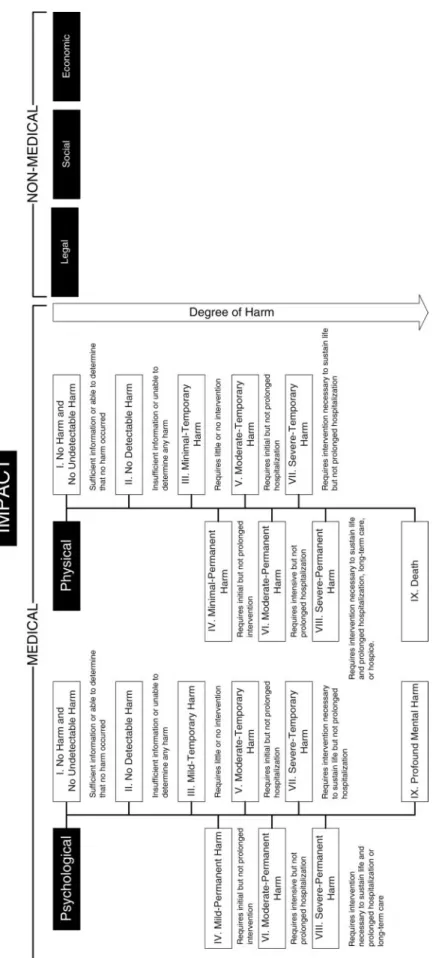
The ‘Impact’ classification (shown in Figure 1) comprised three subclassifications that could discriminate between 18 types of outcomes or effects (harm). The harm index was based on the NCC-MERP Medication Error Taxonomy [12], and is characterized by the degree of harm—ranging from no harm to temporary or permanent impairment of physical or psychological function. Broad distinctions were also made between medical (psychological or physical) and non-medical (legal, social, or economic) impacts.
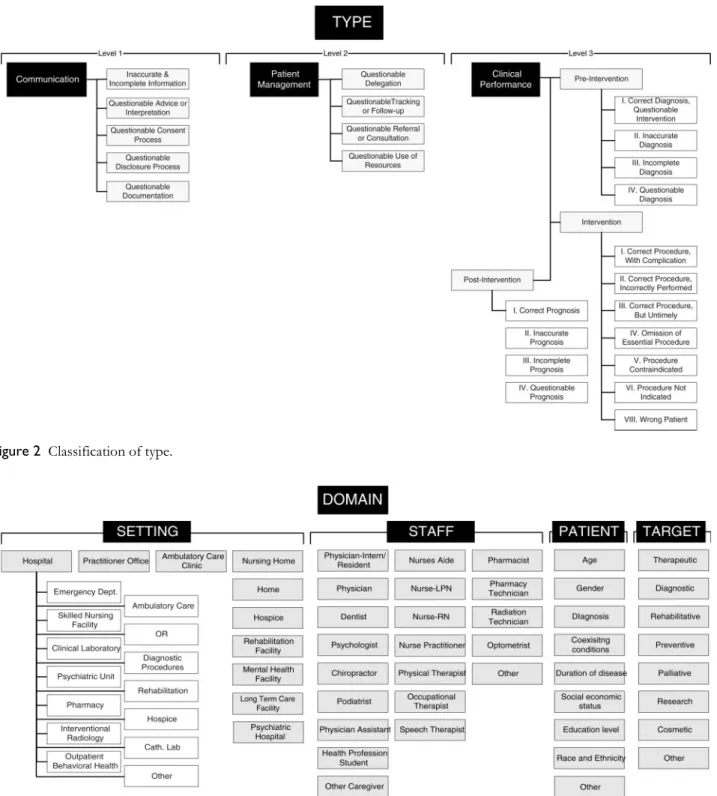
The ‘Type’ classification included three levels that address communication, patient management, and clinical perform- ance (see Figure 2). The ‘communication’ subclassification identified communication problems that exist between provider and patient, provider and patient’s proxy, provider and non-medical staff, and among providers. The ‘patient management’ node classified substandard patient manage- ment that involved improper delegation, failure in tracking or follow-up, wrong referral or consultation, or questionable use of resources. The ‘clinical performance’ subclassification included the full range of failures that could lead to iatrogenic events during the pre-intervention, intervention, and post- intervention phases of care. Analysis of Joint Commission sentinel event data (reported from 1995 to 2002) related to wrong-site surgeries (n = 209) showed that these adverse events could be classified in the following principal groups:
(i) Communication—including communication with the patient and among members of the surgical team; availability of information; and operating room hierarchy; (ii) Patient man- agement—such as preoperative assessment of the patient; and (iii) Clinical performance—including orientation and training, the procedures used to verify the operative site, and distraction.
Alternatively, these areas could represent the clinical or man- agement processes that are associated with events without any judgments about root causes within those processes.
The ‘Domain’ classification included the types of health care professionals commonly involved in patient care and the demographics of patients in a variety of health care settings where events might have occurred (see Figure 3). Analysis of voluntarily reported sentinel events showed that they occur most frequently in the following settings: general hospital (64%); psychiatric hospital (13%); psychiatric unit (6%); out- patient behavioral health (5%); emergency department (4%);
long-term care facility (4%); home care service (3%); and ambulatory care setting (1.5%). From this, we postulated a link between where the event took place (>10 coded cate- gories) and which medical specialty was involved (>21 coded
Downloaded from https://academic.oup.com/intqhc/article/17/2/95/1794432 by guest on 24 November 2021
A. Chang et al.
Figu re 1 Class if ication o f impact.
Downloaded from https://academic.oup.com/intqhc/article/17/2/95/1794432 by guest on 24 November 2021categories). In addition, we specified the intended patient care intervention (eight coded categories—therapeutic, diagnostic, rehabilitative, preventive, palliative, research, cosmetic, and other), which pre-existing conditions the patient had (ICD-9-CM coded categories), and the associated causes and outcomes delineated in the other four primary classifications.
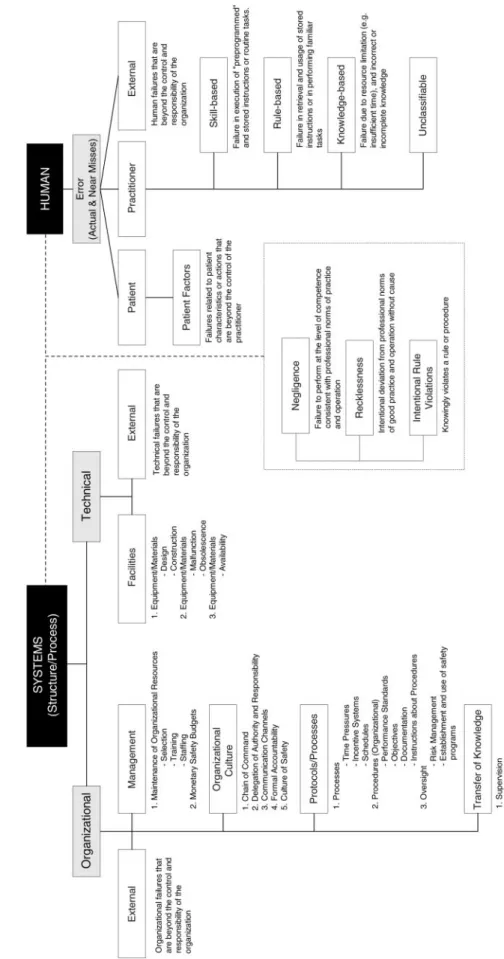
The classification of ‘Causes’ is shown in Figure 4. Root cause analyses of sentinel events in all categories showed that the underlying causes of these events could be classified into
two principal groupings: system failures and human failures.
The principal nodes of the ‘Cause’ classification comprised two subclassifications: system (process/structure) failures and human failures. System failures are remote from the direct control of the clinician and are usually the distal cause of structure and process failures among reported sentinel events (e.g. orientation/training, availability of information, staffing levels; physical environment, alarm systems, organizational culture). System failures are errors in the design, organization, Figure 2 Classification of type.
Figure 3 Classification of domain.
Downloaded from https://academic.oup.com/intqhc/article/17/2/95/1794432 by guest on 24 November 2021
A. Chang et al.
Figu re 4 Class if icat ion o f cau se.
Downloaded from https://academic.oup.com/intqhc/article/17/2/95/1794432 by guest on 24 November 2021training, or maintenance that lead to operator errors. Those failures involving direct contact with the patient—human failures—are often part of the proximate cause of an event [35]. The root cause analysis data yielded groupings that included communication, patient assessment, and continuum of care, among others. The subclassification, ‘latent organiza- tional failure’, included five coded categories: (i) management, (ii) organizational culture, (iii) protocols and processes, (iv) transfer of knowledge, and (v) external factors. Two catego- ries for latent technical failure—facilities and external factors—
were derived from the Eindhoven Classification System [31].
Terminology for the ‘Prevention and Mitigation’ classifica- tion was adopted from the definitions proposed by Gordon [36] for physical disease prevention. In this classification, three types of prevention and mitigation were identified:
universal, selective, and indicated. The ‘universal’ subclassifi- cation covered preventive and corrective measures that are designed for everyone in the eligible population. Prevention and mitigation measures that are directed toward a subgroup of the population whose risk of adverse events is above aver- age were grouped in the ‘selective’ subclassification. Lastly, the ‘indicated’ subclassification combined interventions that are targeted to specific high-risk individuals identified as having a minimal but detectable risk for sustaining an adverse event. Figure 5 illustrates how the preventive strategies of the Joint Commission’s 2004 National Patient Safety Goals [37]
could be classified according to this scheme.
The proposed interrelationships depicted in Figure 6 show the assumptions underlying the Taxonomy framework. The link- ages in this visual analytical framework provide an organized approach to guide the retrospective process of identifying the factors (causes) that contribute to systems failures (type) and adverse events, or to prospectively identify potential risk fac- tors and devise preventive strategies (prevention) and correc- tive actions (mitigation) to protect the patient (in a domain) from harm (impact). The linkages are not meant to lead to pre- mature conclusions about an event, nor are they intended as the only analytical framework. Although the linkages define the specific types of queries, they do not identify precise data sources nor which units of data should populate the taxonomy.
A preliminary test of the alpha version taxonomy con- ducted at one hospital with an active incident reporting system (Stanford’s ICUsrs) demonstrated acceptable correlation between its coded categories (n = 111) and the categorized data requirements of the system. Thirteen (12%) categories were identical, 42 (38%) were synonymous, 45 (41%) were related, and six (5%) had to be extrapolated. Five (4%) cate- gories were unmatched—date and time of incident, patient or family dissatisfaction, and two patient identifiers—and were therefore omitted from the taxonomy.
Using the desirable attributes of patient safety taxonomy identified by the expert advisory workgroup (see Box 1), the face validity of the terminology and classifications inferred from the comments of the experts who reviewed their clarity and completeness was judged to be high. The workgroup recommended inclusion of external factors that are perceived to influence patient safety. The workgroup concluded that the Taxonomy was well suited to meet the need for integration of
patient safety data from disparate sources. A variety of patient safety stakeholders concurred in the taxonomy’s suitability and feasibility for application in incident investigation, report- ing, tracking, and analysis at US hospitals and elsewhere.
Discussion
The Patient Safety Event Taxonomy developed and tested in this study represents a synthesis of traditional, hierarchical classifica- tions represented by single topic areas and settings and the heu- ristic, multidimensional/multisetting classifications that rely on a systems approach to understanding patient safety [38]. It includes all events that are not due to an underlying physiologi- cal or pathological process and is sensitive to minor variations among similar events. This approach compels the user to make explicit, a priori decisions about the key variations in structure and process that relate to any given patient safety event. It also allows others to judge whether important variables were over- looked. Finally, it makes explicit the relationships between these variables and their relevance as valid markers of patient safety.
The number of relevant categories constituting the optimum classification scheme or how best to deconstruct an adverse event will always be subject to debate [39].
Hobgood [40], using a modified Delphi process to differen- tiate between specific classes of medical error common to emergency medicine practice, found that cognitive errors in medical decision-making can be difficult to identify, and suggested that consensus on terminology and classification may be challenging. One source of difficulty we encoun- tered in choosing logical data variables to link disparate ter- minologies and classifications is that they are all loosely attached in an intricate network of information character- ized by events, settings, individuals, and teams of people, protocols, procedures, policies, and communications that function in an uncertain environment. Understanding these relationships could provide a useful basis to guide the devel- opment and improvement of information about near misses and adverse events, and use of the information to make health care safer for patients.
We critiqued existing taxonomies on several grounds. Most were developed in relative isolation from other classification approaches for a specific medical specialty, and few were improvements of earlier work. In this regard, we believe that research that compares different classification schemas con- stitutes a crucial stage in consolidating the discipline of patient safety event reporting.
Aggregating data gathered through different measurement methods into the framework of a standardized taxonomy has been used successfully by epidemiologists to detect nosoco- mial infections [41], and is likely to be useful in detecting trends and patterns in patient safety. In a number of studies, there appears to be an evolving effort to build a science of patient safety measurement that is equivalent to health measurement or psychometrics. This is important because decisions affecting the welfare of patients and the expenditure of public funds are based on the results of patient safety measurements [42].
Downloaded from https://academic.oup.com/intqhc/article/17/2/95/1794432 by guest on 24 November 2021
A. Chang et al.
The potential applications for patient safety event information vary widely depending on the identity of the user—e.g. internal evaluations, oversight bodies, patient safety managers, patients, ethicists, and lawyers, among others. In order to meet the needs of these diverse audi- ences it is essential to identify a common language that is widely applicable and straightforward. The vocabulary adopted for the Taxonomy closely resembles the lexicon commonly used among various users today, and avoids pejorative terms.
In its simplest form, the Taxonomy’s classifications can represent individual fields for the front end of paper-based or electronic reporting systems with individual incidents com- prising the records. At its broadest application, the Taxonomy describes processes that determine the quality of incident reports, the effectiveness of reporting systems, and the success of intervention strategies. The significance is that the Taxonomy could potentially be used as a common backbone when mapped to disparate reporting systems unifying termi- nologies and classifications. This allows aggregated data to be Figure 5 Classification of prevention and mitigation.
Downloaded from https://academic.oup.com/intqhc/article/17/2/95/1794432 by guest on 24 November 2021
combined and tracked over time, provides for consistency across reporting systems, and structures data documentation and presentation using a standardized format. Applied to an electronic health record system, the taxonomy offers a means for interoperability, facilitating exchange of patient safety data across systems.
A decentralized approach to patient safety reporting, using a standardized terminology and classification framework, would simplify the development and maintenance of a coding struc- ture for reporting. Reconciling the data collected by local or focused reporting programs to a national standard would pro- vide a means to integrate the already existing data collection efforts relating to health care errors and systems failures. The framework of the Taxonomy will also lessen the burden on patient safety organizations that operate in multiple states and/
or must be responsive to multiple government agencies, private oversight bodies, and group purchasers, without requiring expensive re-engineering of existing reporting systems.
Limitations
Health care error classification systems are not free of their own problems. For example, they partition categories more coarsely than do keywords, and users, who are accustomed to
the everyday colloquial language of patient safety used in the workplace environment, may not be fluent in the terminology of the classifications. The finite number of elements in the Taxonomy nevertheless encompasses a broad range of areas that could possibly be classified, but there are still likely many areas that could escape detection and reporting. Furthermore, because the anatomy of an event is multidimensional, its deconstructed components may not be mutually exclusive to each of the classifications, subclassifications, coded catego- ries, and narrative fields in the taxonomy. In addition, the multi-tiered features may be too complicated for some audi- ences to use. For example, wrong-site surgery not only results in physical harm, but may also affect the emotional (psycho- logical) and functional status of the patient, and his or her ability to return to work (economics). Near misses in the taxonomy are assumed to have the same root causes as the much smaller subset that actually develops into adverse events. Arguably, the very advantage of using near-miss data to provide information on how an incident ‘recovered’ from a potential adverse event also has a downside. Adverse events are by definition near misses that failed to be recovered in time [43]. By contrast, the events that a hospital successfully prevents from occurring will be just those events that will never be identified in a near-miss information system. Thus, Figure 6 Analytical framework of the JCAHO patient safety event taxonomy.
Box 1 Desirable attributes of a patient safety event taxonomy
Based on unambiguous and generally agreed terminologies and classifications.
Useful for analyzing the processes and outcomes that underlie an event, including its root causes and contributing factors.
Facilitates consistent collection and analysis of near miss and adverse event data across the continuum of health care delivery settings.
Facilitates expedient data exchange and dissemination of patient safety information.
Useful for identifying priority areas for remedial attention and opportunities to improve patient safety.
Downloaded from https://academic.oup.com/intqhc/article/17/2/95/1794432 by guest on 24 November 2021
A. Chang et al.
the Taxonomy must be clear on just what near misses have in common, or not, with adverse events. Notwithstanding the potential limitations of near-miss data, near misses are suffi- ciently clear precursors of adverse events to point the way to identification of specific individual and systems failures.
Conclusion
The Joint Commission Patient Safety Event Taxonomy focuses on the most salient terminologies and classifications. Its design will permit the progressive incorporation of new patient safety data and information over time. However, addi- tional field-testing will be required to bring the taxonomy to full maturity and permit it to realize its overall objectives.
Acknowledgements
The authors gratefully acknowledge the Joint Commission Corporate Members Planning Group on Patient Safety, which included representatives of the American College of Physi- cians (ACP), the American College of Surgeons (ACS), the American Dental Association (ADA), the American Hospital Association (AHA), and the American Medical Association (AMA), for their continuing assistance in this initiative. The authors also wish to thank Jeanne P. Altieri, D.D.S. (ADA), Jim Battles, Ph.D. (AHRQ), William A. Bornstein, M.D., Ph.D. (ACS), Karen S. Ehrat, Ph.D., R.N. (AHA), Thomas Houston, M.D. (AMA), and Don M. Nielsen, M.D. (AHA), who served as members of the Patient Safety Taxonomy Workgroup. Gerry Castro, M.P.H. (Joint Commission) pro- vided beneficial editorial assistance. The U.S. Agency for Healthcare Research and Quality (AHRQ) provided specific expertise and encouragement which made this effort possible.
The opinions expressed in this paper are those of the authors and do not reflect the policies of the Corporate Members.
References
1. Institute of Medicine. Patient Safety: Achieving a New Standard of Care. Washington, DC: National Academy Press, 2003.
2. Implementation Planning Study for the Integration of Medical Event Report- ing Input and Data Structure for Reporting to AHRQ, CDC, CMS, and FDA. Medstat Report submitted to AHRQ, 2002.
3. Runciman WB, Webb RK, Helps SC et al. A comparison of iatrogenic injury studies in Australia and the USA. II: Reviewer behavior and quality of care. Int J Qual Health Care 2000; 12:
379–388.
4. Weingart SN, Wilson RM, Gibberd RW, Harrison B. Epidemiol- ogy of medical error. BMJ 2000; 320: 730.
5. University of California at San Francisco–Stanford University Evidence-based Practice Center. Making Health Care Safer: A Critical Analysis of Patient Safety Practices. Report No. AHRQ 01- E508. Rockville, MD: Agency for Healthcare Research and Quality, 2001.
6. Hofer TP, Hayward RA. What is an error? Eff Clin Pract 2000;
6:
261–269.
7. Doing What Counts for Patient Safety: Federal Actions to Reduce Medical Errors and Their Impact. Report of the Quality Intera- gency Coordination Task Force (QuIC) to the President.
February 2000.
8. Kaplan H, Battles JB, Van der Schaaf TW, Shea CE, Mercer SQ.
Identification and classification of the causes of events in trans- fusion medicine. Transfusion 1998; 38: 1071–1081.
9. Runciman WB, Helps SC, Sexton EJ et al. A classification for incidents and accidents in the health-care system. J Qual Clin Pract 1998; 18: 199–211.
10. Elder NC, Dovey SM. Classification of medical errors and pre- ventable adverse events in primary care: A synthesis of the liter- ature. J Fam Pract 2002; 51: 927–932.
11. Dunn EB, Wolfe JJ. Medication error classification and avoid- ance. Hosp Pharm 1997; 32: 860–865.
12. National Coordinating Council for Medication Error Reporting and Prevention, USA. NCC MERP Taxonomy of Medication Errors. 1998. http://www.nccmerp.org/taxo0731.pdf Accessed 3 June 2003.
13. Betz RP, Levy HB. An interdisciplinary method of classifying and monitoring medication errors. Am J Hosp Pharm 1985; 42:
1724–1732.
14. Kaplan HS, Battles JB, Van der Schaaf TW, Shea CE, Mercer SQ. Identification and classification of the causes of events in transfusion medicine. Transfusion 1998; 38: 1071–1081.
15. Makeham MA, Dovey SM, County M, Kidd MR. An interna- tional taxonomy for errors in general practice: a pilot study. Med J Aust 2002; 177: 62–63.
16. Dovey SM, Meyers DS, Phillips RL et al. A preliminary taxon- omy of medical errors in family practice. Qual Saf Health Care 2002; 11: 233–238.
17. Benner P, Sheets V, Uris P, Malloch K, Schwed K, Jamison D.
Individual, practice, and system causes of errors in nursing. A taxonomy. J Nurs Adm 2002; 32: 509–523.
18. Woods A, Doan-Johnson S. Executive summary: toward a tax- onomy of nursing practice errors. Nurse Manage 2002; 33: 45–48.
19. Loeb J, Chang A. Reduction of Adverse Events through Common Understanding and Common Reporting Tools: Towards an Interna- tional Patient Safety Taxonomy. A Review of the Literature on Existing Classification Schemes for Adverse Events and Near Misses. Report WHO HQ/03/116334. Geneva: World Health Organization, 2003.
20. Institute of Medicine. To Err is Human: Building a Safer Health Sys- tem. Washington, DC: National Academy Press, 2000.
21. Fischer G, Fetters MD, Munro AP, Goldman EB. Adverse events in primary care identified from a risk-management data- base. J Fam Pract 1997; 45: 40–46.
22. Ely JW, Levinson W, Elder NC, Mainous AG III, Vinson DC.
Perceived causes of family physicians’ errors. J Fam Pract 1995;
40: 337–344.
23. Bhasale AL, Miller GC, Reid A, Britt HC. Analyzing potential harm in Australian general practice; an incident-monitoring study. Med J Aust 1998; 169: 73–76.
Downloaded from https://academic.oup.com/intqhc/article/17/2/95/1794432 by guest on 24 November 2021
24. Britten N, Stevenson FA, Barry CA, Barber N, Bradley CP. Mis- understandings in prescribing decisions in general practice: A qualitative study. BMJ 2000; 320: 484–488.
25. Gandhi TK, Sittig DF, Franklin M, Sussman AJ, Fairchild DG, Bates DW. Communication breakdown in the outpatient refer- ral process. J Gen Intern Med 2000; 15: 626–631.
26. Busse DK, Wright DJ. Classification and analysis of incidents in complex medical environments. Top Health Inform Manage 2000;
20: 1–11.
27. Reason J. Human Error. Cambridge, UK: Cambridge University Press, 1990.
28. Rasmussen J. Information Processing and Human–Machine Interaction.
Amsterdam: North-Holland, 1986.
29. Hale A, Wilpert B, Freitag M. After the Event: From Accidents to Organi- zational Learning. Kidlington, Oxford, UK: Elsevier Science, 1997.
30. Wiegmann DA, Shappell SA. Human error analysis of commer- cial aviation accidents: application of the Human Factors Analy- sis and Classification System (HFACS). Aviation, Space Environ Med 2001; 72: 1006–1016.
31. Battles JB, Kaplan HS, Van der Schaaf TW, Shea CE. The attributes of medical event-reporting systems: Experience with a prototype medical event reporting system for transfusion medi- cine. Arch Pathol Lab Med 1998; 122: 231–238.
32. Victoroff MS. The right intentions: errors and accountability.
J Fam Pract 1997; 45: 38–39.
33. Vincent C. Understanding and responding to adverse events.
N Engl J Med 2003; 348: 1051–1056.
34. Runciman WB, Helps SC, Sexton EJ, Malpass A. A classification for incidents and accidents in the health-care system. J Qual Clin Pract 1998; 19: 199–211.
35. Reason J. Understanding adverse events: human factors. Qual Health Care 1995; 4: 80–89.
36. Gordon R. An operational classification of disease prevention.
In Steinberg JA and Silverman MM, eds. Preventing Mental Disor- ders: A Research Perspective. Washington, DC, US Department of Health and Human Services, Public Health Service: Govern- ment Printing Office, 1987: 20–26.
37. Joint Commission on Accreditation of Healthcare Organizations, http://www.jcaho.org/accredited+organizations/patient+safety/
04+npsg/ Accessed on 4 March 2004.
38. Leape LL, Bates DW, Cullen DJ. Systems analysis of adverse drug events. ADE prevention study. JAMA 1995;
274: 35–43.
39. Runciman WB, Edmonds MJ, Pradhan M. Setting priorities for patient safety. Qual Saf Health Care 2002; 11: 224–229.
40. Hobgood CD, Eaton JL, Olmedo E, Weiner BJ. Identifying medical errors; developing consensus on classifications and con- sequences. Acad Emerg Med 2003; 10: 574–575.
41. Gaynes RP, Horan TC. Surveillance of nosocomial infections.
In Mayhall GC, ed. Hospital Epidemiology and Infection Control. Phil- adelphia: Lippincott Williams and Wilkins, 1999.
42. Hofer TP, Hayward RA. Are bad outcomes from questionable clinical decisions preventable medical errors? A case of cascade iatrogenesis. Ann Intern Med 2002; 137: 327–334.
43. Reason J. Too little too late: a commentary on accident and incident reporting systems. In Lucas DA, ed. Near Miss Reporting as a Safety Tool. Butterworth-Heinemann, 1991: 93.
Accepted for publication 8 December 2004
Downloaded from https://academic.oup.com/intqhc/article/17/2/95/1794432 by guest on 24 November 2021
Downloaded from https://academic.oup.com/intqhc/article/17/2/95/1794432 by guest on 24 November 2021