Introduction
Various ceramic materials have been replacing metals in prosthetic fields, including crowns, fixed partial dentures and implant restora- tions, because of their biocompatibility and optical qualities. When these ceramics were used, the soft tissue appeared more similar to the natural color and the bluish appearance of cervical soft tissues as encountered with metal restorations would be avoided.1As the
esthetic demands of dental patients increase, attempts to use zirconia materials for fabricating monolithic crowns in the posterior region have been widely accepted because of their mechanical properties and biocompatibility. However, when selecting implant abutments for the posterior region, zirconia abutments were not preferred over titanium abutments.2-4When using internal connection zirco- nia abutments, the implant-abutment connection area was vulner- able to cracking or fracture.5The development of various zirconia
새로운 타이타늄 구성요소를 사용한 내부연결 임플란트용 지르코니아 지대주의 동적하중 후 나사 제거력
이주희*
울산대학교 의과대학 서울아산병원 치과보철과
Removal torque of a two-piece zirconia abutment with a novel titanium component in an internal connection implant system after dynamic cyclic loading
Joo-Hee Lee*
Department of Prosthodontics, College of Medicine, University of Ulsan, Asan Medical Center, Seoul, Republic of Korea
Purpose: The aim of this study was to evaluate screw removal torque of the two-piece zirconia abutment with the novel titanium component compared to the conventional one- piece titanium abutment in the internal connection implant before and after dynamic cyclic loading. Materials and methods: Two types of the abutment assemblies with inter- nal connection were prepared and divided into the groups; titanium abutment-titanium abutment screw assemblies as control, and zirconia abutment-titanium socket-titanium abutment screw assemblies as experimental group. A total of 12 abutments and implants were used of six assemblies each group. Each assembly was tightened to 30 Ncm. A cyclic load of 300 N at an angle of 30 degrees in reference to the loading axis was applied until one million cycles or failure. The removal torque values (RTVs) of the abut- ment screws were measured with a digital torque gauge before and after cyclic loading. The RTVs of the pre load and post load were analyzed with t-test, and P-values < .05 were considered statistically significant. Results: The assemblies of both groups survived all after the dynamic cyclic loading test without screw loosening. The statistically sig- nificant differences were found between the mean RTVs before and after the cyclic loading in both groups (P < .05). The RTV differences for the control and the experimental group were -7.25 ± 1.50 Ncm and -7.33 ± 0.93 Ncm, respectively. Statistical analysis revealed that the RTV differences in both groups were not significantly different from each other (P > .05). Conclusion: Within the limitation of this study, the two-piece zirconia abutment with the titanium component did not show a significant RTV difference of the abutment screw compared to the titanium abutment after dynamic cyclic loading. (J Korean Acad Prosthodont 2017;55:151-5)
Keywords: Abutment screw; Dynamic loading; Zirconia; Titanium; Removal torque
c cc
2017 The Korean Academy of Prosthodontics
This is an Open Access article distributed under the terms of the Creative Commons Attribution Non-Commercial License (http://creativecommons.org/licens- es/by-nc/3.0) which permits unrestricted non-commercial use, distribution, and reproduction in any medium, provided the original work is properly cited.
*Corresponding Author: Joo-Hee Lee
Department of Prosthodontics, College of Medicine, University of Ulsan, Asan Medical Center, 88 Olympic-ro 43 gil, Songpa-gu, Seoul 05505, Republic of Korea
+82 (0)2 3010 5803: e-mail, [email protected]
Article history: Received March 28, 2017 / Last Revision April 6, 2017 / Accepted April 12, 2017
abutments for internal connection type implants was a major breakthrough in overcoming this weak joint between the abut- ment and the implant connections. Nowadays, even in-office milling of customizable zirconia abutments is available using a sim- ple cementation process with a secondary titanium component. Because of this practicality of two-piece zirconia abutments, many in vitro studies have been performed. In one study, superior strength, com- pared to one-piece zirconia abutment, was achieved by means of an internal connection via a secondary metallic component.6
Another component can be placed between an abutment and the implant. There have mainly been two ways to connect these secondary components to zirconia abutments; using friction fitting and using bonding with luting cement.7The novel titanium socket used in this study had dual hexes; a hex which went into an internal connection implant fixture, and an opposite hex which connected to the zirconia abutment. The zirconia abutment, titanium socket and the implant fixture were all fixated with a single abutment screw without cementation or a friction fitting process.8This type of novel abut- ment assembly design offers many advantages over other types of two-piece zirconia abutments. Since the abutment and the secondary component are screw retained, a cementing procedure is not nec- essary. Screw loosening was a well-known complication in prosthetic restoration.9It might lead to a component failure that demanded a more extensive repair.10,11There are several factors that can play crit- ical roles in screw joint stability, including the preload and screw geom- etry. Screw joint preloading, an important mechanical factor in pre- venting screw loosening, accumulated in the abutment screw as a product of screw tightening.12 When the preload falls below a critical level, joint stability may be compromised, and the screw joint may fail.13,14
Because of the unique dual hex design connecting both the implant fixture and the zirconia abutment, screw loosening is of utmost importance in abutment and prosthetic survival. However, the
author was unable to identify any studies evaluating abutment screw loosening and preload reduction on two-piece zirconia abut- ments with titanium sockets. Therefore, the purpose of this study was to evaluate abutment screw removal torque of the two-piece zirconia abutments with titanium sockets compared to one-piece titanium abut- ments in internal connection systems by measuring torque values before and after cyclic loading.
Materials and Methods
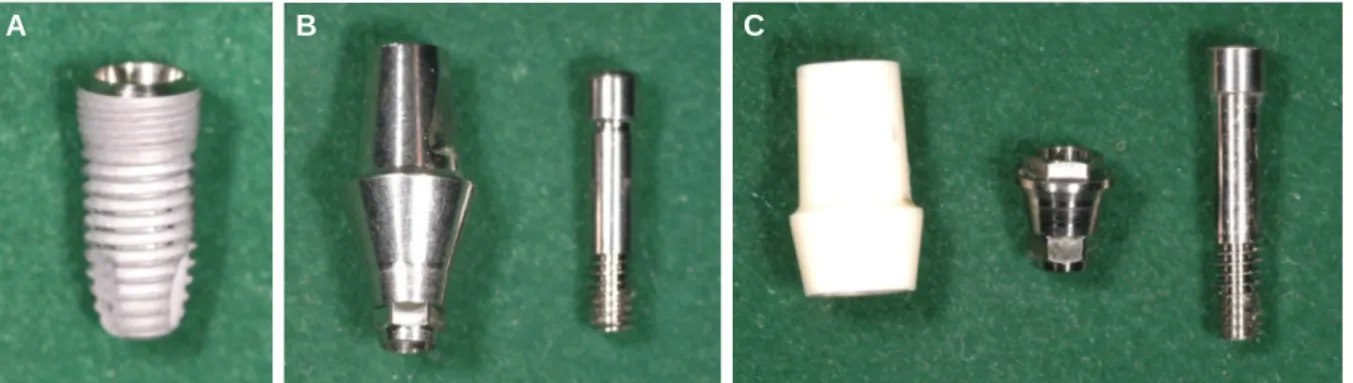
Different types of internal connection implant abutments with anti- rotational structure were selected and divided into two groups; inter- nal connection titanium abutments (Dual Abutment, Dentium Co., Ltd., Seoul, Korea) and titanium abutment screws for control group, and external connection zirconia abutments (ZirAce External, Acucera, Inc., Seoul, Korea) with titanium sockets (Z socket Dentium Regular, Osung MND Co., Ltd., Seoul, Korea) and tita- nium abutment screws for experimental group (Fig. 1). In the experimental group, the titanium sockets were 4.1 mm in width and had dual hex design; a hex which connected into the implant and an opposite hex which connected to the zirconia abutment. The zirconia abutment, the titanium socket and the implant were all fixated with the single screw.
12 internal connection implants (Implantium, Dentium Co., Ltd., Seoul, Korea), which were 4.5 mm in platform diameter, 4.3 mm in body diameter, and 10.0 mm in length, were prepared.
The sample size of the abutments was 6 for each group. Assembly preparation and testing setup were performed basically according to the ISO 14801:2007 protocol. Using the torque gauge, 30 Ncm was applied for the assemblies of both groups. A digital torque gauge (MTT03-12, Mark-10 Co., Hicksville, NY, USA) was used to investigate torque values applied to remove the abutment screws.
The initial pre-reverse torque value (RTV) was defined as the
이주희 새로운 타이타늄 구성요소를 사용한 내부연결 임플란트용 지르코니아 지대주의 동적하중 후 나사 제거력
Fig. 1. The implant/abutment assemblies used in the study, (A) internal connection type titanium implant, (B) control group: internally connected titanium abutment with a titanium screw, (C) experimental group: externally connected zirconia abutment with a titanium socket and a titanium screw.
A B C
RTV measured after tightening with the recommended torque before dynamic cyclic load. The RTV following cyclic loading was also measured and defined as post-RTV. The effect of cyclic load- ing was evaluated by examining the change in the RTVs. Cyclic load- ing was applied by a universal test machine (8871, Instron, Canton, MA, USA). The assemblies were tightened in the metal holder, which was inclined at a 30 degrees angle in reference to the loading axis. For all assemblies, loads of 300 N were applied until one mil- lion cycles, which represented 40 months of simulated function.15 After one million cycles of the loading, the assembly was measured for post-RTV using the digital torque gauge.
The data were analyzed using SPSS 12.0 for Windows (IBM, New York, NY, USA). Data normality was tested using the Kolmogorov- Smirnov test, which revealed the possibility of parametric statisti- cal analyses. Paired t-tests were used to compare the RTVs before and after the dynamic cyclic loading of each group. To compare the RTV differences between the groups, independent t-tests were conducted. A difference was considered significant when P < .05.
Results
The assemblies of both groups survived all after the dynamic cyclic loading test without screw loosening. Table 1 shows the pre load and post load RTVs and the RTV differences. As shown in Table 1, means of the RTVs after repeated load stress tended to be smaller than the values before the cyclic loading. The means and standard deviations of the pre- and post-loading RTVs of the control were 25.92 ± 0.58 Ncm and 18.67 ± 1.13 Ncm, respectively. The means and standard deviations of the pre- and post-loading RTVs of the experimental group were 25.08 ± 0.74 Ncm and 17.75 ± 0.88 Ncm, respectively.
The statistically significant differences were found in the mean RTVs before and after the cyclic loading of both groups (P < .05). The con- trol group showed a lower mean RTV difference value (-7.25 ± 1.50 Ncm) than the experimental group (-7.33 ± 0.93 Ncm). Statistical analysis revealed, however, that the RTV differences between the groups were not significantly different (P > .05).
Discussion
In this study, a constant stress test was used, which has been used
to simulate masticatory function in in vitro studies.16As for the cyclic loading, there were articles, in which various loads were applied at 50 - 450 N.14,15,17-19 A dynamic load of 300 N was used in this study because 300 N represents the maximal physiological occlusal forces on the anterior teeth. The evaluations for screw loosening were reported by measuring RTVs before and after cyclic loading.14,18One million cycles were used in several studies, in which load was applied to the specimen 1.0×10⁶cycles which represented 40 months of sim- ulated function.14,18,19Within the limitations of this in vitro setting, both titanium abutments and two-piece zirconia abutments with a titanium socket survived cyclic loading without screw loosening.
The results implied that the screw retained two-piece zirconia abutment assembly with the titanium socket could successfully with- stand dynamic functional loading when compared to the conventional titanium abutments.
More screw loosening has been reported for externally con- nected implant systems than for internally connected implant sys- tems.20In the study, the separate titanium socket was mounted on the implant together with the zirconium abutment and fixed by one abut- ment screw. When the one-piece zirconia abutments were compared to the one-piece titanium abutments in an internal connection sys- tem, the one-piece zirconia abutments were less fracture-resis- tant than the one-piece titanium abutments.21This may be due to high stress concentration at the internal connection part of the zirconia abutment and the brittle characteristics of zirconia.
Various designs of two-piece zirconia abutments have been tested in vitro, and all of these studies have reported consistent results where two-piece titanium reinforced zirconia abutments had high- er fracture and fatigue resistance than one-piece zirconia abut- ments, regardless of differences in design.20-23The two-piece zirconia abutments also showed competitive results when compared to conventional titanium abutments.22 A common complication of single or multiple implant restoration is screw loosening.23
Screw loosening may occasionally require mechanical repairs.
Currently, there is a lack of studies with regard to abutment screw loosening in zirconia abutments with a secondary titanium component.
In this study, the effect of cyclic loading on screw removal was eval- uated by examining the changes in RTVs in the groups. Abnormal damage or wear due to cyclic loading was not observed on the abut- ment surfaces in either group. From this investigation, it was
Table 1. Pre- and post-cyclic load reverse torque values (RTVs), and RTV differences
Group Pre-cyclic load RTV (Ncm) Post-cyclic load RTV (Ncm) RTV difference (Ncm)
Control 25.92 ± 0.58 18.67 ± 1.13 -7.25 ± 1.50
Experimental 25.08 ± 0.74 17.75 ± 0.88 -7.33 ± 0.93
found that the RTVs were less than the torque used for the initial place- ment before and after cyclic loading in both groups. Before cyclic loading, despite the fact that the screws were tightened to 30 Ncm, the initial preloads were lower than 30 Ncm. After cyclic load- ing, both sample groups showed decreased RTVs compared to the measurements recorded before the cyclic loading. Based on the ana- lyzed results, the RTV differences between the groups were not sig- nificantly different, which indicating that the implant-abutment con- nection with the zirconia abutment and the titanium socket would not be harmful to the stability of the internally connected implant.
However, an additional experiment using larger sample size is necessary to ensure the stability. Further studies about resistance to persistent thermal stress and clinical evaluations will be needed.
Conclusion
In this study, the titanium socket had dual hex design needed to fit both the external connection zirconia abutment and the internal connection titanium implant. The means of RTVs after repeated load- ing were smaller than the RTVs before the cyclic loading. The RTVs before and after the cyclic loading showed statistically signifi- cant differences of both groups. However, there were not statical- ly significant differences in the RTV differences between the groups.
ORCID
Joo-Hee Lee http://orcid.org/0000-0002-7907-3098
References
1. Prestipino V, Ingber A. Esthetic high-strength implant abut- ments. Part I. J Esthet Dent 1993;5:29-36.
2. Manicone PF, Rossi Iommetti P, Raffaelli L. An overview of zir- conia ceramics: basic properties and clinical applications. J Dent 2007;35:819-26.
3. Yildirim M, Fischer H, Marx R, Edelhoff D. In vivo fracture re- sistance of implant-supported all-ceramic restorations. J Prosthet Dent 2003;90:325-31.
4. Apholt W, Bindl A, Lüthy H, Mörmann WH. Flexural strength of Cerec 2 machined and jointed InCeram-Alumina and InCeram- Zirconia bars. Dent Mater 2001;17:260-7.
5. Adatia ND, Bayne SC, Cooper LF, Thompson JY. Fracture re- sistance of yttria-stabilized zirconia dental implant abutments. J Prosthodont 2009;18:17-22.
6. Sailer I, Sailer T, Stawarczyk B, Jung RE, Hämmerle CH. In vit- ro study of the influence of the type of connection on the fracture load of zirconia abutments with internal and external implant-abut- ment connections. Int J Oral Maxillofac Implants 2009;24:850- 8.
7. Gehrke P, Alius J, Fischer C, Erdelt KJ, Beuer F. Retentive strength of two-piece CAD/CAM zirconia implant abutments. Clin Implant Dent Relat Res 2014;16:920-5.
8. Chun HJ, Yeo IS, Lee JH, Kim SK, Heo SJ, Koak JY, Han JS, Lee SJ. Fracture strength study of internally connected zirconia abutments reinforced with titanium inserts. Int J Oral Maxillofac Implants 2015;30:346-50.
9. Theoharidou A, Petridis HP, Tzannas K, Garefis P. Abutment screw loosening in single-implant restorations: a systematic review. Int J Oral Maxillofac Implants 2008;23:681-90.
10. Taylor TD. Prosthodontic problems and limitations associated with osseointegration. J Prosthet Dent 1998;79:74-8.
11. Stüker RA, Teixeira ER, Beck JC, da Costa NP. Preload and torque removal evaluation of three different abutment screws for single standing implant restorations. J Appl Oral Sci 2008;16:55-8.
12. Dhingra A, Weiner S, Luke AC, Ricci JL. Analysis of dimensional changes in the screw and the surface topography at the interface of a titanium screw and a zirconia abutment under cyclic load- ing: an in vitro study. Int J Oral Maxillofac Implants 2013;28:661- 9.
13. Siamos G, Winkler S, Boberick KG. Relationship between im- plant preload and screw loosening on implant-supported prostheses.
J Oral Implantol 2002;28:67-73.
14. Tsuge T, Hagiwara Y. Influence of lateral-oblique cyclic loading on abutment screw loosening of internal and external hexa- gon implants. Dent Mater J 2009;28:373-81.
15. Craig RG. Restorative dental materials, 9th ed, Mosby, St.
Louis, 1993, p. 75-7.
16. Att W, Kurun S, Gerds T, Strub JR. Fracture resistance of single- tooth implant-supported all-ceramic restorations: an in vitro study. J Prosthet Dent 2006;95:111-6.
17. Dittmer MP, Dittmer S, Borchers L, Kohorst P, Stiesch M.
Influence of the interface design on the yield force of the implant- abutment complex before and after cyclic mechanical loading.
J Prosthodont Res 2012;56:19-24.
18. Khraisat A, Abu-Hammad O, Dar-Odeh N, Al-Kayed AM.
Abutment screw loosening and bending resistance of external hexa- gon implant system after lateral cyclic loading. Clin Implant Dent Relat Res 2004;6:157-64.
19. Khraisat A, Hashimoto A, Nomura S, Miyakawa O. Effect of lat- eral cyclic loading on abutment screw loosening of an external hexagon implant system. J Prosthet Dent 2004;91:326-34.
20. Gracis S, Michalakis K, Vigolo P, Vult von Steyern P, Zwahlen M, Sailer I. Internal vs. external connections for abutments/re- constructions: a systematic review. Clin Oral Implants Res 2012;23:202-16.
21. Delben JA, Barão VA, Ferreira MB, da Silva NR, Thompson VP, Assunção WG. Influence of abutment-to-fixture design on reliability and failure mode of all-ceramic crown systems. Dent Mater 2014;30:
408-16.
22. Kim JS, Raigrodski AJ, Flinn BD, Rubenstein JE, Chung KH, Mancl LA. In vitro assessment of three types of zirconia implant abutments under static load. J Prosthet Dent 2013;109:255-63.
23. Dixon DL, Breeding LC, Sadler JP, McKay ML. Comparison of screw loosening, rotation, and deflection among three implant de- signs. J Prosthet Dent 1995;74:270-8.
이주희 새로운 타이타늄 구성요소를 사용한 내부연결 임플란트용 지르코니아 지대주의 동적하중 후 나사 제거력
새로운 타이타늄 구성요소를 사용한 내부연결 임플란트용 지르코니아 지대주의 동적하중 후 나사 제거력
이주희*
울산대학교 의과대학 서울아산병원 치과보철과
목적: 이 연구의 목적은 새로운 타이타늄 구성요소를 가진 지르코니아 지대주의 나사 제거력의 변화에 대해 알아보는 것이다. 내부연결 임플란트 를 위한 새로운 지르코니아 지대주의 동적하중 후 지대주 나사의 제거력을 기존의 타이타늄 지대주와 비교하여 분석하였다.
재료 및 방법: 내측연결 임플란트와 타이타늄 지대주, 타이타늄 구성요소를 가진 지르코니아 지대주를 준비하였다. 12개의 내부연결형 임플란트에 6개의 타이타늄 지대주를 연결하고(대조군), 6개의 타이타늄 구성요소를 가진 지르코니아 지대주(실험군)를 30 Ncm의 토크로 연결한 후 동적하중 전후의 나사 제거력을 측정하였다. 동적 만능재료시험기를 사용하여 연결체의 장축과 30도 각도를 이루도록 하고 300 N 하중크기로 100만번의 하 중이 가해졌다. 동적하중 전후의 지대주 나사 제거력을 t검정을 통해 신뢰구간 95%로 통계적 유의성을 검증하였다.
결과: 두 그룹 모두에서 동적하중 후 나사 풀림을 보이지 않았다. 동적 하중 전후의 나사 제거력은 두 그룹 모두에서 통계적으로 유의한 차이가 있 게 나타났다(P < .05). 동적 하중 전후의 나사 제거력 차이는 대조군에서 -7.25 ± 1.50 Ncm, 실험군에서 -7.33 ± 0.93 Ncm 로 나타났다. 통계분석 결과 두 군간에 나사 제거력 차이에서는 유의한 차이를 보이지 않았다(P > .05).
결론: 이 실험의 결과에 한하여 타이타늄 구성요소를 사용한 지르코니아 지대주의 동적하중 후 지대주 나사 제거력의 변화는 타이타늄 지대주와 통계학적으로 유의한 차이를 보이지 않았다. (대한치과보철학회지 2017;55:151-5)
주요단어: 지대주나사; 동적하중; 지르코니아; 타이타늄; 나사 제거력
*교신저자: 이주희
05505 서울 송파구 올림픽로 43길 88
울산대학교 의과대학 서울아산병원 치과보철과 02 3010 5803: e-mail, [email protected]
원고접수일: 2017년 3월 28일 / 원고최종수정일: 2017년 4월 6일 / 원고채택일: 2017년 4월 20일
2017 대한치과보철학회
이 글은 크리에이티브 커먼즈 코리아 저작자표시-비영리 3.0 대한민국 라이선스에 따라 이용하실 수 있습니다.
c cc