Printed in the Republic of Korea DOI 10.5012/jkcs.2011.55.3.430
석탄회 산업폐기물로부터 제조한 메조다공성 실리카소재를 촉매로 사용하는 Knoevenagel 수용액 반응
Aashish O. Dhokte,Santosh L. Khillare, Machhindra K. Lande, and Balasaheb R. Arbad*
Department of Chemistry, Dr. Babasaheb Ambedkar Marathwada University, Aurangabad (M.S.), 431004, India (접수 2010. 11. 17; 수정 2011. 3. 21; 게재확정 2011. 3. 21)
Knoevenagel Reaction in Water Catalyzed by Mesoporous Silica Materials Synthesized from Industrial Waste Coal Fly Ash
Aashish O. Dhokte,Santosh L. Khillare, Machhindra K. Lande, and Balasaheb R. Arbad*
Department of Chemistry, Dr. Babasaheb Ambedkar Marathwada University, Aurangabad (M.S.), 431004, India
*E-mail: [email protected]
(Received November 17, 2010; Revised March 21, 2011; Accepted March 31, 2011)
요 약. 화력발전소에서 배출되는 석탄회를 이용하여 메조다공성 소재인 MCM-41을 제조하였다. 제조한 소재는 XRD, FT- IR, SEM 및 EDS 방법으로 특성을 규명하였다. 이 소재의 촉매활성을 방향족 알데히드와 malonontrile의 Knoevenagel축합 반응에서 5-arylindene malononitriles의 합성에 대해 연구하였다. 이 방법의 특징은 쉬운 취급법, 안정성, 촉매의 재사용 및 생태친화성, 고수율, 짧은 반응시간, 간단한 실험과정 및 마무리 절차 등을 들 수 있다.
주제어: 석탄회(CFA), 메조다공성 실리카 소재(MCM-41), Knoevenagel 축합반응, 불균일 촉매화반응
ABSTRACT. Coal fly ash of thermal power plants converted into mesoporous materials MCM-41. The synthesized material was characterized by XRD, FT-IR, SEM, and EDS techniques. The catalytic activity of prepared material was studied for the synthesis of 5-arylindene malononitriles via Knoevenagel condensation of aromatic aldehydes and malonontrile is described.
The features of present method are easy handling, stability, reusability, and eco-friendliness of catalyst, high yields, short reac- tion time, simple experimental and work up procedure.
Keywords: Coal fly ash (CFA), Mesoporous silica materials (MCM-41), Knoevenagel condensation reaction, Heterogeneous catalysis
INTRODUCTION
Recently, a considerable attention is given on the mesoporous catalytic materials for ensuring fast synthesis of versatile organic compounds because of their high sur- face area and large pore size and volume. Owing to the necessity of the environmentally safe technological rev- olution, therefore Mesoporous materials are best alterna- tive source to make chemical process clean, efficient, green, and environmentally benign.
Mesoporous molecular sieves designated as M41S have attracted much attention of many researchers, since their discovery at Mobile Oil Corporation in 1992.1-3 Mesopo- rous MCM-41 material can be synthesized using a variety of silica precursors such as n-alkoxysilanes, n-alkyl amines, sodium water glass and aerosil. However, major draw- back of these precursors is the high starting costs of the
raw materials that results in high production cost. To over- come these difficulties, the best alternative silica source is the coal fly ash which is the waste product of coal com- bustion in coal fired power station. This turn generate a huge amount of fly ash up to 5.5 million tones /year.4 So efficient disposal of coal fly ash is a world wide issue, and its harmful effects on the environment.5,6,7 Fly ash is a sil- ica-aluminate material, the major chemical constituents of coal fly ash are SiO2, Al2O3 and Fe2O3 (60-70 and 16-20 wt% and 6-7 Wt% respectively) and varying amount of CaO, MgO, along with unburned carbon. Besides this, some minor elements such as Hg, As, Ge, Ga and traces of heavy metals (Cr, Co, Cu, Pb, Mn, Ni, Zn) and rare earths may also be presents in fly ash.8 However, traces of ele- ments like Al, Na, Ti and Fe were inevitably incorporated into the synthesized materials. The incorporation of alu- minum species into the framework of MCM-41 makes the
sample exhibiting moderate acidity, and which is impor- tant characteristic property of catalyst and adsorption.
Process of synthesized MCM-41from fly ash involved the fusion of sodium hydroxide with fly ash; resulting the dis- appearance of quartz and mullite phases which suggests that silica in its natural crystalline form had reacted with NaOH to form soluble sodium silicate during the fusion process.9 Generally, templates used for synthesis of M41S are selected from the alkyl trialkyl ammonium halide sur- factant family, interaction between the organic surfactant and the inorganic matrix is dictated by the synthesis reagent factor in influencing the physical and chemical properties of the synthesized mesoporous materials.10,11 MCM-41 consists of hexagonal arrays of uniform pore size.
Synthesized zeolite materials (mixed with fly ash or in a pure form) may find its practical applications in removing heavy metals or ammonia from waste waters.12,13,14 or in gas phase adsorptions.15 Compared to zeolite materials, MCM-41 materials have attracted considerable attention due to their potential application as catalyst support or adsorbents because of their high surface area and large pore size and volume. Fly ash supported catalysts have shown good catalytic activities for oxidation,16 dechlori- nation,17 condensation and rearrangement reactions.18 This paper reports a green synthesis route for MCM-41 meso- porous silica material. The chemical and physical prop- erties of synthesized MCM-41 material was characterized by means of crystallinity, porosity and surface study and was then compared with those of MCM-41 synthesized from commercial sodium silicate. After understanding the usability and surface characterization, their catalytic activ- ity was investigated for Knoevenagel condensation reaction.
In organic synthesis one of the most well known reac- tions for C-C bond formation is the Knoevenagel con- densation.19 This reaction has been widely used for the synthesis of intermediate such as coumarin derivatives which are useful in perfumes, cosmetics and bioactive compounds.20 In addition, there has been considerable interest in Knoevenagel condensation product because of there widespread application including inhibition of antiphosphorylation of EGF-receptor and antiprolifera- tive activity.21 As a result of their importance from a phar- macological, industrial and synthetic point of view several methods for the Knoevenagel condensation have been reported presently using of various catalyst such as Silica gel,22 zirconia catalyst,23 MgBr2.OEt2,24 Phosphane,25 ionic liquid, 26 activated fly ash, 18 etc. However, several draw- backs such as large excess of catalyst, not reusable, haz- ardous reaction condition, expensive reagents, long reaction
times, and low yields still exist. Hence herein we report Knoevenagel condensation in distilled water. The major advantage in carrying out the reaction in water is the inflammable, inexpensive, non-toxic and thus economi- cally and environmentally benign nature as a solvent.
EXPERIMENTAL
Materials
The coal fly ash was obtained from Thermal power sta- tion, parli-vaijnath, District- Beed, Maharashtra, India.
The chemical compositions of the as received CFA pow- der are shown in Table 1. Other chemicals used were of synthesis grade reagents (Merck) and used as such, with- out further purification.
Catalyst preparation
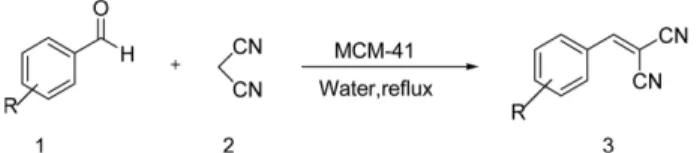
An alkali fusion method reported by Kumar et al.27 was adopted to obtain the alkali-fused CFA powder. The fusion process was carried out by mixing as received CFA powder and sodium hydroxide at a ratio of 1:1.2 and then mixture was heated in an oven at 850 K for 4 hr.The resultant product was cooled and milled overnight after that, the obtained alkali fused CFA powder was mixed with deionised water and aged for at least 1 day under stir- ring condition in an air atmosphere. The mixture was sub- sequently filtered to obtain sodium silicate solution. The cetyltrimethyl ammonium bromide (CTAB) was dis- solved in 140 ml of warm deionised water and to that sodium silicate was added with constant stirring in 4 hr, pH of the resulting solution was adjusted to 8-9 by using Scheme 1. The Knoevenagel condensation reaction using MCM- 41(CFA) as solid heterogeneous catalyst.
Table 1. Chemical composition of as-received coal fly ash Sr. No. Compound Content (wt%) CFA (mol/100 g)
1 SiO2 60.16 1.001
2 Al2O3 25.96 0.254
3 Fe2O3 6.75 0.042
4 CaO 3.05 0.054
5 K2O 1.13 0.012
6 TiO2 1.75 0.021
7 Na2O 0.33 0.005
8 MgO 0.79 0.019
1M HCl, resulting gel was poured in to Teflon packed glass bottle and heated at 373 K for 48 hr. White solid so obtained was filtered, washed with deionised water and dried at 60oC overnight. The template was removed by calcination at 550oC for four hour to obtain surfactant free mesoporous material MCM-41 (CFA).
Catalyst characterization
The X-ray diffraction (XRD) patterns of the catalysts were recorded on a Bruker D8 advance X-ray diffracto- meter using Cu-Kα radiation with a wavelength of 1.54056 Ao. Infrared (FT-IR) spectra were recorded on a FT-IR spectrometer (JASCO, FT-IR, Japan) using dry KBr as a standard reference in the range of 500-4000 cm-1. To study the morphology of synthesized MCM-41 (CFA) scanning electron microscopy (SEM) analyses were carried out with a JEOL JSM-6330 LA operated at 20.0kV and 1.0 nA.
The elemental composition of the metal in the as received coal fly ash was examined using an energy dispersive spectrophotometer (EDS).
General Experimental Procedure
A mixture of aromatic aldehyde (2 mmol) and malono- nitrile (2 mmol) and synthesized MCM-41 (0.1 gm) as catalysts in distilled water (10 ml) was refluxed. The progress of reaction was monitrarted by TLC [hexane/eth- ylacetate (7:3)]. On completion of the reaction, the reac- tion mixture was cooled and product was isolated and recrystallized in ethanol. The purity of the product was determined by comparison to melting points, 1H NMR, FT-IR spectra in the literature.
Spectroscopic data of compound
3i: IR (KBr)-2239, 3052, 1530,1331, 856 cm-1.
1H NMR (δ in DMSO) 8.95 (s, 1H), 8.33(d, 1H), 8.01(t, 1H), 7.94(d, 2H), 7.90(t, 1H).
RESULTS AND DISCUSSION
XRD analysis
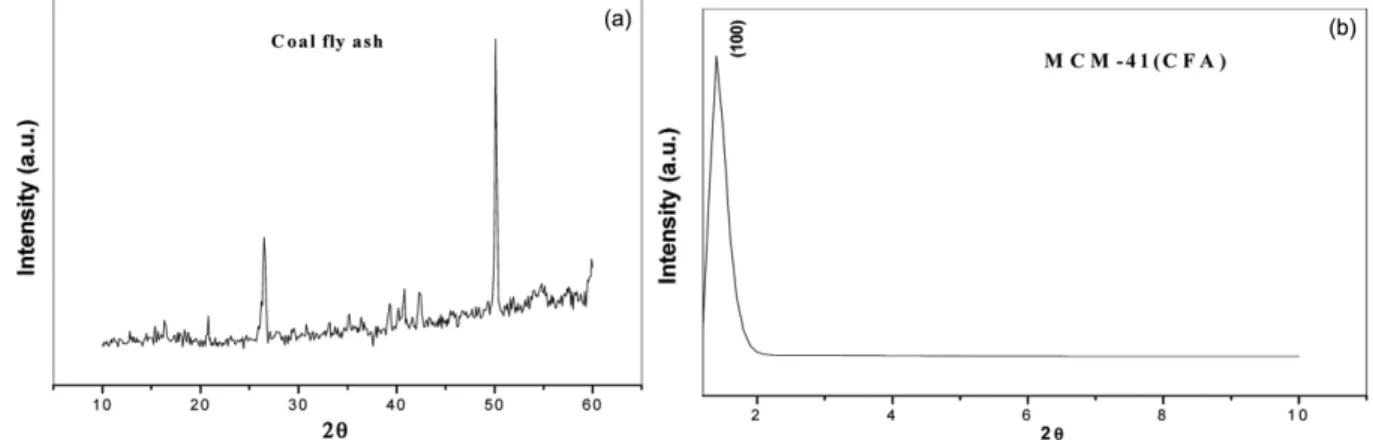
The X-ray pattern of the synthesized mesoporous silica material is an highly periodic silica phases which is nor- mally reflected by the highly distinct XRD signatures at low 2θ angles from 1o to 10o as shown in Fig. 1. There was only a broad band observed of the synthesized material, these sharp signal indicated the long range order of uni- form hexagonal mesoporous materials. The well defined patterns with XRD lines {100} reflections, which are characteristics of the hexagonal lattice symmetry of the MCM-41 structure.1
Estimation of particle size using the Debye-Scherrer equation
The particle sizes of the starting materials played an important role in determining the reactivity of coal fly ash with smaller particle exhibited higher reactivity due to higher specific area.11 The mean particle size as-received coal fly ash used as starting materials in this study was about 10 µm. Generally the particle size of solid materials can be estimated from X-ray line broadening and full at width half maximum (FWHM) values using Debye-Scher- rer equation T = 0.94λ/βcosθ, where T is the particle size, λ is the wavelength, θ is the diffraction angle and β is (FWHM). The particle size of synthesized MCM-41 mate- rial is 24 nm, which have smaller particle size than start- ing material and shows greater surface area and hence greater catalytic activity.
FT-IR analysis
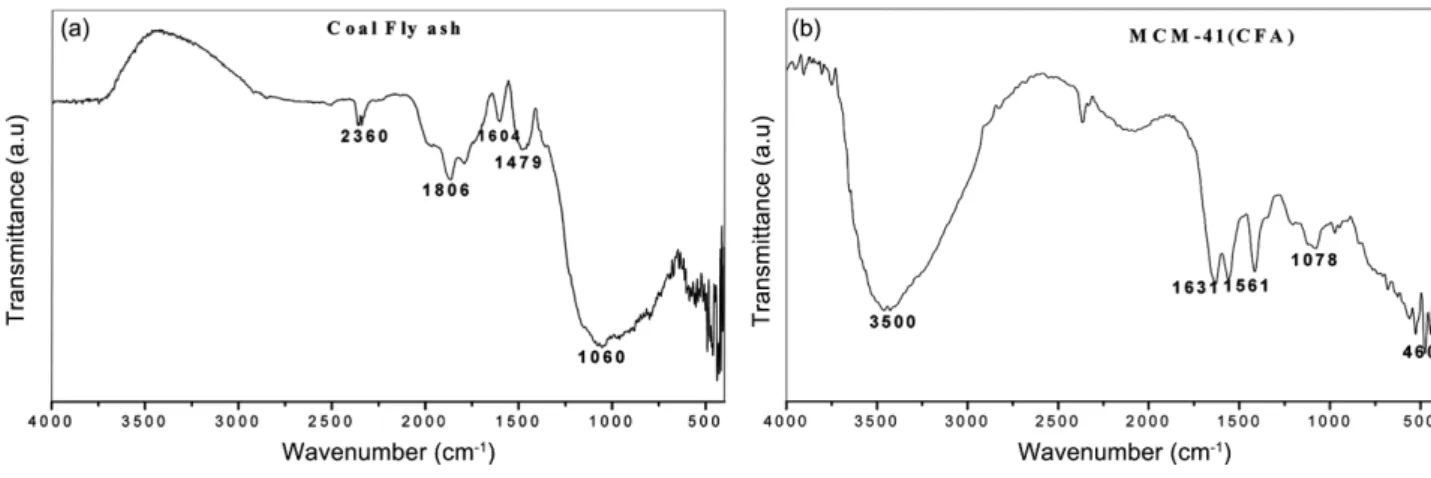
The FT-IR spectra of as synthesized MCM-41 from coal fly ash are shown in Fig. 2. From FT-IR spectra the absorption bands around 2921 and 2851 cm-1 corresponds to n-C-H and d-C-H vibrations of the surfactant mole-
Fig. 1. X-ray diffraction pattern of (a) Coal fly ash (b) Synthesized MCM-41 from coal fly ash.
cules, such bands disappeared in the calcined sample indi- cating the total removal of organic material during calcinations.28 The broad band around 3500 cm-1 was observed due to surface silanols and O-H stretching fre- quency of adsorbed water molecule. Moreover the peaks in the range of 1500-1600 cm-1 are because of the defor- mation mode of surface hydroxyl group.29 A peak at a 1090 cm-1 and 810 cm-1 correspond to the asymmetric and symmetric Si-O stretching vibrations.30 The bands at 970 and 460 cm-1 were due to the stretching and bending vibration of surface Si-O-Si groups respectively.31 The peaks in the range 1010-1079 cm-1 are assigned to M-O-M bonding, the bands from 954 to 990 cm-1 appeared due to Si-O-M (M=metal ions) vibrations in metal incorporation silanols28 which was generally considered to be evidence of the incorporation of the metal ions into the framework.
As the substitution of silicon by different metal ions, a shift in the lattice vibration bands to lower wave numbers was observed.
SEM analysis
SEM images of original coal fly ash are shown in Fig.
3(a). In general, the as-received coal fly ash exhibited smooth spherical particles of cenospheres morphology interspersed with aggregates of crystalline compounds.
During the hydrothermal treatment given in Teflon packed glass bottle for 48 hr, the Coal fly ash species were gradually crystallized in order to form siloxane network (Si-O-Si). From SEM images, it was observed that it exhibited the agglomerated particles with the uniform size smaller than that of the used coal fly ash. This is because the well-organized assembly of coal fly ash reacted with the cationic template in adequate crystallization.
It was also observed from Fig. 3(b) as-synthesized mesoporous MCM-41 from coal fly ash material exhib-
ited mixtures of spherical top, ribbon-like as well as tor- ous shaped particles. The morphological features of the synthesized mesoporous MCM-41 material of present work are in good agreement with that reported in the lit- erature.9,32,33
Catalytic activity results
In continuation of our work to develop a new synthetic methodology,34 herein, we would like to report an effi- cient and rapid method for the synthesis of 5-arylindene malononitriles via Knoevenagel condensation of aro- matic aldehydes and malononitriles in the presence of cat- alytic amount of MCM-41 (CFA) in aqueous media.
Initially, we carried out a model reaction of benzaldehyde with malonontrile using MCM-41 (0.1 gm) as a catalyst in distilled water (10 ml) was refluxed. The reaction pro- ceeded smooth and was completed within 8 minute with 95% yield. Encouraged by this result we turned our atten- tion towards the various substituted aldehyde reacted, rap- idly with malononitrile and results are shown in (Table 2).
A variety of differently substituted aromatic aldehydes possessing electron donating (CH3, -OCH3, -OH) and elec- tron withdrawing groups (NO2) gave good yields (90%) and reactions were completed within 8-15 minutes in dis- Fig. 2. The FT-IR spectrum of (a) Coal fly ash (b) Synthesized MCM-41 from coal fly ash.
Fig. 3. SEM images of (a) coal fly ash (b) Mesoporous MCM- 41 material from coal fly ash.
tilled water. The recovery and reusability of the catalyst was also examined as it is important from an industrial point of view. The catalyst was separated, washed with n- hexane, dried at 60oC and activated at 120oC for 1 hr before the next catalytic run. The reusability of the cat- alyst was investigated for the reaction of 4-chlorobenzal- dehyde, malononitrile and it could be recycled four times without any loss of activity, in this case also the yields were excellent (Table 2). Inexpensiveness and readily availability of fly ash, an industrial waste, which acts as a catalyst will make it a useful strategy for Knoevenagel condensation reaction of Aromatic aldehyde and malono- nitrile.
CONCLUSIONS
The study provides an efficient mesoporous catalyst from fly ash which possesses higher catalytic activity and yield of the product to a great extent. The new application of coal generated fly ash is investigated upon using it as effective solid heterogeneous catalyst for Knoevenagel condensation reaction of aromatic aldehyde and malono- nitrile. The remarkable advantages offered by this method are: catalyst is inexpensive, non-toxic, easy handling and reusable, simple work-up procedure, short reaction time, high yields of product with better purity and green aspect by avoiding toxic catalyst and hazardous solvent.
Acknowledgements. The authors are grateful to the Head, Department of chemistry, Dr. Babasaheb Ambed- kar marathwada university, Aurangabad for providing the laboratory facility.
REFERENCES
1. Kresge, C. T.; Leonowicz, M. E.; Roth, W. J.; Vartuli, J.
C.; Beck, J. S. Nature. 1992, 359, 710.
2. Beck, J. S.; Vartuli, J. C.; Roth, W. J.; Leonowicz, M. E.;
Kresge, C. T.; Schmitt, K. D.; Chu, C. T. W.; Olson, D.
H.; Sheppard, E. W.; McCullen, S. B.; Higgins, J. B.;
Schlenker, J. L.; J. Am. Chem. Soc. 1992, 114, 10834.
3. Beck, J. S.; Vartuli, J. C. Curr. Opin. Solid State Mater.
Sci. 1996, 1, 76.
4. Tanaka, H.; Sakai Y.; Hino, R. Mater. Res. Bull. 2002, 37, 1873.
5. Ferraiolo, G.; Zilli, M.; Converti, A. J. Chem. Technol.
Biotechnol. 1990, 47, 281.
6. Carlson, C. L.; Adriano, D. C. J. Environ. Qual. 1993, 22, 227.
7. Kikuchi, R. Resour. Conserv. Recy. 1999, 27, 333.
8. Kumar, K.; Kumar, S.; Mehrotra, S. P. Resour Conserv Recycl. 2007, 52, 157.
9. Misran, H.; Singh, R.; Shahida, B.; Yarmo, M. A. J. of Materials Processing Technology. 2007, 186, 8.
10. Biz, S.; Occelli, M. L. Catal. Rev. Sci. Eng. 1998, 40, 329.
11. Kimura, T. Micropor. Mesopor. Mater. 2005, 77, 97.
12. Querol, X.; Moreno, N.; Umana, J. C.; Alastuey, A.; Her- nandez, E.; Lopez-Soler A.; Plana, F. Int. J. Coal Geol.
2002, 50, 413.
13. Hollman, G. G.; Steenbruggen, G.; Janssen-Jurkovicova, M. Fuel. 1999, 78, 1225.
14. Hui, K. S.; Chao, C. Y. H.; Kot, S. C. J. Hazard. Mater.
2005, 127, 89.
15. Srinivasan, A.; Grutzeck, M. W. Environ. Sci. Technol.
1999, 33, 1464.
16. Zhang, A. L.; Deng, F. F.; Zhou, J. T.; Jin, R. F.; Liang, L. L.; Zhang, G. L. Huan Jing Ke Xue, 2009, 7, 1942.
17. Abdul, G.; Masaaki, T. React Kinet Catal Lett. 2009, 97, 35.
18. Gopalkrishan, M.; Sureshkumar, P.; Kanagarajan, V.; Tha- nusu, J.; Govindaraju, R. ARKIVOC. 2006, xiii, 130.
19. (a). Knoevenagel, E. Ber. 1898, 312, 585. (b) G. Jones, Org. React. 1967, 15, 204.
20. (a) Tietze, L. F.; Beifuss, U. Comprehensive Organic Syn- thesis. 1991, 2, 304. (b) Menly, W. C.; Othmer, K. Ency- clopendia of Chemical Technology, 3rd Edn; John Wiley
& Sons; New York. 1979, 7, 196. (c). Xing, C.; Zhu, S.;
J. Org. Chem. 2004, 69, 6486. (d) Gallos, J.; Discordia, R. P.; Crispino, J. G. A.; J. A. Grosso, L.; Polniaszek, R.;
True, V. C. Tetrahedron Lett. 2003, 44, 4271.
21. Vijender, M.; Kishor, P.; Satyanarayana, B. Arkivoc. 2008, 7, 122.
22. de la Cruz P.; Díez-Barra, E.; Loupy, A.; Langa, F. Tet- rahedron Lett. 1996, 37, 111.
23. Reddy, B. M.; Patil, M. K.; Rao, K. N.; Reddy, G. K. J.
of Molecular Catalysis A: Chemical. 2006, 258, 302.
24. Saeed Abaee, M.; Mojtahedi, Mohammad, M.; M. Mehdi Zahedi, and Golriz Khanalizadeh ARKIVOC. 2006; (xv) Table 2. Synthesized MCM-41 (CFA) catalyzed Knoevenagel con-
densation reaction of aromatic aldehyde and malononitrilea
Entry R Time (min)
Yieldb (%)
m.p (oC) m.p (oC) Found Reported
3a H 8 95 84 82-84
3b 4-Cl 10 91(91,90,90,90)c 162 162
3c 4-OH 10 90 181 180-182
3d 4-NO2 15 92 160 160
3e 2-Cl 15 89 94 95-96
3f 4-CH3O 15 92 112 115
3g 4-CH3 10 94 134 133-134
3h 3-NO2 15 92 160 160
3i 2-NO2 12 93 136 137-138
aReaction condition 1 (2 mmol) and 2 (2 mmol), MCM-41(CFA) 0.1 gm, distilled water 10 ml
bIsolated yield
cYield after consecutive cycles
48.
25. Yadav, J. S.; Reddy, Basi, V. S.; Basak, A. K.; Boddapati, V.; Akkirala, V. N.; Kommu, N. Eur. J. Org. Chem. 2004, 546.
26. (a) Balaiaie, S.; Nemati, N. Synth. Commun. 2000, 30, 869. (b) Wang, G. W.; Cheng, B. Arkivoc. 2004, (ix), 4.
27. Kumar, P.; Mal, N.; Omani, Y.; Yamana, K.; Sano, T. J.
Mater. Chem. 2001, 11, 3285.
28. Hui, K. S.; Chao, C. Y. H. J. of Hazardous Materials.
2006, B137, 1135.
29. Kiseler, A.V.; Lygin, V. I. 1st ed., Nauka, Moskow, 1992.
30. Romero, A. A.; Alba, M. D.; Zhou, W. Z.; Klinowski, J.
J. Phys.Chem. 1997, B 101, 5294.
31. Takahashi, R.; Sato, S.; Sodesawa, T.; Kawakita, M.;
Ogura, K. J. Phys. Chem. 2000, B 104, 12184.
32. Kumar, D.; Schumacher, K.; Du Fresne von Hohenesche, C.; Gruen, M.; Unger, K. K.; Colloids Surf A: Physico- chem. Eng. Aspects. 2001, 109, 187.
33. Wakihara, T.; Sugiyama, A.; Okubo, T. Microporous Meso- porous Mater. 2004, 7, 70.
34. Rathod, S. P.; Gambhire, A. B.; Arbad, B. R.; Lande, M.
K. Bull. Korean Chem. Soc. 2010, 31, 339.