INTRODUCTION
As the economy rapidly develops, family-oriented en- vironments change along with the fundamental role of fathers. Also, as our society converts ‘from an agricultur- al to industrialized one’, and ‘from a traditional expand- ed family to a modern nuclear family’, the role of grand- parents and relatives, who once have played an impor- tant role in bringing up children, has diminished.
Simultaneously, as more women pursue their careers af- ter marriage, raising children has naturally become an is- sue that requires interests from both mother and father.
Thus, the role of fathers in bringing up children has be- come more crucial these days(Kim, 1998; Yang, 1996).
In other words, unlike in the past when only the moth- er’s role was emphasized in raising children, currently fa- thers have to share the burden of raising children which is what today’s society demands from them (Hur, 1992).
Fathers are required to engage in the activity of bringing
Rearing Behavior and Rearing Stress of Fathers with Children of Preschool
and School Age
Ja-Hyung Lee1, Hye-Young Kim2, Young-Ae Park3
1. Professor, College of Nursing Science, Ewha Womans University 2. Assistant professor, Catholic Sangji College
3. Head Nurse, St. Marry’s Hospital of Catholic University
Corresponding author: Ja-Hyung Lee, Professor, College of Nursing Science, Ewha Womans University, 11-1, Daehyun-dong, Seodaemun-gu, Seoul, 120-750, Korea.
Tel: 82-2-3277-2885 E-mail : [email protected]
Received October 9, 2004 ; Accepted November 24, 2004nuary 31, 2000
Purpose. This study was conducted to compare the paternal rearing behavior and rearing stress level between fathers with a preschooler and fathers with school children so that it can be utilized as a basic source for developing parental rearing education programs.
Methods. A descriptive comparative method was conducted to identify the paternal rearing behavior and pater- nal rearing stress. Respondents were 361 fathers who had either preschoolers (n=189) or children of ele- mentary age (n=172).
Results. Comparing the two group’s means, the rearing activity score and rearing stress there were significant differences. In the school children’s group’s father, ‘outdoor activity’ and ‘guidance on discipline activity’
were significantly higher than the other group. In the preschool children’s fathers group, ‘play interaction activity’ was statistically significant higher than the other, and the child-part mean score of paternal rearing stress was significantly higher than the other group. The correlation between paternal rearing behavior and paternal rearing stress, indicates that more paternal rearing behavior means less paternal rearing stress.
Conclusion. These results of this study will help design more effective rearing programs for fathers that have either preschool children or school children by providing the basic data for paternal rearing behaviors and paternal rearing stress.
Key Words: Rearing behavior, Rearing stress, Father
up children in daily life, not only as a breadwinner but also as an active participant. Also, together with instru- mental role in the past, a more expressive aspect is ex- pected from today’s fathers (Tiller, 1995).
According to a recent report, fathers contribute to rais- ing children differently from mothers in various aspects such as through learning sexual roles, learning cognition and imposing accomplishment motives. Also, it is report- ed that even though fathers spend less time with their kids than mothers, their impacts on the kids are equiva- lent to that of the mother’s (Choi, 1992; Kim & Park, 1996; Sung, 1996). In particular, during the pre-school stage in which children begin to develop sexual roles through their parents as their autonomy and creativity increases, the father’s engagement in raising children has both direct and indirect impacts on the children’s growth (Lee & Kim, 2004). Also, when children start to study academic subjects, children’s internal cognition develops increasingly while their intellectual and understanding abilities dramatically strengthen. Therefore, parents play a major role in forming their children’ s habits and ac- quiring their roles (Lee et al., 2003).
From the science of nursing perspective on family heath, children’s growth and development, the father’s role is an integral part of the family’s health and well-be- ing. Even so, the significance of the father’s role in rais- ing children has been underestimated because of lack of adequate information, education about the father’s role in raising children and of some values that need to be reinterpreted (Kim, 1998). Therefore, although the fa- thers’ rearing role has been emphasized these days, it still remains to be excluded from various studies related to the rearing subject. In particular, the issue has never even been mentioned in the children nursing clinical field (Lee & Kim, 2004). A great variety of researches related to rearing are published these days, but are most- ly centralized on the mother’s rearing (Chung, 1998; Do
& Kim, 1997; Harrison, 2000; Lee, 1998; Lee, 2000).
There are not enough researches to be conducted to identify the father’s rearing. Thus, this study will specifi- cally examine the paternal rearing behavior and stress of fathers who either has a child of pre-school or elemen- tary school age to provide basic data on family-oriented child nursing intervention.
This study was done to compare the paternal rearing behavior and rearing stress level between fathers with a preschooler and fathers with school children so that it can be utilized as a basic source for developing more ef-
fective parental rearing education programs. The specific purpose for this study is to identify the correlation of pa- ternal rearing behavior with parental rearing stress.
METHOD
Study design
This study was designed as a descriptive comparative survey to identify the paternal rearing behavior and pa- ternal rearing stress of fathers with pre-school children and fathers with school children’s.
Sample
Respondents for this study were 361 fathers who had either preschoolers (n=189) or children of elementary age (n=172). Preschoolers are from 3 to 7 years old and elementary students are from 8 to 13 years old.
Respondents currently live with their children and a spouse. They have agreed to participate in this survey.
Data collection
As an effort to collect data from fathers who have chil- dren aged 3 to 7, we sent questionnaires to parents liv- ing in Daegu, the Kyungbook Province, Seoul and the Kyungi Province after we received permission from kindergartens or academies in the designated area. Also, in order to collect data from parents who have children attending elementary schools, we received consent from primary schools in the Daegu and Seoul district to send questionnaires to parents so that a week later they could be collected from the children.
Instruments
Paternal rearing behavior: This was measured by an in- strument based on Bigner’s paternal behavior question- naire (1977) that 3 nursing scholars modified for content validity (Lee & Kim, 2004). The instrument has 18 items in a 4- point Likert scale (from 1 to 4) and was divided by 4 sub categories (daily activity, outdoor activity, play interaction of activity, guidance on discipline activity).
The higher total score, the higher level of paternal rear- ing behavior. The Cronbach’s alpha coefficient reliability of this study was .833.
Paternal rearing stress: This was measured by an in- strument that Yang (2000) modified for Korean culture based on the Abidin (1992)’s PSI (Parenting Stress Index). It is comprised of 24 items in a 5- point scale (from 1 to 5) and divided into 2 parts (Father-part has 12
items, Child-part has 12 items). The lower the total score, the higher level of paternal rearing stress. The Cronbach’s alpha coefficient reliability of this study was .811.
Data analysis
The data were analyzed by the SPSS/PC program with descriptive statistics, x2-test and ANCOVA test to control the covariate. A partial correlation test was used to know the relationship between paternal rearing behav- iors and paternal rearing stress.
RESULTS
Demographic characteristics
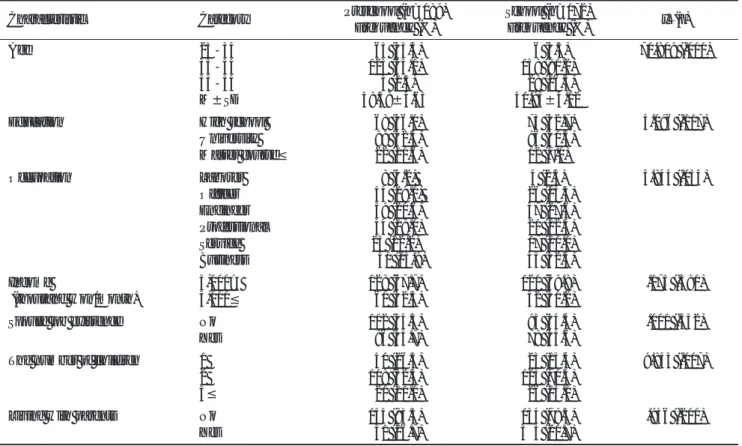
The demographic characteristics of the participants are shown in Table 1. The mean age of the preschooler’s fa- ther group was 38.38±4.63 and that of the school child’s father group was 40.93±4.02. Statistically, signif- icant differences were found in ‘age (x2=70.809, p=
.000)’, and ‘the number of children’ between respon- dents who have preschool children and those who have school children (x2=9.843, p=.007). These two character-
istics were controlled to compare paternal rearing be- havior and paternal rearing stress in the study.
Education and job’s deviations of the two groups were almost identical, and occasionally, respondent’s family income in both groups were less than 3 millions won.
Also there were more cases in which respondents from both groups had spouses with no job and there were no significant distribution differences. More respondents an- swered that their children do not live with grandparents.
Rearing characteristics
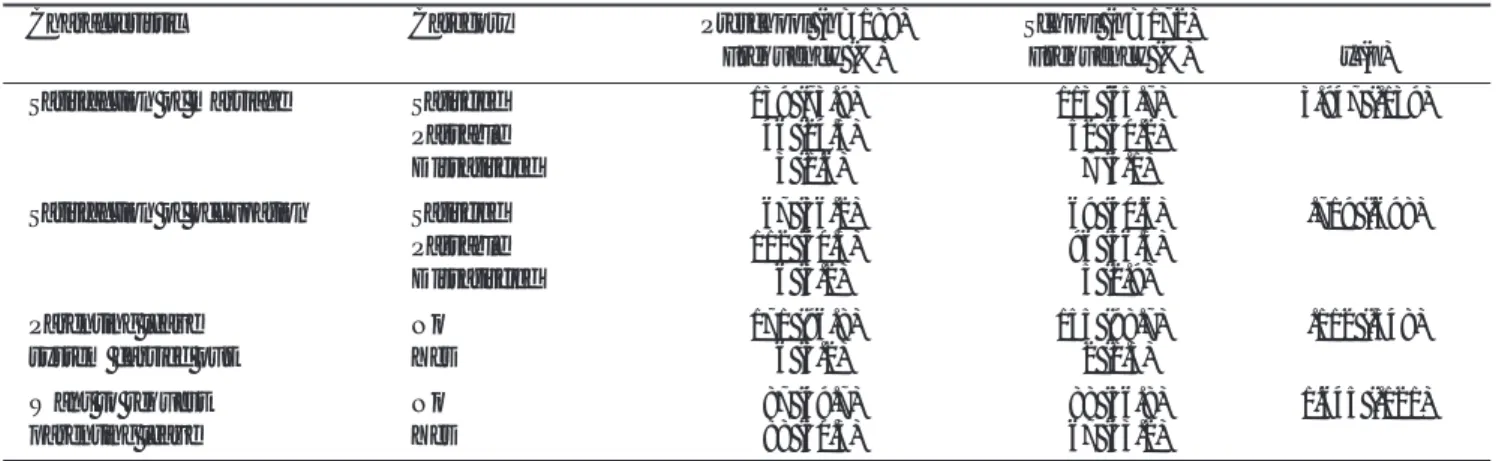
The rearing characteristics of the respondents are shown in Table 2. There were no statistically significant differences between two groups. Therefore these two groups regarding are identical group in rearing character- istics. On the level of satisfaction of marriage, respon- dents who answered ‘satisfied’ were the most and the numbers of them were 139 (73.9%) in the preschooler’s fathers group and 113 (65.7%) in the school children’s fathers group. On the level of satisfaction of occupation, respondents who answered ‘on the average’ were the most in both groups (60.5%, 56.5%).
On answers to the question ‘Is the parental leave sys-
Table 1. Homogeneity Test of Demographic Characteristics (N=361)
Characteristic Category Preschool (n=189) School (n=172)
x2(p) Frequency (%) Frequency (%)
Age 25-34 063 (33.4) 06 (3.5) 70.809 (.000)
35-44 123 (65.1) 138 (80.2)
45-54 03 (1.5) 028 (16.3)
M±SD 38.38±4.63 40.93±4.02
Education High school 068 (36.0) 073 (42.7) 4.096 (.117)
University 099 (52.4) 086 (50.3)
Master course≤ 022 (11.6) 12 (7.0)
Occupation Laborer 08 (4.2) 4 (2.4) 4.844 (.054)
Officer 055 (29.1) 026 (15.3)
Engineer 039 (20.6) 047 (27.6)
Professional 034 (18.0) 021 (12.4)
Service 23 (12.2) 017 (10.0)
Business 0030 (15.9) 055 (32.3)
Income 3,000> 128 (67.7) 120 (69.8) .175 (.381)
(thousand won/month) 3,000≤ 061 (32.3) 052 (30.2)
Spouse job existence No 102 (54.3) 093 (54.4) .001 (.532)
Yes 086 (45.7) 078 (45.6)
The number of children 1 050 (26.5) 023 (13.4) 9.843 (.007)
2 118 (62.4) 123 (71.5)
3≤ 021 (11.1) 026 (15.1)
Living with parents No 155 (83.3) 134 (79.3) .956 (.200)
Yes 031 (16.7) 305 (20.7)
※ No response was deleted in the frequency.
tem carried out in your office?’, the proportion of the re- spondents who said ‘no’ was more than 95% (96.8%, 98.7%). And on answers to the question ‘Would you re- quest for a parental leave if a parental leave program for fathers was carried out in your office?’, 88 persons (50.3%) in the preschooler’s fathers group and 67 per- sons (43.2%) in the school children’s fathers group replied ‘yes’.
Paternal rearing behavior
To identify the difference in the paternal rearing be- havior’s subcategories between the two groups (preschooler’s father group, school children’s father group), the ANCOVA test was used to control the two covariates, the number of children and the mean age.
The result of the test is presented in Table 3.
Comparing the two group’s means, the rearing activity score of the school children’s father group in sectors of
‘outdoor activity (F=13.778, p=.000)’ and ‘guidance on discipline activity (F= 4.846, p=.028)’ was significantly higher than the other group. Also, in the preschool chil- dren’s fathers group, ‘play interaction activity (F=11.422, p=.001)’ was statistically significant higher than the oth- er group’s rearing activity score.
In addition, ‘play interaction activity (2.76±.05)’ was
the highest item in the preschooler’s fathers group and
‘discipline activity (2.60±.07)’ was the highest item in the school children’s fathers group.
Paternal rearing stress
To identify the difference in the paternal rearing stress’s subcategories between the two groups, the AN- COVA test was used to control the two covariates, the number of children and the mean age. The result of the test is shown in Table 4.
The mean score of paternal rearing stress in the preschool children’s fathers group was statistically signifi- cant higher than the other group (F=4.959, p=.027). In particular, the child’s- part mean score was significantly higher in subcategories of paternal rearing stress (F=8.382, p=.004).
Correlation of paternal rearing behavior and pater- nal rearing stress
To identify the correlation of paternal rearing behavior and paternal rearing stress, a partial correlation test was used to control the two covariates, the number of chil- dren and the mean age. The result of the test is shown in Table 5.
In the preschooler’s father group, ‘daily activity (rac=-
Table 2. Homogeneity Test of Rearing Characteristics (N=361)
Characteristic Category Preschool (n=189) School (n=172)
Frequency (%) Frequency (%) x2(p)
Satisfaction of marriage Satisfied 139 (73.9) 113 (65.7) 3.947 (.139)
Passable 046 (24.5) 052 (30.2)
Dissatisfied 03 (1.6) 07 (4.1)
Satisfaction of occupation Satisfied 067 (36.2) 069 (40.6) .719 (.698)
Passable 112 (60.5) 096 (56.5)
Dissatisfied 06 (3.2) 05 (2.9)
Parenting leave No 171 (96.8) 155 (98.7) .112 (.548)
system carried out Yes 06 (3.2) 02 (1.3)
Want to request No 087 (49.7) 088 (56.8) 1.645 (.121)
parenting leave Yes 088 (50.3) 067 (43.2)
※ No response was deleted in the frequency.
Table 3. Difference of Paternal Rearing Behavior
Category Preschool (n=189) M±SD School (n=172) M±SD F(p)
Daily activity 2.43±.42 2.45±.44 00.100 (.752)
Outdoor activity 2.23±.06 2.55±.06 13.778 (.000)
Play interaction activity 2.76±.05 2.51±.05 11.422 (.001)
Guidance on discipline activity 2.39±.06 2.60±.07 04.846 (.028)
Total 2.44±.04 2.51±.04 01.501 (.221)
※ ANCOVA test was used to control the two covariates (the number of children, the mean age)
.236, p=.001; rbc=-.169, p=.021)’ and ‘play interaction activity (rae=-.228, p=.002; rbe=-.320, p=.000)’ has a statistically significant negative correlation with the two sub categories of paternal rearing stress. In the school children’s father group, ‘daily activity’ had a significantly negative correlation with the father-parts of paternal rearing stress (rb’c=-.187, p=.015) and ‘guidance on dis- cipline activity’ had a significant negative correlation with the child’s-part of paternal rearing stress (ra’f=- .187, p=.015).
Examining the correlation between paternal rearing behavior and paternal rearing stress without the divi- sion of subcategories, it can be shown that more pater- nal rearing behavior means less paternal rearing stress (r=- .198, p=.000).
DISCUSSION
Paternal rearing behavior
Recently, as interests in parenting and the role of par- ents have increased, studies on the fathers’ role in raising children have picked up and studies on tracing develop- ments of special parenting which is necessary in main- taining father’s role, are being conducted. (Bryant &
Zick, 1996; Canfield, 1995; Kim, 1998; Kim, 1998; Lee
& Kim, 2004).
In particular, strong relationships between fathers and their children during the pre-elementary period help children discover their talents, explore the world, and experiment things. In short, fathers play a huge role in mental development and personality development.
Based on respect and love towards their fathers, children can develop their sexual identity, self-esteem, and reality verification while at the same time learn to be separate from their mothers (Harrison, 2000; Hong et al., 2003;
Lee et al., 2003).
According to the rearing characteristics of respondents in this study, there were more than 45% of working cou- ples from both groups. Such results are in line with the essential change of which the focus on economical activ- ity in a family centered mostly on fathers, have had con- verted to centrally couple-minded after the 1998 Asian financial crisis (Kang, Lee & Song, 1998). As a bread- winner’s income dwindles or disappears, more women are starting to work to share the burden of finance, pri- vate education tuition or savings for their old ages.
These changes require reestablishment of the roles of husbands, wives, and the issue of raising children.
According to the results from the questionnaires in the study, more than 95% of the couples in both groups said that their companies do not allow them paternal leave.
As for the question that asked the couples if there is any system that allows fathers to requests parental leave in their office, almost the same number of fathering both groups answered that they do or do not want to use the system. That result suggests that, although there were many efforts since the year of 2002 to legally protect the parental leave system without any sexual discrimination and to provide paid parental leave, due to several rea- sons such as concern over reinstatement and unfavorable sentiments toward paternal leave in companies, fathers are still reluctant to use this policy. Also, the legally pro- Table 5. Correlation between Paternal Rearing Behavior and Paternal Rearing Stress
Parent Rearing Stress Preschool (n=189) r(p) School (n=172) r(p)
Total r (p)
Parent Rearing Behavior Child (a) Father (b) Child (a′) Father (b′)
Daily activity (c) -.236 (.001) -.169 (.021) - .139 (.070) - .187 (.015) - .205 (.000) Outdoor activity (d) -.021 (.776) -.042 (.569) -.071 (.355) -.135 (079) - .073 (.166) Play interaction activity (e) -.228 (.002) -.320 (.000) - .031 (.687) - .041 (600) - .148 (.005) Guidance on discipline activity (f) -.054 (.436) -.128 (.081) - .187 (.015) - .140 (069) - .176 (.001)
Total -.190 (.009) -.187 (.010) - .141 (.068) - .171 (026) - .198 (.000)
Table 4. Difference of Paternal Rearing Stress
Category Preschool (n=189) M±SD School (n=172) M±SD F(p)
Child-part 2.30±.04 2.14±.04 8.382 (.004)
Father-part 2.22±.03 2.16±.04 1.241 (.266)
Total 2.26±.03 2.15±.04 4.959 (.027)
※ ANCOVA test was used to control the two covariates(the number of children, the mean age)
tected parental leave can only be applied to fathers who have children younger than 12 months old and only one parent can use this leave, Therefore, it can be said that paternal leave is hard to implement.
Also, the study found that fathers who have children going to school have more impact on their children dur- ing outdoor and discipline activities than fathers with preschool children, whereas fathers who have preschool- ers have more impact in the area of play interaction ac- tivities. In other words, before children attend school, fa- thers tend to spend more time playing with their chil- dren physically while on the other hand, father’s meth- ods of teaching children during their attendance in school move onto more intellectual and mental levels.
This indicates a pattern that fathers help children to adapt naturally to school, do their homework or build up sound relationship with peers. The result is in the same context with other studies (Hoffman, 1989; Ishii-Kuntz, 1994; Jones, 2000; Lee & Kim, 2004; Stacy & Lynn, 1998).
Fathers with children attending school have more im- pact on their children’s outdoor activities than those who have children not attending school. The increasing of children’ outdoor activities, their curiosity being on the rise, and spending more time doing school home- work could contribute to this fact. Another pertinent study (Benzies, Harrison & Magill-Evans, 2004) found that a father’s participation in bringing up children not only helps children to grow more in intellectual and so- cial respects but also in physical respect. The study also said that a father’s attempt to heighten his physical level and activeness in rearing participation might be por- trayed as a good role model to the children. Also, Hoffman (1989) emphasized that if fathers are actively engaged in bringing up their children in various areas in a more conspicuous manner, children will respond more positively to them. Besides taking care of children direct- ly, fathers should be involved in playing or exercising with children, letting children help with the housework, teaching table manners, reading books, or holding dis- cussions over there children’s heath. Fathers also need to express their love and affection to their children and at- tentively look after them.
Despite the fact that fathers have a major impact on bringing up children both directly and indirectly, fathers have little access to information on rearing children due to insufficient information and lack of interest on the is- sue. As a result, child health care programs that enable
fathers to participate are currently not enough. Such pro- grams should be developed based on this study.
Paternal rearing stress
Human beings experience similar changes as they grow, and deal with stress caused by the growth process.
In other words, stress is inseparable from our daily life.
Normal development and growth of human beings al- ways entail stress (Laster, 1981). Abidin (1992) concep- tualized stress from daily life as ‘children rearing stress’
that could be produced from accomplishing parental roles. Also, he had recognized that the stress parents feel could work as an important valuable in affecting their rearing actions. In addition, he said that stress from par- enthood could lead to a negative relationship between parents and their children.
In the context of family development, stress produced during rearing children is natural. In particular, as the importance of the father’s role becomes more significant in the process, the form of the father’s stress is different from that of the mother’s and is affected by various fac- tors (Kim, 1998).
According to a study conducted by Kim (1998), pater- nal rearing stress is caused by natural stress during bring- ing up children, feeling the burden of parenting and con- science of guilty as others take care of their own chil- dren, etc. That stress is diverse according to the father’s income or spouse occupation. Also, he points out that self-respect of fathers affects their stress.
This study found that fathers who have preschoolers feel relatively less stress than their counterpart and no- tably, the fathers received more stress than the child’s- part. These findings suggest that as children grow, the in- teraction between parents and children changes, children are less controlled by their parents, and are allowed to have more freedom (Park, 1994). The study also re- vealed that in the case of fathers who have preschoolers, there was a negative correlation between the ‘daily activ- ity’ and the ‘play interaction activity’ fields of paternal rearing behavior and stress. This means that as a father’s daily activities and interaction with their children in- creases, his stress is reduced. Therefore, nursing pro- grams that help fathers to get rid of their stress caused by children rearing should include interactive activities that can be conducted at home.
Fathers who have children going to schools receive less paternal rearing stress as their interaction with their chil- dren increases. Like fathers who have preschoolers, daily
activities conducted at home are important factors dur- ing the school age period. Also, since children who go to schools have to add another role in life as learners, pa- ternal teaching at home can be important. Hence, as fa- thers spend more time teaching their children, they ob- tain more paternal rearing stress. Especially as paternal rearing stress caused by a child’s peculiarity increase, the physical and mental stress of the father also increases, and this can impose helplessness on the father-part. If this phenomenon occurs, the child’s peculiarity that makes the father feel incompetent should be recognized so that efficient paternal rearing can be achieved through specific and substantial support.
In several studies related to paternal rearing stress, Choi (1998) said that the level of the stress is different in accordance to children’s temperaments. In other words, if their children are picky, then fathers receive more pa- ternal rearing stress. Also, other family-environmental factors such as the relationship between couples, satis- faction of marriage life, health states of the father and other family members affect paternal rearing stress.
Seok (2001) said that father’s participation in bringing up children and children rearing stress not only directly helps children’s health and development, but also affects family happiness and well-being. If the father’s role in rearing children increases and resolutions are found to reduce children rearing stress, mothers will be supported mentally and positive interaction among family mem- bers will improve. Stacy & Lynn (1998) reported that in the case of fathers who are raising their first child, these fathers show similar patterns of rearing stress among themselves. In order for fathers to concentrate on bring- ing up their children and reducing their burden of par- enthood, paternal education programs centered by health organizations or community-based clinics could help effectively.
This study concludes that fathers play an integral role in bringing up children by generating positive impacts on the whole family. Moreover, the fathers themselves are reminded of the importance of children rearing.
Therefore, by emphasizing nursing and health issues, health-related educational programs can be continuously established in the future so that fathers could fulfill their position as a vital supporter for their children.
CONCLUSION
This study was designed as a descriptive comparative
survey to identify the paternal rearing behavior and pa- ternal rearing stress of fathers with pre-school children and fathers with school children’s.
Respondents for this study were 361 fathers who had either preschoolers (n=189) or children of elementary age (n=172). Preschoolers are from 3 to 7 years old and elementary students are from 8 to 13 years old.
Respondents currently live with their children and a spouse. They have agreed to participate in this survey.
The data were analyzed by the SPSS/PC program with descriptive statistics, x2-test and ANCOVA test and the partial correlation test.
In the social demographic characteristics of the Respondents, statistically, significant differences were found in ‘age (x2=70.809, p=.000)’, and ‘the number of children (x2=9.843, p= .007)’ between respondents who have preschool children and those who have school chil- dren.
Comparing the two groups’ means using the ANCOVA test, the rearing activity score of the school children’s fa- ther group in sectors of ‘outdoor activity (F=13.778, p=
.000)’ and ‘guidance on discipline activity (F=4.846, p=
.028)’ was statistically significant higher than the other group. Also, in the preschool children’s fathers group,
‘play interaction activity (F=11.422, p=.001)’ was signifi- cantly higher than the other group’s rearing activity score.
To identify the difference in the paternal rearing stress’s subcategories between the two groups, the AN- COVA test was used, and the mean score of paternal rearing stress in the preschool children’s fathers group was significantly higher than the other group (F=4.959, p=.027). In particular, the child-part mean score was sta- tistically significant higher in subcategories of paternal rearing stress (F=8.382, p=.004).
To identify the correlation of paternal rearing behavior and paternal rearing stress, a partial correlation test was used. In the preschooler’s father group, ‘daily activity (rac=-.236, p=.001; rbc=-.169, p=.021)’ and ‘play in- teraction activity (rae=-.228, p=.002; rbe=-.320, p=.000)’ had a significantly negative correlation with the two subcategories of paternal rearing stress. In the school children’s father group, ‘daily activity’ had a sig- nificantly negative correlation with the father-parts of paternal rearing stress (rb’c=-.187, p=.015) and ‘guid- ance on discipline activity’ had a significant negative cor- relation with the child-part of paternal rearing stress (ra’f=-.187, p=.015). Examining the correlation between
paternal rearing behavior and paternal rearing stress without the division of subcategories, it can be shown that more paternal rearing behavior means less paternal rearing stress (r=-.198, p=.000). These correlation coef- ficients are relatively low, the findings might not be ap- plicable to practice at this time. However, significant neg- ative correlations indicates the need for further research.
This study concludes that fathers play an integral role in bringing up children by generating positive impacts on the whole family. Moreover, the fathers themselves are reminded of the importance of children rearing.
Therefore, by focusing on nursing and health issues, health-related educational programs can be continuously established in the future in order to improve paternal rearing behavior and diminish paternal rearing stress.
Refereces
Abidin, R. R. (1992). The determinants of parenting behavior, Journal of Consulting and Clinical psychology, 21, 407-412.
Benzies, K. M. Harrison, M. J. Magill-Evans, J. (2004). Parenting and childhood behavior problems: Mothers’ and fathers’ voic- es, Issues in mental health nursing, 25(1), 9-24.
Bigner, J. J. (1977). Attitude forward fathering and father-child ac- tivity. Home Economics Research Journal, 6(2), 99-106.
Bryant, W. K., & Zink, C. D. (1996). An examination of parent- child shared time. Journal of Marriage and the Family, 58(1), 227-237.
Canfield, K. R. (1995). Effective fathering practices and fathering satisfaction related to father’s life course, Unpublished doctor- al dissertation, Kansas State University.
Choi, K. S. (1992). The relationship between social competency of the child and the child rearing involvement of the father.
Journal of Child Study, 14(2), 115-135.
Choi, Y. H. (1998). The relationship between young child’s tem- perament and parenting stress of father’s. Unpublished mas- ters dissertation. Sookmyung Women’s University, Seoul.
Chung, D. H. (1998). A study on the relations of a mother’s child- rearing attitude perceived by an infant with the infant’s social competence and the mother’s child-rearing stress. Journal of Korean Open Association for Early Childhood Education, 3(1), 145-171.
Do, H. S., & Kim J. S. (1997). Social support parent-satisfaction and mothers’ parenting behaviors. Journal of the Korean Home Economics Association, 35(6), 127-135.
Harrison, M. J. (2000). Scores on the Nursing Child Assessment Teaching Scale for Father-Toddler Dyads. Public health nurs- ing, 18(2), 94-100.
Hoffman, L. W. (1989). Effects of maternal employment in the two-
parent family, American Psychologist, 44, 283-292.
Hur, S. J. (1992). An analysis on the variables contributing to the father’s role perceptions and involvement behaviors. The Journal of Educational Research, 31(5), 131-152.
Ishii-Kuntz, M. (1994). Parental involvement and perception to- ward fathers’ role: A comparison between Japan and United States. Journal of Family Issues, 15(1), 30-48.
Jones, D. J. (2000). Maternal and Paternal Parenting During Adolescence: Forecasting Early Adult Psychosocial Adjustment. Adolescence, 35(3), 513-530.
Kang, M. H., Lee K. J. & Song B. K. (1998). The Change of Family Life Pattern Since IMF. Research of woman, 13(1), 5-32.
Kim, K. H. (1998). A study on the parenting stress of fathers, Journal of the Korean Home Economics Association, 36(9), 49-62.
Kim, K. W., & Park S. Y. (1996). The role of the Father in Child Development(edited by Michael E. L, 1981), Ewha Womans University Press, Seoul.
Kim, Y. H. (1998). Literature review on infant rearing of father.
Korean Parent-Child Health Journal, 1(1), 75-85.
Laster, J. F. (1981). Toward and Understanding of Stress. Journal of Home Economics, 73(3), 17-19.
Lee, J. H. (2000). The relationship between rearing stress of mother and maladaption behavior of child. Unpublished masters dis- sertation. Konkuk University, Seoul.
Lee, J. H., Ha, Y. S., Kim, L. O., Kim, H. Y., Park, Y. A., Oh, J. A., Lee, J. E., & Jang E. Y (2003). Children Nursing /, Shinkwang press Co.
Lee, J. H., & Kim H. Y. (2004). Paternal rearing behaviors of preschool children’s fathers. Korean Parent-Child Health Journal, 7(1), 50-60.
Park, H. M. (1994). A study on parental stress based on the parent- ing of young children. Unpublished masters dissertation, Ewha Womans University, Seoul.
Seok, I. S. (2001). The effects of cyber education on the stress relat- ed to rearing and the acceptance in fathers’ of child with de- velopmental disorder. Unpublished masters dissertation, Taegu University, Daegu.
Stacy, J. R., & Lynn, K. W. (1998). Satisfaction with parenting: The role of marital happiness, family structure, and parents’ gen- der. Journal of Marriage and the Family, 60, 293-308.
Sung, S. H. (1996). The relationship between children’s achieve- ment motivation and father’s involvement in raising children.
The Journal of Child Education, 5(2), 54-72.
Tiller, C. M. (1995). Father’s Parenting Attitudes During a Child’s First year, JOGNN, 24(6), 508-514.
Yang, M. K (1996). A study on parental child rearing involvement and parental satisfaction. Journal of the Korean Home Economics Association, 34(4), 87-101.
Yang, K.H. (2000). A study on the marital satisfaction and rearing stress of mother of the autistic children and non-autistic chil- dren. Unpublished masters dissertation, Honam University, Kwangju.