Effects of Manual Lymph Drainage on the Activity of Sympathetic Nervous System, Anxiety, Pain, and Pressure Pain Threshold in Subjects with Psychological Stress
Purpose: The aim of this study was to investigate the effects of manual lymph drainage (MLD) on the activity of sympathetic nervous system, anxiety, pain and pressure pain threshold in subjects with psychological stress.
Methods: Twenty-nine subjects with psychological stress were randomly assigned to experimental (MLD) and control (rest) groups. This study was performed as a controlled, randomized study using spectral analysis of electrocardiographic (ECG) activities, the State-Trait Anxiety Inventory (STAI), Visual Analogue Scale (VAS) and Pressure Pain Threshold (PPT).
Results: Heart rate variability differed significantly between the experimental and control groups (p<0.05). Anxiety and pain showed positive change in both group but it were not showed statically differences. The pressure pain threshold in the upper trapezius muscle was increased in the experimental group (p<0.05).
Conclusion: These findings indicate that the application of MLD was effective in reducing the activity of the sympathetic nervous system, anxiety, pain, and increasing the PPT
Key Words:Manual lymph drainage, Pain, Psychological stress Sung-Joong Kim
Department of Physical Therapy, College of Health Science, Kangwon National University
The Journal of Korean Society of Physical Therapy Original articles
I. Introduction
Psychological stress is one of the most frequent complaints made by not only normal people but also patients.1 Such stress can be divided into positive stress (eustress) such as joy or pleasure and negative stress (distress) caused by anxiety, restlessness, and others. Most people face difficulties in psychological, physical, and social aspects due to negative stress.2-4
Although it is psychological stress, it directly and indirectly
Copylight ⓒ 2014 The Korea Society of Physical Therapy
This is an Open Access article distribute under the terms of the Creative Commons Attribution Non-commercial License (Http:// creativecommons.org/license/by-nc/3.0.) which permits unrestricted non-commercial use, distribution,and reproduction in any medium, provided the original work is properly cited.
Received Nov 6, 2014 Revised Dec 10, 2014 Accepted Dec 16, 2014
Corresponding author Sung-Joong Kim, [email protected]
induces physical illness followed by negative emotional state and then cause tension, anxiety, anger, frustration, and others.5 Once people are under stress with such negative influence, body goes through recovery process by homeostasis to restore physical condition and assist normal growth of cell.
With continuous exertion of stress or chronic stress, however, the activity of autonomic nervous system is not reduced and thus becomes more susceptible to infection.5,6 Due to such reasons, psychological stress may bring about illness to normal people and furthermore delay physical recovery of patients with infection or under healing process.7,8
In the field of physical therapy, not only physical treatment but also various approaches to reduce stress in mental aspect may become another method to assist physical treatment at the end. Since numerous sensory receptors are placed on the skin, there are various physical therapies that can induce
this study was randomly divided into two groups and assigned to either experimental (MLD) group or control (rest) group.
All subjects were to participate in experiment after voluntarily signing the informed consent.
2. Measurement tools 1) ECG
The change in autonomic nerve followed by the change in stress was quantitatively assessed with heart rate variability which is used as objective index15-17 for emotional response toward the stimulation. ECG signal was to be displayed in 2 channel monitor and circumstances of experiment was controlled and the data was saved using laptop computer.
ECG signal was digitalized at 256 Hz using 12-bit analog- to-digital converter and TeleScan software package (LAXTHA, Daejeon, Korea) which detects the point of R waves’
appearance was used for processing. Heart rate variability was calculated using power spectrum analysis (frequency domain).
ECG variable was used as data value through designation as following. Low frequency and high frequency rate were calculated based on the result of power spectrum analysis.
2) The State-Trait Anxiety Inventory (STAI)
STAI is most commonly used surveys on state-trait anxiety18 and it is composed of 20 items regarding current state of experiment participants. The degree of anxiety was to be expressed in format of “not anxious”, “little anxious”,
“anxious”, and “very anxious”. In regards to STAI, total point of STAI ranges from 20 to 80 and increase in point signifies higher anxiety index.19-21
positive emotion through adequate stimulation of skin. Manual lymph drainage (MLD) among them is one of representative physical treatment technique which can increase physical immunity and accelerate the recovery through not only body fluid control of dermal layer, removal of metabolites, and others but also emotional well-being, decrease in sympathetic nerve activity, and others by stimulating the dermis with abundant distribution of sensory receptors rather than applying strong pressure to the core.9
MLD is one of manual therapies created by physical therapist Dr. Vodder. Although it is a sector of physical therapy, its application is completely different from normal massage.9 it is composed of 4 basic strokes (stationary circle, scoop, pump, and rotary) for very smooth and light application to broad area of skin. Many studies have been conducted on the effect of MLD and it is applied to various fields including medicine, aesthetics, and others.9-13
Although many studies have been conducted regarding effect of normal massage on stress, no study has been conducted regarding the effect of MLD on the activity of sympathetic nervous system, anxiety, pain and pain threshold of people with psychological stress. Accordingly, purpose of this study lies in examining the effect of MLD on people with psychological stress.
Ⅱ. Methods
1. Subjects
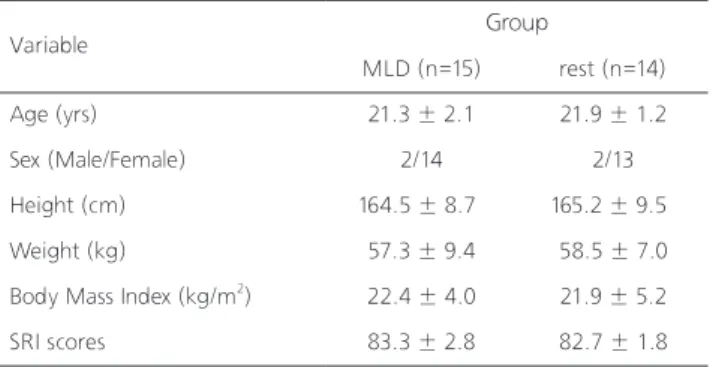
111 physically healthy adult male and female participated as the subject of this study. In regards to the criteria for subject screening, the subjects with stress were screened primarily by instructing those without mental illness, not under medication that can influence electrocardiogram (ECG) signal, and without heart or muscle related diseases to answer stress response Inventory (SRI) developed by Koh et al14 used as stress screening index. This survey is composed of 39 questions on stress related situation (namely, emotional, cognitive, physical, or behavioral) and those with stress were selected as the subject of this study as a result of survey. Then, the 29 subjects with over 80 points in final stress response survey were to participate in this experiment (Table 1). Subject of
Variable Group
MLD (n=15) rest (n=14)
Age (yrs) 21.3 ± 2.1 21.9 ± 1.2
Sex (Male/Female) 2/14 2/13
Height (cm) 164.5 ± 8.7 165.2 ± 9.5
Weight (kg) 57.3 ± 9.4 58.5 ± 7.0
Body Mass Index (kg/m2) 22.4 ± 4.0 21.9 ± 5.2
SRI scores 83.3 ± 2.8 82.7 ± 1.8
Table 1. Homogeneity test for general characteristics (n=29)
MLD: Manual lymph drainage, SRI: stress responses inventory.
3) Visual Analogue Scale (VAS)
In regards to the intensity of pain, degree of pain felt from upper trapezius muscle was measured using 10-mm visual analog scale (VAS). From the scale from 0 to 10, it was set so that 0 signifies no pain and 10 signify intolerable pain.
Participants were to express the degree of pain at each measurement. Reliability for visual analog scale of pain is very high presenting r=0.9922 and it is also reported to present very high construct validity.23
4) Pressure Pain Threshold (PPT)
In regards to the pressure pain, change in muscular tension associated with change in autonomic nervous system followed by psychological stress was measured using pressure pain threshold measurement recommended by Fisher and Fluegee24, Fisher et al25 using pressure algometer (Algometer Commander, JTECH Medical, USA). After explaining the experiment procedure, subjects were comfortably seated to a chair which enables upright posture. Researcher measured the pressure generated from the point of intolerable pain occurrence after gradual increase of pressure at speed of about 0.5 kg/s to trigger point of upper trapezius muscle on both sides and it was used as pressure pain threshold. After three measurements at same location, analysis was conducted using average value calculated from both sides of trapezius muscle.
After measuring with same method with the application of MLD, it was used as a value to compare before and after application of MLD.
3. Intervention
1) Experimental environment
All experiments were conducted on massage table in supine position with pillow under the knee for maximum relaxation of lumbar muscles. In order to minimize environmental effect at data collection and MLD application, indoor temperature was maintained at 22~24℃ with silence. Activity of sympathetic nerve was controlled by regulating the conversation, phone conversation and other noise. Participants were instructed to take comfortable rest at least 5 minutes before basic data collection and ECG was conducted for 5 minutes before the execution of MLD.
2) Intervention procedure
Participants were applied of same methods to neck for 15 minutes under supine position accordingly with the procedure.
All MLD was applied with same order and time based on MLD guideline9 by physical therapist who receives certified education from Dr. Vodder’s School. It takes 7 minutes for total application and it was executed twice in order to bring about better treatment effect. MLD was executed with focus on lymphatic system on both sides of neck and parts with vagal ganglion distribution in this study and maximum skin stretch was induced as gently as possible. Same environment and condition were set for control group and participants were to take comfortable rest with same length as MLD application time.
4. Statistical analysis
Data are given as mean ± SD values. All variables were tested for normality using the one-sample Kolmogorov-Smirnov test and did have a normal distribution. An unpaired t-test was used to test for homogeneity and to compare the MLD and rest groups for differences in variables after intervention.
The collected data were analyzed using a statistical package program (SPSS ver. 19.0). A two-tailed probability of p<0.05 was considered statistically significant.
Ⅲ. Results
1. The activities of sympathetic nervous system
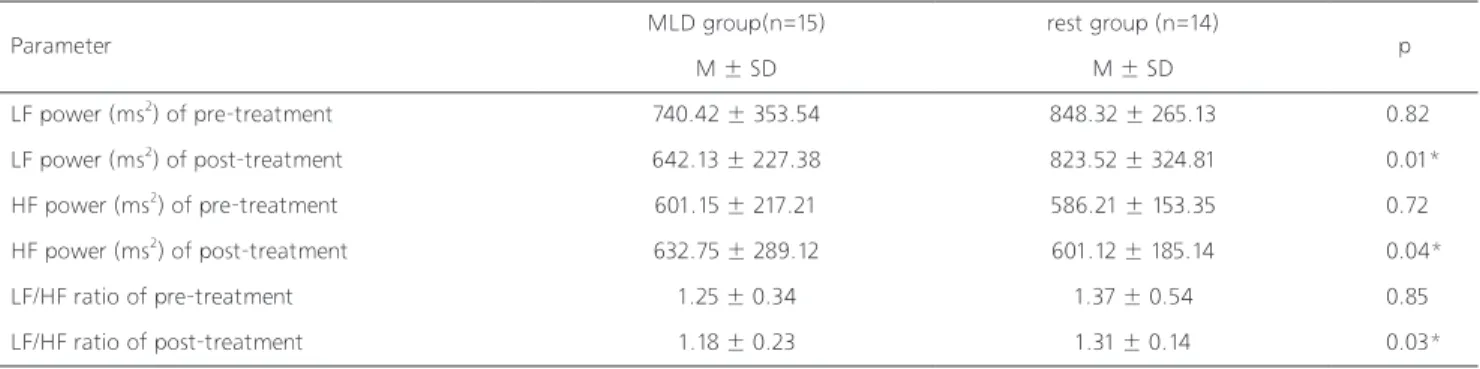
Comparing before and after experiment using LF and HF of ECG, deceased the activity of sympathetic nervous system and increased the activity of parasympathetic nervous system both MLD and rest group. Moreover, it showed significantly change in MLD group. LF/HF ratio was significantly increased in the MLD group than in the rest group (Table 2).
2. STAI
Comparing before and after experiment using state-trait anxiety inventory, decrease in anxiety was presented in both MLD group and rest group. However, it did not present statistically significant difference (Table 3).
3. Pain
the intervention and threshold of rest group did not present distinctive change presenting change from 24.45±2.5 to 23.28±4.3. Pressure pain threshold of MLD group after intervention presented statistically significant difference then rest group (Table 4).
Ⅳ. Discussion
The purpose of this study lies in examining the effect of MLD on activity of sympathetic nervous system, anxiety, pain, and PPT of people with psychological stress. Although there was a previous study13 examining the effect of MLD on As a result of comparing the degree of pain in upper trapezius
muscle using VAS, MLD group presented the decrease from 5.4±1.2 to 5.2±1.1 and rest group presented the change of 5.2±0.9 after application from 5.3±1.4. However, it did not present statistically significant difference in both groups (Table 4).
4. PPT
Change in muscular tension based on change in autonomic nervous system was examined through change in PPT regarding the intervention. Threshold of MLD group increased from 24.32±3.3 to 26.54±2.7 before and after
Parameter MLD group(n=15) rest group (n=14)
M ± SD M ± SD p
LF power (ms2) of pre-treatment 740.42 ± 353.54 848.32 ± 265.13 0.82
LF power (ms2) of post-treatment 642.13 ± 227.38 823.52 ± 324.81 0.01*
HF power (ms2) of pre-treatment 601.15 ± 217.21 586.21 ± 153.35 0.72
HF power (ms2) of post-treatment 632.75 ± 289.12 601.12 ± 185.14 0.04*
LF/HF ratio of pre-treatment 1.25 ± 0.34 1.37 ± 0.54 0.85
LF/HF ratio of post-treatment 1.18 ± 0.23 1.31 ± 0.14 0.03*
Parameter MLD group(n=15) rest group (n=14)
M ± SD M ± SD p
VAS score of pre-treatment 5.4 ± 1.2 5.3 ± 1.4 0.12
VAS score of post-treatment 5.2 ± 1.1 5.2 ± 0.9 0.25
PPT of pre-treatment (kg/cm2) 24.32 ± 3.3 24.45 ± 2.5 0.18
PPT of post-treatment (kg/cm2) 26.54 ± 2.7 23.28 ± 4.3 0.03*
Parameter MLD group(n=15) rest group (n=14)
M ± SD M ± SD p
Scores of pre-treatment 45.24 ± 3.21 44.85 ± 4.12 0.67
Scores of post-treatment 39.47 ± 5.97 41.39 ± 4.35 0.21
Table 2. The immediate effects of MLD on activity of sympathetic nervous system (n=29)
Table 4. The immediate effects of MLD on activity of sympathetic nervous system (n=29) Table 3. The immediate effects of MLD on anxiety (n=29)
MLD: manual lymph drainage.
M: mean, SD: standard deviation, LF: low frequency, HF: high frequency.
*significant different compared with the value of rest group at p<0.05.
MLD: manual lymph drainage.
M: mean, SD: standard deviation, VAS: visual analogue scale, PPT: pressure pain threshold.
*significant different compared with the value of rest group at p<0.05.
MLD: manual lymph drainage.
autonomic nervous system and pain, it was conducted with normal people as its subject. Clinical significance of this study considered to be great as no study has been conducted on people which psychological stress. Consideration on conducted research is as following.
Analysis using heart beat variability is used as very sensitive index presenting the activity of autonomic nervous system which provides quantitative information on mechanism of autonomic nerve control.15,17,26,27 Significant difference was presented for LF and LF/HF ratio between two groups after the intervention. LF value in MLD group was significantly lowered compared to that of control group and there was increase in LF/HF ratio and HF value. This signifies that application of MLD to neck was effective in decreasing the activity of sympathetic nervous system compared to control group which only took rest although application method and time was different compared to previous studyl3 conducted with normal people as its subject. In general, HF value between 0.15 and 0.4 Hz is indirect index of parasympathetic (vagus) nerve flowing into the heart and LF value is associated with a wave known as Mayer waves relevant to blood pressure control. It is applicable to 0.1 Hz and used as index which reflects activity of sympathetic nerve.15,16 LF/HF ratio of MLD group presented statistically significant decrease compared to that of control group in this study and it signifies the increase in activity for parasympathetic nerve of heart. Based on previous findings28 of research which suggests that increase in activity of parasympathetic nerve increases the relaxation of overall body, it signifies that there has been a neurological change when adequate stimulation has been exerted to body with application of MLD.
Both MLD group and rest group showed a general decrease in immediate effects of STAI scores. STAI scores in the MLD group were significantly reduced in anxiety compared with the rest group. But, there were no significant differences between the groups after intervention. Our findings are probably the result of an increased relaxation response and an overall reduction in the defence-arousal (stress) response as a result of MLD, possibly mediated by increased parasympathetic and decreased sympathetic activity. Field et al.29 reported that moderate pressure massage contributed to increased
dopamine which leads to decreased norepinephrine levels;
there anxiety levels are decreased.30 Since MLD is a kind of very gentle pressure massage, it is possible that the same mechanism was at least partly responsible for the decrease in anxiety observed in this study. Pain change on MLD group was not significantly showed. But, it was generally decreased after intervention on both groups. Especially in MLD group.
MLD may increase pain-relieving neurotransmitters such as serotonin which leads to decreased pain intensity. Serotonin has been noted to increase following massage therapy in several pain syndrome.29
Immediately after MLD and rest, MLD group showed a general increase in pressure pain threshold. It means that the MLD group showed a significantly greater reduction in muscle tension on upper trapezius when compared to the rest group. MLD may be able to decrease sympathetic responses and increase parasympathetic responses in the neuromuscular system (sympathicolytic action). Light rhythmic stimulation such as MLD of the skin on nociceptive receptors may have a pain-inhibiting effect.27 In the gate control theory of pain, Wall and Melzack31 explain how light mechanical stimulation can help to reduce the intensity of pain. Many clinical applications of the algometer have been documented, including evaluation25 and identification of trigger points, and evaluation of pain sensitivity.24,25 The PPT of a muscle is the pressure level at which the patient reports that the feeling of pressure changes into a painful sensation.24 Autonomic nerves extend to all parts of the skin; blood vessels, lymphatic vessels, and soft connective tissue ground substance. Signals from the special senses acting via the limbic system and hypothalamus influence the responses of the ANS.9,32 The improvement in pain threshold following MLD are probably due to an increased relaxation response and an overall reduction in the defense-arousal (stress) responses, and are possibly mediated by increased parasympathetic activity.
The present study shows that MLD is a safe and noninvasive technique that is effective in inducing relaxation in normal subjects. It is a relatively simple technique to learn, and under correct instruction could be taught to the caregivers of patients who could benefit from MLD. Whilst it is imprudent to generalize from a healthy population to those
6. Hughes JW, Stoney CM. Depressed mood is related to high- frequency heart rate variability during stressors. Psychosom.
Med. 2000;62(6):796-803.
7. Decker D, Schondorf M, Bidlingmaier F et al. Surgical stress induces a shift in the type-1/type-2 T-helper cell balance, suggesting downregulation of cell-mediated and up-regulation of antibody-mediated immunity commensurate to the trauma.
Surgery. 1996;119(3):316-25.
8. Lawrence DA, Kim D. Central/Peripheral nervous system and immune responses. Toxicology. 2000;142(3):189-201.
9. Wittlinger H, Wittlinger D, Wittlinger A, et al. Dr. Vodder’s Manual Lymph Drainage – A Practical Guide-. New York:
Thieme, 2011:5-32.
10. Cavezzi A and Michelini S. Phlebolymphoedema –From diagnosis to therapy- . Bologna: Edizioni P.R, 1998:36-54.
11. Chikly B. Theory of Practice of Lymph Drainage Therapy.
Arizona: I. H. H. Publishing, 2001:201-82.
12. Kasseroller RG. The Vodder School: The Vodder Method. Cancer.
1998;83(12):2840-2.
13. Kim SJ, Kwon OY, Yi CH. Effects of manual lymph drainage on cardiac autonomic tone in healthy subjects. In J Neurosci.
2009;119(8):1105-17.
14. Koh KB, Park JK, Kim CH. Development of the Stress Response Inventory and its application in clinical practice. Pschosom Med.
2001;63(4):668-78.
15. Pomeranz B, Macaulay RJ, Caudill MA et al. Assessment of autonomic function in humans by heart rate spectral analysis.
Am J Physiol. 1985;248(1 Pt 2):151-3.
16. Schumacher A. Linear and Nonlinear Approaches to the Analysis of R-R Interval Variability. Biol Res Nurs.
2004;5(3):2115-21.
17. Task Force of the European Society of Cardiology and the North American Society of Pacing and Electrophysiology.
Heart rate variability: standards of measurement, physiological interpretation, and clinical use. Circulation. 1996;93(5):1043-65.
18. Spielberger CD, Gorsuch RL, Lushence RE. STAI manual for the state-trait anxiety inventory. CA: Consulting Psychologists Press, 1970:25-124.
19. Fisher P, Durham R. Recovery rates in generalized anxiety disorder following psychological therapy: an analysis of clinically significant change in the STAI-T across outcome studies since 1990. Psychol Med. 1999;29(6):1425-34.
20. Jacobson N, Truax P. Clinical significance: a statistical approach to defining meaningful change in psychotherapy research. J Consult Clin Psychol. 1991;59(1):12-9.
21. Wang SM, Escalera S, Lin EC et al. Extra-1 acupressure for children undergoing anesthesia. Anesth Analg. 2008;107(3):811-6.
22. Gallagher EJ, Bijur PE, Latimer C et al. Reliability and validity of a visual analog scale for acute abdominal pain in the ED. The with disease, certain conditions are characterized by increased
sympathetic tone and reduced HRV, and these conditions might show a relaxation response following MLD that may benefit the sympathovagal balance.
There were some limitations of this study including the lack of subjects and therapist blinding. However, it is because of the nature of treatments which make it difficult to conduct.
Future studies may use the other treatment in the control group and replicate the present finding with other types of subjects.
In conclusion, the present study was the report of the immediate effects on the activity of sympathetic nervous system, anxiety, pain, and PPT using ECG, STAI, VAS and pressure pain algometer. The study provides insight into physiological changes of reduction of psychological stress with MLD. These findings reveal that 15-min of MLD at the neck region produces increase of parasympathetic nerve activity, decrease of anxiety and increase in pressure pain threshold. It is recommended that MLD be considered as one of the manual therapies for stress in subjects with psychological stress.
Acknowledgements
This study was supported by 2014 research Grant from Kangwon National University.
References
1. Dimsdale JE. Psychological stress and cardiovascular disease. J Am Coll Cardiol. 2008;51(13):1237-46.
2. Seo SH, Lee JT. “Stress and EEG,” Convergence and Hybrid Information Technologies. InTech. 2010;413-26.
3. Healey JA, Picard RW. “Detecting Stress During Real-World Driving Tasks Using Physiological Sensors,” IEEE Transactions on Intelligent Transportation Systems. 2004;6(2):1-19.
4. Handri S, Nomura S, Nakamura K. “Detecting Stress Based on the Schedule of an Intermittent Mental Workload Using Physiological Sensor,” in Proceedings of the 11th International Conference on Humans and Computers. 2008;123-6.
5. Cohen H, Benjamin J, Geva AB et al. Autonomic dysregulation in panic disorder and in post-traumatic stress disorder:
application of power spectrum analysis of heart rate variability at rest and in response to recollection of trauma or panic attacks. Psychiatry Res. 2000;96(1):1-13.
american journal of medicine. 2002;20(4):287-90.
23. Wilkie D, Lovejoy N, Dodd M et al. Cancer pain intensity measurement: Concurrent validity of three tools-finger dynamometer, pain intensity number scale, visual analogue scale. Hosp J. 1990;6(1):1-13
24. Fisher AA. Pressure threshold meter: its use for quantification of tender spots. Arch Phys Med Rehabil. 1986;67(11): 836-8.
25. Fisher AA. Documentation of myofascial trigger points. Arch Phys Med Rehabil. 1988;69(4):286-91.
26. Pagani M, Malliani A. Interpreting oscillations of muscle sympathetic nerve activity and heart rate variability. J hypertens. 2000;18(12):1709-19.
27. Pagani M, Malfatto G, Pierini S et al. Spectral analysis of
heart rate variability in the assessment of autonomic diabetic neuropathy. J Auton Nerv Syst. 1998;23(2):143-53.
28. Benson, Herbert, Beary et al. The relaxation response.
Psychiatry. 1974;37(1):37-46.
29. Field T, Diego M, Hernandz-Reif M. Massage therapy research.
Developmental Review, 2007;27(1):75-89.
30. Glover V, Teixeira J, Gitau R, Fisk NM. Mechanisms by which maternal mood in pregnancy may affect the fetus. Contemp Rev Obstet Gynaecol. 1999;11:155-60.
31. Wall PD, Melzack R. Textbook of Pain. Edinburgh: Churchill Livingstone. 1994:32.
32. Ebner. M. Connective Tissue Manipulation: Theory and Therapeutic Application. Florida: Krieger Pub Co, 1985:25-56.