• 검색 결과가 없습니다.

Lymphangiographic Interventions to Manage Postoperative Chylothorax

N/A
N/A
Protected

Academic year: 2021

Share "Lymphangiographic Interventions to Manage Postoperative Chylothorax"

Copied!
7
0
0

로드 중.... (전체 텍스트 보기)

전체 글

(1)

ISSN: 2233-601X (Print) ISSN: 2093-6516 (Online)

Received: January 4, 2019, Revised: June 3, 2019, Accepted: June 5, 2019, Published online: October 5, 2019

Corresponding author: Hyo Yeong Ahn, Department of Thoracic and Cardiovascular Surgery, Pusan National University Hospital, Medical Research Institute, Pusan National University School of Medicine, 179 Gudeok-ro, Seo-gu, Busan 49241, Korea (Tel) 82-51-240-7267 (Fax) 82-51-243-9389 (E-mail) [email protected]

Dr. Kwon equally contributed as co-corresponder.

© The Korean Society for Thoracic and Cardiovascular Surgery. 2019. All right reserved.

This is an open access article distributed under the terms of the Creative Commons Attribution Non-Commercial License (http://creativecommons.org/

licenses/by-nc/4.0) which permits unrestricted non-commercial use, distribution, and reproduction in any medium, provided the original work is properly cited.

Lymphangiographic Interventions to Manage Postoperative Chylothorax

Hyuncheol Jeong, M.D. 1 , Hyo Yeong Ahn, M.D. 1 , Hoon Kwon, M.D. 2 , Yeong Dae Kim, M.D. 1 , Jeong Su Cho, M.D. 1 , Jungseop Eom, M.D. 3

1
Department of Thoracic and Cardiovascular Surgery, Pusan National University Hospital, Pusan National University Medical Research Institution;

2

Department of Radiology, Pusan National University Hospital;

3

Department of Internal

Medicine, Pusan National University Hospital, Pusan National University Medical Research Institution, Busan, Korea

Background: Postoperative chylothorax may be caused by iatrogenic injury of the collateral lymphatic ducts after thoracic surgery. Although traditional treatment could be considered in most cases, resolution may be slow. Radiological interventions have recently been developed to manage postoperative chylothorax. This study aimed to compare radiological interventions and conservative management in patients with post- operative chylothorax. Methods: We retrospectively reviewed periprocedural drainage time, length of hospital stay, and nil per os (NPO) duration in 7 patients who received radiological interventions (intervention group [IG]) and in 9 patients who received conservative management (non-intervention group [NG]). Results: The baseline characteristics of the patients in the IG and NG were comparable; however, the median drainage time and median length of hospital stay after detection of chylothorax were significantly shorter in the IG than in the NG (6 vs. 10 days, p=0.036 and 10 vs. 20 days, p=0.025, respectively). NPO duration after chylo- thorax detection and total drainage duration were somewhat shorter in the IG than in the NG (5 vs. 7 days and 8 vs. 14 days, respectively). Conclusion: This study showed that radiological interventions reduced the duration of drainage and the length of hospital stay, allowing an earlier return to normal life. To overcome several limitations of this study, a prospective, randomized controlled trial with a larger number of patients is recommended.

Key words: 1. Chylothorax 2. Lymphography 3. Postoperative care 4. Thoracic duct 5. Thoracic surgery

Introduction

Postoperative chylothorax may be caused by iatro- genic injury of the collateral lymphatic ducts after thoracic surgery. In most cases, traditional treatment is prescribed; however, recent studies reported suc-

cess rates of 16%–75% depending on the daily out-

put [1-4]. It is especially difficult for elderly patients

to endure nil per os (NPO) status during the post-

operative period, as it causes lethargy and prevents

active rehabilitation. To maximize the likelihood of

early recovery, pleurodesis may be the treatment of

https://doi.org/10.5090/kjtcs.2019.52.6.409

(2)

Table 1. Prior operations in patients with chylothorax

Group Underlying disease Operation No. of patients

Intervention group (n=7) Lung cancer Lobectomy 4

Esophageal cancer Ivor-Lewis operation 2

Thyroid cancer invasion to the trachea Tracheal end-to-end anastomosis 1

Non-intervention group (n=9) Lung cancer Lobectomy 4

Lung cancer Sleeve lobectomy 2

Esophageal cancer Ivor-Lewis operation 1

Esophageal cancer 3-Hole operation 2

choice [5-7]. However, the associated chest pain may prevent lung rehabilitation; patients develop a cough and cannot take deep breaths. Chemical agents may trigger acute respiratory distress syndrome in cases where postoperative air leakage is prolonged [8-10].

Although surgery or another intervention may serve as a last resort, surgery might be problematically in- vasive, especially in the postoperative status.

However, an intervention may be worthwhile if it reveals the leakage site and is therapeutic [2,11-17].

Thoracic duct lymphangiography (TDL) with or with- out thoracic duct embolization (TDE) may solve sev- eral of the above-mentioned problems. Although only a few patients at Pusan National University Hospital have undergone radiological interventions, we herein present a retrospective evaluation of the efficacy of radiological interventions in comparison to conservative management.

Methods

1) Study groups

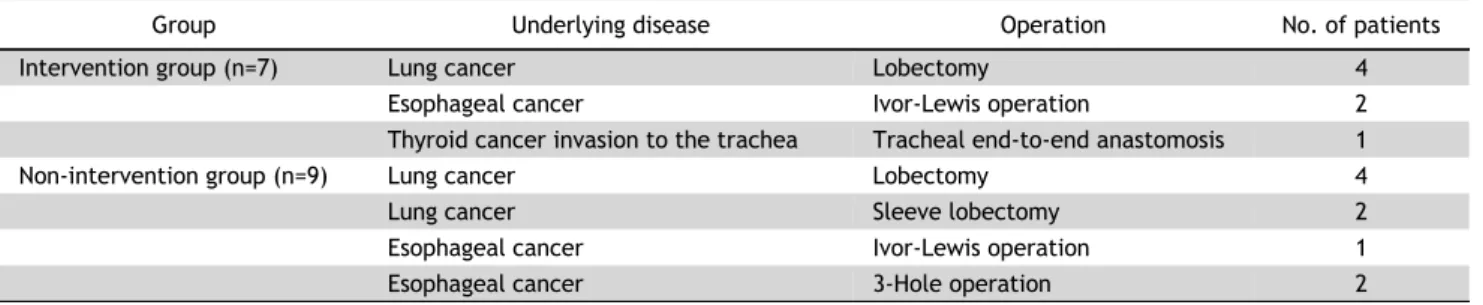
The intervention group (IG) included patients with postoperative chylothorax who underwent radiological interventions (n=7) from January 2017 to September 2018. The non-intervention group (NG) included 9 pa- tients who underwent conservative management from January 2010 to December 2015. In the IG, 5 patients underwent TDE and 2 underwent TDL only.

Of the patients in the IG, 4 underwent thoraco- scopic lobectomies to treat lung cancer, 2 underwent Ivor-Lewis operations to treat esophageal cancer, and 1 underwent an end-to-end tracheal anastomosis to treat thyroid cancer invasion of the trachea. Of the patients in the NG, 4 underwent thoracoscopic lobec- tomies and 2 underwent sleeve lobectomies to treat lung cancer, while 1 patient underwent an Ivor-Lewis operation and 2 patients underwent 3-hole oper-

ations to treat esophageal cancer (Table 1).

2) Radiological interventions

TDL was performed in patients who suffered from postoperative chylothorax, followed by TDE when the lymphatic duct was accessible.

3) Thoracic duct lymphangiography

We preassembled a 26G needle and a short cathe- ter (Cook, Bloomington, IN, USA) fitted to a Luer-lock syringe containing 3–5 mL of lipiodol. Intranodal lymphangiography was performed via the bilateral inguinal or femoral lymph nodes. Lymph node punc- ture was performed under ultrasonographic guidance.

Subsequently, a small amount of lipiodol was injected under fluoroscopic guidance to confirm puncture of the intranodal lymphatic vessel. Lipiodol was then hand-injected at 3 mL/min under intermittent fluoro- scopic guidance (to reduce the radiation dose). When the punctured lymph node became ruptured during the injection, the upper lymph nodes were directly punctured under fluoroscopic guidance and lipiodol injection continued. Lipiodol injection ceased after opacification of the lumbar duct or cisterna chyli.

The total amount of lipiodol was limited to 20 mL to minimize the risk of pulmonary fat embolism.

4) Thoracic duct embolization

Thoracic duct access was obtained via direct punc-

ture of the lumbar duct or cisterna chyli with a 21G

Chiba needle using the transabdominal route. Prior

to access, cone-beam computed tomography was

used to assess the relationship between the duct and

surrounding anatomical structures (such as the aor-

ta). After transabdominal puncture of the cisterna

chyli, we attempted to enter the thoracic duct using

a 0.018-inch (0.46-mm) Transend guidewire (Boston

Scientific Corp., Natick, MA, USA). If the guidewire

(3)

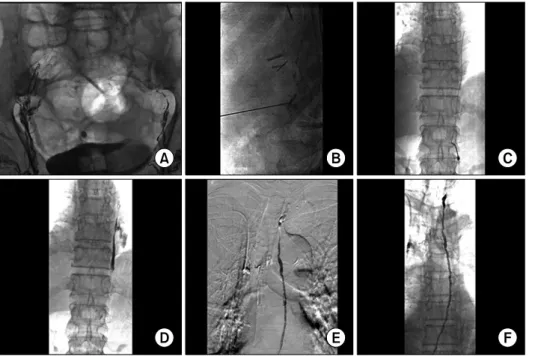
Fig. 1. Thoracic duct embolization.

(A) Intranodal lymphangiography via the bilateral inguinal lymph nodes.

(B) Thoracic duct access via direct puncture of the lumbar duct. (C) Introduction of a microcatheter af- ter insertion of a guidewire. (D) Digital subtraction angiography to establish the chyle leakage site. (E) Microcoil embolization above the leakage site. (F) Embolization using a mixture of N-butyl cyanoacrylate and lipiodol.

entered the duct, we advanced it further and then in- troduced a 2.0- or 2.2F microcatheter (Terumo, Tokyo, Japan), employing the over-the-wire technique. Digital subtraction angiography was performed with the aid of the microcatheter to establish the chyle leakage sites; these were subjected to Concerto microcoil em- bolization (Medtronic, Jacksonville, FL, USA) proximal to (above) the leakage sites, which were then embol- ized using a mixture of N-butyl cyanoacrylate (NBCA, Histoacryl; B Brown, Melsungen, Germany) and lip- iodol (weight ratio 1:1). Coil embolization prevented NBCA migration to the left subclavian vein; the NBCA polymerization time is longer in the lymphatic ves- sels than in blood vessels. If the needle accessed the lymph node, lipiodol was injected. Fluoroscopic im- ages of the cisterna chyli were then obtained. Direct cisterna chyli puncture using a 21G Chiba needle was performed under fluoroscopic guidance, and an 0.018-inch (0.46-mm) guidewire and microcatheter were used to cannulate the thoracic duct, which was then embolized using Concerto 3EA microcoils and an NBCA/lipiodol mixture (weight ratio 1:1) (Fig. 1).

5) Medical records

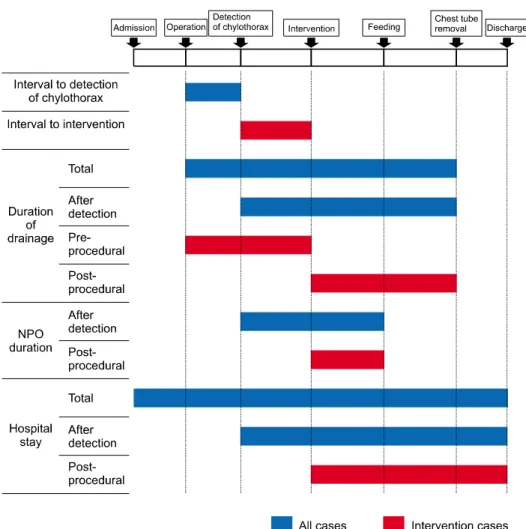
We recorded the patients’ age, total drainage dura- tion, drainage duration after detection of chylothorax, preprocedural and postprocedural drainage duration, day of postoperative chylothorax detection, interval

from detection to intervention, interval from de- tection to oral feeding, postprocedural oral feeding status, total length of hospital stay, length of hospital stay after detection of chylothorax, postprocedural length of hospital stay, complications, and in-hospital mortality in the IG and NG and in the TDE and TDL patients (Fig. 2). The study protocol was approved by the Institutional Review Board of Pusan National University, Busan, Republic of Korea (IRB no., 1908020082), which waived the need for informed patient consent.

6) Statistical analysis

We used the Student t-test, the Mann-Whitney U-test, and the Kolmogorov-Smirnov test as appro- priate. All data are expressed as medians with ranges. A p-value <0.05 was considered to indicate statistical significance. All analyses were conducted using IBM SPSS ver. 24.0 (IBM Corp., Armonk, NY, USA).

Results

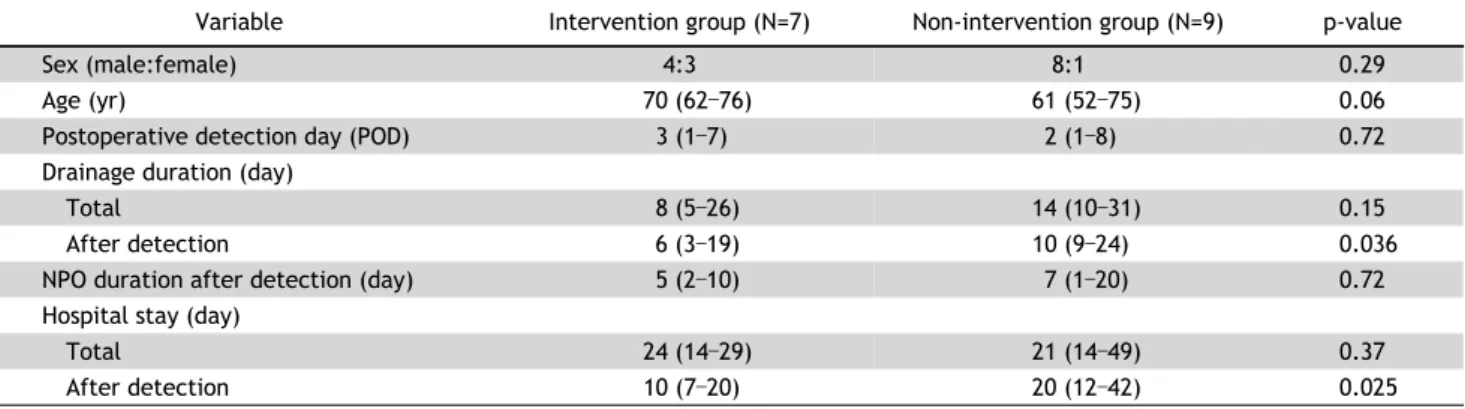
In the IG, the median age was 70 years (range, 62–

76 years), and chylothorax was detected at mean

postoperative day (POD) 3 (range, 1–7 days), al-

though 5 patients (71.4%) exhibited chylothorax ear-

lier, only 1 day after NPO ended. The 2 patients who

(4)

Fig. 2. Schematic of the measure- ment schedule. The measured pa- rameters in all cases include inter- val to detection of chylothorax, to- tal duration of drainage, duration of drainage after detection, NPO duration after detection, total length of hospital stay, and length of hospital stay after detection, whereas the measured parameters in the intervention cases include interval to intervention, preproce- dural/postprocedural duration of drainage, postprocedural NPO dura- tion, and length of hospital stay af- ter intervention. NPO, nil per os.

underwent an Ivor-Lewis operation exhibited chylo- thorax on PODs 5 and 7 because NPO duration was prolonged. The median interval between chylothorax detection and the intervention was 4 days (range, 1–

7 days). The median duration of chest tube drainage was 7 days (range, 5–26 days); of the total drainage days, the preprocedural and postprocedural durations were 5 days (range, 3–13 days) and 4 days (range, 1–

12 days), respectively. Although the median time from the intervention to postprocedural oral feeding was 3 days (range, 1–3 days), 3 of 7 patients (42.9%) commenced oral feeding the day after their procedures. The median time from detection of chy- lothorax to oral feeding was 5 days (range, 2–10 days). The median length of hospital stay after de- tection of chylothorax was 10 days (range, 7–20 days), and the median postprocedural length of hospital stay was 7 days (range, 6–13 days) (Table 2, Fig. 1).

Compared with the IG, the median age of the NG

was 61 years (range, 52–75), and the median chylo- thorax detection time was POD 2 (range, 1–8 days).

The median total drainage duration in the NG was 14 days (range, 10–31 days), and the median total length of hospital stay was 21 days (range, 14–49 days), which did not differ significantly from the IG.

In the NG, the median drainage time after detection of chylothorax was 10 days (range, 9–24 days) and the median length of hospital stay after detection of chylothorax was 20 days (range, 12–42 days), which were significantly different from the IG (p=0.036 and p=0.025, respectively). The NPO duration after de- tection of chylothorax in the NG was 7 days (range, 1–20 days), which was not significantly different from the IG (Table 2).

Of the 7 patients who underwent TDL, 5 success-

fully underwent TDE, but 2 did not. Although the

TDL-only subgroup contained only 2 patients, the

median postoperative chylothorax detection time in

(5)

Table 2. Comparison of clinical findings between the intervention and non-intervention groups of patients with postoperative chylothorax

Variable Intervention group (N=7) Non-intervention group (N=9) p-value

Sex (male:female) 4:3 8:1 0.29

Age (yr) 70 (62–76) 61 (52–75) 0.06

Postoperative detection day (POD) 3 (1–7) 2 (1–8) 0.72

Drainage duration (day)

Total 8 (5–26) 14 (10–31) 0.15

After detection 6 (3–19) 10 (9–24) 0.036

NPO duration after detection (day) 5 (2–10) 7 (1–20) 0.72

Hospital stay (day)

Total 24 (14–29) 21 (14–49) 0.37

After detection 10 (7–20) 20 (12–42) 0.025

Values are presented as median (range), unless otherwise stated.

POD, postoperative day; NPO, nil per os.

Table 3. Comparison of post-procedural findings between patients who underwent TDE and TDL only in the intervention group

Variable TDE (N=5) TDL only (N=2) p-value

Sex (male:female) 3:2 1:1 0.82

Age (yr) 70 (62–74) 72 (68–76) 0.57

Postoperative detection day (POD) 3 (1–7) 3 (2–3) 0.72

Interval from detection to intervention 4 (3–7) 1 (1) 0.09

Drainage duration (day)

Total 8 (5–26) 14 (10–31) 0.38

Pre-procedural 6 (3–19) 10 (9–24) 0.09

Post-procedural 4 (1–12) 3 (2–4) 0.86

NPO duration after detection (day) 3 (1–3) 2 (1–3) 0.09

Hospital stay (day)

After detection of chylothorax 11 (11–20) 8 (7–9) 0.09

Post-procedural 7 (6–13) 7 (6–8) 0.86

Values are presented as median (range), unless otherwise stated.

TDE, thoracic duct embolization; TDL, thoracic duct lymphangiography; POD, postoperative day; NPO, nil per os.

the TDE and TDL subgroups was 3 days (range, 1–7 days) and 3 days (range, 2–7 days), respectively. The median interval between chylothorax detection and the intervention in the TDE and TDL subgroups was 4 days (range, 3–7 days) and 1 day (range, 1 day), respectively. The median total duration of chest tube drainage was 11 days (range, 7–26 days) and 7 days (range, 5–8 days), respectively; the preprocedural drainage duration was 7 days (range, 5–14 days) and 4 days (range, 3–4 days), respectively; and the post- procedural drainage duration was 4 days (range, 1–

12 days) and 3 days (range, 2–4 days), respectively.

The median time to postprocedural oral feeding in the TDE and TDL subgroups was 3 days (range, 1–3 days) and 2 days (range, 1–3 days), respectively. The median length of hospital stay after detection of chy-

lothorax in the TDE and TDL subgroups was 11 days (range, 11–20 days) and 8 days (range, 7–9 days), re- spectively, and the median postprocedural length of hospital stay was 7 days (range, 6–13 days) and 7 days (range, 6–8 days), respectively (Table 3). No postprocedural complications, such as bleeding, in- fection, or empyema, were noted. The mean follow- up duration was 5±3.02 months (range, 1–8 months).

Discussion

The results of our study showed that the baseline

characteristics of the patients in the IG and NG were

generally comparable; however, the median drainage

time and median length of hospital stay after de-

tection of chylothorax were significantly shorter in

(6)

the IG than in the NG. NPO duration after detection and total drainage duration were somewhat shorter in the IG than in the NG.

Postoperative chylothorax has previously been dif- ficult to manage. Generally, most patients are initially conservatively treated employing NPO, total paren- teral nutrition, and pleural drainage [1-4]; however, an operation may be required if leakage persists for longer than 2 weeks or is greater than 1,000 mL/day for more than 5 days despite conservative therapy [1-3]. In such cases, bedside pleurodesis may obviate the need for surgery [5-7,18,19]. However, pleuritic chest pain that prevents lung rehabilitation may de- velop; patients may also develop a cough and be un- able to take deep breaths. Chemical agents could trigger acute respiratory distress syndrome [8-10].

Developments in radiological interventions have led to new therapeutic options (such as TDL and TDE) for treatment of chylous leakage [1,2,17]. In re- cent studies, lymphangiography identified 64%–86%

of leakage sites, and the TDE success rate was >90%

when the thoracic duct could be accessed [1,12,14].

Traditional management in postoperative chylothorax was performed at our hospital before the develop- ment of the intervention technique; however, most patients with postoperative chylothorax opted for the intervention treatment as soon as possible after de- tection of chylothorax. Generally, in patients with lung cancer, chylothorax could be detected on POD 1 or 2, since oral feeding might be started on POD 1.

However, in patients with esophageal cancer, chylo- thorax tended to be detected later, such as on POD 5 –7, when oral feeding was usually initiated. Although variation in timing is possible due to different time- lines for the initiation of oral feeding depending on the disease, we try to let patients undergo the inter- vention as soon as possible after the detection of chylothorax.

We performed radiological interventions to treat 7 patients with postoperative chylothorax from January 2017 to September 2018. To evaluate the efficacy of the interventions, we compared these patients to 9 who underwent conservative management and were enrolled from January 2010 to December 2015. We found that the median drainage and the median length of hospital stay after detection of chylothorax were significantly shorter in the IG than in the NG (p=0.036 and p=0.025, respectively) and that oral

feeding after detection of chylothorax was possible sooner in the IG than in the NG (Table 2). Patients who require thoracic surgery are usually older, and a reduced NPO duration improves quality of life in the elderly.

Of 7 IG patients, 5 underwent TDE, but 2 under- went TDL only because of access failure that was at- tributable to anatomical variations of the thoracic duct, which occur in up to 30% of all subjects. We found no significant difference in postprocedural chest tube drainage duration, the postprocedural oral feeding day, or the postprocedural length of hospital stay between the TDE and TDL subgroups (p=0.857, p=0.095, and p=0.857, respectively). All cases re- solved soon after their procedures regardless of TDE status. This might be explained by the use of

“scratching” to reduce lymphatic flow via multiple needle punctures of the prevertebral lymph vessels;

this releases lymphatic wall tension, allowing lym- phatic leaks to heal [1,17,20]. Although the details of healing after TDL remain unclear, the TDL subgroup had better postprocedural outcomes than the TDE subgroup (Table 3). However, for these findings to reach statistical significance, the number of patients in both subgroups must be increased.

Our study had several limitations. First, the num- ber of patients in both the IG and NG was low.

Second, the IG and NG were formed at different peri- ods, because of developments in interventional techniques. Third, our work was retrospective in nature. A prospective, randomized controlled trial with more patients is required. Finally, we could not compare the efficacy of the radiological interventions;

however, those interventions reduced the duration of drainage and length of hospital stay, allowing an ear- lier return to normal life. The TDE and TDL sub- groups did not differ significantly; evaluation of chyle production via contrast-enhanced imaging is required for TDL-only cases. Animal experiments might con- firm the need for embolization.

Conflict of interest

No potential conflict of interest relevant to this ar-

ticle was reported.

(7)

Acknowledgments

This study was supported by a Grant of the Samsung Vein Clinic Network (Daejeon, Anyang, Cheongju, Cheonan; Fund no. KTCS04-129).

ORCID

Hyuncheol Jeong: https://orcid.org/0000-0003-2556-0808 Hyo Yeong Ahn: https://orcid.org/0000-0003-3198-8237 Hoon Kwon: https://orcid.org/0000-0003-4055-5863 Yeong Dae Kim: https://orcid.org/0000-0001-7135-4648 Jeong Su Cho: https://orcid.org/0000-0002-7422-6171 Jungseop Eom: https://orcid.org/0000-0002-0832-1314

References

1. Schild HH, Strassburg CP, Welz A, Kalff J. Treatment op- tions in patients with chylothorax. Dtsch Arztebl Int 2013;110:819-26.

2. Reisenauer JS, Puig CA, Reisenauer CJ, et al. Treatment of postsurgical chylothorax. Ann Thorac Surg 2018;105:254-62.

3. Stange S, Sziklavari Z. Modern treatment options for post- operative chylothorax: a systematic review. Zentralbl Chir 2019;144:290-7.

4. Takuwa T, Yoshida J, Ono S, et al. Low-fat diet manage- ment strategy for chylothorax after pulmonary resection and lymph node dissection for primary lung cancer. J Thorac Cardiovasc Surg 2013;146:571-4.

5. Cho HJ, Kim DK, Lee GD, et al. Chylothorax complicating pulmonary resection for lung cancer: effective manage- ment and pleurodesis. Ann Thorac Surg 2014;97:408-13.

6. Borcyk K, Kamil A, Hagerty K, Deer M, Tomich P, Anderson Berry AL. Successful management of extremely high-out- put refractory congenital chylothorax with chemical pleu- rodesis using 4% povidone-iodine and propranolol: a case report. Clin Case Rep 2018;6:702-8.

7. Cho HJ, Na KJ, Kim DW, Choi YE, Ma JS, Jeong IS. Chemical pleurodesis using a Viscum album extract in infants with congenital chylothorax. Eur J Pediatr 2014;173:823-6.

8. Leuzzi G, Vita ML, Porziella V, Congedo MT, Cesario A.

Single center experience on talc poudrage morbidity: fo- cus on high talc dosage. J Cardiothorac Surg 2011;6:87.

9. Shinno Y, Kage H, Chino H, et al. Old age and underlying interstitial abnormalities are risk factors for development of ARDS after pleurodesis using limited amount of large particle size talc. Respirology 2018;23:55-9.

10. Evans TJ, Sivakumar P, Ahmed L. Progressive respiratory failure: a rare complication after graded talc pleurodesis.

Br J Hosp Med (Lond) 2017;78:294-5.

11. Hara H, Mihara M, Yamamoto M. Therapeutic lymphangiog- raphy for traumatic chylothorax. J Vasc Surg Venous Lymphat Disord 2018;6:237-40.

12. Jayasinghe SA, Srinivasa RN, Hage AN, Gemmete JJ, Majdalany BS, Chick JFB. Thoracic duct embolization:

analysis of practice patterns. Ann Vasc Surg 2018;52:168- 75.

13. Jimenez Gomez J, Gomez Cervantes M, Nunez Cerezo V, et al. Intranodal lymphangiography in pediatric chylothorax, a diagnostic and therapeutic tool. Cir Pediatr 2019;32:

41-5.

14. Kim PH, Tsauo J, Shin JH. Lymphatic interventions for chy- lothorax: a systematic review and meta-analysis. J Vasc Interv Radiol 2018;29:194-202.

15. Nadolski GJ, Itkin M. Lymphangiography and thoracic duct embolization following unsuccessful thoracic duct liga- tion: imaging findings and outcomes. J Thorac Cardiovasc Surg 2018;156:838-43.

16. Majdalany BS, Khayat M, Downing T, et al. Lymphatic in- terventions for isolated, iatrogenic chylous ascites: a mul- ti-institution experience. Eur J Radiol 2018;109:41-7.

17. Schild HH, Naehle CP, Wilhelm KE, et al. Lymphatic inter- ventions for treatment of chylothorax. Rofo 2015;187:

584-8.

18. Huang PM, Lee YC. A new technique of continuous pleural irrigation with minocycline administration for refractory chylothorax. Thorac Cardiovasc Surg 2011;59:436-8.

19. Mares DC, Mathur PN. Medical thoracoscopic talc pleurod- esis for chylothorax due to lymphoma: a case series. Chest 1998;114:731-5.

20. Binkert CA, Yucel EK, Davison BD, Sugarbaker DJ, Baum

RA. Percutaneous treatment of high-output chylothorax

with embolization or needle disruption technique. J Vasc

Interv Radiol 2005;16:1257-62.

수치

Table 1. Prior operations in patients with chylothorax
Fig. 1. Thoracic duct embolization.
Fig. 2. Schematic of the measure- measure-ment schedule. The measured  pa-rameters in all cases include  inter-val to detection of chylothorax,  to-tal duration of drainage, duration  of drainage after detection, NPO  duration after detection, total  lengt
Table 2. Comparison of clinical findings between the intervention and non-intervention groups of patients with postoperative chylothorax

참조

관련 문서

Methods: We conducted a retrospective analysis of clinical records of obese children who visited to Chosun university hospital between January 2013 and February 2014 due to

This study focuses on the overall survival(OS) and the re-recurrence free survival (RFS) rates for patients according to the Milan criteria status at the time of recurrence as

Next, interviews and surveys were conducted for guidance teachers and parents of students who received music education using empirical analysis methods to look

Through a review of electronic medical records, we analyzed the applied BCSs, perioperative hematologic changes, and morbidity and mortality in JW patients

(Method) Among 102 patients with metastatic liver carcinoma due to colorectal cancer who were treated at Chosun University Hospital from January 2003 to

Higher open conversion rate and prolonged postoperative hospital stay in LATE group were not caused by the delayed operation in this study it seems to be caused by that

We evaluated the associations between body image, eating attitude and depression in children with precocious puberty.. Methods 82 precocious pubertal patients aged

The cost per equivalent life saved by cost-effective analysis (7% discount rate) is estimated to be $2.39 million in front seats and $4.71 million in rear seats. Total