Feedback is a basic teaching method that ensures standards are met.1,2 Trainees are expected to im- prove their performance through feedback that contains specific information about the compar- ison between a trainee's observed performance and a standard.3 Timely feedback needs to be provided because delayed feedback could cause decreased accomplishment in learning.4 Unfortunately, stu- dents/trainees often receive less corrective feed- back than is needed.5,6
Timely and standardized feedback is helpful in self-directed learning.7 Therefore, students are expected to receive timely feedback from their instructors regarding personal performance.
However, medical school and hospital trainers can be hindered in providing feedback due to their busy schedule and heavy workload.8 As a re- sult, medical students do not always receive an adequate level of trainer feedback.
For this reason, the author developed an auto-
Original Article
A Computer-Assisted, Real-Time Feedback System for Medical Students as a Tool for Web-Based Learning
Hyunyong Hwang
Department of Laboratory Medicine, College of Medicine, Kosin University, Busan, Korea
Objectives: Medical students sometimes do not receive proper feedback from their instructors. This study evaluated a newly developed automated and personalized real-time feedback system intended to address this issue.
Methods: Third- and fourth-year medical students participated in quizzes focusing on 17 learning objectives and a five-scale survey that queried their prior knowledge related to blood transfusions. Immediately after completing the quizzes, the students received automated and personalized, real-time feedback and were instructed to take part in self-directed learning. This activity was followed by a final quiz. After completion of the final quiz, the students responded to the five-scale survey that probed the usefulness of and satisfaction with the automated, personalized, real-time feedback system.
Results: Eighty students took part in this study. The third-year group had a higher score for prior knowledge and also on the first quiz (P = 0.008, P = 0.046, respectively). There was no significant difference in final quiz scores between the third- and fourth-year groups (P = 0.633). The scores for usefulness of and satisfaction with the automated, real-time feedback system were 4.45 and 4.34, and 4.55 and 4.40 in the third- and fourth-year students, respectively.
Conclusions: The automated, personalized, real-time feedback system provided timely and effective feedback for medical students and was helpful for their self-directed learning.
Key Words: Automated, Feedback, Personalized, Real-time
Corresponding Author: Hyunyong Hwang, Department of Laboratory Medicine, College of Medicine, Kosin University, 262 Gamchen-ro, Seo-gu, Busan 49267, Korea
Tel: +82-51-990-6279 FAX: +82-51-990-3010 E-mail: [email protected]
Received:
Revised:
Accepted:
May. 21, 2015 Aug. 04, 2015 Sep. 03, 2015
mated, personalized, real-time feedback system based on the Modular Object-oriented Dynamic Learning Environment (Moodle) platform and eval- uated the system by analyzing the performances and survey responses of third- and fourth-year medical students.
MATERIALS AND METHODS
1. MATERIALS
Third- and fourth-year medical students of Kosin University College of Medicine who had re- ceived education regarding blood transfusions by the author during their second year voluntarily agreed to participate in this study. Fourth-year students received education on transfusion once more during the clinical component of their education. All of the processes in this study were voluntarily performed by the students, who were informed in advance that their grades on the quizzes in this study would not be included in their final class grade.
2. METHODS
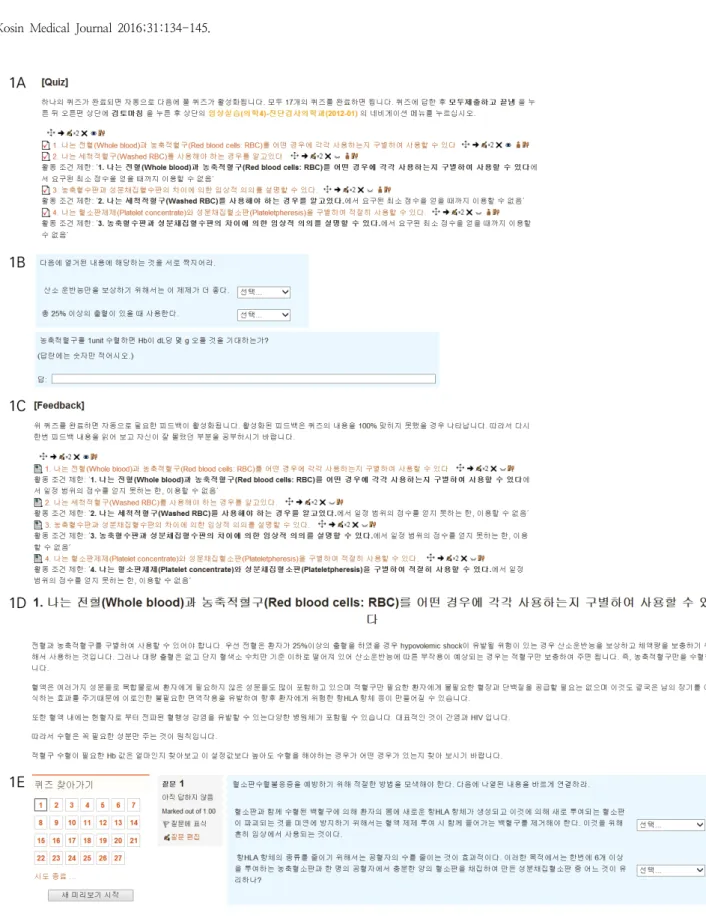
Participants were instructed to login to the web- site developed by the author and to complete the courses presented on the website (Fig. 1). The se- quentially completed courses consisting of a sur- vey that evaluated their prior knowledge, quizzes for testing the learning objectives, the feedback, a final exam, and a survey evaluating the useful- ness of and satisfaction with the automated, re-
al-time feedback system. All of the courses on the website were created using Moodle version 2.2 software. In the first survey, which probed the par- ticipants’ prior knowledge of blood transfusions, students were queried concerning their present knowledge about transfusions with regard to 17 separate learning objectives (Appendix 1).
Responses were given on a five-point Likert-type scale ranging from 1 (strongly disagree) to 5 (strongly agree). The quiz questions reflected the 17 learning objectives and were sequentially pre- sented (Fig. 1A, 1B). Once the questions that as- sessed the first learning objective were answered, the next questions that assessed the second learn- ing objective were shown on the screen, and so on. When the scores on the quizzes were not great- er than the criteria set by the author for each learning objective, relevant feedback was dis- played on the screen (Fig. 1C, 1D). The feedback was designed to support self-directed learning. As a result, any students who failed to obtain higher scores than the criteria received feedback on all learning objectives they had failed. Students who obtained a score greater than the cutoff for all learning objectives did not receive feedback. The feedback was presented when the students com- pleted the quizzes for each learning objective. If all quizzes were not completed in a session, only feedback on the completed quizzes was provided.
Feedback was presented immediately after quiz completion and was created with a function named “web page” on the Moodle platform. The feedback offered learning resources, information,
Fig. 1. The quiz, feedback, and final exam provided to the students in this study. The quiz, feedback, and final exam were hosted on the website, which was developed by the author on the Moodle platform. When students clicked on the quiz question number (A), the quiz question appeared on the screen (B). After completing the quizzes, the students could view feedback that varied depending on quiz score (C), view the activated feedback, and perform self-directed learning guided by the feedback (D). After completion of the self-directed learning, students were permitted to take the final exam.
and comments associated with the learning objective. The author expected the feedback to help the students participate in self-directed learning. After the feedback step, the students were instructed to complete a second presentation of the quiz questions that reflected the same 17 learning objectives, which was intended to con- solidate their learning (Fig. 1E). After completion of the final exam, the students were asked to com- plete a survey on the degree of satisfaction with and usefulness of the automated, real-time feed- back system (Appendix. 2). This survey used a function named “restrict access” on the Moodle platform. The author set the minimum grade re- quired on the quizzes for each learning objective, and the feedback was activated and presented when the requirements were not satisfied.
3. Surveys and statistical analyses
The surveys that assessed the students’ prior knowledge consisted of 17 questions, while the surveys focusing on degree of satisfaction with and usefulness of the automated, real-time feedback system consisted of six and seven questions, respectively. Responses to all questions used a five-point Likert-type scale from 1 (least agree) to 5 (most agree), and the reliability of the test score was calculated using Cronbach’s α statistics.
Subjective opinions from the students regarding the merits and drawbacks of the automated, re- al-time feedback system in this study were also requested (Appendix 2).
To analyze the statistical differences in partic-
ipant prior knowledge, the final exam, degree of satisfaction with and usefulness of an automated real-time feedback system between the third- and fourth-year medical students, independent t-test was performed. All statistical analyses were con- ducting using the Statistical Package for the Social Sciences (SPSS) version 17.0 (SPSS, Chicago, IL, US). P - values < 0.05 were considered statistically significant.
RESULTS
The number of third- and fourth-year medical students who participated was 66 and 65, respectively. Forty students from each class com- pleted all courses for this study (60.61% of third-year and 61.54% of fourth-year students).
1. Survey for prior knowledge
All 17 questions were asked, and the reliability according to the Cronbach’s α was 0.949. The rat- ing mean (standard deviation, SD) of the third- and fourth-year students was 3.35 (0.85) and 3.82 (0.67), respectively; the fourth-year P -values were significantly higher than those of the third-year students (P = 0.008) (Table 1).
2. Quiz
The quiz scores (SD) of the third- and fourth-year medical students were 85.57 (10.26) and 89.66 (7.51) out of 100, respectively, with the fourth-year student score being significantly high-
er (P = 0.046) (Table 2).
3. Final exam
The quiz scores (SD) of the third- and fourth-year medical students were 96.02 (4.56) and 95.53 (4.74) out of 100, respectively. There was no significant difference between the two groups (P = 0.633) (Table 2).
4. Degree of satisfaction with the automated, real-time feedback system
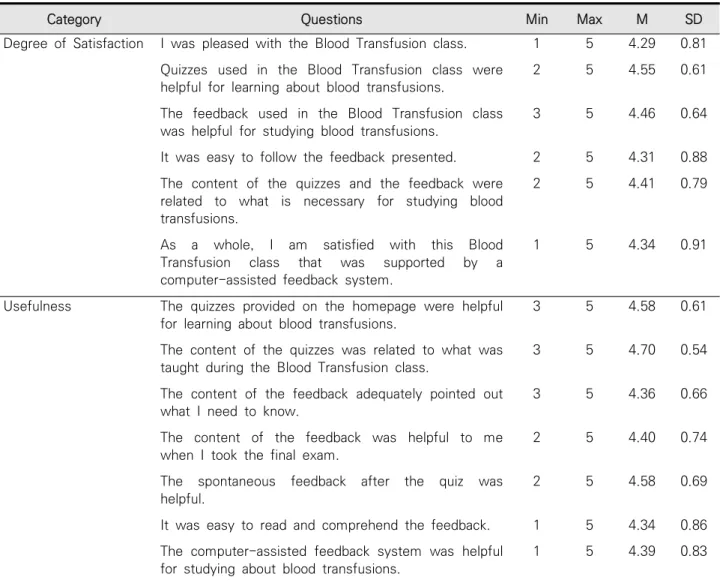
Six questions were asked regarding satisfaction, and the reliability based upon Cronbach’s α was 0.913 (P = 0.00). The rating mean (SD) of the third- and fourth-year medical students was 4.45 (0.64) and 4.34 (0.67), respectively. There was no sig-
nificant difference between the two groups (P = 0.480) (Table 1, 3).
5. Usefulness of the automated, real-time feed- back system
Seven questions regarding usefulness were asked, and the reliability according to Cronbach’s α was 0.857 (P = 0.00). The rating mean (SD) scores of the third- and fourth-year students were 4.55 (0.46) and 4.40 (0.58), respectively. There was no significant difference between the two groups (P
= 0.190) (Table 1, 3).
6. Subjective opinions about the merits and drawbacks of the automated, real-time feedback system
Test items Grade N Mean SD P
Survey of prior knowledge
3 40 3.35 0.85
0.008
4 40 3.82 0.67
Usefulness survey
3 40 4.55 0.46
0.190
4 40 4.40 0.58
Survey of satisfaction
3 40 4.45 0.64
0.480
4 40 4.34 0.67
N, number; SD, standard deviation; P, p-value in t-test
Table 1. Mean, standard deviation (SD), and t-test results of third- and fourth-year medical students on a survey of prior knowledge, usefulness, and satisfaction conducted using Moodle
Category Mean (SD)
T-test Third year (n=40) Fourth year (n=40)
Quiz 85.57 (10.26) 89.66 (7.51) P = 0.046
Final quiz 96.02 (4.56) 95.53 (4.74) P = 0.633
SD, standard deviation
Table 2. Scores between third-year and fourth-year medical students
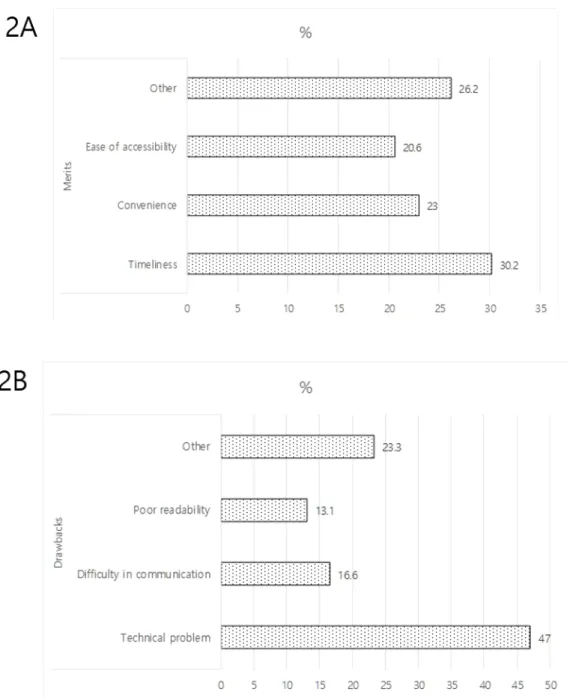
Timeliness (30.2%), convenience (23.0%), and ease of accessibility (20.6%) were the highest ranked subjective opinions from students (Fig. 2A).
The most frequently mentioned drawback was technical problems relating to internet speed or low computer specifications (47.0%), followed by difficulty in communication (16.6%) and poor readability (13.1%) (Fig. 2B).
DISCUSSION
E-learning is already popular in medical educa- tion and is well established in many medical schools.9 An e-learning consortium was estab- lished in Korea in January 2007 with the goal of developing and sharing e-learning content among medical students.10 Thirty-three of the Korea’s 41 medical schools participate in this consortium (http://www.mededu.or.kr). Most medical stu-
Category Questions Min Max M SD
Degree of Satisfaction I was pleased with the Blood Transfusion class. 1 5 4.29 0.81 Quizzes used in the Blood Transfusion class were
helpful for learning about blood transfusions.
2 5 4.55 0.61
The feedback used in the Blood Transfusion class was helpful for studying blood transfusions.
3 5 4.46 0.64
It was easy to follow the feedback presented. 2 5 4.31 0.88 The content of the quizzes and the feedback were
related to what is necessary for studying blood transfusions.
2 5 4.41 0.79
As a whole, I am satisfied with this Blood Transfusion class that was supported by a computer-assisted feedback system.
1 5 4.34 0.91
Usefulness The quizzes provided on the homepage were helpful for learning about blood transfusions.
3 5 4.58 0.61
The content of the quizzes was related to what was taught during the Blood Transfusion class.
3 5 4.70 0.54
The content of the feedback adequately pointed out what I need to know.
3 5 4.36 0.66
The content of the feedback was helpful to me when I took the final exam.
2 5 4.40 0.74
The spontaneous feedback after the quiz was helpful.
2 5 4.58 0.69
It was easy to read and comprehend the feedback. 1 5 4.34 0.86 The computer-assisted feedback system was helpful
for studying about blood transfusions.
1 5 4.39 0.83
Min, minimum; Max, maximum; M, mean; SD, standard deviation.
Table 3. The degrees of satisfaction with and usefulness of a computer-assisted, automated, real-time feedback system amongst medical students
dents are accustomed to accessing the e-learning resources using their smartphone or tablet, re- gardless of time or place.
These internet-based technologies are gradually broadening their educational applications, and students are using the technologies for learning.11-16
Moodle has been continuously evolving as an open-source environment since it was first devel- oped for web-based learning in 1998; it has been applied to medical education in some instances.17,18
The automated, real-time feedback system in this study was developed on the Moodle platform;
Fig. 2. Subjective opinions from students about the merits and drawbacks of the automated, real-time feedback system. Some highly ranked opinions are listed, and more opinions are included in the “Other” category.
the “restrict access” function of Moodle makes it possible for education providers to set the criteria for the grade or activity of the learning, which facilitates an individualized learning environment for students. This means that reaction to activities can differ depending on the responses from stu- dents, which is a very powerful tool for in- dividualized, self-directed learning.
Students who participated in this study also re- ceived different feedback depending on the grade obtained on the quiz. Students who showed good academic performance could save time, which is helpful for efficient academic activity. Delivering feedback is a complex process influenced by many factors.19 More sophisticated modules could be created as the need arises, which is a merit of Moodle.
When the students’ prior knowledge was eval- uated, the mean rating of the fourth-year students was significantly higher than that of the third-year students. This difference was expected since the fourth-year students had been educated on the subject in class as well as in the clinic. On the final exam, however, there was no statistically sig- nificant difference between the two groups.
Instead, the students seemed to study what they needed to learn using the presented feedback, which could have improved their learning and de- creased the difference in quiz scores between the two groups. The automated, real-time feedback system also might have helped standardize learn- ing for the students with lower grades by increas-
ing their self-directed learning.
Although the most frequently mentioned draw- back of the program was technical problems ac- cording to the subjective opinions from students, another important limitation was that students could not ask any additional questions if their aca- demic concern had not been addressed. Sisson et al. insisted that incorporating learner feedback in- to curriculum revision was associated with im- proved educational outcomes.20 To resolve this problem, devices or applications that let students ask additional questions should be included in the curriculum. For this purpose, a social network service or the Moodle “forum” function could be used for communication between students and trainers. Regardless of this drawback, students were very satisfied with the timeliness, con- venience, and ease of accessibility with which they could study what they needed at any time and place.
Considering the busy routines of medical educa- tion providers, medical students often do not re- ceive adequate feedback from their trainers. The automated, real-time feedback system used in this study could be a very useful tool for effective and standardized feedback. Although an additional de- vice would be required to handle any questions from students, it is thought that this automated, personalized, real-time feedback system provided timely effective feedback for the students and was helpful for their self-directed learning.
REFERENCES
1. Branch WT, Jr., Paranjape A. Feedback and re- flection: teaching methods for clinical settings.
Acad Med 2002;77:1185-8.
2. Hewson MG, Little ML. Giving feedback in medi- cal education: verification of recommended techniques. J Gen Intern Med 1998;13:111-6.
3. van de Ridder JM, Stokking KM, McGaghie WC, ten Cate OT. What is feedback in clinical educa- tion? Med Educ 2008;42:189-97.
4. Ende J. Feedback in clinical medical education.
JAMA 1983;250:777-81.
5. Garra G, Wackett A, Thode H. Feasibility and reliability of a multisource feedback tool for emergency medicine residents. J Grad Med Educ 2011;3:356-60.
6. Gil DH, Heins M, Jones PB. Perceptions of medi- cal school faculty members and students on clin- ical clerkship feedback. J Med Educ 1984;59:
856-64.
7. Burr SA, Brodier E, Wilkinson S. Delivery and use of individualised feedback in large class medical teaching. BMC Med Educ 2013;13:63.
8. Halkoaho A, Matveinen M, Leinonen V, Luoto K, Keränen T. Education of research ethics for clinical investigators with Moodle tool. BMC Med Ethics 2013;14:53.
9. Gormley GJ, Collins K, Boohan M, Bickle IC, Stevenson M. Is there a place for e-learning in clinical skills? A survey of undergraduate medical students' experiences and attitudes. Med Teach 2009;31:e6-12.
10. Kim KJ, Han J, Park Ie B, Kee C. Medical educa- tion in Korea: the e-learning consortium. Med Teach 2009;31:e397-401.
11. Lee SP, Su HK, Lee SD. Effects of computer-based immediate feedback on foreign language listen- ing comprehension and test-associated anxiety.
Percept Mot Skills 2012;114:995-1006.
12. Fox S, Reid WA, Evans P. Web-based feedback of medical student assessment results. Med Educ 2003;37:1036-7.
13. Barnett S, Jones SC, Caton T, Iverson D, Bennett S, Robinson L. Implementing a virtual commun- ity of practice for family physician training: a mixed-methods case study. J Med Internet Res 2014;16:e83.
14. Saidinejad M, Zorc J. Mobile and web-based education: delivering emergency department discharge and aftercare instructions. Pediatr Emerg Care 2014;30:211-6.
15. Kuhbeck F, Engelhardt S, Sarikas A. Online TED.com -- a novel web-based audience re- sponse system for higher education. A pilot study to evaluate user acceptance. GMS Z Med Ausbild 2014;31:Doc5.
16. Sampaio-Maia B, Maia JS, Leitᾶo S, Amaral M, Vieira-Marques P. Wiki as a tool for Microbiology teaching, learning and assessment. Eur J Dent Educ 2014;18:91-7.
17. Seluakumaran K, Jusof FF, Ismail R, Husain R.
Integrating an open-source course manage- ment system (Moodle) into the teaching of a first-year medical physiology course: a case study. Adv Physiol Educ 2011;35:369-77.
18. Sparacia G, Cannizzaro F, D'Alessandro DM, D'Alessandro MP, Caruso G, Lagalla R. Initial experiences in radiology e-learning. Radiogra phics 2007;27:573-81.
19. Wilkinson ST, Couldry R, Phillips H, Buck B.
Preceptor development: providing effective
feedback. Hosp Pharm Jan 2013;48:26-32.
20. Sisson SD, Rastegar DA, Hughes MT, Bertram AK, Yeh HC. Learner feedback and educational outcomes with an internet-based ambulatory curriculum: a qualitative and quantitative an- alysis. BMC Med Educ 2012;12:55.
Appendix 1. Questions for probing the participants’ prior knowledge of blood transfusions with the automated, real-time feedback system
Appendix 2. Questions for evaluating the usefulness of and satisfaction with the automated, real-time feedback system
Question numbers 1–7 and 8–13 were used to evaluate the usefulness of and satisfaction with the automated, real-time feedback system, respectively. Three additional questions (numbers 14–16) were included to obtain the students’ opinions about the merits, drawbacks, and requirements of the system.