Long-term outcomes of liver resection for multiple hepatocellular carcinomas: Single-institution experience with 187 patients
Soo-Young Lee1, Chul-Soo Ahn2, Young-In Yoon2, Sung-Gyu Lee2, Shin Hwang2, Ki-Hun Kim2, Deok-Bog Moon2, Tae-Yong Ha2, Gi-Won Song2, Dong-Hwan Jung2, and Gil-Chun Park2
1Department of Surgery, Asan Medical Center, University of Ulsan College of Medicine,
2Division of Hepatobiliary Surgery and Liver Transplantation, Department of Surgery, Asan Medical Center, University of Ulsan College of Medicine, Seoul, Korea
Backgrounds/Aims: Surgical resection for the treatment of multiple hepatocellular carcinomas (HCCs) is controversial.
This study aimed to evaluate the clinical and oncological outcomes after liver resection in patients with multiple HCCs.
Methods: Clinicopathological and survival data of 187 patients who underwent curative resection for multiple HCCs between June 2004 and December 2016 at Asan Medical Center, Seoul, South Korea were retrospectively reviewed.
The prognostic factors for recurrence and survival were identified using univariate and multivariate analyses. Results:
Of the 187 patients, 153 (81.8%) had two nodules, 23 (12.3%) had three nodules, and 11 (5.9%) had more than three nodules. Multiple tumors were located in the ipsilateral lobe in 163 (87.2%) patients. Anatomical resection, non-anatomical resection, and both types of resections were performed in 81.3%, 8.0%, and 10.7% patients, respectively. Recurrence occurred in 133 (71.1%) patients, and the mean time to recurrence after surgery was 34.2 months. Independent risk factors for tumor recurrence in multivariate analyses were indocyanine green retention rate at 15 min ≥15%, preoperative alpha-fetoprotein level ≥400 ng/ml, and total tumor diameter ≥6 cm. The 1-, 3-, 5-, and 10-year disease-free survival rates were 94.1%, 81.7%, 69.7%, and 39.4%, respectively, and the 1-, 3-, 5-, and 10-year survival rates were 93.5%, 74.2%, 64.9%, and 38.8%, respectively. Conclusions: Our experience shows that liver resection can be considered a first-line treatment option for selected patients with multiple HCCs who have well-preserved liver function. (Ann Hepatobiliary Pancreat Surg 2020;24:437-444)
Key Words: Carcinoma; Hepatocellular; Hepatectomy; Survival analysis; Multivariate analysis; Retrospective studies
Received: April 6, 2020; Revised: October 14, 2020; Accepted: October 15, 2020 Corresponding author: Chul-Soo Ahn
Division of Hepatobiliary Surgery and Liver Transplantation, Department of Surgery, Asan Medical Center, University of Ulsan College of Medicine, 88 Olympic-ro 43-gil, Songpa-gu, Seoul 05505, Korea
Tel: +82-2-3010-3942, Fax: +82-2-3010-6701, E-mail: [email protected]
Copyright Ⓒ 2020 by The Korean Association of Hepato-Biliary-Pancreatic Surgery
This is an Open Access article distributed under the terms of the Creative Commons Attribution Non-Commercial License (http://creativecommons.org/
licenses/by-nc/4.0) which permits unrestricted non-commercial use, distribution, and reproduction in any medium, provided the original work is properly cited.
Annals of Hepato-Biliary-Pancreatic Surgery ∙ pISSN: 2508-5778ㆍeISSN: 2508-5859
INTRODUCTION
Hepatocellular carcinoma (HCC) is the most common primary neoplasm of the liver and the second leading cause of cancer-related deaths worldwide.1 Advances in diagnostic imaging and widespread implementation of sur- veillance programs in the high-risk population enable de- tection of HCC at early stages;2,3 however, some patients with HCC continue to be diagnosed with multiple tumors.4 Liver resection has been accepted as the standard treatment modality for patients who have a single lesion with well-preserved liver function.5 However, the treat- ment of multiple HCCs is debatable, with significant var- iation in the different modalities of treatment across dif-
ferent hepatobiliary institutions.
The choice of treatment for patients with multiple HCCs is based on not only the stage of the tumor but also the degree of liver dysfunction. Although liver trans- plantation (LT) is considered the optimal treatment for pa- tients with multiple HCCs if the tumors are small and lim- ited in number,6 its implementation is limited by the avail- ability of donor organs, tumor progression while on the wait list, and technical demand.
With the advances in surgical techniques and perioper- ative management in recent times, aggressive surgical re- section for multiple HCC has been proposed for patients in whom all the tumors can be completely excised and adequate liver function can be preserved postoperatively.
Furthermore, several previous studies have suggested that liver resection can provide survival benefits in patients with multiple HCCs either within or beyond the Milan criteria.7-11 However, the role of liver resection for multi- ple HCCs is controversial as resection can be associated with potentially higher intraoperative risks, increased re- currence, and worse long-term survival. This study aimed to evaluate the clinical and oncological outcomes and de- termine the prognostic factors for recurrence and survival after liver resection in patients with multiple HCC.
MATERIALS AND METHODS
The medical records of patients who underwent cura- tive resection for multiple HCCs from June 2004 to December 2016 at the Asan Medical Center, Seoul, South Korea were retrospectively reviewed. Patients who had undergone liver resection for HCC at other hospitals and those who underwent salvage liver transplantation for re- currence after resection for multiple HCCs were excluded.
Finally, 187 patients with multiple HCCs were included in this study. Multiple HCCs were diagnosed when there were two or more tumors. The diagnosis of HCC and the number of HCCs were confirmed by histopathological ex- amination of the surgical specimens.
Preoperative evaluation
Preoperative diagnosis of multiple HCCs was based on preoperative imaging studies including dynamic computed tomography (CT) and magnetic resonance image (MRI) or a combination of imaging findings and elevated serum al- pha-fetoprotein (AFP) and prothrombin induced by vita- min K absence II (PIVKA-II) levels. Liver function was assessed in detail using liver biochemistry test results, co- agulation profile, indocyanine green retention rate at 15 min (ICGR15), and Child-Pugh classification. The pres- ence of portal hypertension (esophageal varix, noticeable collaterals, and splenomegaly with thrombocytopenia) was also assessed. Based on these laboratory and radiologic examinations, the extent of resection was determined.
Postoperative follow-up
Patients were followed up using abdominal con- trast-enhanced CT or MRI and chest X-ray every 2-3 months during the first year after resection, every 4
months during the second year, and every 6 months subsequently. Serum AFP levels were measured at the same intervals.
The diagnosis of intrahepatic recurrence was estab- lished on imaging if the tumor showed the typical en- hancement characteristics. The line of treatment followed for recurrent HCC was essentially the same as that for pri- mary HCC. Patients with extrahepatic recurrence were managed with all available locoregional treatment modal- ities. Patients with unsatisfactory responses to locoregio- nal treatments were finally treated with systemic chemo- therapy.
Ethical considerations
This study protocol was reviewed and approved by the institutional review board of the Asan Medical Center (approval number 2020-1502) at the University of Ulsan College of Medicine in Seoul, Korea. The requirement for informed consent was waived because of the retrospective nature of the study.
Statistical analysis
Data are expressed as mean±standard deviation. Dis- crete variables are presented as totals and percentages.
The recurrence-free survival (RFS) and overall survival (OS) were calculated using the Kaplan–Meier method.
Variables that showed statistical significance (p<0.05) in the univariate analysis were subsequently included in a multivariate analysis using Cox proportional hazards re- gression models. Statistical significance was set at p<
0.05. All statistical analyses were performed using SPSS version 21.0 (SPSS Inc., Chicago, IL, USA) for Windows.
RESULTS
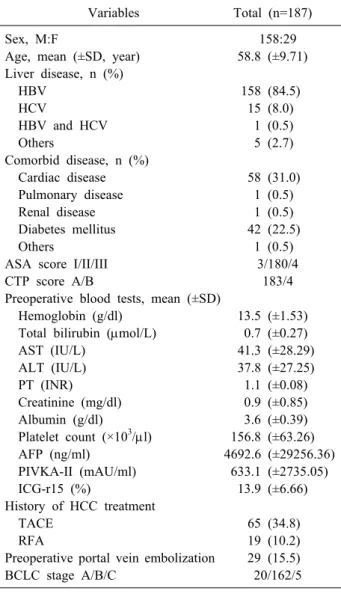
Clinicopathological features of all patients The clinical characteristics of the 187 patients with multiple HCCs are shown in Table 1. Of the 187 patients, 158 (84.5%) were male. Of all patients, 158 (84.5%) and 15 (8.0%) patients had associated hepatitis B and C virus infection, respectively. Further, 97.9% patients had rela- tively good liver function with Child-Pugh class A. Liver cirrhosis was present in 147 (75.9%) patients, confirmed on histological examination after surgery. The preopera- tive mean serum AFP and PIVKA-II levels were 4692.6±
Table 1. Demographics characteristics of the patients
Variables Total (n=187)
Sex, M:F 158:29
Age, mean (±SD, year) 58.8 (±9.71) Liver disease, n (%)
HBV 158 (84.5)
HCV 15 (8.0)
HBV and HCV 1 (0.5)
Others 5 (2.7)
Comorbid disease, n (%)
Cardiac disease 58 (31.0)
Pulmonary disease 1 (0.5)
Renal disease 1 (0.5)
Diabetes mellitus 42 (22.5)
Others 1 (0.5)
ASA score I/II/III 3/180/4
CTP score A/B 183/4
Preoperative blood tests, mean (±SD)
Hemoglobin (g/dl) 13.5 (±1.53)
Total bilirubin (mol/L) 0.7 (±0.27)
AST (IU/L) 41.3 (±28.29)
ALT (IU/L) 37.8 (±27.25)
PT (INR) 1.1 (±0.08)
Creatinine (mg/dl) 0.9 (±0.85)
Albumin (g/dl) 3.6 (±0.39)
Platelet count (×103/l) 156.8 (±63.26)
AFP (ng/ml) 4692.6 (±29256.36)
PIVKA-II (mAU/ml) 633.1 (±2735.05)
ICG-r15 (%) 13.9 (±6.66)
History of HCC treatment
TACE 65 (34.8)
RFA 19 (10.2)
Preoperative portal vein embolization 29 (15.5)
BCLC stage A/B/C 20/162/5
SD, standard deviation; HBV, hepatitis B virus; HCV, hep- atitis C virus; ASA, American society of anesthesiologists;
CTP, child-turcotte-pugh; AST, aspartate transaminase; ALT, alanine transaminase; PT, prothrombin time; AFP, alpha-feto- protein; PIVKA-II, prothrombin induced by vitamin K absence II; ICG, indocyanine green; HCC, hepatocellular carcinoma;
TACE, transarterial chemoembolization; RFA, radiofrequency ablation; BCLC, Barcelona Clinic Liver Cancer
Table 2. Tumor characteristics
Characteristics Total (n=187) Tumor distribution, n (%)
Ipsilateral lobe 163 (87.2)
Right lobe 161 (86.1)
Left lobe 50 (26.7)
Bilateral lobe 24 (12.8)
Pathological characteristics
Liver cirrhosis, n (%) 142 (75.9) Number of tumors, n (%) 2/3/more 153/23/11
(81.8/12.3) Size of the largest tumor, cm (±SD) 4.1 (±3.11) Total tumor diameter, cm (±SD) 6.1 (±3.82) Tumor-free margin, mm (±SD) 13.1 (±15.16) Lymphovascular invasion, n (%) 42 (22.5) Satellite nodule, n (%) 16 (8.5) Bile duct invasion, n (%) 9 (0.5) Portal vein invasion, n (%) 19 (10.2) Glisson capsule invasion, n (%) 20 (10.7) Edmondson-Steiner grade, n (%) I, II/III, IV 58/114 (30.9/61.0) SD, standard deviation
29256.36 ng/ml and 633.1±2735.05 mAU/ml, respectively.
Of the 187 patients, 84 (45.0%) received preoperative treat- ment—65 were treated with transarterial chemoemboliza- tion (TACE) and 19 were treated with radiofrequency ablation (RFA).
The characteristics of HCC are summarized in Table 2.
Of the 187 patients, 153 (81.8%) had two nodules, 23 (12.3%) had three nodules, and 11 (5.9%) had more than three nodules. Multiple tumors were located in the ipsi- lateral lobe in 163 (87.2%) patients. On histopathological
examination, the mean largest tumor size was 4.1 cm, and the total tumor diameter was 6.1±3.82 cm. The rates of microvascular and macrovascular invasion were 22.5%
and 10.2%, respectively. Further, 114 (61.0%) patients had Edmondson-Steiner grade III or IV cancer.
The extent of resection in all patients is summarized in Table 3. Anatomical resection, non-anatomical resec- tion, and both types of resections were performed in 81.3%, 8.0%, and 10.7% patients, respectively. Tumor-free resection margin was obtained in all patients. Tumor thrombectomy from the portal vein and combined re- section of the adjacent organs was performed in 4 patients (2.1%) and 9 patients (4.8%), respectively.
Tumor recurrence
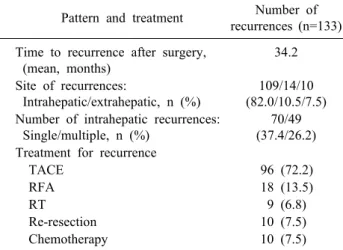
Recurrence was seen in 133 (71.1%) patients during the follow-up, and the mean time to recurrence after surgery was 34.2 months. Of these, 109 patients had only intra- hepatic recurrence, 14 had only extrahepatic recurrence, and 10 had both intrahepatic and extrahepatic recurrence.
The most common treatment modalities for the recurrence of HCC were TACE (n=96, 72.2%) and RFA (n=18, 13.5%) (Table 4).
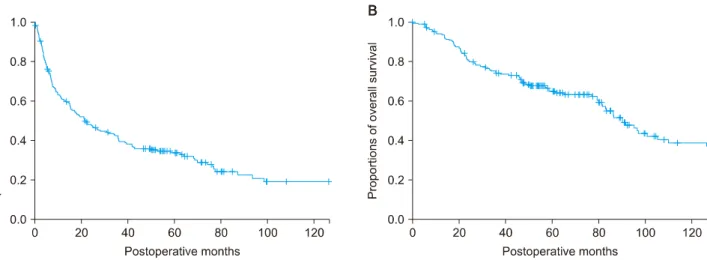
Overall, the 1-, 3-, 5-, and 10-year disease-free survival (DFS) rates were 94.1%, 81.7%, 69.7%, and 39.4%, re-
Table 3. Type of resection
Types Total (n=187)
Open/laparoscopic approach, n (%) 185/2 (98.9/1.1)
Anatomical/non anatomical resection/Both, n (%) 152/15/20 (81.3/8.0/10.7) Type of resection, n (%)
Right hepatectomy 53 (27.9)
Right hepatectomy+wedge resection 5 (2.7)
Right anterior sectionectomy 27 (14.4)
Right anterior sectionectomy+wedge 2 (1.1)
Resection
Right posterior sectionectomy 28 (15.0)
Right posterior sectionectomy+wedge 5 (2.7)
Resection
Right trisectionectomy 1 (0.5)
Right trisectionectomy+wedge resection 1 (0.5)
Central bisectionectomy 3 (1.6)
Left medial sectionectomy 1 (0.5)
Left medial segmenctectomy+S3 1 (0.5)
Segmentectomy
Left medial segmentectomy+wedge 1 (0.5)
Resection
Extended left hepatectomy 1 (0.5)
Left hepatectomy 11 (5.8)
Left hepatectomy+wedge resection 4 (2.1)
Left lateral sectionectomy 11 (5.8)
Left lateral sectionectomy+wedge resection 2 (1.1)
Monosectionectomy 14 (7.5)
S5, 6 segmentectomy 1 (0.5)
Wedge resection 15 (8.0)
Tumor thrombectomy, portal vein, n (%) 4 (2.1)
Combined resection of adjacent organs 9 (4.8)
Table 4. Recurrence pattern and the treatment for recurrence Pattern and treatment Number of
recurrences (n=133) Time to recurrence after surgery,
(mean, months)
34.2
Site of recurrences:
Intrahepatic/extrahepatic, n (%)
109/14/10 (82.0/10.5/7.5) Number of intrahepatic recurrences:
Single/multiple, n (%)
70/49 (37.4/26.2) Treatment for recurrence
TACE 96 (72.2)
RFA 18 (13.5)
RT 9 (6.8)
Re-resection 10 (7.5)
Chemotherapy 10 (7.5)
TACE, transarterial chemoembolization; RFA, radiofrequency ablation; RT, radiative therapy
spectively (Fig. 1A). Univariate analysis showed that ICGR15 ≥15%, preoperative AFP level ≥400 ng/ml, number of tumors ≥3, size of the largest tumor ≥3 cm,
total tumor diameter ≥6 cm, and presence of lymphovas- cular invasion were predictors of recurrence. Multivariate analysis showed that ICGR15 ≥15%, preoperative al- pha-fetoprotein level ≥400 ng/ml, and total tumor diame- ter ≥6 cm) were predictors of recurrence (Table 5).
Overall survival
The cumulative OS rates for all patients at 1-, 3-, 5-, and 10-years were 93.5%, 74.2%, 64.9%, and 38.8%, re- spectively (Fig. 1B).
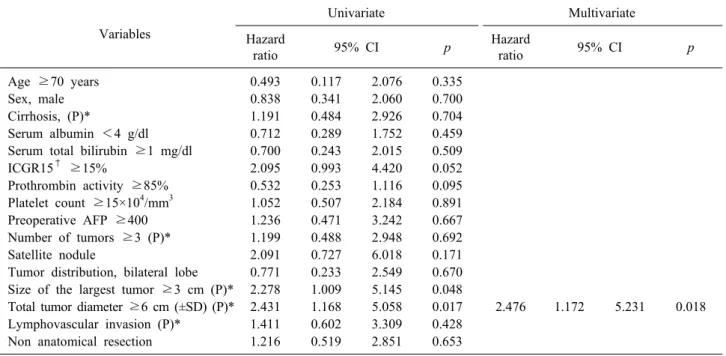
Univariate analysis revealed that size of the largest tu- mor ≥3 cm) and total tumor diameter ≥6 cm were pre- dictors of survival. On multivariate analysis, total tumor diameter ≥6 cm was the only significant predictor of sur- vival (Table 6).
Fig. 1. (A) Disease-free survival rates and (B) overall survival rates and in patients who underwent liver resection for multiple HCC.
Table 5. Univariate and multivariate analysis of risk factors for recurrence Varables
Univariate Multivariate
Hazard
ratio 95% CI p Hazard
ratio 95% CI p
Age ≥70 years 0.822 0.480 1.408 0.475
Sex, male 0.942 0.596 1.490 0.798
Cirrhosis, (P)* 1.263 0.827 1.930 0.280
Serum albumin <4 g/dl 1.229 0.737 2.049 0.429
Serum total bilirubin ≥1 mg/dl 1.243 0.821 1.880 0.304
ICGR15† ≥15% 1.510 1.067 2.138 0.020 1.549 1.087 2.207 0.015
Prothrombin activity ≥85% 1.027 0.701 1.504 0.891 Platelet count ≥15×104/mm3 0.935 0.662 1.319 0.701
Preoperative AFP ≥400 ng/ml 1.618 1.029 2.544 0.037 1.685 1.061 2.675 0.027
Number of tumors ≥3 (P)* 1.672 1.099 2.542 0.016
Satellite nodule 1.602 0.902 2.844 0.108
Tumor distribution, bilateral lobe 1.245 0.765 2.025 0.378 Size of the largest tumor ≥3 cm (P)* 2.008 1.400 2.880 0.000
Total tumor diameter ≥6 cm (P)* 2.292 1.619 3.246 0.000 1.803 1.130 2.879 0.013 Lymphovascular invasion (P)* 1.626 1.094 2.419 0.016
Non anatomical resection 1.458 0.963 2.208 0.075
*Identified after postoperative pathological examination; †Indocyanine green retention rate at 15 min CI, confidence interval; AFP, alpha-fetoprotein
DISCUSSION
Our study showed that surgical resection can provide acceptable OS for patients with multiple HCCs. In the present study, the 1-, 3-, 5-, and 10-year DFS rates were 94.1%, 81.7%, 69.7%, and 39.4%%, respectively, and the 1-, 3-, 5-, and 10-year OS rates were 93.5%, 74.2%, 64.9%, and 38.8%, respectively. Both the survival rates were promising. This was owing to early detection of re- currence and aggressive treatment for both intrahepatic
and extrahepatic recurrences with close follow-up and sur- veillance imaging examination.
The management of HCC is complicated because of its heterogenous biological behavior and association with chronic liver disease.12 In South Korea, HCC is the second leading cause of cancer mortality and it is the fifth most common newly diagnosed cancer.13 The choice of treat- ment in patients with HCC depends on not only tumor staging but also careful evaluation of liver function and physical status. For the treatment of multiple HCCs, surgi-
Table 6. Univariate and multivariate analysis of overall survival in patients with multiple hepatocellular carcinomas Variables
Univariate Multivariate
Hazard
ratio 95% CI p Hazard
ratio 95% CI p
Age ≥70 years 0.493 0.117 2.076 0.335
Sex, male 0.838 0.341 2.060 0.700
Cirrhosis, (P)* 1.191 0.484 2.926 0.704
Serum albumin <4 g/dl 0.712 0.289 1.752 0.459
Serum total bilirubin ≥1 mg/dl 0.700 0.243 2.015 0.509
ICGR15† ≥15% 2.095 0.993 4.420 0.052
Prothrombin activity ≥85% 0.532 0.253 1.116 0.095 Platelet count ≥15×104/mm3 1.052 0.507 2.184 0.891
Preoperative AFP ≥400 1.236 0.471 3.242 0.667
Number of tumors ≥3 (P)* 1.199 0.488 2.948 0.692
Satellite nodule 2.091 0.727 6.018 0.171
Tumor distribution, bilateral lobe 0.771 0.233 2.549 0.670 Size of the largest tumor ≥3 cm (P)* 2.278 1.009 5.145 0.048
Total tumor diameter ≥6 cm (±SD) (P)* 2.431 1.168 5.058 0.017 2.476 1.172 5.231 0.018 Lymphovascular invasion (P)* 1.411 0.602 3.309 0.428
Non anatomical resection 1.216 0.519 2.851 0.653
*Identified after postoperative pathological examination; †Indocyanine green retention rate at 15 min CI, confidence interval; AFP, alpha-fetoprotein
cal and nonsurgical modalities have been used, but the treatment strategies are controversial.14 LT has been gen- erally considered the treatment of choice for small and limited multiple HCCs as it can resolve the corresponding underlying liver cirrhosis and HCC.6,15 Even in patients with HCC beyond the Milan criteria, LT has been per- formed alone or in combination with a nonsurgical modal- ity, such as TACE, RFA, and percutaneous ethanol in- jection, to control the tumor as much as possible. Howev- er, there are many controversies regarding LT in patients with HCC, such as selection of patients considering the organ shortage, tumor progression while on the wait list, use of living donors, and choice of immunosuppression or adjuvant therapies.16
In addition to transplantation, surgical resection and TACE are the two most widely used treatments for multi- ple HCCs. TACE is the most commonly used and is con- sidered the standard palliative treatment for patients with multiple HCCs.5 TACE can induce extensive necrosis in
>50% patients17 and improve their survival.18,19 Howev- er, several studies have suggested that palliative TACE re- sults in a high incidence of viable residual tumor, even after repeated TACE,20,21 and that the poor response in avascular and/or large tumors restricts its use for treating HCCs. Moreover, in recent retrospective cohort studies,
resection provided better survival than TACE, even in pa- tients with multiple HCCs in various stages.4,9,10,22 There- fore, liver resection should be included as a treatment op- tion for multiple HCCs in patients who have well-pre- served hepatic function.
The indications for surgery in patients with multiple HCC have not been established thus far. The predictors of survival for multiple HCCs found in our study were similar to those reported for HCCs in previous studies.4,23 In our study, multivariate analysis identified that total tu- mor diameter ≥6 cm was an independent prognostic fac- tor for both DFS and OS. These results on the prognostic factor in patients with multiple HCCs can help in patient selection for liver resection.
There are a few limitations in our study. First, this study was retrospective in nature, and there might be some selection bias in the choice of treatment. Second, comparison with alternative treatment modalities was not performed. To confirm the efficacy of resection for multi- ple HCCs, its superiority over non-surgical treatment should be proven. Third, our results are mainly based on the data of patients with two HCCs. Further randomized, prospective studies including comparison with alternative treatment modalities and with a large number of patients are necessary to confirm the therapeutic role of liver re-
section in the treatment of patients with multiple HCCs.
In conclusion, on the basis of our experience of liver resection for multiple HCCs, we suggest that surgical re- section could be an important strategy to improve long- term outcomes. However, careful selection of candidates for surgery, meticulous surgical techniques, and early de- tection and aggressive treatment for recurrence is necessary.
In addition, given the complexity of HCC and the avail- ability of several potentially useful treatment modalities, the treatment of patients with multiple HCCs associated with chronic liver disease should be discussed with a mul- tidisciplinary team, including hepatologists, surgeons, ra- diologists, and oncologists.
CONFLICT OF INTEREST
There is no conflict of interest.
ORCID
Soo-Young Lee: https://orcid.org/0000-0002-3916-848X Chul-Soo Ahn: https://orcid.org/0000-0002-3844-3646 Young-In Yoon: https://orcid.org/0000-0002-9308-0366 Sung-Gyu Lee: https://orcid.org/0000-0001-9161-3491 Shin Hwang: https://orcid.org/0000-0002-9045-2531 Ki-Hun Kim: https://orcid.org/0000-0002-4016-0995 Deok-Bog Moon: https://orcid.org/0000-0002-8209-3540 Tae-Yong Ha: https://orcid.org/0000-0001-9932-0212 Gi-Won Song: https://orcid.org/0000-0002-4235-0434 Dong-Hwan Jung: https://orcid.org/0000-0001-5984-023X Gil-Chun Park: https://orcid.org/0000-0003-1631-3258
AUTHOR CONTRIBUTIONS
Conceptualization: CSA. Data curation: SYL, YIY, SGL, SH, KHK, DBM, TYH, GWS, DHJ, GCP. Formal analysis: SYL, CSA, YIY, TYH, GWS, DHJ, KHK, DBM, GCP. Methodology: SYL, YIY. Writing - original draft: SYL, CSA. Writing - review & editing: SYL, CSA, YIY.
REFERENCES
1. Ferlay J, Soerjomataram I, Dikshit R, Eser S, Mathers C, Rebelo M, et al. Cancer incidence and mortality worldwide: sources,
methods and major patterns in GLOBOCAN 2012. Int J Cancer 2015;136:E359-E386.
2. El-Serag HB, Mason AC. Rising incidence of hepatocellular car- cinoma in the United States. N Engl J Med 1999;340:745-750.
3. Bosch FX, Ribes J, Díaz M, Cléries R. Primary liver cancer:
worldwide incidence and trends. Gastroenterology 2004;127(5 Suppl 1):S5-S16.
4. Ho MC, Huang GT, Tsang YM, Lee PH, Chen DS, Sheu JC, et al. Liver resection improves the survival of patients with mul- tiple hepatocellular carcinomas. Ann Surg Oncol 2009;16:848- 855.
5. Bruix J, Sherman M; Practice Guidelines Committee, American Association for the Study of Liver Diseases. Management of hepatocellular carcinoma. Hepatology 2005;42:1208-1236.
6. Yao FY, Ferrell L, Bass NM, Watson JJ, Bacchetti P, Venook A, et al. Liver transplantation for hepatocellular carcinoma: ex- pansion of the tumor size limits does not adversely impact survival. Hepatology 2001;33:1394-1403.
7. Ishizawa T, Hasegawa K, Aoki T, Takahashi M, Inoue Y, Sano K, et al. Neither multiple tumors nor portal hypertension are sur- gical contraindications for hepatocellular carcinoma. Gastroentero- logy 2008;134:1908-1916.
8. Torzilli G, Donadon M, Marconi M, Palmisano A, Del Fabbro D, Spinelli A, et al. Hepatectomy for stage B and stage C hep- atocellular carcinoma in the Barcelona Clinic Liver Cancer clas- sification: results of a prospective analysis. Arch Surg 2008;143:
1082-1090.
9. Lin CT, Hsu KF, Chen TW, Yu JC, Chan DC, Yu CY, et al.
Comparing hepatic resection and transarterial chemoembolization for Barcelona Clinic Liver Cancer (BCLC) stage B hep- atocellular carcinoma: change for treatment of choice? World J Surg 2010;34:2155-2161.
10. Ho CM, Lee PH, Chen CL, Ho MC, Wu YM, Hu RH.
Long-term outcomes after resection versus transplantation for hepatocellular carcinoma within UCSF criteria. Ann Surg Oncol 2012;19:826-833.
11. Ramacciato G, Mercantini P, Petrucciani N, Ravaioli M, Cucchetti A, Del Gaudio M, et al. Does surgical resection have a role in the treatment of large or multinodular hepatocellular carcinoma? Am Surg 2010;76:1189-1197.
12. Guo H, Wu T, Lu Q, Li M, Guo JY, Shen Y, et al. Surgical resection improves long-term survival of patients with hep- atocellular carcinoma across different Barcelona Clinic Liver Cancer stages. Cancer Manag Res 2018;10:361-369.
13. Jung KW, Park S, Won YJ, Kong HJ, Lee JY, Park EC, et al.
Prediction of cancer incidence and mortality in Korea, 2011.
Cancer Res Treat 2011;43:12-18.
14. Korean Liver Cancer Association (KLCA); National Cancer Center (NCC), Goyang, Korea. 2018 Korean Liver Cancer Association-National Cancer Center Korea Practice Guidelines for the management of hepatocellular carcinoma. Korean J Radiol 2019;20:1042-1113.
15. Mazzaferro V, Regalia E, Doci R, Andreola S, Pulvirenti A, Bozzetti F, et al. Liver transplantation for the treatment of small hepatocellular carcinomas in patients with cirrhosis. N Engl J Med 1996;334:693-699.
16. Clavien PA, Lesurtel M, Bossuyt PM, Gores GJ, Langer B, Perrier A. Recommendations for liver transplantation for hep- atocellular carcinoma: an international consensus conference report. Lancet Oncol 2012;13:e11-e22.
17. Llovet JM, Bruix J. Systematic review of randomized trials for unresectable hepatocellular carcinoma: chemoembolization im- proves survival. Hepatology 2003;37:429-442.
18. Lo CM, Ngan H, Tso WK, Liu CL, Lam CM, Poon RT, et al.
Randomized controlled trial of transarterial lipiodol chemo- embolization for unresectable hepatocellular carcinoma. Hepatology 2002;35:1164-1171.
19. Llovet JM, Real MI, Montaña X, Planas R, Coll S, Aponte J, et al. Arterial embolisation or chemoembolisation versus sympto- matic treatment in patients with unresectable hepatocellular car- cinoma: a randomised controlled trial. Lancet 2002;359:1734-1739.
20. Poon RT, Ngan H, Lo CM, Liu CL, Fan ST, Wong J.
Transarterial chemoembolization for inoperable hepatocellular carcinoma and postresection intrahepatic recurrence. J Surg Oncol 2000;73:109-114.
21. Trevisani F, De Notariis S, Rossi C, Bernardi M. Randomized control trials on chemoembolization for hepatocellular carcino- ma: is there room for new studies? J Clin Gastroenterol 2001;
32:383-389.
22. Ng KK, Vauthey JN, Pawlik TM, Lauwers GY, Regimbeau JM, Belghiti J, et al. Is hepatic resection for large or multinodular hepatocellular carcinoma justified? Results from a multi-institu- tional database. Ann Surg Oncol 2005;12:364-373.
23. Fukami Y, Kaneoka Y, Maeda A, Kumada T, Tanaka J, Akita T, et al. Liver resection for multiple hepatocellular carcinomas:
a Japanese nationwide survey. Ann Surg 2020;272:145-154.