INTRODUCTION
Uterine leiomyosarcoma (ULMS) is an uncommon mesenchy- mal neoplasm accounting for 1.3% of all uterine malignancies and 30% to 40% of all uterine sarcomas [1]. In contrast to
endometrial carcinomas which most commonly metastasize to the lymph nodes, ULMS have a high propensity for hema- togeneous spread most commonly to the lungs. The standard management of localized ULMS is surgical and includes total abdominal hysterectomy with or without salpingo-oopho- rotectomy. To date there are no data which demonstrate an overall survival benefit from either adjuvant radiotherapy or adjuvant chemotherapy. ULMS are aggressive tumors with poor 5-year survival rates which vary between 15% and 25%
for all stages of disease [2]. The major factors determining the 5-year disease-specific survival (DSS) include demographic
Metastatic pattern of uterine leiomyosarcoma: retrospective analysis of the predictors and outcome in 113 patients
Sree Harsha Tirumani1,2, Pamela Deaver2, Atul B. Shinagare1,2, Harika Tirumani1, Jason L. Hornick3, Suzanne George4,5, Nikhil H. Ramaiya1,2
1Department of Imaging, Dana-Farber Cancer Institute, Harvard Medical School, Boston, MA; Departments of 2Radiology and
3Pathology, Brigham and Women's Hospital, Harvard Medical School, Boston, MA; 4Center for Sarcoma and Bone Oncology, Dana-Farber Cancer Institute, Harvard Medical School, Boston, MA; 5Department of Medicine, Brigham and Women's Hospital, Harvard Medical School, Boston, MA, USA
Received Apr 22, 2014, Revised Jul 17, 2014, Accepted Jul 29, 2014 Correspondence to Sree Harsha Tirumani
Department of Imaging, Dana-Farber Cancer Institute, Harvard Medical School, 450 Brookline Ave, Boston, MA 02215, USA. E-mail: stirumani@
partners.org
Objective: To describe metastatic pattern of uterine leiomyosarcomas (ULMS) and correlate it with clinical and histopathologic parameters.
Methods: we included 113 women (mean age, 53 years; range, 29 to 72 years) with histopathology-confirmed ULMS from 2000 to 2012. Distribution of metastases was noted from imaging by two radiologists in consensus. Predictors of development of metastases were analyzed with univariate and multivariate analysis. Impact of various clinical and histopathologic parameters on survival was compared using Log-rank test and Cox proportional hazard regression model.
Results: Distant metastases were seen in 81.4% (92/113) of the patients after median interval of 7 months (interquartile range, 1 to 21). Lung was most common site of metastases (74%) followed by peritoneum (41%), bones (33%), and liver (27%). Local tumor recurrence was noted in 57 patients (50%), 51 of whom had distant metastases. Statistically significant correlation was noted between local recurrence and peritoneal metastases (p<0.001) and between lung and other common sites of hematogeneous metastases (p<0.05). Age, serosal involvement, local recurrence, and the International Federation of Gynecology and Obstetrics (FIGO) stage were predictive factors for metastases. At the time of reporting, 65% (74/113) of the patients have died; median survival was 45 months. Stage, local recurrence, and age were poor prognostic factors.
Conclusion: ULMS metastasizes most frequently to lung, peritoneum, bone, and liver. Local recurrence was associated with peritoneal spread and lung metastases with other sites of hematogeneous metastases. Age, FIGO stage and local recurrence predicted metastatic disease and advanced stage, older age and local recurrence predicted poor outcome.
Keywords: Leiomyosarcoma, Neoplasm recurrence, Prognosis, Proportional Hazards Models
pISSN 2005-0380·eISSN 2005-0399
factors such as age and race, histopathological factors such as stage, mitotic index, and lymphovascular invasion [3,4].
Advances in imaging techniques in the last few decades have enabled timely detection of recurrent and metastatic disease in oncology practice. Data pertaining to the metastatic pat- tern of ULMS has not been adequately captured in any of the prior studies including the largest study of 1,396 patients with ULMS obtained from the Surveillance, Epidemiology, and End Results (SEER) data base [4]. Most of the existing studies have focused mainly on the management and prognostic factors of ULMS [3,5-7]. The predictors of metastases, however have not been analyzed in any of these studies. With respect to the metastatic pattern, the literature is replete with several individual case reports of atypical metastatic sites [8-17]. In the large series, the emphasis has always been on lymph nodal involvement and the need for lymphadenectomy [6]. The pur- pose of our study was therefore to review a large database of patients with ULMS at our tertiary cancer institute to describe the pattern of metastasis in ULMS and provide a correlation with various clinical and histopathologic parameters.
MATERIAL AND METHODS
In this Health Insurance Portability and Accountability Act- compliant institutional review board-approved retrospective study, the electronic medical records and imaging studies of 113 women (mean age, 53 years; range, 29 to 72 years) with histopathology-confirmed ULMS seen at our institution between January, 2000 and December, 2012 were reviewed.
Patients with leiomyosarcoma who were treated with morcel- lation were excluded from the study. The demographic data, the date of diagnosis of ULMS and the International Federa- tion of Gynecology and Obstetrics (FIGO) stage 2009 either surgical in patients undergoing surgery or clinical in patients without surgery was recorded in all the patients. The presence of metastases at presentation, the time from diagnosis to metastases and local recurrence, the date of last follow-up and the outcome were also extracted from the electronic medical records. The histopathological features of the primary tumor including the size of the tumor, serosal and cervical involvement, mitotic count, nuclear atypia, lymphovascular invasion, and necrosis were recorded.
All the available computed tomography (CT) scans in the 113 patients were systematically reviewed in consensus by two cancer imaging fellowship-trained radiologists with 8 and 15 years of experience. The restaging CT scans were per- formed at 6 to 8 weeks interval according to the institutional protocol. In total 892 restaging CT scans were reviewed. The
presence or absence of local recurrence, site, number, and size of the distant metastasis and the date of detection of the recurrent/ metastatic disease were recorded for each patient.
The recurrent or metastatic disease was confirmed either by biopsy or by the presence of unequivocal progression on follow-up imaging. Nodal metastases was confirmed either at histopathology or was presumed based on the typical anatomic location on imaging.
The predictors of development of metastases and impact of various clinical and histopathologic parameters on survival were statistically analyzed. The predictive value of age, tumor size, FIGO stage, presence or absence of necrosis, mitotic count, serosal involvement, cervical involvement, and local recurrence for development of metastatic disease was as- sessed using univariate and multivariate analysis; multivariate analysis was performed using logistic regression. For the purpose of this analysis, we divided the tumor stage into three groups, stage 1, stage 2 or 3, and stage 4. This was done partly because there were fewer patients in stages 2 and 3, but also because there is significant prognostic overlap between stage 2 and 3 by both FIGO and American Joint Committee on Cancer (AJCC) classifications [18,19].
Survival between the three FIGO stage-groups was com- pared using Log-rank test. The three FIGO stage-groups were also individually compared with each other for differences in survival. The effect of age, tumor size, stage, and presence of local recurrence on survival was assessed in a multivariate analysis using the Cox proportional hazard regression model.
Time to local recurrence was correlated with size of the primary tumor using Spearman correlation.
RESULTS
1. Patient and tumor characteristics
Of the 113 patients, 76 patients (67%) were ≥50 years of age at the time of first diagnosis of ULMS. The mean tumor size was 10.9 cm (range, 0.5 to 25 cm) with 49 tumors >10 cm in size. Of the 113 patients, 54 (48%) had FIGO stage I tumors, 17 (15%) had stage II tumors, six (5%) had stage III, and 32 (28%) had stage IV tumors (Table 1). The FIGO stage was unknown in four patients. Surgery for primary disease was performed in 111 patients while two patients received only chemotherapy.
Of the 111 patients who underwent surgery, 99 patients under- went total abdominal hysterectomy with or without salpingo- oopphrectomy, 10 patients had supracervial/ subtotal hyster- ectomy and two patients underwent radical hysterectomy. In 12 patients, a myomectomy was performed initially which was followed by total hysterectomy due to detection of ULMS at
histopathology (one patient diagnosed intraoperatively on fro- zen section specimen). Pelvic node assessment was performed in 33 patients with positive nodes seen at histopathology in one patient. Neoadjuvant chemotherapy was administered in three patients. Postoperative chemotherapy was administered in 92 patients 23 after development of recurrent/metastatic disease. Postoperative radiotherapy was administered in 56 patients, 33 after development of recurrent/metastatic disease. At histopathology, serosal involvement was present in 22, absent in 37 and not available in 54 patients. Cervical involvement was present in 13, absent in 76 and not available in 24 patients. The mean mitotic count was 24 per 10 high power fields (range, 0 to 97). Necrosis was present in 76 cases, absent in 13 cases and was not commented in 24 cases.
2. Distribution of metastases
Of the 113 patients, 92 (81%) had radiographic metastasis at any point in the follow-up period of 45 months (range, 4 to 271 months), 12 (10.6%) of whom presented with metastatic disease. The time from diagnosis to metastases was 7 months (interquartile range [IQR], 1 to 21). Lung was the most com- mon site of metastases (84 patients, 74%) followed by the peritoneum (46 patients, 41%), bones (37patients, 33%), and liver (30 patients, 27%). Table 2 shows the distribution and frequency of metastases in ULMS. At least one of the three most common sites of metastases, i.e., lung, peritoneum, and Table 1. Demographic, tumor, and treatment characteristics of
patients with uterine leiomyosarcoma (n=113)
Variable No. (%)
Age (yr)
<50 37 (33)
≥50 76 (67)
Tumor size (cm)
<5 8 (7)
5–10 38 (34)
>10 49 (43)
Unknown 18 (16)
FIGO stage
I 54 (48)
II 17 (15)
III 6 (5)
IV 32 (28)
Unknown 4 (4)
Neoadjuvant chemotherapy 3
Primary treatment
Surgery 111 (98)
Chemotherapy 2 (2)
Adjuvant treatment
Chemotherapy 92 (23 after metastases)
Radiotherapy 56 (33 after metastases)
Histopathology
Serosal involvement
Present 22 (19)
Absent 37 (33)
Unknown 54 (48)
Cervical involvement
Present 13 (12)
Absent 76 (67)
Unknown 24 (21)
Mean mitotic count 24/10 high power fields
Necrosis
Present 76 (67)
Absent 13 (12)
Unknown 24 (21)
Local recurrence
Yes 57 (50)
No 56 (50)
Distant metastases
Yes 92 (81)
No 21 (19)
Death
Yes 74 (65)
No 39 (35)
FIGO, the International Federation of Gynecology and Obstetrics.
Table 2. Sties of metastasis of uterine leiomyosarcoma
Location No. (%)
Lung 84 (74)
Peritoneum 46 (41)
Bones 37 (33)
Liver 30 (27)
Muscles 29 (26)
Lymph nodes 25 (22)
Subcutaneous 17 (15)
Kidney 6 (5)
Pancreas 6 (5)
Brain 5 (4)
Cardiac 5 (4)
Adrenal 2 (2)
Spleen 1 (1)
Thyroid 1 (1)
Breast 1 (1)
Vagina 1 (1)
Orbit 1 (1)
Total 297
bone were involved in all the 92 patients with metastases.
Thirty eight of the 92 patients had metastases in all the three common sites while 47/92 patients had metastases in the lung and peritoneum. In 64/92 patients with metastases, lung was the first site of metastases, nine of whom had concurrent metastases at other sites.
Lung metastases were seen as pulmonary nodules and masses varying in size between 5 mm to 14 cm with cavitation noted in larger nodules. Pleural metastases were noted in 27/84 patients with lung metastases. Peritoneal involvement in all 46 patients was in the form of peritoneal nodules and masses varying in size from 1 to 18 cm, located in the peritoneal cavity including the mesentery, omentum, paracolic gutters, bowel serosa, lesser sac, and pelvis. Two patients developed tumor-bowel fistula.
Bone metastases, the third most common site of metastases seen in 37 patients, were lytic with soft tissue component in 30 patients and sclerotic in seven patients. There was associated epidural soft tissue in four cases. All 30 patients with hepatic metastases had multiple lesions which were low in attenua- tion.
The other sites of metastases were skeletal muscles (29 patients, 26%), lymph nodes (25 patients, 22%), and subcutaneous soft tissues (17 patients, 15%). Of the 25 patients with lymph nodal metastases, 12 had involvement of the supradiaphragmatic nodes mainly the mediastinal and hilar nodes; retroperitoneal node involvement was seen in five cases and pelvic nodal metastases in six cases. Renal and pancreatic metastases were seen in six cases each. Brain and cardiac metastases were found in five patients each. Adrenal glands, spleen, thyroid, breast, orbit, and vagina were uncommon metastatic sites.
3. Predictors of metastases
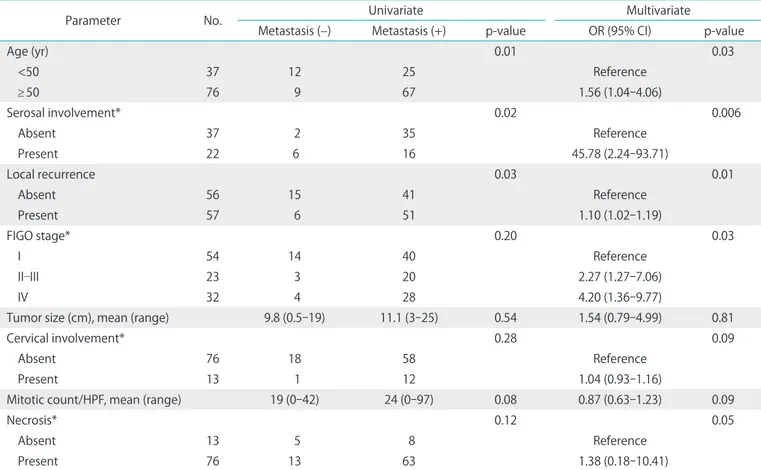
Analysis of the various predictors of metastases showed that age, serosal involvement, local recurrence, and FIGO stage had statistically significant predictive value (Table 3). Ad hoc analysis of age as predictor for metastases, showed that 67/76 patients with ≥50 years of age developed metastases while 25/37 patients <50 years of age developed metastases.
The difference between these two groups was statistically significant (multivariate analysis: p=0.03). Distant metastases
Table 3. Univariate and multivariate associations between metastases and clinicopathologic factors
Parameter No. Univariate Multivariate
Metastasis (–) Metastasis (+) p-value OR (95% CI) p-value
Age (yr) 0.01 0.03
<50 37 12 25 Reference
≥ 50 76 9 67 1.56 (1.04-4.06)
Serosal involvement* 0.02 0.006
Absent 37 2 35 Reference
Present 22 6 16 45.78 (2.24-93.71)
Local recurrence 0.03 0.01
Absent 56 15 41 Reference
Present 57 6 51 1.10 (1.02-1.19)
FIGO stage* 0.20 0.03
I 54 14 40 Reference
II–III 23 3 20 2.27 (1.27-7.06)
IV 32 4 28 4.20 (1.36-9.77)
Tumor size (cm), mean (range) 9.8 (0.5-19) 11.1 (3-25) 0.54 1.54 (0.79-4.99) 0.81
Cervical involvement* 0.28 0.09
Absent 76 18 58 Reference
Present 13 1 12 1.04 (0.93-1.16)
Mitotic count/HPF, mean (range) 19 (0-42) 24 (0-97) 0.08 0.87 (0.63-1.23) 0.09
Necrosis* 0.12 0.05
Absent 13 5 8 Reference
Present 76 13 63 1.38 (0.18-10.41)
HPF, High power fields.
*Cases with unknown parameters were excluded from analysis.
developed in 16/22 patients with serosal involvement (p=0.006) and 51/57 patients with local recurrence (p=0.01).
With respect to FIGO stage, 40/54 patient with stage I, 20/23 patients with stage II/III and 28/32 patients with stage IV disease developed metastatic disease (p=0.03). The size of the tumor (p=0.81), cervical involvement (p=0.09), mitotic count (p=0.09), and necrosis (p=0.05) were not predictive of metastases.
4. Correlation of local recurrence with metastatic pattern During the median follow-up of 45 months (range, 4 to 271 months), local tumor recurrence developed in 57 patients (50%). Distant metastases developed in 51 of these 57 patients with local recurrence. Distant metastases developed before local recurrence in 21/51 patients, after the local recurrence in 14/51 patients and at the same time as local recurrence in 16/51 patients. Analyses of the pattern of distant metastases in the 21 patients who developed distant metastases developed before local recurrence showed that lung was the first site of metastases in 19 patients, one of them having concurrent peritoneal metastases; bone and subcutaneous metastases were the first site in the one each remaining patient. In the 14 patients who developed local recurrence before distant metastases, lung was the first site of metastases in six patients, peritoneal cavity was the first site in four patients, liver in two patients, bone in one patient, and multiple sites (lung, peritoneum, bone) in one another patient. These differences were; however, not statistically significant (p>0.05). Over all, of the 57 patients with local recurrence, 42 developed lung metastases, and 34 developed peritoneal metastases. We correlated local recurrence with the five most common sites of metastases- lung, peritoneum, bones, liver, and muscles which showed statistically significant correlation between local recurrence and peritoneal metastases (Fisher exact test, p<0.001) and no significant correlation with the other sites of metastases. There was statistically significant correlation between lung metastases and other common sites of hematogeneous metastases including bone (Fisher exact test, p=0.0026), liver (Fisher exact test, p<0.001), and muscle (Fisher exact test, p=0.0065).
5. Predictors of survival
The median metastases-free survival in this cohort was 7 months (IQR, 1 to 21 months). At the time of last follow-up, 74/113 patients (65%) have died. Stage-wise analysis showed that 25/54 patients with stage I disease at presentation, 16/23 patients with stage II/III, and 29/32 patients with stage IV disease have died. The median overall survival for all patients was 45 months (IQR, 25 to 74 months). The median survival
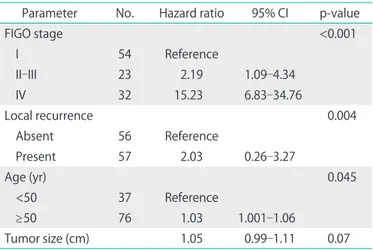
of patients with FIGO stage I, II/III, and IV tumors was 63.5 months (IQR, 35 to 121 months), 45 months (IQR, 31 to 61 months), and 23 months (IQR, 11 to 38 months), respectively (p<0.001). There was statistically significant survival difference between stage I and stage II/III (p=0.004), stage II/III and stage IV disease (p=0.02), and stage I and IV (p<0.001). Analysis of predictors of survival using the Cox proportional regression model showed that stage, local recurrence, and age adversely affected survival (Table 4). Patients with higher FIGO stage and patients with local recurrence had higher risk of death with hazard ratios of 2.19 (range, 1.56 to 3.08) and 2.03 (range, 0.26 to 3.27) respectively. Elderly patients also had statistically significant minimal increase in risk of death with hazard ratio of 1.03 (range, 1.001 to 1.06), although the clinical relevance of this minimal increase in risk is uncertain. The size of the primary tumor did not significantly affect the survival. There was no significant correlation between the size of primary tumor and local recurrence-free interval (Spearman rank correlation, 0.008).
DISCUSSION
The diagnosis of ULMS often occurs in retrospect after surgical resection of a presumed benign uterine neoplasm and therefore, patients often do not undergo preoperative staging work up. Bernstein-Molho et al. [5] found in their study of 33 patients that this lack of preoperative staging as one of the causes for the short disease-free interval in their study. The Na- tional Comprehensive Cancer Network (NCCN) clinical practice guidelines for uterine sarcomas recommend hysterectomy as the initial treatment of choice for all medically operable patients Table 4. Multivariate survival analysis of clinicopathologic factors in terms of metastasis-free survival
Parameter No. Hazard ratio 95% CI p-value
FIGO stage <0.001
I 54 Reference
II–III 23 2.19 1.09–4.34
IV 32 15.23 6.83–34.76
Local recurrence 0.004
Absent 56 Reference
Present 57 2.03 0.26–3.27
Age (yr) 0.045
<50 37 Reference
≥50 76 1.03 1.001–1.06
Tumor size (cm) 1.05 0.99–1.11 0.07
CI, confidence interval; FIGO, International Federation of Gynecology and Obstetrics.
with disease limited to the uterus [20]. However, in patients with suspected extrauterine disease spread, additional surgical resection of metastatic disease, or systemic chemotherapy is recommended after radiological staging. This underscores the significance of the knowledge of the metastatic pattern which helps in planning treatment strategies.
In the autopsy series of 73 patients with uterine sarcomas by Rose et al. [21] which included 19 patients with ULMS, the most common site of metastases was peritoneal cavity followed by lung, lymph nodes, and liver. The most common sites of metastases in our study in descending order of involve- ment were lung, peritoneal cavity, bone, and liver. Though this pattern is slightly different from the autopsy series of Rose et al. [21] which can be due to inclusion of all types of sarcomas in their study and different management strategies, it is in agreement with other studies. In the study of 126 patients with ULMS by Gadducci et al. [6], of the 30 patients with distant metastases, lung, peritoneal cavity, liver, and bone were the most common sites of metastases. Similarly, in a study of 71 patients with ULMS, Mayerhofer et al. [7] found lung to be the most common site of metastases. The high incidence of lung metastases (64/92 patients in our study) justifies the inclusion of thoracic imaging in the follow-up of patients with ULMS.
The management of pelvic and para-aortic lymph nodes in ULMS has been controversial with no clear recommendations by the NCCN guidelines [20]. Though the overall incidence of nodal metastases in our study was 22%, the incidence of pelvic and para-aortic nodal metastases was 8.8% which is in agreement with earlier literature. In the largest study of 1396 ULMS patients till date by Kapp et al. [4], the incidence of nodal metastasis was 6.6% in the 348 patients who underwent lymphadenectomy. The presence of nodal metastases de- creased the 5-year survival from 64% in node negative cases to 26% in node positive cases in their study. The incidence of intrathoracic nodal metastases (10.6%) reported in our study is lower than that reported by Rose et al. (23.6%) [21].
The metastasis-free interval was 7 months in our study. This was shorter than that observed by Gadducci et al. [6] (12 to 16 months) but similar to Mayerhofer et al. [7] (8 months), and may well be influenced by a referral bias to our tertiary center [8,13]. We analyzed the factors which can predict the risk of metastases using univariate and multivariate analysis. Increas- ing age was an important risk factor for distant metastases with patients ≥50 years having higher risk of metastases.
Higher FIGO stage and presence of serosal involvement also translates into increased risk for metastases. Patients with higher FIGO stages, i.e., stage III and stage IV are by definition known to have extrauterine disease which usually occurs with aggressive histology [22]. We did not find a statistically
significant correlation between the risk of metastases and his- topathological parameters like cervical involvement, necrosis, and mitotic count. However, studies have shown that cervical invasion, in addition to high mitotic count portend poor prognosis in ULMS [18,19,23]. The discrepancy with respect to cervical involvement in our study can be in part related to the low number of patients with cervical involvement. Though size is an integral part of FIGO staging and has been shown in several studies to influence the patient outcome, it did not have significant predictive value for metastases in our study [7,22]. Presence of local recurrence increased the risk of distant metastases in our study.
We analyzed the correlation between local recurrence and the pattern of distant metastases. Although not statistically significant, we found that patients who developed distant metastases before local recurrence (21 patients) had a more predictable pattern of distant metastases in that lung was often (19/21) the first site of metastases in them. In contrast, in patients who developed local recurrence before distant metastases, the pattern of metastases was unpredictable. It can be hypothesized that local recurrence indicates presence of viable tumor cells in the surgical bed which makes alternate routes of spread including peritoneal spread, possible. This is further supported by the statistically significant correlation between local recurrence and peritoneal metastases (Fisher exact test, p<0.001) in our study. Rose et al. [21] hypothesized difference routes of spread in uterine sarcomas to explain the different patterns of metastases. While peritoneal disease was presumed to be due to direct implantation and nodal disease due to lymphatic spread, the lung and other distant sites of metastases were thought to result from hematogeneous spread. A similar observation was made in our study in that a statistically significant correlation was noted between pres- ence of lung metastases and presence of bone (Fisher exact test, p=0.0026), liver (Fisher exact test, p<0.001), and muscle (Fisher exact test, p=0.0065), all of which share the common hematogeneous route of dissemination.
Giuntoli et al. [3] developed a risk assessment index for predicting the outcome in patients with ULMS based on the age of the patient, tumor size, FIGO stage, and grade of the tumor. In their study of 208 patients with ULMS, stage and grade were found to be the most important predictors of outcome. Kapp et al. [4] in the their study of 1,396 patients with ULMS concluded that African-American race, older age at diagnosis, higher stage, and grade at the time of diagnosis were associated with poor DSS. The results in our study were in agreement with some of these earlier observations. Stage specific survival showed that higher stage doubled the risk of death for stage IV disease compared to stage I disease.
Similarly, presence of local recurrence and advanced age also shortened the survival, although the shortening of survival with elderly age was minimal. Larger tumor size was associ- ated with decreased DSS and increased risk of local recurrence in the study by Giuntoli et al. [3]. However, in our study tumor size neither affected the survival nor the local recurrence-free interval.
The limitations of our study were the retrospective study design and the selection bias of our cohort treated at our tertiary cancer center which may differ from patients in the general population. Because of this selection bias, we did not calculate the incidence of metastasis in our study which may be over-estimated due to the frequent referral of patients with advanced disease. We did not assess the impact of certain pa- rameters like cervical involvement which was not consistently evaluated in our study.
In conclusion, we found that ULMS metastasizes most fre- quently to the lung, peritoneum, bone and liver. Local recur- rence was often associated with peritoneal spread and lung metastases with other sites of hematogeneous metastases in our study. The factors which predicted the risk of metastases in our study were advanced age and FIGO stage, presence of serosal involvement and local recurrence.
CONFLICT OF INTEREST
No potential conflict of interest relevant to this article was reported.
REFERENCES
1. Tirumani SH, Ojili V, Shanbhogue AK, Fasih N, Ryan JG, Reinhold C. Current concepts in the imaging of uterine sarcoma. Abdom Imaging 2013;38:397-411.
2. Abeler VM, Royne O, Thoresen S, Danielsen HE, Nesland JM, Kristensen GB. Uterine sarcomas in Norway: a histopathological and prognostic survey of a total population from 1970 to 2000 including 419 patients. Histopathology 2009;54:355-64.
3. Giuntoli RL 2nd, Metzinger DS, DiMarco CS, Cha SS, Sloan JA, Keeney GL, et al. Retrospective review of 208 patients with leiomyosarcoma of the uterus: prognostic indicators, surgical management, and adjuvant therapy. Gynecol Oncol 2003;89:460-9.
4. Kapp DS, Shin JY, Chan JK. Prognostic factors and survival in 1396 patients with uterine leiomyosarcomas: emphasis on impact of lymphadenectomy and oophorectomy. Cancer 2008;112:820-30.
5. Bernstein-Molho R, Grisaro D, Soyfer V, Safra T, Merimsky O.
Metastatic uterine leiomyosarcomas: a single-institution experience.
Int J Gynecol Cancer 2010;20:255-60.
6. Gadducci A, Landoni F, Sartori E, Zola P, Maggino T, Lissoni A, et al.
Uterine leiomyosarcoma: analysis of treatment failures and survival.
Gynecol Oncol 1996;62:25-32.
7. Mayerhofer K, Obermair A, Windbichler G, Petru E, Kaider A, Hefler L, et al. Leiomyosarcoma of the uterus: a clinicopathologic multicenter study of 71 cases. Gynecol Oncol 1999;74:196-201.
8. Alonso Gomez J, Arjona Sanchez A, Martinez Cecilia D, Diaz Nieto R, Roldan de la Rua J, Valverde Martinez A, et al. Uterine leiomyosarcoma metastasis to the pancreas: report of a case and review of the literature. J Gastrointest Cancer 2012;43:361-3.
9. Calleja AM, Wellnitz CV, Alharthi MS, Khandheria BK, Chaliki HP.
Extensive cardiac metastases secondary to uterine leiomyosarcoma.
J Am Soc Echocardiogr 2009;22:1419.e5-7.
10. Corcoran S, Hogan AM, Nemeth T, Bennani F, Sullivan FJ, Khan W, et al. Isolated cutaneous metastasis of uterine leiomyosarcoma:
case report and review of literature. Diagn Pathol 2012;7:85.
11. Cordioli E, Pizzi C, Bugiardini R. Left ventricular metastasis from uterine leiomyosarcoma. Cardiologia 1999;44:1001-3.
12. Erkal HS, Ozturk AS, Kutluay L, Aydin D. Endobronchial metastases from a leiomyosarcoma of the uterus. Tuberk Toraks 2008;56:92-5.
13. Gruttadauria S, Pagano D, Li Petri S, di Francesco F, Cintorino D, Gridelli B. Pancreatic metastases from uterine leiomyosarcoma with vascular involvement. Am Surg 2011;77:125-6.
14. Hsiao HH, Liu YC, Hou MF, Lin SF. Uterine leiomyosarcoma metastasis to the breast. Eur J Gynaecol Oncol 2008;29:191-2.
15. Melone GA, D'Elia A, Brogna C, Salvati M. Uterine leiomyosarcoma metastatic to the brain: case report. Tumori 2008;94:856-60.
16. Miglietta L, Canobbio L, Parodi MA, Anselmi L. Unusual osteoblastic secondary lesion as predominant metastatic disease spread in two cases of uterine leiomyosarcoma. Case Rep Oncol 2010;3:49-53.
17. Yamada S, Yamada SM, Nakaguchi H, Murakami M, Hoya K, Matsuno A. A case of multiple brain metastases of uterine leiomyosarcoma with a literature review. Surg Oncol 2011;20:e127-31.
18. Raut CP, Nucci MR, Wang Q, Manola J, Bertagnolli MM, Demetri GD, et al. Predictive value of FIGO and AJCC staging systems in patients with uterine leiomyosarcoma. Eur J Cancer 2009;45:2818-24.
19. Zivanovic O, Leitao MM, Iasonos A, Jacks LM, Zhou Q, Abu-Rustum NR, et al. Stage-specific outcomes of patients with uterine leio- myosarcoma: a comparison of the international Federation of gynecology and obstetrics and american joint committee on cancer staging systems. J Clin Oncol 2009;27:2066-72.
20. National Comprehensive Cancer Network. NCCN Clinical Practice Guidelines in Oncology Endometrial Cancer Version 1.2013 [Internet]. Fort Washington, PA: National Comprehensive Cancer Network; c2014 [cited 2014 Aug 20]. Available from: http://www.
nccn.org/.
21. Rose PG, Piver MS, Tsukada Y, Lau T. Patterns of metastasis in uterine sarcoma: an autopsy study. Cancer 1989;63:935-8.
22. Prat J. FIGO staging for uterine sarcomas. Int J Gynaecol Obstet 2009;104:177-8.
23. Iasonos A, Keung EZ, Zivanovic O, Mancari R, Peiretti M, Nucci M, et al. External validation of a prognostic nomogram for overall survival in women with uterine leiomyosarcoma. Cancer 2013;119:1816-22.