© 2016 Korean Breast Cancer Society. All rights reserved. http://ejbc.kr | pISSN 1738-6756
INTRODUCTION
Cancer is the highest leading cause of death in Korea since 2001 [1-3]. It has become a major burdensome disease to in- dividuals and society [4]. In Korea, breast cancer is the second most common female cancer since 2004. The incidence of Korean breast cancer increased steeply over the last decade. In 2012, 17,792 new breast cancer patients were reported and the age-standardized in incidence rate of female breast cancer was 52.1 per 100,000 [1-3].
The Korean Breast Cancer Society (KBCS) made a nation- wide, hospital-based, breast cancer registry in 1996, and the details of its history, objectives, and activities have been well descripted [5-12]. Since the development of an online regis- tration program in 2001, the database has been actively used for various studies on breast cancer in Korea.
The aim of this study was to report and analyze the basic facts about breast cancer in Korea in 2013, including inci- dence, clinical characteristics, the management of breast can- cer, and their trends from 2002 to 2013.
Data sources
Data were collected on women in Korea who were newly di- agnosed patients with primary breast cancer between January 1, 2013 and December 31, 2013. A nationwide questionnaire sur- vey was used for the total number of patients newly diagnosed with breast cancer (including ductal carcinoma in situ [DCIS]
and invasive breast cancer), and the age of these patients. A to- tal of 99 hospitals answered this questionnaire (See the Supple-
The Basic Facts of Korean Breast Cancer in 2013: Results of a Nationwide Survey and Breast Cancer Registry Database
Sun Young Min, Zisun Kim1, Min Hee Hur2, Chan Seok Yoon2, Eun-Hwa Park3, Kyu-Won Jung4, The Korean Breast Cancer Society Consortium*
Department of Surgery, Kyung Hee University Medical Center, Kyung Hee University School of Medicine, Seoul; 1Department of Surgery, Soonchunhyang University Bucheon Hospital, Soonchunhyang University College of Medicine, Bucheon; 2Department of Surgery, Cheil General Hospital and Women’s Healthcare Center, Dankook University College of Medicine, Seoul; 3Department of Surgery, Gangneung Asan Hospital, University of Ulsan College of Medicine, Gangneung; 4The Korea Central Cancer Registry, Division of Cancer Registration and Surveillance, National Cancer Center, Goyang, Korea SPECIAL ARTICLE
The Korean Breast Cancer Society (KBCS) has reported a na- tionwide breast cancer data since 1996. We present a compre- hensive report on the facts and trends of breast cancer in Korea in 2013. Data on the newly diagnosed patients in the year 2013 were collected from 99 hospitals by using nationwide question- naire survey. Clinical characteristics such as stage of cancer, his- tologic types, biological markers, and surgical management were obtained from the online registry database. A total of 19,316 patients were newly diagnosed with breast cancer in 2013. The crude incidence rate of female breast cancer includ- ing carcinoma in situ was 76.2 cases per 100,000 women. The median age at diagnosis was 50 years, and the proportions of postmenopausal women with breast cancer accounted for more than half of total patients. The proportion of early breast cancer
increased consistently, and the pathologic features have changed accordingly. Breast-conserving surgery was performed in more cases than total mastectomy in the year. The total num- ber of breast reconstruction surgeries markedly increased ap- proaching 3-fold in last 11 years. According to annual percentile change of invasive cancer incidence, the incidence increased rapidly until 2010. And thereafter the increase of it became steadier. For ductal carcinoma in situ, the incidence consistently increased during the same period without any joinpoint. Analysis of nationwide registry data will contribute to defining of the trends and characteristics of breast cancer in Korea.
Key Words: Breast neoplasms, Korea, Online systems, Registries
Correspondence to: Min Hee Hur
Department of Surgery, Cheil General Hospital and Women’s Healthcare Center, Dankook University College of Medicine, 17 Seoae-ro 1-gil, Jung-gu, Seoul 04619, Korea
Tel: +82-2-2000-7277, Fax: +82-2-2000-7791 E-mail: [email protected]
* Additional information: Authors/the Korean Breast Cancer Society Consortium members are presented in the Supplement.
Received: February 22, 2016 Accepted: March 9, 2016
Cancer
ment). Additional data such as cancer stage, type of surgery, pathological information (biological markers and histological types) were obtained from the KBCS online breast cancer reg- istry (http://registry.kbcs.or.kr/ecrf/login.php).
Statistical analysis
Crude rates (CRs) of cancer incidence were calculated using data of the nationwide questionnaire survey. Annual percent change (APC) was calculated for characterization of the trends in cancer rates over time. With this method, the cancer rates are estimated to change at a constant percentage of the rate of the previous year. And average annual percent change (AAPC) was calculated, also. AAPC is a summary measure of the trend over a pre-specified fixed interval [13]. AAPC is ap- plied to use a single number to describe the average APCs over a period of many years. We used a joinpoint regression model [14] to analyze the years when there were significant changes in the CRs of incidence. We used the Joinpoint Re- gression Program (version 4.2.0.2) developed by the U.S. Na- tional Cancer Institute. This program is a Windows-based sta- tistical software that analyzes joinpoint models [13]. Joinpoint regression method identifies changes in data trends by straight light segments joined at “joinpoint.” At “Joinpoint,” crude in- cidence rate trend changes its slope statistically significantly [15]. The APC and the corresponding 95% confidence inter- val (CI) were calculated for each line segment and the AAPC of total period (2002–2013) was estimated.
We also analyzed the trends in the proportion of stages, bio- logical markers, median age by linear regression analysis and a p-value <0.05 was regarded as statistically significant (95%
level of confidence). To determine the reliability of the survey data, we examined the correlation coefficients and compared APC between the crude incidence rate trends in Korean Sta- tistical Information Service (KOSIS) and our survey data dur-
ing the same period, 2002 to 2013. The correlation coefficients were 0.99 (p<0.001), and there was no significant difference between the groups.
BASIC FINDINGS OF KOREAN BREAST CANCER IN 2013
Total number of newly diagnosed breast cancer patients A total of 19,316 patients were newly diagnosed with breast cancer in 2013. It contained 16,012 patients of invasive breast cancer and 3,264 patients of DCIS. Male breast cancer includ- ing DCIS was 43 cases, 0.2% of the total number. The crude incidence rate of female breast cancer including carcinoma in situ was 76.2 per 100,000 women per year. Sixteen thousand six hunderd seven cases (86%) are diagnosed at 68 university hospitals, 2,576 cases (13.3%) at 27 general hospitals. And, 133 cases (0.7%) are diagnosed at four private clinics.
Age distribution
Analyses of the survey data and registry data showed equiv- alent results in the age distribution of newly diagnosed pa- tients (Table 1). The median age at diagnosis was 50 years, the youngest patient was 15 years old, and the oldest 93 years old.
The age group with the highest number of patients was the 40–49 year olds (6,559 cases, 34.1%), followed by the 50–59 year olds (5,767 cases, 30%).
Surgery and staging
The information of surgical methods was obtained from KBCS online registry data. Among 12,522 patients, breast- conserving surgery (BCS) was most frequently performed (8,366 cases, 66.8%), followed by total mastectomy (4,036, 32.2%) (Table 2). Among online registry data, stage I was the most frequent diagnosis (5,152 cases, 41.1%). Stage II was the second frequent as 3,895 cases (31.1%) and stage 0 was 1,749 cases (14.0%), respectively (Table 3).
Pathology and biological markers
Among the 10,516 patients whose pathologic results were Table 1. Age distribution of newly diagnosed breast cancer patients in
Korea, 2013
Year 2013 Survey data
No. of patients (%)
KBCS registry data No. of patients (%) Age (yr)
<20 4 (0.02) 4 (0.03)
20–29 180 (0.9) 135 (1.1)
30–39 1,822 (9.5) 1,288 (10.3)
40–49 6,559 (34.1) 4,620 (36.9)
50–59 5,767 (30.0) 3,889 (31.1)
60-69 2,554 (13.3) 1,713 (13.7)
70–79 1,148 (6.0) 774 (6.2)
>80 150 (0.8) 99 (0.7)
Unknown 1,046 (5.4) 0
Total 19,230 (100.0) 12,522 (100.0)
KBCS=Korean Breast Cancer Society.
Table 2. Surgical management of newly diagnosed breast cancer pa- tients, 2013 (KBCS registry data)
Surgery No. of patients (%)
Mastectomy 4,036 (32.2)
BCS 8,366 (66.8)
Others 57 (0.5)
Unknown 63 (0.5)
Total 12,522 (100.0)
KBCS=Korean Breast Cancer Society; BCS=breast-conserving surgery.
reported on online registry, invasive ductal carcinoma was the most common histologic type (8,375 cases, 79.6%), followed by DCIS (1,417 cases, 13.5%) and invasive lobular carcinoma (432 cases, 4.1%) (Table 4).
The proportions of patients with tumors positive for estro-
gen receptor (ER) and progesterone receptor (PR) expression were 74.9% and 64.6%. When c-erbB-2 expression was identi- fied, 32.7% of all patients were found to have tumors negative for immunohistochemical (IHC) staining. 25.4% had 1+ rat- ing in IHC staining, 19.9% had 2+ rating, and 18.2% had 3+
rating (Table 5).
CHANGING PATTERNS OF BREAST CANCER IN KOREA
Incidence
The number of newly diagnosed breast cancer patients in Korea has increased continuously over the last decade. In 2013, the number of newly diagnosed female breast cancers were 19,273. Compared with 7,551 patients in 2002, it was 2.6 times increased (155.2% increase; R2=0.995, p<0.001) (Fig- ure 1) [8,10-12]. The crude incidence rate of female breast cancer in Korea in 2013, including cases of DCIS was calcul- ated to be 76.2 cases per 100,000 women. According to indi- vidual cancer invasiveness, the crude incidence rate of inva- sive carcinoma was 63.3 cases per 100,000 women. The crude incidence rate of DCIS was 12.9 cases per 100,000 women.
The CRs of invasive cancer significantly increased from 2002 through 2013 with an AAPC of +6.7% (95% CI, 5.9%–7.5%, p<0.001), and the CRs of DCIS increased with an AAPC of +15.1% (95% CI, 11.4%–19.0%, p<0.001) (Table 6).
Table 6 and Figure 2 showed the trends in breast cancer in- cidence in Korea according to invasiveness. For invasive can- cer, there was 1 joinpoint at 2010. A continuous significant in- crease of the CRs was observed with an APC of +8.5% (95%
CI, 7.3%–9.8%) until 2010, and thereafter the CRs increase had slowed with an APC of +2.0% (95% CI, -1.7%–6.0%).
However, slowing of increase of the CRs from 2010 to 2013 was not statistically significant. The CRs of DCIS consistently increased without any joinpoint during observed period (2002–2013).
Figure 1. Number of newly diagnosed breast cancer patients from 2002 to 2013 in Korea (Korean Breast Cancer Society survey data).
25,000 20,000 15,000 10,000 5,000 0
2002 2004 2006 2008 2010 2011 2012 2013 7,551 9,668 11,275
13,908
16,398 16,967
19,273 17,792
Table 3. Stage distribution of newly diagnosed breast cancer patients, 2013 (KBCS registry data)
Stage No. of patients (%)
0 1,749 (14.0)
1 5,152 (41.1)
2 3,895 (31.1)
3 1,121 (9.0)
4 175 (1.4)
Unknown 430 (3.4)
Total 12,522 (100.0)
KBCS=Korean Breast Cancer Society.
Table 4. Histological types, 2013 (KBCS registry data)
Histologic type No. of patients (%)
Ductal carcinoma in situ 1,417 (13.5) Invasive ductal carcinoma 8,375 (79.6) Lobular carcinoma in situ 64 (0.6) Invasive lobular carcinoma 432 (4.1) Paget’s disease (pure form) 7 (0.07) Malignant phyllodes tumor 37 (0.34)
Lymphoma 1 (0.01)
Sarcoma 8 (0.08)
Others 175 (1.7)
Total 10,516 (100.0)
KBCS=Korean Breast Cancer Society.
Table 5. Biological markers, 2013 (KBCS registry data)
Biologic marker No. of patients (%)
ER
Negative 2,557 (24.5)
Positive 7,828 (74.9)
Unknown 64 (0.6)
Total 10,449 (100.0)
PR
Negative 3,624 (34.8)
Positive 6,739 (64.6)
Unknown 65 (0.6)
Total 10,428 (100.0)
c-erbB-2
Negative 3,351 (32.7)
Weak (1+) 2,602 (25.4)
Intermediate (2+) 2,046 (19.9)
Strong (3+) 1,864 (18.2)
Unknown 394 (3.8)
Total 10,257 (100.0)
KBCS=Korean Breast Cancer Society; ER=estrogen receptor; PR=progesterone receptor.
Number
Year
Median age at diagnosis
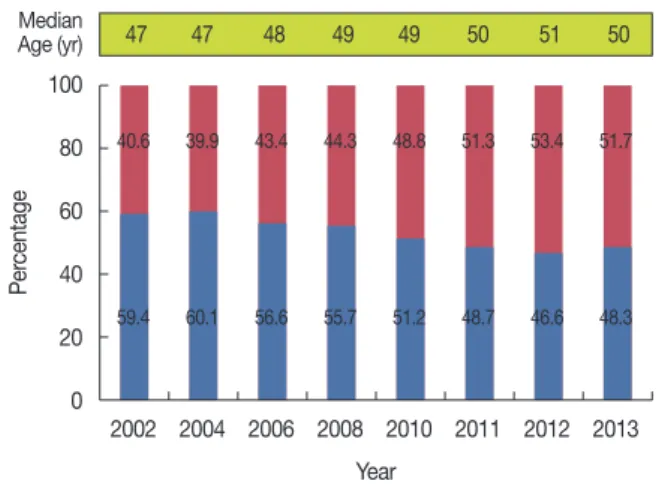
The median age at diagnosis was 50 years in 2013 similar to result of median age in 2012. The proportions of postmeno- pausal women with breast cancer accounted for more than half of total cases since 2011 (Figure 3) [11,12].
Biologic markers and stage distributions
Both the proportions of ER- and PR-positive breast cancer patients consistently increase since 2002. The proportion of ER-positive breast cancer patients increased from 58.2% in 2002 to 74.9% in 2013 (28.6% increase; R2=0.990, p< 0.001), and that of PR-positive breast cancer patients increased from 50.7% in 2002 to 64.6% in 2013 (27.4% increase; R2=0.926,
A B
Figure 2. Trends in crude incidence rates of Korean female breast cancer from 2002 to 2013 (Korean Breast Cancer Society survey data). (A) Crude incidence rates of invasive breast cancer. (B) Crude incidence rates of ductal carcinoma in situ.
70 65 60 55 50 45 40 35 30 25 20
20
15
10
5
0
2001 2002 2003 2004 2005 2006 2007 2008 2009 2010 2011 2012 2013 2014 2001 2002 2003 2004 2005 2006 2007 2008 2009 2010 2011 2012 2013 2014
Year Year
Crude rates of incidence Crude rates of incidence29.5 2.4
36.6
3.9 42.3
4.5 50.4
7.1 58.5
8.7 58.0
9.0 60.1
10.7 63.3
12.9
Invasive breast cancer Ductal carcinoma in situ
Joinpoint 1: 2010
Figure 3. Trends in the median age at breast cancer diagnosis from 2002 to 2013 in Korea, and the ratio of postmenopausal to premeno- pausal women at diagnosis.
100 80 60 40 20 0
2002 2004 2006 2008 2010 2011 2012 2013 Year
Median
Age (yr) 47 47 48 49 49 50 51 50
Postmenopause Premenopause 59.4 60.1 56.6 55.7 51.2 48.7 46.6 48.3 40.6 39.9 43.4 44.3 48.8 51.3 53.4 51.7
Percentage
Figure 4. Changing trends in the hormone receptor-positive breast cancer.
ER=estrogen receptor; PR=progesterone receptor.
100
80
60
40
20
0
2002 2004 2006 2008 2010 2011 2012 2013 Year
58.2 50.7
59.1 52.6
62.9 60.2
65.2 58.5
70.6
59.6 71.2
60.5 73.0
62.4 74.9
64.6
ER positive PR positive
Percentage
Table 6. Trends in crude incidence rates for breast cancer according to joinpoint analysis (KBCS survey data, 2002–2013) AAPC
2002–2013
Trend 1 Trend 2
Period APC 95% CI
Period APC 95% CI
Lower Higher Lower Higher
Invasive breast cancer +6.7* 2002–2010 +8.5* 7.3 9.8 2010–2013 +2.0* -1.7 6.0
DCIS +15.1* 2002–2013 +15.1* 13.5 16.6 - - - -
KBCS =Korean Breast Cancer Society; AAPC =average annual percent rate change, %; APC =annual percent rate change, %; CI =confident interval;
DCIS=ductal carcinoma in situ.
*The annual percent rate change is significantly different from 0 (two-sided p<0.05).
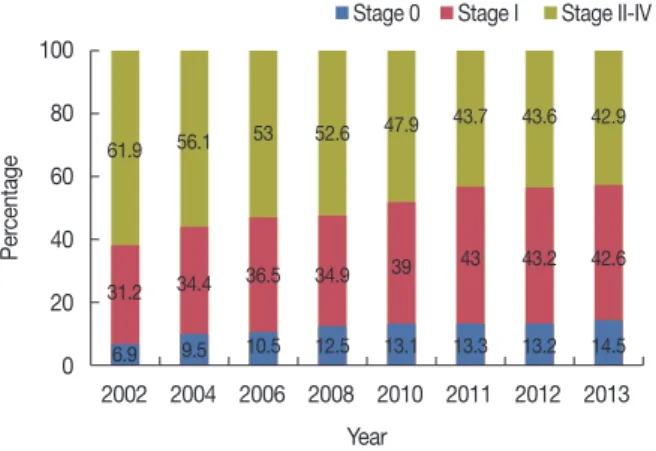
p<0.001) (Figure 4). With regard to stage distribution, the proportion of patients with stage 0 and stage I breast cancer has steadily increased since 2002 and accounted for more than half of total breast cancer patients since 2010. Especially, the proportion of stage 0 cancer patients increased from 6.9% to 14.5% (110.1% increase; R2=0.968, p<0.001). On the con- trary, the proportion of patients with stage II to IV cancers decreased from 61.9% to 42.9% (30.7% decrease; R2=0.982, p<0.001) (Figure 5).
Surgical patterns
Change of surgical patterns of breast cancer was observed during period from 2002 to 2013. The proportion of BCS and that of total mastectomy had reversed since 2006. The propor- tion of patients who was performed BCS increased from 37.6% in 2002 to 67.1% in 2013 (78.5% rise; R2=0.989, p<0.001). Meanwhile, the proportion of patients who under- went total mastectomy decreased from 61.3% in 2002 to 32.4%
in 2013 (47.1% decrease; R2=0.988, p<0.001) (Figure 6).
The number of breast reconstructions performed after total mastectomy markedly increases from 380 cases in 2002 to 1,111 cases in 2013 (192.4% increase; R2=0.976, p<0.001) (Figure 7).
DISCUSSION
Breast cancer is the second most common cancer world- wide, and the most frequent cause of cancer death in women in the world. Age-standardized incidence of Korean breast cancer was 52.1 cases per 100,000 women in 2012. Korea be- came one of the countries in the world with the fastest in- creasing of breast cancer incidence [16].
We reported the basic facts of the Korean breast cancer and analyzed the trends in cancer incidence between 2002 and 2013 using KBCS registry data and nationwide survey data.
KBCS registry system was initiated in 1996 and online regis- tration program was established in 2001. This nationwide reg- istry data were used as the foundation of our annual report as well as various research studies. Compared with data from KOSIS (17,231 women patients), our collected survey data represented 92.9% of women patients with invasive breast cancer.
The clinical facts derived from these data were as follows.
The first was that the number of newly diagnosed breast can- cer patients was still on the increase, it was increasing at close to about 20,000 patients per year. Secondly, the median age of patients at the time of diagnosis was 50 years in 2013. This was similar to results of 2012 [12], and the proportion of post- menopausal women had remained around half of total pa- tients. Thirdly, the proportion of patients who underwent BCS was higher than that of patients who underwent total mastect- omy. However, the changes in trend of surgical methods was not significant in the year of 2013. The proportion of stage 0 and stage I was constantly increasing, particularly. The Figure 7. Changing trends in breast reconstruction in patients with breast cancer surgery.
1,200 1,000 800 600 400 200 0
2002 2004 2006 2008 2010 2011 2012 2013 Year
Number 380
536 626
738 812 845
1,111 910 Number of breast reconstruction
Figure 5. Changes in breast cancer incidence according to stage.
100 80 60 40 20 0
2002 2004 2006 2008 2010 2011 2012 2013 Year
61.9 56.1 53 52.6 47.9 43.7 43.6 42.9
31.2 34.4 36.5 34.9 39 43 43.2 42.6 6.9 9.5 10.5 12.5 13.1 13.3 13.2 14.5
Stage 0 Stage I Stage II-IV
Percentage
Figure 6. Changes in the surgical management of breast cancer.
BCS=breast-conserving surgery.
100
80
60
40
20
0
2002 2004 2006 2008 2010 2011 2012 2013 Year
61.3
37.6
1.1 59 40.2
0.8 49.6 49.1
1.3 42.2 56.8
1 61.9
37.5
0.6 65.7
33.8
0.5 67.2
32.3
0.5 67.1
32.4
0.5 BCS
Mastectomy Others
Percentage
proportion of stage 0 breast cancer highly increased. The pro- portion of classification according to histologic type was not changed. And the proportion of patients who had tumor with +3 expression of c-erbB-2 was not changed, also. Meanwhile, the proportion of ER positive breast cancer patients steadily increased. Finally, the number of patients who underwent breast reconstruction rose rapidly over recent years.
Korea is categorized to high-income countries, which have the highest incidence rate of cancer worldwide. Korea was rat- ed to have the highest incidence rate of breast cancer in Asia (52.1 cases per 100,000 women) in 2012 [16].
In Korea, the incidence rate of breast cancer has increased steeply until the recent years. As we analyzed the trends in cancer incidence of female breast cancer in Korea between 2002 and 2013, we could find the fine change of incidence.
Female breast cancer showed the plateau of CRs in the recent years. The APC of CRs of invasive cancer dropped in the last quarter period (from 8.5%, 2002–2010; to 2.0%, 2010–2013).
Meanwhile, the APC of CRs of DCIS showed no sign of standstill or decline. As we analyzed the trend with 0 to 2 join- points for DCIS, the slope of each line segment was changed in 2008. And, APC of CRs of it was significantly changed from 17.4% to 12.5%. But, it was not the best-fitting model for DCIS. The Joinpoint Regression Program showed that CRs of DCIS was still increased without any joinpoint. In Japanese studies for the trends in cancer incidence with joinpoint re- gression analysis between 1985 and 2013, APC of female breast cancer was 3.9% and age-standardized rates of inci- dence was continuously increased during the observation pe- riods. Also, APC of female breast cancer incidence including carcinoma in situ was increased much more after 2002 (3.8%
in 1985–2002, 95% CI, 3.4%–4.2%; 5.9% in 2002–2010, 95%
CI, 5.0%–6.8%) [17,18]. These changes will be followed to confirm whether it is real change or not.
The median age of patients at the diagnosis of breast cancer was 50 years in 2013, with the proportion of postmenopausal women exceeding half the total number of cases. It was simi- lar with the median age in 2012. Anyway, it was still lower by 10 years than that of the United States, which was 61 years from 2006 to 2010 [19]. The trend of median age at diagnosis will be followed more.
The surprising change of basic facts of female breast cancer in 2013 was the consistency of the proportion of BCS, which increased until 2012. The proportion of BCS was 67.2%, and the proportion of mastectomy was 32.3% in 2012. In 2013, the proportion of BCS was decreased to 67.1% and the proportion of mastectomy was just a little increased to 32.4%. This rever- sal of surgery patterns was found in the operation of the United States, also. A cohort study of the Surveillance, Epidemiology,
and End Results (SEER) had higher mastectomy rates with a similar downward trend for 40% in 2000 to 36% between 2005 and 2006, but a subsequent increase to 38% in 2008 [20]. In early breast cancers, the proportion of BCS-eligible patients who underwent mastectomy increased from 34.3% in 1998 to 37.8% in 2011 with the most striking increase in mastectomy rates occurring after 2006 [21]. Reasons for the change of sur- gical patterns are not clear. But, the wider use of breast mag- netic resonance imaging, the genetic testing, sharing the deci- sion making by patients, trends in surgical choice have been suggested to contribute to this change of surgical patterns in the report [22-24]. The number of breast reconstruction after mastectomy increased rapidly in Korea over the last 11 years (192.4% increase; R2=0.0976, p<0.001), accordingly. Jagsi et al. [25] reported the increased trends of reconstruction from 46% in 1998 to 63% in 2007. Further investigation about the trend of our surgical patterns is warranted.
The following limitations should be considered. First, be- cause our data was based on a nationwide survey, there were differences between our data and that of the National Cancer Registry (NCR). Our data represented 92.9% (16,012 cases) of women patients with invasive breast cancer (17,231 cases) of the NCR. We believe that this data is sufficient to support our results, considering SEER data in the United States. Second, our results of incidence was not age-standardized. Survey data should be complemented by subdivision of age groups.
CONCLUSION
The basic facts of Korean breast cancer have been changed in the years up to 2013. There are several changes of clinical characteristics of breast cancer in Korea, steadily and continu- ously. The proportion of early breast cancer and the propor- tion of hormone receptor-positive breast cancer increased consistently. BCS was performed in more cases than total mastectomy in the year. The total number of breast recon- struction surgeries markedly increased approaching 3-fold in last 11 years. According to APC of invasive cancer incidence, the incidence increased rapidly until 2010 and thereafter the increase of it became steadier. A continuous study using the nationwide registry data will provide more definite informa- tions that can be used to understand the trends and features of breast cancer in Korea.
CONFLICT OF INTEREST
The authors declare that they have no competing interests.
ACKNOWLEDGMENTS
We thank all members of the Korean Breast Cancer Society (KBCS) who participated in this nationwide survey and KBCS online registry.
REFERENCES
1. Cancer statistics. National Cancer Information Center, Ministry of Health and Welfare. http://www.cancer.go.kr. Accessed January 15th, 2016.
2. Statistics Korea 2015. Korean Statistical Information Service. http://
kosis.kr. Accessed January 18th, 2016.
3. Jung KW, Won YJ, Kong HJ, Oh CM, Cho H, Lee DH, et al. Cancer statistics in Korea: incidence, mortality, survival, and prevalence in 2012. Cancer Res Treat 2015;47:127-41.
4. Yoon SJ, Bae SC, Lee SI, Chang H, Jo HS, Sung JH, et al. Measuring the burden of disease in Korea. J Korean Med Sci 2007;22:518-23.
5. Korean Breast Cancer Society. Korean breast cancer data of 1996. J Korean Surg Soc 1998;55:621-35.
6. Korean Breast Cancer Society. Korean breast cancer data of 1997. J Korean Cancer Assoc 1999;31:1202-9.
7. Ahn SH, Yoo KY; Korean Breast Cancer Society. Chronological changes of clinical characteristics in 31,115 new breast cancer patients among Koreans during 1996-2004. Breast Cancer Res Treat 2006;99:209-14.
8. Ko BS, Noh WC, Kang SS, Park BW, Kang EY, Paik NS, et al. Changing patterns in the clinical characteristics of Korean breast cancer from 1996-2010 using an online nationwide breast cancer database. J Breast Cancer 2012;15:393-400.
9. Ko SS; Korean Breast Cancer Society. Chronological changing patterns of clinical characteristics of Korean breast cancer patients during 10 years (1996-2006) using nationwide breast cancer registration on-line program: biannual update. J Surg Oncol 2008;98:318-23.
10. Jung YS, Na KY, Kim KS, Ahn SH, Lee SJ, Park HK, et al. Nation-wide Korean breast cancer data from 2008 using the breast cancer registra- tion program. J Breast Cancer 2011;14:229-36.
11. Kim Z, Min SY, Yoon CS, Lee HJ, Lee JS, Youn HJ, et al. The basic facts of Korean breast cancer in 2011: results of a nationwide survey and breast cancer registry database. J Breast Cancer 2014;17:99-106.
12. Kim Z, Min SY, Yoon CS, Jung KW, Ko BS, Kang E, et al. The basic facts of Korean breast cancer in 2012: results from a Nationwide Survey and Breast Cancer Registry Database. J Breast Cancer 2015;18:103-11.
13. National Cancer Institute, Surveillance, Epidemiology, and End Results
Program. National Cancer Institute Division of Cancer Control &
Population Sciences. http://surveillance.cancer.gov/joinpoint/webhelp/
Executing_the_Joinpoint_Parameters/Statistical_Notes/Statistics_
Related_to_the_k-joinpoint_Model/Average_Annual_Percent_
Change.htm. Accessed January 31st, 2016.
14. Kim HJ, Fay MP, Feuer EJ, Midthune DN. Permutation tests for join- point regression with applications to cancer rates. Stat Med 2000;19:
335-51.
15. Lim D, Ha M, Song I. Trends in major cancer mortality in Korea, 1983- 2012, with a joinpoint analysis. Cancer Epidemiol 2015;39:939-46.
16. Ferlay J, Soerjomataram I, Ervik M, Dikshit R, Eser S, Mathers C, et al.
GLOBOCAN 2012 v1.0, Cancer Incidence and Mortality Worldwide:
IARC CancerBase No. 11. International Agency for Research on Can- cer. http://globocan.iarc.fr. Accessed January 24th, 2016.
17. Katanoda K, Matsuda T, Matsuda A, Shibata A, Nishino Y, Fujita M, et al. An updated report of the trends in cancer incidence and mortality in Japan. Jpn J Clin Oncol 2013;43:492-507.
18. Katanoda K, Hori M, Matsuda T, Shibata A, Nishino Y, Hattori M, et al.
An updated report on the trends in cancer incidence and mortality in Japan, 1958-2013. Jpn J Clin Oncol 2015;45:390-401.
19. Howlader N, Noone AM, Krapcho M, Garshell J, Neyman N, Altekruse SF, et al. SEER cancer statistics review, 1975-2010. National Cancer In- stitute. http://seer.cancer.gov/csr/1975_2010/. Accessed February 2nd, 2016.
20. Mahmood U, Hanlon AL, Koshy M, Buras R, Chumsri S, Tkaczuk KH, et al. Increasing national mastectomy rates for the treatment of early stage breast cancer. Ann Surg Oncol 2013;20:1436-43.
21. Kummerow KL, Du L, Penson DF, Shyr Y, Hooks MA. Nationwide trends in mastectomy for early-stage breast cancer. JAMA Surg 2015;
150:9-16.
22. Evans DG, Barwell J, Eccles DM, Collins A, Izatt L, Jacobs C, et al. The Angelina Jolie effect: how high celebrity profile can have a major impact on provision of cancer related services. Breast Cancer Res 2014;16:442.
23. Balch CM, Jacobs LK. Mastectomies on the rise for breast cancer: “the tide is changing”. Ann Surg Oncol 2009;16:2669-72.
24. Tracy MS, Rosenberg SM, Dominici L, Partridge AH. Contralateral prophylactic mastectomy in women with breast cancer: trends, predic- tors, and areas for future research. Breast Cancer Res Treat 2013;140:
447-52.
25. Jagsi R, Jiang J, Momoh AO, Alderman A, Giordano SH, Buchholz TA, et al. Trends and variation in use of breast reconstruction in patients with breast cancer undergoing mastectomy in the United States. J Clin Oncol 2014;32:919-26.