Validity of the Korean Version of the Fear of Alzheimer’s Disease Scale for the Assessment of Anticipatory Dementia
Anticipatory dementia is related to anxiety, which is a clinical predictor of early conversion to Alzheimer’s disease. The Fear of Alzheimer’s Disease Scale (FADS) is a reliable and valid instrument to address anticipatory dementia. The aim of the present investigation was to develop the Korean version of the Fear of Alzheimer’s Disease Scale (K-FADS) and to verify its reliability and validity. We developed the K-FADS to consist of 30 items with total scores ranging from 0 to 120, as in the original FADS. One hundred eight healthy volunteer participants, drawn from 3 different university hospitals, were evaluated. The K-FADS revealed good reliability (Cronbach α = 0.96) and good validity as compared to the Korean version of the State-Trait Anxiety Inventory Form (r = 0.242, P = 0.013). Test-retest reliability was excellent, as the intra-class correlation coefficient comparing the retest to test was 0.98 (95% confidence interval, 0.96-0.99). Our results show that the K-FADS is a suitable and valuable scale to assess anticipatory dementia in elderly Koreans.
Keywords: Alzheimer Disease; Anticipatory Dementia; Scale; Anxiety; Cognitive Impairment; Korea
Yeonsil Moon,1 Hee-Jin Kim,2 Hojin Choi,3 Seong-il Oh,2 and Seol-Heui Han1,4
1Department of Neurology, Konkuk University Medical Center, Seoul; 2Department of Neurology, College of Medicine, Hanyang University, Seoul;
3Department of Neurology, Hanyang University Guri Hospital, Guri; 4Center for Geriatric Neuroscience Research, Institute of Biomedical Science, Konkuk Medical Science Research Center, Konkuk University, Seoul, Korea
Received: 26 September 2013 Accepted: 19 December 2013 Address for Correspondence:
Seol-Heui Han, MD
Department of Neurology, Konkuk University Medical Center, 120-1 Neungdong-ro, Gwangjin-gu, Seoul 143-729, Korea Tel: +82.2-2030-7460, Fax: +82.2-2030-7469 E-mail: [email protected]
http://dx.doi.org/10.3346/jkms.2014.29.3.411 • J Korean Med Sci 2014; 29: 411-415
INTRODUCTION
As Alzheimer’s disease (AD) becomes of increasing interest to the general population, concerns over developing dementia or AD also increase. Anticipatory dementia is the basic fear that memory problems experienced because of normal aging are instead an indication of dementia. Anticipatory dementia is mixed manifestations of psychiatric symptoms (mostly express
ed as fear or anxiety), physical response, vulnerable attitude, and concerns toward AD. This manifestation could be a conse
quence from person’s own situation such as a proximity to de
mentia, but also from prodromal symptoms of AD. Many stud
ies have reported that anxiety is linked to anticipatory dementia (13), and is a clinical predictor of earlier conversion to AD (3).
However, there is lack of validated, wellconstructed measure
ment scales to assess anticipatory dementia (1). The Fear of Al
zheimer’s Disease Scale (FADS) is one reliable and valid instru
ment to assess anticipatory dementia. FADS is a 30‐item self‐re
port measure to assess 1) basic questions; 2) loss of memory; 3) physical symptoms of fear/anxiety; 4) vegetative symptoms of fear/anxiety; 5) catastrophic attitude towards AD; and 6) family‐
related concerns/loss of autonomy. In the initial development of the FADS, a three‐factor model of General Fear, Physical Symp
toms, and Catastrophic Attitude was constructed by accounted factor loadings. The Cronbach α value, which was calculated to
evaluate the reliability of the entire assessment, was 0.94, indi
cating good internal consistency. In addition, the FADS was strongly correlated with the level of anxiety. No suggested cutoff was provided for predicting anticipatory dementia (1).
The aim of the present investigation was to develop the Kore
an version of the FADS (KFADS) and to verify its reliability and validity.
MATERIALS AND METHODS Development of K-FADS
The forward translation of the original FADS was made by a bi
lingual translator whose mother tongue is Korean. Back trans
lation was provided by 2 translators who were not aware of any information regarding the concepts or medical background of the study. In the first draft translation, all members of the com
mittee, which consisted of 4 neurologists and 2 neuropsycholo
gists, provided translations. These were reviewed, and the pre
final version of the questionnaire was selected based on these translations. The prefinal version of KFADS was initially ad
ministered to 10 volunteers, after which it was finalized on the basis of survey outcomes. The second translation committee reviewed the pretest results and consolidated the final version of KFADS.
The methods of administration and scoring of the KFADS
were similar to procedures used for the FADS. The participants were asked to indicate their degree of concurrence using a five
item Likerttype scale: never; rarely; sometimes; often; or always.
The minimum score of 0 was equated to “never,” and the maxi
mum score was 4 for each statement. The final version consist
ed of a 30‐item self‐report measure, with total scores ranging from 0 to 120, as in the original version of FADS.
Study participants
Evaluation was based on 108 volunteers drawn from 3 different university hospitals. The Memory Clinic and Health Care Cen
ter of Konkuk University Medical Center, Hanyang University Medical Center in Seoul and Guri were involved. Physically in
dependent healthy volunteers aged between 60 and 90 yr, and without subjective or objective cognitive complaints, were re
cruited. Participants who were illiterate, or who were previously diagnosed with dementia or a psychiatric disease, including depressive disorder or schizophrenia, were excluded.
Information about age, sex, years of education, proximity to dementia (cohabit with dementia patient or family history of AD, or no family history of AD), living conditions (live with co
habitant or live alone), and number of comorbidities including hypertension, diabetes mellitus, hyperlipidemia, and cardio
vascular disease were also obtained to analyze response differ
ences by these sociodemographic characteristics.
Experienced neurologists conducted medical examinations to reveal the presence of dementia and excluded participants with focal neurological signs.
Procedures
The KFADS was administered first and foremost to void the ef
fect of other cognitive measurements. Thereafter, the minimen
tal state examination (MMSE) was applied to evaluate cognitive decline. After a screening test for cognitive decline, the State‐
Trait Anxiety Inventory‐Form (STAI) was assessed to obtain the validity of the KFADS. The STAI is a scale designed to measure anxiety in normal subjects (4). The Korean version of the STAI (KSTAI) is the most commonly used instrument for this pur
pose in Korea. The KSTAI consists of 2 sections measuring state anxiety (stateA) and trait anxiety (traitA). Each section includes 20 statements with a fouritem Likerttype measurement scale:
not at all; almost never; almost always; very much so. The KSTAI has demonstrated interrater and testretest reliability, sensitiv
ity and concurrent validity with other instruments (5).
As the inclusion criteria was independent and healthy volun
teers without cognitive declines, three participants who scored under two standard deviation of MMSE were excluded.
Twenty participants were randomly selected from the Konkuk University Medical Center to determine the interrater reliabili
ty of the measurements. The selected participants performed the retest 3 months after the first test.
Statistical analysis
Means, standard deviations, and percentages were used to de
scribe the sociodemographic and neuropsychiatric character
istics. Factor structure was assessed using confirmatory factor analysis. The recommended factor loadings needed to get 80%
power at a significance level of P < 0.05 is 0.60 (6). Reliability was assessed by internal consistency, interrater reliability, and testretest reliability. For internal consistency, the Cronbach α reliability coefficient was used. Coefficients needed to achieve excellent and good internal consistency were α > 0.9 and 0.7 <
α < 0.9, respectively (7). Intraclass correlation coefficients (ICC) were calculated for interrater reliability and testretest reliability.
An ICC between 0.6 and 0.8 is considered a good clinical corre
lation, and an ICC greater than 0.8 is deemed an excellent cor
relation. To evaluate concurrent validity, the KFADS was com
pared with the KSTAI by using Pearson’s correlation coefficient.
Age, sex, years of education, proximity to dementia (cohabi
tation with dementia patient, family history of AD, or no family history of AD), living conditions (live with cohabitant or live alone), and number of comorbidities, including hypertension, diabetes mellitus, hyperlipidemia, and cardiovascular disease, were used as factors that could affect the participant’s fear of AD. The associations between age, years of education, and K
FADS scores were generated using simple regression analysis.
Betweengroup comparisons were performed using the Mann
Whitney U test and KruskalWallis test. Statistical analyses were performed with SPSS 18.0, and the level of statistical significance was set at P < 0.05.
Ethics statement
All participants provided written informed consent regarding the use of their clinical data for research purposes. The study was approved by the institutional review boards of the Konkuk and Hanyang University Medical Centers (IRB No. KUH1170060).
RESULTS
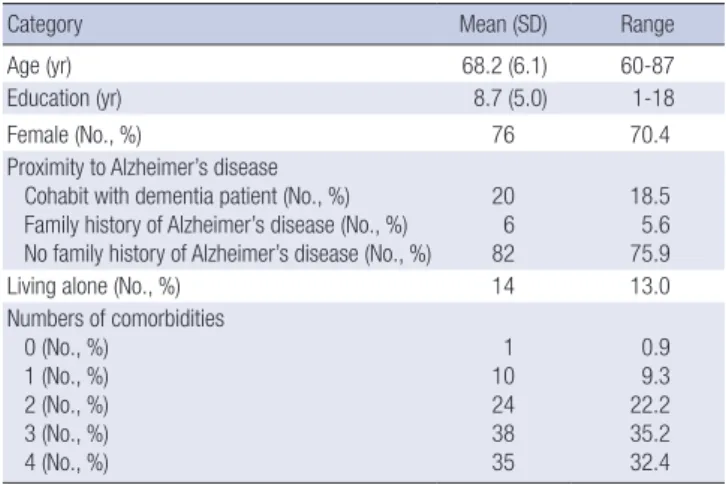
Demographic and neuropsychiatric characteristics The mean age of the participants was 68.2 (range, 60 to 87) yr.
Females were dominant (n = 76, 70.4%) and the majority of participants (n = 82, 75.9%) did not have a family history of de
mentia. Relatively little participants lived alone (n = 14, 13.0%), Almost all participants had more than one disease (n = 107, 99.1%). The additional sociodemographic data are presented in Table 1.
Factor structure
Factor analysis showed that the KFADS is composed of 3 fac
tors, termed General Fear, Physical Symptoms, and Catastroph
ic Attitude in the original FADS. Factor loadings of each state
ment are presented in Table 2. Three of the 30 statements (items
26, 28, and 29) fell below the recommended level of 0.60.
Reliability
The internal consistency was excellent. The Cronbach α for all 30 statements of the KFADS was 0.96, and factors 1, 2, and 3 showed α values of 0.96, 0.93, and 0.95, respectively. After re
moving the 3 statements which fell below the factor loadings of 0.60, the Cronbach α for the other 27 statements of the KFADS was 0.96, and factors 1, 2, and 3 had α values of 0.96, 0.94, and 0.95, respectively. However, we determined that deleting the 3 statements is unnecessary, since there was a minimal improve
ment in internal consistency only in factor 2, without increased reliability of the entire KFADS. Testretest reliability was excel
lent, as the ICC comparing the retest to test was 0.98 (95% con
fidence interval [CI], 0.450.82).
Validity
Concurrent validity was good, as the correlations between the KFADS and KSTAI were significant (Pearson correlation coef
ficient [r] = 0.242, P = 0.013). No correlation was observed be
tween the stateA and KFADS (r = 0.086, P = 0.376), while trait
A revealed a significant correlation with the KFADS (r = 0.326, P = 0.001) (Table 3).
Group responses
There was no effect of age (r2= 0.003, P = 0.590) on the KFADS, otherwise, the years of education had positive correlation with the KFADS (r2= 0.044, P = 0.029). There was no difference of the KFADS between groups defined by the other sociodemo
graphic characteristics including sex, proximity to dementia, living conditions, and numbers of comorbidities (Table 4).
Table 1. Sociodemographics and neuropsychiatric characteristics
Category Mean (SD) Range
Age (yr) 68.2 (6.1) 60-87
Education (yr) 8.7 (5.0) 1-18
Female (No., %) 76 70.4
Proximity to Alzheimer’s disease Cohabit with dementia patient (No., %) Family history of Alzheimer’s disease (No., %) No family history of Alzheimer’s disease (No., %)
20 6 82
18.5 5.6 75.9
Living alone (No., %) 14 13.0
Numbers of comorbidities 0 (No., %)
1 (No., %) 2 (No., %) 3 (No., %) 4 (No., %)
1 10 24 38 35
0.9 9.3 22.2 35.2 32.4 SD, standard deviation.
Table 2. K-FADS factor loadings
Factor 1 Factor 2 Factor 3
K-FADS item 01 0.658 0.432 0.112
K-FADS item 02 0.695 0.451 0.086
K-FADS item 03 0.808 0.196 0.021
K-FADS item 04 0.755 0.438 -0.041
K-FADS item 05 0.613 0.050 0.032
K-FADS item 06 0.647 0.412 0.119
K-FADS item 07 0.701 0.081 0.221
K-FADS item 08 0.704 0.529 -0.030
K-FADS item 09 0.686 0.556 0.098
K-FADS item 10 0.754 0.451 0.157
K-FADS item 11 0.633 0.581 0.107
K-FADS item 12 0.661 0.548 0.161
K-FADS item 13 0.438 0.836 0.135
K-FADS item 14 0.483 0.833 0.116
K-FADS item 15 0.410 0.795 0.183
K-FADS item 16 0.647 0.473 0.375
K-FADS item 17 0.522 0.604 0.295
K-FADS item 18 0.202 0.136 0.817
K-FADS item 19 0.306 0.249 0.613
K-FADS item 20 0.156 0.101 0.819
K-FADS item 21 0.046 0.143 0.925
K-FADS item 22 -0.005 0.166 0.945
K-FADS item 23 0.090 0.095 0.837
K-FADS item 24 0.086 0.165 0.843
K-FADS item 25 0.053 0.110 0.905
K-FADS item 26 0.177 0.442 0.123
K-FADS item 27 0.188 0.630 0.103
K-FADS item 28 0.195 0.573 0.116
K-FADS item 29 0.106 0.540 0.126
K-FADS item 30 0.249 0.734 0.113
K-FADS, Korean version of the Fear of Alzheimer’s Disease Scale.
Table 3. Pearson’s correlations among K-FADS, state-A, trait-A and K-STAI
State-A Trait-A K-STAI
K-FADS 0.086 0.326* 0.242*
State-A 0.507† 0.862†
Trait-A 0.874†
*P < 0.05 level of significance, †P < 0.001 level of significance. K-FADS, Korean ver- sion of the Fear of Alzheimer’s Disease Scale.
Table 4. Group response to K-FADS
Category R2 P value
Age (yr) 0.003 0.590
Education (yr) 0.044 0.029
Subcategory (No.) Mean (SD) P value
Sex Male (n = 32)
Female (n = 76) 33.4 (26.2)
35.3 (25.2) 0.706 Proximity Cohabit with dementia patient (n = 20)
Family history of Alzheimer’s disease (n = 6) No family history of Alzheimer’s disease (n = 82)
32.1 (26.8) 39.0 (24.1) 36.3 (25.8)
0.849
Living
conditions Cohabitant (n = 94)
Living alone (n = 14) 34.7 (25.6)
35.2 (25.3) 0.847 Number of
comorbidities 0-1 (n = 11) 2 (n = 24) 3 (n = 38) 4 (n = 35)
32.8 (31.7) 39.0 (24.2) 34.0 (24.6) 33.3 (25.7)
0.769
K-FADS, Korean version of the Fear of Alzheimer’s Disease Scale; SD, standard devi- ation.
DISCUSSION
The present study indicates that the KFADS is a reliable and valid scale to quantify anticipatory dementia. The factor load
ings showed great internal consistency of structure, which can be summed up by 3 factors. The three factors, named as the General Fear, Physical Symptoms, and Catastrophic Attitude in the original FADS could be apply to the KFADS, as well. In reli
ability study, the KFADS revealed better reliability (Cronbach α = 0.96) than the original FADS study (Cronbach α = 0.94). De
leting the 3 statements which fell below the factor loading 0.60 was unnecessary, because the procedure only improve the Cron
bach α of factors 2 from 0.93 to 0.94, otherwise make the partici
pants feel the entire structure is incomplete. In validity study, there was a good correlation between the KFADS and KSTAI.
As expected, traitA revealed a significant correlation with the KFADS (r = 0.326, P = 0.001), which was in contrast with the stateA (r = 0.086, P = 0.376). Therefore, it is expected that the KFADS would demonstrate that anticipatory dementia is strong
ly correlated with the level of anxiety (1).
The analysis of group responses of the KFADS showed inter
esting results in which age, sex, proximity to dementia, living conditions, and numbers of comorbidities are not related to anticipatory dementia. Previous studies that investigated the relationship between sociodemographic variables and the per
sonal concerns of the general population towards AD revealed that the elderly, women and those with proximity to AD (being a caregiver or having a family history of AD) have more fear of developing AD (8, 9). Among these factors, aging makes the person feel helpless and have a loss of selfregard, which could aggravate memory problems (10). The person’s own experienc
es of AD could also make them perceive AD more seriously. Sex is not an independent factor, but is one of the proximity indica
tors to AD, as women often care for parents with dementia (11).
In contrast with results from French population, who identi
fied a greater fear among low level of education (8, 9), our find
ings showed that participants with the high level of education had more fear of AD. The high selfesteem, which is thought that the welleducated people have more than illiterate, may aggravate the fear even with episodic memory problems.
Our study showed that age and proximity to AD did not af
fect anticipatory dementia as stated in the original FADS (1).
Our finding of this distant relation can be interpreted in several ways. First, the diversity of previous results may be attributed to significant variations in the assessment methods, selection of patients, and duration of followup used in each study. Most previous studies used a single question (i.e., Are you worry for being demented?) to evaluate the fear of AD (1214) As men
tioned earlier, the KFADS is a wellstructured scale which could assess the anticipatory dementia consisting of multiple state
ments. The use of quantified scores by multiple wellconstruct
ed statements of the KFADS is different to the use of a simple question, and enables the meticulous evaluation of anticipatory dementia. A more precisely specified diagnosis of anticipatory dementia could lead to more meaningful results. Second, the KFADS is intended for the general population without cogni
tive complaints. Unlike our study using the KFADS, most previ
ous studies were conducted with patients experiencing cogni
tive decline. Third, it suggested that the KFADS has the power to be used regardless of sociodemographic characteristics. Last
ly, our finding could be a result of the statistical limitation by lack of sufficient number to analysis.
Anticipatory dementia is different from simple fear of AD.
Anticipatory dementia is mixed presentations of psychiatric symptoms (mostly expressed as fear or anxiety), physical re
sponse or signs, catastrophic attitude, and concerns toward AD.
Specifically, the concerns always include the complaints of sub
jective memory impairment. Although objective neuropsychi
atric results showed normal profile, some people still complain some ominous sense and are distressed about AD. We do not know whether the anticipatory dementia is a real pathologic symptom or not. Maybe it could be peoples’ own anxiety which affected by proximity to dementia. Some research has failed to prove an association between anxiety and mild cognitive im
pairment (15, 16). However, previous reports showed that anxi
ety is related to the future development of AD in persons with and without mild cognitive impairment (2), and anticipatory anxiety is a useful clinical marker of earlier conversion to AD (3). In Korean study, anxiety was one of the most common psy
chiatric symptoms of mild cognitive impairment and early AD (17, 18). Because there is lack of study about the prodromal psy
chiatric symptoms or anticipatory dementia, we think this vali
dation study could the fundamental study for future research.
The present study has small sample size (n = 108), and ap
plies the same scale to the elderly as is applied to the general population. The assessment of anxiety in the elderly is complex and has methodological issues (19). However, the reliability and validity was adequate to prove the viability of this method, and in any case, age did not affect the KFADS. As this study is conducted using crosssectional methodology, further longitu
dinal studies are required to ascertain the relation between an
ticipatory dementia and early cognitive impairment.
In summary, this study revealed that the KFADS is a suitable and valuable scale to assess anticipatory dementia in elderly Koreans.
DISCLOSURE
The authors report no conflicts of interest and have nothing to disclose.
ORCID
Yeonsil Moon http://orcid.org/0000-0001-7770-4127 HeeJin Kim http://orcid.org/0000-0001-7880-690X Hojin Choi http://orcid.org/0000-0002-9637-4423 Seongil Oh http://orcid.org/0000-0002-8067-2135 SeolHeui Han http://orcid.org/0000-0003-3608-2514
REFERENCES
1. French SL, Floyd M, Wilkins S, Osato S. The fear of Alzheimer’s disease scale: a new measure designed to assess anticipatory dementia in older adults. Int J Geriatr Psychiatry 2012; 27: 521-8.
2. Palmer K, Berger AK, Monastero R, Winblad B, Bäckman L, Fratiglioni L. Predictors of progression from mild cognitive impairment to Alzheim- er disease. Neurology 2007; 68: 1596-602.
3. Gallagher D, Coen R, Kilroy D, Belinski K, Bruce I, Coakley D, Walsh B, Cunningham C, Lawlor BA. Anxiety and behavioural disturbance as markers of prodromal Alzheimer’s disease in patients with mild cogni- tive impairment. Int J Geriatr Psychiatry 2011; 26: 166-72.
4. Spielberger CD, Gorsuch RL, Lushene RE, Vagg RE, Jacobs GA. Manual for the State-trait anxiety inventory (STAI). Palo Alto: Consulting Psychol- ogists Press, 1983.
5. Hahn DW, Lee CH, Chon KK. Korean adaptation of Spielberger’s STAI (K-STAI). Korean J Health Psychol 1996; 1: 1-14.
6. Hair JF, Black WC, Babin BJ, Anderson RE. Multivariate data analysis.
7th ed. Upper Saddle River: Prentice Hall, 2010.
7. Fleiss JL, Chilton NW. The measurement of interexaminer agreement on periodontal disease. J Periodontal Res 1983; 18: 601-6.
8. CantegreilKallen I, Pin S. Fear of Alzheimer’s disease in the French pop- ulation: impact of age and proximity to the disease. Int Psychogeriatr 2012; 24: 108-16.
9. Cutler SJ, Hodgson LG. Correlates of personal concerns about develop-
ing Alzheimer’s disease among middle-aged persons. Am J Alzheimers Dis Other Demen 2001; 16: 335-43.
10. Yeo LH, Horan MA, Jones M, Pendleton N. Perceptions of risk and pre- vention of dementia in the healthy elderly. Dement Geriatr Cogn Disord 2007; 23: 368-71.
11. Roberts JS, Connell CM. Illness representations among first-degree rela- tives of people with Alzheimer disease. Alzheimer Dis Assoc Disord 2000;
14: 129-36.
12. Cutler SJ, Hodgson LG. Anticipatory dementia: a link between memory appraisals and concerns about developing Alzheimer’s disease. Geron- tologist 1996; 36: 657-64.
13. Hodgson LG, Cutler SJ. Looking for signs of Alzheimer’s disease. Int J Ag- ing Hum Dev 2003; 56: 323-43.
14. Suhr JA, Kinkela JH. Perceived threat of Alzheimer disease (AD): the role of personal experience with AD. Alzheimer Dis Assoc Disord 2007; 21:
225-31.
15. Robert PH, Berr C, Volteau M, BertogliatiFileau C, Benoit M, Guerin O, Sarazin M, Legrain S, Dubois B; PréAL Study Group. Importance of lack of interest in patients with mild cognitive impairment. Am J Geriatr Psy- chiatry 2008; 16: 770-6.
16. Devier DJ, Pelton GH, Tabert MH, Liu X, Cuasay K, Eisenstadt R, Mard
er K, Stern Y, Devanand DP. The impact of anxiety on conversion from mild cognitive impairment to Alzheimer’s disease. Int J Geriatr Psychia- try 2009; 24: 1335-42.
17. Hwangbo R, Kim H, Lee KJ. Neuropsychiatric symptoms in patients with mild cognitive impairment and dementia of Alzheimer’s type. Korean J Psychosom Med 2012; 20: 105-11.
18. Jang KW, Kim JH, Ahn IS, Kim DK. Behavioral and psychological symp- toms according to severity in patients with Alzheimer’s disease. J Korean Geriatr Psychiatry 2009; 13: 77-82.
19. Palmer BW, Jeste DV, Sheikh JI. Anxiety disorders in the elderly: DSM-IV and other barriers to diagnosis and treatment. J Affect Disord 1997; 46:
183-90.