1. Introduction
1)By virtue of the well-known structure of hair[1], hair care product was well developed in leisure generation. Furthermore, because the physical properties of hair in vitro is same as that in vivo[2], hair has been chosen as a model for understanding how the fundamental material adsorb on the biological substrate[3,4]. Hair cuticle plays an im-portant role in regulating hair homeostasis by keeping wa-ter loss to a minimum and by regulating components in hair[5]. The condition and function of the cuticle are af-fected by environmental factors, such as ultraviolet (UV)
† Nae Gyu Kang (e-mail: [email protected]), call: 02)6980-1533
radiation, free radicals, toxic and a conditioning materi-al[6-9]. Specifically, the cuticle undergoes alterations re-sulting in physical properties such as tensile strength, bend-ing moment, and breakage by the UV exposure from sun-light[7].
The UV exposure is inevitable factor for hair damage and an integral component of sunlight. It consists of three radiative energy of UV-A in 320 - 400 nm, UV-B in 280 - 320 nm and UV-C in 200 - 280 nm. Most UV-C energy is absorbed by ozone. UV-A primarily caused injury to der-mal necrosis of endothelial cells[10]. Since UV-A reaches only below 5 μm depth, UV-A causes a damage of melanin. There is concern that any further increases in ambient
lev-A Comprehensive Study for Two Damage Sites of
Human Hair upon UV-B Damage
Sang-Hun Song, Seongkil Son, and Nae Gyu Kang†
LG Household & Health Care, E10 LG Science Park, 70 Magokjungang 10-ro, Gangseo-gu, Seoul 07795, Korea (Received June 11, 2020; Revised July 29, 2020; Accepted August 31, 2020)
Abstract: Protection mechanisms for skin damage of ultraviolet (UV) absorbers in personal care products for protection against UV are well studied, but not for hair protection. The purpose of this study is to describe and compare the changes of physical property produced in human hair by doses of the UV-B exposure causing protein degradation. To observe the change of physical properties in hair, the experimental intensity of UV-B exposure has been established on the basis of statistical data from official meterological administration as daily one hour sunlight exposure for two weeks. Polysilicone-15, ethylhexyl methoxycinnamate (OMC), and octocrylene were employed for UV-B absorber, and those were treated to hair swatch by rubbing wash through shampoo and conditioner. Bending rigidity displayed kinetically successive reduction at high doses of UV exposure up to the 8,000 s, and exhibited different level at each sample of UV-B absorber. However, the values of Bossa Nova Technologies (BNT) for shinning factor were already saturable at the 2,000 s exposure except that treated with polysilicone-15. The differential scanning calorimetry (DSC) to measure a strength of inner protein produces a successive reduction of enthalpy as like a reduction of bending rigidity upon UV exposure. Surface roughness from lateral force microscope (LFM) acquired immediately after UV exposure show a saturable frictional voltage which has been also found in a saturable BNT data as the time of UV exposure increases. Through researching the DSC and the LFM, shinning of hair was much correlated to the protein damage at the surface, and bending rigidity could be regulated by the protein structural damage inside hair. Therefore, the optimization of efficient strategy for simultaneous prevention of hair protein on the surface and internal hair was required to maintain physical properties against UV.
els of UV-A, resulting from absorption in melanin may have a significant impact on alteration of color. UV-B in-duces damage to protein in skin and hair, including DNA, and generate reactive oxygen species (ROS)[11]. In hair science, UV-B affects the protein structure for the keratin protein[12]. The changes in structural composition of hair proteins more likely influenced physical strength such as tensile strength and elastic force[5].
Therefore, recognition of harmful effects of UV-B radia-tion demands a protecradia-tion against UV-B, and a study of quantification of physical properties of hair by sunscreens. Generally, sunscreens are emulsion consists of several or-ganic UV absorbers. The purpose of UV absorbers is to terminate the invasion of UV radiation into the human body, and the UV absorbers are to attenuate energy transfer of UV to human body. However, the regions of wavelength where becomes dissipating upon UV absorbers vary with kinds of UV absorber. Hence, it is important to observe the UV-B absorbers protect hair protein against the poten-tially damaging effects of UV-B. Although the function of UV-B absorbers is well-studied for skin, their effect for the human hair has not been yet studied.
In the present work the behavior of UV-B absorbers un-der irradiation is investigated with an emphasis on unun-der- under-standing the interactions in a filter system of UV absorbers, beyond the physical properties on the hair. The changes occurring with UV-B absorbers of polysilicone-15, ethyl-hexyl methoxycinnamate, and octocrylene are compared in shinning with AFM and bending rigidity with DSC.
2. Material and Methods
2.1. Hair Preparation
Hairs from the proximal root with one swatch per person were obtained by Happycall (Korea). The hair swatches were pre-washed with sodium laureth sulfate (SLES) for 1 min and rinsed with water for 2 min, and this process was repeated twice. The hair swatch was incubated in a 50% humidity room at 25 °C for 24 h.
The shampoos and the conditioner that were used in all tests were formulated as a mixture of ingredients in water.
A cationic cellulose polymer was formulated in water. The ingredients were generated by mixing the solid that needed to b e melted with water at a mixing speed of up to 400 rpm. Additional ingredients, such as electrolytes and vis-cosity control agents, were added to the cooled product. The pH value was adjusted to 6.3. Other ingredients of UV absorber were added to the cooled product. The hair conditioner was also formulated with cetearyl alcohol, glycerin, behentrimonium methosulfate and isopropyl alcohol.
In order to wash hair with surfactant, 4 g hair swatch were pre-wetted with 4 mL water and then covered uni-formly with a shampoo. The foaming was carried out by hand for 15 s. Subsequently, the hair was gently rubbed so that the cationic polymer could be absorbed into each hair shaft for 45 s, and the hair swatch was rinsed with water for 1 min. Tap water used for washing and rinsing flowed from the faucet at a rate of 40 mL/s. After shampooing, the hair swatch was treated with treatment in same way of shampooing, but for the conditioner, hair swatch was sus-pended for 4 min after rubbing hair with the conditioner. After removing excess water, the hair swatch was gently dried with a paper towel. Except for the pre-wetting step, these steps were repeated several times according to the experimental intent. This method of shampoo and condi-tioner rubbing and washing cycle is repeated by 5 times. 2.2. UV Exposure
Solar simulators (Model 16S, Solar Light Company, USA) were used for UV exposure. Intensity of UV-B light is around 350 mJ/cm2 as measured photodiode. Hair
ex-posure was performed in the facility where temperature of 25 ℃ and relative humidity of 50% maintained. 2.3. Evaluation of Shinning
The shine of hair was obtained at the center domain of the hair swatch using the software SAMBA (Bossa Nova Technologies, USA). The incidence beam of white light injected to the center domain of the swatch, is reflected to the detector with integral angles between the camera and the specular reflection. The shinning value was represented
to BNT value determined by the BNT software using equa-tion 1. The measurement was performed on three swatches, and the hair swatch was strictly fixed on the sample holder during the UV exposure.
I = 100⋅Sin/((D+Sout)⋅(Wvisual) (1)
2.4. Bending Test
Hair swatches were objectively measured by using the bending tester (KES-FB, Kato Tech. Co., Japan). The KES-FB enables the quantification of the effects of various process parameters, such as the type and quantity of soft-ness of hair or the fabric. Prior to fabricate a template, hair was washed with a shampoo formulated with the target UV absorber. Three samples of 2 cm x 10 cm were cut with a paper for each 50 hairs. The bending properties could provide sufficient indications of bending rigidity for the hair. Each test was repeated four times in the wale and course directions.
2.5. DSC (Differential Scanning Calorimetry)
Dry-DSC experiments were performed with a DSC-400 (Perkin Elmer, USA). Each samples were subjected to heat-ing and coolheat-ing treatments at a scannheat-ing rate of 10℃/min under nitrogen atmosphere in order to prevent oxidation. A test sample of 4 mg was placed in an aluminum pan with two tiny pinholes and tested over a temperature range of 30 – 290 ℃.
2.6. LFM (Lateral Force Microscope)
LFM spectral measurements were conducted using an atomic force microscope (AFM) of XE-100 (Parksystems, Korea). LFM images of hair was produced to compare its nanoscale topography before and after prolonged UV exposure. Images of morphology and the LFM spectra were obtained using an NCHR cantilever with a spring constant of k = 42 N/m (Nanosensors, Swiss). Topographic image has been scanned after checking a set-point value to con-firm that the scan was non-destructive to hair treatment of UV absorber.
2.7. Materials
Polysilicone-15 commercially available name as PARSOL SLX was purchased from DSM (Netherlands). Ethylhexyl methoxycinnamate named as OMC and octocry-lene named as ESCALOL 597 are obtained respectively from Ashland (USA) and BASF (Germany).
3. Results and Discussion
Since a monthly solar intensity depends on number of rainy days, the quantitatively solar intensity annually ex-hibits much difference. A representative solar intensity of the summer was therefore set to July among June to August, in which the annual difference was the smallest because July has regularly rainy days (data not shown). According to the data of sunlight from Korean Meteorological Administration, the averaged noon-intensity of sunshine in July Seoul is obtained to 324 J/cm2 on the
basis of the 3 hours at the midday (Figure 1). Intensity of UV-B is considered to 67.8 mJ/cm2 as a percentage of
the total UV-B which is about 0.3% of UV[13]. Therefore, the 67.8 mJ/cm2 is attributed to be a representative intensity
of UV-B in Korean summer. The intensity of UV-B at southern US is known to 80 mJ/cm2 per hour[14], and the
latitudinal difference between two regions generates differ-ent intensity.
The purpose of this paper is to describe and compare the change of physical properties produced in human hair by doses of UV radiation in Korean summer causing sim-ilar degrees of dermal damage. The investigation of the pe-riod of Korean people’s daily hours of sunshine exposure revealed that most Koreans have been exposed from 60 min to 90 min, and the second response was from 30 min to 60 min in summer (data not shown). This study has been designed to measure the change of hair property in two weeks of summer on the assumption that daily exposure time is 60 min. Therefore, total exposed time for the two weeks is around 50,000 s due to 3,600 s/day multiply by 14 days. Since this time is too long to realize condition in the lab, all intensities of UV-B in this study was fixed to 350 mJ/cm2 which is five times higher than the normal
intensity to reduce five times shorter time for the lab experiment. Finally, all experiments have been conducted under UV exposure with 350 mJ/cm2 prolonged to 8,000 s.
To identify the possibility of hair strength damage by UV-B exposure, bending moment was initially measured as shown in Figure 2. Each of the hair had 5 test values. Table 1 exhibits the mean and standard deviation for all of the bending rigidities.
Bending rigidity of hair fibers is reflected to slope in Figure 2. The bending rigidity of the hair fibers is defined as the relationship between bending moment and curvature. The slope was decreased when the hair is exposed by UV-B, it means that the hair is weakened in bending and the hair has less elastic behavior in bending deformation.
The bending rigidity of virgin hair was reduced from 0.731 to 0.681 gf as exposure time increases in Table 1. It is clear that the hair bending properties are reduced by the UV exposure. This suggests that UV exposure induced damage of hair structure. On the assumption that UV
ex-posure reduces the bending properties, further experiment was performed to find another alteration of physical prop-erty by UV exposure.
While the number of products marketed as a good con-ditioning shampoo holds a silicone, most shampoos today benefit a good delivery of coacervation through a formula with the silicone due to its higher molecular weight. High molecular weight benefits a good binding affinity to make a coacervation between polymer and anionic surfactant. Polysilicone-15 (Parsol SLX) is one of representative UV-B absorbers. Since it is a silicone based compound, it can be effectively adsorbed in hair due to its high molec-ular weight. Therefore, polysilicone-15 was employed in this study to see protein degradation from UV exposure. Ethylhexyl methoxycinnamate (OMC) was the most fquently used ingredient in many sunscreens. Although re-Figure 1. Time dependence of solar energy in Seoul. Data were
averaged solar intensity for 30 y ears from Korean Meteorological Administration. The error bar amplitude indicates standard deviation (N = 30).
Exposure time (s) Virgin Polysilicone-15 Ethylhexyl methoxycinnamate Octocrylene
0 0.731 (0.05) 0.731 (0.05) 0.731 (0.05) 0.731 (0.05)
2,000 0.713 (0.04) 0.725 (0.12) 0.712 (0.12) 0.714 (0.14)
8,000 0.696 (0.08) 0.712 (0.12) 0.699 (0.12) 0.706 (0.15)
Table 1. Averaged bending rigidity upon UV exposure. The bending rigidity was obtained from the slope of the curve in Figure 2. Blanket indicates standard deviation (N = 5).
Figure 2. Bending moment of the virgin hair and the hair after UV-B exposure with I = 350 mJ/cm2 for 8,000 s. To evaluate
a bending rigidity a connection line at either end of point was depicted as dashed line. The slope of dashed line indicates alteration of the bending moment as the hair swatches is experienced by torque.
cent trend showed a reduction of usage due to an issue of penetration of that into skin and environmental issue, however, it can still be a representative UV-B absorber in cosmetic market.
Normally, octocrylene (ESCALOL 597) is not routinely used in cosmetic applications. It has high viscosity in con-trast to that of ethylhexyl methoxycinnamate, and this is supposed to induce a good adsorption upon hair in washing. Other notion concerning determinants of positive attraction is that the octocrylne covers from UV-B and to UV-A reagion.
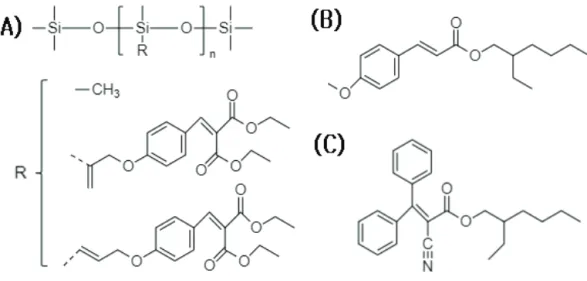
Finally, polysilicone-15, ethylhexyl methoxycinnamate, and octocrylene are employed in this study, and chemical structures are depicted in Scheme 1. The molecular weight of polysilicone-15 is large as mentioned above, however, ethylhexyl methoxycinnamate and octocrylene is 290 and 361, respectively.
Table 1 shows that polysilicone-15 is preventing a bend-ing rigidity at the UV exposure for 2,000 s in comparison to virgin hair. At 8,000 s, a reduction of bending rigidity has been observed in all kinds of hair swatch. Although bending rigidity was reduced regardless of UV absorbers, the bending rigidity did not show a significant difference between before and after UV exposure. Presumably, these statistical results were caused by small number of ex-perimental sample and small influence of UV damage upon
hair.
The shinning factor used BNT value in many academic studies[15,16], and the reduction of BNT indicates a loss of shinning. The BNT value in the hair swatches with poly-silicone-15 was also compared with the hairs treated with ethylhexyl methoxycinnamate or octocrylene.
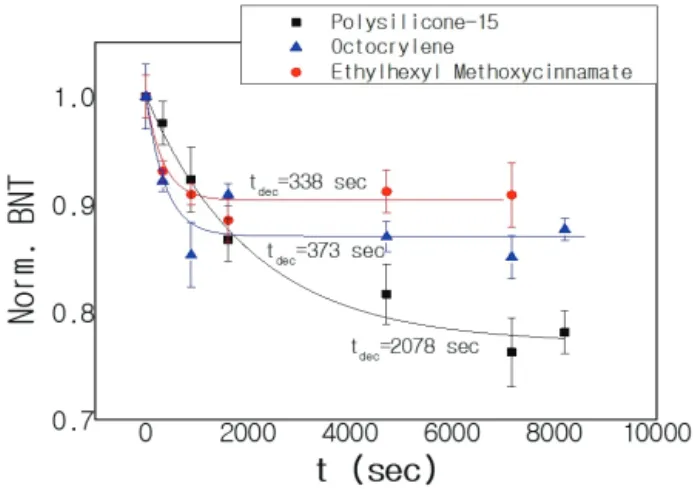
The normalized BNT values are displayed in Figure 3. The BNT values correspond to a refractive index from the surface. Since the refractive index of each UV absorber is different, those in the hair after treatment with different UV absorber are varied. The initial BNT values right after drying hair with rubbing wash showed 28.1, 26.0, and 22.5 for hair with polysilicone-15, octocrylene, and ethylhexyl methoxycinnamate, respectively. Low molecular weigh of ethylhexyl methoxycinnamate (Mw = 290) may be respon-sible for a relatively low BNT values from hair while large molecular weight of polysilicone-15 produces high BNT value due to a good adsorption.
Time constants by an exponential fitting were obtained with 2,078 s, 373 s, and 338 s for polysilicone-15, octocry-lene, and ethylhexyl methoxycinnamate, respectively. In the UV exposure, within a few minutes a photoproduct is formed with an exponentially decayed curve[17]. The shin-ning of the hair treated with polysilicone-15 decays into a decayed photoproduct with time constants of 2,078 s. This transition is accompanied by the intersystem crossing
of the tryptophan and by subsequent conformational changes of the protein (partial unfolding). Strictly, the de-cay of the BNT in hair was fitted as bi-exponential func-tion, and this result indicates two photoproducts. One of photoproduct could be transformed into another photo-product in general photochemistry.
For the ethylhexyl methoxycinnamate, decay time of 338 s was 7 times more faster than that in polysilicone-15. This indicates the ethylhexyl methoxycinnamate has a weaker protection against UV or a less favourable adsorption upon the hair. The decay time of octocrylene of the excited state to the photoproduct was 373 s. Therefore, an efficiency of photo-protection for octocrylene is weaker than that of ethylhexyl methoxycinnamate.
Slow decay of hair with polysilicone-15 suggests that hair damage caused by UV can be effectively prevented by polysilicone-15. The BNT value of that becomes similar to others at 4,000 s-exposure time before normalization. The largest amount of reduction for BNT in Figure 3 has been found in the polysilicone-15. A question arises as to whether the slow decay of the polysilicone-15 is aspects of a perfect prevention to transfer solar energy into the hair, or whether prolonged exposure induces the damage of hair
as same as the untreated hair under UV.
To identify the protein structure of each different hair after UV irradiation, an efficient technique for simulta-neously analyzing the amount of various proteins are required. DSC is an effective method to analyze the protein structure of a biological sample. DSC can determine changes of entropy upon protein denaturation and the corre-sponding enthalpy on the response of UV damage.
The keratin fiber becomes losing their structure at this heating region. Normal wet-DSC peak for hair stands the first peak around 160 ℃ responsible for α-helix[18]. In contrast, Dry-DSC thermograms show the presence of two peaks for all scans of the composites. Although the origin of the peaks are under debate[19], the lower one may be attributed to an α-helix structural distribution[20]. The sec-ond peak appears to be due to cysteine decomposition[21]. Basically, the peak stands from 230 ℃ to 234.5 ℃ started at 630 s under the condition of 10 ℃/min in raising temperature.
The flash point of UV absorber is 166.8 ℃ and 239.5 ℃ for ethylhexyl methoxycinnamate and octocrylene, re-spectively, and that of polysilicone-15 is above 295 ℃. DSC traces of those UV absorber have to stand an exother-mic peak when the temperature was supported above the flash point. This exothermic peak can disturb a calculation of enthalpy by overlapping to the peak of α-helix.
AFM study shows that the thickness of conditioning pol-ymer upon hair after shampooing was undetectible due to its small amount[22]. Instead adsorbed thickness of which was estimated to be 0.4 nm in the consideration of atomic scale on the assumption that monolayer was formed upon hair[23]. Therefore, the amount of UV absorber coated upon hair is negligible, the possibility of overlap for UV absorber and hair is excluded.
Figure 4 shows the first peak responsib le for α-helix changes upon UV exposure. The area of the first peak re-flects enthalpy (ΔH) and the change of the area indicates the structural degradation by UV damage. The ΔH is an important parameter since its magnitude is directly propor-tional to the overall level of structural rigidity for release-ment of the α-helix. All ΔH of virgin hair and that of hair Figure 3. The shinning factor represented by normalized BNT
was assessed upon the hair swatches after washing treatment with three UV-B absorbers. Temporal shinning signals upon UV exposure are shown in solid curve. Intensity of UV-B was 350 mJ/cm2. The error bar amplitude of standard deviation was
inserted to each experimental data from three different hair swatchs.
treated with UV absorbers are similar (data not shown), and those were estimated around 6.2 J/g.
After UV-exposure for 2,000 s in Figure 4B, the en-thalpy for the α-helix was decreased down to 5.83 J/g. Regardless of the time constant by exponential decay from Figure 3, the values of enthalpy for all hair samples are similar. Temporal development of enthalpy from DSC is extremely different to that of BNT in Figure 3 and that may be similar to that of bending rigidity rather than that of BNT.
Figure 4C exhibits the enthalpy from DSC curves of the hair fully exposed by UV for 8,000 s. The enthalpy be-comes being pretty low and this reduction indicates that the structure for the α-helix was weakened due to protein degradation from UV exposure. Nonetheless, the treatment of polysilicone-15 induced dominantly less reduction. This less reduction reflects that the polysilicone-15 protects structural degradation of hair against UV-B radiation from
the sun. It is shown that macroscopically distinguishable degradation was generated by UV absorber in ethylhexyl methoxycinnamate and octocrylene.
While BNT values reflect the protein structural morphol-ogy for the surface of hair, the enthalpy results from the protein inside hair. All reductions of BNT values by UV were almost similar and saturable at the UV exposure for 8,000 s. However, the enthalpy at the 8,000 s time exhibits distinguished gap among hairs treated by different UV absorber. This suggests either BNT can be protected by UV-A absorber or the damage of protein inside hair has been differently proceeded in comparison to the damage at the surface. Scattering of incident light of hair depends on the treatment of hair surface[23], and it is known that the intensity of reflective light depends on the filling struc-ture inside hair[23]. Therefore, since the reduction of BNT depends on the damage of protein correlated to the UV-B, the possibility of wrong selection of UV absorber can be
Figure 4. DSC curves of the hair samples used to calculate the change of enthalpy caused by UV-B damage. Endothermic peaks for an α-helix structure are displayed in black and enthalpy in grey. Iexc = 350 mJ/cm2 for UV-B.
excluded.
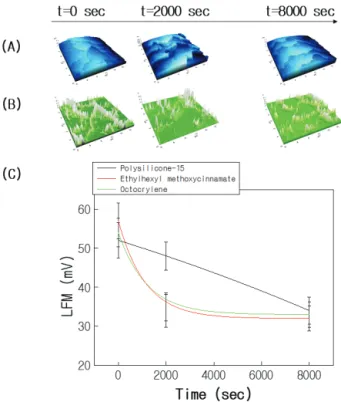
Instead, the damage of surface by UV-B can be dis-tinguished kinetically to that of protein inside hair. This change of morphology on the surface has been confirmed by LFM. Figure 5 describes hair surface on the response of different UV-B absorber upon UV exposure. Since every hair surface is different, the samples of hair were collected from 5 different swatch from each variety.
The change of surface morphology by UV absorber was evaluated by measuring the friction of the surface with an AFM. The laterally repulsive force is generated when the AFM tip attempts to moves the hair surface by moving horizontally. The repulsive force is expressed as force in
the LFM. Spectroscopic scanning images in the case of eth-ylhexyl methoxycinnmate as a representative image are dis-played in Figure 5A and B. The LFM values have been collected in Figure 5C.
Figure 5C shows that force of tip gradually decreases as UV exposed. Regardless of the UV-B absorber, the ten-dency for significantly reduced friction when UV was ex-posed, was consistent to the kinetics of BNT in Figure 3. Furthermore, the temporal development of hair with poly-silicone-15 is relatively slower than others as reduction of BNT. Accordingly, the reduction of BNT is correlated to the alteration of physical property at the surface rather than inside hair.
UV induces protein degradation via radical reaction of amino acid[25]. There are two pathways of hair damage by UV-B: surface and internal side. The protein damage at the surface is represented as shinning, and the protein damage inside hair can be displayed as weak bending force. The fact that there are two damage sites indicates that both must be prevented to maintain physical properties of hair against UV-B.
It is involuntary supposed that an UV absorber becomes being accumulated upon the scalp by repeatedly using the hair care product with the UV absorber. This concern im-plies that both a shampoo as cleansing and a treatment as supporting a function of UV protection must be simulta-neously performed together in order to maintain the health of scalp.
Small molecules of ethylhexyl methoxycinnamate and octocrylene can penetrate into scalp. Even polysilicone-15 is expected to enter in a pore of scalp. UV absorbers fre-quently used in sunscreens, are capable of either penetrat-ing the scalp or enterpenetrat-ing pore may be even more dangerous than UV-B radiation. This study investigated the UV pro-tective efficiency for hair. In future, prognostic values of a repeated treatment performed at different days has to be inspected to lots of people without scalp disease.
4. Conclusion
For the first time, we quantitatively demonstrated that Figure 5. Observation of hair morphology and surface lateral force
by AFM. (A) The morphology of hair treated. (B) LFM image simultaneously obtained as the morphology was scanned. (C) Kinetic analysis of the damage hair using LFM correlated with smoothness of the surface upon UV exposure (N = 10, 5 hair swatches and 2 points at each hair sample). Hair treated with ethylhexyl methoxycinnmate as well as for the hairs which were treated with the polysilicone-15 and octocrylene in the same way are exhibited. Solid lines are fitting curves by exponential function.
UV rays that come into contact with hair proteins during sunlight every day can have a significant effect on the sur-face of hair and on the inner radiance and elasticity of the interior. To assess the ability of UV-B absorbers to prevent protein damage against UV exposure, hair swatches treated with shampoo formulated with UV-B absorber were irradi-ated with sunlamps equally attributed to one hour daily for 2 weeks in summer. Advantages and drawbacks of each material for the UV-B absorbers have been well studied in this study.
The bending strength results are demonstrated that bend-ing rigidity decreases with the UV exposure time. The change of enthalpy for the α-helix under UV exposure shows similar pattern to that of bending rigidity, which means a regulation by the protein inside hair. Kinetic re-duction of BNT and LFM exhibited similar pattern, and change of them is correlated to the hair protein on the surface.
Based on the different patterns between the two ex-perimental groups, we are confident that the strategy to de-fend the hair protein against UV-B radiation must be simul-taneously performed to effectively prevent hair protein. In future, the structural analysis will be focused on topo-graphical changes indicative of damage on the surface, as well as a cross section view analysis to assess possible in-ternal changes.
References
1. B. Alberts, A. Johnson, J. Lewis, M. Raff, K. Roberts, and P. Walter, Molecular Biology of the Cell 4th ed.; Garland Science (2002).
2. V. A. Wilkerson, The chemistry of human epidermis:II. The isoelectric points of the stratum corneum, hair, and nails as determined by electrophoresis. J. Biol. Chem., 112(1), 329 (1935).
3. J. Morton, H. J. Marson, K. A. Ritchie, and M. White, Comparison of hair, nails and unine for biological monitoring of low level inorganic mercury exposure in dental workers, J. Biomarkers, 9(1), 47 (2004). 4. D. S. Im, M. H. Kim, H. S. Jung, and W. H. Park,
Formation and characterization of hollow microtubes by thermal treatment of human hair, ACS Sustainable Chem. Eng., 6(5), 6350 (2018).
5. C. R. Robbins, Chemical and Physical Behavior of Human Hair, Ed C. R. Robbins, 94, Springer, Heidelberg (2012).
6. S. Y. Jeon, L. Q. Pi, and W. S. Lee, Comparison of hair shaft damage after UVA and UVB irradiation, J Cosmet Sci, 59(2), 151 (2008).
7. A. Rook, The clinical importance of ‘weathering’ in human hair, Br. J. Dermatol., 95(1), 111 (1976). 8. T. Gao and A. Bedell, Ultraviolet damage on natural
gray hair and its photoprotection, J Cosmet Sci, 52(2), 103 (2001).
9. J. H. Ji, T. S. Park, H. J. Lee, Y. D. Kim, L. Q. Pi, X. H. Jin, and W. S. Lee, The ethnic differences of the damage of hair and integral hair lipid after ultra violet radiation, Ann. Dermatol.b, 25(1), 54 (2013). 10. R. Rosario, G. J. Mark, J. A. Parrish, and M. C. Mihm,
Histological changes produced in skin by equally erythemogenic does of UV-A, UV-B, UV-C and UV-A with psoralens, Br. J. Dermatol, 101(3), 299 (1979). 11. M. M. Caldwell, C. L. Ballare, J. F. Bornman, S. D.
Flint, L. O. Bjo¨rn, A. H. Teramura, G. Kulandaivelu, and M. Tevini, Terrestrial ecosystems, increased solar ultraviolet radiation and interactions with other climatic change factors, Photochem. Photobiol. Sci., 2(1), 29 (2003).
12. E. Fernandez, C. Barba, C. Alonso, M. Marti, J. L. Parra, and L. Coderch, Photodamage determination of human hair, J. Photochem. Photobiol. B, 106, 101 (2012).
13. S. Das, J. J. Lloyd, D. Walshaw, B. L. Diffey, and P. M. FarrBrit, Response of psoriasis to sunbed treatment: comparison of conventional ultraviolet A lamps with new higher ultraviolet B‐emitting lamps, Br. J. Dermatol, 147(5), 966 (2002).
14. K. M. Hanson and R. M. Clegg, Observation and quantification of ultraviolet-induced reactive oxygen species in ex vivo human skin, Photochem. Photobiol., 76(1), 57 (2002).
15. C. J. Lupton and A. McColl, Measurement of luster in Suri alpaca fiber, Small Ruminant Res., 99(2-3), 178 (2011).
16. D. Stojic, T. Nestorovic, N. Markovic, and R. Cvetkovic, Material defects localization in concrete plate-like structures – experimental and numerical study, Mechan. Res. Commun., 98, 9 (2019). 17. J. Cadet, A. Grand, and T. Douki, Solar UV radiation-
induced DNA bipyrimidine photoproducts: formation and mechanistic insights, Top Curr. Chem., 256, 249 (2015).
18. F. J. Wortmann, G. Sendelbach, and C. Popescu, Fundamental DSC investigations of alpha-keratinous materials as basis for the interpretation of specific effects of chemical, cosmetic treatments on human hair. J Cosmet Sci, 58(4), 311 (2007).
19. C. Popescu and C. Gummer, DSC of human hair: A tool for claim support or incorrect data analysis?, Int J Cosmet Sci, 38(5), 433 (2016).
20. E. G. Bendit, Melting of α-Keratin in Vacuo, Text. Res.
J., 36(6), 580 (1966).
21. M. Spei and R. Holzem, Thermoanalytical investigations of extended and annealed keratins, Colloid and Polymer Sci., 265(11), 965 (1987). 22. V. Monteiro, A. Natal, L. Soledade, and E. Longo,
Morphological analysis of polymers on hair fibers by SEM and AFM, Mat. Res., 6(4), 501 (2003). 23. J. R. Scawartz, Y. M. DeAngelis, and T. L. Dawson,
Practical Modern Hair Science, eds. T. Evans, and R. Wickett, 389, Allured books, Carol Stream (2012). 24. C. Reich and C. R. Robbins, Light scattering and shine
measurements of human hair: A sensitivie probe of the hair surface, J. Soc. Cosmet. Chem., 44, 221 (1993). 25. T. Tsugita, and T. Iwai, Optical coherence tomography using images of hair structure and dyes penetrating into the hair, Skin Res Technol, 20(4), 389 (2014). 26. P. Groves, J. M. Marsh, Y. Sun, T. Chadhary, and V.
Chechik, Effect of humidity on photoinduced radicals in human hair, Free Radical Biol., 121, 20 (2018).