2012 년도 한국멀티미디어학회 춘계학술발표대회 논문집 제 15 권 1 호
205
-Morphology Operations on CUDA
To Remove Skull on MRI Images
Izmantoko, Yonny S.
*, Heung-Kook Choi
**
Department of Computer Engineering, UHRC, Inje University, Korea
E-mail: [email protected], [email protected]
Abstract
Nowadays GPU (Graphic Process Unit) is not only used to show and render some images, but also for another computation. In this paper, we tried to use GPU to do some morphology operations to remove skull from axial MRI images. This skull removing process is an important step in brain segmentation because we would like to work with the brain only, without any skull on it. The result shows that simple morphology operations to remove skull has been successfully applied on MRI images, but there are still many parts that can be develop to get better images.
Keywords: GPU, CUDA, MRI, Morphology, Skull removing
1. Introduction
Magnetic Resonance Imaging (MRI) is a method of looking inside the body without using surgery, harmful dyes or x-rays. The MRI scanner uses magnetism and radio waves to produce clear pictures of the human anatomy. Because of its safety and better result compared with CT-Scan, this device is commonly used in medical imaging. There are 3 types of MRI imaging techniques; T1-weighted, T2-weighted, and FLAIR (Fluid Attenuation Inversion Recovery). T1-weighted and T2-weighted are used to differentiate between fat and fluid. T1-weighted will show fat on brighter regions and fluid in darker regions, whereas T2-weighted will show the fat and fluid on the opposite way. FLAIR will work by suppressing the signal generated by fluids in the body. MRI image consists of three orientations: sagittal, coronal, and transversal. Each orientation is used to analyze specific part of human brain.
The most common object to be observed by MRI is human brain. Human brain is very complex and complicated organ because there are many special parts; such as cerebellum, hippocampus, amygdala, medulla oblongata, thalamus, pons, etc. Each part has its important and specific function. Brain analysis research has been started by many researchers. The main process of brain analysis is brain segmentation to segment each part with others. Previous studies involving MRI brain images and skull removal used in clinical applications is brain mapping [1], brain tumor volume analysis [2], tissue classification [3], epilepsy analysis [4], and brain tumor segmentation [5].
Skull removal is a major phase in brain imaging applications. It refers to the removal of non-cerebral tissues such as skull, scalp, vein or meninges [6]. Removing skull usually done on axial MRI image because skull and brain can be distinguished easily due to the
small gap between brain and skull. But actually it is also possible to do this on sagittal and coronal orientations. There are many methods developed to remove skull from MRI; such like watershed [6] [7], region growing [8] [9], and mathematical morphology [3] [10]. Watershed technique is fast and simple, but there is a big possibility that an over segmentation happened. Besides that, it is very sensitive to noise and also hard to detect area with low contrast boundary and thin structure [11]. Region growing works by growing pixel intensity inside an image until it meets predefined criteria. This method needs a seed point on image to start. It is a disadvantage for this method because it cannot be done automatically. Mathematical morphology is a tool for extracting image components that are useful in the representation and description of region shape, such as boundaries, skeletons, and the convex hull. Previous studies used some morphological operations, such as erosion, dilation, closing, and opening are used on MRI brain image to separate brain from the skull. These operations can work on gray scale or binary image, but to make a better result that can be processed further with original image, binary image is used.
As we know, to produce a binary image from a gray scale image we need to do threshold operation. This operation needs a threshold value. Any intensity below this value will be assigned by value zero, later this region usually called as background, and intensity above this value will be assigned by value one, this region is called foreground or the object itself. MRI brain image has a relatively good contrast, it means difference between low and high intensity can be easily distinguished. Therefore, instead of local threshold that works on each small part of image, global threshold can be used.
We made architecture for morphological operation to segment brain from a whole brain MRI image on
2012 년도 한국멀티미디어학회 춘계학술발표대회 논문집 제 15 권 1 호
206 -NVIDIA GPU using CUDA C. GPU architecture is a good environment for morphological operations to be implemented. Each operation needs to write each pixel of the image for many times. NVIDIA GPU architecture enables parallel morphological operation on different group of pixels on an image. Section 2 describes briefly about NVIDIA GPU architecture. Section 3 will explain about morphological processes that are used, including global flowchart, threshold method, and GPU architecture. Section 4 will show implementation and result of our method. Finally section 5 will conclude this work.
2. GPU/CUDA Architecture
GPU is usually used for graphics rendering and display it on monitor. Nowadays, GPU is not only used for display purpose but also for computation, it is usually called GPGPU (General Purpose Graphic Processing Unit). There are already many computations done parallel on it. GPU is well-suited to address problems that can be expressed as data-parallel computations – the same program is executed on many data elements in parallel – with high arithmetic intensity – the ratio of arithmetic operations to memory operations. Because of this parallel computation utility, NVIDIA introduced CUDA (Computed Unified Device Architecture) in 2006 [Ref CUDA by Example]. It is a general purpose parallel computing architecture – with a new parallel programming model and instruction set architecture – that leverages the parallel compute engine in NVIDIA GPUs to solve many complex computational problems in a more efficient way than on CPU. It also comes with programming environment on CUDA C, a C-like programming language that is easier to be understood and learned than many unfamiliar rendering code and syntax such as OpenGL or OpenCL.
GPU consists of several types of memory and their hierarchy can be seen on Figure 1(a). Each memory has its own usage and characteristics, such as speed, size, etc. Figure 1(b) shows us the hierarchy of thread, block, and grid. The smallest part of GPU is called thread and this is the place where computation takes place. Whereas, kernel is a set of commands that will be executed parallel on each thread on GPU.
3. Morphological Processes
In our method, the process to segment brain from the whole brain MRI image relies on morphological operations only. There are two main operations that will be used, erosion and dilation. Before implementing these operations, input image should be changed into binary image by applying threshold operation on image. Figure 2 shows us flow chart of our method.
(a)
(b)
Figure 1(a) Memory Hierarchy of GPU; (b) CUDA Grid-Block-Thread
3.1 Thresholding
Applying threshold operation is a vital step in this method. We cannot get the exact threshold value that results best binary image, thus we try to approximate the best threshold value using a statistical method. First, we set the initial threshold value, we call it T0. This value will be used in this process as T and it will separate image into 2 groups, less than T group and more than T group. Mean value for each group is calculated and a new threshold value is obtained from the mean from each group. If this new value is the same as value that is used to separate image group, T, then this value is a threshold value that will be used for the next process. Figure 3 shows us flowchart how to get the threshold value.
We obtain this threshold value, then use simple kernel for thresholding on GPU. We use global memory for this process because it just involves one pass on each pixel to check whether its value is lower or higher than threshold value.
2012 년도 한국멀티미디어학회 춘계학술발표대회 논문집 제 15 권 1 호
207 -(a)
(b)
Figure 2(a) global flowchart; (b) thresholding flowchart
3.2 Erosion and Dilation
The result of thresholding is binary image. This image will be used for erosion and dilation operation, which actually have the same characteristics. These operations use a mask called structural element. Structural element will scan each pixel on the image and do different process for erosion and dilation. (Figure 3 shows an example of erosion and dilation).
In erosion, if the pixel value and its neighbors in the source image have the same value as structural element, then only the center pixel value (without its neighbors) on the result image will be set to 1.
In dilation, if the pixel value in the source image is 1, then this pixel value and its neighbors in result image will be set 1.
Figure 3(left) Original image; (center) eroded image; (right) dilated image
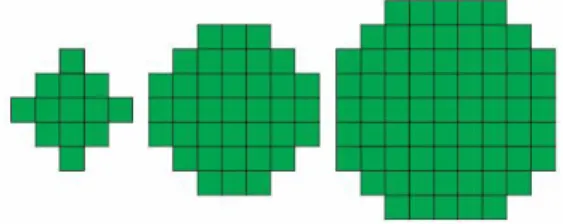
There are several types of structural element, such as square, rectangle, disk, diamond, circle, etc. In case of MRI image of human brain, especially axial orientation, disk shape is chosen because human brain shape can be approximated well using this shape (figure 4). Erosion will remove outer objects that are not brain tissue, by doing so, the brain itself will become smaller. To return brain to its original size, dilation is applied.
Figure 4 Structural element shapes
In GPU, we use global memory to do this operation. Each thread will read a pixel and take a sneak peek to its neighbors in source image. Figure 5 shows the example of structural element with size 3. The index of center pixel, i6, is determined by
i6 = threadIdx.x+
(blockIdx.x*blockDim.x)+ (threadIdx.x*imWidth)+
(blockIdx.y*blockDim.y*imWidth) Other pixels location is determined by respect of this central pixel. This structural element will work parallel on each pixel on input image. Then it will write value in the result image based on the process, whether it is erosion or dilation. Erosion and dilation processes are done iteratively until a good result is achieved. We use different structural element size and iteration number for each image. For example, for an image three consecutive erosions by structural element size 5 are done before dilating the image three times with the same structural element. i0 i2 i4 i5 i3 i6 i7 i8 i1 i8 i9 i12 i11 i10
2012 년도 한국멀티미디어학회 춘계학술발표대회 논문집 제 15 권 1 호
208
-4. Results
We implemented this method on several MRI images on axial orientation separately. From there results we can see that most of the brain is extracted. However, there are some errors in the edge of the brain. Erosion process can remove those parts if the origin of the part is too small. Dilation cannot reconstruct the lost part, so that part will lost in the brain image. This error should be avoided because a small brain area decrement might cause some miss interpretations of the condition of patient. We also need to adjust the structural element size and number iteration for every image. Our main future work is to complete this skull removing on CUDA. Then we will try to integrate this method with another brain analysis processes such as hippocampus segmentation, volume rendering, etc.
Original Brain Segmented Brain
Figure 5 Results of removing skull
5. Conclusions
CUDA can be applied to remove skull from human brain MRI images. In this work, there are still some errors on images because of erosion and dilation. We used global memory on thresholding, erosion, and dilation operation. There are still many other morphological operations (labeling and hole filling) and other types of memory (shared and texture) that can be used to optimize this algorithm.
Acknowledgement
This research was supported by Basic Science Research Program through the National Research Foundation of Korea (NRF) funded by the Ministry of Education, Science, and Technology (2011- 0008627)
References
[1] P. Thompson and A.W. Toga, “A Surface-Based Technique for Warping Three-Dimensional Images of the Brain,” IEEE Transaction Medical Image, 15, 1996. [2] R.B. Dubey, M. Hanmandlu and S.K. Gupta, “Region Growing for MRI Brain Tumor Volume Analysis,” Indian Journal of Science and Technology, Volume 2, No. 9, 2009.
[3] D. Shattuck, S. Sandor-Leahy, K. Schaper, D. Rottenberg and R. Leahy, “Magnetic Resonance Image Tissue Classification using a Partial Volume Model,” Neuroimage, 13, 856-876, 2001.
[4] K. Jafari-Khouzani, M.R. Siadat, H. Soltanian-Zadeh and K. Elisevich, “Texture Analysis of Hippocampus for Epilepsy,” in Proceedings of SPIE, Volume 5031, 2003.
[5] N. Moon, E. Bullitt, K. van Leemput and G. Gerig, “Automatic Brain and Tumor Segmentation,” Medical Image Computing and Computer-Assisted Intervention, Volume 2488, 2002.
[6] H.K. Hahn and H.-O. Peitgen, “The Skull Stripping Problem in MRISolved by a Single 3D Watershed Transform,” Lecture Notes in Computer Science, Medical Image Computing and Computer-Assisted Intervention (MICCAI), Vol. 1935/2000, pp. 134-143, 2000.
[7] F. Segonne, A.M. Dale, E. Busa, M. Glessner, D. Salat, H.K. Hahn and B. Fischl, “A hybrid approach to the skull stripping problem in MRI,”NeuroImage, 22(3), 1060–1075, 2004.
[8] J.G. Park and C. Lee, “Skull Stripping Based On Region Growing For Magnetic Resonance Brain Images,” NeuroImage, 47, 1394-1407, 2009.
[9] R. Adams and L. Bischof, “Seeded region growing,” IEEE Transactions on Pattern Analysis and Machine Intelligence, Vol. 16(6), 641–646, 1994.
[10] T. Kapur, W.E.L. Grimson, W.M. Wells and R. Kikinis, “Segmentation of Brain Tissue from Magnetic Resonance Images,” Medical Image Analysis, Volume 1, Number 2, pp 109-127, 1996.
[11] V. Grau, A.U.J. Mewes, M. Alcaniz, R. Kikinis and S.K. Warfield, “Improved watershed transform for medical image segmentation using prior information,” IEEE Trans. Med. Imag., 23(4), 447–458, 2004.