
2485
Copyright ⓒ The Korean Institute of Electrical Engineers
A Novel Approach of Feature Extraction for Analog Circuit Fault
Diagnosis Based on WPD-LLE-CSA
Yuehai Wang*, Yuying Ma
†, Shiming Cui** and Yongzheng Yan**
Abstract
– The rapid development of large-scale integrated circuits has brought great challenges to the circuit testing and diagnosis, and due to the lack of exact fault models, inaccurate analog components tolerance, and some nonlinear factors, the analog circuit fault diagnosis is still regarded as an extremely difficult problem. To cope with the problem that it’s difficult to extract fault features effectively from masses of original data of the nonlinear continuous analog circuit output signal, a novel approach of feature extraction and dimension reduction for analog circuit fault diagnosis based on wavelet packet decomposition, local linear embedding algorithm, and clone selection algorithm (WPD-LLE-CSA) is proposed. The proposed method can identify faulty components in complicated analog circuits with a high accuracy above 99%. Compared with the existing feature extraction methods, the proposed method can significantly reduce the quantity of features with less time spent under the premise of maintaining a high level of diagnosing rate, and also the ratio of dimensionality reduction was discussed. Several groups of experiments are conducted to demonstrate the efficiency of the proposed method.Keywords:
Feature extraction, Analog circuit fault diagnosis, Wavelet packet decomposition, Local linear embedding, Dimensionality reduction.1. Introduction
The rapid development of large-scale integrated circuits led to its widely using in military, communication, automatic control and other fields. While most of the electronic systems are digitized, 80% or so faults occur in the analog part [1]. Analog circuit fault detection and diagnosis are still considered as an extremely difficult problem [2-4] and have several conundrums due to the following characteristics: the lack of exacted fault models, inaccurate analog components tolerance, the nonlinear nature of the problem, and so on. Thus, test and diagnosis on analog circuits are still evolved very slowly. When the analog circuit fails, the corresponding fault symptoms must be shown, such as voltage and current signal. These symptoms contain the running information and fault information of circuits. Therefore, by collecting the original signals such as voltage and current that reflect the real operation state of the circuit, the accurate fault analysis and pattern extraction can train the accurate fault classifier containing all the known fault information to diagnose the known fault type. The essence of analog circuit fault diagnosis is to classify the fault and locate the faulty component in the circuit, so it is actually a typical pattern
recognition problem. The widespread PR-based analog circuit fault diagnosis approaches generally include 5 steps: (i) circuit data acquisition, (ii) fault feature extraction, (iii) typical feature construction, (iv) classification algorithm, and (v) diagnosis result evaluation and feedback. A well-trained diagnosis approach is based not only on an appropriate classification algorithm, but also on the large amount of training data that should cover every fault class as well as effective feature extracting process that is used to select the fault features [5]. Feature extraction appears to be an important part of analog circuit fault detection and diagnosis. In fact, PR-based diagnosis algorithms are critical procedure which to find some efficient methods to extract more valid features and reduce the dimension of input data to minimize its training and processing time simultaneously. In the literature [6-8], the technique of wavelet analysis is used to extract fault features and it performs well. Due to the perfect local property of wavelet in both time and frequency domain, feature extraction using wavelet analysis technique has become the most appealing fault feature extraction method to process noisy and unstable signals, such as transient response of analog circuit [3]. This type of transformation usually requires continuous sampling of the fault circuit to obtain the critical information of the circuit state. However, the fault features constructed by this process were of high dimension and large quantity. When these features were input to a classifier algorithm directly, it will impose a large amount of computational complexity and may result slowly convergence. Therefore, it is vital to reduce the † Corresponding Author: Dept. of Electronic Information Engineering,
North China University of Technology, China. ([email protected]) * Dept. of Electronic Information Engineering, North China University
of Technology, China. ([email protected])
** Dept. of Computer Science, North China University of Technology, China. ([email protected], [email protected])
dimension of the obtained fault feature data after wavelet analysis in analog circuit fault diagnosis.
In the field of machine learning, dimensionality reduction refers to use a mapping method to obtain a low-dimensional manifold which is embedded in the high-dimensional pixel space. In many algorithms, the reduced dimension algorithm becomes part of the data preprocessing [9]. One of the most widely used methods for dimensionality reduction in many different applications is PCA (principal component analysis) and LDA (linear discriminant analysis). PCA [10] “picks the dimensions of the greatest variance in the initial data and maps all the points to the new coordinate system which is built by the maximum variance directions”. LDA [11] uses the category information to obtain the optimal projection direction by maximizing the ratio of the divergence of the data class to the divergence of the class divergence. But PCA and LDA were usually be used in linear dimensionality reduction applications. Unfortunately, the data of most engineering application are non-linear. Therefore, some typical nonlinear dimensionality reduction algorithms were widely used, such as kernel PCA and manifold learning dimension reduction algorithm. The weaknesses of kernel PCA is that it has no theoretical basis for the selection of kernel functions [12-13]. ISOMAP and LLE are typical representation of the nonlinear dimensionality reduction algorithm based on manifold learning. ISOMAP is global method which “try to preserve the global structure of the information by sustaining pairwise distances between all points in pair, but it impose high computational complexity” [14]. LLE algorithm was proposed by Saul and Roweis in 2000 based on manifold learning, which has the ability to transform the global nonlinearity into local linearity, and extends the perception of diminishing dimensionality [15]. With the advantages of simple parameters and low time complexity [16], LLE is a suitable choice for this problem. In 2016, Deng [17] proposed a method based on wavelet packet and ELM, and applied to analog circuit soft fault diagnosis successfully, but they didn’t discuss the decomposition level of wavelet packet.
In order to fully excavate the fault information and reduce the dimension of input eigenvector, in this paper, a feature extraction and dimension reduction method based on wavelet packet decomposition and LLE algorithm was proposed, and the diagnostic module mainly completes the training with clone selection algorithm and identifies the faults. The WPD-LLE method sovled the problem that the feature dimension of wavelet packet decomposition is increasing exponentially with the growth of decomposition level, which leads to the inefficiency or non-convergence of the diagnosis algorithm. The experimental results show that the proposed fault feature extraction method can well reflect the essential characteristics of fault response signal, not only show better performance than other feature extraction methods, but also well satisfied the two indicators of computation time and diagnosis rate.
The structure of this paper as follows: Section 2 mainly introduces the WPD technology and the LLE algorithm. Section 3 briefly introduces the framework of the whole system. After that, extensive comparative experiments are presented in Section 4 which present the simulation example of WPD-LLE-CSA system on a two-stage four-op-amp biquad low-pass filter circuit. The conclusion is given in the section 5.
2. Method
2.1 Wavelet packet decompositionWavelet packet decomposition (WPD) is an extension of the wavelet transform by combining multiresolution approximation with wavelets [18]. WPD can decompose the high-frequency part and low-frequency part of the of the input signal at the same time, so as to fully exploit the hidden features in the input signal [19]. Thus, assuming the decomposition level is n,wik the quantity of the nodes
after decomposition is 2n.
The methods of extracting wavelet feature vectors include information entropy, extreme value and energy distribution. The wavelet packet energy spectrum includes the characteristic information such as amplitude, period and frequency of corresponding voltage signal, which is the extraction of the intrinsic characteristic of the circuit signal. In general, the output response of analog circuit is a continuous non-stationary signal. When the circuit fails, the energy distribution of each frequency band is obviously affected. The purpose of the diagnosis is to detect the information that is hidden in the mass spectra of energy spectrum in the most efficient way as possible.
The low pass filter h (k) coefficients and the high pass filter g (k) coefficients are respectively in the corresponding multiscale analysis. For a set of discrete signal X (t), the wavelet packet decomposition and reconstruction algorithm as follows: 2 1 2 1 1 ( 2 ) ( ) ( 2 ) ( ) n n j j k n n j j k d h k t d k d g k t d k + + + = -=
-å
å
(1)We define the energy content Ei j, ( )k in each
sub-frequency band as : 2 1 , , |d (k)| E N k j i j i
å
= = (2) , ( ) i jd k represents the wavelet packet coefficients, N
represents the length of the signal. Thus, the high/low frequency coefficients of each layer constitute the energy value of each frequency band. In most cases, the energy spectrum can be regarded as features to construct a feature
vector for faults classification. This energy eigenvector acting as fault feature eigenvector is defined as
1 2
[ , ,..., n]
T = E E E (3)
To eliminate the influence of absolute value of each component, all these components of the vector were usually normalized before they were put into use. This process is the so-called energized procedure.
The algorithm is a step by step decomposing a node into two nodes. , subdivide the entire frequency band of the sampling signal into small segments as shown in Fig. 1. In this way, by increasing the number of decomposed layers, WPD can extract the high frequency components and low frequency components of the input signal to any details.
In Fig. 1, the feature dimension of WPD feature extraction technology increases exponentially with the growth of the decomposition layer. In fact, if the decomposed level of wavelet is too small, valid information cannot be completely extracted. However, if the decomposition level is too large, the feature dimension increases which will fully tap the error message, but this approach would lead to “the curse of dimensionality” problem, that influences the training time and diagnostic speed of the classifier. As a result, how to solve “the curse of dimensionality” problem by WPD, there were no effective guidance rules. Focus on this problem, the WPD-LLE method was proposed to extract the fault features.
2.2 LLE dimensionality reduction algorithm
With the advantages of simple parameters and low time complexity, LLE is suitable for this problem as the LLE algorithm preserves the local geometric structure in the process of dimensionality reduction [20]. The key to the dimension reduction of nonlinear high dimensional data is to find the low dimensional structure hidden in high dimensional data. It tries to keep the linear relationship between the samples in the neighborhood. For a set of data sets with embedded properties, the relationship between the
intrinsic low-dimensional space and the local neighborhood of the embedded space should be constant.
i ij j ik jk il l
x = w x +w x +w x (4)
where wij,w ,ik w is weight coefficient, the sample is il
reduced after the LLE dimension, The projection of x i
in low dimensional space corresponds to x ' and i xj,
xk, x1 corresponds to x 'j , x ' , k x ' respectively, also 1
through a linear combination of reconstruction, that is
i ij j ik jk il l
x '»w x ' w x ' w x '+ + (5)
Thus, wij,w ,ik w to be maintained after mapping. il
In conclusion, the linear combination can only play a role in the vicinity of the neighborhood, and the samples with far distance from the sample point have no effect on the local linear combination, which can reduce the complexity of the dimension reduction.
LLE first finds its neighbor subscript set Q for each i
sample xi, then the coefficients xi for linear reconstruction
of x based on the sample points in i Q were calculate : i
i 2 m i ij j i 1 j Q 2 1 2 m min x w x w , w ,¼, w
å
= -å
Î (6) s.t. i ij j QÎ w =1å
(
)
T(
)
jk i j i kC = x -x x -x , wij has a closed solution,
i i 1 jk k Q ij 1 ls l,s Q C w C -Î -Î =
å
å
(7)LLE keepsw unchanged in low dimensional space, thus i
the low-dimensional spatial coordinates z corresponding i
to x can be solved by: i
i 2 m i ij j i 1 j Q 2 1 2 m min z w z z , z ,¼, z
å
= -å
Î (8)(6) is the same as the optimization target of (8). The only difference is that w is needed in (6), and the lower i
dimension space coordinates z corresponding to i x are i
needed in (8).
(
1 2 m)
Z= z , z ,¼, z ÎRd m¢´ ,( )
W ij=wij(
) (
T)
M= I-W I-W (9) (8) can be rewritten:(
)
T z min tr ZMZ s.t. T ZZ = I (10)where (10) can be solved by eigenvalue decomposition: Fig. 1. The tree structure of five layer wavelet packet
M is the smallest d eigenvalue corresponding to the ’
eigenvector matrix ZT the LLE algorithm can be described as follows:
Input: sample set D=
{
x , x ,1 2 ¼, xm}
; neighborparameter k; Low dimension space d ' .
Since the problems such as noise interference and sparse sampling are often associated with the acquisition of data, the stability of the LLE algorithm is greatly affected, so the stability of the LLE algorithm needs to be strengthened. The weight of each sample is calculated to reflect its importance, so the robustness of the LLE algorithm is improved by reducing the influence of noise point after weighting.
Compared with other dimensionality reduction methods, the advantage of local linear embedding algorithm is to define the only parameters which is the k neighborhood number. The performance of the LLE algorithm depends on the selection of the k neighborhood parameter, so how to select the optimal k neighborhood parameter is crucial. However, there is no clear guide principle for the selection of k values. For different data sets, the choice of the best k value may be different.If the selected k value is too small, it may lead to the loss of the important characteristics of the original data. But if the selection of k value is too large, although it can retain most of the original information, the irrelevant data points will also play a role in the judgment, making the judgment wrong and the performance of the reduction will be worse.
The k values determined by different methods are very different, and it is very important to find the correct k value. In practical engineering applications, the k value usually select a small number, in this paper, using cross validation method, namely the selection of part of samples for training set, part of the sample do test set, to select the optimal value of k. As shown in Fig. 2, by conducting a series of experiments, k was put to 12, which performs better than other choices through experimental verification.
3. The Framework Based on WPD-LLE-CSA
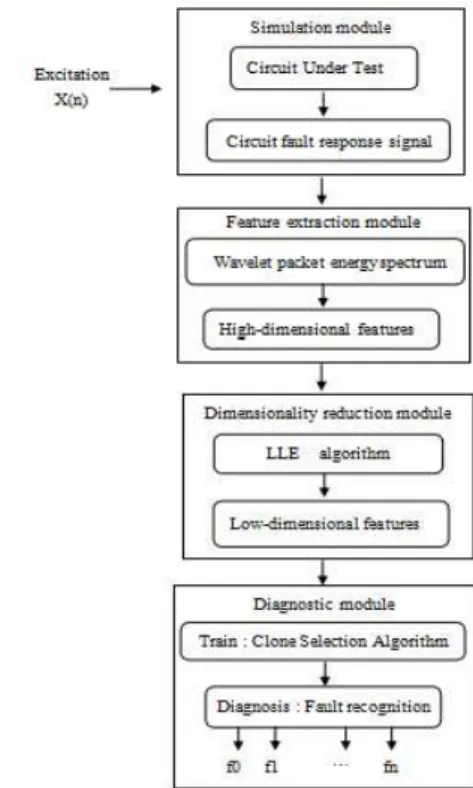
In this investigation, a novel analog circuit fault diagnosis method based on WPD-LLE-CSA which combined with wavelet packet decomposition, local linear embeddingalgorithm and clonal selection algorithm was proposed. The general framework was shown in Fig. 3.
The scheme model contains four parts: simulation module, feature extraction module, dimension reduction module, diagnostic module. The simulation module used Pspice software to simulate the circuit under test in the normal mode and every fault mode, and to obtain the response data of circuit. The feature extraction module extracted the wavelet packet energy spectrum as the high-dimensional features. The LLE algorithm is used to reconstruct the features after WPD, and the low-dimensional features were constructed.
The LLE algorithm is one of the most commonly used algorithms to emphasize local optimization, which has the global optimal solution and is suitable for solving practical problems. The feature dimension of wavelet packet energy spectrum diagram increases exponentially with the increase of the wavelet packet decomposition level n:
n x y
2
= (11)
In the formula (11), y represents the dimension after dimension reduction, for example, when the wavelet decomposes 6 layers, the original characteristic dimension is 64 dimension, and the dimension is reduced to 32, 16, 8, 4 and 2, and the output results are tested. The wavelet packet energy spectrum diagram was shown in Fig. 4.
In order to analyze the performance of the diagnosis scheme, we used the fault classifier after training to diagnose the fault and evaluate the performance with diagnosis rate. Fig. 2. k value experiments result
Fig. 3. WPD-LLE-CSA analog circuit fault diagnosis framework
Diagnostic classification algorithm using the technique of artificial immune clonal selection algorithm, the most prominent technology in this is far more than the neural network has a proven solution fast convergence ability of classification algorithm.
Clone selection algorithm is a kind of directed random search technique that mimics the antigen-antibody reaction of the immune system in mammals [23]. In the field of analog circuit fault diagnosis, the antibodies are vectors corresponding to various trained fault class centers, and the antigens are the faults that need to be identified by the classifier [5]. Clone selection algorithm for troubleshooting mainly consists of three steps: (i) Select the fault training sample. (ii) The training samples were used to train the system, and the clustering centers of each fault mode were obtained. (iii) Using the obtained clustering center to classify the various fault samples of the circuit, and locating the faulty components. Its fast convergence speed can avoid the algorithm falling into local optimum, so this paper adopts the clonal selection algorithm for the fault training and diagnosis algorithm.
4. Experimental Results and Analysis
4.1 Fault settings and experimental environmentIn order to verify the feasibility of our method, we would use a two-stage four-op-amp biquad low-pass filter [3] as benchmark CUT. This type of analog circuit is very common in existing equipment and also is well studied in [8] due to its importance. As to parametric faults, we followed the category description in [3] including mounting of components with values out of tolerance on this biquad low-pass filter. Circuit structure was shown in Fig. 5.
Parameters and fault settings are consistent with [3,8], which set the capacitor capacitance tolerance of ± 10%, the resistance tolerance of ± 5%. The input excitation signal was set to 5V, the width of 10μs narrow pulse. In the test, 15 fault modes were set and the normal mode is shown in Table 1. ↑ and ↓ represent the fault value more than and less than the nominal value.
According to Table 1, the normal state of the circuit and
the 15 fault states were simulated separately. Each time one fault was injected during the experiment, while all the other components change their value within their tolerance alternatively. With this two stage four-op-amp biquad low-pass filter, we input a single impulse of height 5V and duration of 10s and observed its responses. The transient simulation time in P spice was set to 1000μs and the sampling time was set to 2μs. A total of 50 Monte Carlo analyzes were performed on each fault mode and normal mode of the circuit. A total of 800 sets of data were sampled. For each pattern, 30 groups of data selected from the 50 groups were used to train the clonal selection algorithm, and the remained 20 groups of data were used as diagnostic test. The simulation data of the corresponding 16 fault modes (including the normal state) were obtained. 4.2 Experiment results
Since the fault features extracted by Haar show the good performance in the previous experiments [5], thus Haar was selected as the wavelet packet basis function in this paper. As mentioned in the third part, the parameter k of the LLE is selected as 12. The clonal selection classifier was used to calculate the diagnosing rate for each group of experiments. The threshold value of the total population affinity was T=0.01. When the variation value of the Fig. 4. Wavelet packet energy spectrum diagram Fig. 5. The schematic two-stage four-op-amp biquad
low-pass filter circuit Table 1. Circuit fault mode
Fault state Fault type Nominal value Fault value
F0 None F1 C1↑ 0.01μF 0.051μF F2 C2↑ 0.01μF 0.02μF F3 C3↑ 0.01μF 0.048μF F4 C4↑ 0.01μF 0.031μF F5 R3↑ 2.2kΩ 5kΩ F6 R4↓ 1.57kΩ 0.6kΩ F7 R6↑ 10kΩ 16.5kΩ F8 R7↓ 10kΩ 5.5kΩ F9 R8↑ 0.44kΩ 2.2kΩ F10 R9↑ 2.64kΩ 4.3kΩ F11 R16↑ 1.8kΩ 7.8kΩ F12 R17↓ 4.84kΩ 1.6kΩ F13 R19↑ 10kΩ 30kΩ F14 R21↓ 10kΩ 3.75kΩ F15 R22↑ 2.32kΩ 7kΩ
affinity between the two generations of antibody was less than 0.01, the iteration stopped. Clone scale Kscale=8, learning factor =0.3, and antibody inhibition rate was 10%. The optimal antibody selection number n is set to 5.
As shown in Fig. 6, the diagnosis accuracy was improved with the increasing of decomposition level of the wavelet packet. But the attendant question is: the dimension of features is also in exponential growth.
Extensive experiments were conduct to figure out the best proportion of the dimension reduction. Under the primise that 6 levels of decomposition, all experimental conditions remain unchanged, only the ratio of reduction keep changed.
Lots of experiments were conducted on different levels of decomposition, and compared to reveal the tradeoff between accuracy and time consume of traning and test. The optimal diagnosis effect was achieved by studying the combination of different decomposition levels and different dimensionality ratios. According to Table 2, after the original data was decomposed to 6 levels, the best accuracy of dimensional reduction was achieved. When the dimensionality reduction rate was 50%, the fault diagnosing rate was as high as 99.38%. And when the dimensionality reduction rate was 75%, the diagnostic rate
remained at a high level of 99.06%, the time consumption is reduced by a third. But with the increase in the degree of reduction, lots of useful information was discarded, the fault diagnosis effect quickly deteriorated. For instance, when dropped to 2 dimension, the obtained feature dimension is lower than the intrinsic dimension, and the fault diagnosis rate appear a sharp decline, which was only 40% approximately.
As shown in Table 3, the training and test time required for different feature dimensions are listed. It can be clearly seen from the table: the time of training and test was shortened greatly after reducing dimension.
Under the premise of maintaining a high level of diagnosing rate, the computation complexity was greatly reduced. As shown in Table IV, when the feature dimension was compressed to the original 1/4, the diagnosing rate reaching 99.06% , which performs better than that WPD method mentioned in paper [17](96.4%) and [21] (94.4%). The reason of the proposed WPD-LLE-CSA method outperforms other methods consist two main aspects: First, the scheme further excavates the decomposition level of wavelet packet. Second, the LLE algorithm has the advantage that it doesn’t suffer from short-circuiting
Fig. 6. The schematic two-stage four-op-amp biquad low-pass filter circuit
Table 2. WPD-LLE-CSA Fault recognition results under 6 decomposition levels Fault state Fault type 64-2dimension Diagnostic rate 64-4dimension Diagnostic rate 64-8dimension Diagnostic rate 64-16dimension Diagnostic rate 64-32dimension Diagnostic rate F0 C1↑ 45.00% 100.00% 100.00% 100.00% 100.00% F1 C2↑ 15.00% 100.00% 100.00% 100.00% 100.00% F2 C3↑ 0.00% 70.00% 100.00% 95.00% 100.00% F3 C4↑ 100.00% 100.00% 100.00% 100.00% 100.00% F4 R3↑ 45.00% 80.00% 95.00% 95.00% 100.00% F5 R4↓ 30.00% 95.00% 100.00% 100.00% 100.00% F6 R6↑ 15.00% 95.00% 80.00% 100.00% 95.00% F7 R7↓ 15.00% 85.00% 100.00% 100.00% 100.00% F8 R8↑ 100.00% 90.00% 95.00% 100.00% 95.00% F9 R9↑ 55.00% 85.00% 100.00% 95.00% 100.00% F10 R16↑ 65.00% 100.00% 100.00% 100.00% 100.00% F11 R17↓ 15.00% 100.00% 100.00% 100.00% 100.00% F12 R19↑ 0.00% 100.00% 100.00% 100.00% 100.00% F13 R21↓ 0.00% 90.00% 100.00% 100.00% 100.00% F14 R22↑ 55.00% 100.00% 100.00% 100.00% 100.00% F15 Normal 75.00% 95.00% 95.00% 100.00% 100.00% Average 39.38% 92.81% 97.81% 99.06% 99.38%
Table 3. Comparison of results with time consume Feature dimension Training time/s Test time/s
64 2.69 1.92 32 2.36 1.55 16 1.91 1.18 8 1.57 0.99 4 0.95 0.66 2 0.38 0.23
Table 4. Comparison of results with different methods Paper Method Fault mode Diagnostic rate Paper [17] WPD+SVM 7 96.4% Paper [21] WPD+ELM 8 94.4% This paper WPD+LLE+CSA 16 99.06%
referring to erroneous connections in the neighborhood graph, which may seriously influence the pairwise geodesic distances and cause high-dimensional data points poorly to map to a lowdimensional space. It also make the algorithm avoid local optimization. Then, CSA is an efficient classification algorithm, and in previous studies [5] it has been proved that CSA is a method applicable to the research field.
5. Conclusion
In this study, an intelligent fault diagnosis method the two-stage four-op-amp biquad low-pass filter circuit was proposed. First, the fault features are extracted from the original circuit data through wavelet packet decomposition technology, and the high dimensional eigenvectors are acquired. Then, this paper focused on how to determine the appropriate proportion of the dimension reduction. Finally, the clonal selection classifier is used to training and testing to verify and evaluate the feasibility of the scheme. A large number of experimental studies have been conducted on decomposition level and the scale of dimension reduction. The experimental results confirmed the applicability of LLE algorithm in analog circuit fault diagnosis, which provided a useful reference for complicated and practical engineering application.
In future, dimension reduction theory has a good prospect of in the application of analog circuit fault diagnosis. But it is still in the initial stage, the parameter selection of nonlinear reduction algorithm is in the experimental stage, and there is no clear theory guiding principle. It is necessary to pay attention to the development of dimension reduction theory and its research prospect in the field of analog circuit fault diagnosis.
References
[1] W. Peng, Y. Shiyuan, “A new diagnosis approach for handling tolerance in analog and mixed-signal circuits by using fuzzy math,” IEEE Trans. Circuits Syst. I
Reg. Papers, vol. 52, no. 10, pp. 2118-2127, 2005.
[2] Tan, Y., et al. “A Novel Method for Analog Fault Diagnosis Based on Neural Networks and Genetic Algorithms[J],” IEEE Transactions on
Instrumenta-ion and Measurement, vol. 57, no. 11, pp. 2631-2639,
2008.
[3] Aminian, M. and F. Aminian, “A Modular Fault-Diagnostic System for Analog Electronic Circuits Using Neural Networks with Wavelet Transform as a Preprocessor [J],” IEEE Transactions on
Instru-mentation and Measurement, vol. 56, no. 5, pp.
1546-1554, 2007.
[4] Song Liwei, “Fault Diagnosis of Analog Circuits Based on Wavelet Analysis and Neural Network.
[D],” Hunan University, 2012.
[5] Wang, Yuehai, Yongzheng Yan, and Qinyong Wang. “Wavelet-Based Feature Extraction in Fault Diagnosis for Biquad High-Pass Filter Circuit,” Mathematical
Problems in Engineering, 2016.
[6] Liao Jian, Zhou Shaolei, Shi Xianjun, Wang Zhen. “Reducing Dimension of Analog Circuit Fault Feature [J],” Journal of Vibration, Measurement &
Diagnosis, pp. 02:302-308+400, 2015.
[7] Luo, Hui, Wang, Youren, Cui Jiang, “A New Method of Fault Feature Extraction for Analog Circuits Based on the Most Fractional Fourier Transform[J],”.
Chinese Journal of Scientific Instrument, vol. 30, no.
5, pp. 997-1001, 2009.
[8] Aminian, M. and F. Aminian, “Neural-network based analog-circuit fault diagnosis using wavelet transform as preprocessor[J],” IEEE Transactions on Circuits
and Systems II, vol. 47, no. 2, pp. 151-156, 2000.
[9] Cortes, C. and V. Vapnik, “Support-Vector Networks,”
Machine Learning, vol. 20, 3, pp. 273-297, 1995.
[10] PCA I. Jolliffe, “Principal component analysis,” Wiley Online Library, (2002).
[11] Xiao Yingqun, Feng Lianggui, He Yigang, “A fault diagnosis approach of analog circuit using wavelet based fractal analysis and kernel LDA[J],”
Trans-actions of China E1ectrotechnical Society, vol. 27,
no. 8, pp. 230-238(in Chinese), 2012.
[12] B. Scholkopf, A. J. Smola, K.R. Muller, “Nonlinear component analysis as a kernel eigenvalue problem,”
Neural Comput, vol. 10, pp. 1299-1319, 1998.
[13] M. S. Kearns, S. A. Solla, D. A. Cohn, “Kernel PCA and de-noising in feature spaces in Advances in Neural Information Processing Systems 11,” MA,
Cambridge: MIT Press, pp. 536-542, 1999.
[14] J. B. Tenenbaum, V. De Silva, J. C. Langford, “A global geometric framework for nonlinear dimensionality reduction,” Science, vol. 290, no. 5500, pp. 2319-2323, 2000.
[15] Roweis, S.T. and L.K. Saul, “Nonlinear Dimensionality Reduction by Locally Linear Embedding [J],” Science, vol. 290, no. 5500, pp. 2323-2326, 2000.
[16] Polito, Marzia, and Pietro Perona, “Grouping and dimensionality reduction by locally linear embedding,” pp. 2002, 1255-1262, 2002.
[17] DENG Y, YU C S. “Application of factor analysis and ELM in fault diagnosis of analog circuits [J],”
Journal of Electronic Measurement & Instrument-ation, vol. 30, no. 10, pp. 1512-1519, 2016.
[18] L.-Y. Zhao, L. Wang, and R.-Q. Yan, “Rolling bearing fault diagnosis based on wavelet packet decomposition and multi-scale permutation entropy,” Entropy, vol. 17, no. 9, pp. 6447-6461, 2015.
[19] Xie Tao., “Research on Fault Diagnosis of Analog Circuits Based on Multiwavelet Packet, Neural Network and Optimization [D],” Hunan University, 2011.
[20] De Ridder, Dick, and Robert PW Duin., “Locally linear embedding for classification,” Pattern Recogni-tion Group, Dept. of Imaging Science & Technology, Delft University of Technology, Delft, The Netherlands, Tech. Rep. PH-2002-01, pp. 1-12, 2002.
[21] X. He, H. Wang, J. Lu, and W. Jiang, “Analog circuit fault diagnosis method based on preferred wavelet packet and ELM,” Chinese Journal of Scientific
Instrument, vol. 34, no. 11, pp. 2614-2619, 2013.
[22] W.J. Tian, Y. Geng, J.C. Liu, and L. Ai, “Support vector regression and immune clone selection algorithm for intelligent electronic circuit fault diagnosis in Proceedings of the Pacific-Asia Con-erence on Circuits,” Communications and System
(PACCS ’09), IEEE Computer Society, Chengdu, China, pp. 297-300, 2009.
[23] C. Gan, J. Wu, S. Yang, Y. Hu, W. Cao, “Wavelet packet decomposition-based fault diagnosis scheme for SRM drives with a single current sensor,” IEEE
Trans. Energy Convers, vol. 31, no. 1, pp. 303-313,
Mar. 2016.
[24] Liu Xindong. Soft Fault Diagnosis of Analog Circuits Based on LLE and SVM., “System Simulation Tech-ology and Its Application Conference,” Changchun,
Jilin, China, 2010.
Acknowledgments
This work was partially supported by a grant from the National Natural Science Foundation of China(No. 61573019). Research of bionic polarization/optical flow/ INS integrated navigation based on the probability distribution optical flow estimation.
Yuehai Wang He received the Ph.D. degree from Harbin Institute of Technology in 2003. He is currently a Professor with the Dept of Electronical and Information Engineering, North China University of Technology. His research interests are in the areas of circuit testing and fault diagnosis of analog, image processing and intelligent robots.
Yuying Ma She received master degree from North China University of Technology University in 2018. Her research interests are pattern recogni-ion and signal processing.
Shiming Cui He received bachelor degree from North China University of Technology University in 2016. His research interests are image processing and pattern recognition.
Yongzheng Yan He received master degree from North China University of Technology University in 2017. His research interests are intelligent robots and pattern recognition.
![Table 4. Comparison of results with different methods Paper Method Fault mode Diagnostic rate Paper [17] WPD+SVM 7 96.4% Paper [21] WPD+ELM 8 94.4% This paper WPD+LLE+CSA 16 99.06%](https://thumb-ap.123doks.com/thumbv2/123dokinfo/4889779.36730/6.892.73.818.863.1150/table-comparison-results-different-methods-method-diagnostic-paper.webp)
