Management of Asymptomatic Erosive Esophagitis: An E-Mail Survey of
Physician’s Opinions
Seong Woo Lim*, Jun Haeng Lee*, Jie-Hyun Kim†, Jeong Hwan Kim‡, Heung Up Kim§, and Seong Woo JeonⅡ
*Department of Medicine, Samsung Medical Center, Sungkyunkwan University School of Medicine, †Department of Internal Medicine and
Institute of Gastroenterology, Yonsei University College of Medicine, ‡Department of Internal Medicine, Konkuk University School of Medicine,
Seoul, §Department of Internal Medicine, Jeju National University College of Medicine, Jeju, and ⅡDepartment of Internal Medicine, Kyungpook
National University School of Medicine, Daegu, Korea
Background/Aims: The management of asymptomatic erosive esophagitis is controversial. We surveyed physicians’ opinions on asymptomatic erosive esophagitis using e-mail. Methods: All members of the Korean Society of Neurogastro-enterology and Motility were invited to answer the question-naire on the treatment and follow-up of patients with asymp-tomatic erosive esophagitis by e-mail. Results: A total of 73 members answered the questionnaire (response rate, 18%). As initial management, 41% of respondents chose pharma-cologic treatment, whereas 59% chose nonpharmapharma-cologic treatment. In the case of pharmacologic treatment, proton pump inhibitors were the preferred medication. The most common treatment duration was 4 weeks (43%), followed by 8 weeks (38%), and 6 months (11%). Sixty-two percent of the respondents recommended follow-up endoscopy annu-ally, whereas 29% chose no endoscopic follow-up. Thirty-four percent of the respondents answered that they would talk about reflux-related sleep disturbances. Only 25% of the re-spondents explained the possibility of Barrett’s esophagus or esophageal adenocarcinoma to their patients. Conclusions: There are substantial practice variations in the management of asymptomatic erosive esophagitis in Korea. (Gut Liver 2013;7:290-294)
Key Words: Esophagitis; Endoscopy; Asymptomatic diseases; Therapeutics
INTRODUCTION
Gastroesophageal reflux disease (GERD) can be divided into two categories: symptomatic GERD and asymptomatic GERD.
Correspondence to: Jun Haeng Lee
Department of Medicine, Samsung Medical Center, Sungkyunkwan University School of Medicine, 81 Irwon-ro, Gangnam-gu, Seoul 135-710, Korea
Tel: +82-2-3410-3409, Fax: +82-2-3410-6983, E-mail: [email protected]
Received on May 21, 2012. Revised on August 22, 2012. Accepted on September 12, 2012. Published online on April 9, 2013. pISSN 1976-2283 eISSN 2005-1212 http://dx.doi.org/10.5009/gnl.2013.7.3.290
This is an Open Access article distributed under the terms of the Creative Commons Attribution Non-Commercial License (http://creativecommons.org/licenses/by-nc/3.0) which permits unrestricted non-commercial use, distribution, and reproduction in any medium, provided the original work is properly cited.
Asymptomatic GERD can be defined as the presence of esopha-geal mucosal injury that is typical for GERD (erosions, peptic ulceration, and/or Barrett’s esophagus) during upper endoscopy in individuals who lack typical or atypical/extraesophageal manifestations of GERD.1
With recent westernization of Korean lifestyles, prevalence of GERD in Korea has increased. The prevalence of reflux esopha-gitis was 1% to 3% in the early period of 1990’s,2,3
4% to 5% in the early of period of 2000’s,4,5 9% to 11% in late period of
2000’s6,7
in routine check-up population, and the prevalence of symptoms of reflux esophagitis was 7% to 10% in the middle period of 2000’s.8-10
Esophagogastroduodenoscopy is frequently performed as a part of gastric cancer screening program in Korea. Accordingly, the number of asymptomatic patients with erosive esophagitis is increasing continuously. It was reported that 62% to 80% of subjects with erosive esophagitis who were diagnosed by en-doscopy in a routine health check-up program do not have any symptoms in Korea.2,4,11 Because little is known about natural
history of asymptomatic erosive esophagitis, there is currently no consensus regarding the best management strategy for as-ymptomatic erosive reflux esophagitis. In order to examine how the patients with asymptomatic erosive esophagitis are managed in Korea, we surveyed the physician’s opinion about this issue.
MATERIALS AND METHODS
E-mail invitations were sent to 403 members of the Korean Society of Neurogastroenterology and Motility between July 2009 and August 2009. E-mails were sent three times at 1 week interval.
The questionnaire was composed of two parts. In the first part of the survey, participants were asked to describe their practice settings and specialities. The second part of the survey evaluated endoscopists’ practice patterns regarding treatment, surveillance, and explanation to patients of asymptomatic erosive esopha-gitis, which was confined to the Los Angeles classification A. Respondents were asked to choose the best answer from the choices relevant to each question, excepting one question about how to treat (multiple response questions). The questions are as follows: 1) What is your choice for diagnosis code in medical insurance claim bills? 2) How do you explain to patient about endoscopic finding? 3) How do you treat patients with asymp-tomatic erosive esophagitis? 4) How long is the duration of your treatment? 5) When do you exam following endoscopy? 6) Do you ask or explain to patients about sleep disturbance? 7) Do you explain to patients about the possibility of Barrett’s esopha-gus or esophageal adenocarcinoma, or not?
The survey was reviewed independently for content and for-mat of the questionnaire by several expert endoscopists. Skipped questions were not included in the overall response totals. De-scriptive statistics were used to summarize the responses of the
survey, including participant characteristics and clinical ques-tions. Percentages were calculated and used for display in the figures. Proportions of the responses were compared between private practice and academic groups with the chi-square test. A p-value less than 0.05 was considered as statistically significant.
RESULTS
Of the 403 invitations to participate, 73 (response rate, 18.1%) physicians responded. The demographics of the respondents are shown in Table 1. Among the 73 physicians who responded to the survey, 56 (76.7%) practiced in academic medical center, 13 (17.8%) in general hospital, and four (5.5%) in private practice. The specialties of respondents were gastroenterology (90.4%) and internal medicine (9.6%), and no other specialties.
In the question about diagnosis code usage in medical re-cords, the most common response was GERD with esophagitis (K21.0, 93.2%). Other responses were GERD without esophagitis (K21.9, 4.1%), dyspepsia (K30, 1.4%), and esophagitis (K20, 1.4%).
The major 41 respondents (56.2%) explained to patients that they have GERD but do not need treatment. Twenty-four (32.9%) explained that the patients have GERD and need to treat it. A small number (2.7%) did not mention anything about endo-scopic findings of erosive esophagitis.
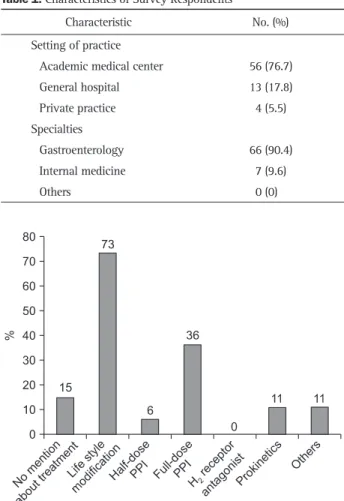
In the question about initial management of asymptomatic esophagitis, 41.1% of respondents chose pharmacologic treat-ment, whereas 58.9% chose nonpharmacologic treatment. In the multiple response question, when asked about how they treat patients with asymptomatic erosive esophagitis, the most com-mon treatment of choice was lifestyle modification (72.6%), fol-lowed by full-dose proton pump inhibitor (PPI) (35.6%). Eleven of the respondents (15.1%) would not talk about treatment (Fig. 1). In case of pharmacologic treatment, PPI was preferred medication. The most common treatment duration was 4 weeks (43.3%), followed by 8 weeks (36.7%), and 6 months (13.3%)
Fig. 1. Distribution of opinions regarding the treatment for asymp-tomatic erosive esophagitis (multiple response question).
PPI, proton pump inhibitor. Fig. 2. Distribution of opinions regarding the duration of pharmaco-logic treatment. Table 1. Characteristics of Survey Respondents
Characteristic No. (%)
Setting of practice
Academic medical center 56 (76.7)
General hospital 13 (17.8) Private practice 4 (5.5) Specialties Gastroenterology 66 (90.4) Internal medicine 7 (9.6) Others 0 (0)
(Fig. 2). Forty-five (61.6%) of the respondents recommended follow-up endoscopy annually, whereas 21 (28.8%) chose no endoscopic follow-up.
Twenty-five (34.2%) of the respondents answered that they would talk about the GERD-related sleep disturbance. Only 18 (24.7%) of the respondents explain the possibility of Barrett’s esophagus or esophageal adenocarcinoma to their patients (Fig. 3).
DISCUSSION
Asymptomatic GERD is a common phenomenon that in-volves the incidental finding of erosive esophagitis, Barrett’s esophagus, and the evolution of esophageal adenocarcinoma in asymptomatic patients. The clinical consequences of asymptom-atic GERD are various. Son et al.12 reported that most patients
with asymptomatic reflux esophagitis showed improvement or a stable course during 3 years of endoscopic follow-up. This report, albeit with many limitations, suggests that the medical treatment such as PPI is unnecessary in asymptomatic patients with erosive esophagitis. The patients who are diagnosed inci-dentally with asymptomatic erosive esophagitis are unlikely to maintain themselves on antireflux treatment because of poor compliance resulting from the lack of disease-related symp-toms.13 However, there is currently no guidance about what to
do with asymptomatic erosive esophagitis.
Reflux esophagitis results from the combination of excessive gastroesophageal reflux of gastric juice and impaired esophageal clearance of the gastric acid. The treatment of reflux esophagitis should be titrated to disease severity. Minimal therapy for GERD patients is comprised of lifestyle modification, dietary modifica-tion, as needed antacid use, H2 receptor antagonists, and PPIs.
Lifestyle modifications are aimed at enhancing esophageal acid clearance, minimizing the incidence of reflux events, or both as with cessation of smoking and avoidance of late meals. How-ever, a systematic review of the published literature concluded that weight loss and head of bed elevation are effective lifestyle interventions for GERD but there is no evidence supporting an improvement in GERD measures after cessation of tobacco, al-cohol, or other dietary interventions.14 Although their
effective-ness has not been extensively evaluated in clinical trials, these
approaches have been used clinically. Similarly in this survey, the most common choice for initial management of asymptom-atic erosive esophagitis was nonpharmacologic treatment such as lifestyle modification.
Among the respondents who chose pharmacologic treatment, 41.1% chose a PPI (full-dose PPI 35.6%, half-dose PPI 5.5%) and 11.0% chose a prokinetic agent, but none chose a H2
re-ceptor antagonist. Acid-suppressant drugs predominate in the treatment of GERD. Many trials have established the efficacy of the various PPIs and H2 receptor antagonists in the treatment
of esophagitis.15,16 PPIs are the first-line of choice in both reflux
esophagitis and nonerosive reflux disease. In a meta-analysis, complete relief from heartburn occurred at a rate of 11.5% per week with a PPI compared to 6.4% per week with a H2 receptor
antagonist.17 On the other hand, asymptomatic Barrett’s
esopha-gus represents no indication for treatment, although recent studies have suggested that potent antireflux treatment (such as PPIs) may retard neoplastic progression in patients with Barrett’s esophagus.18,19 Prokinetic drugs such as bethanechol or
meto-clopramide can be used in the treatment of GERD by increasing lower esophageal sphincter pressure, enhancing gastric empty-ing, or improving peristalsis. However, the currently available promotility agents are hampered by side effects that limit their use in GERD.20 A guideline on GERD management developed
by the American Gastroenterological Association Institute rec-ommends against use of metoclopramide as monotherapy or adjunctive therapy because of these side effects.20
In this survey in Korea, 56.2% of respondents explain to pa-tients that they have GERD, but do not require treatment. And 58.9% chose nonpharmacologic treatment for initial manage-ment of asymptomatic erosive esophagitis without medication. In spite of these responses, more than half of respondents sur-vey following endoscopy annually. The need for endoscopy in patients with GERD is unsettled. Some experts advocated an en-doscopy in patients who require continuous maintenance medi-cal therapy to rule out Barrett’s esophagus.21 In patients without
Barrett’s esophagus on an initial examination, the cancer risk is too low to justify a follow-up endoscopy. Exceptions are pa-tients who develop bleeding, dysphagia, or a significant change in symptoms while on effective therapy.
Sleep and GERD have a bidirectional relationship in which Fig. 3. Distribution of opinions regarding discussing the following with patients: (A) sleep disturbances and (B) the possibility of Barrett’s esophagus or esophageal adenocar-cinoma.
GERD adversely affects the quality of sleep, and poor quality of sleep worsens GERD.22-24 Unfortunately, the clinical features of
sleep disorders including obstructive sleep apnea are nonspecific and the diagnostic accuracy of clinicians’ subjective impres-sion is poor.25 Recent studies have shown that, even in patients
without nighttime heartburn, gastroesophageal reflux may re-sult in sleep disturbances.26 It suggests that the presence of sleep
disturbances and poor quality of sleep could be clinical clues for identifying patients with asymptomatic GERD. However, there is little interest in this area, unlike extraesophageal symptoms such as cough, asthma or laryngitis in Korea. In this survey, only 34% were explaining to the patients about sleep disturbance.
Barrett’s esophagus is a metaplastic change of the esophageal mucosa, such that the normal squamous epithelium is replaced by specialized columnar epithelium.27 The condition develops as
a consequence of chronic GERD, and predisposes to the devel-opment of adenocarcinoma of the esophagus. Estimates of the frequency of Barrett’s esophagus in the general population have varied widely ranging from 0.9% to 4.5% depending in part upon the population studied and the definitions used.28,29 To
de-crease mortality from esophageal adenocarcinoma, it has been proposed that patients with GERD symptoms should be screened endoscopically for Barrett’s esophagus.21,30 However, a
signifi-cant number of patients presenting with adenocarcinoma of the esophagus don’t have any GERD-related symptoms such as heartburn or regurgitation during their lifetime.31 In other
stud-ies, fewer than 5% were known to have had Barrett’s esophagus before they presented with symptoms of esophageal cancer.32 It
is not clear that patients who have Barrett’s esophagus benefit from surveillance. In addition, there is little evidence that these programs have prevented deaths from esophageal adenocarci-noma. Even more, because the epidemiological study about re-lationship between GERD and Barrett’s esophagus or esophageal adenocarcinoma is insufficient in Korea, explanation of risk like this on the basis of just endoscopic finding of erosive esophagi-tis is maybe unnecessary. In this survey, only 25% was explain-ing to the patients about possibility of Barrett’s esophagus or esophageal adenocarcinoma.
Practice variation in countries other than Korea is yet to be reported. Fass and Dickman1 suggested that the clinical
implica-tions of silent GERD are vast, but no specific treatment guide-line was recommended. According to Lu33 in Taiwan, whether to
treat asymptomatic GERD patients is an open question.
One of the limitations of our study is that the opinions of members of the Korean Society of Neurogastroenterology and Motility do not necessarily reflect the opinions and practices of endoscopists nationwide and that only 18.1% of the group responded to the survey. There are also inherent limitations to a multiple choice survey; however, several of our questions al-lowed for write-in responses. Additionally, given the anonymity of our survey design, we were unable to characterize differences between respondents and nonrespondents that may affect the
survey results.
In summary, there are substantial practice variations in the management of asymptomatic erosive esophagitis in Korea. A majority of our survey respondents prefer nonpharmacologic treatment such as lifestyle modification to pharmacologic treat-ment such as PPI. Practice patterns of endoscopic surveillance are variable.
CONFLICTS OF INTEREST
No potential conflict of interest relevant to this article was reported.
ACKNOWLEDGEMENTS
We would like to thank the participating members of the Ko-rean Society of Neurogastroenterology and Motility.
REFERENCES
1. Fass R, Dickman R. Clinical consequences of silent gastroesopha-geal reflux disease. Curr Gastroenterol Rep 2006;8:195-201. 2. Yi SY, Lee SK, Kim MH, Han DS, Kim JW, Min YI. Epidemiologic
study of reflux esophagitis in general health screening people. Ko-rean J Med 1994;46:514-520.
3. Jung SA, Jung HY, Kim KR, Min YI. The prevalence of reflux esophagitis of Korean adults for 10 years of 1990’s. Korean J Gas-trointest Motil 2001;7:161-167.
4. Oh JH, Choi MG, Kim HR, et al. Clinical spectrum of endoscopic reflux esophagitis in routine check-up subjects in Korea. Korean J Neurogastroenterol Motil 2006;12:12-18.
5. Cho YS, Choi MG, Jeong JJ, et al. Prevalence and clinical spec-trum of gastroesophageal reflux: a population-based study in Asan-si, Korea. Am J Gastroenterol 2005;100:747-753.
6. Yoo SS, Lee WH, Ha J, et al. The prevalence of esophageal disor-ders in the subjects examined for health screening. Korean J Gas-troenterol 2007;50:306-312.
7. Kim JH, Hwang JK, Kim J, et al. Endoscopic findings around the gastroesophageal junction: an experience from a tertiary hospital in Korea. Korean J Intern Med 2008;23:127-133.
8. Hwang JK, Kim J, Hong SG, et al. A prospective multicenter study on the prevalence and symptoms of erosive reflux esophagitis in secondary and tertiary hospitals in Korea. Korean J Gastroenterol 2009;53:283-291.
9. Yang SY, Lee OY, Bak YT, et al. Prevalence of gastroesophageal reflux disease symptoms and uninvestigated dyspepsia in Korea: a population-based study. Dig Dis Sci 2008;53:188-193.
10. Lee JH, Kim N, Chung IK, et al. Clinical significance of minimal change lesions of the esophagus in a healthy Korean population: a nationwide multi-center prospective study. J Gastroenterol Hepa-tol 2008;23(7 Pt 1):1153-1157.
esophagitis among Koreans. J Gastroenterol Hepatol 2001;16:373-376.
12. Son JI, Kim JJ, Park MK, et al. The natural history of asymp-tomatic reflux esophagitis: a retrospective study from periodic health check-up program. Korean J Neurogastroenterol Motil 2004;10:100-104.
13. Fass R, Shapiro M, Dekel R, Sewell J. Systematic review: proton-pump inhibitor failure in gastro-oesophageal reflux disease: where next? Aliment Pharmacol Ther 2005;22:79-94.
14. Kaltenbach T, Crockett S, Gerson LB. Are lifestyle measures ef-fective in patients with gastroesophageal reflux disease? An evidence-based approach. Arch Intern Med 2006;166:965-971. 15. Kahrilas PJ, Shaheen NJ, Vaezi MF, et al. American
Gastroen-terological Association Medical Position Statement on the man-agement of gastroesophageal reflux disease. Gastroenterology 2008;135:1383-1391.
16. Bell NJ, Hunt RH. Role of gastric acid suppression in the treatment of gastro-oesophageal reflux disease. Gut 1992;33:118-124. 17. Chiba N, De Gara CJ, Wilkinson JM, Hunt RH. Speed of healing
and symptom relief in grade II to IV gastroesophageal reflux dis-ease: a meta-analysis. Gastroenterology 1997;112:1798-1810. 18. El-Serag HB, Garewel H, Kuebeler M, Sampliner RE. Is the length
of newly diagnosed Barrett’s esophagus decreasing? The experi-ence of a VA Health Care System. Clin Gastroenterol Hepatol 2004;2:296-300.
19. Koop H. An evidence-based look at pharmacotherapy for gastro-esophageal reflux. Chirurg 2005;76:353-358.
20. Kahrilas PJ, Shaheen NJ, Vaezi MF; American Gastroenterological Association Institute; Clinical Practice and Quality Management Committee. American Gastroenterological Association Institute technical review on the management of gastroesophageal reflux disease. Gastroenterology 2008;135:1392-1413.
21. DeVault KR, Castell DO. Updated guidelines for the diagnosis and treatment of gastroesophageal reflux disease. The Practice Param-eters Committee of the American College of Gastroenterology. Am
J Gastroenterol 1999;94:1434-1442.
22. Schey R, Dickman R, Parthasarathy S, et al. Sleep deprivation is hyperalgesic in patients with gastroesophageal reflux disease. Gas-troenterology 2007;133:1787-1795.
23. Dickman R, Green C, Fass SS, et al. Relationships between sleep quality and pH monitoring findings in persons with gastroesopha-geal reflux disease. J Clin Sleep Med 2007;3:505-513.
24. Chen CL, Robert JJ, Orr WC. Sleep symptoms and gastroesopha-geal reflux. J Clin Gastroenterol 2008;42:13-17.
25. Hoffstein V, Szalai JP. Predictive value of clinical features in diag-nosing obstructive sleep apnea. Sleep 1993;16:118-122.
26. Orr WC. Heartburn: another danger in the night? Chest 2005;127: 1486-1488.
27. Lee JH. Barrett’s esophagus-with emphasis on endoscopic disgno-sis. Korean J Gastrointest Endosc 2009;39:185-198.
28. Hirota WK, Loughney TM, Lazas DJ, Maydonovitch CL, Rholl V, Wong RK. Specialized intestinal metaplasia, dysplasia, and cancer of the esophagus and esophagogastric junction: prevalence and clinical data. Gastroenterology 1999;116:277-285.
29. Cameron AJ, Zinsmeister AR, Ballard DJ, Carney JA. Preva-lence of columnar-lined (Barrett’s) esophagus. Comparison of population-based clinical and autopsy findings. Gastroenterology 1990;99:918-922.
30. Inadomi JM, Sampliner R, Lagergren J, Lieberman D, Fendrick AM, Vakil N. Screening and surveillance for Barrett esophagus in high-risk groups: a cost-utility analysis. Ann Intern Med 2003;138:176-186.
31. Lagergren J, Bergström R, Lindgren A, Nyrén O. Symptomatic gastroesophageal reflux as a risk factor for esophageal adenocar-cinoma. N Engl J Med 1999;340:825-831.
32. Dulai GS, Guha S, Kahn KL, Gornbein J, Weinstein WM. Preop-erative prevalence of Barrett’s esophagus in esophageal adenocar-cinoma: a systematic review. Gastroenterology 2002;122:26-33. 33. Lu CL. Silent gastroesophageal reflux disease. J Neurogastroenterol