This is an open-access article distributed under the terms of the Creative Commons Attribution Non-Commercial License (http://creativecommons.org/ licenses/by-nc/4.0/), which permits unrestricted non-commercial use, distribution, and reproduction in any medium, provided the original work is properly cited. CC
Modified difficult index adding extremely difficult for fully impacted
mandibular third molar extraction
Jae-Young Kim, Hae-Sung Yong, Kwang-Ho Park, Jong-Ki Huh
Department of Oral and Maxillofacial Surgery, Gangnam Severance Hospital, Yonsei University College of Dentistry, Seoul, Korea
Abstract(J Korean Assoc Oral Maxillofac Surg 2019;45:309-315)
Objectives: The aim of this study was to evaluate the validity of the existing classification and difficulty index of impacted mandibular third molars in clinical situations and propose a more practical classification system.
Materials and Methods: This study included 204 impacted mandibular third molars in 154 patients; panoramic x-ray images were obtained before tooth extraction. Factors including age, sex, and pattern of impaction were investigated. All impacted third molars were classified and scored for spatial relationship (1-5 points), depth (1-4 points), and ramus relationship (1-3 points). All variables were measured twice by the same observer at a minimum interval of one month. Finally, the difficulty index was defined based on the total points scored as slightly difficult (3-4 points), moderately difficult (5-7 points), very difficult (8-10 points), and extremely difficult (11-12 points).
Results: The strength of agreement of the total points scored and difficulty index were 0.855 and 0.746, respectively. Most cases were classified as moderately difficult (73.0%). Although only 13 out of 204 cases (6.4%) were classified as extremely difficult, patients classified as extremely difficult were the oldest (P<0.05).
Conclusion: For difficulty classification, the authors propose one more difficult category beyond the existing three-step difficulty index: the clinician should consider the patient’s age in the difficulty index evaluation.
Key words: Third molar, Tooth extraction, Impacted tooth, Classification
[paper submitted 2019. 7. 22 / revised 1st 2019. 9. 25, 2nd 2019. 10. 10 / accepted 2019. 11. 2]
Copyright © 2019 The Korean Association of Oral and Maxillofacial Surgeons. All rights reserved.
I. Introduction
Extraction of impacted third molars is one of the most common procedures performed by oral and maxillofacial sur-geons. It is important to evaluate the difficulty of the extrac-tion in an outpatient clinic because this will allow predicextrac-tion of the duration of the procedure and appointment time with the patient. Moreover, the pattern of the impacted third molar and difficulty of extraction are known to be associated with postoperative complications1,2.
In the Korean insurance system, “full impaction state” is
defined as impaction of more than two-thirds of the crown of the third molar in the alveolar bone. However, not all full impaction states represent the same degree of extraction dif-ficulty. In some clinical cases, fully impacted third molars can be extracted relatively simply by removing the alveolar bone and splitting the teeth; in others, the molar is so deeply impacted that general anesthesia is required.
These severely displaced teeth are often accompanied by pathologic changes of the surrounding tissue where the dif-ficulty of tooth extraction is much higher. However some re-port severely displaced impacted third molars that are neither cystic nor tumorous3,4.
Pell and Gregory5 and Winter6 reported a classification
system to predict the difficulty of an impacted third molar extraction. A recent difficulty index was recently proposed by Pederson7 based on Winter’s classification6 and the Pell
and Gregory classification5, but all the variables were not
in-cluded (Note: Reference No. 7 is quoted by the article of Ko-erner8. The book is out of print)7-9. For example, there is no
consideration for an inverted tooth when evaluating the dif-ficulty index. According to Gbotolorun et al.10, “depth from
Jong-Ki Huh
Department of Oral and Maxillofacial Surgery, Gangnam Severance Hospital, Yonsei University College of Dentistry, 211 Eonju-ro, Gangnam-gu, Seoul 06273, Korea
TEL: +82-2-2019-4560 FAX: +82-2-3463-4052 E-mail: [email protected]
point of elevation” is a significant factor to consider when estimating the difficulty of extraction. In previous classifica-tions, however, there is also a lack of detailed consideration for teeth that are deeply impacted, such as a description of which part of the crown of the impacted third molar is located
underneath the root of the adjacent second molar. Therefore, further studies are necessary to determine how to fully evalu-ate the difficulty of an impacted third molar extraction8-12.
The purpose of this study was to evaluate the validity of the existing classification system and difficulty index of the impacted mandibular third molars in clinical situations and propose a more practical classification system.
II. Materials and Methods
This study included patients visiting the Department of Oral and Maxillofacial Surgery, Gangnam Severance Hospital from January to December 2017 for third molar examination and undergoing an impacted mandibular third molar extrac-tion. A third molar was considered impacted when more than two-thirds of its crown was impacted in the alveolar bone. Patients were excluded if they were below 19 years of age, had a displaced mandibular third molar with cystic lesions, or had undergone panoramic x-ray imaging at another hospital. Ultimately, 154 patients with 204 impacted mandibular third molars were selected.
All patients underwent panoramic x-ray imaging before ex-traction. Based on the panoramic x-ray image, the impacted mandibular third molar was evaluated for three major pa-rameters: spatial relationship, depth, and ramus relationship/ space available7-9. This retrospective study was approved by
the Institutional Review Board of the Gangnam Severance Hospital (approval No. 3-2019-0118), and the informed
con-*
(a)
(b)
Fig. 1. Measurement and classification of the impacted third
molar. Spatial relationship was classified based on the angle mea-sured between the long axis of the impacted third molar and ad-jacent second molar (yellow line and an asterisk mark). Depth was classified based on the line connecting the cervico-enamel junc-tion (CEJ) of the adjacent second molar (dotted blue line). Ramus relationship/space available was subcategorized based on the ratio between the distance from the ascending ramus to the distal of second molar (a) and the diameter of the impacted third molar (b) (pink arrows).
Jae-Young Kim et al: Modified difficult index adding extremely difficult for fully impacted mandibular third molar extraction. J Korean Assoc Oral Maxillofac Surg 2019
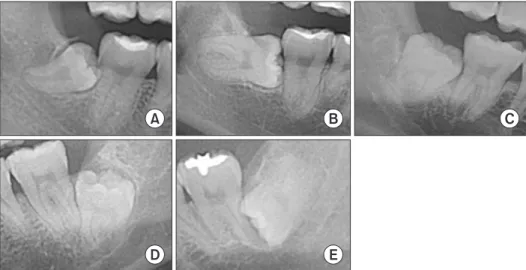
Fig. 2. Spatial relationship. Mesioangulated (A), horizontal (B), vertical (C), distoangulated (D), reverse mesioangulated (E) was defined
when the long-axis of the third molar was impacted between 11° to 79°. Horizontal and vertical were defined as cases where the angle between the adjacent second molar was 80° to 100° (almost perpendicular) and –10° to 10° (almost parallel), respectively. When the long axis was –11o to –79o, it was designated distoangulated. Reverse was defined when the crown of impacted third molar was more
root-oriented than horizontal.
Jae-Young Kim et al: Modified difficult index adding extremely difficult for fully impacted mandibular third molar extraction. J Korean Assoc Oral Maxillofac Surg 2019
A B C
sent was waived.
1. Classification of the impacted third molar based on panoramic x-ray images
One observer analyzed the panoramic x-ray images ob-tained twice at a minimum interval of one month. In the first analysis, the impacted third molar was classified by visual impression, whereas, in the second, medical software (ZeTTA PACS; Tae Young Soft, Anyang, Korea) was used for mea-surement.(Fig. 1) If there were a discrepancy between the two analyses, the measurement value from the second analy-sis was used.
Based on Winter’s classification, the spatial relationship was subcategorized as mesioangulated (Mes), horizontal (Hor), vertical (Ver), distoangulated (Dis), or reverse (Rev)6,13.
Cases where the angle between the adjacent second molar was 80o to 100o (almost perpendicular) and –10o to 10o (almost
parallel) were categorized as Hor and Ver, respectively. Cases where the inclination of the long axis of third molar was 11o
to 79o and –11o to –79o were categorized as Mes and Dis,
re-spectively. Cases where the crown of the impacted third mo-lar were more root oriented than horizontal were categorized as Rev13.(Fig. 2)
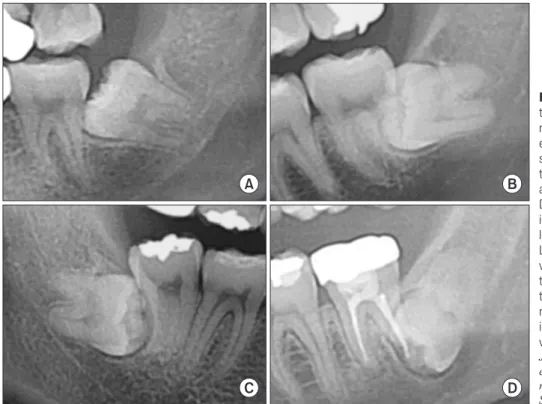
Depth was subcategorized as levels A, B, C, or D.(Fig. 3) When more than half of the crown of the impacted third
mo-lar was above the cervico-enamel junction (CEJ) of the adja-cent second molar, it was defined as level A. When less than half of the presented crown was above the CEJ, it was de-fined as level B. When the entire crown of the impacted third molar was located below the CEJ of the adjacent second mo-lar, it was defined as either level C or level D. Level C was defined as a condition when more than half of the impacted third molar crown was located superior to the mid-level of the adjacent second molar root. Third molar crown levels inferior to the aforementioned reference were categorized as level D.
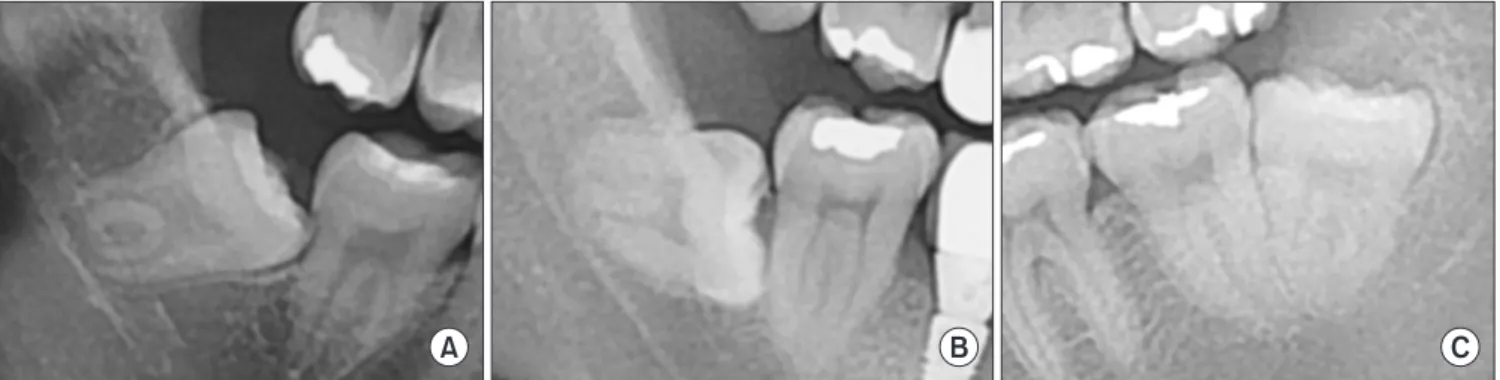
The ramus relationship/space available was subclassified into three categories based on the calculated eruption space: class I, II, or III. Eruption space was calculated as the ratio of the distance between the ascending ramus to the distal side of the second molar (a) and diameter of the impacted third mo-lar (b), as illustrated in Fig. 1. An eruption space (a/b) mo-larger than two-thirds was classified as class I, between one-third and two-thirds was class II, and smaller than one-third was class III.(Fig. 4)
2. Scoring
According to the difficulty, the spatial relationship was scored on a scale of 1 to 5 as follows: Mes (1), Hor (2), Ver (3), Dis (4), and Rev (5)8. For depth, 1 to 4 points were assigned
A B
C D
Fig. 3. Depth. A. Level A, when more
than half of the crown of impacted third molar was existing above the cervico-enamel junction (CEJ) of the adjacent second molar. B. Level B, when less than half of the presented crown was above the CEJ. Level C (C) and Level D (D), when the entire crown of the impacted third molar was located be-low CEJ of the adjacent second molar. Level C was defined as a condition when more than half of the impacted third molar crown was located superior to the mid-level of the adjacent second molar root. Third molar crown levels inferior to the aforementioned reference was categorized as level D.
Jae-Young Kim et al: Modified difficult index adding extremely difficult for fully impacted mandibular third molar extraction. J Korean Assoc Oral Maxillofac Surg 2019
from levels A to D, respectively. Similarly, 1 to 3 points were given to classes I to III, respectively. The total points were calculated by adding the scores of each category.
3. Difficulty index
The difficulty index was classified into four categories ac-cording to the total points scored8. As in the previous method,
scores up to 10 points were classified into three grades. One grade was added when the total points exceeded 10. Finally, four grades were defined as follows: category I (3-4 points, slightly difficult), category II (5-7 points, moderately dif-ficult), category III (8-10 points, very difdif-ficult), and category IV (11-12 points, extremely difficult).
4. Statistical analyses
Quadratic weighted kappa analysis was used for categorical variables, and intra-class correlation coefficient analysis was used for continuous variables to analyze the intra-observer consistency. An independent t-test was used to analyze the age differences according to the sex of the patients included in the study. An ANOVA was performed to analyze the dif-ference in age according to the difficulty index. Difdif-ference in sex and the difficulty index were analyzed using the chi-squared test. The data were analyzed using a statistical analysis program (SAS ver. 9.3 [SAS Institute, Cary, NC, USA] and IBM SPSS Statistics ver. 23.0 [IBM, Armonk, NY, USA]). A P-value less than 0.05 indicated significance.
III. Results
Among 154 patients, 67 were males and 87 were female, with a mean age of 29.91±9.10 years (range, 19-64 years). There was no significant difference in age based on the sex (male: 30.18±8.97 years, female: 29.70±9.22 years; P=0.747).
Quadratic weighted kappa values (95% confidence in-terval) were 0.775 (0.684-0.866), 0.744 (0.673-0.815), and 0.663 (0.573-0.753) for spatial relationship, depth, and ramus relationship, respectively, indicating substantial agreement. The agreement for the total points calculated twice was 0.855 (0.813-0.888), indicating very high agreement. For the as-sessed difficulty index, the quadratic weighted kappa was 0.746 (0.655-0.837), indicating substantial agreement.
Of the 204 impacted mandibular third molars, 89 were im-pacted on the left side, and 115 were imim-pacted on the right. Hor teeth were most common (n=88, 43.1%), followed by Mes (n=80, 39.2%). Rev type impaction was observed in 15 cases (7.4%).
In the depth category, level B was observed in 105 out of 204 cases (51.5%). Levels A and C were observed in 31 and 59 cases, respectively. In contrast, level D, which was not ob-served in the conventional classification by Pell and Gregory, was observed only in 9 cases (4.4%), which is a relatively smaller percentage as compared to the other categories. Re-garding the ramus relationship, 107 cases (52.5%) belonged to class II, whereas class III was the second most common (n=78, 38.2%).
When calculating the total points, a total of 6 was the most common (62 cases, 30.4%), followed by 5 points (47 cases, 23.0%) and 7 points (40 cases, 19.6%). Only a few cases (13
A B C
Fig. 4. Ramus relationship/space available. A. Class I. B. Class II. C. Class III. Eruption space was calculated as the ratio of the distance
between the ascending ramus to the distal of second molar (a) and diameter of the impacted third molar (b), which was illustrated in Fig. 1. When eruption space (a/b) was larger than two-thirds, it was classified as class I, between one-third and two-thirds, it was classified as class II, and when smaller than one-third, it was classified as class III.
out of 204, 6.4%) had a total of more than 10 points.
In terms of difficulty, category II (moderately difficult) was the most common (149 cases, 73.0%) followed by category III (very difficult; 28 cases, 13.7%), and there were 13 cases (6.4%) of category IV (extremely difficult). The mean age was the highest in category IV (40.15±7.93 years) and was subsequently lower in each successive category: category III (31.82±9.57 years), category II (28.23±7.95 years), and category I (25.64±6.30 years) with a significant difference (P<0.001). There was no significant difference between the difficulty index and sex (P=0.149).(Table 1)
IV. Discussion
It is important to recognize the difficulty and impaction pattern before an impacted mandibular third molar extraction because several investigators have reported that these could be associated with postoperative complications and subse-quent treatment plans. According to Eshghpour and Nejat1, a
difficulty score based on radiography was associated with the incidence of a dry socket. Ishii et al.2 reported that the
hori-zontal inclination angle is associated with the risk of inferior alveolar nerve injury during mandibular third molar extrac-tion. General anesthesia accompanying more complicated
procedures is required for a more deeply impacted tooth14.
Several studies on impacted third molars used the difficulty index described by Pederson7 to predict the difficulty of the
impacted third molar extraction7-9. This index was developed
based on the Pell and Gregory classification5 and the Winter’s
classification6. However, the classification categories of the
difficulty index are not always perfectly applicable in clinical situations. Therefore, the purpose of this study was to evalu-ate the validity of the classification of the impacted man-dibular third molar in clinical situations and propose a more practical classification system.
In this study, patients under 19 years old were excluded in accordance with the previous study15,16. Impacted teeth
ac-companied with pathologic conditions, such as cysts, were also excluded because the impacted third molars could mi-grate because of the pathologic lesions. According to Quek et al.13, the spatial relationship (angulation) of the impacted
third molar was still analyzed via visual impression based on Winter’s classification. In this study, we used visual impres-sion in the first analysis and conducted a follow-up measure-ment using medical software for a more objective judgmeasure-ment in the second analysis to compare the agreement of these dif-ferent methods.
Since there were three to five subcategories, we used a Table 1. Age, sex distribution, and pattern of impaction according to difficulty index
Difficulty index Total P-value Category I II III IV No. of patients (%) 14 (6.9) 149 (73.0) 28 (13.7) 13 (6.4) 204 (100) Age (yr) 25.64±6.30* 28.23±7.95* 31.82±9.57 40.15±7.93 29.31±8.64 <0.001 Sex 0.149 Male 2 65 12 7 86 Female 12 84 16 6 118 Spatial relation <0.001 Mesioangulated 14 66 0 0 80 Horizontal 0 72 16 0 88 Vertical 0 8 0 0 8 Distoangulated 0 3 10 0 13 Reverse 0 0 2 13 15 Depth <0.001 Level A 9 22 0 0 31 Level B 5 92 8 0 105 Level C 0 35 17 7 59 Level D 0 0 3 6 9 Ramus relation <0.001 Class I 7 12 0 0 19 Class II 7 93 7 0 107 Class III 0 44 21 13 78
*P<0.05 compared to Category IV.
Difficulty index: Category I, slightly difficult; Category II, moderately difficult; Category III, very difficult; Category IV, extremely difficult. Refer to Fig. 3 for the definition of depth category.
Refer to Fig. 4 for the definition of ramus relation.
quadratic weighted kappa value. For all categories, the kappa value was over 0.6, which indicated substantial agreement between visual impression and software measurement17.
Therefore, as Quek et al.13, we considered visual impression a
reliable method to determine the degree of impaction. In the current difficulty index described by Pederson7, there
are four grades for spatial relationship, three for depth, and three for the ramus relationship/space described. The level of difficulty was defined by three grades depending on the score: slightly difficult (3-4), moderately difficult (5-7), and very difficult (8-10). In our study, we added Rev and level D, which are not included in the currently used difficulty index8.
Thus, one more advanced category (category IV: extremely difficult) was added in the difficulty index.
According to the results of this study, Hor impaction was the most common angulation type, consecutively followed by Mes and Ver. Previous studies reported Mes as the most com-mon type in Iranian and Singapore Chinese populations13,16.
This difference is presumed to be due to a different study population because every mandibular third molar in our study had more than two-thirds of the crown impacted. Addition-ally, we presumed that relatively simple cases were extracted in private clinics, not in a medical facility like our hospital, which is a tertiary medical institution. In the depth category, level B was the most common type, as is consistent with the findings of previous studies13,18.
In this study, the mean age was highest in category IV and lowest in category I. It is presumed that deeply impacted third molars have a relatively lower probability of causing discom-fort or further problems, including pericoronitis; hence, pa-tients would delay a visit to the hospital for an impacted third molar. Gbotolorun et al.10 reported the importance of clinical
variables such as age, body mass index, and root curvature in predicting surgical difficulty. Therefore, considering the age of the patient, the extraction of teeth in patients in category IV could be much more difficult.
In the future, it is necessary to record the actual extraction time according to the classification category to determine the prediction value of this updated classification system.
V. Conclusion
The authors propose a four-step difficult index because the clinician should consider one more extremely difficult cat-egory beyond the existing three-step difficulty index to make a treatment plan for extracting wisdom teeth. The patient’s age should be taken into consideration while evaluating the
difficulty of extraction.
ORCID
Jae-Young Kim, https://orcid.org/0000-0002-9423-438X Hae-Sung Yong, https://orcid.org/0000-0001-8671-4175 Kwang-Ho Park, https://orcid.org/0000-0003-1942-2986 Jong-Ki Huh, https://orcid.org/0000-0002-7381-3972
Authors’ Contributions
J.Y.K. collected data and wrote a manuscript. H.S.Y. col-lected data and participated in statistical analysis. K.H.P. par-ticipated in study design and provided figures. J.K.H. partici-pated in study design and drafted the manuscript. All authors read and approved the final manuscript.
Acknowledgements
We would like to thank Hye Sun Lee (PhD, Biostatisti-cian) and Sinae Kim (MS BiostatistiBiostatisti-cian) of the Biostatistics Collaboration Unit, Yonsei University College of Medicine, Seoul, Korea for their help with the statistical analyses.
Ethics Approval and Consent to Participate
This retrospective study was approved by the Institutional Review Board of the Gangnam Severance Hospital (approval No. 3-2019-0118), and the informed consent was waived.
Conflict of Interest
No potential conflict of interest relevant to this article was reported.
References
1. Eshghpour M, Nejat AH. Dry socket following surgical removal of impacted third molar in an Iranian population: incidence and risk factors. Niger J Clin Pract 2013;16:496-500.
2. Ishii S, Abe S, Moro A, Yokomizo N, Kobayashi Y. The horizontal inclination angle is associated with the risk of inferior alveolar nerve injury during the extraction of mandibular third molars. Int J Oral Maxillofac Surg 2017;46:1626-34.
3. Lee YK, Park SS, Myoung H. Surgical extraction of mandibular third molar in pterygomandibular space: a case report. J Korean Assoc Oral Maxillofac Surg 2013;39:242-5.
4. Kupferman SB, Schwartz HC. Malposed teeth in the pterygo-mandibular space: report of 2 cases. J Oral Maxillofac Surg 2008;66:167-9.
and modified techniques for removal. Dent Digest 1933;39:330-8. 6. Winter GB. Principles of exodontia as applied to the impacted
mandibular third molar. St. Louis: American Medical Book Com-pany; 1926.
7. Pederson GW. Oral surgery. Philadelphia: WB Saunders, 1988. 8. Koerner KR. The removal of impacted third molars. Principles and
procedures. Dent Clin North Am 1994;38:255-78.
9. Yuasa H, Kawai T, Sugiura M. Classification of surgical difficulty in extracting impacted third molars. Br J Oral Maxillofac Surg 2002;40:26-31.
10. Gbotolorun OM, Arotiba GT, Ladeinde AL. Assessment of factors associated with surgical difficulty in impacted mandibular third molar extraction. J Oral Maxillofac Surg 2007;65:1977-83. 11. Sammartino G, Gasparro R, Marenzi G, Trosino O, Mariniello M,
Riccitiello F. Extraction of mandibular third molars: proposal of a new scale of difficulty. Br J Oral Maxillofac Surg 2017;55:952-7. 12. García AG, Sampedro FG, Rey JG, Vila PG, Martin MS.
Pell-Gregory classification is unreliable as a predictor of difficulty in extracting impacted lower third molars. Br J Oral Maxillofac Surg 2000;38:585-7.
13. Quek SL, Tay CK, Tay KH, Toh SL, Lim KC. Pattern of third mo-lar impaction in a Singapore Chinese population: a retrospective radiographic survey. Int J Oral Maxillofac Surg 2003;32:548-52.
14. Abu-El Naaj I, Braun R, Leiser Y, Peled M. Surgical approach to impacted mandibular third molars--operative classification. J Oral Maxillofac Surg 2010;68:628-33.
15. Fielding AF, Douglass AF, Whitley RD. Reasons for early removal of impacted third molars. Clin Prev Dent 1981;3:19-23.
16. Eshghpour M, Nezadi A, Moradi A, Shamsabadi RM, Rezaei NM, Nejat A. Pattern of mandibular third molar impaction: a cross-sec-tional study in northeast of Iran. Niger J Clin Pract 2014;17:673-7. 17. Landis JR, Koch GG. The measurement of observer agreement for
categorical data. Biometrics 1977;33:159-74.
18. Padhye MN, Dabir AV, Girotra CS, Pandhi VH. Pattern of mandib-ular third molar impaction in the Indian population: a retrospective clinico-radiographic survey. Oral Surg Oral Med Oral Pathol Oral Radiol 2013;116:e161-6.
How to cite this article: Kim JY, Yong HS, Park KH, Huh JK.
Modified difficult index adding extremely difficult for fully im-pacted mandibular third molar extraction. J Korean Assoc Oral Maxillofac Surg 2019;45:309-315. https://doi.org/10.5125/jka-oms.2019.45.6.309