https://doi.org/10.1140/epjc/s10052-018-5970-2 Regular Article - Experimental Physics
Background model for the NaI(Tl) crystals in COSINE-100
P. Adhikari1, G. Adhikari1, E. Barbosa de Souza2, N. Carlin3, S. Choi4, W. Q. Choi5, M. Djamal6, A. C. Ezeribe7, C. Ha8, I. S. Hahn9, A. J. F. Hubbard2, E. J. Jeon8,a, J. H. Jo2, H. W. Joo4, W. G. Kang8, M. Kauer11, W. S. Kang10, B. H. Kim8, H. Kim8, H. J. Kim12, K. W. Kim8, M. C. Kim10, N. Y. Kim8, S. K. Kim4, Y. D. Kim8,1, Y. H. Kim8,13, V. A. Kudryavtsev7, H. S. Lee8, J. Lee8, J. Y. Lee4, M. H. Lee8, D. S. Leonard8, W. A. Lynch7, R. H. Maruyama2, F. Mouton7, S. L. Olsen8, H. K. Park15, H. S. Park13, J. S. Park8, K. S. Park8, W. Pettus2, H. Prihtiadi6, S. Ra8, C. Rott10, A. Scarff7, N. J. C. Spooner7, W. G. Thompson2, L. Yang14, S. H. Yong8
1Department of Physics and Astronomy, Sejong University, Seoul 05006, South Korea 2Wright Laboratory, Department of Physics, Yale University, New Haven, CT 06520, USA 3Physics Institute, University of São Paulo, São Paulo 05508-090, Brazil
4Department of Physics and Astronomy, Seoul National University, Seoul 08826, Republic of Korea 5Korea Institue of Science and Technology Information, Daejeon 34141, Republic of Korea 6Department of Physics, Bandung Institute of Technology, Bandung 40132, Indonesia 7Department of Physics and Astronomy, University of Sheffield, Sheffield S3 7RH, UK
8Center for Underground Physics, Institute for Basic Science (IBS), Daejeon 34126, Republic of Korea 9Department of Science Education, Ewha Womans University, Seoul 03760, Republic of Korea 10Department of Physics, Sungkyunkwan University, Seoul 16419, Republic of Korea
11Department of Physics and Wisconsin IceCube Particle Astrophysics Center, University of Wisconsin-Madison, Madison, WI 53706, USA 12Department of Physics, Kyungpook National University, Daegu 41566, Republic of Korea
13Korea Research Institute of Standards and Science, Daejeon 34113, Republic of Korea 14Department of Physics, University of Illinois at Urbana-Champaign,, Urbana IL 61801, USA 15Department of Accelerator Science, Graduate School, Korea University, Sejong 30019, South Korea
Received: 17 April 2018 / Accepted: 1 June 2018 / Published online: 12 June 2018 © The Author(s) 2018
Abstract The COSINE-100 dark matter search experi-ment is an array of NaI(Tl) crystal detectors located in the Yangyang Underground Laboratory (Y2L). To understand measured backgrounds in the NaI(Tl) crystals we have per-formed Monte Carlo simulations using the Geant4 toolkit and developed background models for each crystal that consider contributions from both internal and external sources, includ-ing cosmogenic nuclides. The background models are based on comparisons of measurement data with Monte Carlo sim-ulations that are guided by a campaign of material assays and are used to evaluate backgrounds and identify their sources. The average background level for the six crystals (70 kg total mass) that are studied is 3.5 counts/day/keV/kg in the (2–6) keV energy interval. The dominant contributors in this energy region are found to be210Pb and3H.
1 Introduction
COSINE-100 is a dark matter search experiment consisting of a 106 kg array of eight ultra-pure NaI(Tl) crystals [1,2]. ae-mail:[email protected]
Its primary goal is to test DAMA/LIBRA’s assertion of an observation of annual modulation signal [3–6]. The experi-ment has been operating at the Yangyang Underground Lab-oratory (Y2L) since September 2016 [7]. COSINE-100 is one of several NaI(Tl)-based dark matter searches in oper-ation (DM-Ice17 [8], ANAIS [9,10]) or under development (DM-Ice [11], KamLAND-PICO [12], SABRE [13], COSI-NUS [14]). Previously, the KIMS-CsI experiment put a limit on interaction rates in CsI crystals [15,16] that precluded the interpretation of the DAMA modulation signal as being due to WIMPs scattering from I or Tl nuclei, considering the dif-ferent quenching factors of iodine and thallium for NaI(Tl) and CsI(Tl).
The COSINE-100 crystal array is immersed in a tank of liquid scintillator (LS) that tags backgrounds that originate from outside the LS as well as decays of40K nuclides inside the crystals. To determine the sources of the backgrounds, we have performed Monte Carlo simulations using the Geant4 toolkit (V.4.9.6.p02) [17] and built a background model for the eight detectors by iteratively fitting their contributions to the measured energy spectra; two crystals are excluded in this paper due to their low light yields, which result in a background spectrum without characteristic peaks of
iso-topes by the worse energy resolution, and relatively higher background contamination in the low energy region.
The paper is structured as follows: the COSINE-100 experimental setup is described in Sect.2. Section3describes the background modeling, with the simulation method described in Sect.3.2, sources of the background internal and external to the crystal and of cosmogenic origin in Sects.3.2– 3.4. Section4describes the comparison and fit to the data, and Sect.5provides discussions of the background developed by the fits. Finally Sect.6provides conclusions.
2 COSINE-100 setup and simulation geometry
The experimental setup is described in detail in Ref. [7]. The simplified geometry used for the simulations is shown in Fig.1. Eight NaI(Tl) crystals, arranged in two layers, are located in the middle of a four-layer shielding structure. From outside inward, the four shielding layers are plastic scintilla-tor panels, a lead-brick castle, a copper box, and a scintillating liquid. The eight NaI(Tl) crystal assemblies and their support
table are immersed in the scintillating liquid that serves both as an active veto and a passive shield.
The eight NaI(Tl) crystals were grown out of batches of powder provided by Alpha Spectra [18] with successive improvements. The first attempts, which produced an order of magnitude reduction in40K, were AS-B and AS-C. This was followed by WIMPScint-II (AS-WSII) which reduced the 210Pb contamination, and WIMPScint-III (AS-WSIII) which resulted in another factor of two reduction of 40K. The results are summarized in Table1. The final crystals are cylindrically shaped and hermetically encased in OFE cop-per tubes with wall thickness of 1.5 mm and quartz windows (12.0 mm thick) at each end. Each crystal’s lateral surfaces were wrapped in roughly 10 layers of 250µm-thick PTFE reflective sheets. The quartz windows are optically coupled to each end of the crystal via 1.5 mm thick optical pads. These, in turn, are optically coupled to 3-inch Hamamatsu R12669SEL photomultiplier tubes (PMTs) with a thin layer of high viscosity optical gel. The PMTs are protected from the liquid scintillator by a housing made of copper and PTFE.
Fig. 1 Front (a) and Side (b) views of the detector geometry used in the Geant4 simulations. From outside inward, the four shielding layers include:
3 cm thick plastic scintillator panels (dark blue), 20 cm lead (pink), 3 cm copper box (light green), and liquid scintillator (not shown)
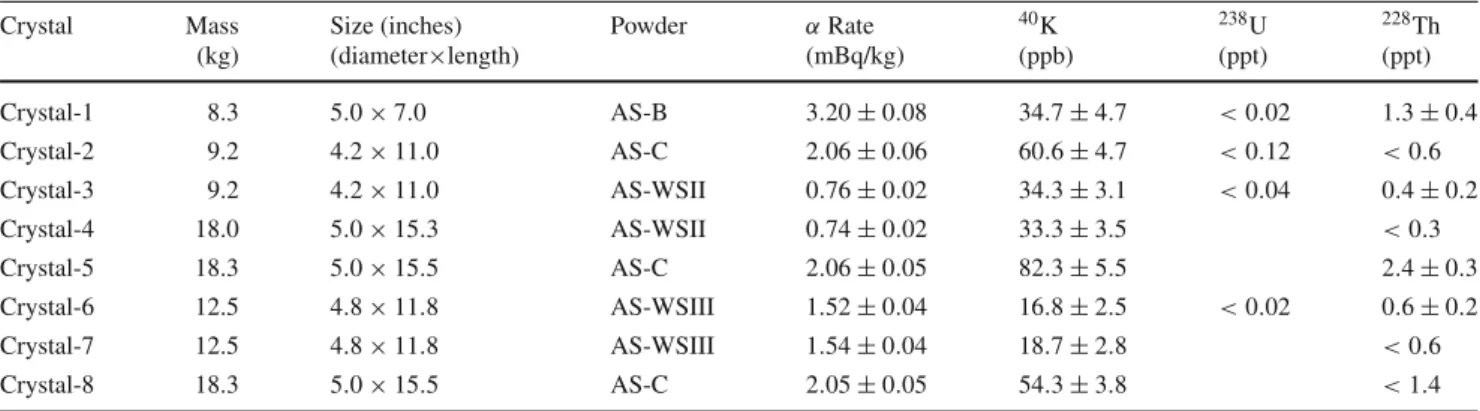
Table 1 Radioactive contamination levels in the COSINE-100 crystals reported in Ref. [7]. These were used as inputs when fitting the simulations
to the data. The238U and232Th decays were assumed to be in equilibrium
Crystal Mass Size (inches) Powder α Rate 40K 238U 228Th
(kg) (diameter×length) (mBq/kg) (ppb) (ppt) (ppt) Crystal-1 8.3 5.0 × 7.0 AS-B 3.20 ± 0.08 34.7 ± 4.7 < 0.02 1.3 ± 0.4 Crystal-2 9.2 4.2 × 11.0 AS-C 2.06 ± 0.06 60.6 ± 4.7 < 0.12 < 0.6 Crystal-3 9.2 4.2 × 11.0 AS-WSII 0.76 ± 0.02 34.3 ± 3.1 < 0.04 0.4 ± 0.2 Crystal-4 18.0 5.0 × 15.3 AS-WSII 0.74 ± 0.02 33.3 ± 3.5 < 0.3 Crystal-5 18.3 5.0 × 15.5 AS-C 2.06 ± 0.05 82.3 ± 5.5 2.4 ± 0.3 Crystal-6 12.5 4.8 × 11.8 AS-WSIII 1.52 ± 0.04 16.8 ± 2.5 < 0.02 0.6 ± 0.2 Crystal-7 12.5 4.8 × 11.8 AS-WSIII 1.54 ± 0.04 18.7 ± 2.8 < 0.6 Crystal-8 18.3 5.0 × 15.5 AS-C 2.05 ± 0.05 54.3 ± 3.8 < 1.4
The following components of the detector have been included in the simulation: PTFE reflective sheets, copper tubes, quartz windows, optical gel, PMT housing, and PMTs.
3 Background modeling 3.1 Simulation method
The Physics list classes of G4EmLivermorePhysics for low energy electromagnetic process and G4RadioactiveDecay for radioactive decay process were used [19–21]. The238U and232Th decay chains were treated as broken at the long-lived parts of the chain. The238U chain was broken into five distinct groups and the232Th chain was broken into three groups. The details are reported in Ref. [22].
Each simulated event record includes all energy deposited in the crystals within an event window of 10µs from the time a decay is generated, to account for the conditions in the data acquisition system (DAQ) of the experimental setup [7]. Sometimes decays with relatively short half-lives, such as
212Po decay (with a half-life of 300 ns) and the subsequent
daughter decays will appear in the 10µs time window, result-ing in pileup events. They are treated as a sresult-ingle event in the simulation.
The simulated spectrum was convolved with an energy dependent energy resolution function developed during a cal-ibration run. Calcal-ibration points were measured usingγ –ray sources: 59.5 keV(241Am), 1173.2 and 1332.5 keV (60Co). Internal background peaks at 3.2 and 1460.8 keV from40K, 67.3 keV from125I, and 609.3 keV from 214Bi were used to calibrate the measured spectra; peaks at 3.2, 59.5, and 67.3 keV were used for the low energy calibration below 70 keV.
3.2 Internal backgrounds in the NaI(Tl) crystals
After the insertion of the crystals into the shield and prior to filling the liquid scintillator container, their background lev-els were measured to verify that they were free of any addi-tional contamination. Overall, the eight crystals have accept-able238U and232Th contaminations as shown in Table1[7]. Secular equilibrium in the chains is assumed for the interpre-tation of238U and232Th related radioactivity measurements, with the exception of210Pb.
In order to estimate the background contributions from
238U,232Th,40K, and210Pb, we simulated background
spec-tra from the internal radioactive contaminants and normal-ized them by their measured activities in Table 1. In the normalization we assumed a chain equilibrium and, thus, all related activities within the chains are equal to the238U,
232Th, and40K activities multiplied by the branching ratios
for decay of the daughter isotopes. We also added the
back-ground simulation of internal210Pb by considering the mea-suredα rate. The resultant background contributions, except for those from 40K and210Pb, were negligible in all eight crystals.
The 40K contribution is reduced by the LS veto detec-tor. To measure the reduction efficiency of the40K gener-ated 3.2 keV emission background provided by tagging the accompanying 1460.8 keVγ -ray in one of the other NaI(Tl) crystals or the LS, and to compare this to the efficiency pro-vided by the other crystals alone, we generated40K decays at random locations inside a NaI(Tl) crystal for the cases with and without the LS veto. From these simulations, we deter-mined that the Crystal-6 tagging efficiency by other crystals without LS is 31.7±0.1 % and by the LS only is 64.9±0.2 %. The total combined efficiency is 81.7±0.3%. The efficiency is measured in the crystal energy range between 2 and 6 keV by requiring the LS energy deposit be larger than 20 keV. Effi-ciencies vary depending on the crystal location in the detec-tor. For example, Crystal-1 (at the corner of the 4×2 array) shows higher coverage by the LS (75 %) than neighboring crystals (17 %), but the combined efficiency is similar to that of Crystal-6 (82 %). The tagging efficiency of the 1460.8 keV γ -ray in the LS-only case is lower because the range of the γ -ray in the NaI(Tl) crystal is shorter than in the LS. There-fore, moreγ -rays are stopped in the other crystals than in the LS. These estimated efficiencies are in agreement with measurements [7]. Accordingly, the40K background level is reduced by as much as 80 % by requiring single-hit crystal events with no signal in the LS.
The210Pb contribution is estimated by modeling the back-ground from bulk210Pb and surface210Pb as discussed in Sect.4.
3.3 External background sources
The externalγ background from the radioactive isotopes in the surrounding rocks is shielded by the 20 cm-thick lead cas-tle and the 3 cm-thick copper box. By using the full shielding structure with N2gas flowing into the inside of the copper
shield to avoid backgrounds from 222Rn in the air at Y2L
(measured to be 1.20 ± 0.49 pCi/L [23]), we reduced the environmental background by a factor of 10,000 based on the measurements of a high-purity Ge (HPGe) detector, thus ensuring that those contributions are negligibly small.
Despite all the efforts to block backgrounds due to external sources, some backgrounds from radioactive contaminations in detector components inside the shielding are still expected, including from the PMTs, grease, copper case, bolts, cables, acrylic supports, liquid scintillator, copper box, and steel that supports the lead block housing. We simulated background spectra from those external sources to test their effects and compared the shapes of contributions to the crystals’ energy spectra. We found that all the spectra from these external
Table 2 Radioactivity levels in detector components inside the
shield-ing. (a) The radioactivities were measured with a HPGe detector at Y2L; upper limits are quoted with 90% C.L. The PMTs are measured in units of mBq/PMT and the other external sources are measured in units of mBq/kg (b) SEL means “selected for high quantum efficiency” External source Radioactivitya
U (214Bi) Th (228Ac) (40K) PMT [1] 25± 5 12± 5 58± 5 (R12669SELb) Quartz window < 1.8 < 7.5 < 20 PTFE reflector < 0.5 < 1.0 < 6.4 Cable ties < 4.2 < 3.5 149± 32 LS < 2.7 < 3.3 7± 4
sources are similar in shape and, thus, could be represented by a spectrum that is obtained by simulating238U,232Th, and
40K, distributed randomly in the volume outside the eight
crystals. Because the PMTs are the main contributer to the external background we used two kinds of spectra for the external background modeling; one is the spectrum from the PMTs and another is the spectrum from the other external sources that is treated as a parameter floating in the fit. The radioactivity levels of the PMTs and PMT surrounding parts were measured underground with a HPGe detector and the results are listed in Table2. We used the measured activi-ties from the PMTs to constrain the data fitting and treated background contributions from the PMTs in nine groups as broken at the long-lived parts of the chain.
3.4 Treatment of cosmogenic radionuclides
Although the eight NaI(Tl) crystals had underground radioac-tivity cooling times that ranged from several months to three years, there are still background contributions due to the long-lived cosmogenic isotopes that were activated by cosmic rays while they were on the surface.
To consider these backgrounds, we first checked the list of cosmogenic radioactive isotopes that are produced in NaI(Tl), as reported in Refs. [24–27]. In Table3a, we list the contributing cosmogenic isotopes with their half lives; short-lived isotopes, for which half lives are less than a year, are
125I,121Te, 121mTe,123mTe,125mTe,127mTe, and113Sn and
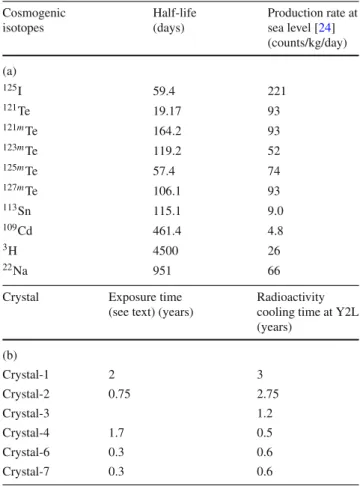
long-lived isotopes are109Cd, 3H, and 22Na. The radioac-tivity cooling time at Y2L for each crystal at the time data-taking for COSINE-100 started, is listed in Table3b. The short-lived isotopes are not expected to contribute to either Crystal-1 or Crystal-2 because their cooling times are long enough to reduce these activities to a negligible level.
However, we expect some backgrounds from the short-lived isotopes in other crystals because their production rates at sea level, as listed in Table3a, are high and their cooling
Table 3 Cosmogenic radionuclides in NaI(Tl) crystal (a) and exposure
time and radioactivity cooling time at Y2L (b) Cosmogenic isotopes Half-life (days) Production rate at sea level [24] (counts/kg/day) (a) 125I 59.4 221 121Te 19.17 93 121mTe 164.2 93 123mTe 119.2 52 125mTe 57.4 74 127mTe 106.1 93 113Sn 115.1 9.0 109Cd 461.4 4.8 3H 4500 26 22Na 951 66
Crystal Exposure time (see text) (years)
Radioactivity cooling time at Y2L (years) (b) Crystal-1 2 3 Crystal-2 0.75 2.75 Crystal-3 1.2 Crystal-4 1.7 0.5 Crystal-6 0.3 0.6 Crystal-7 0.3 0.6
times are less than or equal to a year. In addition, there are long-lived109Cd,3H, and22Na nuclides that are potentially hazardous background sources; e.g., the beta-decay spectrum of tritium has an endpoint energy of 18 keV. We thus need to understand their background contributions in the low energy region, especially in the (2–6) keV WIMP signal region of interest (ROI). Because it is impossible to compute the initial activities of those isotopes from the production rates in each crystal at Y2L without knowing the cosmic ray exposure conditions: time, location, altitude, etc. [24], we investigated the correlation of characteristic peaks produced byγ /X-rays from the decay of cosmogenic isotopes.
• 109Cd decays by electron capture to the isomeric state
of109Ag depositing in the crystal the binding energy of the Ag K-shell electrons (25.5 keV), that will be accom-panied by the 88 keV γ ray from the isomer transi-tion of109Ag having a mean time of 57.4 s. By using the timing information of two adjacent events that have each 25.5 keV and 88 keV, we measured the background contribution of109Cd in Crystal-4 and found it to be 0.10±0.01 mBq/kg.
• 22Na decays via positron emission (90%) and electron
capture (10%), followed by 1274.6 keVγ -ray emission with a mean lifetime of 3.8 yr. The electron capture decay produces 0.9 keV emissions. Therefore, ∼10% of the
22Na decay will produce 0.9 keV X-rays and 1274.6 keV
γ rays simultaneously. Meanwhile, the positron will be converted to two 511 keV annihilationγ rays.
However, it is generally difficult to measure long-lived cosmogenics’ activities, such as those for3H, directly from the data due to their long half-lives. Therefore, we simulated background spectra from cosmogenic isotopes listed in Table 3a and used their shapes in the data fitting, while floating their unknown fractions. The details of their treatment in the background model for each NaI(Tl) crystal are discussed in Sect.4.
4 Comparison with measured data
To model the COSINE-100 detector backgrounds, we used data collected between Oct 21 and Dec 19 2016. We applied low energy noise cuts as described in Ref. [7].
The LS veto threshold was set at 20 keV for both single crystal and multiple crystal events. Events in coincidence with an LS signal (>20 keV in LS) and/or more than 4 photo electrons in other crystals are defined as multiple events.
Crystals 1 and 2 have no short-lived cosmogenic contam-inants and were used for comparisons. Since Crystal-3 and Crystal-4 have different production times and delivery times at the Y2L, their expected short-lived cosmogenic activities are quite different. But they are made of the same NaI pow-der and expected to have similar internal activities. Crystal-6 and Crystal-7 are twin crystals made up of the same NaI powder and at the same time. They are installed between Crystal-5 and 8 and expected to have similar external back-ground. Both crystals are expected to have the same amount of internal, external and cosmogenic activities. We compare the activities of these crystal subdivisions.
We use a log likelihood method to fit the data. The fitting range is 6 keV–2MeV and we perform four simultaneous fits: single-hit low-energy, single-hit high-energy, multiple-hit low-energy and multiple-multiple-hit high-energy. Because differ-ent FADC systems are used for low- and high-energy data the resolutions are different. Low-energy means below 70 keV and high-energy means above 70 keV. The internal238U,
232Th, and40K levels are constrained to be within 20% of
their measured values. We use a 10µm thickness to distin-guish between surface and bulk210Pb components to study surface contamination in the crystals that is generated uni-formly within the thickness; their levels are allowed to float. The238U,232Th, and40K levels in the PMTs are constrained to be within 50% of their measurements, taking into account
contributions from PMT surrounding parts. Cosmogenic and the external238U,232Th,40K, and 60Co levels from other parts of the detector are free floated.
4.1 Background model for crystals 1 and 2
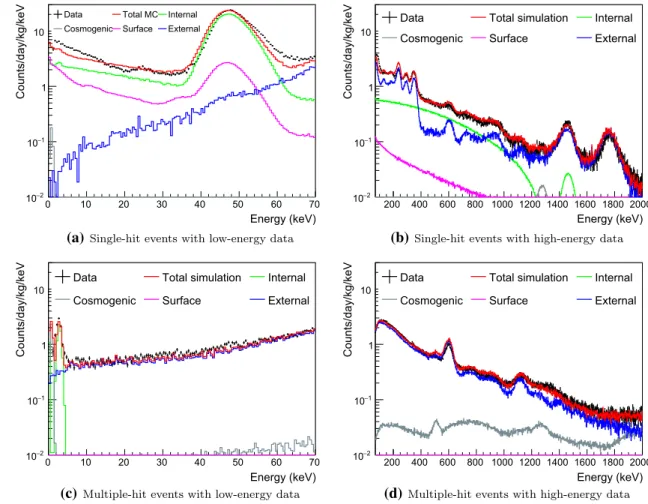
The surface exposure time of 1 is longer than Crystal-2 by more than a year and it is expected to have more long-lived cosmogenic isotopes such as3H and109 Cd. In addi-tion, it was delivered by air while Crystal-2 was shipped by sea. At first we did not consider long-lived cosmogenic isotopes in the data fitting for Crystal-1 and the resulting four-channel fits are shown in Fig. 2. The overall energy spectrum is well matched to the data for both single-hit and multiple-hit events, except for the single-hit low-energy events. The agreement between the measured and fitted multiple-hit background spectra of Crystal-2, 3, 4, 6, and 7 is as good as shown for Crystal-1.
The peak around 46 keV is due to210Pb in the crystals. However only a small part, 4.3%, is due to the 46.5 keV gamma-ray line; most of the events in the peak are from the conversion electrons, Auger electrons, and X-rays, followed by beta electrons from the decay to210Bi. As a result, the peak is non-Gaussian. It is not well reproduced by the simu-lations using the Geant4 version 4.9.6.p02 and, thus, we will consider a higher version number for further modeling.
We found that it was not possible to model the Crystal-1 and 2 background spectra for energies below 30 keV with only bulk and surface210Pb contaminations (see Fig.2a). To get adequate fits to both crystals, we had to include significant contributions from3H and109Cd, as shown in Fig.3a, b. They are also included in the models for the other crystals.
Internal210Pb contamination levels independently deter-mined from the alpha activities in the crystals are listed in Table1. To study surface contamination in the crystals both bulk and surface210Pb components are free floated in the fit. The 40K contamination levels in the crystals are iden-tified by coincident signals between a 3.2 keV emission in one NaI(Tl) detector and a 1460.8 keV gamma-ray in one of the other NaI(Tl) crystals or an energy deposition in the LS. Background from the readout PMTs and surrounding material is considered as external components.
4.2 Background model for crystals 3 and 4
Although Crystal-3 and 4 were both grown with WIMP-Scint-II grade powder by Alpha Spectra in July 2014, they were delivered to the Y2L at different times. Crystal-3 has a complicated exposure history and was repaired once before arriving at Y2L in July 2015 and has remained underground ever since. On the other hand, Crystal-4 was delivered at the Y2L in March 2016 after being exposed to surface-level cosmic rays for about 2 years and was installed for
COSINE-Energy (keV) 0 10 20 30 40 50 60 70 Counts/day/kg/keV 2 − 10 1 − 10 1 10
Data Total MC Internal Cosmogenic Surface External
Energy (keV) 200 400 600 800 1000 1200 1400 1600 1800 2000 Counts/day/kg/keV 2 − 10 1 − 10 1 10
Data Total simulation Internal
Cosmogenic Surface External
a t a d y g r e n e -h g i h h t i w s t n e v e t i h -e l g n i S (b) a t a d y g r e n e -w o l h t i w s t n e v e t i h -e l g n i S (a) Energy (keV) 0 10 20 30 40 50 60 70 Counts/day/kg/keV 2 − 10 1 − 10 1 10
Data Total simulation Internal
Cosmogenic Surface External
Energy (keV) 200 400 600 800 1000 1200 1400 1600 1800 2000 Counts/day/kg/keV 2 − 10 1 − 10 1 10
Data Total simulation Internal
Cosmogenic Surface External
(c)Multiple-hit events with low-energy data (d) Multiple-hit events with high-energy data
Fig. 2 Measured single- and multiple-hit background spectra of Crystal-1 fitted with all simulated background spectra using four channel
simul-taneous fitting.3H and109Cd are excluded in the fit
0 10 20 30 40 50 60 Counts/day/kg/keV 2 − 10 1 − 10 1 10 Energy (keV) 200 400 600 800 10001200140016001800
Data Total MC Internal
Cosmogenic Surface External
0 10 20 30 40 50 60 Counts/day/kg/keV 2 − 10 1 − 10 1 10 Energy (keV) 200 400 600 800 10001200140016001800
Data Total MC Internal
Cosmogenic Surface External
2 -l a t s y r C (b) 1 -l a t s y r C (a)
Fig. 3 Measured single-hit background spectra of Crystal-1 and Crystal-2 fitted with all simulated background spectra.3H and109Cd are included
in the fit
100 after just six months of cooling. As a result, Crystal-4 is expected to have short-lived cosmogenic isotopes as well as long-lived cosmogenic isotopes.
The background spectrum of Crystal-3, shown in Fig.4a, has a peak around 10 keV that has not changed over time. To understand its origin, we studied the effect of surface210Pb from PTFE reflective sheets that wrapped each crystal’s
lat-eral surfaces in ten layers with 250µm total thickness. We simulated the background spectrum of210Pb by generating
it randomly within the layer of the PTFE sheets with vari-ous thicknesses: 0.1, 0.5, 1.0, 2.0, 3.0, 5.0µm, and also in the bulk. The simulated spectra are shown in Fig.5, where each color represents the different surface depths and the bulk reflector (black solid line). The peaks at 12 keV and 46 keV,
0 10 20 30 40 50 60 Counts/day/kg/keV 2 − 10 1 − 10 1 10 Energy (keV) 200 400 600 800 10001200140016001800
Data Total MC Internal
Cosmogenic Surface External
0 10 20 30 40 50 60 Counts/day/kg/keV 2 − 10 1 − 10 1 10 Energy (keV) 200 400 600 800 10001200140016001800
Data Total MC Internal
Cosmogenic Surface External
Crystal-4
(b)
Crystal-3
(a)
Fig. 4 Measured single-hit background spectra of Crystal-3 and Crystal-4 fitted with all simulated background spectra
Energy(keV) 0 10 20 30 40 50 60 Counts/day/kg/keV 0.5 1 1.5 2 2.5 m µ 0.1 0.5µm 1.0µm m µ 2.0 5.0µm 10.0µm Bulk
Fig. 5 Comparison of background spectra of210Pb simulated for
var-ious surface thicknesses of PTFE reflector. The activity of 1 mBq/kg is used to normalize the simulation results
which are prominent for the bulk reflector, are due to the X-rays and 46.5 keVγ -ray from the decays of210Pb,
respec-tively. Conversion electrons contribute peaks around 30 keV and 43 keV and beta electrons contribute a continuum at peaks at low energy. Since the conversion electrons’ energy losses depend on the thickness of PTFE that they penetrate, these peaks move to lower energies as the depth increases. In the simulation we used the spectrum of210Pb from the bulk
reflector to model the 12 keV peak because the surfaces can be treated as a bulk with∼ 10 layers of PTFE sheets.
The Crystal-4 spectrum, shown in Fig.4b, has three cor-related peaks from the decay of109Cd:∼3 and ∼25 keV binding energies from L-shell/K-shell electron captures and
∼88 keV gamma-ray line from the isomer transition of 109Ag. We also determined its half-life by measuring the
change of∼25 keV binding energies contribution over time with a result that is in a good agreement with the 462 day expectation. The activity from the fit to the data, found to be 0.09±0.06 mBq/kg, is consistent with the measurement.
4.3 Background model for crystals 6 and 7
Crystal-6 and 7 are twin crystals made from WIMPScint-III grade powder by Alpha Spectra at the same time. They were installed 7 months after their delivery to Y2L, similar to Crystal-4. However their surface exposure times were shorter than those of the other crystals. Figure6shows that the fitted simulation spectra accurately reproduce the measured data. As expected, they have similar contamination levels of short-lived cosmogenic isotopes.
0 10 20 30 40 50 60 Counts/day/kg/keV 2 − 10 1 − 10 1 10 Energy (keV) 200 400 600 800 10001200140016001800
Data Total MC Internal
Cosmogenic Surface External
0 10 20 30 40 50 60 Counts/day/kg/keV 2 − 10 1 − 10 1 10 Energy (keV) 200 400 600 800 10001200140016001800
Data Total MC Internal
Cosmogenic Surface External
Crystal-7
(b)
Crystal-6
(a)
Activity (mBq/kg) 0 0.5 1 1.5 2 2.5 3 Fitted Measured
Crystal-1 Crystal-2 Crystal-3 Crystal-4 Crystal-6 Crystal-7
Activity (mBq/kg) 0 0.5 1 1.5 2 2.5 3 3.5 4 4.5 5 Fitted Measured
Crystal-1 Crystal-2 Crystal-3 Crystal-4 Crystal-6 Crystal-7
(a)Internal40K (b)Bulk210Pb
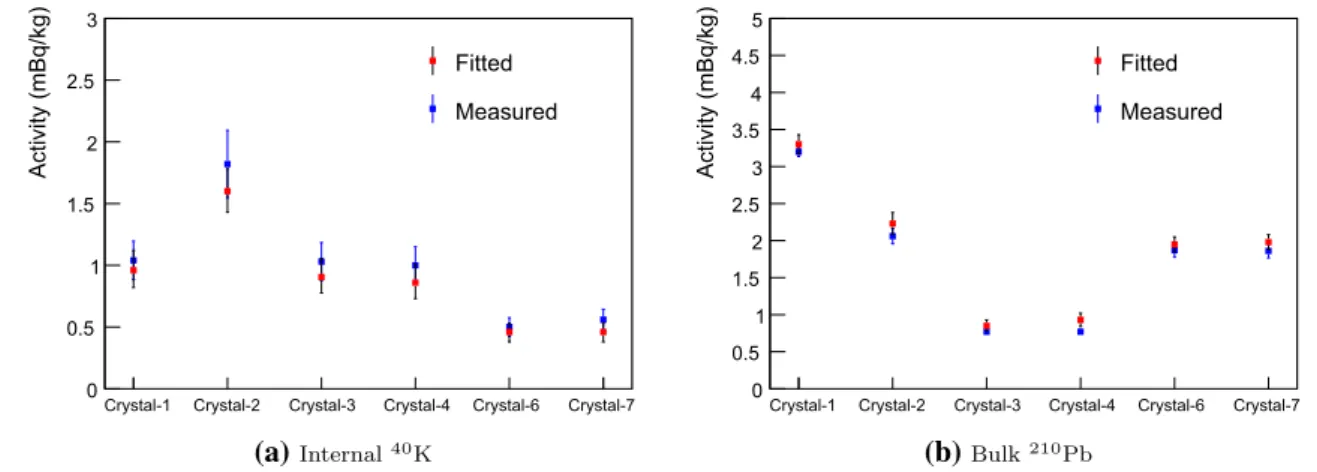
Fig. 7 Comparison of the measured and the fitted activity levels in six NaI(Tl) crystals
5 Discussion of fitted background spectra
We have simulated background spectra from radioactive sources: full decay chains of238U,232Th, and40K from the crystals, 16 PMTs, and the other external sources; bulk and surface210Pb from the crystals; surface210Pb from PTFE reflector;125I,121Te,121mTe,123mTe,125mTe,127mTe,113Sn,
109Cd,22Na, and3H for cosmogenic isotopes, and have
fit-ted them to the data to estimate their unknown contamination levels.
In Fig.7we compare the fitted activities of internal40K and210Pb to their measured levels for the six crystals, where there is agreement at the∼20% level. The fitted activities of cosmogenic isotopes:3H,109Cd,22Na, and125I, surface
210Pb, and PTFE 210Pb for the six crystals are shown in
Fig.8. As explained in Sect.4, Crystal-1 and 4 have two-year-long exposure times and, thus, relatively high3H levels (see Fig.8a). The largest contribution of109Cd is in Crystal-4
(Fig.8b) and the fitted activity is in a good agreement with the measured value. The fitted activities of125I in Crystal-4, 6, and 7 are similar to each other and higher than other crystals due to their relatively short cooling times underground, as shown in Fig.8c. There are more contributions from surface
210Pb in Crystal-1, 2, and 3, and small contributions from
PTFE210Pb in Crystal-1 and 2. Crystal-3 has large contri-butions from the surface210Pb for both the crystal itself and the PTFE reflector, albeit with large errors.
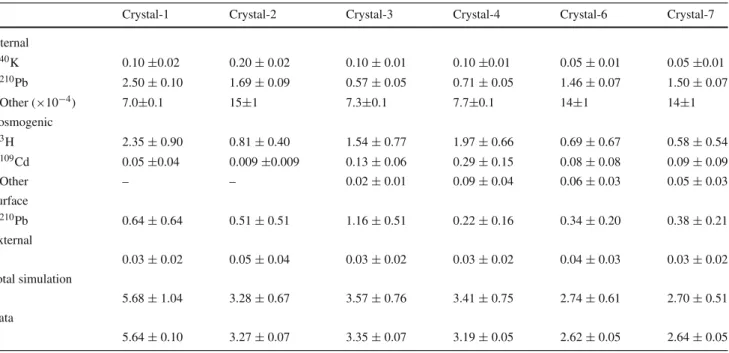
Based on the background model for the six NaI(Tl) detec-tors we determine the background levels in units of dru (counts/day/keV/kg) in the 2–6 keV energy interval and list them in Table4. The dominant background contributions are from210Pb and3H; representative background spectra of Crystal-7 in the 2-6 keV energy region are shown in Fig.9. The overall simulated background spectra well describe the measured data for the six NaI(Tl) detectors.
Activity (mBq/kg) 0.1 0.2 0.3 0.4 0.5 0.6 0.7 H 3 (a) 0.05 0.1 0.15 0.2 0.25 (b)109Cd 0.2 0.4 0.6 0.8 1 1.2 1.4 1.6 1.8 Na 22 (c) 0.1 0.2 0.3 0.4 0.5 0.6 0.7 0.8 0.9 I 125 (d) 0.1 0.2 0.3 0.4 0.5 0.6 0.7 0.8 0.9 Pb 210 Crystal surface (e) 0 0.2 0.4 0.6 0.8 1 1.2 1.4 1.6 1.8 Pb 210 PTFE (f)
Crystal-1 Crystal-2 Crystal-3 Crystal-4 Crystal-6 Crystal-7
Fig. 8 Fitted activities for a3H, b109Cd, c22Na, d125I, e Crystal
sur-face210Pb, and f PTFE210Pb that correspond to the averaged activities between Oct 21 and Dec 19 2016. Activities of crystal surface210Pb and PTFE210Pb were normalized by a total mass of the crystal
Table 4 Fitted background events in units of dru (counts/day/keV/kg) in the (2–6) keV energy interval
Crystal-1 Crystal-2 Crystal-3 Crystal-4 Crystal-6 Crystal-7
Internal 40K 0.10±0.02 0.20± 0.02 0.10± 0.01 0.10±0.01 0.05± 0.01 0.05±0.01 210Pb 2.50± 0.10 1.69± 0.09 0.57± 0.05 0.71± 0.05 1.46± 0.07 1.50± 0.07 Other (×10−4) 7.0±0.1 15±1 7.3±0.1 7.7±0.1 14±1 14±1 Cosmogenic 3H 2.35± 0.90 0.81± 0.40 1.54± 0.77 1.97± 0.66 0.69± 0.67 0.58± 0.54 109Cd 0.05±0.04 0.009±0.009 0.13± 0.06 0.29± 0.15 0.08± 0.08 0.09± 0.09 Other – – 0.02± 0.01 0.09± 0.04 0.06± 0.03 0.05± 0.03 Surface 210Pb 0.64± 0.64 0.51± 0.51 1.16± 0.51 0.22± 0.16 0.34± 0.20 0.38± 0.21 External 0.03± 0.02 0.05± 0.04 0.03± 0.02 0.03± 0.02 0.04± 0.03 0.03± 0.02 Total simulation 5.68± 1.04 3.28± 0.67 3.57± 0.76 3.41± 0.75 2.74± 0.61 2.70± 0.51 Data 5.64± 0.10 3.27± 0.07 3.35± 0.07 3.19± 0.05 2.62± 0.05 2.64± 0.05 Energy (keV) 2 4 6 8 10 12 14 16 18 20 Counts/day/kg/keV 0 0.5 1 1.5 2 2.5 3 3.5
Data Total MC Internal Cosmogenic Surface External
Fig. 9 Comparison of data and Monte Carlo simulation of the
low-energy background spectra of Crystal-7
6 Conclusion
We have studied, using the Geant4 toolkit, the background of the NaI(Tl) crystal detectors that are being used in the COSINE-100 dark matter search experiment. The crystals have different exposure histories and underground radioac-tivity cooling times.
In the background modeling the overall energy spectrum summed over all simulations is well matched to the data not only for single-hit events but also for multiple-hit events. Crystal-1 and Crystal-2 that had cooling times as long as three years at the Y2L are dominated by210Pb and3H for energies below 20 keV. The background contribution of3H in Crystal-2 is smaller than that in Crystal-1 due to its shorter surface exposure time. Crystal-6 and 7 show clear contribu-tions from125I due to their short cooling times underground,
as expected. Crystal-3 had an additional treatment for a repair that increased the background near 10 keV that is well mod-eled by surface210Pb on the PTFE wrapping foil. Crystal-4
was exposed to surface cosmic rays for two years and only had a six month-long underground cooling time. As a result, this crystal has significant background contributions from both short-lived and long-lived cosmogenic isotopes.
Background contributions from external sources and inter-nal40K are reduced to the level of 0.03 dru and about 0.1 dru in the energy range of 2–6 keV, respectively, by the LS veto detector that surrounds the crystals.
The average background rate in the (2-6) keV energy range for the six crystals (with a total mass of 70 kg) studied here is 3.5 counts/day/keV/kg. The dominant contributions in this energy range are from210Pb and3H.
Acknowledgements We thank the Korea Hydro and Nuclear Power
(KHNP) Company for providing underground laboratory space at Yangyang. This work is supported by: the Institute for Basic Science (IBS) under project code IBS-R016-A1, Republic of Korea; UIUC cam-pus research board, the Alfred P. Sloan Foundation Fellowship, NSF Grants no. PHY-1151795, PHY-1457995, 1122492 and DGE-1256259, WIPAC, the Wisconsin Alumni Research Foundation, Yale University and DOE/NNSA Grant no. DE-FC52-08NA28752, United States; STFC Grant ST/N000277/1 and ST/K001337/1, United King-dom; and CNPq and Grant no. 2017/02952-0 FAPESP, Brazil.
Open Access This article is distributed under the terms of the Creative
Commons Attribution 4.0 International License (http://creativecomm ons.org/licenses/by/4.0/), which permits unrestricted use, distribution, and reproduction in any medium, provided you give appropriate credit to the original author(s) and the source, provide a link to the Creative Commons license, and indicate if changes were made.
References
1. K.W. Kim et al. (KIMS Collaboration). Astropart. Phys. 62, 249 (2015)
2. P. Adhikari et al. (KIMS Collaboration). Eur. Phys. J. C 76, 185 (2016)
3. R. Bernabei et al., Eur. Phys. J. C 56, 333 (2008) 4. R. Bernabei et al., Eur. Phys. J. C 67, 39 (2010) 5. R. Bernabei et al., Eur. Phys. J. C 73, 2648 (2013) 6. R. Bernabei et al. (DAMA/LIBRA).arXiv:1805.10486
7. G. Adhikari et al., Eur. Phys. J. C 78, 107 (2018)
8. E. Barbosa de Souza et al. (DM-Ice Collaboration). Phys. Rev. D
95, 032006 (2017)
9. J. Amare et al., Nucl. Instrum. Meth. Phys. Res., Sect. A 742, 187 (2014)
10. J. Amare et al., Eur. Phys. J. C 76, 429 (2016)
11. J. Cherwinka et al. (DM-Ice Collaboration). Phys. Rev. D 90, 092005 (2014)
12. K. Fushimi et al., Phys. Proc. 61, 67 (2015)
13. C. Tomei et al. (SABRE Collaboration). Nucl. Instrum. Meth. A
845, 418 (2017)
14. G. Angloher et al., Eur. Phys. J. C 76, 441 (2016)
15. H.S. Lee et al. (KIMS Collaboration). Phys. Rev. Lett. 99, 091301 (2007)
16. S.C. Kim et al. (KIMS Collaboration). Phys. Rev. Lett. 108, 181301 (2012)
17. S. Agostinelli et al., Nucl. Instrum. Meth. Phys. Res., Sect. A 506, 250 (2003)
18. Alpha Spectra Inc.http://www.alphaspectra.com
19. S. Chauvie et al., Conf. Rec. IEEE Nucl. Sci. Symp., pp. 1881-1885 (2004)
20. Tullio Basaglia et al., J. Phys.: Conf. Ser. 664, 072037 (2015) 21. J. Allison et al., Nucl. Instrum. Meth. Phys. Res., Sect. A 835, 186
(2016)
22. G. Adhikari et al., Eur. Phys. J. C 77, 437 (2017) 23. M. Lee et al., J. Kor. Phys. Soc. 58(4), 713–718 (2011)
24. Walter C. Pettus, Ph.D. thesis, University of Wisconsin-Madison (2015)
25. J. Amare et al., JCAP 02, 046 (2015)
26. P. Villar et al., Int. J. Mod. Phys. A 33(9), 1843006 (2018) 27. J. Amare et al. Astropart. Phys. 97, 96 (2018)