INTRODUCTION
The Diagnostic and Statistical Manual of Mental Disorders defines insomnia as dissatisfaction with sleep quantity or quality accompanied by difficulty in initiating sleep, difficulty in maintaining sleep, or early-morning awakening with an inability to return to sleep despite adequate opportunity for sleep. If these sleep disturbances cause clinically significant distress in important areas of functioning and occur at least three nights per week for at least three months, a diagnosis of insomnia is warranted.1 Insomnia is receiving increasing
at-tention because of its impact on quality of life, relationship to other medical conditions,2,3 and psychiatric disorders,4,5 and
OPEN ACCESS
association with increased mortality rates among patients with congestive heart failure, coronary diseases, and metabolic diseases.6 Insomnia is quite common, affecting 8–17% of the
general population,7,8 and its prevalence increases with age,
lower socioeconomic status, and concurrent medical and psy-chiatric comorbidity.9 However, only 5% of individuals with
chronic insomnia seek help for their sleep problems from a health care provider.10
Guidelines recommend cognitive behavioral therapy for in-somnia (CBT-i) as a first-line treatment for inin-somnia.11,12
De-spite these guidelines, doctors still routinely prescribe hyp-notics for insomnia.13 Although hypnotics effectively reduce
the symptoms of insomnia, they cause many side effects in-cluding increased risk of falls resulting in fracture, cognitive impairment, impaired motor coordination, sedation, confu-sion, motor vehicle accidents, and dependence.14,15 In
con-trast, CBT-i treats insomnia by modifying thought patterns and behaviors that reinforce poor sleep, with minimal side ef-fects and no potential for dependency. Previous studies show that CBT-i improves sleep efficiency, increases total sleep time, and reduces wake time after sleep onset in patients with
in-Cognitive Behavioral Therapy for Insomnia Reduces
Hypnotic Prescriptions
Kyung Mee Park1, Tae Ho Kim1, Woo Jung Kim2, Suk Kyoon An1, Kee Namkoong1, and Eun Lee1 1Institute of Behavioral Science in Medicine and Department of Psychiatry, Yonsei University College of Medicine, Seoul, Republic of Korea 2Department of Psychiatry, Seonam University College of Medicine, Myongji Hospital, Goyang, Republic of Korea
Objective This study determined whether cognitive behavioral therapy for insomnia (CBT-i) decreased the need for sleep medications and produced better treatment outcomes than pharmacotherapy alone.
Methods We reviewed data from patients with insomnia in the outpatient clinic of a general hospital between 2009 and 2015. We com-pared 41 patients who received five sessions of CBT-i with 100 age- and sex-matched patients who received pharmacotherapy only. We evaluated the change in prescription for sleep (i.e., antidepressants, hypnotics, and others) between the first and last visits using repeated measures analysis of variance (ANOVA). Clinical global impressions and completion status at the last visit were assessed using the chi-square test.
Results We found a significant decrease in the prescription rate and the dosage of hypnotics among patients who received CBT-i when compared with control patients. There was no significant change in the dosage of antidepressants between the two groups. Achievement of case closure was better in the CBT-i group at the trend level. Clinical global impression at the last visit was not significantly different.
Conclusion These results show that CBT-i reduces the need for hypnotics among insomnia patients. Our results indicate that CBT-i offers additional benefits beyond improving sleep characteristics and thus provides another reason for recommending CBT-i as a first-line
treatment for insomnia. Psychiatry Investig 2018;15(5):499-504
Key Wordsaa Insomnia, Hypnotics, Cognitive behavioral therapy, Cognitive behavioral therapy for insomnia, Sleep.
Received: August 1, 2017 Revised: October 10, 2017 Accepted: November 20, 2017
Correspondence: Eun Lee, MD, PhD
Department of Psychiatry, Yonsei University College of Medicine, 50-1 Yonsei-ro, Seodaemun-gu, Seoul 03722, Republic of Korea
Tel: +82-2-2228-1620, Fax: +82-2-313-0891, E-mail: [email protected]
cc This is an Open Access article distributed under the terms of the Creative Commons Attribution Non-Commercial License (http://creativecommons.org/licenses/by-nc/4.0) which permits unrestricted non-commercial use, distribution, and reproduc-tion in any medium, provided the original work is properly cited.
somnia.16-18 CBT-i exerts similar short-term therapeutic effects,
but better long-term therapeutic effects on insomnia symp-toms than hypnotics.19 However, there are some barriers to
administering CBT-i to insomnia patients. Changing thought patterns and behaviors takes more effort than taking medica-tion, and patience is required to see treatment effects. Further-more, patients may not want to visit the clinic every week to receive CBT-i. For these reasons, patients and clinicians are reluctant to use CBT-i despite knowledge of its benefits, and insomnia patients often receive pharmacotherapy in addition to CBT-i.
This study determined whether insomnia patients who re-ceived CBT-i had 1) a reduced need for sleep medications and 2) better treatment outcomes during long-term follow-up than control patients who received pharmacotherapy only. Using a retrospective study design, we reviewed outpatient clinic data from a psychiatry department in a general hospi-tal setting and compared prescribed medication dosages and treatment outcomes between CBT-i and control groups.
METHODs
Participants
We reviewed electronic medical records of patients diag-nosed with and initiating treatment for insomnia (G47.0) or primary insomnia (F51.0) in the Severance Hospital outpatient clinic from January 2009 to December 2014. We found 41 pa-tients who completed five sessions of CBT-i as confirmed by doctors’ orders and payment statements. For comparison, we selected 100 outpatients with the same diagnoses who did not receive CBT-i during the same period matched for age, sex, and medical comorbidity. We excluded those cases diag-nosed with major psychiatric disorders including schizophre-nia spectrum and other psychotic disorders, bipolar I disor-der, major depressive disordisor-der, persistent depressive disordisor-der, substance use disorder, or sleep apnea as a principal diagno-sis in order to focus on insomnia treatment. Because of the small sample size, we did not exclude any psychiatric diagno-sis for the CBT-i group. As a result, we included 141 patients. We followed up using their medical records through Decem-ber 2015 for the evaluation of successful treatment. The In-stitutional Review Board of Severance Hospital approved this study (4-2015-1027).
Procedures
Our CBT-i program was based on Edinger’s CBT-i proto-col.20 The program was implemented as five weekly
90-min-ute therapy sessions discussing an introduction to the method, stimulus control, sleep restriction, sleep hygiene, and cogni-tive therapy and trouble-shooting. We provided the treatment
program to groups of 2–4 persons served by two mental health professionals (one psychiatrist and one nurse). As the CBT-i program is not an exclusive treatment arm in our hospital, pa-tients could also receive pharmacotherapy. In this data, CBT-i was performed between January 2009 and December 2014.
Measurement
We reviewed the electronic medical records to obtain infor-mation about patients’ sex, age, comorbid medical and psychi-atric conditions, prescribed medications for sleep, total num-ber of clinic visits, first and last visit dates, total duration of follow-up, clinical global impression (CGI), and status of case closure at the last visit as indicated by doctors’ comments. Because most patients undergoing CBT-i also were prescribed medications for sleep, we evaluated the additive effect of CBT-i to theCBT-ir treatment regCBT-imen. As the benefCBT-its of CBT-CBT-i are evCBT-i- evi-dent after 12 months of treatment,19,21 we investigated 1)
changes in the need for sleep medications between the first and last visits and 2) treatment outcome at the last visit.
To evaluate changes in the need for sleep medications, we reviewed data on all prescribed medications for sleep at the first and last clinic visits. We sorted prescribed medications into three categories: hypnotics, antidepressants, and other medications. In the case of hypnotics, we separated them into two categories based on elimination half-lives: short-acting (<24 hours) and long-short-acting (≥24 hours) hypnotics.22
We investigated the prescription rate and the dosage of sleep medication at the first and the last visit. We also examined the prescription rate and dosage of mirtazapine and trazodone specifically because of their frequent off-label use for insom-nia.23 To evaluate the prescribed dosages, we converted the
antidepressant dosage to dose equivalent of fluoxetine24,25
and the hypnotic dosage to dose equivalent of lorazepam.26
To evaluate treatment outcome, we assessed doctors’ com-ments at the last visit and categorized CGI as follows: improve-ment, no change, or decline. We also assessed the status of case closures, which were defined as meeting two conditions: 1) doctor’s comment that specified case closure on the last outpatient clinic visit and 2) absence of next visit appointment. If there was no comment about case closure, we defined it as “lost to follow-up.” If a next visit appointment was present af-ter 12/31/2015, the case was defined as “treatment mainte-nance.”
statistical analysis
We performed Chi-square statistical analysis to compare prescription rates from the first to the last visits and between the CBT-i and the control group. We also conducted repeated measures analysis of variance (ANOVA) to examine the change in prescribed dosage of hypnotics and antidepressants from
the first to last visits between the two groups. We did not an-alyze the converted dosage of other medications because of their relatively low occurrence (<5%). We excluded “as need-ed” prescriptions, because it was difficult to know exact use of these medications. Comparison of CGI and status of case closure between the two groups were performed using chi-squared analysis. Independent sample t-tests and chi-chi-squared tests were used to compare continuous and categorical vari-ables between CBT-i and control patients, respectively. Data analyses were conducted using SPSS for Windows version 20 (IBM Corp., Armonk, NY, USA), and statistical significance was set at p<0.05.
REsUlTs
Demographic and clinical characteristics
Patients ranged in age from 20 to 84 years. Within the CBT-i group, psychCBT-iatrCBT-ic comorbCBT-idCBT-itCBT-ies were generalCBT-ized anxCBT-iety disorder (n=1), major depressive disorder (n=2), bipolar II disorder (n=1), acute stress disorder (n=1), and panic disorder (n=2). Within the control group, psychiatric comorbidities were: generalized anxiety disorder (n=1), panic disorder (n=7), somatic symptom disorder (n=3), and social phobia (n=1). We found no significant difference in the frequency of psy-chiatric comorbidities between groups (Table 1). Among the
control patients, five started their psychiatric treatment dur-ing admission. None required re-hospitalization for psychiat-ric comorbidity during the observation period. Their diagnoses were as follows: two adjustment disorders, two depressive disorders, and one anxiety disorder. None were admitted for psychiatric comorbidity in the CBT-i group.
As our institution is a general hospital, approximately one-third of CBT-i and control patients had medical comorbidi-ties, including hypertension, diabetes mellitus, thyroid dis-ease, cardiovascular disdis-ease, migraine, herniated cervical discs, and cancer. No patients had uncontrolled medical illness, and there was no significant difference in the frequency of medical comorbidities between groups (Table 1). There were four patients with cancer in the CBT-i group (breast cancer, n=2; thyroid cancer, n=1; acute myeloblastic leukemia, n=1) and ten patients with cancer in the control group (advanced gastric cancer, n=2; breast cancer, n=6; thyroid cancer, n=1; sig-moid colon cancer, n=1). All patients with cancer were in a sta-ble disease state and were not admitted during the study pe-riod, except for scheduled chemotherapy (CBT-i group, n=1; control group, n=1).
Need for sleep medication
We compared the differences in the prescription rate be-tween the two groups at their first and the last visit (Table 2).
Table 1. Demographic and clinical characteristics of patients
CBT-i (N=41) Control (N=100) p
Mean age, years (SD) 51.80 (14.62) 52.12 (14.04) 0.90
Sex, male/female 10/31 26/74 0.84
Patients with psychiatric comorbidities, N (%) 7 (17) 13 (13) 0.33
Patients with medical comorbidities, N (%) 13* (31) 34† (34) 0.80
Patients with cancer, N (%) 4‡ (10) 10§ (10) 0.97
Mean duration of total follow-up, days (SD) 541.85 (694.95) 610.09 (643.33) 0.58
*hypertension (N=3), diabetes mellitus (N=2), chronic heart failure (N=1), destroyed lung due to old pulmonary tuberculosis (N=1), cancer
(N=4), †hypertension (N=8), diabetes mellitus (N=3), coronary artery disease (N=3), end stage renal disease (N=2), migraine (N=2), asthma
(N=1), herniated cervical disc (N=1), osteoporosis (N=1), hyperthyroidism (N=1), aneurysm (N=1), cancer (N=10), ‡breast cancer (N=2),
thyroid cancer (N=1), acute myeloblastic leukemia (N=1), §breast cancer (N=6), advanced gastric cancer (N=2), thyroid cancer (N=1),
sig-moid colon cancer (N=1). CBT-i: cognitive behavioral therapy of insomnia, SD: standard deviation
Table 2. Prescribed medications at the first and last visit
First visit
p Last visit p
CBT-i (N=41) Control (N=100) CBT-i (N=41) Control (N=100)
Any pharmacotherapy, N (%) 35 (85) 94 (94) 0.11 22 (53) 91 (91) <0.001 Hypnotics, N (%) 33 (81) 92 (92) 0.08 23 (56) 90 (90) <0.001 Antidepressants, N (%) 20 (49) 65 (65) 0.07 12 (30) 54 (54) 0.01 Others, N (%) 2* (5) 3† (3) 0.63 0 (0) 5‡ (5) 0.32 Short-acting hypnotics, N (%) 29 (71) 83 (83) 0.10 20 (49) 74 (74) 0.004 Long-acting hypnotics, N (%) 8 (20) 29 (29) 0.25 6 (15) 39 (39) 0.005
At the first visit, no difference was found. However, at the last visit, the prescription rates of hypnotics and antidepressant in the CBT-i group were significantly lower than in the con-trols. We also examined the prescription rate and dosage of mirtazapine and trazodone, and found no differences at either the first or the last visit.
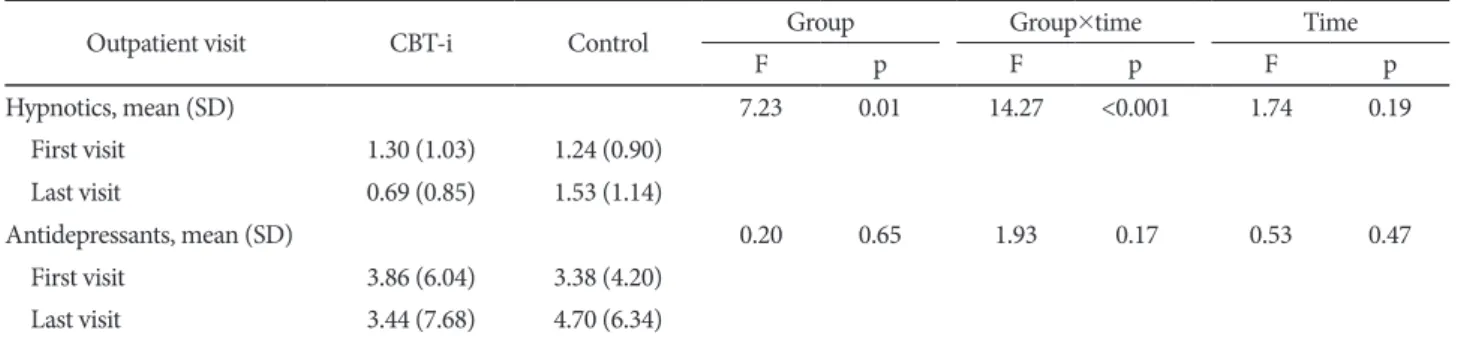
We examined changes in the dosages of prescribed sleep medications between the first and last visits using repeated measures of ANOVA. We found a significant change in group by time interaction on hypnotic dosage (Table 3). The dosage of hypnotics decreased over time in the CBT-i group; howev-er, it remained the same in the control group (Figure 1). We
found no significant change in group by time interaction on the dosage of antidepressants over time.
Treatment outcome
We performed χ2 tests for CGI and status of case closure at
the last visit for comparison of treatment outcomes. Achieve-ment of case closure was better in the CBT-i group at the trend level (Table 4). However, the number of improved cases evaluated by CGI at the last visit was not significantly differ-ent between the two groups (80.6% in the CBT-i group vs. 81% in the control group, p=0.17).
DIsCUssION
We found CBT-i reduced the need for hypnotics among pa-tients with insomnia. Previous studies show that CBT-i im-proves sleep efficiency, increases total sleep time, and reduces wake time after sleep onset.18 Thus, in contrast to most
previ-ous studies that focused on sleep characteristics, our study is unique because it examined the effect of CBT-i on the prescrip-tion of sleep medicaprescrip-tions routinely combined with CBT-i.27,28
Hypnotic use increases the risk of abuse, decreases cogni-tive function, and increases traffic accidents and falls in a dose-dependent manner.14,29 Thus, our finding that CBT-i
de-creased the prescription rate and dosage of hypnotics can help avoid those risks. Our result is consistent with that of a previ-ous study showing a decrease in sleep medication use among patients receiving internet-based CBT-i.30 Few studies have
examined the role of CBT-i in reducing the use of hypnotics. Belleville et al.31 reported outstanding benefits from CBT-i
Table 3. Comparison of dose changes in prescribed medications for sleep between the CBT-i and control groups
Outpatient visit CBT-i Control Group Group×time Time
F p F p F p Hypnotics, mean (SD) 7.23 0.01 14.27 <0.001 1.74 0.19 First visit 1.30 (1.03) 1.24 (0.90) Last visit 0.69 (0.85) 1.53 (1.14) Antidepressants, mean (SD) 0.20 0.65 1.93 0.17 0.53 0.47 First visit 3.86 (6.04) 3.38 (4.20) Last visit 3.44 (7.68) 4.70 (6.34)
The antidepressant dosage was converted to dose equivalent of fluoxetine, and the hypnotic dosage was converted to dose equivalent of loraz-epam. CBT-i: cognitive behavioral therapy of insomnia, SD: standard deviation
Figure 1. Prescription of hypnotics for insomnia. CBT: cognitive
behavioral therapy.
First visit Last visit
Eq ui va len t dos ag e o f h yp no tics: a s lo razep am (m g) 1.8 1.5 1.2 0.9 0.6 0.3 0 Insomnia CBT group Control group
Table 4. Status of treatment at the last visit
CBT-i (N=41) (N=100)Control p Case closure, N (%) 6 (15) 4 (4) 0.07 Lost to follow-up, N (%) 27 (66) 78 (78) Treatment maintenance, N (%) 8 (20) 18 (18)
on tapering hypnotics in self-help insomniacs. On the other hand, Taylor et al.32 showed no change in hypnotic use after
CBT-i among hypnotic dependent patients. We assume that the comorbid condition of hypnotic dependence made CBT-i less effectCBT-ive. Our study CBT-is not comparable wCBT-ith Taylor’s study because we excluded patients with substance abuse disorders. In another study showing no superior effect of CBT-i, total du-ration of follow-up was a relatively short 3 months.33 There
are only five cases with reduced prescription dosage by more than half in their first month after CBT-i. However, during the follow-up period after CBT-i, which was 513 days in average, twelve out of 41 patients quit hypnotics. This is a consistent finding that the effect of CBT-i is incremental rather than im-mediate.16,17
Previous studies report that CBT-i is helpful for insomnia patients with major depressive disorder and is an effective aug-mentation therapy for depression itself.34 However, we found
no significant change in antidepressant use after CBT-i, per-haps because of the low dosage of prescribed antidepressants in our study. Specifically, the prescribed antidepressant dosage was similar between groups and equivalent to a fluoxetine dose of 3.5–5 mg, which is lower than the therapeutic dosage for depressive disorder. Indeed, antidepressant dosages for primary insomnia tends to be lower than those for major de-pressive episodes.35 As only two patients in our study had
co-morbid major depressive disorder, we speculate that antide-pressants were prescribed not for the depression per se, but rather for sleep disturbances. This may explain why we ob-served no change in antidepressant dosage in either group.
Previous studies showed that medical comorbidities such as cardiovascular disease, diabetes, cancer, and some medica-tions can influence the insomnia state.36-39 Approximately 30%
of patients had medical comorbidities, which may be due to our hospital being a general hospital. We thought that these medical comorbid states may affect the results. However, we found medical comorbidity had no effect on the prescription rate and dosage of sleep medications in either group. Previous studies confirm the efficacy of CBT-i among insomnia patients with medical comorbidities.40,41 Even though some patients
had cancer, there were no unplanned admissions. Therefore, we can speculate that CBT-i reduces hypnotic prescription in patients with medical comorbidities as well as in healthy in-somniacs.
We speculate that the continued use of hypnotics after CBT-i CBT-is assocCBT-iated wCBT-ith doctors’ or patCBT-ients’ reluctance to stop medCBT-i- medi-cation because of the fear of insomnia recurrence. This fear may be due to the chronic nature of these sleep disturbances. In addition, the average follow-up duration of patients who received CBT-i was more than 500 days, which is also indica-tive of the chronic nature of their insomnia. Chronic insomnia
may be maintained by its self-perpetuating nature, involving selective attention and monitoring, distorted perceptions of daytime deficits, and counterproductive safety behaviors.42 A
previous study showed that the prognosis of insomnia pa-tients after CBT-i was better when use of hypnotics was stopped entirely, than when using these drugs as needed.17 Although
additional research is needed, our results indicate that doctors should try to stop prescribing hypnotics after CBT-i.
Our study has some limitations, mostly related to its retro-spective design. First, our study has a small sample size. Be-cause we included only patients who completed five sessions of CBT-i as confirmed by doctors’ orders and payment state-ments, only 41 patients were included in the final cohort. Sec-ond, selection bias may have been present. In the clinic, doc-tors might have recommended CBT-i to patients with milder symptoms, greater motivation, or greater financial or time re-sources. However, there were no significant differences be-tween groups in regard to clinical characteristics or medica-tion dosages at the first visit, thus minimizing the possibility of selection bias. Last, we could not completely exclude cases with psychiatric or medical comorbidities because of our study being conducted in a general hospital setting. Although we found no effect of psychiatric or medical comorbidities on the results, there are still possibilities that either comorbidi-ties or their treatments could affect the study results.
In summary, we show that CBT-i reduces the need for hyp-notics in insomnia patients. This finding is important because CBT-i can reduce the risk of accidents and complications as-sociated with hypnotic use. Our results indicate that CBT-i offers additional benefits beyond improving sleep character-istics, and thus provides further reasons to recommend CBT-i as a fCBT-irst-lCBT-ine treatment for CBT-insomnCBT-ia.
Acknowledgments
This work was supported by the National Research Foundation of Korea Grant funded by the Korean Government (NRF-2017S1A3A2067165) and a grant of the Korean Mental Health Technology R&D Project, Ministry of Health & Welfare, Republic of Korea (HM15C0995).
REFERENCES
1. American Psychiatric Association. Diagnostic and Statistical Manual of Mental Disorders (DSM-V). Arlington, VA: American Psychiatric Association Publishing; 2013.
2. Cho HJ, Seeman TE, Kiefe CI, Lauderdale DS, Irwin MR. Sleep distur-bance and longitudinal risk of inflammation: moderating influences of social integration and social isolation in the Coronary Artery Risk De-velopment in Young Adults (CARDIA) study. Brain Behav Immun 2015; 46:319-326.
3. Kim TH, Carroll JE, An SK, Seeman TE, Namkoong K, Lee E. Associ-ations between actigraphy-assessed sleep, inflammatory markers, and insulin resistance in the Midlife Development in the United States (MIDUS) study. Sleep Med 2016;27-28:72-79.
4. Lee E, Cho HJ, Olmstead R, Levin MJ, Oxman MN, Irwin MR. Persis-tent sleep disturbance: a risk factor for recurrent depression in
com-munity-dwelling older adults. Sleep 2013;36:1685-1691.
5. Kallestad H, Hansen B, Langsrud K, Ruud T, Morken G, Stiles TC, et al. Impact of sleep disturbance on patients in treatment for mental dis-orders. BMC Psychiatry 2012;12:179.
6. Tobaldini E, Costantino G, Solbiati M, Cogliati C, Kara T, Nobili L, et al. Sleep, sleep deprivation, autonomic nervous system and cardiovas-cular diseases. Neurosci Biobehav Rev 2017;74:321-329.
7. Morin CM, LeBlanc M, Belanger L, Ivers H, Merette C, Savard J. Prev-alence of insomnia and its treatment in Canada. Can J Psychiatry 2011; 56:540-548.
8. Roth T, Coulouvrat C, Hajak G, Lakoma MD, Sampson NA, Shahly V, et al. Prevalence and perceived health associated with insomnia based on DSM-IV-TR; International Statistical Classification of Diseases and Related Health Problems, Tenth Revision; and Research Diagnostic Criteria/International Classification of Sleep Disorders, Second Edi-tion criteria: results from the America Insomnia Survey. Biol Psychia-try 2011;69:592-600.
9. Ohayon MM. Epidemiology of insomnia: what we know and what we still need to learn. Sleep Med Rev 2002;6:97-111.
10. Sadock BJ, Sadock VA, Ruiz P. Kaplan and Sadock’s Synopsis of Psy-chiatry. Behavioral Sciences/Clinical Psychiatry Eleventh Edition. Philadelphia, PA: Lippincott Williams & Wilkins; 2014.
11. Qaseem A, Kansagara D, Forciea MA, Cooke M, Denberg TD. Man-agement of chronic insomnia disorder in adults: a clinical practice guideline from the American college of physicians. Ann Intern Med 2016;165:125-133.
12. Schutte-Rodin S, Broch L, Buysse D, Dorsey C, Sateia M. Clinical guide-line for the evaluation and management of chronic insomnia in adults. J Clin Sleep Med 2008;4:487-504.
13. Olfson M, King M, Schoenbaum M. Benzodiazepine use in the United States. JAMA Psychiatry 2015;72:136-142.
14. Smink BE, Egberts AC, Lusthof KJ, Uges DR, de Gier JJ. The relation-ship between benzodiazepine use and traffic accidents: a systematic literature review. CNS Drugs 2010;24:639-653.
15. Wagner AK, Zhang F, Soumerai SB, Walker AM, Gurwitz JH, Glynn RJ, et al. Benzodiazepine use and hip fractures in the elderly: who is at greatest risk? Arch Intern Med 2004;164:1567-1572.
16. Morin CM, Colecchi C, Stone J, Sood R, Brink D. Behavioral and phar-macological therapies for late-life insomnia: a randomized controlled trial. JAMA 1999;281:991-999.
17. Morin CM, Vallieres A, Guay B, Ivers H, Savard J, Merette C, et al. Cog-nitive behavioral therapy, singly and combined with medication, for persistent insomnia: a randomized controlled trial. JAMA 2009;301: 2005-2015.
18. Irwin MR, Cole JC, Nicassio PM. Comparative meta-analysis of behav-ioral interventions for insomnia and their efficacy in middle-aged adults and in older adults 55+ years of age. Health Psychol 2006;25:3-14. 19. Morin CM, Colecchi C, Stone J, Sood R, Brink D. Behavioral and
phar-macological therapies for late-life insomnia: a randomized controlled trial. JAMA 1999;281:991-999.
20. Edinger JD, Colleen EC. Overcoming Insomnia: A Cognitive-Behav-ioral Therapy Approach, Therapist Guide. Second Edition. New York, NY: Oxford University Press; 2 edition; 2014.
21. Morin CM, Vallières A, Guay B, Ivers H, Savard J, Mérette C, et al. Cognitive behavioral therapy, singly and combined with medication, for persistent insomnia: a randomized controlled trial. JAMA 2009;301: 2005-2015.
22. Ray WA, Griffin MR, Downey W. Benzodiazepines of long and short elimination half-life and the risk of hip fracture. JAMA
1989;262:3303-3307.
23. Wiegand MH. Antidepressants for the treatment of insomnia: a suit-able approach? Drugs 2008;68:2411-2417.
24. Hayasaka Y, Purgato M, Magni LR, Ogawa Y, Takeshima N, Cipriani A, et al. Dose equivalents of antidepressants: evidence-based recom-mendations from randomized controlled trials. J Affect Disord 2015; 180:179-184.
25. Wagstaff AJ, Ormrod D, Spencer CM. Tianeptine: a review of its use in depressive disorders. CNS drugs 2001;15:231-259.
26. Inada T, Inagaki A. Psychotropic dose equivalence in Japan. Psychiatry Clin Neurosci 2015;69:440-447.
27. Kaldo V, Jernelöv S, Blom K, Ljótsson B, Brodin M, Jörgensen M, et al. Guided internet cognitive behavioral therapy for insomnia compared to a control treatment - A randomized trial. Behav Res Ther 2015;71: 90-100.
28. Mitchell MD, Gehrman P, Perlis M, Umscheid CA. Comparative effec-tiveness of cognitive behavioral therapy for insomnia: a systematic re-view. BMC Fam Pract 2012;13:40.
29. Herings RM, Stricker BH, de Boer A, Bakker A, Sturmans F. Benzodi-azepines and the risk of falling leading to femur fractures. Dosage more important than elimination half-life. Arch Intern Med 1995;155: 1801-1807.
30. Blom K, Jernelöv S, Rück C, Lindefors N, Kaldo V. Three-year follow-up of insomnia and hypnotics after controlled internet treatment for insomnia. SLEEP 2016;39:1267-1274.
31. Belleville G, Guay C, Guay B, Morin CM. Hypnotic taper with or without self-help treatment of insomnia: a randomized clinical trial. J Consult Clin Psychol 2007;75:325-335.
32. Taylor HL, Rybarczyk BD, Nay W, Leszczyszyn D. Effectiveness of a CBT intervention for persistent insomnia and hypnotic dependency in an outpatient psychiatry clinic. J Clin Psychol 2015;71:666-683. 33. O’Connor K, Marchand A, Brousseau L, Aardema F, Mainguy N,
Landry P, et al. Cognitive-behavioural, pharmacological and psycho-social predictors of outcome during tapered discontinuation of benzo-diazepine. Clin Psychol Psychother 2008;15:1-14.
34. Charles M, Morin M, Benca R. Chronic insomnia. Lancet 2012;379: 1129-1141.
35. Becker PM. Pharmacologic and nonpharmacologic treatments of in-somnia. Neurol Clin 2005;23:1149-1163.
36. Kasasbeh E, Chi DS, Krishnaswamy G. Inflammatory aspects of sleep apnea and their cardiovascular consequences. South Med J 2006;99:58-67.
37. Knutson KL, Ryden AM, Mander BA, Van Cauter E. Role of sleep du-ration and quality in the risk and severity of type 2 diabetes mellitus. Arch Intern Med 2006;166:1768-1774.
38. Davidson JR, MacLean AW, Brundage MD, Schulze K. Sleep distur-bance in cancer patients. Soc Sci Med 2002;54:1309-1321.
39. Foral P, Knezevich J, Dewan N, Malesker M. Medication-induced sleep disturbances. Consult Pharm 2011;26:414-425.
40. Vitiello MV, Rybarczyk B, Von Korff M, Stepanski EJ. Cognitive be-havioral therapy for insomnia improves sleep and decreases pain in old-er adults with co-morbid insomnia and osteoarthritis. J Clin Sleep Med 2009;5:355-362.
41. Johnson JA, Rash JA, Campbell TS, Savard J, Gehrman PR, Perlis M, et al. A systematic review and meta-analysis of randomized controlled trials of cognitive behavior therapy for insomnia (CBT-I) in cancer survivors. Sleep Med Rev 2016;27:20-28.
42. Harvey AG. A cognitive model of insomnia. Behav Res Ther 2002;40: 869-893.