© 2018 Korean Breast Cancer Society. All rights reserved. http://ejbc.kr | pISSN 1738-6756
INTRODUCTION
Breast cancer is the most prevalent malignancy among women, not only in Western countries, but also in Korea. More than half the newly diagnosed patients are postmeno-pausal women, even though women younger than 50 years
Assessment of Quality of Life and Safety in Postmenopausal Breast Cancer
Patients Receiving Letrozole as an Early Adjuvant Treatment
Yongsik Jung, Soo Jung Lee1, Juneyoung Lee2, Woo Chul Noh3, Seok Jin Nam4, Byeong-Woo Park5, Young Tae Bae6, Sung-Soo Kang7, Heung Kyu Park8, Jung-Han Yoon9, Je Ryong Kim10, Se Hun Cho11, Lee Su Kim12, Byung In Moon13, Sung Hoo Jung14, Chol Wan Lim15, Sung Yong Kim16, Ho Yong Park17, Jeongyoon Song18, Kwang Man Lee19, Sung Hwan Park20, Joon Jeong21, Hae Lin Park22, Sung Won Kim23, Beom Seok Kwak24, Sun Hee Kang25, Young Up Cho5, Geum Hee Gwak26, Yong Lae Park27, Sang Wook Kim28, Sehwan Han
Department of Surgery, Ajou University School of Medicine, Suwon; 1Department of Surgery, Yeungnam University Hospital, Daegu; 2Department of
Biostatistics, Korea University College of Medicine, Seoul; 3Department of Surgery, Korea Institute of Radiological and Medical Science, Seoul; 4Department
of Surgery, Samsung Medical Center, Seoul; 5Department of Surgery, Yonsei University College of Medicine, Seoul;6Department of Surgery, Pusan National
University School of Medicine, Busan; 7Department of Surgery, Cheil General Hospital & Women’s Healthcare Center, Dankook University College of
Medicine, Seoul; 8Department of Surgery, Gachon University Gil Hospital, Incheon; 9Department of Surgery, Chonnam National University Hwasun
Hospital, Hwasun; 10Department of Surgery, Chungnam National University Hospital, Daejeon; 11Department of Surgery, Dong-A University Hospital,
Busan; 12Department of Surgery, Hallym University College of Medicine, Anyang; 13Breast Cancer Center, Ewha Womans University Hospital, Seoul; 14Department of Surgery, Chonbuk National University Medical School, Jeonju; 15Department of Surgery, Soonchunhyang University Bucheon Hospital,
Bucheon; 16Department of Surgery, Soonchunhyang University Cheonan Hospital, Cheonan; 17Department of Surgery, Kyungpook National University
Medical Center, Daegu; 18Department of Surgery, Kyung Hee University Hospital at Gangdong, Seoul; 19Department of Surgery, Wonkwang University
Hospital, Iksan; 20Department of Surgery, Daegu Catholic University Hospital, Daegu; 21Department of Surgery, Yonsei University Gangnam Severance
Hospital, Seoul; 22Department of Surgery, CHA Gangnam Medical Center, Seoul; 23Department of Surgery, Daerim St. Mary’s Hospital, Seoul; 24Department
of Surgery, Dongguk University Ilsan Hospital, Goyang; 25Department of Surgery, Keimyung University School of Medicine, Daegu; 26Department of
Surgery, Inje University Sanggye Paik Hospital, Seoul; 27Department of Surgery, Kangbuk Samsung Hospital, Seoul; 28Department of Surgery, Bundang
Jesaeng Hospital, Seongnam, Korea
ORIGINAL ARTICLE
Purpose: There are few reports from Asian countries about the long-term results of aromatase inhibitor adjuvant treatment for breast cancer. This observational study aimed to evaluate the long-term effects of letrozole in postmenopausal Korean women with operable breast cancer. Methods: Self-reported quality of life (QoL) scores were serially assessed for 3 years during adjuvant letrozole treatment using the Korean version of the Functional Assessment of Cancer Therapy-Breast questionnaires (version 3). Changes in bone mineral density (BMD) and serum cholesterol levels were also examined. Results: All 897 patients received the documented informed consent form and completed a baseline questionnaire before treatment. Adjuvant chemotherapy was administered to 684 (76.3%) subjects, and 410 (45.7%) and 396 (44.1%) patients had stage I and II breast cancer, respectively. Each patient completed questionnaires at 3, 6, 12, 18, 24, 30,
and 36 months after enrollment. Of 897 patients, 749 (83.5%) completed the study. The dropout rate was 16.5%. The serial trial outcome index, the sum of the physical and functional well-being subscales, increased gradually and significantly from baseline during letrozole treatment (p<0.001). The mean serum cholesterol level increased significantly from 199 to 205 after 36 months (p=0.042). The mean BMD significantly decreased from –0.39 at baseline to –0.87 after 36 months (p<0.001). Conclusion:
QoL gradually improved during letrozole treatment. BMD and serum cholesterol level changes were similar to those in Western countries, indicating that adjuvant letrozole treatment is well tol-erated in Korean women, with minimal ethnic variation.
Key Words: Breast neoplasms, Letrozole, Quality of life, Treatment
Correspondence to: Sehwan Han
Department of Surgery, Ajou University School of Medicine, 206 World cup-ro, Yeongtong-gu, Suwon 16499, Korea
Tel: +82-31-219-7836, Fax: +82-31-219-5755 E-mail: [email protected]
This work was supported by Novartis Korea.
Received: April 23, 2018 Accepted: June 4, 2018
old comprise a relatively large proportion [1]. More than 80% of those who undergo treatment for breast cancer have early breast cancer and around 70% have hormone receptor-posi-tive disease. Anti-estrogen treatment is preferred over cyto-toxic chemotherapy for hormone receptor-positive breast cancer as identified by advanced risk assessment tools such as molecular profiling [2].
A number of clinical trials indicate that third-generation aromatase inhibitors (AI) are more effective than tamoxifen in reducing disease recurrence in postmenopausal women with hormone receptor-positive tumors [3-5]. In contrast to tamoxifen, AI have specific adverse effects such as osteoporo-sis, joint pain, and change in serum lipoproteins, because of their estrogen-depriving function [6,7]. A number of clinical trials reported AI-specific adverse events; however, the major-ity of the patients studied were not Asian. There have been few reports from Asian countries about the long-term results of adjuvant AI treatment in postmenopausal women with breast cancer [8,9].
The primary aim of postoperative adjuvant therapy in early breast cancer is prevention of disease recurrence. Safety and tolerability of adjuvant treatment are important considering the relatively lower risk of recurrence in early breast cancer.
This observational study was performed to evaluate the long-term effects of letrozole in postmenopausal Korean women with early breast cancer. We analyzed the quality of life (QoL) of postmenopausal women who underwent adju-vant letrozole treatment. We also summarized the changes in bone mineral density (BMD) and serum cholesterol levels during adjuvant letrozole treatment.
METHODS
Study design and patients
Women from 30 institutes participated in this study. The study received institutional review board approval from indi-vidual ethics committees of the participating institutes. All the women were postmenopausal with histologically proven, op-erable, invasive breast carcinoma; had estrogen receptor-posi-tive tumors; and were Korean. Women were eligible if they were at least 50 years of age and amenorrheic for at least 12 consecutive months before letrozole treatment, if they were younger than 50 years old but were postmenopausal or had undergone a bilateral oophorectomy, or if they had postmeno-pausal levels of follicle-stimulating hormone.
All patients had completed primary treatment for breast cancer (surgery and/or systemic chemotherapy and/or radia-tion therapy) according to the individual institutes’ treatment principles. Systemic chemotherapy was started within 8 weeks
of surgery and completed within 8 weeks of entry to the study. Patients were excluded if the investigator believed that they would be unable to comply with the protocol because of psy-chological or literacy issues.
Ethical considerations
All procedures performed in studies involving human par-ticipants were in accordance with the ethical standards of the institutional and/or national research committee and with the 1964 Helsinki declaration and its later amendments or com-parable ethical standards. Each subject received a documented informed consent form to participate in the study and this study was approved by Institutional Review Board of Ajou University (Protocol No. AJIRB-CRO-07). The study is regis-tered with ClinicalTrials.gov (number: NCT00913016). Procedures
Each subject completed a baseline questionnaire before ad-juvant letrozole treatment. A follow-up questionnaire was completed by each patient without help from a medical per-son, before visiting their clinician 3, 6, 12, 18, 24, 30, and 36 months after enrollment.
QoL was assessed using the Korean version of the Func-tional Assessment of Cancer Therapy-Breast (FACT-B) ques-tionnaire (version 3) [10]. FACT-B is a 23-item quesques-tionnaire that measures physical (seven items) and functional (seven items) well-being and includes additional subscales more spe-cific to breast cancer (nine items).
Outcomes
The primary endpoint of the QoL study was the trial out-come index (TOI) of FACT-B questionnaires, which is the sum of the physical and functional well-being and breast can-cer-specific subscales. The sum of TOI scores was converted to the mean TOI score at every visit and the changes in mean TOI were analyzed.
Serum total cholesterol levels were measured every 6 months for 3 years, while the BMD was measured every year. Subsequently, all these values were analyzed.
Statistical analysis
The primary end point of the TOI was used to determine an appropriate sample size. It was noted that a 5-point change in TOI compared to the baseline was clinically relevant [10,11]. According to Fallowfield et al. [12] the mean TOI score for the primary disease group, which was similar to that in our study population, was 72.3 after a 3-month follow-up. We presumed that this mean TOI score would be maintained for 3 years unless adjuvant treatment was administered.
Meanwhile, Fallowfield et al. [13] showed that an average 3.49 point (with an estimated standard deviation [SD] of 12.45) change in TOI was achieved during 2 years of follow-up in the tamoxifen group. Hence, we should expect an increase of 1.51 points in the TOI with adjuvant letrozole treatment. This im-plied that in order to achieve an average TOI score of 73.8 rather than 72.3 with an SD of 12.45 for adjuvant therapy dur-ing the study period, a total of 717 subjects were needed. This sample size would ensure at least 90% statistical power based on a one-sample t-test with a two-sided significance level of 5%. Assuming a follow-up loss rate of 20%, a total of 897 pa-tients were recruited.
The primary endpoint for QoL was analyzed using the in-tention-to-treat (ITT) population, which included all patients who received at least one dose of treatment. The per-protocol population was used for sensitivity analysis, excluding indi-viduals from the ITT population without any QoL and TOI evaluation for the baseline and final visit (at 36 months).
Patients’ demographics are summarized as mean±SD or number of subjects (percentage), as appropriate. QoL scores were calculated for those with valid questionnaires. Changes in the QoL and BMD scores over the study period were as-sessed using the generalized estimating equations (GEE) method to incorporate the longitudinal nature of the data. In subgroup analyses, QoL scores were compared between the chemotherapy and non-chemotherapy groups and femur and spine BMDs were compared between the calcium and non-calcium groups. The Student t-test was used to compare base-line differences between groups. Overall changes during the study period and linear or quadratic patterns of the trend were examined using GEE. The significance of the mean TOI score changes between the baseline and each follow-up visit were also examined using contrasts within the GEE model.
All analyses were conducted using SAS statistical software, version 9.4 (SAS Institute Inc., Cary, USA), and a p-value
<0.05 was considered statistically significant.
RESULTS
In total, 897 patients were enrolled and available for ITT analysis. Of the 897 patients, 749 (83.5%) completed the study, while 148 (16.5%) dropped out. The main reasons for dropout were loss to follow-up (35.1%), adverse events (30.4%). Other reasons for dropouts are described in Table 1.
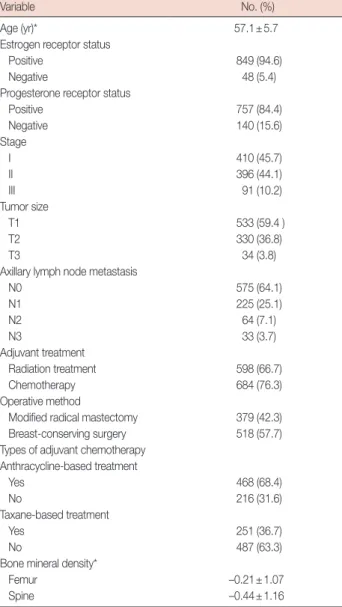
The median age of the enrolled patients was 57 years (range, 51–79 years). The estrogen receptor was positive in 849 pa-tients (94.6%) and the progesterone receptor was positive in 84.4% (n=757). The numbers of patients with stage I and stage II disease were 410 (45.7%) and 396 (44.1%), respective-ly. Ninety-one patients (10.2%) had stage III disease, while 575 women (64.1%) had node-negative disease (Table 2).
Table 1. Distribution of study subjects in the intention-to-treat popula-tion
Category No. (%)
Enrolled subjects 897 (100)
Completed study 749 (83.5)
Early dropouts 148 (16.5)
Reasons for dropouts
Adverse events 45 (30.4)
Abnormal laboratory tests 19 (12.9)
Protocol violation 7 (4.7)
Withdrawal of informed consent 18 (12.2)
Follow-up loss 52 (35.1)
Death 7 (4.7)
Table 2. Demographic characteristics of the study subjects (n=897)
Variable No. (%)
Age (yr)* 57.1±5.7
Estrogen receptor status
Positive 849 (94.6)
Negative 48 (5.4)
Progesterone receptor status
Positive 757 (84.4) Negative 140 (15.6) Stage I 410 (45.7) II 396 (44.1) III 91 (10.2) Tumor size T1 533 (59.4 ) T2 330 (36.8) T3 34 (3.8)
Axillary lymph node metastasis
N0 575 (64.1) N1 225 (25.1) N2 64 (7.1) N3 33 (3.7) Adjuvant treatment Radiation treatment 598 (66.7) Chemotherapy 684 (76.3) Operative method
Modified radical mastectomy 379 (42.3) Breast-conserving surgery 518 (57.7) Types of adjuvant chemotherapy
Anthracycline-based treatment Yes 468 (68.4) No 216 (31.6) Taxane-based treatment Yes 251 (36.7) No 487 (63.3)
Bone mineral density*
Femur –0.21±1.07
Spine –0.44±1.16
Women who had undergone breast-conserving surgery numbered 518 (57.7%), and 684 women (76.3%) underwent adjuvant chemotherapy before entry into the study. Anthracy-cline-containing chemotherapy was administered to 468 (68.4%) women, and 251 women (36.7%) received taxane-based adjuvant chemotherapy.
Of the 897 women included in the analyses, 95.1% com-pleted the questionnaire at 6 months, 92.4% at 12 months, 87.2% at 24 months, and 79.3% at 36 months. For QoL analy-sis, the TOI scores at each follow-up were converted to mean TOI scores, which were the sum of all the question scores di-vided by the number of question items.
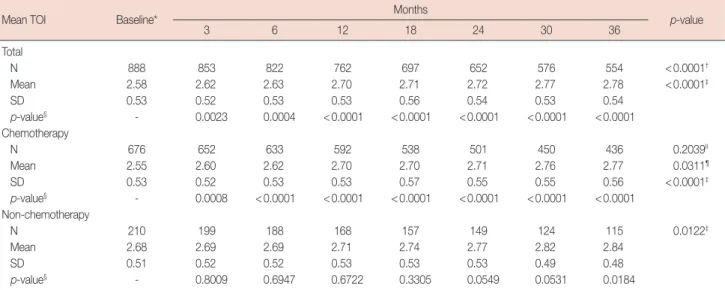
The mean TOI score was 2.58 at baseline, increased at the 6-month follow-up (mean TOI, 2.63), and reached 2.78 at the end of the study (Table 3). The change in the TOI was statisti-cally significant (p<0.0001), when its trend was analyzed us-ing GEE analysis.
The changing QoL pattern was analyzed to see whether ad-juvant chemotherapy could affect QoL during letrozole treat-ment. The mean TOI score was significantly lower (p= 0.0025) in women who underwent adjuvant chemotherapy than in women who were at the nadir of adjuvant chemother-apy (mean TOI, 2.55 vs. 2.68) at the beginning of the study (Table 3). However, the mean TOI increased more rapidly in women who underwent adjuvant chemotherapy before letro-zole treatment than in women who did not (Figure 1). The mean TOI increased steadily and linearly in both groups. The increase in the mean TOI was not different between the two
groups during letrozole treatment.
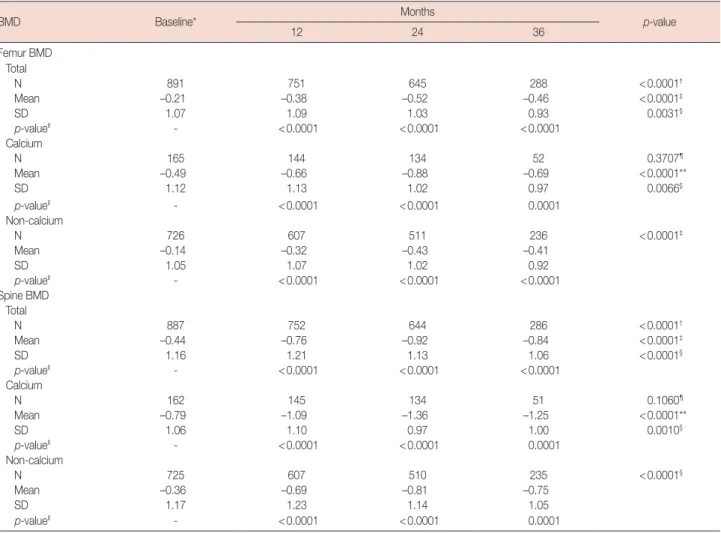
The mean BMD of long bones (femur) was –0.21 at the be-ginning of the study and decreased steadily during the follow-up period, reaching –0.46 36 months after enrollment (Table 4). The decrease in the BMD of long bones with the use of le-trozole was statistically significant (p<0.0001) (Figure 2A). The findings were similar when we measured the mean spine BMD. It decreased from –0.44 at enrollment to –0.84 at the end of the study (Table 4, Figure 2B).
The change in BMD was also analyzed according to calcium supplement intake during the letrozole treatment. Mean BMD
Table 3. Changes in the mean TOI score over the study period in the intention-to-treat population
Mean TOI Baseline* Months p-value
3 6 12 18 24 30 36 Total N 888 853 822 762 697 652 576 554 <0.0001† Mean 2.58 2.62 2.63 2.70 2.71 2.72 2.77 2.78 <0.0001‡ SD 0.53 0.52 0.53 0.53 0.56 0.54 0.53 0.54 p-value§ - 0.0023 0.0004 <0.0001 <0.0001 <0.0001 <0.0001 <0.0001 Chemotherapy N 676 652 633 592 538 501 450 436 0.2039II Mean 2.55 2.60 2.62 2.70 2.70 2.71 2.76 2.77 0.0311¶ SD 0.53 0.52 0.53 0.53 0.57 0.55 0.55 0.56 <0.0001‡ p-value§ - 0.0008 <0.0001 <0.0001 <0.0001 <0.0001 <0.0001 <0.0001 Non-chemotherapy N 210 199 188 168 157 149 124 115 0.0122‡ Mean 2.68 2.69 2.69 2.71 2.74 2.77 2.82 2.84 SD 0.51 0.52 0.52 0.53 0.53 0.53 0.49 0.48 p-value§ - 0.8009 0.6947 0.6722 0.3305 0.0549 0.0531 0.0184
TOI=trial outcome index; SD=standard deviation.
*p=0.0025 using Student t-test for equality of mean baseline TOI scores between the chemotherapy and non-chemotherapy groups; †For equality of mean TOI scores across visits using the generalized estimating equation (GEE); ‡For a linear trend test of mean TOI scores across visits using GEE analysis; §For comparisons of mean TOI score changes between baseline and each follow-up visit using contrasts within the GEE; IIFor an interaction effect between the chemotherapy/non-chemotherapy group and visits using the GEE; ¶Overall equality of mean TOI scores between the chemotherapy and non-chemotherapy groups using the GEE.
Figure 1. Comparison of mean trial outcome index (TOI) score changes between the chemotherapy-receiving and non-chemotherapy groups.
3.2 3.0 2.8 2.6 2.4 2.2 0 3 6 12 18 24 30 36 Visit (mo)
Mean TOI scor
e
Chemotherapy Non-chemotherapy
Table 4. Changes in femur/spine BMD compared to the baseline in the intention-to-treat population during letrozole treatment
BMD Baseline* Months p-value
12 24 36 Femur BMD Total N 891 751 645 288 <0.0001† Mean –0.21 –0.38 –0.52 –0.46 <0.0001‡ SD 1.07 1.09 1.03 0.93 0.0031§ p-valueII - <0.0001 <0.0001 <0.0001 Calcium N 165 144 134 52 0.3707¶ Mean –0.49 –0.66 –0.88 –0.69 <0.0001** SD 1.12 1.13 1.02 0.97 0.0066§ p-valueII - <0.0001 <0.0001 0.0001 Non-calcium N 726 607 511 236 <0.0001‡ Mean –0.14 –0.32 –0.43 –0.41 SD 1.05 1.07 1.02 0.92 p-valueII - <0.0001 <0.0001 <0.0001 Spine BMD Total N 887 752 644 286 <0.0001† Mean –0.44 –0.76 –0.92 –0.84 <0.0001‡ SD 1.16 1.21 1.13 1.06 <0.0001§ p-valueII - <0.0001 <0.0001 <0.0001 Calcium N 162 145 134 51 0.1060¶ Mean –0.79 –1.09 –1.36 –1.25 <0.0001** SD 1.06 1.10 0.97 1.00 0.0010§ p-valueII - <0.0001 <0.0001 0.0001 Non-calcium N 725 607 510 235 <0.0001§ Mean –0.36 –0.69 –0.81 –0.75 SD 1.17 1.23 1.14 1.05 p-valueII - <0.0001 <0.0001 0.0001
BMD=bone mineral density; SD=standard deviation.
*p=0.0001 for equality of mean baseline femur/spine BMD between the calcium and non-calcium groups using the Student t-test; †For equality of mean femur/ spine BMD across visits using the generalized estimating equation (GEE); ‡For a linear trend test of mean femur/spine BMD across visits using GEE analysis; §For a quadratic trend test of mean femur/spine BMD across visits using GEE analysis; IIFor comparisons of mean femur/spine BMD changes between baseline and each follow-up visit using contrasts within the GEE; ¶For an interaction effect between the calcium/non-calcium group and visits using the GEE; **For overall equality of mean femur/spine BMD between the calcium and non-calcium groups using the GEE.
Figure 2. Changes in bone mineral density (BMD) compared to baseline with or without calcium medication during letrozole treatment. (A) Femur BMD. (B) Spine BMD. 0 –0.5 –1.0 –1.5 0 –0.5 –1.0 –1.5 –2.0 0 12 24 36 0 12 24 36
Visit (mo) Visit (mo)
Femur BMD Spine BMD A B Calcium Non-calcium Calcium Non-calcium
at enrollment was –0.49 in women who received calcium sup-plements, while the mean BMD was –0.14 in women who did not take calcium supplements. The difference between the groups was statistically significant (p<0.0001) at the begin-ning of the study (Table 4) and was maintained until the end of the study (Figure 2).
Serum cholesterol for all patients was monitored annually. Mean total cholesterol levels increased after 12 months of le-trozole treatment from 198 at enrollment to 203 and the in-creasing trend was maintained until the end of the study. The increase was statistically significant (p=0.0423) (Table 5).
DISCUSSION
Most clinical trials testing the clinical efficiency of AI have concentrated on the therapeutic superiority of AI to tamoxi-fen [3-5]. Based on the results of large-scale clinical trials, AI are now the standard treatment for postmenopausal women with hormone receptor-positive breast cancer. In these trials, patients’ QoL was assessed as a subprotocol in a relatively small population of patients. There were no significant differ-ences in TOI scores over time in most large-scale clinical trials [13-15].
In this study, patients’ QoL significantly and continuously increased during letrozole treatment. This finding is some-what different from other studies where QoL was maintained during AI treatment. Contrary to other studies, the TOI score increased during the follow-up period and the increase was statistically significant. This could be due to a younger popu-lation in our study or due to an ethnic difference, since all the patients in this study were Korean.
In some studies, older age was a predictor of worsening QoL in terms of overall physical health and bodily pain [14,16]. In the MA.17 trial, the majority of the patients were older than 60 years of age, while the mean age in this study was about 57 years. A review of adjuvant endocrine treatment
in elderly patients revealed that QoL is minimally affected; however, more long-term data may be needed [17].
Maintenance of QoL is especially important in the adjuvant AI treatment of postmenopausal women with early breast cancer. The standard treatment duration for adjuvant AI in hormone receptor-positive patients is currently 5 years. Com-pliance with AI treatment is critical for an improved patient outcome in breast cancer. In daily practice settings, it has been reported that around one-third of patients failed to complete a 5-year adjuvant tamoxifen treatment course for various rea-sons [18]. Deterioration of QoL can affect the patients’ com-pliance with adjuvant letrozole treatment. Of the 148 patients who dropped out, 40 patients discontinued the medication due to joint pain, although this symptom has been known to be associated with a better outcome [19].
A stable QoL status during letrozole treatment indicates that adjuvant letrozole treatment is well tolerated in post-menopausal Korean women with breast cancer.
During letrozole treatment in the current study, the BMD of the spine and femur decreased steadily. Subgroup analysis of the Breast International Group (BIG) 1-98 indicates that any type of adjuvant letrozole treatment, upfront or sequen-tial, results in a decrease in BMD; however, BMD is not a per-fect surrogate marker for predicting the bone fracture rate [20]. An association between the increased bone fracture rate and decreased BMD was observed in letrozole-treated pa-tients in the BIG 1-98 trials. The MA.17 study also demon-strated a significant decrease in lumbar spine BMD and total hip BMD [21]. An increased risk of bone loss and bone frac-ture in AI-treated patients was reported in another large-scale clinical trial [15]. The finding was consistent with that in the current study. The mean spine and femur BMD decreased steadily in the current study. The decrease in BMD was not corrected by calcium supplementation. Results from the cur-rent and other large-scale studies indicate that prophylactic management for bone loss such as bisphosphonate treatment is necessary along with adjuvant letrozole treatment, since zoledronic acid is reported to have a prophylactic effect on bone loss during adjuvant letrozole treatment [22]. A recent large population study demonstrated that simultaneous use of oral bisphosphonate can counterbalance the effect of AI-in-duced bone loss in osteopenic and osteoporotic women [23].
We monitored serum cholesterol levels on an annual basis. Serum cholesterol increase did not affect the compliance of le-trozole treatment, but the increase was statistically significant.
Complete estrogen deprivation because of letrozole is known to affect the serum lipid level. However, the results are not consistent among different studies. The National Cancer Institute of Canada Clinical Trial Group MA.17 lipid substudy Table 5. Changes of total cholesterol from baseline during letrozole
treatment with intention-to-treat population
Total cholesterol Baseline Months p-value
12 24 36 N 881 778 672 281 0.0423* Mean (mg/dL) 198.9 202.1 201.1 203.7 0.0211† SD (mg/dL) 35.9 35.4 35.0 31.4 p-value‡ - 0.0130 0.0391 0.0142 SD=standard deviation.
*For an equality of mean total cholesterol across visits using generalized esti-mating equation (GEE); †For a linear trend test of mean total cholesterol across visits within GEE analysis; ‡For comparisons of mean total cholesterol change from baseline to each of following visits using contrasts within GEE.
reported no remarkable changes in total cholesterol levels for patients treated with letrozole after 5 years of tamoxifen treat-ment [24]. However, the frequency of hypercholesterolemia in patients treated with anastrozole was significantly increased compared to that in patients treated with tamoxifen [6]. An-other clinical trial with Japanese postmenopausal early breast cancer patients reported that AI had no clinically significant effect on serum lipids [9]. However, the study used exemes-tane and anastrozole, but did not include letrozole. Thus, di-rect comparison with the current study was not feasible.
This study has several limitations. It was an open label, sin-gle arm study without a control group. The questionnaire re-sults might be influenced by the patients’ community group or public medical information. Moreover, records of detailed adverse events and endocrine symptoms were missed. Despite these limitations, this study is meaningful in several points. It was performed with a considerable number of postmeno-pausal Asian women with primary breast cancers. While most large-scale QoL studies have been intended for a Western population, this study was targeted toward Asian women to make a comparison based on ethnic differences.
In conclusion, QoL significantly and continuously im-proved during letrozole treatment in postmenopausal Korean women with early breast cancer. The changing profiles for BMD and serum cholesterol levels were similar to those of Western countries. The results of this study indicate that adju-vant letrozole treatment is well tolerated in Korean women, with minimal ethnic variation compared to Western popula-tions.
CONFLICT OF INTEREST
The authors declare that they have no competing interests.
REFERENCES
1. Park EH, Min SY, Kim Z, Yoon CS, Jung KW, Nam SJ, et al. Basic facts of breast cancer in Korea in 2014: the 10-year overall survival progress. J Breast Cancer 2017;20:1-11.
2. Goldhirsch A, Winer EP, Coates AS, Gelber RD, Piccart-Gebhart M, Thürlimann B, et al. Personalizing the treatment of women with early breast cancer: highlights of the St Gallen International Expert Consensus on the Primary Therapy of Early Breast Cancer 2013. Ann Oncol 2013; 24:2206-23.
3. Howell A, Cuzick J, Baum M, Buzdar A, Dowsett M, Forbes JF, et al. Results of the ATAC (Arimidex, Tamoxifen, Alone or in Combination) trial after completion of 5 years’ adjuvant treatment for breast cancer. Lancet 2005;365:60-2.
4. Coombes RC, Hall E, Gibson LJ, Paridaens R, Jassem J, Delozier T, et al. A randomized trial of exemestane after two to three years of tamoxifen
therapy in postmenopausal women with primary breast cancer. N Engl J Med 2004;350:1081-92.
5. BIG 1-98 Collaborative Group, Mouridsen H, Giobbie-Hurder A, Goldhirsch A, Thürlimann B, Paridaens R, et al. Letrozole therapy alone or in sequence with tamoxifen in women with breast cancer. N Engl J Med 2009;361:766-76.
6. Arimidex, Tamoxifen, Alone or in Combination (ATAC) Trialists’ Group, Forbes JF, Cuzick J, Buzdar A, Howell A, Tobias JS, et al. Effect of anastrozole and tamoxifen as adjuvant treatment for early-stage breast cancer: 100-month analysis of the ATAC trial. Lancet Oncol 2008;9:45-53.
7. Geisler J, Haynes B, Anker G, Dowsett M, Lønning PE. Influence of letrozole and anastrozole on total body aromatization and plasma estrogen levels in postmenopausal breast cancer patients evaluated in a randomized, cross-over study. J Clin Oncol 2002;20:751-7.
8. Ohsumi S, Shimozuma K, Ohashi Y, Shinji M, Hozumi Y, Mukai H, et al. Health-related quality of life and psychological distress of breast cancer patients after surgery during a phase III randomized trial com-paring continuation of tamoxifen with switching to anastrozole after adjuvant tamoxifen for 1-4 years: N-SAS BC 03. Breast Cancer Res Treat 2011;127:143-52.
9. Hozumi Y, Suemasu K, Takei H, Aihara T, Takehara M, Saito T, et al. The effect of exemestane, anastrozole, and tamoxifen on lipid profiles in Japanese postmenopausal early breast cancer patients: final results of National Surgical Adjuvant Study BC 04, the TEAM Japan sub-study. Ann Oncol 2011;22:1777-82.
10. Brady MJ, Cella DF, Mo F, Bonomi AE, Tulsky DS, Lloyd SR, et al. Reliability and validity of the Functional Assessment of Cancer Therapy-Breast quality-of-life instrument. J Clin Oncol 1997;15:974-86. 11. Cella D, Hahn EA, Dineen K. Meaningful change in cancer-specific
quality of life scores: differences between improvement and worsening. Qual Life Res 2002;11:207-21.
12. Fallowfield LJ, Leaity SK, Howell A, Benson S, Cella D. Assessment of quality of life in women undergoing hormonal therapy for breast cancer: validation of an endocrine symptom subscale for the FACT-B. Breast Cancer Res Treat 1999;55:189-99.
13. Fallowfield L, Cella D, Cuzick J, Francis S, Locker G, Howell A. Quality of life of postmenopausal women in the Arimidex, Tamoxifen, Alone or in Combination (ATAC) Adjuvant Breast Cancer Trial. J Clin Oncol 2004;22:4261-71.
14. Whelan TJ, Goss PE, Ingle JN, Pater JL, Tu D, Pritchard K, et al. Assess-ment of quality of life in MA.17: a randomized, placebo-controlled trial of letrozole after 5 years of tamoxifen in postmenopausal women. J Clin Oncol 2005;23:6931-40.
15. Mincey BA, Duh MS, Thomas SK, Moyneur E, Marynchencko M, Boyce SP, et al. Risk of cancer treatment-associated bone loss and frac-tures among women with breast cancer receiving aromatase inhibitors. Clin Breast Cancer 2006;7:127-32.
16. Muss HB, Tu D, Ingle JN, Martino S, Robert NJ, Pater JL, et al. Efficacy, toxicity, and quality of life in older women with early-stage breast cancer treated with letrozole or placebo after 5 years of tamoxifen: NCIC CTG intergroup trial MA.17. J Clin Oncol 2008;26:1956-64.
17. Muss HB. Adjuvant treatment of elderly breast cancer patients. Breast 2007;16 Suppl 2:S159-65.
tamoxifen therapy in women with primary breast cancer. J Clin Oncol 2003;21:602-6.
19. Cuzick J, Sestak I, Cella D, Fallowfield L; ATAC Trialists’ Group. Treat-ment-emergent endocrine symptoms and the risk of breast cancer re-currence: a retrospective analysis of the ATAC trial. Lancet Oncol 2008; 9:1143-8.
20. Zaman K, Thürlimann B, Huober J, Schönenberger A, Pagani O, Lüthi J, et al. Bone mineral density in breast cancer patients treated with adju-vant letrozole, tamoxifen, or sequences of letrozole and tamoxifen in the BIG 1-98 study (SAKK 21/07). Ann Oncol 2012;23:1474-81. 21. Perez EA, Josse RG, Pritchard KI, Ingle JN, Martino S, Findlay BP, et al.
Effect of letrozole versus placebo on bone mineral density in women with primary breast cancer completing 5 or more years of adjuvant tamoxifen: a companion study to NCIC CTG MA.17. J Clin Oncol 2006;24:3629-35.
22. Brufsky A, Harker WG, Beck JT, Carroll R, Tan-Chiu E, Seidler C, et al. Zoledronic acid inhibits adjuvant letrozole-induced bone loss in post-menopausal women with early breast cancer. J Clin Oncol 2007;25:829-36.
23. Sestak I, Singh S, Cuzick J, Blake GM, Patel R, Gossiel F, et al. Changes in bone mineral density at 3 years in postmenopausal women receiving anastrozole and risedronate in the IBIS-II bone substudy: an interna-tional, double-blind, randomised, placebo-controlled trial. Lancet Oncol 2014;15:1460-8.
24. Wasan KM, Goss PE, Pritchard PH, Shepherd L, Palmer MJ, Liu S, et al. The influence of letrozole on serum lipid concentrations in postmeno-pausal women with primary breast cancer who have completed 5 years of adjuvant tamoxifen (NCIC CTG MA.17L). Ann Oncol 2005;16:707-15.