19-3 / S. Tezuka
IMID 2009 DIGEST •
Synthesis of Ba
2SiS
4:Eu
2+Blue-Green Phosphor Prepared by
Spray Drying Method Using Water Soluble Silicon Compound
Satoko Tezuka1, Yoshihito Suzuki1, Valery Petrykin2 and Masato Kakihana1
1Institute of Multidisciplinary Research for Advanced Materials, Tohoku University,
2-1-1, Aobaku, Sendai, 980-8577, Japan
TEL.: 81-22-217-5651, E-mail: [email protected]
2J. Heyrovsky Institute of Physical Chemistry, Dolejskova 3, 18223 Prague, Czech Republic
Keywords: Ba2SiS4:Eu2+, water soluble silicon compound, spray drying method,
sulfurization, carbon dioxide
Abstract
The single phase Ba2SiS4 doped with Eu2+was successfully
synthesized by direct sulfurization of an oxide precursor prepared by a spray drying method using a novel water soluble silicon compound, which remains soluble in a given aqueous solution. The intensity of the emission peak of thus obtained Ba2SiS4:Eu2+was 1.75 times larger than that of a
sample prepared by a solid state reaction method, and it approached 106% compared to one of the best commercially available YAG:Ce3+phosphor.
1. Introduction
Ba2SiS4 doped with Ce3+ has recently emerged as a bright cyan-blue phosphor for possible use in solid-state lighting applications through the excitation by a near UV light emitting diode (LED) [1]. Until now, the new material of Ba2SiS4:Ce3+ composition have been usually synthesized by the conventional solid-state reaction (SSR) method, typically starting from the constituent metal sulfides and involving mixing and subsequent heat-treatment under inert of H2S containing atmosphere. Despite the apparent simplicity, such a synthesis procedure might yield a material with non-uniform distribution of a given activator ion within the host crystal, leading to depression of fluorescent properties [2, 3]. The aim of our work was therefore to develop a new methodology for a solution-based synthesis of thiosilicates with a view to obtaining phosphors with excellent photoluminescent characteristics. In this paper, we describe a new approach for synthesis of Ba2SiS4:Eu2+ blue-green phosphor by an original three-step process, which includes spray drying of an aqueous solution containing a novel water-soluble silicon (WSS) compound [4-7] together with Ba and Eu ions (1st step), calcination of the spray-dried powder to form an
oxide precursor of Ba2SiO4:Eu3+ composition (2nd step) and sulfurization of the precursor under Ar/CS2 atmosphere to obtain single phase Ba2SiS4:Eu2+ (3rd step). To the best of our knowledge, this is the first report on solution-based synthesis of metal thiosilicates, the details of which are now presented.
2. Experimental
Synthesis of Ba2SiS4:Eu2+ (5 mol% of Eu for Ba) material consists of three steps. The first step involves the spray drying (SD) at 200˚C of an aqueous solution containing the WSS [4-6], barium nitrate and europium acetate taken in the appropriate stoichiometry. The total metal concentration in the solution for the SD procedure was 30mM. During the second step the spray-dried powder is subjected to heat treatment at 800˚C for 2h to obtain the oxide precursor of Ba2SiO4:Eu3+ composition. The final third step is the sulfurization of the Ba2SiO4:Eu3+ precursor in a tube furnace at 1010˚C for 2h with Ar/CS2 flow generated by bubbling an Ar carrier gas through a liquid of CS2 at room temperature, that yields the target Ba2SiS4:Eu2+ material.
For comparison, a solid-state reaction (SSR) method was employed for synthesis of Ba2SiS4:Eu2+ (5mol% of Eu for Ba). For this synthesis the required amounts of barium carbonate, europium oxide and silicon dioxide (SiO2) were mechanically mixed and heat-treated at 800˚C for 2h, followed by the sulfurization under the identical conditions as described above.
The obtained materials were characterized by X-ray diffraction (XRD) phase analysis using RINT-2000 (Rigaku) with CuKα radiation (λ=0.15405nm). The
19-3 / S. Tezuka
• IMID 2009 DIGEST
carried out by use of a fluorescence spectrometer (F4500, Hitachi).
3. Results and discussion
XRD patterns of powders prepared by the two methods (the spray drying (SD)-based and the SSR methods) before and after the sulfurization are shown in Fig.1. The XRD pattern of the SD-based product just before the sulfurization (Fig.1(a)) corresponds to the single phase Ba2SiO4 and importantly one cannot
identify any impurity phases containing Eu, which means that the activator ions (Eu3+) are
homogeneously distributed in the Ba2SiO4 matrix. The
XRD pattern of the SD-based product after the sulfurization (Fig.1(b)) confirms formation of the single phase Ba2SiS4 sample without evidence of any
impurities. In contrast, the XRD pattern of the product prepared by the SSR method just before the sulfurization (Fig.1(c)) indicates rather incomplete formation of Ba2SiO4 with a small fraction of this
phase relative to the amount of unreacted BaCO3
(identified by the strongest two peaks around 23° in 2θ) and formation of traces of unidentified phases.
Rather unexpectedly, the XRD pattern of the subsequent product after the sulfurization (Fig.1(d))
reveals formation of the single phase Ba2SiS4 material.
However, a careful inspection of the two XRD patterns of the single phase Ba2SiS4 leads us to notice
that the diffraction peaks of Ba2SiS4 sample prepared
by the SSR method are significantly broader than those of another Ba2SiS4 phase prepared by the
SD-based method. This may indicate that the former Ba2SiS4 could be more heterogeneous than the latter
Ba2SiS4 with respect to the compositional
homogeneity including distribution of activator ions (Eu2+). To confirm this hypothesis, we have compared
photo-luminescent spectra of these two Ba2SiS4
samples, since it is believed that the intensity of a given emission spectrum is sensitive to such compositional inhomogeneities as well as to the phase purity [2, 3, 7-9].
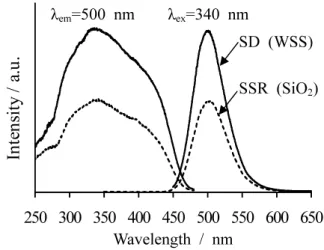
Figure 2 presents photo-luminescent spectra of the two Ba2SiS4 samples mentioned above. The emission
spectra of these two samples have the main single peaks centered at the same position of 500 nm with the corresponding excitation maxima at 340 nm. One may immediately notice that the emission intensity demonstrated by the Ba2SiS4:Eu2+ sample prepared by
the SD-based method is 1.75 times larger than that of the corresponding sample prepared by the SSR method. It is supposed that the superior emission characteristic of the sample prepared by the SD-based method is due to its superior compositional homogeneity. The maximum emission intensity of this Ba2SiS4:Eu2+ sample was 106% compared to that of
250 300 350 400 450 500 550 600 650
Wavelength / nm
Figure 2. Excitation (left) and emission (right) spectra of Ba2SiS4:Eu2+ (5mol% of Eu for Ba)
materials prepared by the spray drying method using water-soluble silicon (WSS) compound [SD(WSS)] and the solid state reaction method [SSR(SiO2)].(λem=500 nm, λex=340 nm). SD (WSS) SSR (SiO2) In te ns ity / a. u. λem=500 nm λex=340 nm
Figure 1. XRD patterns of powders prepared by the spray drying(SD)-based and the solid-state reaction (SSR) methods just before and after the sulfurization: (a) the product after calcination of the spray dried powder at 800˚C for 2h in air, (b) the SD-based product after the sulfurization of the product (a), (c)the product obtained by the SSR method after calcinaton at 800˚C for 2h in air just before the sulfurization, and (d) the SSR-based product after the sulfurization of the product (c).
20 25 30 35 40 2θ / ° In te ns ity / a. u. (d) (c) (b) (a)
19-3 / S. Tezuka
IMID 2009 DIGEST •
one of the best commercially available YAG:Ce3+ phosphor, when excited by a light with a wave length of 340 nm, and it moderately decreased down to 80%, when excited by a light with a longer wavelength of ca. 400 nm. We believe that the emission intensity demonstrated by this material under excitation by the near UV light with a wavelength of ca. 400 nm may be further improved, and it represents a relevant task since this excitation energy is used in the typical solid-state lighting applications based on the near UV LED, which can excite the Ba2SiS4:Eu2+ green-blue phosphor together with the other phosphors emitting blue and red lights.
4. Summary
For the first time, the europium-doped barium thiosilicate with a composition of Ba2SiS4:Eu2+ (5 mol% of Eu for Ba), which shows a potential for solid-state lighting applications, was successfully synthesized by a solution-based technology. A powder obtained after spray drying (SD) of a homogeneous aqueous solution containing the required amounts of Ba, Si and Eu as each individual soluble species in the solution was heat-treated at 800˚C for 2h to form the single-phase Ba2SiO4:Eu3+ oxide, which was subsequently converted to the target material of Ba2SiS4:Eu2+ composition by a single-step direct sulfurization in Ar/CS2 atmosphere at 1010˚C for 2h. The intensity of the emission peak of thus obtained Ba2SiS4:Eu2+ was 1.75 times larger than that of a reference sample prepared by the conventional solid-state reaction method, that was attributable to its superior compositional homogeneity. The use of a completely homogeneous solution for the SD procedure, which was realized only by employing the novel water-soluble silicon compound [4-6], was indispensable for achieving high homogeneity of cations distribution. The relatively large magnitude of the emission intensity under excitation by the near UV light with a wavelength of ca. 400 nm suggested that the thiosilicate with a composition of Ba2SiS4:Eu2+ could be used as a possible phosphor for a solid-state lighting application employing the near UV LED.
5. References
[1] T. Ohashi and K. Ohmi, J. Light & Vis. Env., 32,
p.139 (2008).
[2] N. Takahashi, Y. Suzuki and M. Kakihana, Rare
Earths, 52, p.102 (2008).
[3] M. Kakihana, J. Ceram. Soc. Jpn., 117, p.857
(2009).
[4] Y. Suzuki and M. Kakihana, J. Ceram. Soc. Jpn.,
117, p.330 (2009).
[5] Y. Suzuki and M. Kakihana, J. Phys.: Conf.
Series: Mater. Sci. and Engineering, 1, p.012012
(2009).
[6] N. Takahashi, Y. Suzuki and M. Kakihana, J.
Ceram. Soc. Jpn., 117, p.313 (2009).
[7] V. Petrykin and M. Kakihana, J. Ceram. Soc. Jpn.,
115, p.615 (2007).
[8] V. Petrykin and M. Kakihana, Chem. Mater., 20,
p.5128 (2008).
[9] V. Petrykin and M. Kakihana, J. Am. Ceram. Soc.,