Electronic Properties of LaSrCoO
3Alloys Studied by High-Resolution Neutron
Diffraction
J. Y. Kim, Y. J. Yoo, K. K. Yu, Y. P. Lee, K. W. Kim*, K. P. Hong**
q-Psi and Department of Physics, Hanyang University, Seoul, 133-791 * Department of Physics, Sunmoon University, Asan, 336-708
**
Korea Atomic Energy Research Institute, P. O. Box 105, Yuseong, Daejeon, 305-353
Since an unconventional magnetic ordering was discovered in the La1-xSrxCoO3 (LSCO) alloys
system, many studies on electromagnetic, optical, and structural properties, including magnetic susceptibility, ellipsometric and Raman spectra, and neutron diffraction have been performed to explain the unusual magnetic behavior. These oxides are promising for the practical applications, because of high electrical and excellent ionic conductivities which make them good electrode materials for fuel cells and ferroelectric memory devices. The unusual magnetoreistive behavior and magnetic properties, presumably associated with the spin-state transition, is believed due to the evolution from a low level of Sr doping, so-called “glassy state” which is referred to spin-glass or cluster-glass, to the ferromagnetic state at a higher level of doping (x > 0.18).
Preliminary studies illustrates that various magnetic states are attributed to the coexistence of ferromagnetic, spin-glass, and low- and intermediate-spin state regions depending on interaction of Co3+ and Co4+ ions in a large span of
Sr concentration (from x = 0.1 to 0.5). In other words, a small amount of Sr doping (x ≈ 0.05) in La1-xSrxCoO3 leads to a ferromagnetic long-range
order, and the metal-insulator transition takes place near x ≈ 0.18.
In spite of numerous studies employing different
experimental methods to illustrate the origin of various magnetic states in terms of spin dynamics, exchange interaction between Co ions and structural or chemical disorder, one needs to note that the nature of magnetic ordering in the LSCO alloys are not clearly explained but still on debate. Hence, we have systematically examined the structural, the chemical and the magnetic
properties of Sr-doped polycrystalline La
1-xSrxCoO3 alloys in the “glassy state” at a low Sr
concentration (x < 0.18) and in the ferromagnetic state at a high Sr concentration (x > 0.18).
Polycrystalline La1-xSrxCoO3 (x = 0.15, 0.25 and
0.30)bulk samples were prepared by the standard solid-state reaction. The structural properties of the samples were characterized by x-ray diffraction and by x-ray photoemission spectroscopy. The LSCO alloys crystallize in a rhombohedrally-distorted perovskite structure at low temperatures, which is close to cubic, and the degree of the distortion decreases with increasing x, eventually vanishing at x = 0.5.
The temperature dependence of inverse susceptibility for the polycrystalline LSCO was measured. The measured susceptibility follows the Curie-Weiss law (see Fig. 1). The Curie temperatures are obtained from the results of Curie-Weiss fit, and the values are found to be
Transactions of the Korean Nuclear Society Autumn Meeting Busan, Korea, October 27-28, 2005
147, 217 and 232K for x = 0.15, 0.25 and 0.30, respectively.
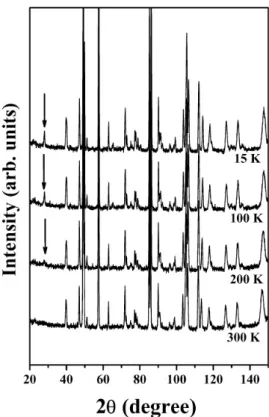
The neutron diffraction data from the samples for x=0.25 and 0.30 were also measured as a function of temperature from 20 K to room temperature. A typical plot for x = 0.25, recorded at different temperatures are shown in Fig. 2. As decreasing temperature an evolution of the diffraction line is observed at a low angle in two theta (indicated by arrows in the figure). This result implies the existence of the long-range ordered ferromagnetic state which is inconsistent with the short-range ordered ferromagnetic cluster model.
Fig. 2. High-resolution neutron diffraction data for La0.75Sr0.25CoO3, measured at
different temperatures.
Fig. 1. Plots of the inverse magnetic susceptibility as a function of temperature for La1-xSrxCoO3 samples (x = 0.15, 0.25