© Korean Powder Metallurgy Institute 1241
-1. Introduction
Since the discovery of high Tc superconductors with transition above liquid nitogen temperature, many efforts have been concentrated on increasing the critical current Jc for practical application. Several effective methods to fabricate ceramic superconductors into wire or a tape shape with high Jc exceeding 104 A/cm2 at 77K have been
developed for the YBaCuO system[1]. Most of the rare earth elements except cerium and praseodymium have been known to form the 1-2-3 superconducting phase (Re1Ba2Cu3Ox) which reveals high Tc of about 90K [2-3].
Thease elements can be completely and partialy substituted each other because of their similar valance state and ionic radius. In the case of the CeO2 dopedYBaCuO system,
suggesting that there is no solubility of cerium in 1-2-3 phase. The reason why cerium was not soluble in 1-2-3 phase was explained interm of the different valance state of Ce+4 from Y+3, Ba+2, Cu+3 and Cu+2. This fact can be
avail-able in designing a superconductor-nonsuperconductor composite which may improve critical current density and mechanical properties of the oxide superconductor. The key point in increasing Jc is improving weak link properties of grain boundary and trapping of magnetic field by non superconducting phase in a superconducting matrix. In the present work, effects of CeO2 addition in YBaCuO
superconductor have been invesigated. Reaction between dopant and YBCuO, characteristics of microstructure and superconductivity were observed and the effects of CeO2
doping on the magnetism, magnetic shielding were investigated in view of flux pinning.
2. Experimental and Results
The YBaCuO powder used in this experiment was made
by the conventional solid state reaction of Y2O3, BaCO3 and
CuO powders of 99.99% purity and the powders were mixed and calcined at 950℃ for 20h in air and then furnace cooled. The calcined cakes were crushed in an alumina mortar with a pestle, mixed with CeO2 powder of 99.99%
purity up to 10wt%, pressed isostatically into pellets. The pellets were sintered at 950℃ for 10h in air, slowly cooled down to 400℃, held for 24h, and then furnace cooled. For the transformation of the tetragonal phase to the orthorombic one, the pellets were cooled slowly down to 450℃, held for 24h, and then air cooled. The pellets were 13mm in diameter and 5mm in thickness. The magnetization hysteresis curve at 77K was obtained between 0 and 2T using a vibrating sample magnetometer (VSM) for the sample dimension of 3×3×5 mm. The phase formed after sintering was identified by powder X-ray diffraction using CuKα radiation. Microstructure for the etched surface of samples was investigated by a electron probe microscopy analysis (EPMA). The magnetic shielding effect was evaluated by measuring the output voltage induced in the secondary coil, initially setting at 0.5 V prior to placing a sample after an AC voltage at 125 KHz is applied to the primary coil.
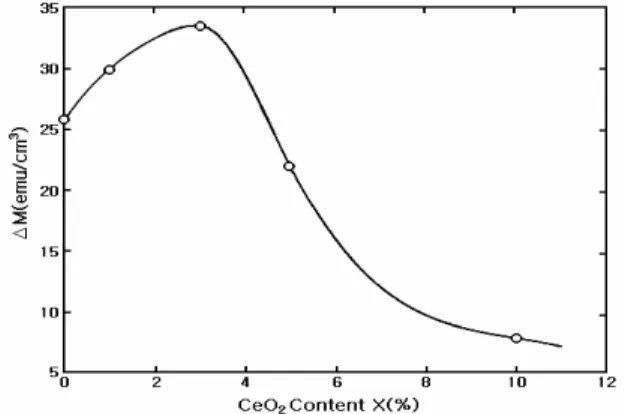
The difference in the magnetization, M=M△ +-M-, showed
that the magnetization decreases with applied field due to the increase in the intrinsic pinning by normal conducting volume. M increases with dopent, showing a maximum at △ 3% CeO2 doping, and decreased with further doping as in
Fig.1. The intergranular current density, JC, estimated by
The intergranular current density Jc in the superconductor increases with volume fraction of dopent and with decreasing particle size of dopent because the smaller the particle size the larger the ratio of its surface area to its volume. The magnetic flux is generated by a vortex current
2006 POWDER METALLURGY World Congress
PC14-W-04
Effect of Metal Oxide on the Superconductivity of YBCO
Sang Heon Lee1,a1
Department of Electronic Engineering, Sun Moon University, 100 Kasan, Tangjeong, Asan, Chungnam 336-708 Korea
[email protected] Abstract
Electromagnetic properties of CeO2 doped and undoped YBaCuO superconductors were evaluated to investigate the effect of
pinning center on the magnetization and magnetic shielding. The variation △M with doping was maximum for 3% doping and decrease with further doping. The magnetic shielding was evaluated by measuring the induced voltage in secondary coil and the voltage initially set to 0.5V, decreased to 0.17V and 0.28V respectively for the undoped and 3% CeO2 doped sample.
The much less change in the induced voltage for the 3% doped sample is attributed to the increased flux shielding by shielding vortex current. The CeO2 was converted to fine BaCeO3 particleswhich were trapped in YBaCuO superconductor
during the reaction sintering. The trapped fine particles, BaCeO3 may be acted as a flux pinning center.
© Korean Powder Metallurgy Institute 1242 -which circulates around the vortex with a sense of rotation opposite to that of the diamagnetic screening surface current
Fig. 1. M dependence on CeO△ 2 addition from the
characteristics of magnetization hysteresis.
Fig. 2. Powder x-ray diffraction patterns of the CeO2
doped YBaCuO Oxides.
The powder XRD patterns of the CeO2 doped YBaCuO
superconductor were illustrated in Fig. 2. The pattern of undoped superconductor consists of orthorhombic YbaCuO (123) peaks. With 123 peaks, the BaCeO3 peaks are
observed in the CeO2 doped superconductors, and the
relative fraction of this phase increased with increasing CeO2 content. In order to determine the chemical
composition of the fine particle, EPMA anaysis was carried out for the 5% CeO2 superconductor. Fig.3 shows the
EPMA surface micrograph of the superconductor etched in
1% HNO3 solution. It was clearly observed that large
particles and fine particles were trapped in YBaCuO 123 matrix. It could be confirmed that the large particles are BaCeO3 . The results was consistent with the XRD analysis
of Fig.2. The trapped fine particles, BaCeO3 may be acted
as a flux pinning center. The CeO2 was converted to fine
BaCeO3 particles which were trapped in YBaCuO
superconductor during the reaction sintering. 3. Summary
Electromagnetic properties of CeO2 doped and undoped
YBaCuO superconductors were evaluated to investigate the effect of pinning center on the magnetization and magnetic shielding . The variation M with doping was maximum △ for 3% doping and decrease with further dopingThe magnetic shielding was evaluated by measuring the induced voltage in secondary coil and the voltage initially set to 0.5V, decreased to 0.17V and 0.28V respectively for the undoped and 3% CeO2 doped sample. The much less
change in the induced voltage for the 3% doped sample is attributed to the increased flux shielding by shielding vortex current. The CeO2 was converted to fine BaCeO3 particles
which were trapped in YBaCuO superconductor during the reaction sintering. The trapped fine particles, BaCeO3 may
be acted as a flux pinning center. Acknowledgment
This research was financially supported by a grant from ETEP.
4. References
1. C.K.McMichael,K.B.Ma,M.A.Lamb,L.Chow, .H.Hor, .K.Chu: Appl.Phys.Lett. Vol.60 (1992) p.1893.
2. H.Fukuyama,K.Seki, T.Takizawa, S.Aihara,
M.Murakami, H.Takaichi, and S.Tanaka : Proc. 4th Int. Symp. on Superconductivity Tokyo Springer, (1991) pp.279-2841.
3. M.B.Maple, Y.Dalichaouch, J.M.Ferreira, R.R.Hake, B.W.Lee, J.J.Neumeier, M.S.Torikachvili, K.N.Yang and H.Zhou : Physica B, Vol. B148 (1987) p.155. 4. K.N.Yang, B.W.Lee, M.B.Maple, and S.S..Laderman :
Appl.Phys. Vol.A46 (1988) p.229. 5. F.Peters: Nature, Vol.396 (1998) p.144.