† 교신저자, 한국철도기술연구원, 무선통신열차제어연구단 E-mail : [email protected]
* 한국철도기술연구원, 무선통신열차제어연구단 ** 우송대학교, 철도대학원
도시철도용 무선통신기반 열차제어시스템 기능배치 연구
A study of system functions allocation of wireless communications
based train control system
윤용기† 오세찬* 김민수* 김용규* 최준영** 박재영** Yong-Ki Yoon Seh-Chan Oh Min-Su Kim Yong-Kyu Kim June-Young Choi Jae-Young Park
ABSTRACT
A Train control system is intended to assure train operation safety and to improve train operation efficiency. To perform these missions, the Train Control System consists of train safety space control part, train route control part and train operation management part. Train control technology changed from track circuit based to wireless based. And Wireless based train control technologies were developed by some railway signaling companies in Korea. To commercialize these control technologies, the development project is carried now. This project did analyze system requirements, and made the system development specification. Now this project finished system functions allocation, which will be performed by some subsystem. This paper describes roles of each function and the allocation of these functions to each subsystem.
1. 서론
열차제어시스템(철도신호시스템)은 철도운영의 안전과 효율성을 보장하는 바이탈 시스템으로서 서브시스템인 ATS(Automatic Train Supervision), ATP (Automatic Train Protection) 및 EI(Electronic Interlocking)로 성된다. 또한 이동폐색과 무인(driverless)자동운전을 구현하기 위한 열차제어용 무선통신망과 ATO(Automatic Train Operation)도 열차제어시스템을 구성하는 하부시스템이다. ATP는 지상과 차상에 설치되어 열차방호 기능을 수행하고 있으며, ATO도 지상과 차상에 설치되어 열차자동운전기능을 담당하고 있다. 무선통신 기반의 열차제어시스템은 지상에 설치되어 있는 장치(이하 지상장치)와 차상에 설치되어 있는 장치(이하 차상장치)간에 몇 가지 특징을 갖고 있다. 우선 지상장치와 차상장치간에 끊김없는 양방향 송수신을 적 용하고 있으며, 두 번째는 차상장치가 열차위치를 높은 정밀도를 검지하고 지상장치가 실시간으로 열차 위치를 추적할 수 있으며, 마지막으로 지상장치와 차상장치 모두 열차방호에 필요한 vital기능을 수행하 고 있다. 현재까지도 사용하고 있는 궤도회로(track circuits)기반의 열차제어시스템은 지상장치가 열차점 유정보형태로 열차위치를 추적하여 열차속도명령을 차상장치로 전송하고, 차상장치는 전송된 열차속도 명령에 맞추어 열차속도를 감시하는 단방향의 열차제어프로세스를 갖는다[1]. 무선통신기반 열차제어시 스템은 지상장치와 차상장치에서 양방향의 열차제어프로세스를 갖는다. 무인(driverless)자동운전을 지원하는 무선통신기반 열차제어시스템은 기존 시스템과 비교해서 구성은 단순하지만 많은 기능을 수행하고 있기 때문에 보다 복잡해졌으며, 소프트웨어로 구현되고 있다. 따라서 열차제어시스템과 소프트웨어의 신뢰성과 안전성을 높이는 것이 중요한 사항으로 인식되어 IEC 622267, IEC 62290 및 IEC 61508 등과 같은 국제표준을 마련하였다. 또한 열차제어시스템개발에 참여하는 모든 이해관계자가 동의할 수 있는 방법으로 개발과정을 체계화하는 것도 중요한 부분이다. 열차제어시스템 을 개발하기에 앞서 시스템개념, 시스템정의․적용조건, 리스크분석, 시스템요구사항 및 시스템요구사항 의 배치(분담)을 수행한다[2]. 시스템요구사항은 시스템기능, 시스템성능, 인터페이스 등을 포함하며, 이 에 대한 이해관계자의 동의를 확보하는 것이 매우 중요하다. 이해당사자는 의뢰인(사용자), 분석자, 프로 그래머 등 다양하므로 이들의 이해력과 판단력을 고려한 방법을 활용하여 한다. 본 연구는 무인자동운전을 지원하는 도시철도용 무선통신기반 열차제어시스템 개발사양서를 기준으로
Basic function of train operation On-sight train operationNon-automated train operation
Semi automated train operation
Driverless train operation Ensure safe route *(points command
/control in the TCS)
TCS
(Train control system) TCS TCS Ensure safe separation of trains * TCS TCS TCS
Ensure safe speed
*(train speed supervision in the
TCS)
TCS TCS TCS
Control acceleration and braking * * TCS TCS Prevent collision with obstacles * * * TCS+타 장치 Prevent collision with persons on
tracks * * * TCS+타 장치
Control passenger doors * * TCS TCS
Prevent injuries to persons between cars or between platform
and a train
* * * *
Ensure safe starting conditions * * * TCS
도표 1. 열차운행모드(Train operation mode) 및 주요 기능
ATS, ATP, ATO 및 EI에 대한 기능배치를 수행하였다. 이를 위해서 철도건설운영기관, 철도신호시스템 제작사, 철도전문기관 등의 의견을 반영하여 도시철도용 무선통신기반 열차제어시스템 개발사양서(또는 시스템 요구사양서) 작성하였다[3]. 2. 본론 2.1 무선통신기반 열차제어시스템 열차제어시스템의 주요 특성은 (1)궤도회로와는 상관없이 열차위치를 고해상도로 검지하고 결정, (2) 열차위치 실시간 추적, (3) 신뢰할 수 있고 연속적인 고성능 차상-지상간 양방향 무선데이터통신, (4)지 상장치와 차상장치에서 바이탈 기능 수행, (5)무인운전이다. 열차제어시스템은 ATS, ATP(지상/차상), ATO, EI, 열차제어 통신망(Data Communication Network)과 역인터페이스(Station Interface)로 구성되며, 그 림1에 나타나 있다. ATP/ATO의 구성품인 트랜스폰더와 정위치정차검지센서는 열차위치정보 보정에 사 용된다. ATS 운영요원은 EI 운영요원과 구분되며, ATS가 연동장치 디스플레이 제어 모드에 있을 때, EI 운영요원은 EI기능을 관리할 수 있다.
그림1. 열차제어시스템 구성도
열차제어시스템은 무인운전(driverless train operation), 자동운전(semi-automated train operation), 수 동운전(non-automated train operation), 개방운전(on-sight train operation)과 같이 자동화 등급을 4단계 로 구분하였다. 자동화 등급에 맞추어 열차제어시스템이 처리하여야 할 열차운전기능은 도표1과 같다. 도표1에서 알 수 있듯이 열차제어시스템이 책임을 갖고 수행하는 기능, 보조장치(또는 안전설비)와 연 계하여야 하는 기능, 운영요원이 관여하는 기능으로 분류하였다.
Set in / Set off operation
(Put in / take out of operation) * * * *
Supervise the status of trains * * * TCS
Ensure detection and management
of emergency situation * * * *
NOTE * = responsibility of operations staff (may be realized by the TCS)
Subsystem Basic functions (Level 1)
Sub functions
Level 2 Level 3
ATS Manage the train timetable(train operation schedule)
Import timetables Select timetable Modify the timetable
Assign journey to the timetable Manage the train service Set routes automatically
Regulate trains Manage train missions
Add and withdraw trains to/from revenue service Supervise train tracking
Supervise the status of the TCS equipment, train and other systems
Fault of the TCS Fault status of a train Fault status of other systems Monitor traction power
Process commands Process safety related commands Process non-safety related commands Provide the operator interface
Provide interface with the communication system for passenger and staff
Provide interface with the passenger information system
Manage train and staff resource Operator management
Management of train operation plan Compilation of rescue train
Relief train for abnormal performance
ATP Ensure safe movements of trains Ensure safe separation of trains Initialize trains location Determine location of trains
Determine limits of safer trains separation
Ensure safe speed Determine actual train speed
Determine maximum authorized speeds Authorize train movement Determine movement authority limit
Determine train protection profile – static speed profile
Determine train protection profile – dynamic speed profile
Determine train protection profile – safe braking model
Supervise train movement Supervise safe train speed Supervise train rollaway
Supervise emergency brake requests by staff
React to unexpected revesal of unequipped train
Reaction to train location failure
Operate a train Set in / set off operation Awake trains Set trains to sleep Change driving modes (train operation
mode change)
Operate a train between two operation stops
도표 2. 열차제어시스템의 하부시스템별 주요 기능
도표 1에 기술된 열차제어시스템의 기본기능과 자동화 등급(또는 열차운전모드)에 맞추어 열차제어시 스템의 하부시스템인 ATS, ATP, ATO 및 EI가 수행하여야 할 기능을 도표2와 같이 정의하였다.
Change the driving direction (traffic direction reversal interlocks)
Supervise passenger transfer Control doors Command train doors opening Command train doors closing Ensure safe starting conditions Verify safety related conditions
Verity operational conditions Authorize station departure Ensure detection and management of
emergency situations
React to detected train equipment failure
React to detected fire / smoke React to detected derailment Supervise train integrity Supervise train doors
Supervise track Prevent collision with obstacles
Prevent collision with person on tracks React on emergency stop request from platform
Protect staffs on the track ATO Automatic speed control Determine ATO profile
Control train movement in accordance with ATO profile
Stop train in station and control doors Stop train in station Control doors Control inching
Control platform berthing Support train operation Wayside-train interface
On-board equipment control
Identification of the train in operation Self diagnostic function
EI Set route Select route
Check route availability Reserve route
Issue movement commands Confirm movable route elements Lock route elements
Supervise route
Determine conditions for route entry Select signal aspect
Lock route Release route
2.2 열차제어시스템 기능배분
도표1과 도표2와 같이 도시철도용 무선통신기반 열차제어시스템 개발사양서는 열차제어시스템의 자동 화 등급별 열차제어시스템이 수행하여야 할 기본기능을 정의하였고, 이것을 토대로 하부시스템인 ATS, ATP, ATO 및 EI가 수행하여야 할 기능을 정의하였다. 따라서 열차제어시스템 개발사양서에서 정의된 기능을 토대로 각 하부시스템별 기능모듈을 작성하였다.
2.2.1 ATS의 기능모듈
열차제어시스템을 구성하는 ATS는 궤도회로기반의 ATS에서 수행하던 기존 기능과 함께 이동폐색과 무인자동운전을 수행하는데 필요한 기능을 수행하여야 한다. ATS의 기능모듈을 (1) train identification, (2) train tracking, (3) train routing, (4) automatic train regulation, (5) station train stop, (6) restricting train operation, (7) passenger information system interfaces, (8) fault reporting, (9) ATS user interface로 분류하였다. 이동폐색을 적용함에 따라서 실시간으로 열차위치를 추적하는 train tracking이 추가되었다. 기존 ATS는 연동장치에서 검지한 궤도회로정보를 바탕으로 열차식별과 열차추 적을 수행하였으나, 새로운 ATS는 ATP와의 인터페이스를 통하여 보다 정밀하게 열차위치정보를 수신 한다. 무인운전을 지원하기 위해서 열차운전상태를 실시간으로 감시하고, 필요 시 열차를 원격제어하기 위한 기능모듈을 추가하였으며, 이를 수행하기 위한 장치로서 그림2와 같이 Train Monitor Console을 설치하였다. 열차원격제어명령은 ATP의 감독하에 처리되도록 하였다.
그림 2 ATS 구성도 2.2.2 ATP의 기능모듈
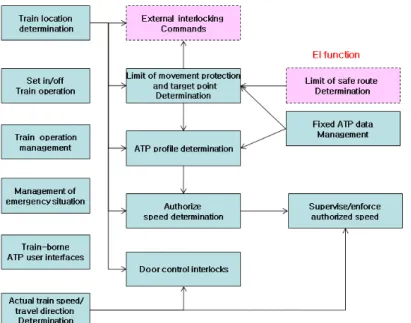
ATP는 열차제어시스템의 핵심기능으로서 (1) train location determination, (2) Limit of movement protection & target point determination, (3) ATP profile determination, (4) authorized speed determination, (5) supervise/enforce authorized speed, (6) door control interlocks, (7) train-born ATP user interface, (8) fixed ATP data management로 기능모듈을 설정하였다. 추가적으로 set in/off train operation, train operation management, management of emergency situation 기능모듈을 설정하였다. 각 기능모듈간 관계는 그림3과 같다.
그림 3. ATP 기능모듈 2.2.2 ATO의 기능모듈
ATO는 열차제어시스템의 무인자동운전을 담당하는 서브시스템으로서 기능모듈을 (1) determine ATO profile, (2) determine train berthing location, (3) Regulate train speed, (4) door control, (5) train-borne display data interface로 설정하였다. 기능모듈 determine train berthing location은 열차길 이와 승강장길이를 고려하여 열차의 정차위치를 결정하는 기능으로서, 열차정지선 위치에 종속되는 기 능모듈이다. 열차정지선을 승강장의 중간에 배치할 경우, 기능모듈 determine train berthing location은 많은 상세기능을 필요로 하겠지만, 열차정지선을 승강장의 끝부분에 설치할 경우, 기능모듈 determine train berthing location은 매우 단순한 구조를 갖는다.
2.2.3 EI의 기능모듈
이동폐색을 적용한 열차제어시스템의 장점을 충분히 활용하기 위해서는 EI도 이동폐색기반을 적용하 는 것이 필요하지만, 기존 EI에서 사용하는 연동논리를 그대로 활용할 수 있도록 EI을 최소한으로 수정
하였다. 또한 도시철도의 선로특성을 고려하여 EI의 구조를 그림4와 같이 분산형으로 구성하였다. 기존 의 EI는 궤도회로장치로 부터의 열차의 선로점유 정보를 연동장치의 입출력모듈(입력모듈)을 통하여 열 차위치(선로점유 정보, 블록단위)를 입력받아 처리하였으나, 이동폐색을 적용할 경우는 ATP와의 인터페 이스를 통하여 블록단위를 세분화한 단위(세그먼트 단위)로 열차위치정보를 수신하여 처리하는 형태이 다. 이를 위해서 ATP와의 인터페이스와 가상블록 설정이 고려되어야 한다. 이중계 LAN통신 기반의 고 신뢰도 Fail-Safe Protocol을 사용하여 ATP의 위치정보, MA 및 진행방향 등의 정보를 수신하며, 기존의 연동로직을 변경 하지 않고 사용할 수 있도록 가상블록을 논리적으로 설정하여 세그먼트 단위의 위치정보를 가상블록 점 유정보로 변환하여 사용한다. 그림 4. EI 구성도 3. 결론 무인자동운전을 지원하는 도시철도용 무선통신기반 열차제어시스템 개발사양서를 기준으로 ATS, ATP, ATO 및 EI에 대한 기능배치를 수행하였다. ATS는 무인자동운전과 이동폐색을 지원하기 위해서 열차위치실시간추적 기능모듈과 열차원격제어 기능모듈을 설정하였으며, 이에 필요한 train monitoring console을 추가하였다. ATP/ATO의 기능모듈은 보다 구체적으로 작성하였다. EI는 궤도회로기반의 연 동논리를 변경하지 않았으며, ATP와의 열차위치정보 송수신을 위한 인터페이스와 EI구성을 보완하였 다.
참고문헌
1. IEEE 1474.1, “IEEE standard of Communications Based Train Control(CBTC) Performance and Functional Requirements,” IEEE, 2005
2 IEC 62278, “Railway applications-Specification and demonstration of reliability, availability, maintainability and safety(RAMS)”, IEC, 2002