P2-47 / D. –K. Lee
• IMID 2009 DIGEST
Abstract
This paper describes organic acid-based wet chemical etching behaviors of amorphous Ga-doped zinc oxide (GZO) thin film sputter-deposited at low temperature (room temperature). Wet etch parameters such as etching time, temperature, and etchant concentration are investigated for formic and citric acid etchants, and their effects on the etch rate, etch residue and the feature of edge line are compared.
1. Introduction
Recently, transparent conducting oxides (TCOs) with indium-free or indium-less compositions have been proposed as alternative candidates to indium tin oxide (ITO) because of an indium shortage and its violent price fluctuation. Among alternatives, Ga- or Al-doped zinc oxide (ZnO) has been regarded as one of the most competitive TCO due to its low material cost, environmentally benign nature, and optical/electrical properties comparable to ITO.
The crystallinity of sputter-deposited GZO film sensitively depends on the deposition temperature, affecting its electrical property, i.e., typically the higher temperature, the lower electrical resistivity. However, GZO film on PET (polyethylene terephthalate) substrate should be deposited at low temperature due to its poor thermal stability of the plastic substrate [1]. TCO deposition on a flexible substrate is being actively studied for many advantages of flexible devices including their lightweight and foldability over conventional rigid devices [2-4]. Prior to the practical application of ZnO-based TCO films to flexible electronics, some important issues such as control over wet patterning of
films and improvement of the adhesion between film/flexible substrate should be investigated. In particular, ZnO-based films are very susceptible to etchant attacks, and thus it is often difficult to attain a controllable etch rate and etch profile in wet-patterning them.
In this work, we used organic acids to control etch rate and etch profile of GZO films. Firstly, GZO films deposited at room temperature on glass substrate were etched with citric and formic acid to understand their unique wet chemical etching behaviors. Secondly, etching conditions that were optimized from GZO films on glass substrate were applied for etching those on PET substrate.
2. Experimental
150 nm thick GZO films were deposited on glass substrate (corning 1747) and PET substrate (Teijin Dupont PET-HF1D22, PET-KDL86W 188μm) by an RF magnetron sputtering using a ZnO target containing 5.3 wt% of Ga2O3. Etch mask for etching
GZO films was formed with a line pattern of 10 μm by a conventional photolithography using a positive photoresist (PR, AZ1512). Wet etching was performed with citric (C6H8O7) or formic acid (CH2O2)-based
aqueous solutions with a concentration range of 0.004−0.2 M, but 0.02 M was mainly used for most of etching experiments. PR-patterned GZO films were soaked in the above etchant aqueous solutions and placed in an oven at 30−60 oC without agitation.
An α–step (Tencor alpha-step 200) profilometer was used to calculate the film etch rate. Morphological etching results of patterned GZO films were observed by using a Hitachi S-4300 SEM
Organic Acid-Based Wet Chemical Etching of
Amorphous Ga-Doped Zinc Oxide Films
on Glass and PET substrates
Dong-Kyoon Lee
1, Seung Jung Lee
2, Jungsik Bang
2, Mungi Park
3,
Heesun Yang
1,*
1
Dept. of Materials Science and Engineering, Hongik University, Seoul, Korea Phone: 82-2-320-3039, E-mail: [email protected]
2
LG Research Park, LG Chem. Ltd., Daejeon, Korea 3
LG Display. Ltd., Gyeonggi-do, Korea
P2-47 / D. –K. Lee
IMID 2009 DIGEST • operated at 10 kV and 10 μA.
3. Results and discussion
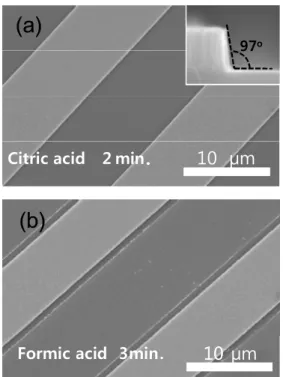
Fig. 1 presents the SEM images of patterned GZO films etched with citric and formic acids. The etchant concentration of 0.02 M and etching temperature of 30oC were used for all. Etching results by citric acid
exhibited a steep sidewall angle (97o) and no surface
residues on substrate. In case of etching by formic acid, a surface residue that covers an unmasked area uniformly remains unetched with an enhanced etching along pattern line edges. The vertical etch rates of citric and formic acid were 383 and 141 nm/min, respectively. According to our previous study [5], etch rates of GZO film deposited at high substrate temperature (200oC) resulted in 75 and 91 nm/min,
respectively. Faster etch rates of RT-deposited GZO film than those of 200oC-deposited samples are
thought to be involved with the degree of crystallinity of GZO films. Although 0.02 M citric acid generates an excellent etch profile, etch rate over 300 nm/min might be too fast for the practical application.
10 µm
10
10 µm
3min. 2 min.
Formic acid Citric acid(a)
(b)
97oFig. 1. SEM images of patterned GZO thin films by 0.02 M of (a) citric and (b) formic acids at 30°C.
To decelerate the etch rate, a diluted 0.004 M citric acid was tested and their etching results are shown in Fig. 2(a). Like 0.02 M citric acid, excellent patterning behaviors and controlled etch rate (72 nm/min) were
observed. Besides, the concentration of formic acid was varied from 0.02 to 0.1 M with an effort to get rid of surface residues, resulting in complete removal of residues as shown in Fig. 2(b).
(b)
45 sec.10 µm
10
0.1M Formic acid(a)
10 µm
5 min. 0.004M Citric acidFig. 2. SEM images of etched GZO thin films by (a) 0.004 M of citric and (b) 0.1 M formic acids at 30°C.
Etching behaviors of the organic acids are involved with their activation energy. According to J.J. Cen et al. [6], reaction-diffusion system is divided into two regimes. For semiconductor etching, typical etching activation energies for the diffusion-limited process are <6 kcal/mol and reaction-limited regimes are ≥6 kcal/mol. In our amorphous (RT-deposited) GZO etching, the activation energies of 0.02 M citric and formic acids were calculated to be 7.79 and 3.88 kcal/mol, respectively, as shown in Fig. 3. Accordingly, 0.02 M citric acid is reaction-limited and 0.02 M formic acid etching is diffusion-limited. Reaction-limited mode is known to be more desirable for the practical device fabrication. On the other hand, diffusion-limited etching exhibits undesirable etching behaviors such as bulging effect and enhanced edge etching due to surface diffusion of etchant species [7-9]. For this reason, etching behaviors under diffusion limited etching can be influenced by other etching parameters such as agitation. In addition to concentration increase of formic acid, the formic acid
P2-47 / D. –K. Lee
• IMID 2009 DIGEST
etching was conducted under sonic wave or stirring with other etching conditions unchanged. As a result, residues on substrate was eliminated completely and etch rate was increased slightly. This result may be due to breakdown of stagnant boundary layer by the above agitations used.
3.0x10⁻³ 3.1x10⁻³ 3.2x10⁻³ 3.3x10⁻³ 102 2x10² 4x10² 6x10² 8x10² 2x10³
RT-GZO with 0.02M formic acid vertical direction Ea=3.88 Kcal/mol
RT-GZO with 0.02M citric acid vertical direction Ea=9.17 Kcal/mol
E tc h in g ra te (n m/ m in) 1/T
Fig. 3. Arrhenius plots of etch rates of amorphous GZO films in 0.02 M of citric and formic acids.
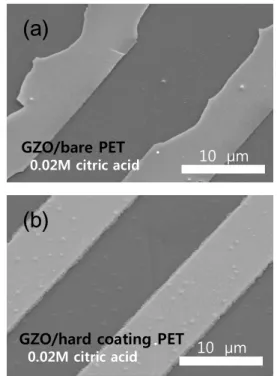
With etching conditions optimized from amorphous GZO films on glass substrate, the etching for those on PET substrate has been conducted. Prior to GZO deposition, typically an interlayer (or buffer layer) is pre-deposited on polymer substrate in order to prevent the degradation of the substrate during the deposition, and enhance the adhesion between GZO and polymer substrate [1]. Thus, we used a commercialized hard coating-PET substrate instead of interlayer deposition. Fig. 4 presents SEM images of patterned GZO films that were deposited on bare- and hard coating-PET substrates. In case of the patterning of GZO film on bare-PET, a sharp sidewall shape and a steep edge angle could be seen in Fig. 4(a). However, bubble-like dots were observed on both PET substrate and GZO surface. Besides, the partial exfoliation at patterned GZO line edges could be found. This behavior could be attributed to the poor adhesion between GZO and bare-PET. For the patterning of GZO film on hard coating-PET, a larger number of dots appeared on the surface of GZO and PET substrate, which is presumably due to plasma damage or out-gassing during sputtering process. But partial exfoliation at the edge line, which was observed from bare-PET/GZO etching, was not observed, indicating an improved adhesion between GZO and hard coating-PET. It is therefore concluded that citric acid could be an
appropriate organic etchant for producing an excellent etch profiles and controllable etch rates in patterning low temperature (RT) sputter-deposited ZnO-based TCO films on flexible polymer substrate, although the out-gassing and film/substrate adhesion is needed to be further improved from the deposition processing viewpoints. 10 µm GZO/bare PET . 0.02M citric acid 10 µm
GZO/hard coating PET .
0.02M citric acid
(a)
(b)
Fig. 4. SEM images of etched GZO thin films on (a) bare-PET and (b) hard coating-PET by 0.02 M citric at 30°C.
4. Summary
The wet chemical etching characteristics of GZO films deposited at room temperature have been evaluated using aqueous solution of citric and formic acids. These etching behaviors include etch profiles (edge line shape, sidewall angle, surface residue) and etch rate. When the GZO film on glass was etched by formic acid, unetched residues persistently remained. Increasing formic acid concentration and enforcing agitation were effective to eliminate the surface residues. On the other hand, citric acid etching gave an excellent edge profile and controllable etch rate without generating surface residues. Patterning of GZO films on bare- and hard coating-PET substrates was conducted by using 0.02 M citric acid. Straight etch line and steep sidewall angle could be reproduced by applying the identical etching conditions for citric acid etching of GZO films on glass, even though deposition processing-related issues such as the formation of bubble-like dots and adhesion between
P2-47 / D. –K. Lee
IMID 2009 DIGEST • GZO film and PET substrate remain unsolved.
5. Acknowledgment
This work was supported by a Grant-in-Aid for R&D Programs (No. 10030059) from the Korea Ministry of Knowledge Economy.
6. References
1. Z. L. Pei, X. B. Zhang, G. P. Zhang, J. Gong, C. Sun, R.F. Huang, L.S. Wen, Thin Solid Films, 497, 20 (2006).
2. J. Kim, S. Lee, J. S. Bae, S. Park, U. Choi, C. Cho,
Thin Solid Films, 516, 5223 (2008).
3. C. Lee, A. Park, Y. Cho, M. Park, W. I. Lee, H. W. Kim, Ceramics International, 34, 093 (2008). 4. A. N. Banerjee, C. K. Ghosh, K. K. Chattopadhyay,
H. Minoura, A. K. Sarkar, A. Akiba, A. Kamiya, T. Endo, Thin Solid Films, 496, 112 (2006).
5. D.K. Lee, S.J. Lee, J. Bang, H. Yang, J.
Electrochem. Soc. 156, D211 (2009).
6. J.J. Chen, S.W. Jang, F. Ren, Y.J. Li, H.S. Kim, D.P. Norton, S.J. Pearton, A. Osinksy, S.N.G. Chu, J.F. Weaver, J. Electron. Mater. 35, 516 (2006). 7. H.K. Juiken, J.J. Kelly, P.H.L. Notten, J.
Electrochem. Soc. 133, 1217 (1986).
8. P. Rath, J.C. Chai, Y.C. Lam, V.M. Murukeshan, H. Zheng, J. Heat Transfer 129, 509 (2007).
9. M. Chahoud, Modell. Simul. Mater. Sci. Eng. 15, 441 (2007).