INTRODUCTION
The application of radiation on polymer matrix can be employed in various fields: medical, textile, electrical, mem-brane, cement, coatings, rubbers, tires, aerospace, etc. The irradiation (electron beam, X-rays, ion beam, and gamma ray) of polymer matrix creates very energetic ions and ex-cited states, which decay to reactive free radicals. These intermediates can follow variable reaction paths, resulting in new bonds formation and in the case of peroxide a degra-dation process (Lugao et al. 2007). Radiation-based
process-es have many advantagprocess-es over other conventional methods. First, as no catalyst or additives are required, the purity of processing can be maintained. Second, the molecular weight of the products can be regulated. Finally, throughout the entire curing process the speeds are at the highest point (Bhattacharya et al. 2000; Clough et al. 2001; Saleeh et al. 2002). Radiation curing methods were developed on acrylic derivative epoxies, which undergo polymerization via a radi-cal mechanism. However, the obtained materials did not appropriately required thermal and mechanical properties. Materials with enhanced thermal and mechanical behaviors similar to those of the materials obtained via thermal curing were obtained when Crivello et al. (Crivello et al. 2002) used initiators for cationic polymerization of epoxy resins using
─ ─ 137 ──
Effect of Gamma Ray Irradiation on the Mechanical and
Thermal Properties of MWNTs Reinforced Epoxy Resins
Bum Sik Shin, Jin Wook Shin, Joon Pyo Jeun, Hyun Bin Kim, Seung Hwan Oh and Phil Hyun Kang*
Radiation Research Division for Industry and Environment, Korea Atomic Energy Research Institute, Jeongeup 580-185, Korea
Abstract -- Epoxy resins are widely used as high performance thermosets in many industrial ap-plications, such as coatings, adhesives and composites. Recently, a lot of research has been carried out in order to improve their mechanical properties and thermal stability in various fields. Carbon nanotubes possess high physical and mechanical properties that are considered to be ideal rein-forcing materials in composites. CNT-reinforced epoxy system hold the promise of delivering superior composite materials with their high strength, light weight and multi functional features. Therefore, this study used multi-walled carbon nanotubes (MWNT) and gamma rays to improve the mechanical and thermal properties of epoxy. The diglycidyl ether of bisphenol A (DGEBA) as epoxy resins were cured by gamma ray irradiation with well-dispersed MWNTs as a reinforcing agent and triarylsulfonium hexafluoroantimonate (TASHFA) as an initiator. The flexural modulus was measured by UTM (universal testing machine). At this point, the flexural modulus factor exhibits an upper limit at 0.1 wt% MWNT. The thermal properties had improved by increasing the content of MWNT in the result of TGA (thermogravimetric analysis). However, they were decreased with increasing the radiation dose. The change of glass transition temperature by the radiation dose was characterized by DMA (dynamic mechanical analysis).
Key words : Epoxy resin, Carbon nanotube, Flexural strength, Thermal property, Gamma ray
* Corresponding author: Phil Hyun Kang, Tel. +82-63-570-3061, Fax. +82-63-570-3068, E-mail. [email protected]
UV irradiation (Vollenberg et al. 1990).
Epoxy resins are widely used as matrices in structural appli-cations, such as carbon fiber reinforced composites (CFRP) for aerospace, automobiles and surface coating materials. However, the main drawback of epoxy resins is their inher-ent brittleness due to their highly cross-linked structure, which has led to extensive research in efforts to improve upon their low toughness. Elastomeric materials have been used to improve the mechanical properties of epoxy resins for the last few decades. However, these materials have lower flexural strengths and modulus. Several works have investi-gated the improvement of the mechanical properties of epoxy resins by incorporating rigid inorganic fillers (Moloney et al. 1987; Hussain et al. 1996; Li et al. 2004).
Carbon nanotubes (CNTs) were first discovered in 1991 by Sumio Iijima (Melissa et al. 2007). CNTs are excellent candidates for the nanoscale reinforcement of a variety of polymer matrices because of their excellent strength, thermal conductivity, electrical capacity, stiffness, and thermal sta-bility. Nanophased matrices based on polymers and CNT have attracted great interest because they frequently have superior mechanical, electronic, light weight, multi function-al features, and flame retardant properties (Zhu et function-al. 2004; Tseng et al. 2007). The polymer and CNT nanophased matri-ces can widen their use as potential applications in areas such as aerospace and automotive materials, optical switches, EMI shielding, photovoltaic devices, packaging (films and con-tainers), adhesives and coatings. Various polymers and CNT nanocomposites, such as polypropylene, polyurethane, poly-amides, polyimides and epoxy have been investigated (Oga-sawara et al. 2004; Koerner et al. 2005; Zhao et al. 2005;
Kim et al. 2006; Peng et al. 2007).
In this study, the effect of gamma ray irradiation was in-vestigated on the curing of epoxy resins. Additionally, we investigated the effect of carbon nanotubes on the mechani-cal and thermal properties of epoxy resin. Flexural tests were performed to evaluate mechanical performances using uni-versal testing machine (UTM). Thermogravimetric analysis (TGA) was performed to evaluate thermal performance. The morphology of epoxy resins were investigated using a scan-ning electron microscope (SEM). The change of glass transi-tion temperature by radiatransi-tion dose was characterized by dynamic mechanical analysis (DMA).
EXPERIMENTALS
1. Materials
Diglycidyl ether of bisphenol A (DGEBA) epoxy (YD-128, viscosity==11,500~13,500 cps, density==1.16~1.18 g cm-3,
epoxy equivalent weight==184~190 g eq-1, Kukdo
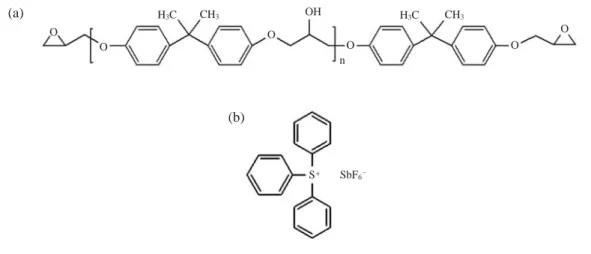
Chemi-cal Co. Republic of Korea) was used as the matrix. Triaryl-sulfonium hexafluoroantimonate (TASHFA) was purchased from Aldrich Co. (USA) and used as a cationic initiator. Fig. 1 shows the chemical structures of DGEBA and TASHFA. Multi-walled carbon nanotubes (MWNTs, O.D.==10~30 nm,
I.D.==3~10 nm, length==1~10μm, purity›90%, Aldrich
Co. USA) were used as reinforcements.
2. Fabrication of MWNTs reinforced epoxy resin
The most important step in the processing is homogeneous
Fig. 1. The chemical structures of the foundation materials: (a) DGEBA and (b) TASHFA.
O O H3C CH3 OH H3C CH3 O S++ SbF 6 -O O O n (b) (a)
dispersion of the epoxy and MWNTs. Generally, good dis-persion of CNTs are hindered in their aggregation as a result of Van der Waals interactions (Mohamed et al. 2010). The dispersion method used here involved the addition of ethanol into the MWNT powder. Subsequently, the bonds between the MWNTs were broken ultrasonically, and the solution was filtered through filter paper and dried in a vacuum oven at 80�C for 24 h. Next, dried MWNTs and ethanol were mixed ultrasonically for 30 min. Note that MWNTs have different weight percentages ranging from 0 to 0.5%, and the mixture was therefore added to the epoxy resin ultrasonically for 1 h. The mixture was then mixed into the initiator ultrasoni-cally for 1 h and was subsequently kept in an oven at 80�C. The epoxy/MWNT/initiator mixture was poured into a 150×
150×2 mm aluminum mold that was treated with a release
agent, and was then cured by gamma rays. The irradiation was carried out at a dose rate of 10 kGy h-1from a 60Co source under a nitrogen atmosphere at room temperature.
3. Measurements
The Raman spectra were obtained using a LabRam HR with a 0.5 mW argon-ion laser, 514 nm Raman microprobe system, and a charged-coupled decive (CCD) as a detector. All the spectra were curve-fitted using Lorentzian and Gaus-sian rules, from which the G′ band positions and intensities were obtained (Cooper et al. 2001). Flexural tests were per-formed according to ASTM D790 under a three-point bend configuration using UTM (Instron 4443). The machine was run under displacement control mode at a crosshead speed of 0.8 mm min-1. All tests were performed at room
tempera-ture. Test samples were cut from the panels into rectangular bars measuring 10×50×2 mm by a diamond cutter. Five
re-plicate specimens from five different materials were prepared for static flexure tests. The flexural strength is an ability of a material to withstand the bending force applied vertically to its horizontal axis. The stress induced due to flexural load is one combination of compressive and tensile stress. TGA was conducted with a TA instrument SDT Q600 at a heating rate of 10�C min-1, from 100 to 700�C. The TGA samples
were cut into small pieces and machined using a mechanical grinder to maintain sample weights between 9 and 11 mg. All TGA tests were run under nitrogen gas. The fracture surface of epoxy resin was observed using SEM (JSM-6390, JEOL). Specimens were coated by gold sputtering for 5 min. The
working distance of the SEM was 5 mm and the accelerating power was 15 kV. Dynamic mechanical properties were analyzed by DMA (DMA Q800, TA instrument Co. USA). The measurement conditions included a temperature range from 50 to 150�C, a heating rate of 5�C min-1and frequency
of 1 Hz in air. The test samples were cut to the dimensions 10×60×2 mm by a diamond cutter.
RESULTS AND DISCUSSION
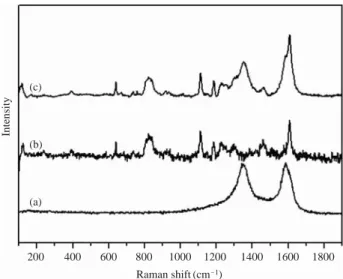
The Raman spectroscopy is an ideal characterization tech-nique to study the orientation of nanotubes in polymer ma-trices. The ratio between D-band and G-band is a good indi-cator of quality on bulk samples. If these both bands have similar intensity this indicates a high quantity of structural defects. MWNT spectrum is the one who shows the lowest ration, consequently higher quantity of structural defects due to its multiple graphite layers. The Raman spectra of MWNT, epoxy and the MWNT/epoxy composite are shown in Fig. 2. The bands at 852, 916 and 1,252 cm-1are
associat-ed with the epoxide ring and the band at 640 cm-1is
asso-ciated with the aromatic ring moiety. MWNT exhibited two strong bands at approximately 1,342 and 1,585 cm-1that
cor-related to D-band and G-band. The peak at 1,342 cm-1
(D-band) of MWNT suggests the existence of an amorphous car-bonaceous material adhered to the defective pentagonal and heptagonal structures in the graphitized walls. However,
cur-Fig. 2. Raman spectra of (a) MWNT, (b) epoxy and (c) MWNT/
epoxy composite. Intensity 200 400 600 800 1000 1200 1400 1600 1800 Raman shift (cm-1) (c) (b) (a)
ing of MWNT/epoxy shifted the peak to a higher frequency (1,351 cm-1). Similarly, the peaks of the G-band appeared at 1,585 cm-1(MWNT) and 1,589 cm-1(MWNT/epoxy), respectively.
The mechanical properties of epoxy/MWNT composites were investigated, including the flexural strength and flexur-al modulus. The flexurflexur-al strength σ (MPa) is calculated based on the lower equation.
σ==3Fl/2dh2
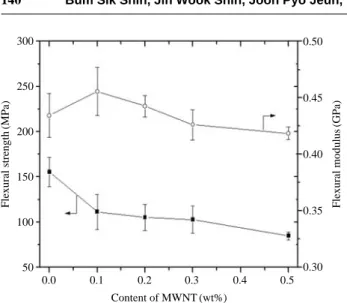
where F is the load (N), l is distance of supports (mm) and d and h are width (mm) and thickness (mm) of the samples. Fig. 3 shows that the relationship of between strength and modulus of 200 kGy irradiated MWNT/epoxy nanocom-posites were dependant on MWNT contents. The flexural strength decreased gradually with an increasing of MWNT contents. The flexural modulus decreased by 3.6% with the addition of 0.5 wt% of MWNT. However, the best condition was the one with 0.1 wt% infusion, showing a 4.9% modulus enhancement. Peng et al. reported the effect of silane func-tionalization on the properties of CNT/epoxy nanocompo-sites (Tseng et al. 2007). The addition of untreated CNT into
epoxy resulted in a decrease of flexural strength, whereas the nanocomposites containing silane functionalized CNT showed a moderate increase in strength. These results can be explained in terms of dispersion and interfacial interactions between the CNT and epoxy. For the untreated CNT, both the dispersion in epoxy and the interfacial interactions were poor due to the agglomeration and the inherently inert/hydro-phobic nature of CNT.
Fig. 4 shows the TGA curves of 200 kGy irradiated MWNT/epoxy nanocomposites depending on MWNT con-tents. The normalized weight versus temperature curves of five materials overlap. Epoxy resins began to decompose around 400�C and completely decomposed around 550�C. Fig. 3. Flexural strength and modulus of epoxy resin depending on
the MWNT contents: 200 kGy gamma ray irradiation.
Table 1. Thermal stability of MWNT/epoxy nanocomposites
de-pending on MWNT contents
Epoxy 0.1 wt% 0.2 wt% 0.4 wt% 0.5 wt%
neat MWNT MWNT MWNT MWNT
Td(K) 677.8 676.7 675.6 673.9 673.4
Residue 4.5 5.7 6.9 10.6 12.3
Fig. 4. Thermogravimetric analysis of epoxy resin depending on the
MWNT contents: 200 kGy gamma ray irradiation.
Fig. 5. Thermogravimetric analysis of epoxy resin depending on the
radiation dose: 0.3 wt% reinforced MWNT.
Flexural strength (MPa) Flexural modulus (GPa) 300 250 200 150 100 50 0.50 0.45 0.40 0.35 0.30 0.0 0.1 0.2 0.3 0.4 0.5 Content of MWNT (wt%) Weight (%) 100 80 60 40 20 0 100 200 300 400 500 600 700 Temperature (�C) MWNT 0.5 wt% MWNT 0.3 wt% MWNT 0.2 wt% MWNT 0.1 wt% MWNT 0 wt% Weight (%) 100 80 60 40 20 0 300 400 500 600 700 800 900 1000 Temperature (K) 200 kGy 300 kGy 400 kGy
Decomposition temperatures and residual yield are present-ed in Table 1. Thermal stability of the samples containing MWNT deteriorated as the MWNT content increased, where-as the residual yields of the MWNT/epoxy nanocomposites increased with an increase in MWNT content. These pheno-mena ascribe to the physical barrier effect, where the MWNT impede the propagation of decomposition reactions in the MWNT/epoxy nanocomposites. Fig. 5 shows the TGA cur-ves of 0.3 wt% MWNT reinforced of nanocomposites
de-pended on the radiation dose. Both the decomposition tem-perature and residual yield are increased with an increase of radiation dose, from 200 kGy to 400 kGy. These reasons con-sidered that epoxy structures are degraded and that interfacial interactions of MWNT deteriorated.
Fig. 6 shows the tan δ curves of 0.3 wt% reinforced MWNT/epoxy nanocomposites depended on radiation dose, from 200 kGy to 400 kGy, by DMA. DMA is a popular and proven method for measuring the viscoelastic properties as a function of temperature, load, and frequency. The advan-tage of DMA over many other methods in determining glass transition temperature (Tg) is that it is sensitive enough to
detect even weak transitions. The Tgvalue is the temperature
corresponding to the peak of the tan δ versus Temperature (T) curve. Chemical bonding at a joint of the epoxy and MWNT matrix could lead to an interrupt on the relaxation mobility in the polymer near a joint, which leads to an increase in the Tgvalue. However, a lack of surrounding entanglements and
reduced curing densities at a joint are also important, as they may cause a decrease in the Tgvalue (Shin et al. 2009). Tg
value decreased slightly with an increase of radiation dose. This fact is probably due to an occurrence of the change in interaction between epoxy and MWNTs by more than 200 kGy gamma ray irradiation.
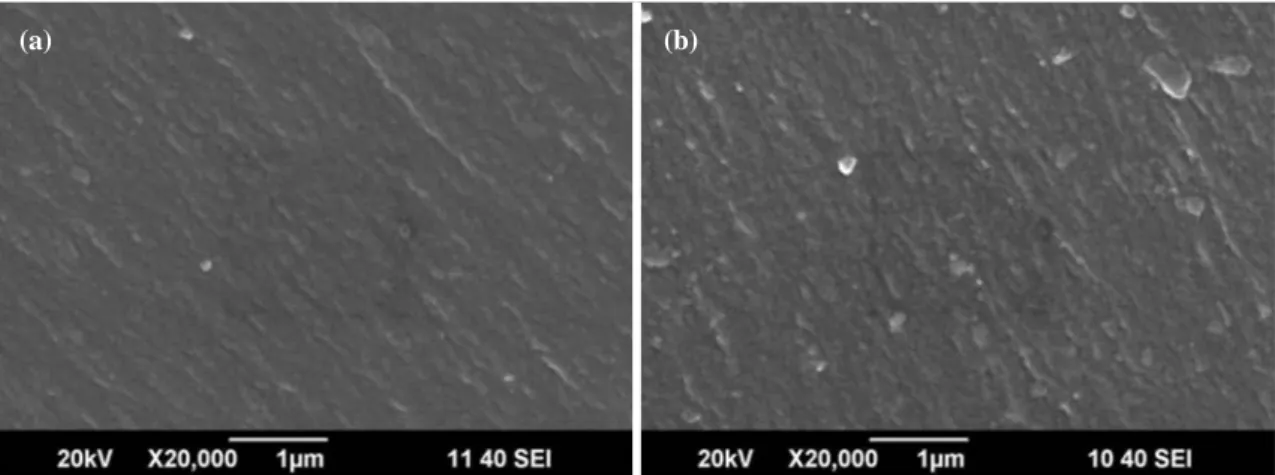
The fracture surfaces of epoxy and MWNT/epoxy com-posite were compared using a SEM. Epoxy exhibits a rela-tively smooth fracture surface, representing the brittle failure of a homogeneous material. No obvious difference was ob-served between the epoxy and MWNT/epoxy composites. With an increase in MWNT content, the MWNT tended to agglomerate into larger sizes, while the overall fracture sur-Fig. 6. Dynamic mechanical analysis of epoxy resin depending on
the radiation dose: 0.3 wt% reinforced MWNT.
Table 2. Thermal stability of 0.3 wt% MWNT reinforced
nano-composites depending on radiation dose
200 kGy 300 kGy 400 kGy
Td(K) 673.9 673.4 672.5
Residue 10.6 8.6 7.9
Fig. 7. SEM images of (a) epoxy and (b) MWNT/epoxy composite.
tan δ 0.8 0.6 0.4 0.2 0.0 30 60 90 120 150 Temperature (�C) 200 kGy 300 kGy 400 kGy 114.7�C 113.7�C 111.9�C (a) (b)
face morphology did not change much. However, the cor-responding fracture strength consistently decreased because the MWNT aggregates acted as a stress concentrator.
CONCLUSION
This study investigated the mechanical, thermal properties, and effect of gamma ray of MWNT reinforced epoxy nano-composites. Different loadings of MWNT were dispersed in epoxy resin by the ultrasonic cavitation method. These MWNTs/epoxy nanocomposites were cured by 60Co gamma
rays. However, thermal stability of composites depending on the radiation dose was confirmed to be decrease via TGA and
tan δ curves. The system with 0.1 wt% reinforced MWNTs
in epoxy resin showed the highest enhancement in flexural modulus, as compared to neat and other MWNT/epoxy com-posites. This enhancement can be caused by a high disper-sion of MWNT that are due to an optimum amount of rein-forcements. However, the addition of MWNT into epoxy resin resulted in a decreasing of flexural strength. Composi-tes containing a higher MWNT infusion exhibited lower decomposition temperatures and higher residue content than neat epoxy resin. Future studies will focus on alignment of CNTs and search for an optimum radiation curing conditions of epoxy nanocomposites.
ACKNOWLEDGMENTS
This study was supported by Nuclear R&D program through the Korea Science and Engineering Foundation funded by the Ministry of Education, Science and Technology, Republic of Korea.
REFERENCES
Bhattacharya A. 2000. Radiation and industrial polymers. Prog.
Polym. Sci. 25(3):371-401.
Clough RL. 2001. High-energy radiation and polymers: A re-view of commercial processes and emerging applications.
Nucl. Instrum. Meth. B. 185(1):8-33.
Cooper CA, Young RJ and Halsall M. 2001. Investigation into the deformation of carbon nanotubes and their composites through the use of Raman spectroscopy. Compos. PartA
-Appl. Sci. Manuf. 32(3):401-411.
Crivello JV. 2002. Advenced curing technologies using photo-and electron beam induced cationic polymerization. Radiat.
Phys. Chem. 63(1):21-27.
Hussain M, Nakahira A, Nishijima S and Koichi N. 1996. Cor-relation of microstructure and mechanical properties of Al2O3-dispersed poly(ethersulphone)-epoxy blends. Mater.
Lett. 27(6):367-371.
Kim S, Pechar TW and Marand E. 2006. Poly(imide siloxane) and carbon nanotube mixed matrix membranes for gas sepa-ration. Desalination. 192(3):330-339.
Koerner H, Liu WD, Alexander M, Mirau P, Dowty H and Vaia RA. 2005. Deformation-morphology correlations in electri-cally conductive carbon nanotube-thermoplastic polyure-thane nanocomposites. Polymer. 46(12):4405-4420. Li CS, Liang TX, Lu WZ, Tang CH, Hu XQ, Cao MS and Liang
J. 2004. Improving the antistatic ability of polypropylene fibers by inner antistatic agent filled with carbon nanotubes.
Compos. Sci. Technol. 64(14):2089-2096.
Lugao AB, Artel BWH, Yoshiga A, Lima LFCP, Parra DF, Bueno JR, Liberman S, Farrah M, Tercariol WR and Ota-guro H. 2007. Production of high melt strength polypropy-lene by gamma irradiation. Radiat. Phys. Chem. 71(11): 1691-1695.
Melissa P and Tarun G. 2007. Carbon nanotubes - Production and industrial applications. Mater. Design. 28(5):1477-1489. Mohamed A, Derrick D, Merlin T, Jennifer F, Elijah N and Gary P. 2010. Magnetically processed carbon nanotube/ epoxy nanocomposites: Morphology, thermal, and mechani-cal properties. Polymer. 51(7):1614-1620.
Moloney AC, Kausch HH, Kaiser T and Beer HR. 1987. Para-meters determining the strength and toughness of particu-late filled epoxide resins. J. Mater. Sci. 22(2):381-393. Ogasawara T, Ishida Y, Ishikawa T and Yokota R. 2004.
Cha-racterization of multi-walled carbon nanotube/phenylethynyl terminated polyimide composites. Compos. Part A - Appl.
Sci. Manuf. 35(1):67-74.
Peng CM, Kim JK and Ben ZT. 2007. Effects of silane func-tionalization on the properties of carbon nanotube/epoxy composites. Compos. Sci. Technol. 67(14):2965-2972. Salleh NG, Glasel HJ and Mehnert R. 2002. Development of
hard materials by radiation curing technology. Radiat. Phys.
Chem. 63(3):475-479.
Shin JW, Jeun JP and Kang PH. 2009. Fabrication and charac-terization of the mechanical properties of multi-walled car-bon nanotube-reinforced epoxy resins by e-beam irradiation.
J. Ind. Eng. Chem. 15(3):555-560.
Tseng CH, Wang CC and Cheng CY. 2007. Functionalizing carbon nanotubes by plasma modification for the preparation of covalent-integrated epoxy composites. Chem. Mater.
19(2):308-315.
Vollenberg PTH and Heikensa D. 1990. The mechanical pro-perties of chalk-filled polypropylene. J. Mater. Sci. 25(7): 3089-3095.
Zhao CG, Hu GJ, Justice R, Schaefer DW, Zhang S, Yang MS and Han CC. 2005. Synthesis and characterization of multi-walled carbon nanotubes reinforced polyamide 6 via in situ polymerization. Polymer. 46(14):5125-5132.
Zhu J, Peng HQ, Rodriguez-Macias F, Margrave JL, Khaba-shesku VN, Imam AM, Lozano K and Barrera EV. 2004. Reinforcing epoxy polymer composites through covalent integration of functionalized nanotubes. Adv. Funct. Mater. 14(7):643-648.
Manuscript Received: May 12, 2011 Revision Accepted: May 24, 2011